Your first year as a nurse can feel like being handed the keys to a moving train.
You passed nursing school.
You passed the NCLEX.
You got the badge, the scrubs, the schedule, and the professional title.
Then reality hits.
Patients are sicker than the textbook examples.
Med pass takes longer than you expected.
Charting never seems finished.
Families ask questions you do not know how to answer yet.
A provider calls back before you have your thoughts organized.
A preceptor corrects you in real time.
You drive home replaying every decision.
That does not mean you picked the wrong career.
It means you are in the transition from student nurse to licensed nurse.
This guide gives you a realistic first-year map: what to expect, why the transition feels so intense, and how to survive without losing your safety, confidence, or health.
Why the first year as a nurse is so hard
The first year is hard because everything changes at once.
In nursing school, you had:
- one or two patients
- direct instructor supervision
- limited medication access
- scheduled clinical days
- time to look things up
- slower expectations
- permission to be a learner
In practice, you now have:
- full RN accountability
- multiple patients
- competing priorities
- real-time provider communication
- rapid admissions and discharges
- family questions
- alarms
- documentation requirements
- time pressure
- high-alert medications
- unit politics
- shift work fatigue
- emotional exposure
- patient deterioration
This is not just a knowledge transition.
It is a professional identity transition.
First-year turnover is a system signal, not a personal failure
Newly hired nurse turnover remains a major workforce issue.
The 2026 NSI National Health Care Retention & RN Staffing Report recorded national staff RN turnover at 17.6% in 2025. It also reported that 22.7% of newly hired RNs left within a year, with first-year RN turnover accounting for 29.0% of RN separations. NSI notes this newly hired RN metric includes all RNs by tenure at that hospital and should not be confused as a graduate-nurse-only turnover measure.
That distinction matters.
But the message is still clear:
The first year is a high-risk period for nurse retention.If your first year feels harder than expected, you are not alone.
Why nurse residency and transition support matter
NCSBN describes transition-to-practice programs as a way to support newly licensed nurses, improve patient outcomes, and reduce new nurse attrition.
The Vizient/AACN Nurse Residency Program was developed to help newly licensed nurses transition from academic preparation to practice using an evidence-based curriculum and structured support.
A strong nurse residency or transition program does not make the first year easy.
It can make the first year safer.
For more on choosing programs, see NurseZee's nurse residency programs guide.
The first-year transition: reality shock
Reality shock is the gap between what you expected nursing to be and what the job actually feels like.
It is common in new nurses.
It does not mean you are weak.
It means your brain is adapting to a new level of responsibility.
Reality shock is not linear
You may move back and forth between confidence and panic.
You may have one shift where you feel strong, then one shift where you cry in the car.
That is normal.
A better way to think of it:
Month 1:
I need help with everything.

Month 4:
I can do more, but I now understand how much I do not know.

Month 8:
I am tired, but I am seeing patterns.

Month 12:
I still ask questions, but I can manage a shift safely.
Phase 1: Honeymoon and orientation
Typical time frame:
Months 1-3This is the phase where you feel excited, nervous, and heavily supported.
You may be:
- proud to be licensed
- learning unit routines
- shadowing your preceptor
- practicing documentation
- learning medication workflow
- figuring out where supplies are
- meeting providers
- adjusting to 12-hour shifts
- receiving feedback daily
- getting your first real nurse paychecks
Common thoughts
I am finally a nurse.
This is scary, but I have a preceptor.
I love my badge.
I need to write everything down.
I hope they do not think I am slow.
Survival focus
During this phase, focus on foundations:
- medication safety
- assessment flow
- charting basics
- unit routines
- escalation policies
- patient identification
- infection control
- fall prevention
- report structure
- where supplies are
- who to call for help
What to do during orientation
Do not waste orientation trying to look independent.
Use it.
Ask:
How do you organize your morning?
What findings do you report immediately?
What meds on this unit are high-alert?
What labs do you always check before giving these meds?
What provider communication mistakes do new nurses make?
What policies should I know before coming off orientation?
What is the unit's rapid response process?
What would make you call charge right away?Phase 2: Shock and disillusionment
Typical time frame:
Months 4-9This is often the hardest stretch.
Orientation may be over.
You may be taking your own assignment.
The unit may expect more speed.
You may feel like you are always behind.
You may notice staffing issues, moral distress, workplace politics, or gap between ideal care and real conditions.
Common thoughts
Nursing school did not prepare me for this.
Everyone else is faster.
I am a fraud.
I am scared I will miss something.
I do not know if I can do this.
I am exhausted on my days off.
Why this phase is intense
You now know enough to see risk, but not enough to feel smooth.
That creates anxiety.
You may be responsible for multiple competing needs:
- one patient needs pain medication
- one has abnormal vitals
- one is confused and trying to climb out of bed
- one has discharge paperwork
- one family wants an update
- one provider is calling back
- one admission is coming
- charting is unfinished
Your brain is building pattern recognition.
That takes time.
Survival focus
During this phase, focus on:
- prioritization
- time management
- asking for help without shame
- early escalation
- charting discipline
- medication confidence
- managing anxiety
- setting recovery routines
- identifying safe mentors
Phase 3: Recovery and resolution
Typical time frame:
Months 10-12By the end of the first year, many nurses start to feel more grounded.
Not expert.
More grounded.
Common thoughts
That shift was hard, but I handled it.
I know who to call.
I can spot when something is off.
I still ask questions, but I trust my process more.
I am starting to feel like a real nurse.
What improves
You may notice:
- you can give report more clearly
- you anticipate common orders
- you recognize unstable patients faster
- you chart more efficiently
- you know the unit flow
- you manage calls better
- you are less afraid to ask providers for what you need
- you know which nurses are safe mentors
- you can recover after hard shifts better
What still feels hard
Even after one year, some things may still feel hard:
- codes
- deaths
- angry families
- unsafe staffing
- high-acuity patients
- new procedures
- floating
- conflict
- complex discharges
- moral distress
That is okay.
Competence grows in layers.
What no one tells you about your first year
You will be slower than experienced nurses
That is expected.
A nurse with 10 years of experience has pattern recognition you do not have yet.
Speed comes after safety.
You will not know every medication
No nurse knows every medication.
Safe nurses look things up.
You will miss things
You will forget a supply.
You will chart late sometimes.
You will need reminders.
You will leave a shift thinking of something you could have done better.
The goal is not to never miss anything.
The goal is to catch high-risk issues and create systems that reduce misses.
You will replay shifts
This is common.
But if you replay every shift until you cannot sleep, you need a decompression routine and possibly more support.
You may question your specialty
Many new nurses wonder if they chose the wrong unit.
Sometimes the specialty is wrong.
Sometimes the unit culture is wrong.
Sometimes you are simply in the hardest part of transition.
Give yourself enough time to tell the difference, unless the environment is unsafe or harmful.
Challenge 1: Imposter syndrome
Imposter syndrome is the feeling that you are a fraud and everyone will discover you do not belong.
In nursing, it often sounds like:
I passed NCLEX, but I do not feel like a nurse.
I should know this by now.
My coworkers are going to think I am stupid.
What if I hurt someone?
What if I am not cut out for this?
Why it happens
New nurses are in a strange position.
You have a license.
You have legal accountability.
But you are still developing real-world judgment.
That gap can feel like fraud.
It is not fraud.
It is transition.
Reframe fear as safety
A new nurse who is cautious can be safe.
A new nurse who is overconfident can be dangerous.
Your fear becomes useful when it makes you:
- verify medication orders
- ask before procedures
- check policies
- call for help early
- report changes
- slow down with high-alert meds
- double-check calculations
- use SBAR
- speak up
When imposter syndrome becomes a problem
It becomes harmful when it makes you:
- hide uncertainty
- avoid asking questions
- overwork to prove yourself
- never rest
- avoid new skills
- panic before every shift
- interpret feedback as proof you are failing
- compare yourself constantly
Script for asking questions
Use:
I want to do this safely. Can you verify this with me?or:
I have not done this independently yet. Can you walk through the first one with me?or:
I am concerned about this change. Can I run it by you?These are safe statements.
Not weak statements.
Challenge 2: Time management
Time management is usually the biggest daily struggle for new nurses.
You are learning:
- assessment flow
- medication timing
- charting
- interruptions
- call lights
- patient education
- admissions
- discharges
- provider calls
- labs
- procedures
- family updates
- wound care
- blood sugars
- fall precautions
- unit routines
No wonder it feels impossible.
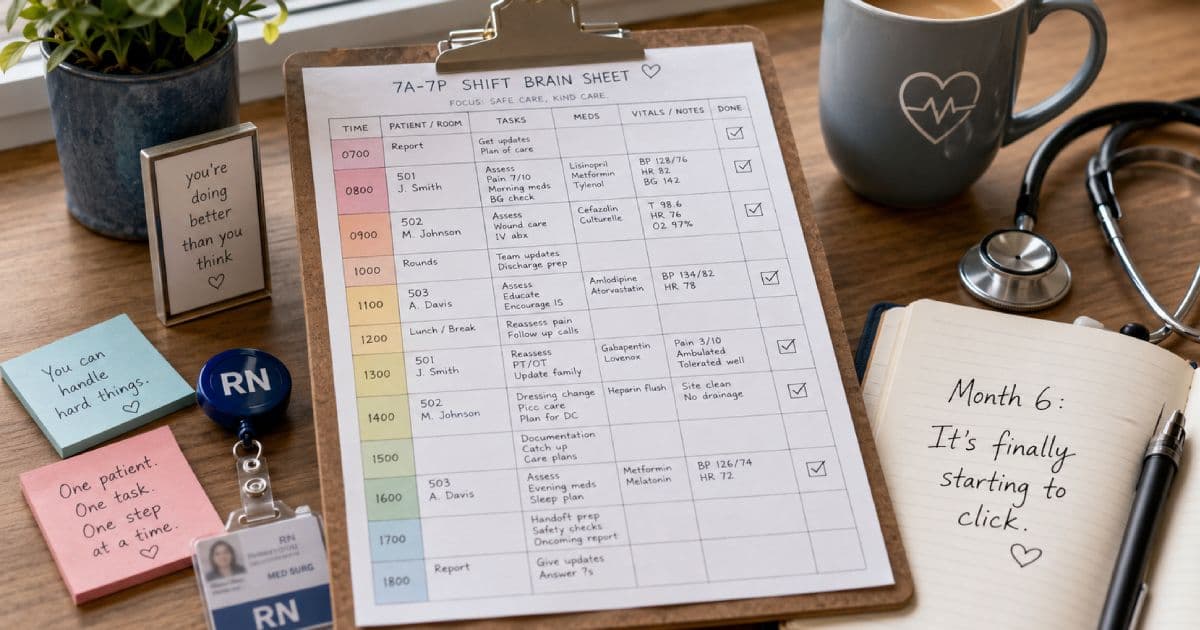
Build a shift map
Use a nursing brain sheet.
See NurseZee’s nursing report sheet template if you need a starting format.
What to write on your brain
Track:
Room number:
Diagnosis:
Code status:
Allergies:
Precautions:
Diet:
Activity/mobility:
Oxygen:
IV access:
Drips/fluids:
Wounds/drains/tubes:
Pain plan:
Blood sugar checks:
Med times:
Labs:
Critical results:
Procedures/tests:
Provider notifications:
Family concerns:
Discharge needs:
Tasks by hour:
First-hour routine
The first hour can set up the whole shift.
1. Receive report.
2. Circle safety issues.
3. Check orders, labs, and med times.
4. See unstable or high-risk patients first.
5. Perform quick safety rounds.
6. Confirm oxygen, IVs, drains, pain, mental status, fall risk, and call light.
7. Prioritize 0900 meds and urgent tasks.
8. Ask charge/preceptor early if assignment concerns exist.
Hourly planning method
Create an hourly grid.
Example:
0700 report
0730 safety rounds
0800 assessments
0900 meds
1000 chart assessments / pain reassessments
1100 blood glucose / wound care / labs
1200 meds / lunch coverage
1300 discharge teaching
1400 provider follow-up
1500 reassessments
1600 charting check
1700 meds / patient education
1800 final rounds
1900 report
Real shifts will not follow the plan perfectly.
The point is to notice what is falling behind.
The two-minute rule
If a task takes less than two minutes and prevents later chaos, do it now.
Examples:
- put the bed alarm on
- refill water if allowed
- update the whiteboard
- restock gloves before a dressing change
- label tubing
- write down a lab value
- send the quick message now
- clarify an order before med pass
The charting trap
New nurses often wait until the end of the shift to chart.
Then the shift explodes.
Better approach:
Chart assessments as soon as possible after completing them.
Chart pain reassessments on time.
Chart abnormal events close to when they happen.
Do not rely on memory at 1850.
Prioritization shortcut
When you are overwhelmed, ask:
Who is unstable?
Who could die or deteriorate first?
Who has airway, breathing, circulation, neuro, bleeding, or sepsis concerns?
What medication or task is time-critical?
What can wait safely?
What can I delegate?
Who needs help now?
For more practice, see NurseZee’s NCLEX prioritization questions guide.
Challenge 3: Provider communication
Calling a provider can be terrifying at first.
You may worry about:
- sounding stupid
- missing information
- being yelled at
- not knowing what to request
- calling too early
- calling too late
- not understanding the response
- forgetting the order
AHRQ describes SBAR as Situation, Background, Assessment, and Recommendation or Request, a structured communication tool for sharing patient information.
Use it.
Before calling the provider
Gather:
Patient name and room:
Age:
Diagnosis:
Code status:
Allergies:
Relevant history:
Current issue:
Vital signs and trends:
Assessment findings:
Pain score:
Oxygen/device:
Relevant labs:
Recent meds:
Intake/output if relevant:
What you already did:
What you need:
SBAR template for calling a provider
S - Situation:
Hi, this is [your name], RN on [unit]. I am calling about [patient name/room] because [urgent issue].

B - Background:
The patient was admitted for [diagnosis]. Relevant history includes [key history]. Current orders include [relevant orders].

A - Assessment:
Current vitals are [vitals]. My assessment is [focused findings]. This is a change from [baseline/trend].

R - Recommendation/Request:
I am concerned about [problem]. I would like [specific order/evaluation/action], or I need you to evaluate the patient.
Example: shortness of breath
S:
Hi, this is Zoe, RN on Med-Surg 4. I am calling about Mr. Lopez in 412 because he has new shortness of breath.

B:
He is post-op day 2 after a total hip replacement. He was on room air earlier today and has no home oxygen use.

A:
His respiratory rate is 26, heart rate 112, BP 138/86, and SpO2 is 89% on room air. He is using accessory muscles, and breath sounds are diminished on the right. This is a change from this morning.

R:
I am concerned about acute respiratory change. I placed him upright and notified charge. I am requesting oxygen orders, provider evaluation, and whether you want a stat chest X-ray or additional workup.
If the provider sounds irritated
Stay professional.
Use:
I understand. I am calling because this is a change from baseline and I am concerned about patient safety.or:
Can I repeat back the plan to make sure I understood correctly?Always read back orders
Follow facility policy for verbal or telephone orders.
When allowed, repeat back:
Just to confirm: give 20 mg IV furosemide now, repeat BMP in 4 hours, and notify you if urine output is less than 30 mL/hr. Is that correct?Challenge 4: Medication safety
Medication errors are one of the biggest fears for new nurses.
That fear is valid.
But fear should turn into process.
High-risk medication habits
Before giving medication, ask:
Right patient?
Right medication?
Right dose?
Right route?
Right time?
Right reason?
Right assessment?
Right documentation?
Right response/evaluation?
Check before giving
For common meds:
Antihypertensives:
Check BP and pulse as appropriate.

Insulin:
Check glucose, meal timing, insulin type, and sliding scale.

Opioids:
Check pain, sedation, respiratory rate, allergies, and timing.

Anticoagulants:
Check labs, bleeding, platelets, procedure status, and dose.

Diuretics:
Check BP, potassium, renal function, urine output.

Digoxin:
Check apical pulse, potassium, renal function, toxicity signs.

Antibiotics:
Check allergies, cultures if ordered, renal dosing when relevant.
Use double checks
Follow policy for:
- insulin
- heparin
- blood products
- chemotherapy
- PCA pumps
- high-alert drips
- pediatric medications
- weight-based meds
Stop when something feels wrong
If you think:
This dose seems too high.
This lab does not match.
This patient looks different.
This order conflicts with the diagnosis.
I have never given this before.
Stop.
Ask.
Call pharmacy if needed.
Check policy.
Protect the patient.
Challenge 5: Patient deterioration
New nurses often fear missing a decline.
That fear improves with pattern recognition and escalation habits.
Changes to report promptly
Report:
- new chest pain
- new shortness of breath
- oxygen drop
- new confusion
- sudden weakness
- stroke symptoms
- uncontrolled bleeding
- low blood pressure
- rapid heart rate with symptoms
- fever with instability
- low urine output
- severe pain change
- blood glucose emergency
- fall
- seizure
- change in level of consciousness
- signs of sepsis
- abnormal critical lab
- worsening wound or drain output
Use the “different from baseline” phrase
This helps providers understand urgency.
This is a change from baseline.Example:
He was alert and oriented this morning. Now he is oriented only to self and trying to climb out of bed. This is a change from baseline.Call rapid response early
If your gut says the patient is deteriorating, call for help.
New nurses sometimes delay because they do not want to overreact.
A rapid response is not a personal failure.
It is a safety tool.
Challenge 6: Documentation
Charting can feel endless.
But documentation is part of nursing care.
Chart what matters
Chart:
- assessment findings
- abnormal findings
- interventions
- patient response
- provider notifications
- patient education
- refusals
- pain reassessments
- safety measures
- wounds
- lines/tubes/drains
- intake/output
- medication responses
- escalation events
Do not chart emotions or blame
Avoid:
Patient is rude.
Family is annoying.
Patient is noncompliant.
Doctor refused to help.
Patient is drug seeking.
Use objective language:
Patient declined medication after education. Stated, "I do not want it because it makes me dizzy." Provider notified.For note examples, see NurseZee’s nursing progress notes guide, SOAP notes guide, and DAR charting guide.
Chart close to the event
Do not wait hours to document critical events.
Memory fades.
Timelines matter.
Challenge 7: Lateral violence, bullying, and unit politics
A hard unit is one thing.
A toxic unit is another.
The American Nurses Association’s workplace violence position statement says registered nurses and employers share responsibility for creating a culture of respect free from incivility, bullying, and workplace violence.
Examples of bullying or incivility
- eye rolling whenever you ask questions
- humiliating you in front of patients
- refusing to help with unsafe situations
- withholding information
- gossiping about your mistakes
- assigning you unfairly because you are new
- yelling or intimidation
- sabotaging orientation
- telling you “nurses eat their young”
- mocking your questions
- retaliation for reporting concerns
What to do
Document patterns.
Write:
Date:
Time:
Who was involved:
What happened:
Patient safety impact:
Who you notified:
What response occurred:
Then escalate appropriately:
- preceptor
- charge nurse
- nurse educator
- residency coordinator
- unit manager
- human resources
- professional practice office
- union representative if applicable
When to leave
Leaving before one year is not ideal if the only issue is normal transition discomfort.
But leaving may be appropriate if:
- the unit is unsafe
- bullying is persistent
- your license is at risk
- staffing is dangerously inadequate
- you receive no support
- retaliation occurs
- your mental health is deteriorating
- you are pressured to practice outside policy or competence
Golden rules of first-year nurse survival
Rule 1: Verify, do not guess
If you are unsure, stop.
Verify:
- policy
- medication dose
- pump settings
- procedure steps
- provider order
- patient identity
- lab trend
- blood product process
- isolation precautions
- escalation chain
Guessing is how nurses get into trouble.
Rule 2: Protect your license and the patient at the same time
Your license is protected by safe practice, not by hiding uncertainty.
Protect both by:
- asking questions
- documenting objectively
- reporting changes
- following policy
- refusing unsafe shortcuts
- escalating concerns
- owning mistakes
- staying within scope
Rule 3: Avoid excessive overtime early
Overtime money is tempting.
But your first months are cognitively exhausting.
If you can afford to avoid extra shifts early, do it.
Your brain needs recovery.
If you must pick up shifts, avoid stacking too many in a row.
Rule 4: Find your clinical anchor
A clinical anchor is a safe, experienced nurse you can go to.
They are:
- calm
- knowledgeable
- respectful
- honest
- patient-safety focused
- willing to teach
- not dismissive
Ask:
Can I run something by you?A good anchor can keep a hard shift from becoming an unsafe shift.
Rule 5: Use your charge nurse
The charge nurse should know when:
- a patient is deteriorating
- you are overwhelmed
- you have a difficult family
- you need help with an admission
- you are unsure about a policy
- a provider is not responding
- you made an error
- staffing feels unsafe
- you are falling behind on time-critical tasks
Do not wait until the shift is on fire.
Rule 6: Own mistakes immediately
If you make an error:
1. Assess the patient.
2. Notify charge/preceptor.
3. Notify provider as required.
4. Follow policy.
5. Document accurately.
6. Complete event reporting if required.
7. Reflect on what system/process failed.
Do not hide.
The Joint Commission emphasizes the importance of supporting healthcare workers after adverse events and using a just culture approach to learn from system defects.
Rule 7: Learn one shift at a time
Do not try to become a five-year nurse in five weeks.
After each shift, identify:
One thing I did well.
One thing I need to review.
One thing I will do differently next shift.
That is enough.
A practical first-year timeline
Months 1-3: Orientation foundation
Focus on:
- unit routines
- safe medication administration
- basic assessments
- documentation flow
- finding supplies
- asking questions
- understanding policies
- learning report
- learning common diagnoses
- building preceptor communication
Avoid:
- comparing yourself to experienced nurses
- hiding uncertainty
- volunteering for extra shifts before you can manage your base schedule
- judging your whole career based on week two
Months 4-6: Independent survival
Focus on:
- shift organization
- prioritization
- provider calls
- early escalation
- charting efficiency
- understanding common complications
- learning your specialty’s high-risk meds
- identifying safe mentors
Avoid:
- pretending you are fine when you are drowning
- taking unsafe shortcuts
- delaying rapid response
- skipping breaks every shift
- ignoring sleep debt
Months 7-9: Pattern building
Focus on:
- anticipating changes
- improving patient education
- refining SBAR
- recognizing deterioration faster
- managing admissions/discharges
- learning family communication
- building confidence with common skills
Avoid:
- overconfidence
- dismissing new nurses behind you
- stopping your learning routine
- picking up too much overtime because you feel slightly more confident
Months 10-12: Professional identity
Focus on:
- specialty growth
- certifications when appropriate
- feedback for annual review
- long-term career planning
- healthy boundaries
- mentoring students gently
- deciding whether to stay, transfer, or grow in specialty
Avoid:
- staying in a harmful environment because you think suffering proves dedication
- switching jobs impulsively without identifying the real problem
- ignoring burnout symptoms
New nurse time-management system
Build a “must do” list and a “can wait” list
Must do:
unstable patient assessment
time-critical meds
critical labs
blood glucose/insulin timing
pain reassessment
provider notification
fall/safety intervention
admission assessment
discharge time-sensitive teaching
Can often wait briefly:
nonurgent water refill
routine linen change
nonurgent chart cleanup
restocking
routine education if patient stable
non-time-critical documentation
Use judgment.
A water refill can wait.
A choking patient cannot.
Batch tasks safely
Examples:
Before entering an isolation room:
Bring meds, flushes, dressing supplies, vitals equipment, and patient education materials.

Before calling provider:
Gather vitals, labs, assessment findings, med list, code status, and specific request.

Before med pass:
Check labs, allergies, parameters, and missing meds.
Use alarms carefully
Set reminders for:
- antibiotics
- blood sugars
- reassessments
- timed labs
- neuro checks
- post-fall vitals
- post-procedure checks
- pain reassessment
- restraint checks if applicable
- blood transfusion vitals
Do not depend only on memory.
End-of-shift safety sweep
Before report:
Are all patients breathing comfortably?
Any unresolved abnormal vitals?
Any critical labs not addressed?
Any meds overdue?
Any pain reassessments missing?
Any provider calls pending?
Any IVs infiltrated?
Any drains/tubes needing output?
Any safety issues for night shift?
Any charting that affects continuity of care?
SBAR cheat sheet for new nurses
Use this before calling a provider.
SBAR quick worksheet
S - Situation:
Why am I calling right now?

B - Background:
What does the provider need to know to understand the patient?

A - Assessment:
What did I assess? What changed? What data support my concern?

R - Recommendation/Request:
What do I need: order, evaluation, clarification, parameter, transfer, rapid response?
SBAR phrases that help
I am concerned about...
This is a change from baseline...
The trend is...
I have already...
I need clarification on...
Would you like...
Can you evaluate the patient?
I recommend...
What not to do
Avoid:
- apologizing for calling about a real concern
- giving a five-minute unfocused story
- calling without recent vital signs
- hiding your concern
- accepting unclear orders without read-back
- failing to document notification
What to do after a hard shift
Hard shifts happen.
Your nervous system needs a shutdown routine.
The 20-minute decompression plan
1. Leave the unit.
2. Hydrate.
3. Eat something.
4. Do not replay the whole shift immediately.
5. On the drive home, listen to something non-clinical.
6. Shower.
7. Write down one learning point if needed.
8. Sleep.
If you cannot stop replaying
Ask:
Is there an unresolved patient safety issue?
Do I need to call the unit?
Do I need to report something?
Or am I rumination-looping?
If there is a real safety issue, follow policy.
If it is rumination, write it down and set it aside.
After an error or traumatic event
You may need more support.
Use:
- charge nurse
- manager
- educator
- peer support
- employee assistance program
- therapist
- chaplain
- debriefing
- second victim support if available
Do not carry it alone.
Burnout prevention in your first year
Burnout is not solved by bubble baths alone.
The National Academy of Medicine describes clinician burnout as a systems issue tied to job demands and available resources.
CDC/NIOSH notes that healthcare workers face challenging working conditions and high stress levels that can harm mental and physical health, including long hours, exposure to suffering and death, and hazardous conditions.
That means burnout prevention requires both personal habits and workplace accountability.
Early burnout signs
Watch for:
- dread before every shift
- emotional numbness
- irritability
- trouble sleeping
- crying often
- constant fatigue
- headaches or GI symptoms
- feeling detached from patients
- increased mistakes
- resentment
- hopelessness
- using alcohol or substances to cope
- feeling trapped
- thoughts of self-harm
If you have thoughts of self-harm or feel unsafe, seek urgent support immediately through local emergency services or a crisis line.
Personal protection habits
You can control some things:
- sleep routine
- hydration
- meal planning
- decompression ritual
- boundaries on overtime
- movement on days off
- social connection outside nursing
- therapy or counseling if needed
- journaling or reflection
- saying no when safe and appropriate
- asking for help early
Workplace factors matter
You should not blame yourself for:
- chronic understaffing
- unsafe assignments
- bullying
- lack of breaks
- lack of supplies
- no educator support
- poor leadership
- repeated moral distress
- violence or threats
- unsafe ratios
If the environment is unsafe, escalate.
Related NurseZee guides:
- Nurse burnout strategies
- Self-care for nurses
- Compassion fatigue in nursing
- Moral distress in nursing
- Workplace violence in nursing
How to handle an unsupportive preceptor
A good preceptor can change your first year.
A poor preceptor can damage confidence and safety.
Normal preceptor feedback
Normal feedback may feel uncomfortable.
Examples:
- correcting sterile technique
- asking you to explain a medication
- redirecting priorities
- giving charting corrections
- expecting preparation
- pushing you to think ahead
That is teaching.
Red flag preceptor behavior
Red flags include:
- humiliation
- yelling
- refusing to answer questions
- unsafe lack of supervision
- gossiping about you
- assigning tasks beyond readiness
- no feedback until the end
- contradicting policies
- mocking mistakes
- disappearing during high-risk care
- telling you to stop asking questions
What to do
First, try a direct professional conversation if safe.
I want to improve and I learn best with clear feedback. Can we spend five minutes at the end of each shift reviewing what I did well and what I should focus on next?If unsafe or harmful, escalate.
I am concerned that this preceptor match is affecting my learning and patient safety. I would like to meet with the educator or residency coordinator to discuss support.Document specifics.
Do not make it personal.
Make it about learning and safety.
When to switch units or jobs
Staying one year can help your resume and confidence.
But one year is not worth sacrificing safety or health in a dangerous environment.
Consider staying if
- the unit is hard but supportive
- you are learning
- you have safe mentors
- feedback is fair
- staffing is imperfect but not routinely unsafe
- your anxiety is improving over time
- the specialty still interests you
- you are in a structured residency
Consider transferring or leaving if
- assignments are unsafe
- bullying is persistent
- leadership ignores safety concerns
- you are asked to practice outside scope or policy
- you are not trained for required tasks
- you dread work to the point of dysfunction
- your mental health is worsening
- errors are becoming more likely because of conditions
- you have no pathway for support
Before quitting
If possible:
Talk to a trusted mentor.
Document concerns.
Meet with manager or educator.
Explore internal transfer.
Review contract obligations.
Update resume.
Avoid burning bridges.
Protect your license.
For career moves, see NurseZee’s first nursing job after graduation guide and new grad nurse resume guide.
First-year nurse survival checklist
Before each shift
Sleep plan:
Meal packed:
Water bottle:
Badge:
Stethoscope:
Pens:
Brain sheet:
Compression socks:
Arrive early:
Review common unit meds:
Set one learning goal:
Start of shift
Receive report:
Circle unstable patients:
Check code status/allergies:
Check isolation:
Check med times:
Check labs:
Check orders:
Safety round:
Ask charge if concerns:
During shift
Assess high-risk patients first:
Give time-critical meds:
Document assessments early:
Reassess pain:
Report changes:
Ask for help early:
Use SBAR:
Take break if possible:
Update brain sheet:
End of shift
Resolve critical issues:
Finish required charting:
Update I&O:
Give clear report:
Report pending labs/tests:
Clean up loose ends:
Dispose of patient info:
Decompress after leaving:
What to learn in your first year
By the end of year one, aim to improve in:
- focused assessment
- safe medication administration
- prioritization
- SBAR
- recognizing deterioration
- fall prevention
- infection control
- documentation
- patient education
- discharge basics
- wound/line/tube basics for your unit
- de-escalation
- time management
- calling rapid response
- working with CNAs/techs
- receiving feedback
- setting boundaries
You do not need to master every specialty.
You need to build safe nursing habits.
First-year nurse scripts
Asking for help
I need help prioritizing. I have pain meds due in 412, a new admission coming to 414, and 416 has abnormal vitals.Calling charge nurse
Can you come assess this patient with me? Something is different from baseline.Calling provider
I am concerned about a change in respiratory status and need to discuss next steps.Speaking to a difficult family member
I hear that you are worried. I am going to check the latest information and update you on what I can. I cannot guess, but I can find out who needs to be involved.Responding when you do not know
I do not know the answer, but I will find out and follow up.Declining unsafe overtime
I am not available to pick up safely right now. I need recovery time before my next scheduled shift.Reporting a mistake
I need to report a medication error/near miss. The patient is stable right now. I have assessed them, and I need guidance on next steps per policy.Frequently asked questions about the first year as a nurse
Is the first year as a nurse really that hard?
Yes, for many nurses it is. The first year combines clinical learning, professional accountability, time pressure, shift work, emotional stress, and real patient safety responsibility. Struggling does not mean you are not meant to be a nurse.
What is new grad nurse reality shock?
Reality shock is the stress and disillusionment that happens when the reality of bedside nursing differs from what you expected in school. It often peaks after orientation when you begin practicing more independently.
How long does it take to feel comfortable as a nurse?
Many new nurses start feeling more grounded around the end of the first year. It may take two years or more to feel truly comfortable in a specialty. Some skills and situations will still feel new after that.
Is it normal to cry after nursing shifts?
Yes. Crying after a difficult shift can be a normal decompression response. But if you cry before every shift, cannot sleep, feel hopeless, or feel unsafe, seek support.
What if I feel like a fraud as a new nurse?
That is imposter syndrome. Reframe it as a normal part of transition. Keep asking questions, preparing, and using safety checks. You are not expected to know everything as a new nurse.
How do I improve time management as a new nurse?
Use a consistent brain sheet, create an hourly task map, assess high-risk patients first, chart early, batch tasks safely, set reminders, and ask for help before you are overwhelmed.
What is the best brain sheet for new nurses?
The best brain sheet is one you can actually use during a busy shift. It should track diagnosis, code status, allergies, precautions, vitals, meds, labs, tasks by hour, lines/tubes/drains, mobility, and provider notifications.
How do I call a doctor as a new nurse?
Use SBAR: Situation, Background, Assessment, and Recommendation/Request. Gather current vitals, relevant labs, assessment findings, and your specific concern before calling.
What should I do if a provider is rude?
Stay calm and patient-focused. Use phrases like, “I am calling because this is a change from baseline and I am concerned about patient safety.” Escalate through charge nurse or policy if communication becomes unsafe or abusive.
Should I pick up overtime as a new nurse?
Be cautious. Overtime can be tempting, but the first months are mentally and physically demanding. If possible, protect recovery time until you have a stable routine.
What if I make a medication error?
Assess the patient, notify charge/preceptor, notify the provider as required, follow facility policy, document accurately, and complete event reporting if required. Do not hide errors.
What if my preceptor is harsh or unsupportive?
Ask for clear feedback if the relationship is salvageable. If the behavior is unsafe, humiliating, or interfering with learning, document specifics and speak with the educator, residency coordinator, or manager.
Can I switch specialties during my first year?
Yes, but think carefully. If the issue is normal transition discomfort, time may help. If the unit is unsafe or toxic, transfer or job change may be appropriate.
Should I stay one year in my first nursing job?
A year can help build experience and stability, but it is not worth staying in an unsafe environment that threatens your license, health, or patient safety.
How do I know if my unit is unsafe?
Warning signs include chronic unsafe assignments, no help during deterioration, bullying, pressure to work outside policy, ignored safety concerns, no orientation support, and repeated near misses due to workload.
What is a nurse residency program?
A nurse residency program is a structured transition-to-practice program for newly licensed nurses. It may include classes, preceptor support, debriefing, evidence-based practice, skills development, and professional support.
What should I focus on during orientation?
Focus on medication safety, assessments, charting, unit routines, policies, report, escalation, common diagnoses, high-risk meds, and who to ask for help.
How do I stop taking work home emotionally?
Create a decompression ritual, write down one lesson, avoid replaying every detail, use peer support, and seek counseling if intrusive thoughts or distress persist.
Is it normal to feel slow as a new nurse?
Yes. Speed comes with repetition. Focus on safe routines first. Experienced nurses are faster because they have pattern recognition and unit familiarity.
How do I build confidence as a new nurse?
Confidence comes from repeated safe practice, feedback, asking questions, surviving hard shifts, reflecting honestly, and seeing patterns over time. Do not confuse confidence with never needing help.
Final thoughts
Your first year as a nurse will stretch you.
You will feel proud, scared, exhausted, humbled, frustrated, and sometimes deeply grateful.
You will make mistakes.
You will ask questions.
You will learn which alarms matter, which labs scare you, which nurses teach well, which providers want concise calls, and which routines keep you safe.
You do not have to become perfect in year one.
You need to become safer.
You need to build your process.
You need to learn when to ask for help.
One shift at a time, the chaos starts to organize itself.
That is how you become a nurse.
Sources and references
- NCSBN: Transition to Practice
- NCSBN: Transition to Practice Study Results
- 2026 NSI National Health Care Retention & RN Staffing Report
- Vizient/AACN Nurse Residency Program
- AACN: Nurse Residency Program
- AHRQ TeamSTEPPS: SBAR Tool
- ANA: Workplace Violence Position Statement
- CDC/NIOSH: Risk Factors for Stress and Burnout in Healthcare Workers
- National Academy of Medicine: Taking Action Against Clinician Burnout
- The Joint Commission: Supporting Second Victims
- NurseZee: Nurse Residency Programs
- NurseZee: First Nursing Job After Graduation
- NurseZee: New Grad Nurse Resume
- NurseZee: New Grad Nurse Interview Questions and Answers
- NurseZee: Nursing Report Sheet Template
- NurseZee: Nursing Progress Notes
- NurseZee: SOAP Notes for Nurses
- NurseZee: DAR Charting for Nurses
- NurseZee: NCLEX Prioritization Questions
- NurseZee: Nurse Burnout Strategies
- NurseZee: Self-Care for Nurses
- NurseZee: Compassion Fatigue in Nursing
- NurseZee: Moral Distress in Nursing
- NurseZee: Workplace Violence in Nursing