Nursing school clinicals are where nursing starts to feel real.
You move from lectures, slides, lab checkoffs, and exams into patient rooms.
You take vital signs on real people.
You hear real lung sounds.
You see pain, fear, confusion, healing, grief, discharge planning, family dynamics, teamwork, and the limits of the healthcare system.
That can feel exciting.
It can also feel terrifying.
That is normal.
You are not expected to walk into your first clinical rotation and act like an independent nurse.
You are expected to prepare, show up safely, ask good questions, follow scope, protect patients, and learn.
What are nursing school clinicals?
Nursing school clinicals are supervised patient-care experiences required in prelicensure nursing programs.
You work in real or simulated healthcare settings under the direction of a clinical instructor, preceptor, staff nurse, or faculty member.
Clinical learning helps you connect:
- Pathophysiology
- Pharmacology
- Health assessment
- Nursing skills
- Communication
- Documentation
- Prioritization
- Delegation
- Patient safety
- Professional behavior
- Clinical judgment
In class, you learn what should happen.
In clinical, you learn what care looks like when real patients have pain, family questions, abnormal labs, mobility limits, discharge needs, and changing conditions.
Why clinicals make students anxious
Clinical anxiety is common.
You may worry about:
- Hurting a patient
- Not knowing enough
- Being watched
- Forgetting supplies
- Talking to patients
- Talking to nurses
- Performing skills
- Getting yelled at
- Being judged by your instructor
- Making a medication error
- Not understanding report
- Getting lost in the hospital
- Failing clinical
A little anxiety can keep you alert.
Too much anxiety can make it harder to think.
Preparation helps.
So does remembering this:
You are there to learn.
You are not supposed to know everything yet.
What clinicals are supposed to teach
Clinicals teach more than tasks.
You are learning how to think like a nurse.
That includes:
- Recognizing changes in patient status
- Organizing patient information
- Communicating with the care team
- Prioritizing safety
- Performing skills correctly
- Using infection control
- Understanding medication risks
- Charting accurately
- Teaching patients
- Respecting dignity
- Asking for help early
- Reflecting on what you missed
For clinical judgment and exam preparation, nursing programs often connect clinical learning to the Next Generation NCLEX model: recognizing cues, analyzing cues, prioritizing hypotheses, generating solutions, taking action, and evaluating outcomes.
What to expect during nursing clinical rotations
Every school is different.
Every facility is different.
But most clinical rotations follow a similar structure.
Clinical schedule
Clinicals may be:
- 6-hour shifts
- 8-hour shifts
- 10-hour shifts
- 12-hour shifts
- One day per week
- Two days per week
- Consecutive clinical days
- Weekend rotations
- Evening rotations
- Early morning shifts
- Specialty blocks
- Preceptorship hours near graduation
A common hospital clinical day may run:
0645 to 1515
0630 to 1830
0700 to 1900
1500 to 2300
1900 to 0700 in some senior placements
Do not assume clinicals will fit neatly around your preferred schedule.
Clinical group
You may be placed in a small clinical group.
Common group sizes:
6 to 10 students with one clinical instructorThis can vary by school, state rules, facility policy, specialty, and instructor availability.
Clinical instructor
Your clinical instructor is responsible for student supervision and evaluation.
They may:
- Assign patients
- Review preparation work
- Observe skills
- Supervise medications
- Ask clinical reasoning questions
- Review documentation
- Lead post-conference
- Grade care plans or concept maps
- Communicate with staff nurses
- Decide whether you can perform certain skills
The instructor is not there to embarrass you.
They are there to keep patients safe and help you grow.
Staff nurse
The staff nurse is the licensed nurse assigned to the patient.
You may work with them during care.
They are busy.
Respect their workflow.
Ask how you can help, but do not disappear with their patient information or perform care without communicating.
Patient assignment
Early in nursing school, you may have one patient.
Later, you may have two or more.
During senior practicum or preceptorship, you may follow a nurse with a larger assignment.
Your responsibility grows over time.
Pre-conference and post-conference
Many clinical days include a group meeting before and after the shift.
Pre-conference may include:
- Unit expectations
- Patient assignments
- Safety reminders
- Learning goals
- Medication review
- Skills available that day
- Instructor questions
- Patient privacy reminders
Post-conference may include:
- What you learned
- Clinical judgment discussion
- Patient safety review
- Care plan discussion
- Ethical issues
- Communication challenges
- Medication questions
- Debriefing difficult experiences
Common nursing clinical rotation types
Clinical rotations are designed to expose you to different populations and settings.
You may not get every specialty.
But most programs include several of the following.
Fundamentals clinical
This is often your first clinical rotation.
Focus areas:
- Vital signs
- Hand hygiene
- PPE
- Bed baths
- Oral care
- Feeding
- Transfers
- Ambulation
- Bedmaking
- Intake and output
- Therapeutic communication
- Basic assessment
- Comfort care
- Fall prevention
- Call light response
- Patient dignity
Common settings:
- Long-term care
- Skilled nursing facility
- Rehabilitation
- Hospital unit
- Simulation lab
What students learn:
How to enter a patient room, introduce yourself, provide basic care, communicate respectfully, and notice safety risks.Medical-surgical clinical
Med-surg is the backbone of nursing education.
You care for adults with acute and chronic conditions.
Common diagnoses:
- Pneumonia
- Heart failure
- COPD
- Diabetes
- Sepsis
- Kidney disease
- Stroke
- GI bleed
- Post-op recovery
- Cellulitis
- Wounds
- Fractures
- Fluid and electrolyte imbalance
Focus areas:
- Head-to-toe assessment
- Medication administration
- Lab interpretation
- Wound care
- IV therapy observation or practice depending on rules
- Oxygen therapy
- Mobility
- Pain management
- Patient teaching
- Discharge planning
- Prioritization
- SBAR communication
Med-surg can feel overwhelming because patients often have many problems at once.
That is the point.
You learn how to organize complexity.
Maternity and OB clinical
Maternity clinical may include labor, delivery, postpartum, newborn nursery, or outpatient prenatal settings.
Focus areas:
- Maternal assessment
- Fetal monitoring basics
- Labor stages
- Postpartum assessment
- Fundus and lochia
- Breastfeeding support
- Newborn vitals
- Newborn safety
- Pain control
- C-section recovery
- Patient teaching
- Family-centered care
Common student anxiety:
“I do not want to say the wrong thing to a laboring patient.”Best approach:
Be respectful, calm, and ask the nurse how you can help.
Pediatric clinical
Pediatrics focuses on children and families.
Focus areas:
- Developmental stages
- Family-centered care
- Pediatric vital sign ranges
- Weight-based dosing
- Safety
- Pain scales by age
- Respiratory assessment
- Hydration
- Feeding
- Medication safety
- Communication with caregivers
- Play and comfort measures
Pediatrics can be intimidating because children are not small adults.
Their assessments, doses, communication needs, and deterioration patterns can differ from adults.
Psychiatric mental health clinical
Psych clinical focuses on communication and safety.
Focus areas:
- Therapeutic communication
- Boundaries
- Suicide risk
- Safety checks
- Milieu therapy
- Psychiatric medications
- Crisis communication
- Group therapy observation
- Substance use care
- Trauma-informed care
- De-escalation basics
You may not perform many physical skills in psych clinical.
That does not make it less important.
Communication is a nursing skill.
Community health clinical
Community health may take place in:
- Schools
- Public health departments
- Home health
- Shelters
- Clinics
- Health fairs
- Immunization sites
- Senior centers
- Community outreach programs
Focus areas:
- Health promotion
- Population health
- Social determinants of health
- Patient education
- Screening
- Prevention
- Home safety
- Resource referral
- Cultural humility
Critical care, ICU, ED, or specialty clinical
These rotations may happen later in school.
Focus areas:
- High-acuity assessment
- Monitors
- Drips
- Ventilators
- Rapid changes
- Prioritization
- Team communication
- Emergency response
- Complex medications
- Advanced pathophysiology
- Family communication
Students may observe more than perform.
Observation is still valuable.
Watch how nurses think, communicate, and anticipate problems.
The night before clinical
Preparation starts before your alarm goes off.
The night before clinical should be boring.
That is the goal.
Check the clinical details
Confirm:
Facility name:
Unit:
Start time:
Meeting location:
Parking plan:
Badge requirement:
Uniform:
Instructor contact:
Required paperwork:
Patient prep requirements:
Lunch rules:
Allowed supplies:
Skills you may perform:
Plan your route
Do not assume the hospital entrance is obvious.
Check:
- Parking garage
- Staff/student parking
- Badge entry
- Security desk
- Elevator route
- Unit location
- Time from car to unit
- Weather
- Traffic
- Shuttle schedule if needed
Arriving late because you could not find parking still counts as late.
Prepare your uniform
Set out:
- Approved scrubs
- School patch if required
- Student badge
- Watch with second hand or digital seconds
- Approved shoes
- Compression socks if you use them
- Hair ties
- Minimal jewelry per policy
- Clean undershirt if allowed
- Lab coat or scrub jacket if allowed
Pack your clinical bag
Do not pack your whole apartment.
Bring what you need.
Leave valuables at home.
Review your skills
If you know the unit or patient type, review likely skills.
Examples:
- Vital signs
- Head-to-toe assessment
- Blood glucose check
- Medication rights
- Foley care
- Wound assessment
- Incentive spirometer teaching
- Oxygen safety
- Transfer safety
- Isolation PPE
- SBAR report
Sleep matters
Do not stay up all night rewriting a care plan.
You need your brain.
Tired students make more mistakes.
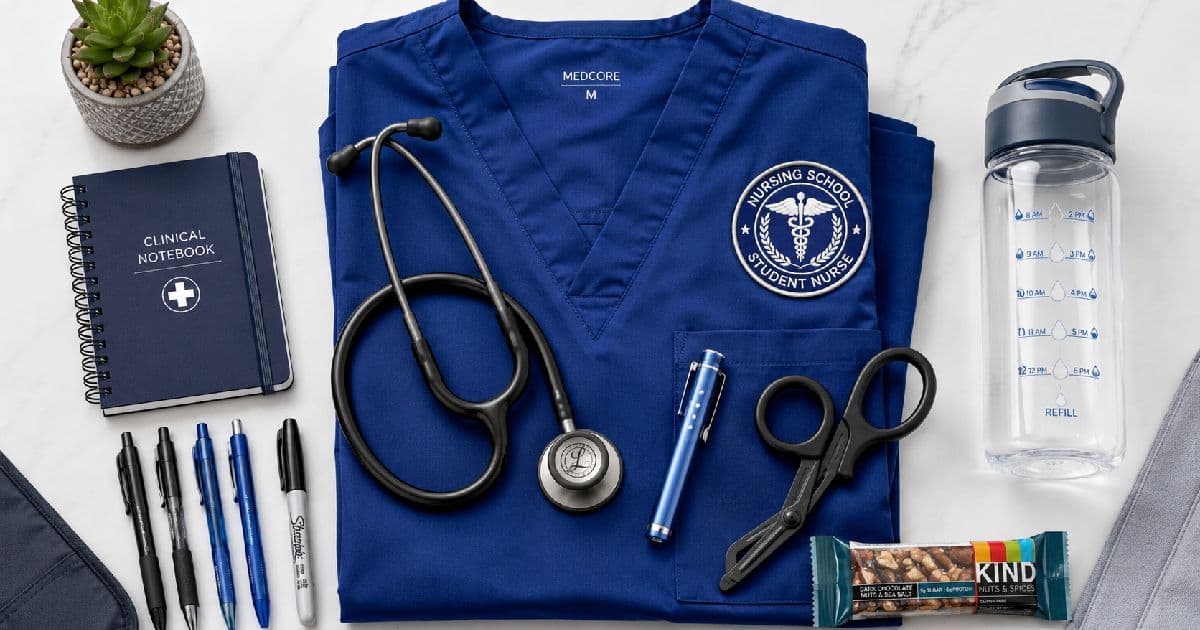
What to pack for nursing clinicals
Your school may have specific rules.
Use this as a general checklist.
Required items
Student ID badge
Facility badge if issued
Stethoscope
Watch with seconds
Black or blue pens
Small notebook
Report sheet or brain sheet
Penlight
Bandage scissors or trauma shears if allowed
Permanent marker
Highlighter
Drug guide or approved app if allowed
Clinical paperwork
Care plan/concept map materials
Clipboard if allowed
Personal comfort items
Water bottle
High-protein snack
Lunch
Gum or mints if allowed
Small hand lotion if allowed
Lip balm
Hair ties
Compression socks
Small amount of cash or card
Phone charger, kept off patient-care areas per policy
Infection control and safety items
Pocket hand sanitizer if allowed
Extra mask if allowed
Small disinfecting wipes if allowed by policy
Eye protection if required and reusable
Always follow facility policy.
Do not bring unauthorized PPE or supplies into patient care areas if the facility prohibits it.
What not to bring
Avoid:
- Large backpack on the unit
- Expensive jewelry
- Perfume or strong fragrance
- Long nails or artificial nails
- Smartwatch if prohibited
- Personal medications loose in bag
- Unapproved clinical apps
- Recording devices
- Patient-identifying papers that could be lost
- Food in patient care areas
Stethoscope tip
A solid basic stethoscope is enough for most students.
For help choosing one, see NurseZee’s best stethoscopes for nursing students guide.
The morning of clinical
The morning of clinical is not the time to improvise.
Arrive early
A good rule:
On time is late. Early is on time.Aim to arrive early enough to:
- Park
- Find the unit
- Put belongings away
- Meet your group
- Review assignment
- Settle your nerves
- Start on time
Do not walk onto the unit at the exact start time with coffee in one hand and your badge missing.
Check in professionally
Introduce yourself.
Example:
Good morning, I’m Michelle, a nursing student from NurseZee College. I’m assigned to work with Room 412 today with my clinical instructor.Be polite to unit clerks, techs, nurses, environmental services, transporters, and every staff member.
Students are remembered for professionalism.
Receive report
Listen carefully.
Write down:
- Patient name/initials per policy
- Room number
- Age
- Code status
- Allergies
- Diagnosis
- Relevant history
- Vital sign concerns
- Oxygen
- IV access
- Diet
- Activity level
- Isolation
- Fall risk
- Pain plan
- Med times
- Labs
- Procedures
- What changed overnight
- What needs follow-up
Use NurseZee’s nursing report sheet template to structure your brain sheet.
Confirm what requires instructor supervision
Before the shift gets busy, ask:
What skills may I perform independently?
What skills require you at bedside?
Can I give medications today?
What medication process do you want me to follow?
Can I perform blood glucose checks?
Can I chart in the EHR?
Should I notify you before contacting the nurse or provider?
Do not guess.
Your first hour on the unit
The first hour matters.
You are trying to understand your patient and identify safety risks.
Step 1: Review the chart if allowed
Follow facility and school policy.
Look for:
- Code status
- Allergies
- Isolation
- Diagnosis
- Recent vitals
- Labs
- Medications
- Orders
- Mobility
- Diet
- Intake and output
- Fall risk
- Wounds
- Tubes and drains
- Recent notes
- Pending tests
Step 2: Meet your patient
Knock.
Introduce yourself.
Verify patient identity according to policy.
Explain your role.
Example:
Good morning, my name is Michelle. I’m a student nurse working with your nurse and my instructor today. I’ll be helping with your care, and I’ll let you know before I do anything.Step 3: Safety scan
Before doing a full assessment, check:
- Patient breathing
- Level of consciousness
- Bed position
- Call light
- Bed alarm if needed
- Fall risk signs
- Oxygen setup
- IV lines
- Tubes
- Drains
- Clutter
- Non-skid socks
- Pain or distress
- Isolation signs
Step 4: Focused assessment
Complete assessment based on patient condition and instructor expectations.
You may assess:
- Neuro status
- Pain
- Lung sounds
- Heart sounds
- Bowel sounds
- Skin
- Edema
- Pulses
- Wounds
- Mobility
- IV site
- Intake/output
- Safety risks
Step 5: Report important changes
Tell the staff nurse and instructor about abnormal findings.
Examples:
New shortness of breath
Oxygen saturation drop
New confusion
Chest pain
Blood pressure very low or high
Blood glucose abnormal
Fever
Fall
Bleeding
IV infiltration
Uncontrolled pain
Wound change
Urine output concernClinical scope of practice for nursing students
Student scope is limited.
Your allowed activities depend on:
- State rules
- School policy
- Facility policy
- Course level
- Instructor decision
- Patient condition
- Staff nurse agreement
- Skill validation status
Skills students may do with supervision
Depending on your level and policy, students may perform:
- Vital signs
- Basic assessment
- Bed baths
- Oral care
- Feeding
- Ambulation
- Transfers
- Repositioning
- Intake and output
- Blood glucose checks
- Medication administration
- Injections
- Wound care
- Foley catheter insertion
- IV medication observation or administration
- IV starts in some programs
- Patient education
- Documentation
Skills often restricted
Many schools restrict or require close supervision for:
- IV push medications
- Blood administration
- Central line care
- Titrating drips
- Chemotherapy
- Conscious sedation
- Independent medication administration
- Independent invasive procedures
- Taking verbal orders
- Witnessing consent
- Independent discharge teaching
- High-risk medications
- Restraint initiation
- Telephone triage
- Pronouncing death
Your program may differ.
Never do these without permission
Do not:
- Give medication alone
- Perform sterile procedures alone
- Silence alarms without understanding why
- Disconnect lines or tubes without approval
- Chart assessments you did not perform
- Document care before giving it
- Accept verbal orders independently
- Tell families new results without nurse/provider guidance
- Leave the unit without telling instructor
- Take patient information home
- Post anything about clinical online
Medication administration in clinical
Medication administration is one of the highest-risk clinical tasks.
It is also one of the best learning opportunities.
Before giving medications
Know:
- Patient identity
- Allergies
- Medication name
- Class
- Indication
- Dose
- Route
- Time
- Relevant vital signs
- Relevant labs
- Side effects
- Hold parameters
- Nursing assessments
- Patient teaching
- What to monitor after administration
Medication prep worksheet
Medication:
Class:
Why patient takes it:
Safe dose:
Route:
Time:
Before giving, check:
Major side effects:
Labs/vitals:
Patient teaching:
Hold/question if:
For medication study help, use NurseZee’s NCLEX pharmacology study guide.
Common student med questions
Your instructor may ask:
Why is this patient taking this medication?
What is the safe dose range?
What should you assess before giving it?
What lab matters?
What side effect worries you most?
What will you teach the patient?
When would you hold it?
Medication errors
If you think you made a medication error or near miss:
- Stop.
- Tell your instructor immediately.
- Tell the staff nurse.
- Assess the patient.
- Follow facility and school policy.
- Document as directed.
- Reflect and learn.
Do not hide it.
Honesty is a safety requirement.
How to work with staff nurses
Staff nurses can make clinical amazing.
They can also be busy, stressed, short-staffed, and cautious with students.
Your professionalism matters.
Introduce yourself clearly
Example:
Hi, I’m Michelle, a second-semester nursing student. I’m assigned to your patient in Room 412 today with my instructor. I’ll check with you before care and keep you updated.Ask useful questions
Good questions:
What are your biggest concerns for this patient today?
What should I watch for?
Are there tasks I can help with?
Do you want me to report vitals directly to you?
Can I observe that dressing change?
Is now a good time to ask a question?
Less helpful questions:
What should I do?
Can you teach me everything about this patient?
Why are you so busy?
Can I do the exciting stuff?
Help with basic care
Never act like basic care is beneath you.
Offer to help with:
- Turning
- Repositioning
- Toileting
- Hygiene
- Feeding
- Ambulation
- Linen changes
- Call lights
- Water refills if allowed
- Vital signs
- Intake and output
- Oral care
Basic care is nursing.
It is also where you notice changes.
Do not slow down urgent care
If the nurse is handling an urgent patient issue, observe quietly unless asked to help.
Save non-urgent questions for later.
Say thank you
A simple thank-you matters.
Thank you for letting me observe that. I appreciate you explaining it.How to be proactive without overstepping
Good students look for learning opportunities.
Unsafe students act without supervision.
There is a difference.
Proactive and safe
Examples:
Answering call lights after checking with instructor/unit expectations
Offering to help turn a patient
Asking to observe a procedure
Preparing questions about medications
Reviewing labs before meds
Telling the nurse about abnormal vitals
Asking if you may help with hygiene
Looking up diagnoses during downtime
Overstepping
Examples:
Giving meds without instructor
Doing a sterile dressing alone
Disconnecting IV tubing without permission
Telling a family the provider’s plan without guidance
Charting for another student
Taking patient photos
Leaving the unit without telling anyone
Downtime rule
If your patient is stable and sleeping, do not scroll on your phone.
Use downtime to:
- Review chart
- Update your report sheet
- Look up meds
- Review labs
- Help with call lights if allowed
- Ask staff if you can observe
- Practice documentation
- Work on concept map
- Restock if allowed
- Ask instructor for learning goals
Clinical paperwork: care plans, concept maps, and reflections
Clinical paperwork can feel like punishment.
It is not supposed to be.
It is meant to help you connect patient data with nursing decisions.
Traditional care plans
A care plan may include:
- Assessment data
- Nursing diagnosis
- Goals
- Expected outcomes
- Interventions
- Rationales
- Evaluation
Example structure:
Assessment:
Diagnosis:
Goal:
Interventions:
Rationales:
Evaluation:
For more help, see NurseZee’s nursing diagnosis guide.
Concept maps
Concept maps are visual.
They connect:
- Medical diagnosis
- Pathophysiology
- Assessment findings
- Labs
- Medications
- Nursing diagnoses
- Interventions
- Patient education
- Complications
- Priorities
Concept maps help you see relationships.
Example:
Heart failure
→ fluid overload
→ crackles, edema, weight gain, dyspnea
→ furosemide, daily weight, I&O, low sodium teaching
→ monitor K+, BP, renal function
NGN clinical judgment paperwork
Many programs now connect paperwork to clinical judgment.
You may be asked to show:
- Recognizing cues
- Analyzing cues
- Prioritizing hypotheses
- Generating solutions
- Taking action
- Evaluating outcomes
Example:
Recognize cues:
O2 sat 88%, RR 28, crackles, new confusion.

Analyze cues:
Possible worsening respiratory status.

Prioritize hypothesis:
Impaired gas exchange.

Generate solutions:
Raise head of bed, apply oxygen per order/protocol, notify RN/instructor, assess lung sounds, review meds/labs.

Take action:
Notify RN immediately and stay with patient.

Evaluate outcomes:
O2 sat improved to 94%, RR decreased, provider notified.
Reflection journals
Reflection helps you learn from the shift.
Strong reflection:
Today I realized I was focusing on completing tasks instead of connecting them to the patient’s condition. My patient had pneumonia, and I took vital signs, encouraged incentive spirometer use, and helped with ambulation. After post-conference, I understood that those were all connected to oxygenation and preventing complications. Next week, I will start my shift by writing the patient’s top two risks on my report sheet.Weak reflection:
Clinical was good. I learned a lot.How to handle clinical anxiety
Clinical anxiety is normal.
But you need a plan.
Before clinical
Reduce anxiety by preparing:
- Pack the night before
- Sleep
- Eat breakfast
- Arrive early
- Review basic skills
- Print or prepare your report sheet
- Know the unit location
- Write three learning goals
- Practice introducing yourself
During clinical
Use grounding.
Pause.
Take one slow breath.
Look at the patient.
Ask: What is the priority right now?
Do the next safe step.
When you feel frozen
Say:
I need a moment to think through this safely.Or:
I’m not sure. I want to check with my instructor before I proceed.That is better than guessing.
When an instructor asks a question and you do not know
Say:
I do not know yet, but I know where I would look it up.Then explain your plan.
Example:
I would check the MAR, medication guide, patient labs, and facility policy before giving it.After clinical
Do a short debrief.
Ask:
What went well?
What felt unsafe or unclear?
What did I learn?
What do I need to review before next week?
What question should I ask my instructor?What instructors look for in clinical
Clinical grading is not only about skills.
Instructors evaluate professional behavior and safety.
Strong clinical behaviors
Instructors like to see:
- Preparedness
- Punctuality
- Safe practice
- Honesty
- Professional communication
- Respect for patients
- Respect for staff
- Initiative
- Appropriate questions
- Medication preparation
- Infection control
- Accurate documentation
- Patient privacy
- Growth over time
Red flags
Instructors worry about:
- Lateness
- Unsafe shortcuts
- Hiding mistakes
- Poor hygiene
- Disrespectful behavior
- Phone use
- Medication knowledge gaps without preparation
- Ignoring patient safety
- Leaving unit without permission
- Falsifying documentation
- Breaching confidentiality
- Arguing when corrected
- Repeating the same unsafe behavior
How to ask for feedback
Ask:
What is one thing I did well today?
What is one thing I should improve before next clinical?
Is there a skill or patient type I should focus on next week?
Do not wait until the end of the semester to learn you are struggling.
Mistakes nursing students make in clinical
Mistake 1: Trying to look confident instead of asking
Confidence is not the goal.
Safety is.
Mistake 2: Not knowing the patient’s diagnosis
You should be able to say why your patient is in the hospital.
Mistake 3: Ignoring code status and allergies
These are safety basics.
Know them early.
Mistake 4: Not checking mobility status
A fall can happen fast.
Know whether the patient is independent, standby assist, one assist, two assist, bedrest, or needs a lift.
Mistake 5: Forgetting to reassess pain
If you give or observe pain medication, reassessment matters.
Mistake 6: Not reporting abnormal findings
Do not assume the nurse already knows.
Mistake 7: Sitting around when there is care to do
Clinical is active learning.
Mistake 8: Taking things personally
A patient may refuse student care.
A nurse may be too busy to teach.
An instructor may correct you firmly.
Stay professional.
Mistake 9: Poor time management
Write down med times, assessments, glucose checks, and paperwork deadlines.
Mistake 10: Breaching privacy
Never post about patients, units, cases, photos, or “crazy clinical stories.”
Even without a name, details can identify someone.
Patient privacy and professionalism
Clinical gives you access to protected health information.
That access is for patient care and learning only.
Do not share patient information
Do not share:
- Names
- Room numbers
- Photos
- Unique diagnoses
- Screenshots
- Dates
- Family details
- Facility details that identify the patient
- Stories on social media
- Text messages with identifiable information
- Printed paperwork with identifiers outside approved settings
Use only what you need
Your care plan may require patient data.
Follow your school and facility rules for de-identification.
Remove identifiers before leaving the facility if required.
Do not take home documents with protected health information unless explicitly permitted under school and facility policy.
Social media rule
Do not post about clinical.
Not even vague posts.
Not even “no names.”
Not even in private groups.
The risk is not worth it.
Infection control in clinical
Infection control is not optional.
Students are expected to follow standard precautions.
CDC describes standard precautions as practices used for all patient care based on risk assessment and PPE use to protect healthcare providers and prevent spread between patients.
Core habits
Use:
- Hand hygiene before and after patient care
- Gloves when exposure is possible
- Gown when clothing contamination is possible
- Mask/eye protection when splash or spray is possible
- Proper sharps disposal
- Clean equipment between patients
- Isolation precautions as posted
- Respiratory hygiene
- Safe injection practices
Isolation signs
Before entering a room, check for:
- Contact precautions
- Droplet precautions
- Airborne precautions
- Protective precautions
- Special PPE instructions
If you do not know what PPE is required, ask before entering.
For exam review, see NurseZee’s NCLEX infection control precautions guide.
Hand hygiene moments
Perform hand hygiene:
- Before touching patient
- Before clean or aseptic task
- After body fluid exposure risk
- After touching patient
- After touching patient surroundings
- Before and after gloves
- After leaving isolation rooms
Communication in clinical
Nursing is communication-heavy.
You need to talk to patients, nurses, instructors, providers, CNAs, therapists, family members, and classmates.
Introduce yourself to patients
Use plain language.
Hi, I’m Michelle. I’m a student nurse working with your nurse today. I’ll help with your care and keep your nurse updated.Use SBAR for concerns
AHRQ describes SBAR as Situation, Background, Assessment, and Recommendation or Request. It is a structured way to communicate patient information.
Student SBAR example:
S: My patient in Room 412 is reporting new shortness of breath.
B: He was admitted with pneumonia and was on 2 L nasal cannula this morning.
A: His oxygen saturation is now 88% on 2 L, respiratory rate is 28, and he has increased work of breathing.
R: I need you to come assess him with me now.
Use SBAR with:
- Staff nurses
- Instructors
- Providers if allowed and supervised
- Rapid response situations
- Handoff
- Post-conference cases
Patient communication tips
Do:
- Knock
- Use the patient’s preferred name
- Explain what you are doing
- Ask permission
- Protect privacy
- Listen
- Avoid medical jargon
- Validate feelings
- Tell the nurse if the patient reports a concern
Do not:
- Promise outcomes
- Give results you are not authorized to explain
- Argue with the patient
- Share personal medical opinions
- Dismiss pain or fear
- Speak over the patient
- Discuss the patient in hallways
What to do when a patient refuses student care
Patients have the right to refuse student involvement.
Do not take it personally.
What to say
I understand. I’ll let your nurse and my instructor know.Then leave respectfully.
What not to say
Do not say:
But I need this for school.
You have to let me.
I already prepared your care plan.
The nurse said I could.
The patient’s autonomy matters.
What happens next
Your instructor may:
- Assign you to another patient
- Let you observe elsewhere
- Give you a different skill opportunity
- Use the situation as a communication lesson
A refusal is disappointing.
It is not a failure.
What to do if you make a mistake
Every nurse remembers mistakes.
The most important thing is what you do next.
If you make a mistake
- Stop.
- Ensure patient safety.
- Tell your instructor immediately.
- Tell the assigned nurse.
- Follow facility policy.
- Document as directed.
- Reflect honestly.
- Learn what should change next time.
Examples of mistakes to report immediately
- Wrong medication or near miss
- Missed blood glucose check
- Fall or assisted fall
- Dropped sterile supplies
- Contaminated sterile field
- Abnormal vital sign not reported
- IV infiltration noticed
- Patient complaint of chest pain
- Documentation error
- Privacy issue
- Equipment disconnection
- Patient injury
- You performed a task outside your scope
Do not hide mistakes
Hiding a mistake can be worse than the mistake itself.
Nursing requires honesty.
How to succeed in each clinical day
Use this framework.
Before the shift
Pack supplies.
Review unit/specialty basics.
Arrive early.
Know your assignment.
Check safety items.
Write learning goals.
During report
Listen for diagnosis, code, allergies, precautions, vitals, labs, meds, mobility, and what changed.During patient care
Introduce yourself.
Assess safety.
Perform care within scope.
Ask before skills.
Report changes.
Help with basic care.
Update your brain sheet.
During downtime
Review chart.
Look up meds.
Work on concept map.
Ask to observe skills.
Answer call lights if allowed.
Help staff safely.
Before leaving
Report off to staff nurse.
Complete documentation.
Clean up patient area.
Submit paperwork as required.
Thank staff.
Attend post-conference.
Dispose of any patient information properly.
Nursing clinical preparation checklist
Use this before every clinical.
Night before
Uniform clean:
Badge packed:
Stethoscope packed:
Watch packed:
Pens packed:
Penlight packed:
Report sheet printed:
Notebook packed:
Lunch/snacks packed:
Water bottle packed:
Clinical paperwork ready:
Parking/route checked:
Alarm set:
Phone charged:
Sleep plan:
Morning of
Arrive early:
Hair/nails/jewelry compliant:
Badge visible:
Phone away:
Meet instructor/group:
Receive assignment:
Review chart if allowed:
Write down code/allergies/precautions:
Introduce self to nurse:
Introduce self to patient:
Safety scan complete:
During shift
Vitals reviewed:
Assessment complete:
Abnormal findings reported:
Meds reviewed:
Labs reviewed:
Patient teaching noted:
Care plan/concept map updated:
Documentation completed:
Staff nurse updated:
Instructor updated:
End of shift
Report given:
Patient safe:
Room tidy:
Documentation complete:
Questions answered:
Paperwork de-identified:
Clinical reflection done:
Report sheet disposed of per policy:
What to review before common rotations
Before fundamentals
Review:
- Vital signs
- Hand hygiene
- PPE
- Bed bath
- Transfers
- Fall precautions
- Feeding safety
- Intake and output
- Communication
Before med-surg
Review:
- Head-to-toe assessment
- Common labs
- Medication classes
- Diabetes care
- Oxygen therapy
- Wound care basics
- Pain assessment
- Post-op care
- Heart failure
- Pneumonia
- COPD
Before OB
Review:
- Gravida/para
- Labor stages
- Fetal monitoring basics
- Postpartum assessment
- Newborn safety
- Fundus and lochia
- Rh status
- Preeclampsia warning signs
Before pediatrics
Review:
- Pediatric vital signs by age
- Weight-based dosing
- Developmental stages
- Family-centered care
- Pediatric pain scales
- Respiratory distress signs
Before psych
Review:
- Therapeutic communication
- Suicide precautions
- Common psych meds
- Boundaries
- De-escalation
- Safety checks
Before ICU/ED
Review:
- ABCs
- Oxygen devices
- Vital sign trends
- Common drips at a basic level
- ECG basics if taught
- Sepsis signs
- SBAR
- Rapid response criteria
Clinical skills students often practice
Depending on school rules, you may practice:
- Vital signs
- Full assessment
- Focused assessment
- Blood glucose checks
- Medication administration
- Subcutaneous injections
- Intramuscular injections
- Oral meds
- Wound dressing changes
- Foley catheter insertion
- Nasogastric tube care or observation
- Ostomy care
- Tracheostomy care observation
- IV pump setup observation
- IV piggyback medication with supervision
- Patient education
- Ambulation
- Transfers
- Bed baths
- Oral care
- Feeding assistance
- Charting
- SBAR report
Do not chase rare skills and ignore basic care.
The basic skills are how nurses keep patients safe.
How clinicals connect to NCLEX
Clinical is where NCLEX-style thinking becomes real.
The NCSBN Clinical Judgment Measurement Model includes cognitive skills such as recognizing cues, analyzing cues, prioritizing hypotheses, generating solutions, taking action, and evaluating outcomes.
Clinicals help you practice those steps at the bedside.
Example
Patient:
72-year-old admitted with pneumonia.
O2 sat 89% on room air.
RR 26.
Crackles right lower lobe.
Temp 101.5°F.
New confusion.
Clinical judgment:
Recognize cues:
Low oxygen saturation, tachypnea, fever, crackles, confusion.

Analyze cues:
Possible worsening infection and impaired oxygenation.

Prioritize hypothesis:
Impaired gas exchange or sepsis risk.

Generate solutions:
Apply oxygen if ordered/protocol, elevate HOB, notify RN/instructor, reassess lung sounds, review labs and antibiotics.

Take action:
Report immediately and stay with patient.

Evaluate outcomes:
O2 saturation improves, respiratory rate decreases, provider orders received, patient monitored.
This is the same thinking the NCLEX tests.
It starts in clinical.
Sample first clinical day timeline
This is a realistic example for a day-shift med-surg clinical.
0630
Arrive, park, meet clinical group.
0645
Pre-conference and assignment.
0700
Receive handoff report.
0715
Review chart and write safety priorities.
0730
Meet patient, check ID, perform safety scan.
0800
Vital signs and focused assessment.
0830
Review meds with instructor.
0900
Medication pass with instructor and staff nurse.
1000
Reassess pain, check labs, update report sheet.
1100
Assist with hygiene, ambulation, incentive spirometer, or wound care.
1200
Lunch rotation if allowed.
1300
Patient teaching and documentation.
1400
Work on concept map/care plan and ask instructor questions.
1500
Give report to nurse, complete documentation.
1530
Post-conference.
1600
Leave after instructor dismissal.
Frequently asked questions about nursing school clinicals
What are nursing school clinicals?
Nursing school clinicals are supervised patient-care experiences where nursing students practice assessment, communication, skills, documentation, clinical judgment, and professional behavior in real healthcare settings.
When do nursing students start clinicals?
It depends on the program. Some students start clinicals in the first semester with fundamentals or long-term care. Others start after completing skills lab, health assessment, and initial safety competencies.
How long are nursing clinical shifts?
Clinical shifts may be 6, 8, 10, or 12 hours depending on the program, facility, course, and semester. Senior practicums may follow full nurse shifts.
What should I bring to nursing clinicals?
Bring your student badge, stethoscope, watch, pens, penlight, report sheet, small notebook, required paperwork, water, snacks, lunch, and any school-approved supplies. Follow your program’s supply list.
What should I wear to clinicals?
Wear the uniform approved by your program: clean scrubs, badge, proper shoes, school patch if required, and hair/jewelry/nail standards that meet policy. Avoid fragrance and anything that violates infection control or professional standards.
How early should I arrive for clinical?
Arrive early enough to park, find the unit, store belongings, meet your group, and start on time. Many students aim for 15 to 20 minutes early, but follow your instructor’s expectations.
What happens on the first day of clinical?
You may tour the unit, review safety rules, meet staff, receive a patient assignment, observe care, take vital signs, practice basic assessment, help with hygiene, and attend post-conference. First days often focus on orientation and safety.
What if I am scared before clinical?
Clinical anxiety is normal. Prepare the night before, arrive early, focus on one task at a time, and ask for help before doing anything unfamiliar. You are there to learn.
What if a patient refuses student care?
Respect the refusal. Patients have the right to decline student involvement. Notify your instructor and assigned nurse. Do not argue or take it personally.
Can nursing students give medications in clinical?
Often yes, but only under the supervision required by the school and facility. Never give medication alone unless your program explicitly allows it and you are following policy.
Can nursing students start IVs?
Some programs allow IV starts after validation and with supervision. Others do not. Your state, school, facility, course level, and instructor determine what you can do.
What is a clinical instructor looking for?
Clinical instructors look for safety, preparation, honesty, professionalism, communication, patient privacy, infection control, growth, and appropriate clinical judgment.
Can I fail nursing clinicals?
Yes. Clinical failure can happen for unsafe practice, repeated unprofessional behavior, medication errors, dishonesty, falsified documentation, privacy violations, attendance problems, or failure to meet course outcomes.
What should I do if I make a mistake in clinical?
Tell your clinical instructor and assigned nurse immediately. Patient safety comes first. Follow facility and school policy. Do not hide mistakes.
What is the difference between a care plan and a concept map?
A care plan is usually a written plan with nursing diagnoses, goals, interventions, rationales, and evaluation. A concept map is a visual layout showing connections between diagnosis, assessment findings, labs, medications, interventions, and priorities.
How do clinicals help with NCLEX?
Clinicals help you practice clinical judgment: recognizing cues, analyzing data, prioritizing problems, choosing interventions, taking action, and evaluating outcomes. That thinking is central to Next Gen NCLEX questions.
What should I do during downtime in clinical?
Review medications, update your report sheet, work on your concept map, answer call lights if allowed, ask to observe skills, help with basic care, or ask your instructor for learning goals. Avoid sitting on your phone.
Do I need a care plan for every clinical?
That depends on your program. Some require weekly care plans. Others use concept maps, clinical judgment worksheets, reflections, or electronic documentation assignments.
How do I impress nurses during clinical?
Be prepared, polite, safe, and helpful. Introduce yourself, ask how you can assist, report important findings, help with basic care, and respect the nurse’s time.
What should I never do in clinical?
Never give medications alone, perform restricted skills without supervision, falsify documentation, breach privacy, post about patients, ignore abnormal findings, leave the unit without permission, or hide a mistake.
Final thoughts
Nursing clinicals can feel intimidating at first.
That does not mean you are unprepared.
It means you care about doing it right.
Show up early.
Know your scope.
Protect patient privacy.
Ask questions.
Help with basic care.
Report changes.
Own mistakes.
Reflect after each shift.
Clinical is where you start becoming the nurse you are studying to be.
Not perfect.
Not independent yet.
But safer, sharper, and more confident each week.
Sources and references
- NCSBN: 2026 NCLEX-RN Test Plan
- NCLEX: Clinical Judgment Measurement Model
- AHRQ: SBAR Tool
- CDC: Standard Precautions for All Patient Care
- CDC: Hand Hygiene in Healthcare Settings
- CDC: Guideline for Hand Hygiene in Health-Care Settings
- HHS: HIPAA Privacy Rule Summary
- ANA: Code of Ethics for Nurses
- QSEN Institute: Pre-Licensure KSAs
- AACN: The Essentials
- NurseZee: Nursing School Prerequisites
- NurseZee: Nursing Report Sheet Template
- NurseZee: Best Stethoscopes for Nursing Students
- NurseZee: Nursing Diagnosis Guide
- NurseZee: Nursing Progress Notes
- NurseZee: NCLEX Pharmacology Study Guide
- NurseZee: NCLEX Infection Control Precautions
- NurseZee: NCLEX Prep
- NurseZee Practice Questions