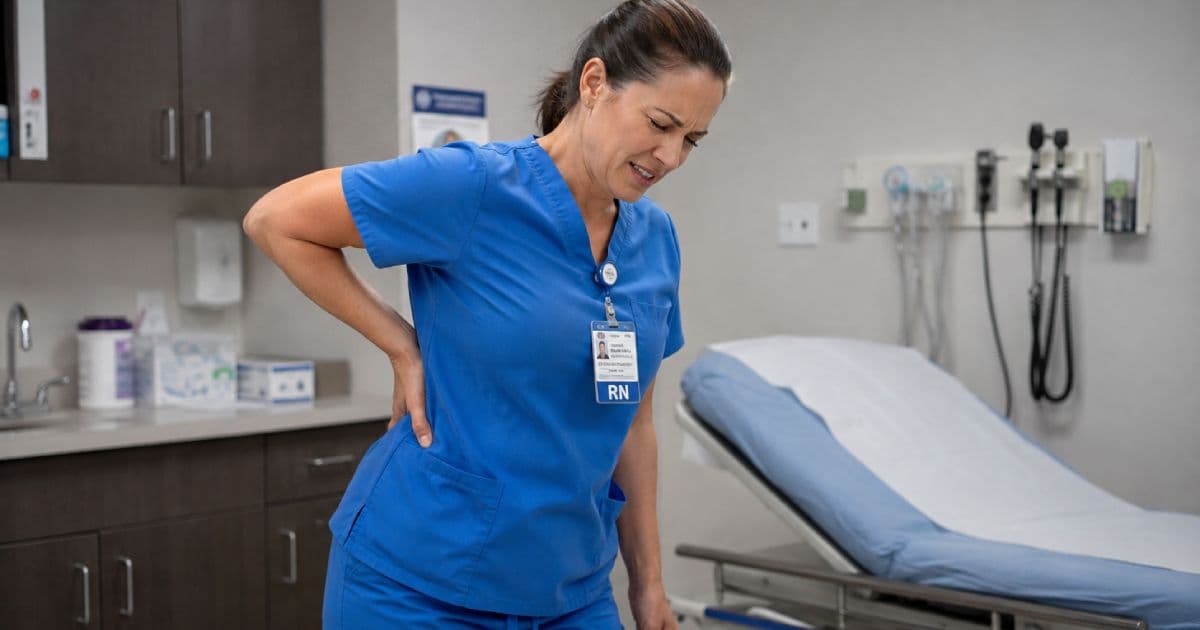
Bedside nursing is physically demanding. A single shift may involve boosting patients, turning dependent adults, moving occupied beds, assisting unsteady walkers, reaching across procedure tables, and maintaining a bent or rotated posture during wound care. The load is not only heavy; it is often unpredictable.
That unpredictability distinguishes patient handling from lifting a box. A patient may fatigue, lose balance, resist, become confused, or suddenly transfer all of their weight to the nurse. Lines, drains, narrow rooms, wet floors, and time pressure add risk. According to NIOSH, patient handling is the greatest work-related musculoskeletal disorder risk factor for healthcare workers.
Back pain is common—and the World Health Organization identifies low back pain as the leading cause of disability globally—but it should not be accepted as an unavoidable price of nursing. The most effective prevention strategy is not perfect posture or a stronger core. It is reducing hazardous manual handling through a functioning Safe Patient Handling and Mobility (SPHM) program, then using sound ergonomics, staffing, conditioning, and early injury reporting to reduce the remaining risk.
This guide explains the evidence behind the 35-pound recommendation, how to select handling equipment, which bedside body mechanics still matter, how to distinguish ordinary muscular soreness from urgent symptoms, and what to do after a job-related back injury.
Why Back Injuries Are Common in Nursing
Work-related musculoskeletal disorders include injuries or conditions affecting muscles, tendons, ligaments, nerves, discs, and joints. They can follow one high-force event or accumulate through repeated exposure to force, awkward posture, reaching, pushing, pulling, and static loading.
Healthcare workers face several risks at once:
- Unpredictable loads: A patient who appears stable may buckle without warning.
- Awkward geometry: Beds, bathrooms, imaging tables, and equipment may force nurses to reach away from the body.
- Repetition: Repositioning, turning, and transport occur throughout a 12-hour shift.
- High force: Bariatric care, floor recovery, and moving malfunctioning equipment can require substantial force.
- Sustained posture: Charting, procedures, bathing, and wound care can keep the trunk flexed or rotated.
- Fatigue and staffing pressure: Tired workers have less reserve and may take shortcuts when assistance is delayed.
- Previous injury: A prior back problem can increase vulnerability to recurrence.
OSHA reported that U.S. hospitals recorded 249,570 injuries and illnesses involving days away, restricted work, or job transfer in 2021–2022. Its hospital guidance identifies repeated manual lifting as a risk to both staff and patients, including falls, bruising, skin tears, and fractures during an unsafe transfer. The problem is therefore not merely personal wellness; it is a workforce and patient-safety issue.
Back pain is also multifactorial. Physical load matters, but sleep, recovery, stress, fear of movement, previous pain, general health, and psychosocial conditions can influence symptoms and disability. Prevention should not blame the nurse's posture or fitness for hazards the organization has a duty to control.
Safe Patient Handling: Why Body Mechanics Are Not Enough
For years, healthcare training emphasized a straight back, bent knees, and a two-person lift. Those techniques may reduce risk during an appropriate low-load task, but they cannot make a high-force or unpredictable patient transfer safe.
OSHA specifically identifies “focusing on body mechanics and lifting techniques instead of providing mechanical lifting devices” as a patient-care-unit hazard. NIOSH recommends accessible equipment, training, and a comprehensive SPHM program.
Use the hierarchy of controls
| Priority | Bedside application | Why it matters |
|---|---|---|
| 1. Eliminate or redesign | Avoid unnecessary transfers; organize care so the patient can participate; choose adjustable-height surfaces | Removes or reduces the hazardous task |
| 2. Engineering controls | Ceiling lifts, floor lifts, powered sit-to-stand devices, air-assisted transfer systems, powered transport equipment | Equipment carries or reduces the physical load |
| 3. Administrative controls | SPHM algorithms, lift teams, competency training, adequate staffing, equipment inspection and availability | Creates a reliable system for safe decisions |
| 4. Work-practice controls | Raise the bed, reduce reach, pivot the feet, coordinate the move, keep ordinary objects close | Reduces residual strain but does not neutralize a hazardous patient lift |
| 5. Personal equipment | Appropriate footwear; prescribed supports only when clinically indicated | May address comfort or another risk, but does not replace higher-level controls |
The 35-pound recommendation—what it does and does not mean
The often-quoted 35-pound patient-handling limit is not an OSHA regulation. It comes from applying the Revised NIOSH Lifting Equation to selected patient-handling tasks. A 2007 analysis concluded that, in general, 35 pounds was the maximum recommended manual load under limited conditions. OSHA describes the NIOSH equation as voluntary guidance.
This number is frequently misunderstood:
- It is not permission to manually lift 35 pounds of every patient.
- It is not a guarantee that a lift below 35 pounds is safe.
- It refers to the portion of patient weight the worker actually supports—not the patient's total body weight.
- The recommended amount falls when the task includes reaching, twisting, repetition, poor handholds, sudden movement, or unfavorable height.
- Many common patient moves do not meet the assumptions of an ideal, predictable lift.
- It does not override a facility's minimal-lift policy, state law, equipment algorithm, or manufacturer instructions.
If a patient cannot reliably support most of their own weight, use mechanical assistance selected for the task. When conditions are uncertain, pause and reassess rather than testing the patient's weight with your back.
Match the Equipment to the Patient and Task
Equipment selection should be based on a current mobility assessment, not yesterday's report or the patient's statement that they “usually walk fine.” Before moving a patient, assess:
- Ability to bear weight through each leg
- Upper-body strength and ability to grasp
- Trunk control, balance, and endurance
- Ability to understand and follow instructions
- Cooperation, agitation, impulsivity, or sedation
- Orthostatic symptoms, pain, dyspnea, and fatigue
- Recent surgery, fractures, weight-bearing restrictions, and skin integrity
- Lines, drains, tubes, wounds, and devices
- Patient size and compatible sling or equipment capacity
- Transfer surface, destination, floor conditions, and available space
The VA Safe Patient Handling app includes patient-assessment tools, algorithms, and equipment guidance. Use the algorithm approved by your employer and stay within your training.
Common SPHM tools
| Patient or task | Equipment commonly considered | Important limitations |
|---|---|---|
| Dependent or non-weight-bearing transfer | Ceiling-mounted or mobile full-body lift with compatible sling | Verify weight rating, sling type and size, attachment points, staffing, and manufacturer's instructions |
| Cooperative patient who bears some weight but cannot safely rise or balance | Powered or mechanical sit-to-stand device | Not appropriate if the patient cannot meet device-specific weight-bearing, trunk-control, cooperation, or physical criteria |
| Bed-to-stretcher or other lateral transfer | Air-assisted lateral transfer device, friction-reducing sheet, or approved transfer board | Match equipment to surfaces and patient; use the number of trained staff specified by policy |
| Repositioning in bed | Ceiling lift with repositioning sling, powered repositioning system, or friction-reducing sheets | Do not pull from the patient's arms or use a drawsheet as if it eliminates load |
| Ambulation with limited stability | Appropriate mobility aid, gait belt when indicated, and trained assistance | A gait belt is not a lifting handle and does not make a dependent transfer safe |
| Patient on the floor | Clinical assessment followed by approved floor-lift equipment | Do not manually dead-lift a patient from the floor |
Mechanical equipment must be accessible, charged, maintained, and stocked with compatible slings. OSHA emphasizes that simply owning lifts is not enough; the right equipment must be available where and when staff need it.
The “just this once” trap
Shortcuts commonly occur when the lift is in another hallway, a sling is missing, the patient is embarrassed, or a team member says the transfer will take only seconds. The injury does not become less likely because the unit is busy.
A concise bedside response can keep the focus on safety:
“Based on the current mobility assessment, this transfer requires the lift. I’ll get the equipment and another trained staff member so we can move you safely.”
Explain that the device protects the patient as well as the staff. A rushed manual transfer can lead to a fall, skin injury, line removal, or fear of future mobility.
Bedside Ergonomics and Body Mechanics
Good body mechanics still matter—for positioning equipment, handling supplies, and reducing strain during tasks that remain appropriate for manual assistance. They are the final layer, not permission to perform a hazardous transfer.
1. Raise the work surface
Before bathing, dressing a wound, changing linens, or repositioning with approved equipment, adjust the bed or procedural surface to a height that lets you work without sustained trunk flexion. OSHA's nursing-home ergonomics guidance commonly uses caregiver waist height as a practical reference.
The best height depends on the nurse, the task, and the required force. Fine work may need a different height than pushing or positioning equipment. The goal is a neutral, comfortable working posture with the task close to the body.
When finished:
- Return the bed to the prescribed safe position.
- Lock controls if required.
- Restore ordered rails and alarms.
- Place the call light and needed items within reach.
- Confirm the patient is aligned, comfortable, and safe.
Bed-height adjustment is both an ergonomic intervention and a patient-safety transition. Do not walk away with the bed elevated.
2. Reduce horizontal reach
The farther a load is from the body, the longer the lever arm and the greater the demand on the back. There is no universal rule that holding a load 10 inches away creates exactly ten times the force; the actual load depends on posture, distance, direction, acceleration, and anatomy.
Practical ways to reduce reach include:
- Work from both sides of the bed instead of reaching across it.
- Move supplies and monitors into the working zone before starting.
- Bring the patient toward the side where care will be performed using approved repositioning equipment.
- Ask a colleague to manage lines rather than stretching around them.
- Use long-handled or task-specific equipment when provided.
3. Create a stable base
Stand with the feet comfortably apart. A staggered stance—one foot slightly in the intended direction of movement—can improve balance and allow weight to shift through the legs. Keep the knees soft rather than locked.
Foot position does not increase the amount of patient weight that is safe to lift. It simply improves control during a task already judged appropriate.
4. Hinge at the hips and use the legs
For ordinary objects and low-load tasks, bend through the hips and knees while keeping the object close. Avoid prolonged rounding of the low back. Use smooth, coordinated movement instead of jerking.
Deep squatting is not appropriate for everyone, and there is no single perfect spinal posture. Nurses with pain, mobility limits, pregnancy-related changes, or prior injury may need an individualized occupational-health or physical-therapy assessment.
5. Pivot instead of twisting under load
Turn by stepping the feet in the new direction rather than planting them and rotating the trunk. Combined force, flexion, and rotation can increase spinal demand—especially when the load changes suddenly.
Plan the path before starting. Remove obstacles, position the receiving surface, manage tubing, apply brakes as required by the equipment instructions, and identify who will lead the count.
6. Push thoughtfully; avoid uncontrolled pulling
When equipment is designed to be pushed, face the direction of travel, keep the elbows near the body, and use powered assistance when available. Check wheels and brakes before transport. A difficult-to-steer occupied bed, stretcher, or supply cart is an equipment and staffing problem—not a test of strength.
Do not move a heavy device blindly or use body weight to force equipment with damaged casters. Stop, secure the patient or load, and request help or replacement equipment.
7. Coordinate the team
“On three” is useful only after everyone agrees on the task, equipment, direction, destination, and stop signal. Assign one leader. Confirm that every person is ready and that no one is handling a line, limb, or device in a conflicting direction.
Adding staff does not automatically make an unsafe manual lift safe. Team assistance should support the correct engineering control—not replace it.
Conditioning and Recovery That Support—But Do Not Replace—SPHM
Fitness can improve capacity, function, and recovery. It cannot compensate for a dependent manual transfer, broken lift, unsafe staffing, or an excessive workload.
Build whole-body strength and control
The “core” includes abdominal, back, diaphragm, pelvic-floor, hip, and gluteal muscles working together. A balanced program is more useful than repeatedly bracing the abdomen or training only one muscle.
Examples that may be included in a graded program are:
- Bird dogs
- Dead bugs
- Side-plank or modified side-plank variations
- Glute bridges
- Squats or sit-to-stands
- Hip-hinge practice
- Rows and loaded carries appropriate to the individual
- Walking or another aerobic activity
Technique, progression, and consistency matter more than choosing a supposedly perfect “back exercise.” The general federal activity target for adults includes at least 150 minutes of moderate aerobic activity weekly plus muscle strengthening on at least two days, but any program should fit the individual's health and current symptoms.
If an exercise produces sharp pain, worsening leg symptoms, numbness, weakness, or loss of function, stop and seek clinical guidance. Nurses with persistent or recurrent pain may benefit from a physical therapist, sports medicine clinician, physiatrist, or occupational-health professional who can assess movement, work demands, and a graded return plan.
Vary posture and take brief recovery opportunities
There is no posture that remains ideal for an entire shift. Prolonged standing, sitting, bending, or holding the same position can all become uncomfortable. When clinical demands allow:
- Alternate charting positions.
- Walk briefly rather than remaining static at the workstation.
- Reset the work surface before a prolonged procedure.
- Relax unnecessary shoulder and jaw tension.
- Use scheduled breaks for food, hydration, and recovery instead of catching up on additional manual tasks.
Stretching may improve comfort and mobility, but it does not remove an ergonomic hazard. A 30-second stretch cannot cancel the load of an unsafe transfer.
Footwear, Orthotics, Compression Socks, and Back Belts
Supportive gear is often marketed as back-injury prevention. The claims are usually stronger than the evidence.
Work shoes
Choose footwear that fits, stays secure on the heel, provides traction appropriate to the clinical environment, and remains comfortable through the shift. Replace shoes when cushioning, tread, structure, fit, or comfort has meaningfully deteriorated.
There is no evidence-based universal rule requiring every nurse to replace shoes every three to six months or after exactly 500 hours. Wear depends on shoe construction, walking pattern, body size, rotation between pairs, surface, cleaning, and mileage.
Custom orthotics are not routine protective equipment for every nurse. Evidence for low-back-pain benefit is mixed and condition-specific. A podiatrist, physical therapist, or other qualified clinician can assess persistent foot pain, marked asymmetry, or a diagnosed foot condition.
Compression socks
Graduated compression stockings may reduce lower-leg swelling and discomfort during prolonged standing. They have not been shown to prevent lumbar injury or meaningfully reduce back loading. Treat them as a leg-comfort or venous-management tool, not a spine-protection device.
The correct pressure and fit depend on the person. Seek clinical advice before using medical compression if you have known or suspected peripheral arterial disease, significant neuropathy, fragile skin, heart failure, or unexplained one-sided swelling. Sudden unilateral leg swelling, pain, warmth, or shortness of breath requires medical evaluation rather than self-treatment with compression.
Back belts and lifting braces
NIOSH does not recommend back belts as a workplace injury-prevention measure for previously uninjured workers. Its review found insufficient evidence that belts reduce spinal loading or back-injury rates, and a belt may create false confidence that encourages heavier lifting. NIOSH advises redesigning work and reducing lifting hazards instead.
That conclusion is different from a clinician prescribing a brace temporarily for a specific diagnosis or rehabilitation plan. A prescribed orthosis should be used for its clinical indication—not as permission to bypass lift equipment.
Is It Shift Soreness or a Back Injury?
It is not always possible to distinguish muscle soreness from a strain, disc problem, or another condition without an assessment. Symptoms also do not have to be dramatic to deserve reporting.
Features more consistent with uncomplicated muscular soreness
- Mild or moderate diffuse aching or stiffness
- A clear relationship to unusual activity or a demanding shift
- No bowel, bladder, saddle-sensation, or neurological changes
- No fever, major trauma, or other systemic symptoms
- Improvement with gentle movement, sleep, reduced load, or simple comfort measures over the following days
Delayed-onset muscle soreness may become more noticeable the day after unfamiliar exertion. However, pain that is severe, focal, progressively worsening, recurrent, or function-limiting should not be dismissed as “normal nursing pain.”
Emergency back-pain red flags
Seek emergency medical evaluation now for back pain with any of the following:
- New inability to urinate, loss of normal bladder sensation, or overflow incontinence
- New bowel incontinence or loss of anal control
- New saddle anesthesia—numbness or altered sensation around the genitals, anus, buttocks, or inner thighs
- Rapidly progressive weakness in both legs, inability to stand or walk, or paralysis
- Severe back pain after major trauma
- Back pain with collapse, fainting, severe abdominal or chest pain, or signs of shock
The combination of bladder or bowel dysfunction, saddle sensory change, and lower-extremity weakness raises concern for cauda equina syndrome, a rare compression of the nerve roots that can cause permanent bladder, bowel, sexual, sensory, and motor dysfunction. The American Association of Neurological Surgeons advises immediate medical attention for these red flags. Do not finish the shift, drive yourself if impaired, or wait for an outpatient appointment.
Urgent same-day assessment
Contact a clinician or urgent service the same day for:
- New focal weakness, including foot drop
- New or worsening numbness accompanied by weakness
- Severe back pain with fever, chills, or systemic illness
- Back pain with immunosuppression, injection drug use, bloodstream infection, recent spinal injection or surgery, or another significant infection risk
- Pain after significant trauma, or after lesser trauma in someone with osteoporosis or prolonged corticosteroid exposure
- New persistent pain with a history of cancer, unexplained weight loss, or other concerning systemic features
- Severe pain that cannot be controlled enough to walk, sleep, or perform basic activities
Red flags are interpreted together; one symptom does not prove a diagnosis. Their purpose is to prompt timely clinical evaluation.
Sciatica is not automatically an emergency
Sciatica commonly describes pain radiating from the low back or buttock down a leg, sometimes below the knee. Radiation alone does not necessarily require the emergency department. Seek prompt assessment if the pain is severe, persists, or is accompanied by numbness. Treat it as an emergency when it occurs with bowel or bladder dysfunction, saddle anesthesia, rapidly progressive weakness, or the other emergency features above.
What to Do After an Acute Back-Pain Episode
If the pain followed a work task, stop the hazardous activity and begin the workplace reporting process. For uncomplicated pain without red flags, prolonged bed rest is generally not recommended. Gentle movement and ordinary activity within tolerance are usually preferable to complete inactivity.
Heat or ice?
There is no mandatory rule that every injury requires ice for 48 hours followed by heat. Superficial heat has evidence for short-term relief in acute or subacute nonradicular low back pain; some people prefer a wrapped cold pack after a fresh strain. Use whichever is comfortable, protect the skin, and limit exposure to short sessions. Avoid heating or icing an area with impaired sensation unless a clinician directs it.
Heat and ice are comfort measures, not treatment for neurological deficits, infection, fracture, or cauda equina syndrome.
Medication needs an individual safety check
Over-the-counter medicines are not safe for everyone. NSAIDs can be inappropriate with kidney disease, gastrointestinal bleeding risk, some cardiovascular conditions, anticoagulants, pregnancy, or medication interactions. Acetaminophen also has dose and liver-safety considerations. Ask a pharmacist or clinician what is appropriate for you, and avoid working while impaired by a sedating medication.
Imaging is not always the first step
For acute low back pain without red flags, immediate X-ray, CT, or MRI is often unnecessary. The American College of Radiology rates initial imaging as usually not appropriate for uncomplicated acute low back pain. Imaging becomes more relevant when the history or examination suggests cauda equina syndrome, fracture, infection, cancer, significant neurological compromise, or persistent symptoms after appropriate management.
What to Do After an On-the-Job Back Injury
Workplace reporting protects access to timely assessment, helps preserve an accurate account, and allows the facility to correct hazards. It does not mean you are blaming a patient or colleague.
1. Make the immediate situation safe
If the injury occurs during care, call for help and ensure the patient is stable. Stop lifting, pulling, or continuing a hazardous movement. If emergency symptoms are present, obtain emergency medical care before completing paperwork.
2. Notify the appropriate leader promptly
Tell the charge nurse, supervisor, or manager as soon as practicable. Follow the facility's process for contacting Employee or Occupational Health, the house supervisor, or a designated injury line. Do not wait until the next scheduled shift simply to see whether pain disappears.
Some work-related conditions develop gradually or are not obvious immediately. OSHA states that reporting procedures should account for injuries that build over time or do not initially appear serious. Report once you recognize that symptoms may be work-related.
3. Obtain a clinical assessment
Use the employer's designated pathway unless emergency care is needed. Describe the mechanism, symptom onset, neurological symptoms, and actual job demands. A clinician cannot write useful restrictions without understanding that nursing may involve patient handling, pushing beds, prolonged standing, emergency response, or repeated bending.
4. Complete the workplace injury report
Record objective facts:
- Date, time, unit, and exact location
- Task being performed and direction of movement
- Patient assistance level and equipment selected
- Whether the equipment was available, functioning, and compatible
- Number and roles of staff involved
- Any sudden patient movement, slip, obstruction, or equipment failure
- When symptoms began and how they changed
- Names of witnesses
- Who was notified and when
Use the organization's approved systems for protected patient information. Do not keep patient identifiers in a personal notebook, personal email, or phone. If the event also affected the patient, follow the separate patient-safety reporting process.
In the patient's chart, document clinically relevant patient care, assessment, notification, and outcomes. Do not chart your workers' compensation claim or write “incident report completed” in the patient record unless policy specifically and lawfully requires otherwise.
5. Start the workers' compensation process
Workers' compensation rules and deadlines vary by state, employer, and employment arrangement. An internal safety report may not automatically create a workers' compensation claim. Ask Employee Health, Human Resources, the claims administrator, or a union representative which forms and deadlines apply, and retain copies of permitted records.
6. Follow written restrictions
Restrictions such as no patient handling, limited pushing or pulling, shortened shifts, or temporary alternative duty should be specific and written. Give them to the required employer representative and do not exceed them because the unit is short staffed.
If the assigned work conflicts with restrictions, stop and contact the supervisor and Employee Health for clarification. A safe return-to-work plan should progress according to function and clinical assessment—not pressure to resume full duty early.
7. Report the hazard as well as the injury
If a lift was missing, uncharged, broken, incompatible, or inaccessible, report the equipment or system issue through the approved safety channel. Tag or remove defective equipment from service according to policy. Include near misses; they can reveal a hazard before someone is seriously injured.
U.S. workers have the right to report occupational injuries and safety concerns without retaliation. OSHA requires reasonable reporting procedures and prohibits retaliation for reporting. Legal deadlines for retaliation or safety complaints can be short, so obtain prompt advice from OSHA, a union, or a qualified employment attorney if needed.
If Your Unit Does Not Have Working Lift Equipment
Do not quietly normalize the hazard, and do not assume that recruiting one more coworker converts every manual transfer into a safe task.
- Reassess the patient and defer a nonurgent transfer if it cannot be completed safely.
- Notify the charge nurse or supervisor that the required control is unavailable.
- Locate approved equipment from another unit, the lift team, transport, rehabilitation, or the equipment pool.
- Use the alternative specified by the facility's SPHM policy or patient-handling algorithm.
- Report broken or unavailable equipment through the safety and maintenance systems.
- Document care delays or changes in the appropriate clinical record without blaming individuals.
- Escalate recurring equipment or staffing failures to unit leadership, occupational safety, shared governance, a safety committee, or a union representative.
The legal right to refuse work is narrower and more fact-specific than a general right to decline any uncomfortable task. OSHA advises workers to raise the hazard with the employer; protected refusal generally requires a good-faith belief in imminent serious harm and other conditions. Seek role-specific guidance rather than relying on a blanket statement.
Frequently Asked Questions
Is 35 pounds the legal maximum a nurse may lift?
No. The 35-pound figure is a research-derived maximum recommendation for limited manual patient-handling conditions, not a universal OSHA standard. Many patient tasks require a lower manual load or mechanical assistance because the patient is unpredictable, distant from the nurse, or handled in an awkward posture.
Can proper lifting technique make a dependent transfer safe?
No. Body mechanics can reduce residual strain during an appropriate task, but they cannot make a high-force, dependent, or unpredictable manual lift safe. Use the current mobility assessment, SPHM algorithm, and appropriate lift equipment.
Can core strengthening prevent nursing back injuries?
Strength and conditioning can improve physical capacity and may help manage or reduce some back-pain risk, but they cannot neutralize an unsafe patient-handling load. Core exercise should support—not replace—lift technology, accessible equipment, patient assessment, and adequate staffing.
Is a two-person manual lift safer than a mechanical lift?
Not necessarily. Adding a second person does not eliminate awkward reach, unpredictability, or high spinal load. The number of staff should support the equipment and procedure selected by the patient-handling algorithm.
What bed height should nurses use?
Adjust the bed to a task- and worker-appropriate height that limits sustained bending and reaching; waist height is a common practical reference. Reassess for each task and caregiver. Always return the bed to the patient's safe prescribed position afterward.
Should nurses wear back belts or weightlifting braces?
Not as routine injury-prevention equipment. NIOSH has not found evidence that workplace back belts prevent back injury and warns about false confidence. A clinician-prescribed brace for a specific condition is a different use and still does not replace SPHM equipment.
Do compression socks prevent back pain?
No evidence shows that compression socks prevent lumbar injury. They may reduce lower-leg swelling or discomfort during prolonged standing. Choose compression based on individual health needs and seek advice when vascular, neurological, skin, or cardiac conditions are present.
How often should a nurse replace work shoes?
There is no universal three- or six-month deadline. Replace them when tread, cushioning, structure, fit, or comfort has deteriorated. Nurses with persistent foot or gait-related symptoms should seek an individualized assessment rather than relying on a generic replacement schedule or unprescribed orthotics.
Should I use ice or heat after a shift?
Either may be used briefly for comfort if there are no red flags and skin sensation is intact. Superficial heat has evidence for short-term relief in uncomplicated acute or subacute low back pain; some people prefer a wrapped cold pack after fresh exertion. There is no mandatory 48-hour switch.
Is pain shooting below the knee always an emergency?
No. Radiating pain can occur with nerve-root irritation and warrants assessment when severe, persistent, or accompanied by numbness. It becomes an emergency with new bladder or bowel dysfunction, saddle anesthesia, rapidly progressive weakness, or other major red flags.
What symptoms suggest cauda equina syndrome?
New urinary retention or overflow incontinence, bowel dysfunction, saddle numbness, sexual dysfunction, and significant or progressive leg weakness are key warning signs. Not every symptom is present in every case. Seek emergency evaluation rather than waiting to see whether it resolves.
Do I need an MRI after every lifting injury?
No. Imaging is usually not the first step for uncomplicated acute low back pain without red flags. A clinician uses the history and examination to decide whether concern for cauda equina syndrome, fracture, infection, cancer, or significant neurological compromise makes urgent imaging appropriate.
Should I report pain if there was no single injury event?
Yes, if you believe work may have caused or aggravated it. Musculoskeletal conditions can develop over repeated shifts, and symptoms may become apparent later. Report as soon as practicable after recognizing the possible work relationship and follow the employer's procedure.
Does completing an incident report automatically open a workers' compensation claim?
Not always. Internal safety reporting and workers' compensation may be separate processes. Ask the appropriate employer or claims representative which forms, medical network rules, and deadlines apply in your state.
What should I do if a lift is unavailable or broken?
Pause a nonurgent transfer, notify the supervisor, obtain approved equipment or a trained lift team, and follow the facility's alternative SPHM pathway. Report and remove defective equipment from use according to policy. More manual helpers are not a universal substitute for the required device.
Final Takeaway
Preventing back pain in nurses starts with a system, not a slogan about lifting with the legs. Mechanical lift technology, patient-specific mobility assessment, accessible equipment, trained staffing, and honest hazard reporting do more to control risk than body mechanics alone.
Ergonomics, physical conditioning, suitable footwear, varied posture, and recovery still matter—but as supporting layers. Know the emergency signs, report work-related symptoms promptly, and treat restrictions as safety orders. Protecting your back is not stepping away from patient care; it is part of delivering that care safely for an entire career.
Related NurseZee Guides
- Night Shift Nursing: Sleep, Schedule, and Survival Tips
- Nurse Bullying: What It Looks Like and How to Respond
- Nurse Imposter Syndrome: Why New Nurses Feel It and What Helps
Authoritative Resources
- NIOSH: Safe Patient Handling and Mobility
- OSHA: Safe Patient Handling
- OSHA: Work-Related Musculoskeletal Disorders in Patient Care Units
- OSHA: Guidance on the 35-Pound Patient-Handling Recommendation
- VA: Safe Patient Handling and Mobility
- AANS: Cauda Equina Syndrome
- American College of Radiology: Low Back Pain Imaging Criteria
- American College of Physicians: Noninvasive Treatment of Low Back Pain
- NIOSH: Back Belts—Do They Prevent Injury?
- OSHA: Injury Reporting and Anti-Retaliation Rights
Medical, workplace, and legal disclaimer: This article is educational and does not diagnose or treat back pain, determine work restrictions, interpret a specific collective-bargaining agreement, or provide legal advice. Emergency symptoms require immediate medical evaluation. Facility policies, state SPHM laws, workers' compensation rules, and reporting deadlines vary; verify the requirements that apply to your workplace and location.