Failing the NCLEX hurts.
It can feel embarrassing, scary, and unfair.
You may think about the job offer waiting on your license, the money you already spent, your classmates who passed, your family expectations, and the months of studying that suddenly feel wasted.
Take a breath.
Failing the NCLEX is not a final verdict on your ability to become a nurse.
It means your exam performance did not meet the passing standard on that attempt.
That is serious.
It is also fixable.
The worst thing you can do in the first 24 hours is panic-buy three new review courses, schedule the earliest possible retake without a plan, or decide that you are not meant for nursing.
You need a calm, legal, targeted retake plan.
That is what this guide gives you.
First: give yourself permission to be disappointed
You are allowed to be upset.
You are allowed to cry.
You are allowed to feel angry, ashamed, numb, exhausted, or confused.
NCLEX failure can feel personal because nursing school took so much from you:
- time
- money
- sleep
- family events
- work hours
- mental energy
- confidence
- emotional bandwidth
That pain is real.
But feelings are not a study plan.
Give yourself a short recovery window, then move into action.
What not to do immediately after failing
Avoid these common panic moves:
- buying an expensive course before reading your CPR
- scheduling the earliest possible date without a plan
- asking strangers to diagnose your failure from question count
- rereading every textbook from page one
- switching resources every few days
- blaming yourself without analyzing what happened
- ignoring state retake rules
- hiding the result from everyone who could support you
- studying while emotionally flooded
You need a reset, not a spiral.
The first 48 hours after failing NCLEX
The first 48 hours should be simple.
Your job is to stabilize and gather facts.
Step 1: Confirm the result through official channels
NCLEX results are released by the nursing regulatory body, not the testing center.
Some candidates may have access to quick results, depending on jurisdiction and service availability, but official licensure decisions come through the nursing regulatory body.
Do not make major decisions based only on rumors, tricks, or screenshots.
Step 2: Do not restart heavy studying immediately
Take at least a short break.
A failed exam attempt can leave you mentally overloaded.
For the first few days, focus on:
- sleep
- food
- hydration
- movement
- emotional support
- official result review
- retake requirements
You do not need to wait weeks to act.
But you should avoid panic-studying while your brain is still in survival mode.
Step 3: Check your retake eligibility
NCLEX retake eligibility is controlled by your nursing regulatory body.
The national baseline retake rule is important, but your state or jurisdiction can be stricter.
You need to check:
Minimum waiting period:
Attempt limit:
Application renewal or reapplication:
Fees:
Background check or fingerprinting updates:
Remedial course requirements:
Time limit from graduation:
ATT validity dates:
Testing accommodations if needed:
Step 4: Tell the right people
Depending on your situation, you may need to notify:
- employer or nurse residency recruiter
- school advisor
- board of nursing contact
- Pearson VUE if registration help is needed
- trusted family member
- mentor
- therapist or healthcare provider if anxiety is severe
Keep the message simple.
Example:
I received my NCLEX result and did not pass this attempt. I am reviewing my Candidate Performance Report and state retake requirements now. I will follow up when I have a retake timeline.Step 5: Do one practical task
Choose one task that gives you control.
Examples:
Download official retake instructions.
Find your board's reapplication page.
Create a folder for NCLEX retake documents.
Save your CPR when available.
Choose a date to restart studying.
NCLEX retake rules: the national baseline
NCSBN's retake policy allows candidates to take the NCLEX up to eight times per year, with at least 45 test-free days between attempts.
However, nursing regulatory bodies may impose stricter limits.
That means the national rule is only the starting point.
What "45 test-free days" means
The 45-day retake period means you cannot take the exam again until at least 45 days have passed between exam attempts.
Your new Authorization to Test should reflect the eligible testing window.
Important exception
If you missed an exam appointment or your ATT expired, NCSBN says you do not have to wait 45 days before retesting because you did not actually take the exam.
You still need to follow your nursing regulatory body's process.
National rule versus state rule
Use this hierarchy:
NCSBN baseline: 45 test-free days and up to 8 attempts per year.
Your nursing regulatory body: can require longer waits, fewer attempts, remediation, reapplication, or time limits.
Your ATT: controls the valid scheduling window after eligibility is issued.How to re-register for the NCLEX after failing
Retaking the NCLEX usually requires two connected steps.
You work with both:
- your nursing regulatory body
- Pearson VUE
NCSBN's retake process tells candidates to contact their nursing regulatory body, determine what materials or fees must be resubmitted, and reregister with Pearson VUE.
General retake process
1. Receive official fail result.
2. Review your Candidate Performance Report when available.
3. Contact your nursing regulatory body.
4. Submit reapplication or retake paperwork if required.
5. Pay board fees if required.
6. Reregister with Pearson VUE.
7. Pay the NCLEX registration fee.
8. Wait for the board to make you eligible.
9. Receive new ATT from Pearson VUE.
10. Schedule your retake within ATT dates.
Do you pay again?
Usually yes.
You typically need to pay:
- Pearson VUE NCLEX registration fee again
- state board or nursing regulatory body reapplication/retake fee if required
Fees vary by jurisdiction.
Do not schedule before you are ready
Eligibility is not readiness.
Just because you can test again does not mean you should test again.
The best retake date is where these overlap:
You are legally eligible.
Your ATT is active.
Your CPR-based study plan is complete.
Your practice data show improvement.
Your anxiety plan is practiced.
Candidate Performance Report: what it is and why it matters
The Candidate Performance Report, or CPR, is your most important retake tool.
NCLEX says the CPR provides a review of your exam results and performance indicators for NCLEX Test Plan content areas and Clinical Judgment.
The CPR uses three performance labels:
- Below the Passing Standard
- Near the Passing Standard
- Above the Passing Standard
These labels help you identify where to focus before retesting.
What "Below the Passing Standard" means
This is a high-priority remediation area.
It means your performance in that category was clearly not where it needed to be.
Do not fix this with question volume alone.
You likely need content rebuilding.
Examples:
Review core content.
Make one-page summaries.
Practice targeted questions.
Review rationales slowly.
Teach the concept out loud.
Retest the topic after 48-72 hours.
What "Near the Passing Standard" means
This is often your best opportunity.
You were close.
Small improvements may matter.
Use:
- targeted practice questions
- rationale review
- priority frameworks
- NGN case studies
- timed sets
- error tracking
What "Above the Passing Standard" means
Do not ignore these areas completely.
But do not spend most of your retake plan here.
Maintain them with light mixed practice.
CPR audit worksheet
Use this when you get your report.
CPR date:
Exam type: RN / PN
Attempt number:
Total items, if known:

Category:
Rating: Above / Near / Below
Likely problem:
Content gap / strategy gap / anxiety gap / time gap
Study action:
Practice resource:
Review date:

Clinical Judgment rating:
Main cue-recognition issues:
Main prioritization issues:
Main NGN item-type issues:Why you failed: identify the pattern
Failing the NCLEX usually comes from one or more patterns.
Do not assume it was only content.
Pattern 1: Content gaps
Signs:
- many categories below passing
- weak pharmacology
- weak physiology
- weak maternal-newborn or pediatric concepts
- weak infection control
- weak labs
- weak disease management
Fix:
Rebuild content before doing huge question sets.
Use focused notes.
Teach-back.
Then practice targeted questions.
Pattern 2: Test-taking strategy problems
Signs:
- you knew content but chose less safe answers
- you changed correct answers
- you missed keywords like first, priority, best, except
- you over-selected SATA items
- you confused assessment versus intervention
- you ignored unstable cues
Fix:
Use a question decision framework.
Track why you miss questions.
Practice mixed sets.
Review rationales for wrong and right answers.
Pattern 3: NGN case-study difficulty
Signs:
- panic when seeing multiple tabs
- trouble identifying cues
- over-selecting matrix answers
- missing trends
- poor prioritization in unfolding cases
- fatigue during long cases
Fix:
Practice case studies daily.
Use the NCSBN clinical judgment model.
Slow down and identify cues before answering.
Pattern 4: Anxiety and stamina
Signs:
- blank mind during exam
- rereading without comprehension
- panic after question 85
- rushing near the end
- physical symptoms
- poor sleep before exam
- unable to recover after hard questions
Fix:
Timed practice.
Full-length blocks.
Break strategy.
Box breathing.
Grounding.
A realistic test-day plan.
Pattern 5: Passive studying
Signs:
- watched many videos but did few questions
- read notes repeatedly without testing yourself
- highlighted everything
- avoided rationales
- studied what felt familiar
- skipped weak categories
Fix:
Active recall.
Daily questions.
Rationale notebook.
Teach-back.
Weekly readiness checks.
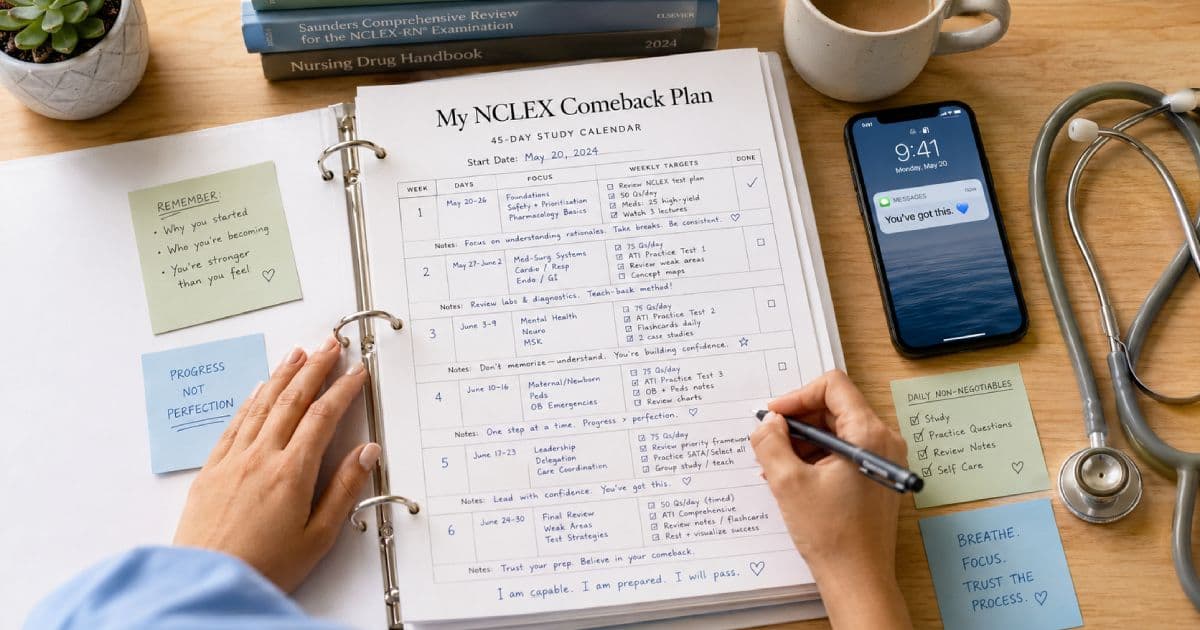
The 45-day NCLEX retake plan
This timeline assumes you are eligible to retest after 45 days.
Your state may require a longer wait, remediation, or additional steps.
Adjust the plan to your board's rules.
Overview
Days 1-3:
Recover and gather official requirements.

Days 4-7:
CPR audit and retake registration steps.

Days 8-20:
Targeted content rebuilding.

Days 21-34:
Question bank and NGN case-study intensive.

Days 35-41:
Timed mixed exams and weak-area tightening.

Days 42-45:
Light review, test-day logistics, sleep, and anxiety protocol.Days 1-3: recovery and reality check
Goals
- confirm official result
- avoid panic-buying resources
- sleep and recover
- check board retake rules
- write down what happened on test day
Do
Rest.
Eat normally.
Hydrate.
Take a walk.
Tell one safe person.
Save official result information.
Find board retake rules.
Write a short exam reflection.
Do not
Buy three courses.
Schedule blindly.
Study 12 hours.
Compare yourself online.
Decide your nursing career is over.
Exam reflection prompts
Write this before memory fades:
What question types stressed me most?
Did I panic after a certain question number?
Did I rush?
Did I take a break?
Did I use all available time?
Which topics felt unfamiliar?
Did I over-select SATA or matrix items?
Did I change answers often?
Did I sleep the night before?
Days 4-7: registration and CPR audit
Goals
- start the retake process
- obtain or save CPR
- build study priorities
- choose resources
- create calendar
Retake registration checklist
Nursing regulatory body contacted:
Retake application submitted, if required:
Board fee paid, if required:
Pearson VUE registration completed:
Pearson fee paid:
Eligibility pending:
New ATT received:
Retake scheduled only after plan is realistic:
CPR audit
Sort CPR categories into three groups.
Group A: Below passing standard
These are content rebuild priorities.
Study first.
Group B: Near passing standard
These are high-yield improvement targets.
Practice heavily.
Group C: Above passing standard
Maintain with mixed questions.
Do not over-study these.
Choose a simple resource stack
Do not use ten resources.
Choose:
One question bank
One content review resource
One lab/pharm quick reference
One notebook or spreadsheet for missed questions
One anxiety strategy plan
Good NurseZee support guides:
- NCLEX prep
- NCLEX prioritization questions
- NCLEX delegation questions
- NCLEX infection control precautions
- NCLEX pharmacology study guide
- NCLEX lab values cheat sheet
- NCLEX anxiety
- NurseZee practice questions
Days 8-20: targeted content rebuilding
This is the phase many retakers skip.
Do not.
If the CPR shows below-passing areas, random question volume may not be enough.
You need to rebuild weak content.
Daily structure
Use this schedule for 10 to 13 days.
30-45 minutes:
Review one weak topic.

45-60 minutes:
Do targeted questions on that topic.

45-60 minutes:
Review rationales.

15 minutes:
Write a one-page safety summary.

10 minutes:
Review yesterday's missed concepts.
What to rebuild
Common retake content areas include:
- prioritization
- delegation
- infection control
- pharmacology
- lab values
- maternal-newborn emergencies
- pediatric safety
- mental health safety
- fluids and electrolytes
- diabetes
- cardiac conditions
- respiratory conditions
- renal disorders
- endocrine disorders
- neurological changes
- post-op complications
One-page safety summary template
Topic:
Most dangerous complication:
Priority assessment:
Priority intervention:
Labs to watch:
Meds to know:
Patient teaching:
NCLEX trap:
Safety rule:
Example: heart failure safety summary
Topic: Heart failure
Most dangerous complication: pulmonary edema / respiratory distress
Priority assessment: lung sounds, SpO2, work of breathing, weight, edema
Priority intervention: high Fowler's, oxygen as ordered, notify provider, diuretic as ordered
Labs to watch: potassium, BNP, renal function
Meds to know: furosemide, ACE inhibitors, beta blockers, digoxin
Patient teaching: daily weights, low sodium, report rapid weight gain
NCLEX trap: ignoring new crackles and dyspnea
Safety rule: breathing problems beat routine medsDays 21-34: active question banking and NGN practice
Now shift to active practice.
Daily question target
A reasonable target:
50-75 questions per day
plus 1-2 NGN case studies
If you work full time, adjust.
Quality matters more than bragging about volume.
The rationale rule
Spend at least as much time reviewing rationales as answering questions.
For every missed question, write:
What was the topic?
What cue did I miss?
Why was my answer unsafe or less correct?
What rule will I use next time?
Missed question log
Date:
Question topic:
Item type:
Why I missed it:
- content gap
- misread stem
- overthinking
- anxiety
- over-selected
- priority error
Correct safety rule:
Review date:
NGN case-study process
Use this every time.
1. Read the patient snapshot.
2. Identify the setting and chief concern.
3. Scan vitals and trends.
4. Review labs and meds.
5. Identify abnormal cues.
6. Ask what is most dangerous.
7. Answer only what the item asks.
8. Do not over-select.
Partial credit caution
Next Gen NCLEX item scoring can include partial-credit methods.
But that does not mean you should select every answer that sounds possible.
On plus/minus-style items, wrong selections can reduce credit.
Use this rule:
Select what you can defend.
Do not select maybes.
Days 35-41: timed mixed practice and stamina
This phase prepares you for test-day endurance.
What to do
Complete:
2-3 timed mixed practice exams or long blocks
1 focused weak-area quiz after each exam
NGN case study practice every other day
Daily anxiety reset practice
Simulate the real exam
Practice with:
- no phone
- quiet room
- timer
- no notes
- no answer checking mid-block
- no music
- planned break strategy
Review the long-block results
Ask:
Did my score drop from fatigue?
Which item types caused errors?
Did I rush near the end?
Did anxiety increase after hard questions?
Did I over-select SATA or matrix answers?
Which content still repeats in missed questions?
Test anxiety practice
Use:
- box breathing
- 5-4-3-2-1 grounding
- scheduled breaks
- positive reset phrases
- question counter reframing
For deeper anxiety support, see NurseZee's NCLEX anxiety guide.
Days 42-45: light review and test readiness
The last few days are not for panic.
They are for confidence, sleep, and logistics.
Do
- light review
- lab values
- infection control
- high-yield meds
- prioritization rules
- short mixed sets
- sleep schedule
- testing center plan
- ID check
- ATT check
Do not
- take five readiness exams
- start a new question bank
- study all night
- read online panic posts
- change your entire plan
- compare yourself to classmates
Final 24-hour plan
Morning:
Light review only.

Midday:
Stop heavy studying.

Afternoon:
Pack ID, plan route, eat normally.

Evening:
Review calming script, sleep routine, no panic forums.

Exam morning:
Normal caffeine, familiar food, arrive early, one question at a time.
What to change for your second attempt
The goal is not to do more of the same.
The goal is to do the right work differently.
If you only read content last time
Add:
- daily questions
- rationale review
- timed blocks
- NGN cases
- missed-question log
If you only did questions last time
Add:
- targeted content review
- one-page summaries
- teach-back
- weak category remediation
If anxiety took over
Add:
- timed practice
- box breathing
- 5-4-3-2-1 grounding
- break strategy
- question count reframing
- sleep routine
If NGN cases hurt you
Add:
- daily case studies
- cue recognition practice
- trend interpretation
- matrix and bow-tie practice
- select-only-what-you-can-defend rule
If you overthought answers
Add:
Change answer only if I misread, missed a keyword, or found clear evidence.
Do not change because of panic.State-specific retake rules: check before you schedule
NCLEX retake rules vary.
This section gives examples, not a substitute for your board's current rules.
Always verify directly with your nursing regulatory body.
Florida example
Florida requires an approved remedial course after three consecutive NCLEX failures.
The Florida Board of Nursing’s remedial-course page says applicants who have failed the NCLEX three consecutive times require a letter to begin the remedial course.
Florida law also states that an applicant who fails the examination three consecutive times must complete a board-approved remedial course before being approved for reexamination.
Texas example
Texas requires initial licensure applicants to pass the NCLEX-PN or NCLEX-RN within four years of completing graduation requirements.
Texas rule language states that an applicant who has not passed within that four-year period must complete a board-approved nursing education program to take or retake the exam.
California example
California has a repeat/reapply process through the Board of Registered Nursing.
The California BRN repeat/reapply page instructs applicants to submit an RN Repeat/Reapply Application through BreEZe and pay required fees.
Because state rules can change, California candidates should verify current retake limits, fees, and application steps directly with the BRN before scheduling.
Other states
Some jurisdictions may require:
- longer waiting periods
- limited attempts per year
- limited lifetime attempts
- remediation after a set number of failures
- refresher courses
- repeat education after a time limit
- updated background checks
- new application fees
- board review before retesting
How to choose a new NCLEX resource after failing
You may need a new resource.
You may not.
Choose based on your failure pattern.
If you need content rebuilding
Look for a resource with:
- structured content review
- clear disease summaries
- pharmacology review
- fundamentals and safety
- lab interpretation
- active recall tools
If you need question strategy
Look for:
- high-quality rationales
- NGN cases
- prioritization questions
- SATA and matrix practice
- readiness tracking
- performance analytics
If you need anxiety support
Look for:
- timed simulations
- break planning
- test-day routines
- cognitive reframing
- manageable study schedule
Avoid resource overload
Do not buy everything.
A simple retake stack:
One primary question bank.
One content resource.
One notebook/spreadsheet.
One weekly readiness check.
One anxiety plan.
How to study after failing NCLEX while working
Some candidates must work while preparing.
That is harder, but possible.
Workday schedule
Before work:
15-20 review questions or flashcards.

After work:
30-45 minutes rationale review or weak content.

Days off:
Longer question blocks and NGN cases.
Weekly minimum
Try to complete:
250-400 questions per week
4-6 NGN case studies per week
2 content rebuild blocks per week
1 timed mixed block per week
Adjust if you are working heavy hours.
Sleep still matters.
How to tell an employer or residency program you failed
If you already had a job offer, the employer may need to know your license timeline changed.
Keep the message professional and brief.
Email template
Subject: NCLEX licensure timeline update

Hello [Name],

I wanted to update you that I did not pass the NCLEX on my recent attempt. I am already reviewing my Candidate Performance Report, confirming retake requirements with the board, and preparing for my next exam attempt.

I remain very interested in the position and will keep you updated on my licensure timeline as soon as I have my new testing window.

Thank you for your understanding.

Best,
[Name]
What not to do
Do not over-explain.
Do not blame the exam.
Do not promise a date before you have eligibility.
Do not hide it if the job requires active licensure by a deadline.
What if your classmates passed and you did not?
This is one of the hardest parts.
You may feel left behind.
But their pass does not make your failure permanent.
Protect your focus
For a few weeks, consider:
- muting group chats
- avoiding pass announcement threads
- limiting social media
- studying with one trusted partner only
- asking friends not to send exam rumors
What to tell yourself
Their timeline is not my timeline.
I need a license, not a perfect story.
This attempt gave me data.
I am building a better plan.
Retake readiness checklist
Before scheduling or keeping your retake date, confirm:
I reviewed my CPR:
I know my Below categories:
I know my Near categories:
I completed content rebuilding:
I completed NGN case practice:
I practiced timed mixed blocks:
I reviewed rationales consistently:
I improved weak areas:
I know my state retake rules:
I have a valid ATT:
I checked my ID:
I have a test-day anxiety plan:
I am not scheduling from panic:
If most of these are blank, you may need more preparation.
Retake test-day strategy
On test day, keep your plan simple.
Use the safety question
For each item, ask:
Which answer keeps the patient safest right now?Use the five-step question method
1. Read the final sentence first.
2. Identify what the question asks.
3. Find the safety issue.
4. Eliminate unsafe or irrelevant answers.
5. Choose and move on.
If you pass question 85
Say:
More questions mean more chances.If you reach 150
Say:
This question still matters.If panic rises
Use:
Feet on floor.
Exhale slowly.
Relax shoulders.
Read again.
Choose the safest answer.
Frequently asked questions about failing and retaking the NCLEX
I failed the NCLEX. What should I do first?
Wait for official results, give yourself time to process, review your Candidate Performance Report when available, contact your nursing regulatory body, and confirm retake steps before scheduling.
How long do I have to wait to retake the NCLEX?
NCSBN allows retesting after at least 45 test-free days, but some nursing regulatory bodies require longer waiting periods or additional steps. Check your board.
How many times can I take the NCLEX?
NCSBN allows up to eight attempts per year, but your nursing regulatory body can impose stricter annual, lifetime, remediation, or time-limit rules.
What is the Candidate Performance Report?
The Candidate Performance Report is a diagnostic report for candidates who do not pass. It shows performance indicators for NCLEX content areas and clinical judgment using Below, Near, and Above the Passing Standard labels.
How should I use my CPR?
Prioritize Below and Near Passing Standard areas. Use Below areas for content rebuilding and Near areas for targeted practice. Maintain Above areas with mixed review.
How soon should I start studying again?
Many candidates benefit from a short rest period of a few days before restarting. Use that time to gather retake rules and emotionally reset. Then start with your CPR audit.
Should I buy a new NCLEX course after failing?
Not automatically. First identify why you failed. You may need a new resource, but you may also need better rationale review, content rebuilding, NGN practice, or anxiety management.
Should I schedule my retake exactly 45 days later?
Only if you are ready. The 45-day rule is the minimum waiting period, not a guarantee that you should test on day 46.
Do I have to pay Pearson VUE again?
Usually yes. Retaking the NCLEX generally requires re-registering with Pearson VUE and paying the NCLEX registration fee again.
Do I have to pay my state board again?
Often yes, but rules vary. Your nursing regulatory body may require a reapplication, retake application, additional fee, or updated materials.
What happens if my ATT expires?
If your ATT expires before you test, follow Pearson VUE and board instructions to re-establish eligibility. NCSBN says if you missed an exam appointment or your ATT expired, you do not have to wait 45 days because you did not take the exam.
Will employers know I failed the NCLEX?
Employers generally verify whether you have an active nursing license. They do not normally see your exam attempt history. If a job offer depends on licensure by a certain date, you may need to update the employer about your timeline.
What if I failed the NCLEX three times in Florida?
Florida requires a board-approved remedial course after three consecutive NCLEX failures before reexamination approval. Verify current steps with the Florida Board of Nursing.
What is a remedial course?
A remedial course is a board-approved program required by some jurisdictions after multiple failed attempts. It may include classroom and clinical components designed to address knowledge and safety gaps.
What if I fail in Texas and do not pass within four years?
Texas rules require initial licensure applicants to pass the NCLEX within four years of completing graduation requirements. If not, the applicant must complete a board-approved nursing education program to take or retake the exam.
Can I retake in another state to avoid my board's rule?
Be very careful. Licensure is controlled by the nursing regulatory body where you apply. Trying to bypass remediation or eligibility rules can create licensure problems. Contact the relevant boards before making changes.
How many questions should I do per day for a retake?
Many retakers do well with 50-75 focused questions per day plus NGN case studies, but quality matters more than volume. Review rationales carefully.
How do I stop over-selecting SATA and NGN answers?
Use this rule: select only answers you can defend with patient data or a safety principle. Do not choose answers just because they sound possible.
What if I failed because of anxiety?
Build anxiety practice into your study plan. Use timed exams, planned breaks, box breathing, grounding, and question-count reframing. If anxiety is severe, talk with a qualified professional and ask your board early about accommodations.
Can I still be a good nurse if I failed NCLEX?
Yes. Failing the NCLEX means you did not meet the passing standard on that attempt. It does not erase nursing school, clinical growth, compassion, or future potential. Use the failure as data and build a better plan.
Final thoughts
Failing the NCLEX is painful.
But it is not the end of your nursing career.
Do not retake from panic.
Retake from data.
Read your CPR.
Check your board's rules.
Re-register correctly.
Study your weak areas first.
Practice NGN case studies.
Build stamina.
Manage anxiety.
Then walk back in with a plan.
You do not need a perfect comeback story.
You need a license.
One step at a time.
Sources and references
- NCSBN: What is the process to retake the NCLEX?
- NCSBN: How many times can I take the NCLEX?
- NCLEX: Results and Retake Policy
- NCLEX: Candidate Performance Report
- NCLEX: Register
- NCSBN: 2026 NCLEX Candidate Bulletin
- NCLEX: 2026 Candidate Bulletin PDF
- NCSBN: 2026 NCLEX-RN Test Plan
- NCLEX: Test Plans
- NCSBN: Clinical Judgment Measurement Model
- NCSBN: Next Generation NCLEX scoring resources
- Florida Board of Nursing: Approved Remedial Courses
- Florida Statutes Chapter 464.008
- Texas Board of Nursing: Reeducation of Candidates Who Fail to be Licensed within Four Years of Graduation PDF
- Texas Administrative Code Rule 217.2
- California Board of Registered Nursing: Repeat/Reapply for Examination
- NurseZee: NCLEX Prep
- NurseZee: NCLEX Anxiety
- NurseZee: NCLEX Prioritization Questions
- NurseZee: NCLEX Delegation Questions
- NurseZee: NCLEX Infection Control Precautions
- NurseZee: NCLEX Pharmacology Study Guide
- NurseZee: NCLEX Lab Values Cheat Sheet
- NurseZee Practice Questions