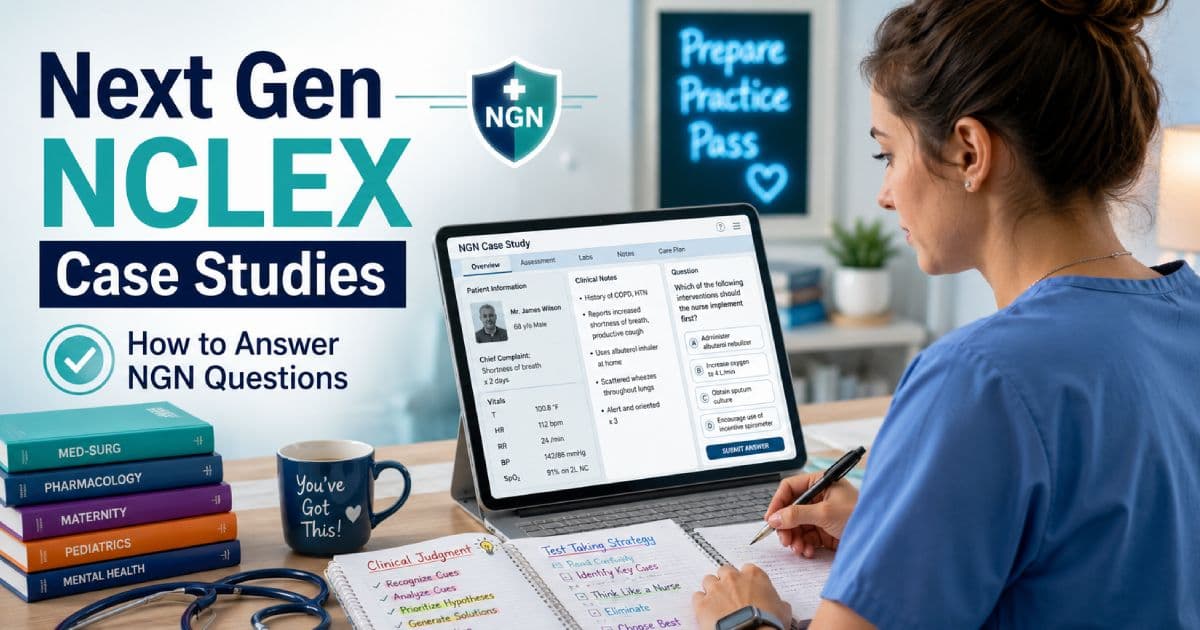
Next Gen NCLEX case studies are not trying to trick you with a new format.
They are trying to measure something nursing school talks about constantly: clinical judgment.
Can you notice the right cues? Can you tell what matters now versus what is just background information? Can you choose the safest first action? Can you evaluate whether the patient improved?
That is the heart of NGN.
The 2026 NCLEX Candidate Bulletin says clinical judgment is explicitly measured by 18 case-study items, meaning three item sets, plus approximately 10% stand-alone clinical judgment items, depending on exam length. The NCLEX-RN and NCLEX-PN both remain computerized adaptive tests with 85 to 150 items and a five-hour time limit.
This guide shows you how to answer NGN case studies step by step, without panicking over item formats.
What are Next Gen NCLEX case studies?
Next Gen NCLEX case studies are unfolding patient scenarios designed to measure clinical judgment.
A case study may include electronic health record-style tabs, such as:
- Nurses’ notes
- Provider orders
- Vital signs
- Laboratory results
- Medication administration record
- Health history
- Assessment findings
- Diagnostic results
- Intake and output
- Progress notes
The case then asks several questions about the same patient. Each question usually aligns with part of the clinical judgment process.
Official source:
How many NGN case studies are on the NCLEX?
The 2026 Candidate Bulletin says clinical judgment processes are explicitly measured by:
- 18 case-study items
- That equals three item sets
- Plus approximately 10% stand-alone clinical judgment items, selected depending on exam length
Official source:
What is the NCSBN Clinical Judgment Measurement Model?
NCSBN developed the NCSBN Clinical Judgment Measurement Model, or NCJMM, to measure clinical judgment and decision-making in the NCLEX.
The six measurable clinical judgment functions are:
- Recognize cues
- Analyze cues
- Prioritize hypotheses
- Generate solutions
- Take action
- Evaluate outcomes
Official source:
NGN case-study strategy: the 7-step method
Use this method every time you see a case study.
Step 1: Read the first sentence like a nurse
Before you look at answer choices, identify:
- Age
- Setting
- Diagnosis or complaint
- Current status
- Time frame
- Immediate risk
Example:
A 68-year-old client is admitted with shortness of breath and fever.Your first thought should be:
Respiratory problem + possible infection. Watch oxygenation, respiratory rate, work of breathing, temperature, sepsis risk, and mental status.Step 2: Scan every tab before answering
Do not answer from the first tab only.
Look for:
- Vital-sign trends
- New symptoms
- Labs that explain the problem
- Medications that change risk
- Orders that affect next steps
- Allergies
- Code status
- Baseline vs current condition
- Safety risks
Step 3: Separate cues from noise
A cue is data that changes your nursing judgment.
High-value cues include:
- New abnormal vital signs
- Trends over time
- Sudden changes from baseline
- High-risk symptoms
- Critical labs
- Medication effects or contraindications
- Safety risks
- Recent procedures
- Patient statements that suggest deterioration
Lower-value details may include:
- Old history that does not affect the current problem
- Stable chronic conditions
- Normal findings
- Extra description that does not change priority
Step 4: Ask what clinical judgment step is being tested
Before selecting an answer, ask:
Is this asking me to notice data, interpret data, prioritize, plan, act, or evaluate?| Question wording | Clinical judgment step |
|---|---|
| Which findings require follow-up? | Recognize cues |
| Which findings support the condition? | Analyze cues |
| Which problem is the priority? | Prioritize hypotheses |
| Which interventions are appropriate? | Generate solutions |
| What should the nurse do first? | Take action |
| Which finding shows improvement? | Evaluate outcomes |
Step 5: Use priority frameworks, but do not use them blindly
Helpful frameworks include:
- ABCs: airway, breathing, circulation
- Safety
- Acute before chronic
- Unstable before stable
- Actual problem before potential problem
- Least invasive when appropriate
- Nursing process
- Maslow, when clinically relevant
- Expected vs unexpected finding
- Trends over single values
But do not force a framework if the case data point elsewhere.
Example:
A pain score of 8/10 matters, but if the patient also has new stridor, the airway concern comes first.
Step 6: Choose answers that fit the nurse’s role
NCLEX questions expect safe entry-level nursing judgment.
Ask:
- Is this within RN or PN/LVN scope for this exam?
- Is this a nursing action or provider action?
- Does this require an order?
- Is this an assessment I should do before intervention?
- Is this urgent enough to notify the provider now?
- Should I delegate this task?
For role and exam differences, review the current test plan for your exam:
Step 7: Reassess after every action
NGN cases often ask whether an intervention worked.
Look for:
- Improved vital signs
- Reduced symptoms
- Better oxygenation
- Stabilized mental status
- Improved urine output
- Lab values moving toward expected range
- Patient demonstrating correct teaching
- No further deterioration
How to answer each clinical judgment step
1. Recognize cues
Recognizing cues means identifying important patient data.
What to look for
- Abnormal values
- Changes from baseline
- New symptoms
- High-risk history
- Medication red flags
- Signs of deterioration
- Safety issues
- Patient statements that match serious conditions
Common mistake
Students choose every abnormal value, even when the question asks for findings that require immediate follow-up.
Strategy
Ask:
Which findings change what I would do next?Example
Patient with pneumonia:
| Finding | Cue or noise? | Why |
|---|---|---|
| SpO2 88% on room air | Cue | Oxygenation problem |
| RR 30/min | Cue | Respiratory distress |
| WBC 15,000/mm3 | Cue | Infection/inflammation |
| History of appendectomy 20 years ago | Noise | Not relevant now |
| New confusion | Cue | Possible hypoxia/sepsis/deterioration |
2. Analyze cues
Analyzing cues means connecting data to meaning.
What to look for
- Clusters of findings
- Pathophysiology patterns
- Expected vs unexpected results
- Complications
- Medication effects
- Patient response to treatment
Common mistake
Students memorize isolated facts but do not connect them.
Strategy
Use this sentence:
These cues together suggest ___ because ___.Example
Fever + tachycardia + tachypnea + hypotension + confusion in a patient with infection suggests sepsis risk because the patient has systemic signs of deterioration.3. Prioritize hypotheses
Prioritizing hypotheses means choosing the most urgent or likely problem.
What to look for
- Life-threatening risks
- Rapidly changing conditions
- ABC problems
- Complications of diagnosis or treatment
- Time-sensitive conditions
- Highest-risk explanation
Common mistake
Students choose the diagnosis they know best, not the one that is most urgent.
Strategy
Ask:
What could harm or kill this patient fastest if I miss it?Example
A post-op patient has incisional pain, nausea, and sudden shortness of breath with SpO2 86%.
Priority hypothesis:
Respiratory complication or pulmonary embolism risk, not routine post-op pain.4. Generate solutions
Generating solutions means identifying appropriate interventions.
What to look for
- Safety interventions
- Monitoring
- Focused assessment
- Nursing interventions
- Provider notification
- Protocol-based care
- Teaching
- Medication or treatment actions with orders
Common mistake
Students jump to provider notification without choosing nursing actions that should happen now.
Strategy
Ask:
What can the nurse do now that is safe, ordered or within scope, and directly addresses the priority?5. Take action
Taking action means choosing what the nurse should do first or next.
What to look for
- Immediate safety
- Airway, breathing, circulation
- Stop harmful intervention
- Assess before treating when needed
- Activate emergency response when criteria are met
- Administer ordered urgent treatment
- Notify provider using SBAR
Common mistake
Students choose a long-term action when the question asks for an immediate action.
Strategy
Ask:
If I could only do one thing in the next 60 seconds, what would protect the patient most?6. Evaluate outcomes
Evaluating outcomes means deciding whether the intervention worked.
What to look for
- Expected improvement
- Expected side effect
- No change when improvement was expected
- Worsening after intervention
- New adverse effect
- Need for further escalation
Common mistake
Students choose a normal value that is unrelated to the intervention.
Strategy
Ask:
What finding proves the intervention addressed the problem?Example:
If oxygen was applied for hypoxia, the best outcome is improved oxygenation and work of breathing, not simply improved appetite.
NGN item types you may see
The NCLEX Candidate Bulletin says NCLEX items have multiple formats and directs candidates to the official NCLEX Prepare section and tutorial for item-type practice. It also notes partial credit scoring for items with more than one key, using plus/minus, zero/one, and rationale scoring methods.
Official source:
Common NGN-style formats include:
Matrix
You may need to classify findings across rows and columns.
Example task:
For each finding, indicate whether it is expected, unexpected, or requires follow-up.Strategy
Work row by row. Do not let one correct row make you rush the rest.
Bow-tie
Bow-tie items usually ask you to connect:
- Condition or problem
- Actions to take
- Parameters or findings to monitor
Strategy
Solve the center first.
What is the most likely or most dangerous condition?Then choose actions and monitoring items that match that condition.
Drop-down cloze
You choose words or phrases to complete a clinical sentence.
Strategy
Read the sentence after filling the blanks. It should sound clinically coherent and match the data.
Highlight
You may be asked to highlight relevant cues in the chart.
Strategy
Highlight data that directly support the patient’s priority problem or risk. Avoid highlighting every abnormal finding.
Drag-and-drop or ordered response
You may place actions in sequence.
Strategy
Use:
Assess → safety/urgent action → notify/implement → reassessBut adjust for emergencies where immediate action comes first.
Multiple response
You may select more than one option.
Strategy
Treat each option as true/false. Do not choose extra options just because “there must be more.”
Worked NGN case study example
Case: Shortness of breath after surgery
Exhibit 1: Nurses’ note
0900: Client returned from abdominal surgery yesterday. Reports incisional pain 5/10. Ambulated once with assistance overnight.
1130: Client reports sudden shortness of breath and sharp chest pain with deep inspiration.
Exhibit 2: Vital signs
| Time | T | HR | RR | BP | SpO2 |
|---|---|---|---|---|---|
| 0900 | 37.2°C | 92 | 18 | 128/76 | 96% RA |
| 1130 | 37.4°C | 124 | 30 | 104/66 | 88% RA |
Exhibit 3: Assessment
Client appears anxious and restless. Breath sounds diminished at bases. Incision clean, dry, intact. No active bleeding noted. Right calf appears slightly swollen compared with left.Question 1: Recognize cues
Which findings require immediate follow-up? Select all that apply.
- Sudden shortness of breath
- Incisional pain 5/10
- HR 124
- SpO2 88% on room air
- Right calf swelling
- Incision clean, dry, intact
Best answers
- Sudden shortness of breath
- HR 124
- SpO2 88% on room air
- Right calf swelling
Why
The urgent cue cluster suggests possible pulmonary embolism risk or another acute respiratory/circulatory complication. Incisional pain may need treatment, but it is not the immediate safety issue. A clean, dry, intact incision is reassuring.
Question 2: Analyze cues
The nurse should recognize that the client is most likely experiencing which complication?
- Atelectasis
- Pulmonary embolism
- Wound infection
- Urinary retention
Best answer
Pulmonary embolismWhy
Sudden dyspnea, pleuritic chest pain, tachycardia, hypoxia, anxiety/restlessness, post-op status, limited mobility, and unilateral calf swelling point toward PE risk.
Question 3: Take action
Which action should the nurse take first?
- Encourage oral fluids
- Apply oxygen per protocol/order
- Reinforce use of incentive spirometer
- Assess the incision dressing
Best answer
Apply oxygen per protocol/orderWhy
The client is hypoxic. Oxygenation is the immediate priority while escalating care according to facility policy.
Question 4: Generate solutions
Which additional actions are appropriate? Select all that apply.
- Notify the rapid response team or provider according to policy
- Keep the client in bed
- Prepare for diagnostic testing as ordered
- Massage the swollen calf
- Reassess respiratory status and vital signs
Best answers
- Notify the rapid response team or provider according to policy
- Keep the client in bed
- Prepare for diagnostic testing as ordered
- Reassess respiratory status and vital signs
Why
The patient needs urgent evaluation and monitoring. Do not massage the calf when DVT/PE is a concern.
Question 5: Evaluate outcomes
Which finding would indicate improvement after oxygen is applied?
- SpO2 increases to 95% and work of breathing decreases
- Incisional pain remains 5/10
- Client states appetite improved
- Calf swelling remains present
Best answer
SpO2 increases to 95% and work of breathing decreasesWhy
The intervention targeted oxygenation and respiratory distress.
Worked NGN case study example: sepsis risk
Case: Fever and confusion
Exhibit 1: Nurses’ note
Client admitted yesterday with cellulitis of the left lower leg. At 0800, alert and oriented x4. At 1200, family reports the client is “not acting right.”Exhibit 2: Vital signs
| Time | T | HR | RR | BP | SpO2 |
|---|---|---|---|---|---|
| 0800 | 37.8°C | 96 | 18 | 132/78 | 97% RA |
| 1200 | 39.1°C | 122 | 28 | 92/54 | 94% RA |
Exhibit 3: Labs
WBC 18,000/mm3
Lactate pending
Creatinine increased from baseline
Recognize cues
High-risk cues:
- Fever
- Tachycardia
- Tachypnea
- Hypotension
- New confusion
- Known infection
- Elevated WBC
- Creatinine increase
Analyze cues
The cue cluster suggests systemic infection with possible sepsis and poor perfusion.
Prioritize hypotheses
Priority concern:
Sepsis or septic shock riskGenerate solutions
Appropriate nursing actions may include:
- Notify provider or activate sepsis protocol per facility policy
- Obtain full set of vital signs
- Maintain IV access
- Prepare for cultures, lactate, fluids, and antibiotics as ordered/protocol-directed
- Monitor urine output
- Reassess mental status and perfusion
- Escalate if hypotension, confusion, or respiratory status worsens
Evaluate outcomes
Improvement may include:
- Blood pressure improves
- Heart rate decreases
- Respiratory rate decreases
- Mental status improves
- Urine output improves
- Lactate trends down if elevated
- Temperature begins to improve after treatment
The biggest NGN mistakes students make
1. Answering before reading all exhibits
The clue may be in the medication list, allergy section, trend table, or latest nurse note.
2. Treating all abnormal findings as equally urgent
Not every abnormal finding is the priority.
Ask:
Which abnormal finding is most dangerous right now?3. Missing trends
NGN loves trends because real nursing judgment depends on change over time.
Watch for:
- RR increasing
- O2 requirement increasing
- BP decreasing
- HR increasing
- Urine output decreasing
- Mental status worsening
- Pain changing in character
- Labs moving the wrong direction
4. Choosing provider actions instead of nursing actions
If the option says “diagnose,” “prescribe,” or “perform surgery,” it is usually not the nurse’s action. But notifying the provider, preparing for ordered tests, and implementing standing protocols may be appropriate.
5. Overusing ABCs without context
ABCs matter, but the safest answer depends on the full case. A patient with mild shortness of breath may not outrank a patient with active hemorrhage and hypotension.
6. Selecting too many options
For select-all or matrix questions, do not select an answer unless the case data supports it.
7. Ignoring scope differences between RN and PN
RN and PN exams reflect different scopes. If you are taking NCLEX-PN, pay close attention to monitoring, reporting, reinforcement of teaching, and assignment within PN/LVN scope.
NGN practice routine
Use this routine three to five days per week.
1. Warm up with 10 mixed questions
Goal:
- Get into test mode
- Avoid overstudying one topic
- Notice weak areas
2. Complete one NGN case study slowly
Goal:
- Practise the clinical judgment steps
- Read all exhibits
- Talk through your reasoning
3. Remediate immediately
Use this template:
Case topic:
Clinical judgment step missed:
Cue I missed:
Wrong assumption I made:
Priority principle:
Correct reasoning:
How I will recognize this pattern next time:
4. Do a short targeted drill
If you missed a sepsis question, do 10 sepsis or infection questions.
If you missed a delegation question, do 10 prioritization/delegation questions.
5. Re-test after 72 hours
Do not trust “I read the rationale, so I know it now.”
Re-test the same concept later with fresh questions.
How to review NGN rationales
Do not only read why the correct answer is right.
Review:
- Why the correct answer is safest
- Why each wrong option is less safe, out of scope, too late, or unsupported
- Which cue you missed
- Whether you misread the question
- Whether you had a content gap or a judgment gap
Content gap vs judgment gap
| Miss type | What it means | Fix |
|---|---|---|
| Content gap | You did not know the disease, medication, lab, or procedure | Review content, then do targeted questions |
| Judgment gap | You knew the content but picked the wrong priority | Practise clinical judgment steps and prioritization |
| Reading gap | You missed a word, value, or time trend | Slow down and use exhibit scanning |
| Scope gap | You chose an action outside the nurse’s role | Review RN/PN scope and delegation |
| Stamina gap | You missed it because you were tired or rushing | Timed practice and break strategy |
High-yield topics for NGN case studies
Prioritize case studies that involve:
- Sepsis
- Respiratory distress
- Heart failure
- COPD/asthma exacerbation
- Stroke symptoms
- Post-op complications
- Hemorrhage
- Shock
- DKA and hypoglycemia
- Electrolyte imbalance
- Renal failure
- Medication adverse effects
- Anticoagulant safety
- OB emergencies
- Newborn respiratory distress
- Mental health crisis
- Fall risk and restraints
- Infection prevention and isolation
- Delegation and prioritization
For medication calculations and safety, review NurseZee’s med math for nurses guide.
How to pace yourself on NGN case studies
Do not rush case studies, but do not get stuck.
A good approach:
30-45 seconds: scan scenario and tabs
60-90 seconds: answer the item
15-30 seconds: check whether answer matches priority and scope
Some items take longer. That is okay. But if you spend five minutes on one item, you may hurt your overall pacing.
The Candidate Bulletin warns that rapid guessing can lower performance on an adaptive test. A reasonable pace is safer than panic-clicking.
NGN study plan: 2 weeks
Use this if you already have content review underway and need to sharpen NGN strategy.
Days 1-2: Learn the model
- Review the six clinical judgment steps.
- Do 2 untimed case studies.
- Write rationales in your own words.
- Identify whether misses are content gaps or judgment gaps.
Days 3-5: Recognize and analyze cues
- Drill abnormal findings and trends.
- Practise labs, vitals, and priority cues.
- Do 3 case studies focused on cue recognition.
- Review sepsis, respiratory distress, and shock.
Days 6-8: Prioritize and act
- Drill prioritization and delegation.
- Review ABCs, safety, acute vs chronic, stable vs unstable.
- Do 3 case studies and 50 mixed questions.
Days 9-11: Evaluate outcomes
- Practise outcome questions.
- Review medication effects, oxygen therapy, fluids, pain interventions, and teaching outcomes.
- Do 3 case studies with remediation.
Days 12-14: Mixed readiness
- Do timed mixed sets.
- Complete at least 3 additional case studies.
- Retest weak concepts.
- Build a final “patterns I miss” sheet.
NGN study plan: 6 weeks
| Week | Focus |
|---|---|
| 1 | Clinical judgment model and exhibit scanning |
| 2 | Recognize cues and analyze cues |
| 3 | Prioritization, safety, delegation, scope |
| 4 | Pharmacology, labs, risk reduction |
| 5 | Mixed NGN case studies and weak-category retesting |
| 6 | Timed practice, readiness checks, final remediation |
For broader exam planning, use NurseZee’s NCLEX prep guide and 2026 NCLEX test plan guide.
NGN checklist before test day
You should be able to:
- Explain the six clinical judgment steps
- Read all exhibits before answering
- Identify abnormal and changing cues
- Separate urgent findings from background noise
- Prioritize unstable over stable clients
- Choose nursing actions within scope
- Use ABCs without ignoring context
- Interpret basic labs and vital trends
- Answer matrix and bow-tie items without panicking
- Remediate missed questions by reasoning pattern
- Keep a steady pace without rapid guessing
Frequently asked questions about Next Gen NCLEX case studies
What are NGN questions?
NGN questions are Next Generation NCLEX items designed to measure clinical judgment. They may appear as case-study items or stand-alone clinical judgment items using formats such as matrix, bow-tie, highlight, cloze, ordered response, or multiple response.
How many case studies are on the NCLEX?
The 2026 Candidate Bulletin says clinical judgment is measured by 18 case-study items, which equals three item sets, plus approximately 10% stand-alone clinical judgment items depending on exam length.
Are NGN case studies only on NCLEX-RN?
No. Clinical judgment is included across NCLEX-RN and NCLEX-PN. The RN and PN exams reflect different scopes of practice, so use the correct test plan for your exam.
What are the six clinical judgment steps?
The six steps are recognize cues, analyze cues, prioritize hypotheses, generate solutions, take action, and evaluate outcomes.
What is the best way to answer NGN questions?
Read all exhibits, identify abnormal and changing cues, decide which clinical judgment step is being tested, prioritize the most dangerous problem, choose safe nursing actions within scope, and evaluate whether the intervention worked.
Are NGN questions harder than regular NCLEX questions?
They can feel harder because they require you to connect several pieces of data. But once you learn the clinical judgment pattern, NGN questions become more predictable.
Do NGN questions have partial credit?
Some NCLEX items with more than one key use partial credit scoring. The 2026 Candidate Bulletin describes plus/minus, zero/one, and rationale scoring methods.
Should I select every abnormal finding in a matrix question?
No. Select findings that answer the question. If the question asks what requires immediate follow-up, choose urgent findings, not every minor abnormal value.
How do I get better at bow-tie questions?
Solve the center first. Identify the most likely or most dangerous condition, then choose actions and monitoring findings that match that condition.
How do I improve on NGN case studies?
Do case studies regularly, remediate misses by clinical judgment step, track cue-recognition errors, and re-test weak patterns after a few days.
Where can I practise NGN-style questions?
Use a question bank with NCLEX-style and NGN-style items. NurseZee’s practice site includes 1,100+ NCLEX-style questions.
Final thoughts
Next Gen NCLEX case studies are not a separate subject.
They are nursing judgment in test form.
The case gives you a patient. Your job is to notice the important cues, understand what they mean, choose the safest priority, take the right action, and evaluate whether the patient improved.
Practise that process enough times, and NGN questions stop feeling like a strange format.
They start feeling like what they are: a short version of safe entry-level nursing practice.
Sources and references
- NCLEX Clinical Judgment Measurement Model
- 2026 NCLEX Candidate Bulletin PDF
- NCLEX Exam Publications
- 2026 NCLEX-RN Test Plan
- 2026 NCLEX-RN Test Plan PDF
- 2026 NCLEX-PN Test Plan
- 2026 NCLEX-PN Test Plan PDF
- NCLEX Prepare
- NurseZee: 2026 NCLEX Test Plan
- NurseZee: NCLEX Prep
- NurseZee Practice: 1,100+ NCLEX-style questions
- NurseZee: Med Math for Nurses