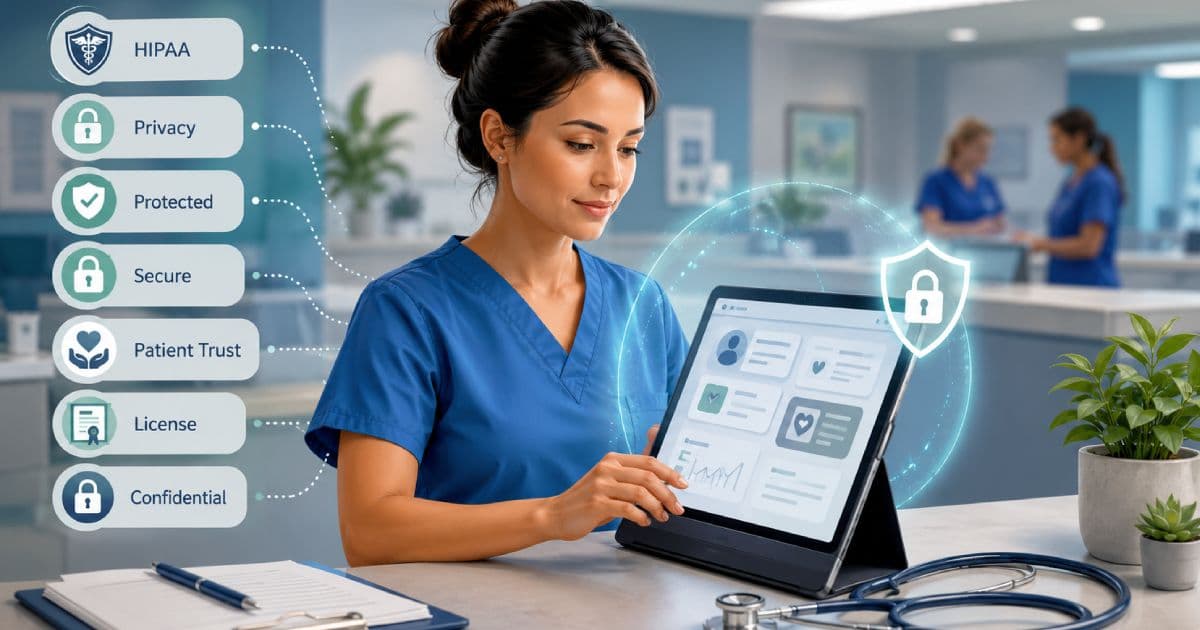
HIPAA can sound intimidating: annual modules, legal language, privacy warnings, audit trails, and stories about nurses being fired for looking at the wrong chart.
But the core idea is simple: patients trust nurses with information they would not share with almost anyone else. HIPAA helps protect that trust.
For nurses, HIPAA is not only a compliance topic. It affects everyday bedside practice: hallway conversations, phone calls, EHR access, text messages, shift report, family updates, social media, printed worksheets, discharge teaching, and even casual stories after work.
This guide explains the HIPAA rules nurses need most, in plain language.
What is HIPAA?
HIPAA stands for the Health Insurance Portability and Accountability Act. In everyday nursing practice, people usually mean the HIPAA privacy and security rules that protect health information.
Two rules matter most for nurses:
HIPAA Privacy Rule
The Privacy Rule protects individually identifiable health information held or transmitted by covered entities and their business associates. It applies to information in any form: oral, paper, or electronic.
It also gives patients rights over their health information, including rights to access records and request corrections.
HIPAA Security Rule
The Security Rule protects electronic protected health information, often called ePHI. It requires safeguards that help protect the confidentiality, integrity, and availability of ePHI.
For nurses, this includes practical habits like logging out, using approved devices, protecting passwords, avoiding personal email for patient information, and reporting suspicious activity.
Official source: HHS HIPAA Privacy Rule
Who has to follow HIPAA?
HIPAA applies directly to covered entities and business associates.
Covered entities include many:
- Health care providers that conduct certain electronic transactions
- Health plans
- Health care clearinghouses
Business associates are people or organizations that perform certain services involving PHI for covered entities, such as billing companies, EHR vendors, consultants, and some technology vendors.
Nurses are usually part of a covered entity’s workforce. That means your employer or clinical site is responsible for HIPAA compliance, and you are expected to follow its policies.
What is PHI?
PHI means protected health information.
In plain English, PHI is health information that can identify a patient when it is created, received, maintained, or transmitted by a covered entity or business associate.
PHI can be:
- Spoken
- Written
- Printed
- Texted through an approved system
- Stored in the EHR
- On a wristband
- On a specimen label
- On a whiteboard
- In a photo
- In a voicemail
- In a handoff sheet
- In a billing record
- In an email
PHI includes information about:
- A patient’s past, present, or future physical or mental health
- Health care provided to the patient
- Payment for health care
Official source: HHS guidance on de-identification and PHI
The 18 HIPAA identifiers nurses should know
Under the HIPAA Safe Harbor method for de-identification, 18 types of identifiers must be removed, and the covered entity must not have actual knowledge that the remaining information could identify the person.
Here are the 18 identifiers in nurse-friendly language.
| # | Identifier | Nursing example |
|---|---|---|
| 1 | Names | Patient name, family member names |
| 2 | Geographic details smaller than a state | Street address, city, county, precinct, most ZIP codes |
| 3 | Dates related to the individual, except year | Birth date, admission date, discharge date, death date, exact surgery date |
| 4 | Phone numbers | Patient or family phone number |
| 5 | Fax numbers | Home or office fax number |
| 6 | Email addresses | Patient email address |
| 7 | Social Security numbers | SSN in registration or records |
| 8 | Medical record numbers | MRN on labels, wristbands, forms |
| 9 | Health plan beneficiary numbers | Insurance member number |
| 10 | Account numbers | Billing account number |
| 11 | Certificate or license numbers | Driver’s license or professional license number |
| 12 | Vehicle identifiers and serial numbers | License plate in trauma notes or EMS record |
| 13 | Device identifiers and serial numbers | Implanted device number, equipment serial tied to patient |
| 14 | Web URLs | Personal website or unique patient portal link |
| 15 | IP addresses | Internet protocol address |
| 16 | Biometric identifiers | Fingerprints, voiceprints |
| 17 | Full-face photos and comparable images | Patient face, identifying tattoo photo, visible wristband photo |
| 18 | Any other unique identifying number, characteristic, or code | Rare diagnosis plus local news details, unique case detail, specific incident details |
De-identified does not mean “I removed the name”
A common mistake is thinking a story is safe because the patient’s name is not included.
That is not enough.
A patient may still be identifiable from:
- Age
- Room number
- Date
- Rare diagnosis
- Injury mechanism
- Facility name
- Photo background
- Local event
- Family details
- Job or school
- Unusual clinical course
- News coverage
Example:
“The 19-year-old from last night’s ATV crash who came to our small-town ED” may identify someone even without the name.
Use de-identification only when you truly understand the standard, have removed identifiers, and have no actual knowledge that the remaining details could identify the patient.
The minimum necessary standard
The minimum necessary standard means you should use, access, or disclose only the PHI needed for the task.
For nurses, this is one of the most important HIPAA habits.
Ask:
- Do I need this chart to care for this patient?
- Do I need this entire record or only one result?
- Do I need to say the diagnosis out loud here?
- Do I need to include the patient’s name in this message?
- Do I need to print this?
- Do I need to keep this note after my shift?
Official source: HHS Minimum Necessary Requirement
Important nuance: treatment and minimum necessary
HIPAA’s minimum necessary requirement does not apply to every situation. For example, HHS explains that it does not apply to disclosures to or requests by a health care provider for treatment.
That does not mean nurses can access anything they want. Your access still must be role-based, job-related, and consistent with facility policy.
Everyday HIPAA rules for nurses
1. Do not snoop in charts
Access only the records you need for your assigned role.
Do not look up:
- Your own chart through work access
- Your child’s chart
- A spouse or partner’s chart
- A coworker’s chart
- A celebrity’s chart
- A neighbor’s chart
- A patient you heard about but are not caring for
- A former patient unless you have a current job-related need
Use the patient portal, medical records request, or right-of-access process for your own records.
2. Keep conversations private
HIPAA does not mean nurses can never speak about patients. Nurses need to communicate to provide care. But you should reduce avoidable exposure.
Safer habits:
- Lower your voice at the nurses’ station.
- Avoid detailed patient conversations in elevators, cafeterias, parking lots, and public hallways.
- Step into private spaces when possible.
- Use room number or initials only when appropriate and permitted by policy.
- Do not share “interesting cases” with friends or family.
- Be careful in semi-private rooms.
- Pause if visitors or other patients can overhear.
3. Protect screens and workstations
Good habits:
- Lock the screen before walking away.
- Do not share passwords.
- Do not chart under someone else’s login.
- Position screens away from public view when possible.
- Use privacy screens where available.
- Log out of shared devices.
- Report lost badges, tokens, or devices immediately.
4. Handle paper like PHI
Paper PHI is still PHI.
Examples:
- Brain sheets
- Handoff notes
- Medication labels
- Specimen labels
- MAR printouts
- Discharge paperwork
- Patient stickers
- Lab slips
- Fax confirmations
- Assignment sheets
- Whiteboard printouts
Safer habits:
- Keep papers face down or covered.
- Do not leave printouts at printers.
- Use approved shred bins.
- Do not take patient notes home.
- Do not throw labels or report sheets in regular trash.
- Follow facility rules for whiteboards and census sheets.
5. Be careful with family updates
Family communication is common in nursing, but it still requires care.
Before sharing information, confirm:
- Who the person is
- Whether the patient has agreed or objected
- Whether the disclosure is permitted by policy
- Whether the caller has the required code or verification, if your facility uses one
- Whether the information is relevant to that person’s involvement in care or payment
If the patient has capacity and can decide, ask the patient what can be shared and with whom.
If you are unsure, pause and escalate.
6. Use approved secure messaging only
Do not use personal SMS, personal email, social media DMs, consumer messaging apps, or personal cloud storage for patient information.
CMS updated hospital and critical access hospital guidance in 2024. It says texting patient information and patient orders among health care team members is permissible if it is done through a HIPAA-compliant secure texting platform and complies with Medicare Conditions of Participation.
Official source: CMS: Texting of Patient Information and Orders for Hospitals and CAHs
7. Do not take patient photos on personal devices
Clinical photos can contain PHI even when the face is not visible.
Examples:
- Wounds
- Rashes
- Injuries
- Monitors
- Whiteboards
- Wristbands
- Specimen labels
- Room numbers
- Tattoos
- Unique devices
Use only approved devices, approved apps, and approved workflows. If the image is for wound care, consults, documentation, teaching, or escalation, follow policy.
Do not store patient images on your phone.
8. Do not post patient stories on social media
Social media is one of the easiest ways for nurses to create privacy and licensing problems.
Avoid posting:
- Patient stories
- Room details
- Shift details that identify a patient
- Photos taken on a unit where PHI may appear in the background
- “No names, but…” stories
- Rare cases
- Screenshots from EHRs
- Whiteboards, monitors, labels, or wristbands
- Comments about difficult patients or families
NCSBN warns that inappropriate social media use by nurses can lead to licensure and legal consequences and emphasizes patient confidentiality and professional boundaries.
Official source: NCSBN: A Nurse’s Guide to the Use of Social Media
9. Do not teach with real patient screenshots unless approved
Screenshots from EHRs can contain PHI in obvious and hidden ways.
Before using anything for teaching:
- Follow the facility’s education process.
- Use approved de-identified training materials.
- Remove all identifiers.
- Check the background and metadata.
- Do not use personal devices or personal cloud folders.
- Ask the privacy officer or educator if unsure.
10. Report mistakes quickly
If you make a privacy mistake, report it promptly.
Examples:
- You opened the wrong chart.
- You gave discharge papers to the wrong patient.
- You sent a message to the wrong recipient.
- You left paperwork in a public area.
- You lost a report sheet.
- You clicked a phishing link.
- You accidentally posted or sent something that may contain PHI.
Early reporting helps the organization assess risk, mitigate harm, meet breach-notification obligations if needed, and correct process problems.
HIPAA scenarios nurses actually face
| Scenario | Safer practice | Risky practice |
|---|---|---|
| Nurses’ station | Keep voices low, lock screens, cover papers | Discuss diagnoses loudly near visitors |
| Elevator | Wait until you are in a private space | Give report while the public can hear |
| Family phone call | Verify caller and follow policy | Share details because the caller sounds familiar |
| Social media | Do not post patient stories | “No names, but…” rare case story |
| Brain sheet | Secure and shred per policy | Take home or throw in regular trash |
| Text message | Use approved secure platform | Personal SMS or personal email |
| Chart access | Assigned patients only | Curiosity lookup |
| Personal medical record | Use portal/records request | Access through employee EHR login |
| Clinical photo | Use approved device/workflow | Personal phone camera |
| Wrong chart access | Close and report | Keep reading or ignore it |
What if the patient gives permission?
Patient permission matters, but it does not automatically make every action appropriate.
Example: A patient may say, “Sure, you can take a picture of my wound.” That does not mean you can use your personal phone, store it in your camera roll, or text it to someone outside approved systems.
Follow facility process for:
- Consent
- Purpose of the image or disclosure
- Documentation
- Approved device
- Approved storage
- Approved recipient
- Retention and deletion
Can nurses share PHI for treatment?
Yes, nurses can share PHI for treatment when it is appropriate and allowed by policy.
Examples:
- Giving report to the oncoming nurse
- Calling the provider about a change in condition
- Communicating with pharmacy about medication safety
- Handing off to transport or procedural staff
- Coordinating discharge with case management
- Communicating with another facility during transfer
But treatment-related sharing should still be professional, secure, and limited to the care purpose.
HIPAA and law enforcement requests
Nurses may occasionally encounter police, correctional officers, investigators, subpoenas, warrants, or other requests for patient information.
Do not guess.
Your role is usually to follow facility policy and involve the right department, such as:
- Charge nurse
- House supervisor
- Privacy officer
- Risk management
- Legal department
- Security
- Medical records or health information management
Some disclosures may be permitted or required by law, but the rules are fact-specific. Do not hand over PHI simply because someone asks with authority.
HIPAA and reproductive health privacy: 2026 update
This is an area that changed after the original 2024 final rule.
HHS states that on June 18, 2025, a federal court vacated most of the HIPAA Privacy Rule to Support Reproductive Health Care Privacy. HHS also states that remaining Notice of Privacy Practices modifications were not fully vacated and compliance with remaining NPP modifications is required by February 16, 2026.
Official source: HHS: HIPAA Privacy Rule and Disclosures of Information Relating to Reproductive Health Care
For bedside nurses, the safest takeaway is:
- Do not personally decide how to respond to law enforcement, court, oversight, or outside requests for reproductive health information.
- Follow the current facility process.
- Escalate to privacy, compliance, legal, or health information management.
- Expect policies and Notice of Privacy Practices language to change as organizations implement remaining requirements and respond to legal developments.
HIPAA Security Rule update watch
HHS OCR issued a proposed rule in December 2024 to modify the HIPAA Security Rule and strengthen cybersecurity protections for ePHI. HHS describes the proposal as responding to increased cyberattacks and large breaches affecting health information.
As of this article’s last check, this is a proposed rule, not a final replacement for your current facility policy.
Official source: HHS HIPAA Security Rule NPRM fact sheet
Nurse-friendly implications to watch:
- Stronger authentication expectations
- More emphasis on encryption
- More formal cybersecurity policies
- Vendor and business-associate scrutiny
- More security training
- More attention to phishing, ransomware, and downtime procedures
HIPAA consequences for nurses
HIPAA violations can have several layers of consequences.
Workplace discipline
Depending on the situation, a nurse may face:
- Coaching
- Written warning
- Suspension
- Termination
- Loss of access privileges
- Mandatory retraining
- Reporting to a board of nursing
Board of nursing discipline
State boards of nursing can discipline nurses for unprofessional conduct, breach of confidentiality, unethical conduct, or violations of the nurse practice act.
This can affect:
- License status
- Probation
- Fines
- Monitoring
- Employment opportunities
- Professional reputation
Civil enforcement
HHS OCR enforces HIPAA rules and may require corrective action plans, settlements, or civil money penalties for covered entities and business associates. OCR reports enforcement highlights and case examples publicly.
Official sources:
Criminal penalties
HIPAA criminal penalties apply to knowing unauthorized obtaining or disclosure of individually identifiable health information. HHS notes that OCR refers appropriate cases involving knowing disclosure or obtaining of PHI to the Department of Justice for criminal investigation.
Official source: HHS OCR Enforcement Highlights
These cases are uncommon for accidental bedside errors, but they are real for intentional misuse, false pretenses, personal gain, malicious harm, or selling information.
Rapid-response checklist for nurses
Use this when you are unsure.
- Pause. Do I need this PHI for my role right now?
- Check the setting. Can others see or hear?
- Use approved tools. EHR, secure messaging, approved phone, approved camera, approved printer.
- Share with need-to-know people only. Do not add extra details.
- Protect paper. Cover, secure, shred.
- Protect ePHI. Lock screens, no password sharing, no personal cloud.
- Escalate gray areas. Privacy officer, charge nurse, supervisor, risk, legal.
- Report mistakes immediately. Do not wait and hope nobody notices.
HIPAA myths nurses should stop believing
Myth 1: “It is not a violation if I do not say the name.”
Wrong. A patient can be identified by other details.
Myth 2: “I can look up my own chart because it is my information.”
Wrong in most workplaces. Use the patient portal or medical records process.
Myth 3: “The family asked, so I can tell them everything.”
Not automatically. Verify authority, patient preference, and policy.
Myth 4: “Deleted posts disappear.”
Wrong. Screenshots, shares, backups, and audit trails may remain.
Myth 5: “Personal texting is okay if the provider asked for it.”
Not if it contains PHI and is outside approved systems.
Myth 6: “HIPAA means I can never talk about patients.”
Wrong. Nurses must communicate for care. HIPAA requires appropriate, limited, secure communication.
Myth 7: “A celebrity chart is only a problem if I change something.”
Wrong. Unauthorized viewing alone can be a serious violation.
Frequently asked questions about HIPAA for nurses
What is HIPAA in nursing?
HIPAA is a federal law and set of rules that protect health information. For nurses, it affects how patient information is accessed, discussed, documented, shared, stored, transmitted, and disposed of.
What is PHI?
PHI is protected health information. It is health information that identifies a patient or could reasonably be used to identify a patient when held or transmitted by a covered entity or business associate.
What are examples of PHI in nursing?
Examples include names, medical record numbers, wristbands, room-linked information, birth dates, diagnoses, medication lists, lab results, photos, discharge papers, handoff sheets, billing information, and anything else that connects a patient to health care.
What is ePHI?
ePHI is electronic protected health information. It includes PHI in EHRs, secure messages, emails, scanned documents, digital images, electronic reports, and other electronic systems.
Can nurses talk about patients at the nurses’ station?
Nurses can communicate for patient care, but they should use a low voice, limit details, avoid public exposure, and move sensitive conversations to a private area when possible.
Can I look up my own medical record at work?
Usually no. Use the patient portal or medical records request process. Accessing your own chart through employee EHR access commonly violates employer policy and may violate HIPAA-related access rules.
Can I look up a family member’s chart if they gave permission?
Do not use work access unless it is part of your assigned job role and allowed by policy. Family permission does not automatically make employee access appropriate. Use the formal patient access or authorization process.
Can nurses text patient information?
Only through employer-approved secure systems. CMS says texting patient information and patient orders in hospitals and critical access hospitals is permissible if done through a HIPAA-compliant secure texting platform and in compliance with Conditions of Participation.
Can nurses take patient photos?
Only through approved workflows, devices, and consent/documentation processes. Do not use a personal phone or store patient images in personal apps.
Can nurses post about patients if names are removed?
No, not if the patient could still be identified. Patient details, images, timing, location, diagnosis, or unusual circumstances can identify someone.
Is a room number PHI?
A room number by itself may not identify a patient to everyone, but in context it can. Treat room numbers carefully, especially when paired with diagnoses, dates, units, or other details.
What is the minimum necessary rule?
It means using, accessing, or disclosing only the PHI needed for the task. There are exceptions, including certain treatment disclosures, but nurses should still use role-based access and follow facility policy.
What should I do if I accidentally open the wrong chart?
Stop, close the chart, do not continue reading, and report it according to policy. Quick reporting is better than trying to hide it.
What should I do if I send PHI to the wrong person?
Report it immediately through your facility process. Do not try to fix it alone unless policy instructs you to take a specific immediate step.
Can I throw away my report sheet after shift?
Only in approved secure disposal, such as a shred bin. Do not throw report sheets, labels, or patient printouts in regular trash or open recycling.
Can I use patient stories for school assignments?
Use only the minimum necessary details, follow school and clinical-site policy, remove identifiers, and avoid unique details that could identify the patient. When in doubt, ask your instructor and clinical site.
Does HIPAA apply to nurses outside work?
HIPAA obligations arise through covered entities and business associates, but your professional duty of confidentiality does not end when you clock out. Your employer, school, and board of nursing may discipline patient privacy violations that happen outside work, including social media posts.
Can a nurse be fired for a HIPAA violation?
Yes. Many employers treat unauthorized chart access, improper disclosure, social media violations, and mishandling PHI as serious disciplinary issues that can lead to termination.
Can a nurse lose a license over HIPAA?
A board of nursing may discipline a nurse for confidentiality, professionalism, ethics, or nurse practice act violations. Whether a license is affected depends on the facts and state board process.
Is HIPAA changing in 2026?
Several HIPAA-related issues are active. HHS has proposed Security Rule updates, and HHS states that remaining Notice of Privacy Practices modifications connected to reproductive health and substance use disorder records require compliance by February 16, 2026. Follow official HHS updates and employer policy.
Final thoughts
HIPAA is not just an annual training module. For nurses, it is a daily professional habit.
The safest nurses do the simple things consistently: access only what they need, speak carefully, use approved systems, protect paper and screens, avoid social media mistakes, and report concerns early.
If you treat patient information with the same care you give the patient, you are already thinking in the right direction.
Sources and references
- HHS: HIPAA Privacy Rule
- HHS: Summary of the HIPAA Privacy Rule
- HHS: Methods for De-identification of PHI
- HHS: Minimum Necessary Requirement
- HHS: HIPAA Enforcement Rule
- HHS OCR: Enforcement Highlights
- CMS: Texting of Patient Information and Orders for Hospitals and CAHs
- HHS: HIPAA Security Rule NPRM Fact Sheet
- HHS: HIPAA Privacy Rule and Disclosures of Information Relating to Reproductive Health Care
- HHS: Model Notices of Privacy Practices
- NCSBN: A Nurse’s Guide to the Use of Social Media