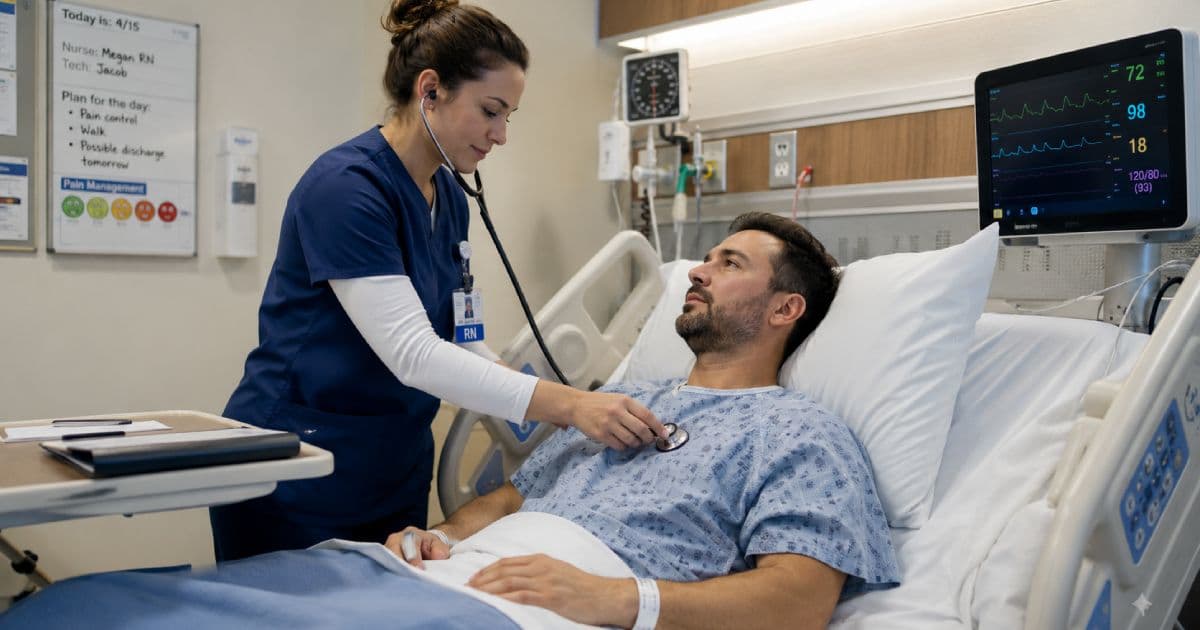
A head-to-toe assessment is not a performance for your instructor.
It is how nurses catch change early.
A new facial droop. A respiratory rate that crept from 18 to 28. A patient who is “a little more confused.” A cool foot after a vascular procedure. A distended abdomen with absent bowel sounds. A pressure injury starting under a device.
The goal is not to memorize a script forever. The goal is to build one repeatable flow you can use on clinical checkoffs, admissions, shift assessments, post-op checks, and any moment when your nurse gut says, “Something is different.”
What is a head-to-toe assessment?
A head-to-toe assessment is a structured nursing assessment that reviews the patient’s overall condition and major body systems in a consistent order.
It helps you:
- Establish a baseline
- Detect changes from baseline
- Identify early deterioration
- Prioritize care
- Communicate clearly during handoff
- Document objective and subjective findings
- Decide when to escalate
OpenRN’s Nursing Skills head-to-toe checklist includes many of the same core elements students learn: general appearance, vital signs, neuro, HEENT, cardiovascular, respiratory, abdomen, musculoskeletal, integumentary, devices, tubes, drains, and safety checks.
Source:
When do nurses perform a head-to-toe assessment?
Common times include:
- Admission
- Start of shift, according to unit policy
- Post-op arrival or transfer
- Change in condition
- After a fall
- Before or after high-risk medication or procedure, if relevant
- ICU, stepdown, ED, or high-acuity reassessments
- Clinical skills checkoff or OSCE
- Before calling a provider when you need a complete picture
Head-to-toe assessment flow to memorize
Use this order until it becomes automatic:
Intro
General survey
Vitals and pain
Neuro
HEENT
Neck
Respiratory
Cardiovascular and peripheral vascular
Abdomen
GU
Skin
Musculoskeletal
Back and posterior
Safety
Documentation
Why this order works
- It starts with safety and patient identity.
- It catches urgent airway, breathing, circulation, and neurologic concerns early.
- It keeps the patient from being repositioned repeatedly.
- It works well for school checkoffs and bedside practice.
- It makes documentation easier because your note follows your exam.
Before you start: 60-second preparation
A good assessment starts before you touch the patient.
1. Review the chart and handoff
Check:
- Diagnosis or reason for visit
- Code status
- Allergies
- Isolation precautions
- Fall risk
- Diet and activity orders
- Oxygen orders
- Lines, drains, tubes, wounds, or devices
- Recent procedures
- Abnormal labs or imaging
- Pain plan
- Neuro checks, vitals frequency, or special monitoring
- Provider concerns from handoff
For handoff structure, see NurseZee’s nursing handoff report guide.
2. Gather supplies
Common supplies:
- Stethoscope
- Penlight
- Watch with second hand
- Thermometer
- Blood pressure cuff
- Pulse oximeter
- Gloves
- Alcohol wipes
- Tape or dressing supplies if needed
- Measuring tool for wounds if within role/policy
- Documentation device or brain sheet
- Clean linen if repositioning
3. Use hand hygiene and PPE
Perform hand hygiene before patient contact. Use PPE according to transmission-based precautions and facility policy.
4. Introduce yourself and confirm identity
Use two identifiers according to policy.
Example:
Hi, I’m Michelle, your nurse today. Can you tell me your full name and date of birth?5. Explain what you are doing
Patient-friendly script:
I’m going to do a head-to-toe assessment to check your breathing, heart, abdomen, skin, movement, pain, and safety. I’ll explain as I go, and you can ask me to pause at any time.6. Provide privacy and positioning
- Close the door or curtain.
- Keep the patient covered as much as possible.
- Raise the bed to working height.
- Lower the bed again before leaving.
- Ask for help before turning high-risk patients.
Step-by-step nursing head-to-toe assessment
1. General survey
The general survey starts the moment you see the patient.
Assess
- Appearance: well, ill, frail, diaphoretic, pale, flushed, distressed
- Position: upright, tripod, guarding, curled up, restless
- Speech: clear, slurred, short phrases, unable to speak
- Breathing: unlabored or labored
- Skin color: pink, pale, cyanotic, mottled, jaundiced
- Level of consciousness: alert, drowsy, confused, unresponsive
- Affect: calm, anxious, withdrawn, agitated
- Environment: oxygen, lines, pumps, drains, call light, bed position, clutter, alarms
Normal example
Patient awake, calm, and sitting upright in bed. Breathing unlabored. Speech clear. Skin warm and dry. No acute distress noted.Red flags
Escalate promptly for:
- New altered level of consciousness
- Cyanosis
- Severe respiratory distress
- Active bleeding
- Unresponsive patient
- Severe agitation with safety risk
- Pump alarms on critical medications
- Oxygen disconnected or empty tank during transport
- Patient appears much worse than handoff suggested
2. Vital signs and pain
Vital signs are not just numbers. They are trend data.
Johns Hopkins describes vital signs as measurements of the body’s most basic functions and notes they are useful in detecting or monitoring medical problems. NCBI’s respiratory assessment chapter notes that nurses should evaluate respiratory rate and pulse oximetry to verify the patient is stable before proceeding with the physical exam.
Sources:
Assess
- Temperature
- Heart rate
- Respiratory rate
- Blood pressure
- Oxygen saturation
- Pain
- Blood glucose if ordered or clinically indicated
- Weight if relevant
- Orthostatic vitals if ordered or indicated
Adult ranges to know
Use these as general adult reference ranges, not rigid rules. Compare with baseline, diagnosis, medications, and provider parameters.
| Vital sign | Common adult reference range |
|---|---|
| Heart rate | 60-100 bpm |
| Respiratory rate | 12-20/min at rest |
| Temperature | about 36.5-37.5°C / 97.7-99.5°F |
| SpO2 | often 94-98% in many adults, but baseline and disease matter |
| Blood pressure | compare with baseline and ordered parameters |
Pain assessment
Use PQRST or OLDCARTS.
PQRST:
- Provokes/palliates: What makes it better or worse?
- Quality: Sharp, dull, burning, pressure?
- Region/radiation: Where is it? Does it move?
- Severity: 0-10 or appropriate pain scale
- Timing: When did it start? Constant or intermittent?
Red flags
Escalate according to policy for:
- SpO2 below ordered goal or sudden drop from baseline
- New or worsening shortness of breath
- Respiratory rate very high, very low, or trending worse
- Systolic BP below ordered parameters or severe hypertension
- New chest pain
- Heart rate with symptoms such as dizziness, chest pain, hypotension, syncope, or shortness of breath
- Fever with clinical deterioration
- Severe uncontrolled pain
- New sepsis concern
CDC states that sepsis is a medical emergency and emphasizes recognizing signs and acting fast. In clinical care guidance, CDC notes sepsis treatment requires urgent medical care and careful monitoring of vital signs, with early and frequent reassessment.
Sources:
3. Neurological assessment
Start with the basics. Go deeper if there is a neuro diagnosis, fall, head injury, stroke concern, sedation, delirium risk, or change from baseline.
Assess
- Level of consciousness
- Orientation to person, place, time, and situation
- Speech clarity
- Pupils: size, equality, reaction to light
- Facial symmetry
- Grip strength
- Arm drift
- Foot pushes and pulls
- Sensation if indicated
- Gait or balance if safe and relevant
- Glasgow Coma Scale if ordered or clinically indicated
Normal example
Alert and oriented x4. Speech clear. PERRLA 3 mm to 2 mm brisk bilaterally. Facial symmetry intact. Grips and foot pushes 5/5 bilaterally. No drift noted.Red flags
Escalate for:
- New confusion
- New weakness
- Facial droop
- Slurred speech
- Unequal or nonreactive pupils
- New severe headache
- New seizure
- Decreased level of consciousness
- New loss of sensation
- Sudden vision changes
- Acute agitation or delirium
SBAR escalation example
S: I’m calling about a new neuro change.
B: Patient was A&Ox4 at 0800 after admission for pneumonia.
A: Now confused to place and time, with new left facial droop and left grip 3/5.
R: I need urgent evaluation and stroke protocol guidance now.
4. HEENT: head, eyes, ears, nose, throat
HEENT can be quick unless the patient has relevant symptoms.
Head and face
Assess:
- Scalp lesions or trauma
- Facial symmetry
- Tenderness
- Swelling
- Skin color
- Drains, dressings, or surgical sites if present
Eyes
Assess:
- Pupils
- Sclera color
- Conjunctiva
- Drainage
- Vision changes
- Glasses or contacts
- Eye pain, redness, or photophobia if relevant
Ears and nose
Assess:
- Hearing difficulty
- Drainage
- Epistaxis
- Nasal cannula skin pressure
- NG tube position and skin integrity if present
Mouth and throat
Assess:
- Oral mucosa moisture
- Dentition or dentures
- Lesions
- Tongue
- Swallow concerns
- Speech
- Secretions
- Aspiration risk
Normal example
Head normocephalic. Face symmetric. Sclera white, conjunctiva pink. No eye, ear, or nasal drainage noted. Oral mucosa moist, no lesions observed. Swallow intact per patient report.Red flags
Escalate for:
- New facial droop
- New difficulty swallowing
- Stridor or airway concern
- New unequal pupils
- Severe eye pain or sudden vision loss
- Copious secretions with inability to protect airway
- New bleeding from ears or nose after trauma
5. Neck
Assess
- Trachea midline
- Neck swelling or masses if visible
- Lymph nodes if indicated and within scope/rubric
- JVD if indicated, often with head of bed about 30-45 degrees
- Carotids if trained and appropriate: auscultate before palpation when indicated; palpate one side at a time
- Range of motion if relevant and safe
Normal example
Trachea midline. No visible neck swelling. No JVD observed at 45 degrees.Red flags
Escalate for:
- Neck swelling with airway symptoms
- Tracheal deviation
- New JVD with respiratory distress or chest symptoms
- Neck stiffness with fever or altered mental status
- Carotid symptoms or bruit concerns according to role/policy
6. Respiratory assessment
Respiratory changes are often early signs of deterioration. Do not skip respiratory rate.
NCBI’s respiratory assessment chapter lists the normal adult respiratory rate as 12-20 breaths per minute at rest and describes pulse oximetry as part of evaluating stability before the physical exam.
Source:
Use IPPA
For most respiratory assessments:
- Inspect
- Palpate
- Percuss if indicated or required
- Auscultate
Inspect
Assess:
- Respiratory rate and rhythm
- Work of breathing
- Accessory muscle use
- Chest rise symmetry
- Cough
- Sputum
- Oxygen device and flow rate
- Skin color
- Ability to speak in full sentences
- Positioning
Palpate
Assess if indicated:
- Chest expansion
- Tenderness
- Crepitus
- Tactile fremitus if required by exam or policy
Percuss
Percussion may be required in school or advanced assessment and may help identify dullness or hyperresonance, depending on training and scope.
Auscultate
Listen:
- Anterior and posterior
- Side to side
- Apex to bases
- Compare corresponding areas
- Ask the patient to breathe through the mouth if appropriate
- Avoid auscultating through clothing when possible
Common sounds:
| Sound | Possible meaning |
|---|---|
| Clear | No adventitious sounds heard |
| Crackles | Fluid, atelectasis, pneumonia, fibrosis, or other causes depending on context |
| Wheezes | Airway narrowing or bronchospasm |
| Rhonchi | Secretions or larger airway sounds |
| Diminished | Low airflow, poor effort, hyperinflation, effusion, obstruction, or other causes |
| Absent | Emergency if new or associated with distress |
Normal example
RR 16, even and unlabored. SpO2 96% on room air. Chest expansion symmetric. Lungs clear to auscultation anteriorly and posteriorly. No cough noted.Red flags
Escalate for:
- New hypoxia
- Increased oxygen requirement
- Respiratory distress
- Accessory muscle use
- Cyanosis
- Silent chest
- New absent breath sounds
- New unilateral chest expansion
- Stridor
- New confusion with respiratory changes
- SpO2 not improving with ordered interventions
7. Cardiovascular and peripheral vascular assessment
Assess central cardiovascular status
- Heart rate
- Rhythm if on monitor
- Apical pulse if indicated
- Heart sounds: S1/S2, extra sounds, murmurs if heard and trained to identify
- Chest pain or pressure
- Dizziness or syncope
- Palpitations
- Telemetry alarms and rhythm strips if applicable
Auscultation sites
Common five-point pattern:
- Aortic
- Pulmonic
- Erb’s point
- Tricuspid
- Mitral/apical
Assess peripheral vascular status
- Skin color
- Skin temperature
- Capillary refill
- Radial pulses
- Dorsalis pedis and posterior tibial pulses
- Edema
- Calf pain or swelling if relevant
- Neurovascular checks if ordered
- Lines, arterial sites, vascular access, or post-procedure puncture sites
Edema scale
| Grade | Description |
|---|---|
| 0 | No edema |
| 1+ | Mild pitting |
| 2+ | Moderate pitting |
| 3+ | Deep pitting |
| 4+ | Very deep pitting, often with significant swelling |
Normal example
HR 78 regular. S1/S2 present. No chest pain reported. Radial and pedal pulses 2+ bilaterally. Cap refill less than 2 seconds. No edema noted.Red flags
Escalate for:
- New chest pain or pressure
- Symptomatic irregular pulse
- New severe bradycardia or tachycardia
- Hypotension with symptoms
- Cool, mottled, pulseless, painful, or numb extremity
- New unilateral leg swelling or calf pain
- Rapidly worsening edema with dyspnea
- Bleeding, hematoma, or loss of pulse after vascular procedure
8. Abdomen assessment
The abdomen is the exception to the usual IPPA order.
Use IAPP:
- Inspect
- Auscultate
- Percuss
- Palpate
Auscultate before percussion and palpation because touching the abdomen can alter bowel sounds. NCBI’s head-to-toe checklist also places abdominal auscultation before palpation.
Source:
Inspect
Assess:
- Contour: flat, rounded, distended
- Symmetry
- Scars
- Bruising
- Drains
- Dressings
- Ostomy
- Visible pulsation
- Tube placement and skin integrity
Auscultate
Listen in all quadrants.
Document:
- Active
- Hypoactive
- Hyperactive
- Absent, only according to facility/school definition and after adequate listening time
Percuss
Percuss if required or indicated to assess tympany, dullness, or organ size depending on role and skill level.
Palpate
Start light. Ask about tenderness first.
Assess:
- Tenderness
- Guarding
- Rigidity
- Masses if trained/required
- Rebound tenderness only if taught/appropriate; do not cause unnecessary pain
- Organomegaly if within skill level/rubric
Ask
- Last bowel movement
- Passing flatus
- Nausea or vomiting
- Diet tolerance
- Appetite
- Abdominal pain
- Diarrhea or constipation
- Blood in stool or emesis
Normal example
Abdomen soft, nondistended, and nontender. Bowel sounds active in all four quadrants. Tolerating diet. Denies nausea or vomiting. Last bowel movement today.Red flags
Escalate for:
- Rigid abdomen
- Guarding
- Rebound tenderness
- Severe or worsening abdominal pain
- Distention with vomiting
- Absent bowel sounds with pain or distention
- GI bleeding signs
- New hypotension with abdominal pain
- New post-op abdominal change
- Ostomy color change, no output when expected, or concerning stoma findings
9. Genitourinary assessment
Approach GU respectfully and only expose when necessary.
Ask
- Voiding pattern
- Pain or burning with urination
- Urgency or frequency
- Urine color and odor
- Incontinence
- Last void
- Menstrual, pregnancy, or reproductive concerns if relevant
- Genital symptoms only when clinically relevant and appropriate
Assess devices
For urinary catheter or external device:
- Indication
- Tubing position
- Dependent drainage
- Kinks
- Securement
- Bag below bladder
- Urine color, clarity, amount
- Perineal skin condition if visible and appropriate
- Catheter care per policy
Urine output red flag
A common adult concern is low urine output. Many clinical references use less than 0.5 mL/kg/hr as an oliguria threshold, but always follow facility policy and provider parameters.
Normal example
Voiding without difficulty. Urine clear yellow per patient report. Denies dysuria, urgency, or flank pain.Red flags
Escalate for:
- Very low urine output
- No urine output when expected
- Catheter blockage
- Frank hematuria
- New flank pain with fever
- New urinary retention
- Sudden incontinence with neurologic symptoms
- Catheter-associated infection concern
10. Skin assessment
Skin assessment is pressure-injury prevention, infection detection, circulation assessment, and dignity work.
Assess
- Color
- Temperature
- Moisture
- Turgor
- Rashes
- Lesions
- Bruising
- Incisions
- Wounds
- Dressings
- Drainage
- Devices causing pressure
- Sacrum
- Heels
- Elbows
- Occiput
- Skin folds
- Under oxygen tubing, masks, braces, compression devices, and catheters
For wounds
Document according to policy:
- Location
- Size
- Wound bed
- Edges
- Drainage
- Odor
- Periwound skin
- Dressing type
- Pain
- Photos only if policy allows
Normal example
Skin warm, dry, and intact. No redness noted over sacrum or heels. Turns self in bed. Heels elevated.Red flags
Escalate for:
- New pressure injury
- Nonblanchable redness
- Rapidly spreading rash
- Skin breakdown under device
- Wound dehiscence
- Purulent drainage
- Sudden color or temperature change in an extremity
- Petechiae or bruising with bleeding concern
- Burns, suspected abuse, or concerning injury patterns according to policy
11. Musculoskeletal assessment
Assess
- Range of motion
- Strength
- Grip strength
- Foot pushes/pulls
- Mobility level
- Gait if safe
- Balance
- Assistive devices
- Weight-bearing status
- Pain with movement
- Splints, casts, braces, traction, or surgical restrictions
- Fall risk
Strength scale
| Grade | Meaning |
|---|---|
| 0/5 | No contraction |
| 1/5 | Trace contraction |
| 2/5 | Movement with gravity eliminated |
| 3/5 | Movement against gravity |
| 4/5 | Movement against some resistance |
| 5/5 | Full strength |
Normal example
Moves all extremities equally. Strength 5/5 upper and lower extremities bilaterally. Ambulates with steady gait and no assistive device.Red flags
Escalate for:
- New weakness
- New inability to bear weight
- New severe pain after fall or injury
- New numbness or tingling
- Loss of movement distal to injury/cast
- Unsafe mobility
- Suspected fracture or dislocation
- Change in neurovascular status
12. Back and posterior assessment
Reposition safely with help if needed.
Assess
- Posterior lung sounds
- Spine alignment if relevant
- Back pain
- Scapulae
- Sacrum
- Buttocks
- Heels
- Posterior surgical sites or drains
- Skin under devices and linens
- Pressure areas
Normal example
Posterior lungs clear bilaterally. Back skin intact. Sacrum and heels without redness. Patient repositioned with call light within reach.Red flags
Escalate for:
- New sacral or heel breakdown
- New posterior crackles or diminished sounds with symptoms
- Severe new back pain
- New neurologic symptoms with back pain
- Drainage or dehiscence from posterior surgical site
13. Final safety check
Do not leave until safety is reset.
Check:
- Bed low and locked
- Call light within reach
- Personal items within reach
- Non-slip socks or footwear
- Bed or chair alarm per policy
- Side rails according to policy
- Oxygen connected and correct setting
- IV pumps running as ordered
- Tubes and drains not kinked or pulling
- Lines labeled per policy
- Patient comfortable
- Pain plan addressed
- Toileting needs addressed
- Patient knows how to call for help
- Hand hygiene completed
Closing script
I’m done with your assessment. Your call light is here, your bed is locked and low, and I’ll be back to reassess your pain and check your labs. Is there anything urgent you need before I step out?Normal vs abnormal findings: quick chart
| System | Common normal findings | Concerning findings |
|---|---|---|
| General | Calm, no acute distress, speaking clearly | New distress, cyanosis, severe agitation, altered LOC |
| Vitals | Near baseline, stable trend | New hypoxia, unstable BP, fever with deterioration, abnormal RR trend |
| Neuro | A&Ox4, clear speech, equal strength | Facial droop, slurred speech, unilateral weakness, new confusion |
| Respiratory | Unlabored, clear or baseline sounds | Accessory muscles, new wheeze/crackles, silent chest, rising O2 need |
| Cardiac/PV | Regular pulse, warm extremities, pulses present | Chest pain, symptomatic arrhythmia, cool/pulseless limb, rapid edema |
| Abdomen | Soft, nontender, bowel sounds present | Rigidity, guarding, rebound, distention with vomiting, GI bleeding |
| GU | Voiding, clear yellow urine | Oliguria, retention, frank hematuria, blocked catheter |
| Skin | Warm, dry, intact | Nonblanchable redness, new wound, drainage, rapidly spreading rash |
| MSK | Equal movement, steady gait | New weakness, unsafe mobility, severe pain, neurovascular change |
| Safety | Call light, alarms, bed position appropriate | Fall risk not addressed, oxygen/IV/pump issue, unsafe environment |
Documentation examples
Good documentation is objective, concise, and tied to action.
Normal head-to-toe documentation example
A&Ox4. Speech clear. PERRLA 3 mm brisk bilaterally. RR 16 even/unlabored, SpO2 97% RA. Lungs clear anterior/posterior. HR 78 regular, S1/S2 present. Radial and pedal pulses 2+ bilaterally, cap refill <2 sec, no edema. Abd soft, nontender, bowel sounds active x4, denies N/V. Voiding without difficulty. Skin warm/dry/intact, sacrum and heels without redness. Moves all extremities, strength 5/5 bilaterally. Ambulates with steady gait. Bed low/locked, call light within reach.Abnormal respiratory documentation example
Patient reports increased shortness of breath. RR 28 with mild accessory muscle use. SpO2 89% on RA, improved to 94% on 2 L NC per protocol/order. Lungs with crackles at bilateral bases. Provider notified using SBAR. Chest X-ray and BMP ordered. Will continue to monitor respiratory status and oxygen requirement.Abnormal neuro documentation example
At 1410, patient noted with new left facial droop, slurred speech, and left grip 3/5. Last known baseline A&Ox4 with clear speech at 1200. Charge RN notified. Stroke protocol activated per policy. VS obtained. Patient remained in bed with safety measures in place.Abnormal abdomen documentation example
Patient reports 8/10 diffuse abdominal pain with nausea. Abdomen distended and firm with guarding. Bowel sounds hypoactive x4. No BM x3 days per patient. Provider notified. Patient made NPO per order, abdominal imaging pending. Pain reassessment planned.SOAP note example
S: Patient reports 6/10 epigastric pain that began 2 hours ago and worsens after meals. Denies shortness of breath or chest pain.

O: A&Ox4. BP 148/92, HR 96 regular, RR 22, SpO2 97% RA, temp 37.1°C. Lungs clear. Abdomen soft with epigastric tenderness, bowel sounds active x4. No vomiting observed.

A: Epigastric pain; hemodynamically stable at this time.

P: Antacid administered as ordered. Provider updated. Reassess pain in 30 minutes and monitor for worsening abdominal pain, vomiting, or vital-sign changes.
Printable nursing head-to-toe assessment template
Copy this into your notes app, clinical paperwork, or report sheet.
PATIENT:
Date/time:
Diagnosis/reason for admission:
Code status:
Allergies:
Precautions:
Baseline:

INTRO / SAFETY
ID checked:
Hand hygiene/PPE:
Consent/explanation:
Pain:
Bed/call light/safety:

GENERAL SURVEY
Appearance:
Distress:
Speech:
Skin color:
Work of breathing:
Lines/drains/tubes/pumps:

VITALS
T:
HR:
RR:
BP:
SpO2:
Pain:
Blood glucose if ordered:
Trend/concern:

NEURO
LOC/orientation:
Pupils:
Speech:
Face:
Grips:
Foot pushes/pulls:
Drift:
Sensation/gait if indicated:
Concern:

HEENT
Head/face:
Eyes:
Ears/nose:
Mouth/throat/swallow:
Concern:

NECK
Trachea:
JVD:
ROM:
Other:
Concern:

RESPIRATORY
Oxygen/device:
RR/work of breathing:
Chest expansion:
Lung sounds anterior:
Lung sounds posterior:
Cough/sputum:
Concern:

CARDIOVASCULAR / PERIPHERAL VASCULAR
HR/rhythm:
Heart sounds:
Chest pain:
Pulses:
Cap refill:
Edema:
Skin temp/color:
Lines/access:
Concern:

ABDOMEN
Inspect:
Bowel sounds:
Tenderness:
Distention:
N/V:
Diet tolerance:
Last BM/flatus:
Drains/ostomy:
Concern:

GU
Voiding:
Urine:
Catheter/device:
Output:
Dysuria/retention:
Concern:

SKIN
Color/temp/moisture:
Pressure areas:
Wounds/incisions:
Dressings:
Devices causing pressure:
Concern:

MUSCULOSKELETAL
ROM:
Strength:
Mobility:
Assistive device:
Fall risk:
Concern:

BACK / POSTERIOR
Posterior lungs:
Spine/back pain:
Sacrum:
Heels:
Concern:

PLAN / ESCALATION
Abnormal findings:
Provider/charge notified:
Orders/interventions:
Reassessment time:
Patient education:
12-minute student workflow
This timing is for practice, OSCEs, and stable adults. Real patients may need more or less time.
| Time | Action |
|---|---|
| 1 minute | Intro, ID, consent, hand hygiene, privacy |
| 2 minutes | General survey, vitals, pain |
| 2 minutes | Neuro and HEENT |
| 2 minutes | Respiratory |
| 2 minutes | Cardiovascular/peripheral vascular |
| 1.5 minutes | Abdomen and GU questions |
| 1 minute | Skin, MSK, back/posterior |
| 30 seconds | Safety check and close |
OSCE and clinical checkoff tips
Do these
- Wash hands.
- Introduce yourself.
- Confirm two identifiers.
- Explain the assessment.
- Ask about pain early.
- Compare side to side.
- Auscultate skin, not clothing when possible.
- Count respirations accurately.
- Auscultate abdomen before palpation.
- Protect privacy.
- Reposition safely.
- End with call light, bed position, and safety.
- Summarize abnormal findings and escalation.
Avoid these
- Forgetting patient ID
- Jumping around body systems
- Palpating abdomen before listening
- Skipping posterior lungs
- Saying “vitals stable” without numbers
- Ignoring patient pain
- Missing IVs, drains, oxygen, or pumps
- Failing to lower the bed after assessment
- Documenting findings you did not assess
If you forget a step
Say:
I’m going to return to one item I missed before moving on.Recovering safely is better than pretending.
When to escalate abnormal findings
Escalate according to facility policy, rapid response criteria, provider orders, and clinical judgment.
AHRQ PSNet notes that rapid recognition and response to deterioration is a crucial element of safe inpatient care, and rapid response systems rely on recognition, referral, and response. NICE describes early warning systems as track-and-trigger tools that use physiological parameters to identify deterioration risk. NHS England explains that NEWS standardizes recording, scoring, and responding to changes in routinely measured physiological parameters.
Sources:
- AHRQ PSNet: Recognizing and Responding to Clinical Deterioration
- NICE: Early Warning Score Systems
- NHS England: National Early Warning Score
Escalation red flags by system
Airway and breathing
- Stridor
- Severe shortness of breath
- SpO2 below goal
- Rapidly increasing oxygen requirement
- Respiratory rate trending up or down dangerously
- Silent chest
- Cyanosis
- New confusion with hypoxia
Circulation
- New chest pain
- Symptomatic arrhythmia
- Hypotension with symptoms
- Cool, mottled, or pulseless extremity
- New uncontrolled bleeding
- Signs of shock
Neurologic
- New facial droop
- New unilateral weakness
- Slurred speech
- Seizure
- Decreased LOC
- New severe headache
- Unequal/nonreactive pupils
Infection or sepsis concern
- Fever or hypothermia with deterioration
- Tachycardia, tachypnea, hypotension, confusion, low urine output
- Suspected infection plus clinical worsening
- New lactate or lab concern if available
Abdomen/GI
- Rigid abdomen
- Guarding
- Severe new pain
- GI bleeding
- Persistent vomiting
- Distention with absent or concerning bowel sounds
- Post-op change
GU/renal
- Low urine output
- New retention
- Frank hematuria
- Catheter blockage
- Flank pain with fever
Skin/MSK
- New pressure injury
- Wound dehiscence
- Neurovascular compromise
- Suspected fracture
- Rapidly spreading rash
SBAR script for escalation
Use SBAR when calling a provider, charge nurse, rapid response nurse, or supervisor.
AHRQ describes SBAR as a structured communication framework for sharing information about a patient condition or issue that needs attention.
Source:
S: I’m calling about [patient], room [number], admitted for [diagnosis]. I’m concerned because [current problem].

B: Relevant background: [history, recent procedure, code status, allergies, baseline].

A: Current assessment: [vitals, focused findings, what changed, what you have done].

R: I need [specific action/order/evaluation]. What parameters should I use for further notification?
Example:
S: I’m calling about Mr. James in 512, admitted for cellulitis. I’m concerned about possible sepsis.

B: He has diabetes and CKD. He was A&Ox4 this morning and afebrile overnight.

A: Now temp 38.8°C, HR 118, RR 26, BP 94/58, and he is newly confused. Urine output has been 20 mL/hr for the last 2 hours.

R: I need urgent evaluation and sepsis orders. Do you want blood cultures, lactate, fluids, and antibiotics initiated per protocol?
Common head-to-toe assessment mistakes
1. Memorizing a script but not thinking
A script helps you start. Clinical judgment helps you decide what matters.
2. Skipping respiratory rate
Respiratory rate is often rushed or estimated. Count it carefully, especially if the patient looks unwell.
3. Documenting “WNL” without detail
“WNL” can be vague. Specific normal findings are more useful.
Better:
RR 16 unlabored, lungs clear bilaterally, SpO2 97% RA.4. Forgetting baseline
A heart rate of 105 may be normal for one patient and a warning sign for another. Always compare with baseline.
5. Assessing over clothing
You can miss wounds, devices, skin color, drains, and pressure injuries.
6. Not checking lines, drains, tubes, and pumps
Assessment includes equipment. Verify that IV fluids, oxygen, drains, tubes, and alarms match the plan.
7. Finding an abnormality but not escalating
Assessment without action does not protect the patient.
8. Forgetting to reassess after intervention
Pain medication, oxygen, fluids, bronchodilators, antihypertensives, antiemetics, and other interventions require reassessment according to policy.
Frequently asked questions about head-to-toe assessment
What is a head-to-toe assessment in nursing?
A head-to-toe assessment is a structured nursing assessment that reviews the patient’s general appearance, vital signs, pain, neurologic status, HEENT, respiratory, cardiovascular, abdominal, GU, skin, musculoskeletal, posterior, and safety status.
What is the correct order for a head-to-toe assessment?
A common order is intro and ID, general survey, vital signs and pain, neuro, HEENT, neck, respiratory, cardiovascular/peripheral vascular, abdomen, GU, skin, musculoskeletal, back/posterior, safety check, and documentation.
What does IPPA mean in nursing?
IPPA means inspect, palpate, percuss, and auscultate. It is a common physical-assessment sequence for many body systems.
Why is the abdomen assessed differently?
The abdomen is usually assessed with IAPP: inspect, auscultate, percuss, palpate. Auscultation comes before touching because palpation and percussion can alter bowel sounds.
How long should a head-to-toe assessment take?
For a stable adult, a practiced nurse may complete a routine assessment in about 10-15 minutes. New students may take longer. Unstable or complex patients require more time and focused reassessment.
What should I assess first?
Start with safety, identity, general appearance, airway, breathing, circulation, level of consciousness, vital signs, and pain. If the patient looks unstable, get help before continuing a routine checklist.
What is included in neuro assessment?
Basic neuro assessment includes level of consciousness, orientation, speech, pupils, facial symmetry, grip strength, foot pushes/pulls, drift, sensation if indicated, and gait if safe.
What lung sounds should I document?
Document clear, diminished, crackles, wheezes, rhonchi, or absent sounds, including location and whether findings are new or baseline.
What should I document after a normal assessment?
Document specific normal findings by system. Include orientation, vitals, respiratory status, heart/peripheral vascular findings, abdomen, GU, skin, mobility, pain, and safety measures.
What are urgent abnormal findings?
Urgent findings include new hypoxia, respiratory distress, chest pain, new neuro deficits, severe hypotension, altered mental status, rigid abdomen, frank bleeding, very low urine output, or sudden circulation changes in an extremity.
Do nursing students need to percuss?
Often yes for OSCEs or health-assessment courses. In everyday bedside nursing, percussion may be less common unless indicated, taught, and within facility expectations. Follow your rubric and policy.
How often should nurses do a full head-to-toe assessment?
Follow unit policy. Full assessments are common on admission, once per shift, post-op or transfer arrival, and with change in condition. Focused reassessments happen more often based on patient status.
Can I shorten the assessment for stable patients?
Yes, but only according to policy and clinical judgment. Stable patients may need a focused assessment plus safety checks. New, unstable, post-op, or changing patients need a more complete assessment.
What if I find something abnormal?
Stay with the patient if needed, assess ABCs, get vital signs, notify charge nurse/provider or activate rapid response according to policy, use SBAR, implement ordered protocols, and document objectively.
Final thoughts
A strong head-to-toe assessment is not about sounding impressive.
It is about noticing what changed, connecting the finding to risk, and acting before the patient gets worse.
Use the same flow until it becomes automatic. Compare side to side. Count respirations. Listen before palpating the abdomen. Check the skin you cannot see at first glance. Verify oxygen, lines, drains, tubes, and pumps. End with safety. Then document what you found and escalate what does not fit.
That is how assessment becomes clinical judgment.
Sources and references
- NCBI Bookshelf: Head-to-Toe Assessment Checklist
- NCBI Bookshelf: Nursing Skills
- NCBI Bookshelf: Respiratory Assessment
- Johns Hopkins Medicine: Vital Signs
- Merck Manual Professional: Monitoring and Testing the Critical Care Patient
- CDC: Sepsis
- CDC: Caring for Patients with Sepsis
- AHRQ PSNet: Recognizing and Responding to Clinical Deterioration
- NICE: Early Warning Score Systems
- NHS England: National Early Warning Score
- AHRQ TeamSTEPPS: SBAR
- NurseZee: Nursing Handoff Report