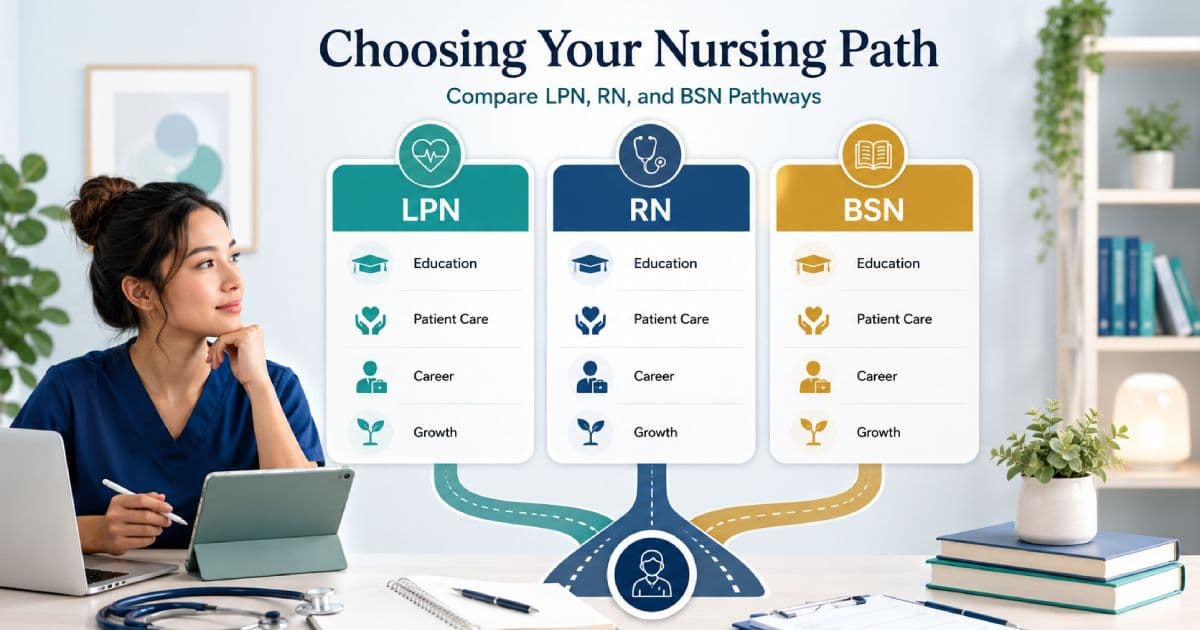
Choosing between LPN, RN with an ADN, and RN with a BSN is not just choosing a school. It is choosing how quickly you want to start working, what scope of practice you want, how much flexibility you need, and how far you want your nursing career to stretch later.
The good news: nursing has more than one starting line.
You can start as an LPN/LVN and bridge later. You can become an RN through an ADN program and complete a BSN while working. Or you can start with a BSN if you want the broadest path into hospitals, leadership, public health, and graduate nursing.
This guide compares the three common routes side by side so you can choose the path that fits your timeline, budget, family responsibilities, and long-term goals.
The biggest difference: license vs degree
Before comparing paths, separate the license from the degree.
License: what you are legally allowed to do
A nursing license gives legal authority to practise nursing within a state’s Nurse Practice Act and rules.
Common nursing licenses include:
- LPN/LVN: Licensed Practical Nurse or Licensed Vocational Nurse
- RN: Registered Nurse
California and Texas use LVN instead of LPN. The role is broadly similar, but scope of practice still depends on the state.
Degree or certificate: how you get there
Education paths include:
- Practical nursing certificate or diploma: Usually leads to NCLEX-PN and LPN/LVN licensure
- ADN or ASN: Associate Degree in Nursing; leads to NCLEX-RN and RN licensure
- BSN: Bachelor of Science in Nursing; leads to NCLEX-RN and RN licensure
- ABSN: Accelerated BSN for students who already hold a bachelor’s degree in another field
- Bridge programs: LPN-to-RN, LPN-to-BSN, RN-to-BSN, or ADN-to-BSN
NCSBN explains that a state’s Nurse Practice Act and rules govern nursing practice, including scope of practice, licensure qualifications, and nursing titles.
Source: NCSBN Nurse Practice Act Toolkit
LPN vs RN vs BSN: side-by-side comparison
| Factor | LPN / LVN | RN with ADN / ASN | RN with BSN |
|---|---|---|---|
| What it is | Nursing license after practical/vocational nursing program | RN license after associate nursing degree | RN license after bachelor’s nursing degree |
| Typical education | State-approved practical/vocational nursing program | Associate degree in nursing | Bachelor of Science in Nursing |
| Common timeline | About 1 year | About 2 to 3 years including prerequisites | About 4 years, or accelerated if you already have a bachelor’s |
| Licensure exam | NCLEX-PN | NCLEX-RN | NCLEX-RN |
| Scope | Foundational nursing care, usually under RN/provider direction | Full RN scope under state law | Same RN license, with broader BSN preparation |
| Common settings | Long-term care, clinics, home health, rehab, some hospitals | Hospitals, clinics, home health, outpatient, long-term care | Hospitals, academic medical centers, public health, leadership pathways, graduate school prep |
| 2024 U.S. median pay | $62,340 for LPN/LVN | $93,600 for RNs overall | $93,600 for RNs overall |
| Job outlook 2024-2034 | 3% growth | 5% RN growth | 5% RN growth |
| Best for | Fastest entry into paid nursing | Fast lower-cost route to RN | Broadest long-term mobility |
| Main limitation | Narrower scope and lower median pay than RN | May need BSN later for advancement or certain employers | Longer and often more expensive upfront |
Current salary and job outlook
The U.S. Bureau of Labor Statistics is the strongest baseline source for national nursing wage and outlook data.
| Occupation | 2024 median annual pay | 2024 median hourly pay | Projected growth, 2024-2034 | Average openings per year |
|---|---|---|---|---|
| Licensed practical and licensed vocational nurses | $62,340 | $29.97 | 3% | 54,400 |
| Registered nurses | $93,600 | $45.00 | 5% | 189,100 |
Sources:
LPN / LVN: fastest entry into nursing
An LPN or LVN provides basic medical care under the supervision or direction of RNs, advanced practice nurses, or physicians, depending on state law and setting.
BLS says LPNs and LVNs provide basic medical care, and that they typically complete a state-approved educational program that takes about one year before obtaining licensure.
Common LPN/LVN duties
LPN/LVN duties vary by state and employer, but may include:
- Taking vital signs
- Monitoring patient status
- Assisting with activities of daily living
- Changing dressings
- Collecting samples
- Documenting care
- Reinforcing patient teaching
- Reporting changes to the RN or provider
- Administering medications in some settings
- Starting IVs in some states with additional training
BLS notes that in some states, LPNs/LVNs can give medication or start IV drips, and that duties depend on state law.
Common LPN/LVN settings
LPNs/LVNs often work in:
- Nursing and residential care facilities
- Long-term care
- Skilled nursing facilities
- Rehabilitation
- Home health
- Physician offices
- Clinics
- Correctional health
- Hospice
- Some hospitals, depending on local market
BLS reports that the largest LPN/LVN employment settings include nursing and residential care facilities, hospitals, home healthcare services, physicians’ offices, and government.
Pros of becoming an LPN/LVN first
- Fastest route into nursing
- Often lower tuition than RN programs
- Good option if you need to start earning sooner
- Strong fit for long-term care, rehab, clinic, and home health
- Can help confirm whether nursing is right for you
- Bridge options may allow LPN-to-RN later
Cons of becoming an LPN/LVN first
- Narrower scope than RN
- Lower median pay than RN
- Fewer hospital opportunities in some markets
- May work under RN/provider direction
- May need a bridge program to expand career options
- Some specialty roles are limited to RNs
RN with ADN / ASN: fastest route to RN licensure
An ADN or ASN program prepares you to take the NCLEX-RN and become a registered nurse.
BLS says registered nurses usually take one of three education paths: bachelor’s degree, associate degree, or diploma from an approved nursing program. RNs must be licensed.
Common ADN-prepared RN duties
Once licensed, ADN-prepared RNs practise as registered nurses under the state Nurse Practice Act.
RN duties may include:
- Comprehensive assessment
- Care planning
- Medication administration
- IV therapy
- Patient and family education
- Wound care
- Clinical judgment and prioritization
- Coordination with providers
- Delegation to LPNs/LVNs and assistive personnel
- Monitoring and responding to changes in condition
- Discharge teaching
- Documentation
- Patient advocacy
BLS lists RN duties such as assessing patients, recording histories and symptoms, administering medicines and treatments, setting up or contributing to care plans, consulting with healthcare professionals, monitoring equipment, and teaching patients and families.
Common ADN settings
ADN-prepared RNs may work in:
- Hospitals
- Long-term care
- Home health
- Clinics
- Outpatient surgery
- Dialysis
- Corrections
- Behavioral health
- School nursing
- Public health, depending on role and employer
- Skilled nursing facilities
- Rehabilitation
Pros of the ADN route
- Usually faster than a traditional BSN
- Often less expensive than university-based BSN programs
- Leads to RN licensure eligibility when state-approved
- Good option for working adults
- Can complete RN-to-BSN later, often online
- May allow earning RN wages sooner
Cons of the ADN route
- Some hospitals prefer or require BSN-prepared nurses
- Leadership and specialty pathways may expect BSN
- Graduate nursing programs usually require a BSN or bridge pathway
- Some states or employers may require BSN completion after licensure
- You may need to return to school while working
RN with BSN: widest long-term runway
A BSN graduate takes the same NCLEX-RN as an ADN graduate and becomes licensed as an RN after meeting state requirements.
The difference is the educational depth and career runway.
BSN programs usually include additional coursework in areas such as:
- Leadership
- Evidence-based practice
- Research
- Community and public health
- Population health
- Quality improvement
- Health policy
- Informatics
- Care coordination
- Nursing theory
- Professional development
Common BSN-prepared RN settings
BSN-prepared RNs may work in all RN settings, including:
- Hospitals
- Academic medical centers
- Magnet or Magnet-aspiring facilities
- ICU, ED, OR, pediatrics, oncology, labor and delivery
- Public health
- Case management
- School nursing
- Military nursing
- Research support roles
- Nurse residency programs
- Leadership tracks
- Graduate nursing pathways
Pros of the BSN route
- Strongest general RN starting credential
- Often preferred by major hospitals and academic medical centers
- Better preparation for leadership and systems thinking
- Required or preferred for many RN-to-MSN, NP, CRNA, CNS, CNM, DNP, and educator pathways
- May improve competitiveness for new-grad residencies
- May avoid needing to return for RN-to-BSN later
AACN’s employer survey found that, based on responses from 643 schools of nursing, 25.0% of hospitals and healthcare settings required new hires to have a BSN, while 69.8% expressed a strong preference for BSN graduates.
Source: AACN New Graduate Employment Data
Cons of the BSN route
- Longer upfront timeline if you do not already have a degree
- Often higher upfront tuition
- Competitive admission
- More general education requirements
- Not always necessary for every first nursing job
- May not produce a higher starting wage in every market
ABSN: accelerated BSN for second-degree students
An accelerated BSN, or ABSN, is designed for students who already hold a non-nursing bachelor’s degree.
ABSN programs can be intense because they compress nursing coursework and clinicals into a shorter timeline. Many are full-time and make working difficult.
ABSN may fit if:
- You already have a bachelor’s degree
- You want RN licensure with a BSN
- You can handle a fast, demanding program
- You have prerequisite courses completed
- You can manage the cost and reduced work time
ABSN may not fit if:
- You need to work full-time
- You need a slower pace
- You have weak science prerequisites
- You do not have financial support or savings
- You need extensive academic support
LPN-to-RN, LPN-to-BSN, and RN-to-BSN bridge options
Bridge programs let nurses move up without starting over.
LPN-to-RN bridge
An LPN-to-RN bridge prepares LPNs/LVNs for RN licensure. Depending on the program, it may lead to an ADN/ASN or BSN.
Good for:
- LPNs who want broader scope
- LPNs seeking higher earning potential
- LPNs targeting hospital roles
- Nurses who need to keep working while advancing
LPN-to-BSN bridge
An LPN-to-BSN route may take longer than LPN-to-ADN, but it can lead directly to BSN-prepared RN status.
Good for:
- LPNs who already know they want BSN-level mobility
- Nurses targeting leadership or graduate school later
- Students who can commit to a longer program
RN-to-BSN
An RN-to-BSN program is for licensed RNs who already completed ADN, ASN, or diploma education and want the BSN.
Good for:
- ADN-prepared RNs in hospitals that prefer BSN
- RNs pursuing leadership
- RNs planning graduate school
- RNs in states or employers with BSN completion expectations
NCLEX-PN vs NCLEX-RN
The NCLEX is the licensure exam used by nursing regulatory bodies.
NCLEX-PN
The NCLEX-PN is for practical or vocational nurse licensure. It is the exam LPN/LVN candidates take after completing an approved practical nursing program.
NCLEX-RN
The NCLEX-RN is for registered nurse licensure. ADN, diploma, and BSN graduates take the NCLEX-RN if they are seeking RN licensure.
NCSBN says the NCLEX supports safe nursing licensure, and the NCLEX site explains that registration involves NCSBN, Pearson VUE, and the candidate’s nursing regulatory body.
Official sources:
Scope of practice: what can LPNs and RNs do?
Scope of practice is controlled by each state’s Nurse Practice Act and regulations. That means the exact line between LPN and RN duties can vary.
In general:
LPN/LVN scope often includes
- Basic nursing care
- Vital signs
- Basic wound care
- ADL support
- Medication administration depending on state and training
- Reporting patient changes
- Reinforcing education
- Working under RN/provider direction
RN scope often includes
- Comprehensive assessment
- Nursing diagnosis/care planning
- Patient education
- Complex medication administration
- IV therapy
- Clinical judgment and prioritization
- Delegation and supervision
- Coordination of care
- Evaluation of outcomes
- Responding to deterioration
- Leadership responsibilities depending on role
Use NCSBN’s Nurse Practice Act resources and your state board to verify specific rules.
Official sources:
Employer preferences: does BSN matter?
Yes, but not the same way everywhere.
For many first jobs, especially outside major academic hospitals, ADN-prepared RNs can still get hired. But a BSN can matter more in:
- Magnet or Magnet-aspiring hospitals
- Academic medical centers
- Nurse residency programs
- Public health
- Military nursing
- Case management
- Leadership tracks
- Specialty units
- Graduate school applications
AACN’s current new graduate employment page reports that 25.0% of hospitals and healthcare settings required a BSN for new hires, while 69.8% strongly preferred BSN graduates.
This does not mean every ADN graduate is blocked from hospital nursing. It means you should check your local market before choosing a program.
What is “BSN in 10”?
“BSN in 10” usually refers to New York’s law requiring certain registered nurses to earn a baccalaureate or higher degree in nursing within 10 years of initial licensure unless they meet exemption conditions.
New York State’s Office of the Professions says Chapter 502 of the Laws of 2017 amended Education Law section 6905 to require RNs to obtain a baccalaureate or higher degree in nursing within 10 years of licensure unless exempt, and that an amendment to the Commissioner’s Regulations took effect on April 29, 2026 to further define and clarify the requirements.
Official source:
Which path is fastest?
Fastest route to paid nursing:
- LPN/LVN
- ADN-to-RN
- BSN-to-RN
But fastest is not always best.
A faster program may be right if you need income soon. A longer program may be better if it reduces the need to return to school later.
Which path costs less?
Usually, the lowest-cost route is:
- Public LPN/LVN program or community college ADN
- Public university BSN
- Private university BSN or ABSN
But this depends heavily on state, scholarships, transfer credits, living costs, and whether you can work during the program.
Budget for:
- Tuition
- Fees
- Books
- Testing packages
- Uniforms
- Transportation
- Childcare
- Lost work hours
- Background checks
- Drug screens
- Immunizations
- NCLEX and licensure fees
- Bridge-program costs later
Which path has the best long-term career options?
Usually, BSN gives the widest long-term flexibility because it supports:
- Competitive hospital hiring
- Leadership pathways
- Public health roles
- Military nursing
- School nursing in some states
- Case management
- Graduate nursing
- APRN programs
- Nurse educator pathways
- Quality improvement
- Informatics and systems roles
However, an ADN-to-RN plus RN-to-BSN can reach the same BSN endpoint while allowing you to earn RN income sooner.
Choose-your-path guide
Choose LPN/LVN if:
- You want to start working sooner
- You need a shorter program
- You want to test whether nursing is right for you
- You are comfortable with a supervised scope
- You like long-term care, rehab, clinic, or home health settings
- You plan to bridge later
Choose ADN-to-RN if:
- You want RN licensure quickly
- You need a lower-cost path
- You can attend a strong community college or state college program
- Local hospitals hire ADN-prepared RNs
- You plan to complete RN-to-BSN later
- You want to earn RN income before finishing a bachelor’s degree
Choose BSN-to-RN if:
- You want maximum career mobility
- You can commit to a longer or more intensive program
- You want competitive hospital options
- You want leadership, public health, or graduate school later
- You already have a bachelor’s and can do an ABSN
- Your local market strongly prefers BSN-prepared nurses
Questions to ask before choosing a program
Ask every school:
- Is the program approved by the state board of nursing?
- Is the nursing program accredited by ACEN, CCNE, or another recognized nursing accreditor?
- What was the first-time NCLEX pass rate for the last three years?
- What is the graduation or completion rate?
- How many students start and finish?
- What are the clinical sites?
- Are clinical placements guaranteed?
- Can students work during the program?
- What is the total cost, including fees and supplies?
- Does the program support bridge pathways?
- Do local employers hire graduates?
- What support exists for students who struggle?
LPN vs RN vs BSN FAQ
Is an LPN the same as an RN?
No. LPNs/LVNs and RNs are different nursing licenses. LPNs/LVNs usually provide basic nursing care under RN or provider direction, while RNs have broader assessment, planning, education, delegation, and coordination responsibilities. Exact scope depends on state law.
Is an LVN the same as an LPN?
Generally, yes. California and Texas use the title LVN, while most other states use LPN. Scope still varies by state.
Is a BSN the same as an RN?
No. BSN is a degree. RN is a license. A BSN graduate must still pass the NCLEX-RN and meet state requirements to become licensed as an RN.
Do ADN and BSN graduates take the same NCLEX?
Yes. ADN and BSN graduates both take the NCLEX-RN if they are applying for registered nurse licensure.
Does a BSN nurse have a different license than an ADN nurse?
Usually no. Both hold an RN license. The BSN is an educational credential that may affect hiring, advancement, and graduate-school options.
Do BSN nurses make more than ADN nurses?
BLS does not separate ADN and BSN RN wages in its national RN wage figure. Some employers offer BSN differentials or higher advancement opportunities, but pay differences vary by location and employer.
Which is faster, LPN or RN?
LPN/LVN is usually faster, often about one year. ADN-to-RN is usually about two to three years including prerequisites. BSN is usually about four years unless you complete an accelerated second-degree BSN.
Can an LPN become an RN?
Yes. LPN-to-RN bridge programs allow LPNs/LVNs to advance to RN eligibility, usually through an ADN or BSN pathway.
Can an ADN nurse get a BSN later?
Yes. RN-to-BSN programs are designed for licensed RNs who completed ADN, ASN, or diploma programs.
Is ADN still worth it?
ADN can be worth it if it is state-approved, accredited, affordable, has strong NCLEX outcomes, and your local employers hire ADN-prepared RNs. It is strongest when paired with a clear RN-to-BSN plan.
Is BSN worth it?
BSN is worth it for many students because it offers the widest long-term mobility. It may help with hospital hiring, leadership, public health, military nursing, specialty roles, and graduate school.
Should I become an LPN before RN?
It depends. LPN first can be smart if you need to work sooner or want a stepwise path. If your goal is RN as quickly as possible and you can manage the cost and workload, ADN or BSN may be more direct.
What is the highest-paying path?
Nationally, RN has a higher BLS median wage than LPN/LVN. BSN may improve access to higher-paying specialties, leadership, or graduate pathways, but BLS does not publish separate ADN vs BSN national RN median wages.
What path is best for becoming a nurse practitioner?
A BSN is usually the cleanest route because most NP programs require a BSN or provide an RN-to-MSN bridge. If you start with ADN, plan your BSN or bridge pathway early.
What if I already have a bachelor’s degree?
Consider an accelerated BSN or entry-level master’s program. Compare cost, length, NCLEX outcomes, clinical placement, and whether you can work during the program.
What should I verify before enrolling?
Verify state board approval, programmatic nursing accreditation, institutional accreditation, NCLEX pass rates, clinical placements, total cost, and transfer or bridge options.
Final thoughts
There is no single right nursing path.
LPN/LVN is the fastest way to enter nursing. ADN is often the fastest and most affordable way to become an RN. BSN usually offers the widest long-term career runway.
The best choice depends on your money, time, family responsibilities, local job market, and future goals. Pick the path you can finish, verify the program carefully, and keep your next bridge option open.