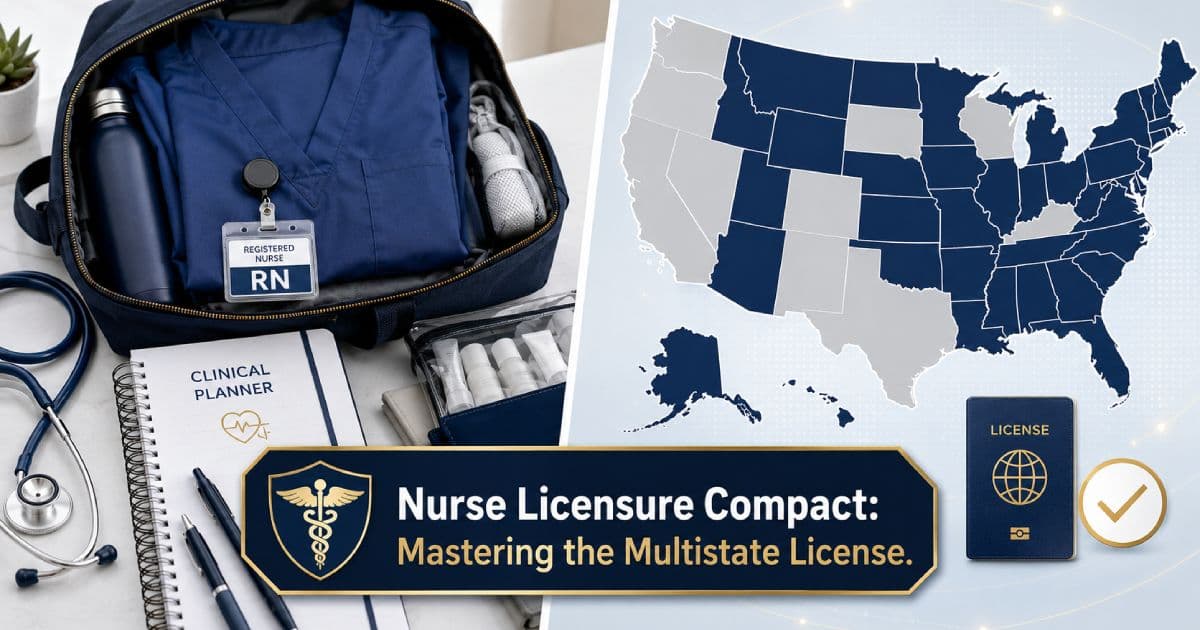
The Nurse Licensure Compact, or NLC, is one of the most important licensing rules for nurses who travel, move, commute across state lines, or provide telehealth.
It can make practice across participating states much easier.
It can also create serious confusion if you misunderstand the residency rules.
A compact license is not based on where you want to work.
It is based on where you legally live.
That one detail causes many mistakes.
What is the Nurse Licensure Compact?
The Nurse Licensure Compact is an interstate agreement that allows eligible nurses to practice across participating jurisdictions with one multistate license.
NCSBN describes the NLC as a compact that increases access to care by allowing nurses to practice in other NLC states without obtaining additional licenses.
The compact applies to:
- registered nurses
- licensed practical nurses
- licensed vocational nurses
It does not apply to:
- nurse practitioners
- clinical nurse specialists
- certified nurse-midwives
- certified registered nurse anesthetists
- other APRN licenses
Advanced practice licensure is handled separately.
The driver's license analogy
The simplest way to understand the NLC is the driver's license analogy.
If you live in Texas and hold a Texas driver's license, you can drive in Florida, North Carolina, Arizona, or other states without getting a separate license in each state.
The NLC works similarly.
If your primary state of residence is an NLC state and you hold a multistate license from that state, you may practice nursing in other NLC states under compact privilege.
But there is a key difference.
Nursing practice is regulated by state nurse practice acts.
When you practice in another compact state, you must follow that state's nursing laws and scope of practice rules.
License versus privilege to practice
A multistate license is issued by your home state.
Other compact states recognize your authority to practice through a compact privilege.
| Term | Meaning |
|---|---|
| Home state | The compact state that is your primary state of residence |
| Remote state | Another compact state where you practice using compact privilege |
| Multistate license | The license issued by your home state that authorizes practice in compact states |
| Privilege to practice | Legal authorization to practice in a remote compact state under your multistate license |
| Single-state license | A license valid only in the state that issued it |
Example:
Primary state of residence: North Carolina
License type: North Carolina multistate RN license
Assignment: Tennessee hospital
Practice authority: Tennessee compact privilege under North Carolina multistate license
Nursing law to follow while caring for Tennessee patients: Tennessee nurse practice rulesNurse Licensure Compact status in 2026
NLC status changes as states pass legislation and complete implementation.
As of this update, the official Nurse Compact site states that 43 jurisdictions are part of the NLC.
That does not mean every enacted jurisdiction is fully operational in the same way.
Implementation status matters.
2026 summary
The 43 enacted jurisdictions include 41 states plus Guam and the U.S. Virgin Islands.
However:
- some jurisdictions are fully implemented
- Guam has had partial implementation status
- Massachusetts has enacted the compact but remains listed with implementation to be determined
- the U.S. Virgin Islands has enacted the compact but remains listed with implementation to be determined
- states outside the NLC still require traditional single-state licensure
Fully implemented or operational examples
Major NLC jurisdictions include states such as:
- Alabama
- Arizona
- Arkansas
- Colorado
- Connecticut
- Delaware
- Florida
- Georgia
- Idaho
- Indiana
- Iowa
- Kansas
- Kentucky
- Louisiana
- Maine
- Maryland
- Mississippi
- Missouri
- Montana
- Nebraska
- New Hampshire
- New Jersey
- New Mexico
- North Carolina
- North Dakota
- Ohio
- Oklahoma
- Pennsylvania
- Rhode Island
- South Carolina
- South Dakota
- Tennessee
- Texas
- Utah
- Vermont
- Virginia
- Washington
- West Virginia
- Wisconsin
- Wyoming
This list can change. Always verify with the official NLC map and your board of nursing.
Important recent implementation updates
Connecticut
Connecticut fully implemented the Nurse Licensure Compact on October 1, 2025.
That means Connecticut is no longer only a pending/enacted state.
Pennsylvania
Pennsylvania fully implemented the Nurse Licensure Compact on July 7, 2025.
That means eligible Pennsylvania resident RNs and LPN/VNs can apply for multistate licenses, and nurses from other compact states may practice in Pennsylvania under compact privilege if they meet the rules.
Rhode Island
Rhode Island implemented the compact in January 2024.
Massachusetts
Massachusetts enacted the Nurse Licensure Compact, but the Massachusetts Board of Registration in Nursing has said compact implementation must be completed before out-of-state compact license holders are authorized to practice in Massachusetts under compact privilege.
Until full implementation is complete, nurses should not treat Massachusetts as open to compact practice.
Notable noncompact states and jurisdictions
As of this guide's update, several major jurisdictions remain outside active NLC participation.
These include:
- Alaska
- California
- District of Columbia
- Hawaii
- Illinois
- Michigan
- Minnesota
- Nevada
- New York
- Oregon
- some U.S. territories not fully participating
If your patient is located in a noncompact state, you usually need that state's license.
Primary State of Residence: the rule that controls everything
Primary State of Residence, or PSOR, is the foundation of compact licensure.
Your PSOR is your legal home state.
It is not necessarily:
- where you are currently working
- where you want to work
- where you own property
- where your travel assignment is located
- where your agency is based
- where you went to nursing school
- where your parents live
- where you spend a temporary contract
The NLC FAQ describes PSOR as the state where you hold documents such as a current driver's license, voter card, federal income tax return, military form no. 2058, or W-2 form.
Evidence of PSOR
Common evidence may include:
Driver's license
State-issued ID
Voter registration card
Federal income tax return
W-2 form
Military Form No. 2058
Your board of nursing may ask for proof at application or audit.
What property ownership does not do
Owning a home in a compact state does not automatically make that state your PSOR.
Example:
You live in California.
You own a rental property in Arizona.
You file taxes and vote in California.
Your driver's license is California.
Your PSOR is likely California, not Arizona.
Because California is not an NLC state, you cannot obtain a compact license based only on Arizona property ownership.
One nurse, one PSOR
You can only have one primary state of residence.
That matters because you can only hold one active multistate license.
PSOR outcome table
| Your legal PSOR | Your compact eligibility |
|---|---|
| Compact state | May be eligible for a multistate license if you meet all uniform licensure requirements |
| Noncompact state | Not eligible for a compact license based on that residence; may apply for single-state licenses where needed |
| Compact state but you do not meet ULRs | Not eligible for multistate status until requirements are met |
| Temporary assignment in another compact state | Does not change PSOR unless you permanently relocate |
Uniform licensure requirements for a multistate license
Living in a compact state is not enough.
To qualify for a multistate license, you must meet the uniform licensure requirements.
The NLC lists requirements that include:
- meeting home-state licensure requirements
- graduating from a board-approved program or qualifying international program
- passing NCLEX-RN, NCLEX-PN, or predecessor exam
- holding or being eligible for an active, unencumbered license
- submitting to state and federal fingerprint-based criminal background checks
- having no felony conviction under applicable state or federal law
- having no misdemeanor conviction related to nursing practice as determined case by case
- not currently participating in an alternative program
- self-disclosing current participation in an alternative program
- holding a valid U.S. Social Security number
- meeting English proficiency requirements when applicable
Why a nurse may receive only a single-state license
You may live in a compact state but still receive a single-state license if you do not meet all multistate requirements.
Examples:
- active discipline
- unresolved eligibility issue
- missing federal background check
- felony disqualifier
- current alternative-to-discipline participation
- no valid U.S. Social Security number
- PSOR not proven
A single-state license is still a nursing license, but it only authorizes practice in that state.
How to know whether you have single-state or multistate status
Do not guess.
Use Nursys QuickConfirm or your state board verification system.
Look for wording such as:
License type: RN
Status: Active
Compact status: Multistate
Privilege to practice: Listed states or map
Discipline: None / see history
If the license says single-state, you do not have compact privileges.
How to apply for a multistate license
The application goes through your state board of nursing.
There is no separate national compact license application at NCSBN.
Common application situations
You may apply for multistate status through:
- license by exam as a new graduate
- license by endorsement after moving
- renewal
- upgrading a single-state license to multistate
- international graduate licensure process if eligible
Basic application steps
1. Confirm your legal primary state of residence is an active NLC state.
2. Confirm you meet uniform licensure requirements.
3. Go to your home state's board of nursing website.
4. Choose the correct application: exam, endorsement, renewal, or upgrade.
5. Submit PSOR evidence if required.
6. Complete fingerprints/background check if required.
7. Pay board fees.
8. Watch for board messages.
9. Verify multistate status in Nursys after issuance.
New graduate example
You graduate from nursing school in Florida.
Your legal residence is Florida.
You apply to Florida for RN licensure by exam.
You pass NCLEX and meet all ULRs.
Florida issues a multistate RN license.
You may practice in other active compact states under compact privilege.
Existing license upgrade example
You hold an active single-state Tennessee RN license.
You legally reside in Tennessee.
You meet all ULRs.
You apply through the Tennessee board to upgrade to multistate status.
After approval, you verify multistate status in Nursys.
Noncompact resident example
You live in California.
You want to work in Texas.
California is not an NLC state.
You cannot get a compact license based on California residence.
You apply to Texas for a single-state Texas license by endorsement.
The 60-day moving rule
The 60-day rule is one of the most important NLC changes for nurses who relocate.
Effective January 2, 2024, a multistate licensee who changes primary state of residence from one compact state to another compact state must apply for a multistate license in the new primary state of residence within 60 days.
The 60-day clock begins when the nurse arrives in the new state with the intent of making it the new PSOR.
What the rule requires
You do not need the new license to be issued within 60 days.
You need to submit the application within 60 days.
Compact-to-compact move example
Old PSOR: Texas
Old license: Texas multistate RN license
New PSOR: North Carolina
Move type: Permanent relocation
Requirement: Apply for North Carolina multistate RN license within 60 days
Practice while application is processed: You may continue under the old multistate license if you applied on time and meet NLC rules
After new license is issued: Texas multistate license is no longer your compact license
Travel nurses and the 60-day rule
Temporary travel assignments usually do not change PSOR.
Example:
You live in Iowa.
You take a 13-week assignment in Tennessee.
You keep Iowa as your legal residence.
Your driver's license, taxes, and voter registration remain Iowa.
Your PSOR remains Iowa.
The 60-day moving rule does not usually apply because you did not permanently relocate.
If the temporary assignment becomes permanent and you change your legal residence, then the 60-day rule may apply.
Military spouse note
The NLC guidance notes that military families may be stationed in another state temporarily. A military spouse nurse may continue to practice under the multistate license from the nurse's PSOR when the family is temporarily stationed in another NLC state, depending on circumstances and rules.
Always check board guidance for military-specific options.
Moving scenarios nurses get wrong
Scenario 1: Compact state to compact state
You move permanently from Arizona to Colorado.
What to do:
Apply for a Colorado multistate license within 60 days of moving.
Provide proof of Colorado PSOR.
Continue practice under your former compact license only as allowed while the application is processed.
Verify the new license in Nursys.
Scenario 2: Compact state to noncompact state
You move permanently from Florida to California.
What happens:
California is not a compact state.
You are no longer eligible for a compact license based on Florida residence.
Your Florida multistate status does not authorize California practice.
You must apply for California RN licensure if you want to practice in California.
Depending on board rules, your former compact-state license may convert to single-state status or lose multistate privileges after PSOR changes.
Verify with the board.
Scenario 3: Noncompact state to compact state
You move permanently from New York to Texas.
What to do:
Apply to Texas by endorsement.
Establish Texas PSOR.
Provide proof of residence.
Meet ULRs.
Texas may issue a multistate license after requirements are met.
Scenario 4: Noncompact state resident working in compact state
You live in Oregon but want a travel assignment in Idaho.
Because Oregon is not an NLC state, you cannot hold a compact license based on Oregon residency.
You need an Idaho single-state license or another legal authorization recognized by Idaho.
Scenario 5: Compact license plus noncompact license
You live in Tennessee and hold a Tennessee multistate RN license.
You also want to practice in California.
You may keep your Tennessee multistate license and apply for a California single-state license.
Your compact license does not replace California licensure.
Scenario 6: Owning property in a compact state
You live in New York and own a vacation home in Florida.
Property ownership alone does not establish PSOR.
You are not eligible for a Florida compact license unless Florida becomes your legal primary residence and you meet ULRs.
Travel nursing and the NLC
The NLC is especially useful for travel nurses.
If you hold a multistate license from your compact PSOR, you may accept assignments in other active compact jurisdictions without applying for separate licenses in each compact state.
What compact travel nurses should verify
Before accepting an assignment, verify:
Your license is active.
Your license says multistate.
Your PSOR has not changed.
The assignment state is active in the NLC.
The facility accepts compact privilege.
You meet the state scope-of-practice rules.
You have required specialty certifications.
Compact license does not replace facility requirements
Even with a valid multistate license, a facility may require:
- BLS
- ACLS
- PALS
- TNCC
- specialty experience
- background check
- drug screen
- immunizations
- onboarding modules
- state-specific education
- competency checkoffs
The compact is about licensure, not job qualification.
Travel nurse PSOR warning
Travel nurses sometimes confuse tax home, temporary housing, and PSOR.
Do not rely on social media advice.
If your legal residence changes, your compact license may need to change.
If your travel tax home is complicated, speak with a qualified tax professional and verify licensure rules with the board.
Telehealth and compact nursing practice
Telehealth makes NLC rules especially important.
The NLC FAQ states nurses are required to be licensed in the state where the patient is located at the time service is provided.
A multistate license can cover patients located in compact states.
It does not automatically cover patients in noncompact states.
Telehealth example
Nurse location: North Carolina
License: North Carolina multistate RN license
Patient location: Virginia
Result: Compact privilege may authorize RN practice if all requirements are met.
Noncompact telehealth example
Nurse location: North Carolina
License: North Carolina multistate RN license
Patient location: California
Result: The nurse likely needs California RN licensure because California is not an NLC state.
Telehealth checklist
Before telehealth work, confirm:
Patient state:
Compact status of patient state:
Your multistate license status:
Whether RN scope covers the service:
Employer policy:
Documentation requirements:
State-specific mandatory reporting rules:
State law and scope of practice
A multistate license does not create one national nursing scope of practice.
Every state still has its own nurse practice act and board rules.
When you practice in a remote compact state, follow the remote state's laws.
Examples of state-specific issues
Rules may differ for:
- IV therapy
- LPN/LVN scope
- delegation
- medication administration
- pronouncement of death
- school nursing
- correctional nursing
- telehealth
- documentation
- mandatory reporting
- continuing education
- supervision requirements
Practical rule
Before practicing in a new state, read:
Board of nursing scope guidance
Nurse practice act
Facility policy
Employer onboarding materials
Compact guidanceHow to verify compact status in Nursys
Nursys is the national nurse license verification database.
NCSBN describes Nursys as the only national database for nurse license verification, discipline information, and practice privileges for RNs, LPN/VNs, and APRNs licensed in participating jurisdictions.
Use Nursys QuickConfirm when you need to know:
- whether a license is active
- whether it is single-state or multistate
- whether there is discipline
- what practice privileges are shown
- whether the license record has history
Quick verification steps
1. Go to Nursys.com.
2. Use QuickConfirm License Verification.
3. Search by name, license number, or NCSBN ID.
4. Confirm license type and status.
5. Look for multistate status.
6. Review practice privilege information.
7. Save documentation if your employer requires it.
When to verify
Verify before:
- accepting a travel assignment
- starting telehealth
- relocating
- onboarding with a new employer
- renewing your license
- changing PSOR
- assuming a compact privilege applies
Compact license versus endorsement
Licensure by endorsement means applying for a license in another jurisdiction based on your existing license.
The NLC can reduce the need for endorsement in active compact states if you hold a multistate license.
But endorsement is still needed in many situations.
You may still need endorsement if:
- your PSOR is noncompact
- the patient state is noncompact
- you move to a new state and need that state's license
- you hold only a single-state license
- the NLC has been enacted but not implemented in the state
- your role is APRN practice
- your compact license is not active or is encumbered
Example
You live in Minnesota.
You hold a Minnesota RN license.
Minnesota is not an NLC state.
You want to work in Wisconsin.
You must apply to Wisconsin by endorsement for a Wisconsin license.
Students and new graduates
Nursing students should understand the compact before applying for first licensure.
Your first license application should generally be in the state where you intend to legally reside or practice.
The NCLEX can be taken at a testing location convenient to you, but results are sent to the board where you applied for authorization and licensure.
New grad examples
You live in a compact state
You live in Ohio.
You graduate from nursing school.
You apply to Ohio for RN licensure by exam.
You meet ULRs and pass NCLEX.
Ohio issues a multistate license.
You live in a noncompact state
You live in New York.
You graduate from nursing school.
You apply to New York for RN licensure by exam.
New York issues a single-state license if you meet requirements.
If you want to work in another state, apply by endorsement there.
You went to school in one state but will live in another
You attended nursing school in Missouri.
Your legal residence after graduation will be North Carolina.
You should contact the North Carolina board about licensure by exam and requirements.
For NCLEX preparation, see NurseZee's NCLEX prep guide and NCLEX anxiety guide.
What employers should check
Employers should verify compact authority, not just accept a copy of a license card.
Employer checklist
License active:
Single-state or multistate:
PSOR appropriate:
State of patient care:
Privilege to practice valid:
Discipline check:
Expiration date:
Specialty certifications:
Role-specific state scope:
Common employer mistake
Mistake:
Hiring a nurse with a compact license from a former PSOR after the nurse permanently moved and failed to apply in the new PSOR.Better:
Ask relocating nurses whether they have changed PSOR and whether they submitted the required application within 60 days.APRN Compact: separate from the NLC
The standard Nurse Licensure Compact applies only to RNs and LPN/LVNs.
It does not cover APRN practice.
If you are a nurse practitioner, CRNA, CNM, or clinical nurse specialist, you still need to check APRN licensure rules state by state.
APRN Compact status
The APRN Compact is a separate agreement.
The APRN Compact site describes it as an agreement that would allow APRNs to practice in multiple participating states with a single license.
However, it is not yet broadly operational like the RN/LPN NLC.
The APRN Compact requires a threshold of states to enact legislation before it becomes operational. NCSBN materials have described the seven-state threshold, and recent state information indicates five states have enacted the APRN Compact: Delaware, North Dakota, South Dakota, Utah, and Wyoming.
Because the APRN Compact is not yet operational, APRNs generally still need individual APRN licensure in each state of APRN practice.
APRN warning
Do not assume your RN multistate license authorizes nurse practitioner practice in another state.
Example:
You hold a Texas multistate RN license.
You are also licensed as an NP in Texas.
You want to provide NP telehealth to a patient in Florida.
The RN compact license does not automatically authorize Florida APRN practice.
Check Florida APRN licensure, scope, prescribing, collaborative agreement, and telehealth rules.
Common NLC myths
Myth 1: I can get a compact license from any compact state
No.
You can only obtain a multistate license from your primary state of residence if that state is in the NLC and you meet all ULRs.
Myth 2: Owning property creates PSOR
No.
Property ownership alone does not establish primary state of residence.
Myth 3: Travel nursing changes PSOR automatically
No.
Temporary travel assignments generally do not change PSOR.
Myth 4: I can hold multiple compact licenses
No.
You can only hold one active multistate license at a time.
Myth 5: A compact license covers every U.S. state
No.
It covers active compact jurisdictions.
Noncompact states still require separate licensure.
Myth 6: Compact privilege means the same scope everywhere
No.
You must follow the nurse practice act where the patient is located.
Myth 7: The compact applies to APRNs
No.
The NLC applies to RN and LPN/LVN licenses only.
NLC audit checklist for nurses
Use this before moving, traveling, or starting telehealth.
My legal primary state of residence:
Is my PSOR an NLC state?:
Do I have proof of PSOR?:
My license state:
License type:
Single-state or multistate:
Nursys verified date:
Any discipline or restrictions?:
Patient/work state:
Is patient/work state active in NLC?:
Is this RN/LPN/LVN practice or APRN practice?:
Do I need endorsement?:
Have I moved permanently?:
If compact-to-compact move, have I applied within 60 days?:
Do I understand the remote state's nurse practice act?:
Employer verified license?:
Moving checklist
Use this when you relocate.
Before moving
Identify old PSOR:
Identify new PSOR:
Check whether both states are NLC states:
Review new board application:
Gather driver's license/state ID plan:
Gather voter registration/tax/W-2 documentation:
Ask board about temporary license if needed:
Notify employer/recruiter:
Verify current Nursys status:
After moving
Determine date you arrived with intent to make the new state PSOR:
Start 60-day clock if compact-to-compact:
Submit new license application:
Upload PSOR evidence:
Complete background check/fingerprints if required:
Monitor board messages:
Verify new license in Nursys:
Keep records:
Compact state categories for 2026 planning
Use these categories rather than a static memorized list.
Category 1: Active NLC state
The state is implemented and participates in compact practice.
Examples include Texas, Florida, Ohio, North Carolina, Arizona, Washington, Pennsylvania, Connecticut, Rhode Island, Georgia, and many others.
Category 2: Enacted but not fully implemented
The jurisdiction has enacted the compact but is not fully operational for compact practice.
Examples include Massachusetts and the U.S. Virgin Islands based on the official map/status information available at this update.
Category 3: Partial implementation
A jurisdiction may accept compact privileges before issuing multistate licenses to its own residents.
Guam has appeared in this category on official NLC materials.
Category 4: Noncompact
The jurisdiction is not active in the compact.
Examples include California, Oregon, New York, Nevada, Alaska, Hawaii, Illinois, Michigan, Minnesota, and the District of Columbia at this update.
Frequently asked questions about the Nurse Licensure Compact
What is the Nurse Licensure Compact?
The Nurse Licensure Compact is an agreement among participating jurisdictions that allows eligible RNs and LPN/LVNs to hold one multistate license from their primary state of residence and practice in other compact jurisdictions under compact privilege.
Is a compact license the same as a multistate license?
Yes. The terms compact license and multistate license are commonly used interchangeably.
Who can get a multistate nursing license?
You must legally reside in a compact state, meet that state's licensure requirements, and meet the uniform licensure requirements for multistate status.
Can I get a compact license if I live in California?
No. If your primary state of residence is California, you are not eligible for a compact license based on that residence. You may apply for single-state licenses in states where you want to practice.
Can I get a compact license if I live in New York?
No. New York is not an NLC state. New York residents cannot obtain a compact license unless they permanently establish legal residence in an NLC state and meet that state's requirements.
Does a travel assignment change my primary state of residence?
Usually no. Temporary travel assignments do not automatically change PSOR. Your legal residence is based on documents such as driver's license, voter registration, federal tax return, W-2, or military residency form.
What is the 60-day moving rule?
When a multistate licensee permanently moves from one compact state to another compact state and changes PSOR, the nurse must apply for a multistate license in the new PSOR within 60 days.
Does the new compact license have to be issued within 60 days?
No. Official NLC guidance says the application must be submitted within 60 days. The new license does not have to be issued within that 60-day window.
Can I keep my old compact license until it expires after moving?
No. If you permanently changed PSOR, the old multistate license is no longer tied to your current legal residence. The expiration date does not override the PSOR requirement.
Can I hold two compact licenses at the same time?
No. You can hold only one active multistate license at a time, issued by your primary state of residence.
Can I hold a compact license and a noncompact license?
Yes. For example, you may hold a multistate Texas RN license and a single-state California RN license if you meet each state's requirements.
Does the NLC apply to LPNs and LVNs?
Yes. The NLC applies to RNs and LPN/VNs.
Does the NLC apply to nurse practitioners?
No. The NLC applies to RN and LPN/LVN licenses only. APRNs need separate APRN licensure unless and until an APRN Compact becomes operational and applies.
What is the APRN Compact status?
The APRN Compact is separate from the NLC. It is intended to allow APRNs to practice across participating states with one multistate APRN license, but it is not yet broadly operational. APRNs should maintain state-specific licensure for each state of APRN practice.
How do I verify my compact license?
Use Nursys QuickConfirm or your board of nursing's license verification system. Look for active status and multistate status.
Can I practice telehealth across state lines with a compact license?
If the patient is located in an active compact jurisdiction and you hold a valid multistate license, compact privilege may authorize RN or LPN/LVN practice. If the patient is in a noncompact state, you usually need that state's license.
Which state's nursing laws apply when I practice under compact privilege?
The laws of the state where the patient is located apply. You must follow the remote state's nurse practice act, scope, delegation, documentation, and reporting requirements.
Is Massachusetts a compact nursing state?
Massachusetts has enacted the NLC but is still in implementation according to state guidance. Out-of-state compact license holders should not assume they can practice in Massachusetts under compact privilege until implementation is complete.
Is Pennsylvania fully compact now?
Yes. Pennsylvania fully implemented the Nurse Licensure Compact on July 7, 2025.
Is Connecticut fully compact now?
Yes. Connecticut fully implemented the Nurse Licensure Compact on October 1, 2025.
Can a noncompact resident hold multiple single-state licenses?
Yes. NLC FAQ guidance says residents of noncompact states may hold as many single-state licenses as required to practice.
Does a multistate license replace employer credentialing?
No. Employers may still require background checks, onboarding, certifications, health records, competencies, and specialty experience.
Final thoughts
The Nurse Licensure Compact can be a powerful tool for nurses.
It supports travel nursing, telehealth, military mobility, border-state employment, disaster response, and faster workforce access.
But the compact only works when nurses follow the rules.
Remember the essentials:
Your multistate license comes from your primary state of residence.
Your PSOR must be a compact state.
You must meet uniform licensure requirements.
You can only hold one multistate license at a time.
You follow the laws where the patient is located.
You must apply within 60 days after a permanent compact-to-compact move.
The NLC does not cover APRN practice.
Nursys is the safest verification tool.
Do not rely on a recruiter, coworker, social media thread, or old screenshot.
Verify.
Then practice.
Sources and references
- Nurse Compact: Official NLC home
- Nurse Compact: How It Works
- Nurse Compact: Applying for Licensure
- Nurse Compact: FAQs
- Nurse Compact: Official NLC Map PDF
- Nurse Compact: 60-Day Residency Rule PDF
- NCSBN: Licensure Compacts
- NCSBN: Interstate Commission adopts new residency rule
- NCSBN: Pennsylvania fully implements NLC July 7, 2025
- NCSBN: Connecticut fully implements NLC October 1, 2025
- Massachusetts Board of Registration in Nursing: NLC implementation
- Nursys
- NCSBN: License Verification
- APRN Compact: Official home
- APRN Compact: About
- NCSBN: South Dakota enacts APRN Compact
- Wyoming State Board of Nursing: APRN Compact
- NurseZee: How to Become an RN
- NurseZee: RN Salary by State
- NurseZee: First Nursing Job After Graduation
- NurseZee: Nurse Residency Programs
- NurseZee: NCLEX Prep
- NurseZee: NCLEX Anxiety
- NurseZee Practice Questions