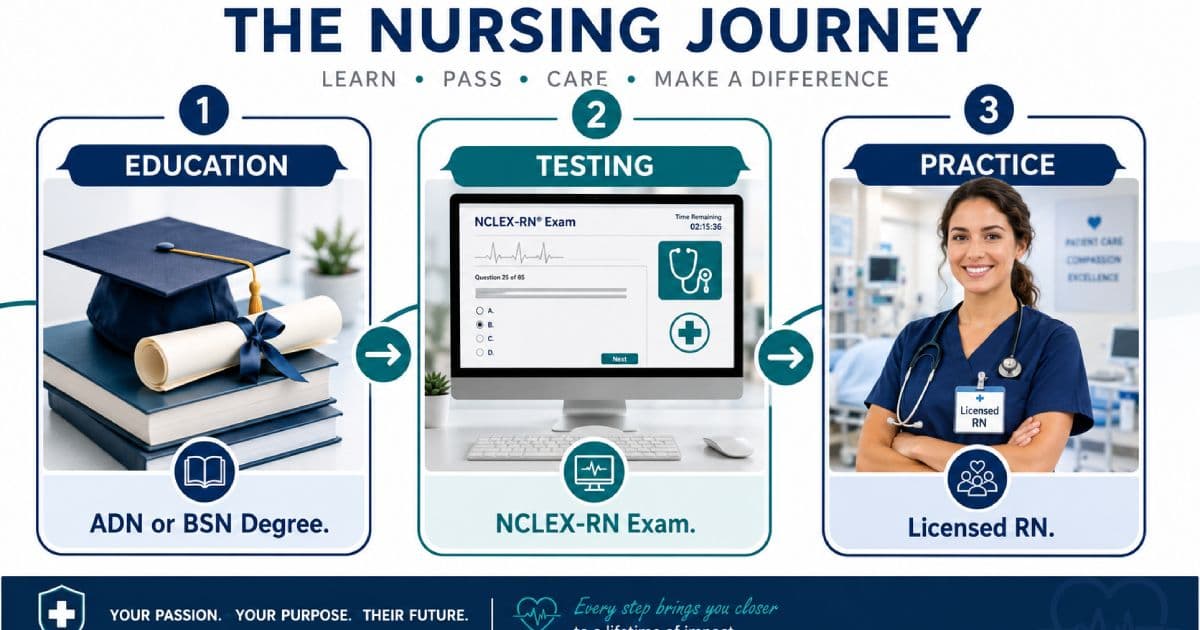
Becoming a registered nurse takes more than finishing nursing school.
You need three things:
- An approved nursing education.
- A passing NCLEX-RN result.
- A nursing license from the state or jurisdiction where you are authorized to practice.
That order matters.
Nursing school prepares you.
The NCLEX-RN tests whether you can practice safely as an entry-level RN.
The board of nursing gives you legal authority to practice.
This guide walks through the process from first prerequisite to first RN job.
What does an RN do?
A registered nurse provides patient care, education, assessment, medication administration, care coordination, clinical monitoring, and patient advocacy.
RNs work in many settings, including:
- Hospitals
- Clinics
- Emergency departments
- ICUs
- Operating rooms
- Labor and delivery units
- Pediatrics
- Oncology
- Behavioral health
- Long-term care
- Home health
- Hospice
- Public health
- Schools
- Correctional health
- Dialysis centers
- Telehealth
- Case management
- Insurance and utilization review
- Research
- Informatics
- Leadership
The RN role is broad.
That is one reason nursing attracts students from many backgrounds.
RN career outlook
The Bureau of Labor Statistics lists registered nurses as licensed professionals and reported a May 2024 median annual wage of $93,600. BLS also projected RN employment to grow 5% from 2024 to 2034, with about 189,100 openings per year on average over that period.
That does not mean every new grad starts at the median.
Your pay depends on:
- State
- City
- Employer
- Specialty
- Shift
- Experience
- Union status
- Overtime
- Differentials
- Benefits
- Cost of living
For salary comparisons, see NurseZee's RN salary by state guide.
Step 1: Understand what “RN” means
RN stands for registered nurse.
It is a licensed role.
You can become eligible for RN licensure through different education pathways, but the license is the same legal category: registered nurse.
An ADN-prepared RN and a BSN-prepared RN both take the NCLEX-RN and both can hold an RN license.
The difference is the degree, not the license name.
RN versus LPN/LVN
An RN is different from a licensed practical nurse or licensed vocational nurse.
LPN/LVN programs are usually shorter and lead to the NCLEX-PN.
RN programs lead to the NCLEX-RN.
RNs generally have a broader scope of practice, more responsibility for assessment and care planning, and more pathways into specialty, leadership, and graduate roles.
If you are already an LPN, review NurseZee's LPN to RN programs guide.
RN versus CNA
A certified nursing assistant is not a nurse.
CNAs provide essential direct care and help with activities of daily living, vital signs, mobility, and patient support under supervision.
CNA experience can be valuable before nursing school, but it does not replace RN education.
RN versus NP
A nurse practitioner is an advanced practice registered nurse.
To become an NP, you first become an RN, then complete graduate-level nursing education and state-specific APRN requirements.
Step 2: Choose your RN education pathway
There is more than one way to become an RN.
The right path depends on your timeline, budget, prior education, GPA, work schedule, and career goals.
RN pathway comparison
| Pathway | Best for | Typical length | Leads to NCLEX-RN? | Main caution |
|---|---|---|---|---|
| ADN | Cost-conscious students, community college students, working adults | Often 2 years of nursing coursework after prerequisites | Yes, if approved | Some employers may prefer BSN or require BSN completion later |
| BSN | First-time college students, students seeking hospital flexibility | Usually about 4 years total | Yes, if approved | Higher cost and longer timeline |
| Accelerated BSN | Career changers with a non-nursing bachelor's degree | Often about 12-18 months after prerequisites | Yes, if approved | Very intense; limited ability to work |
| Direct-entry MSN or graduate-entry route | Non-nurses with a bachelor's degree who want graduate-level entry | Often 2-3 years, varies widely | Usually yes after prelicensure portion, if approved | Expensive and complex; verify licensure point and credential |
| LPN-to-RN bridge | Current LPNs/LVNs | Varies | Yes, if approved | Requires active LPN/LVN status and bridge prerequisites |
| RN-to-BSN | Current RNs with ADN/diploma | Often 9-24 months | No, already licensed RN | Not a prelicensure route |
Associate Degree in Nursing
An Associate Degree in Nursing is a common route to RN licensure.
ADN programs are often offered by community colleges.
They can be a strong option if you want:
- Lower tuition
- A local program
- A faster path to RN licensure
- Smaller initial debt
- A plan to complete BSN later while working
ADN advantages
ADN programs may offer:
- Lower cost
- Community college access
- Strong local clinical relationships
- A path into RN work sooner
- Good fit for working adults
ADN cautions
Ask about:
- Waitlists
- Competitive admission
- Clinical placement
- NCLEX pass rates
- Graduation rates
- Employer BSN expectations
- RN-to-BSN transfer agreements
Some major hospital systems hire ADN graduates but expect BSN completion within a certain timeframe.
Bachelor of Science in Nursing
A BSN is a four-year nursing degree.
Traditional BSN programs usually include general education, prerequisites, nursing theory, clinicals, research, leadership, public health, and evidence-based practice.
A BSN may be a strong fit if you want:
- Broader hospital hiring flexibility
- Leadership options later
- Public health exposure
- Research and evidence-based practice coursework
- Graduate school preparation
- Specialty options later
BSN advantages
BSN programs may offer:
- More leadership and population health content
- More direct route to MSN, DNP, CRNA, NP, or educator paths
- Stronger fit for some hospital employers
- Traditional college experience
- More time for clinical maturity
BSN cautions
Ask about:
- Total cost
- Direct admission versus pre-nursing
- Progression requirements
- Clinical locations
- NCLEX trend
- Retention
- Scholarship support
Accelerated BSN
An accelerated BSN is designed for students who already have a non-nursing bachelor's degree.
It is usually full time and fast.
AACN describes accelerated baccalaureate programs as a quick route to RN licensure for adults who already completed a bachelor's or graduate degree in another field.
ABSN may fit if you
- Already have a bachelor's degree
- Can study full time
- Can manage a fast pace
- Have completed prerequisites
- Can limit work hours
- Want a BSN rather than an ADN
ABSN cautions
ABSN programs can be intense.
Before applying, ask:
Can students work during the program?
How many hours per week are classes, clinicals, simulation, and studying?
What is the program completion rate?
What is the NCLEX-RN pass rate?
What is the total cost?
Are clinical sites guaranteed?
For a deeper comparison, see NurseZee's accelerated BSN programs guide.
Direct-entry MSN or graduate-entry nursing
Direct-entry MSN programs are for students who have a non-nursing bachelor's degree and want to enter nursing through a graduate pathway.
These programs vary a lot.
Some are called:
- Direct-entry MSN
- Master's entry program in nursing
- Entry-level MSN
- Graduate-entry nursing
- Master's entry to nursing practice
The key question is when the program makes you eligible for RN licensure.
Direct-entry questions to ask
At what point am I eligible for the NCLEX-RN?
What degree or credential do I earn before licensure?
Does the program prepare me for RN licensure only, or also advanced practice?
Is the program approved by the state board for prelicensure RN education?
What is the total cost?
What is the NCLEX-RN pass rate for the prelicensure cohort?
Read NurseZee's direct-entry MSN programs guide before choosing this route.
Step 3: Check approval and accreditation
This is one of the most important steps.
Do it before you apply.
Board approval
A nursing program must be approved or otherwise accepted by the board of nursing in the state where it operates for graduates to be eligible for licensure.
Do not rely only on marketing language.
Check the board of nursing approved program list.
Verify:
School name:
Campus:
Program type:
ADN, BSN, diploma, ABSN, or graduate-entry:
Approval status:
Current admissions status:
Any warnings, probation, or conditions:
National nursing accreditation
National nursing accreditation is separate from board approval.
Common nursing accreditors include:
- ACEN
- CCNE
ACEN accredits multiple levels of nursing education, including practical, diploma, associate, baccalaureate, master's, and doctoral nursing programs.
CCNE accredits baccalaureate and graduate nursing programs.
Why accreditation matters
Accreditation can affect:
- Graduate school eligibility
- Credit transfer
- Employer preference
- Federal aid eligibility depending on school structure
- Long-term mobility
- Program quality review
Red flags
Be careful if a program:
- Will not show current board approval
- Has repeated low NCLEX pass rates
- Has unclear clinical placements
- Has high pressure admissions tactics
- Is very expensive with weak outcomes
- Has unclear accreditation
- Says you can complete prelicensure nursing entirely online without approved clinicals
- Cannot explain licensure eligibility
Step 4: Complete nursing school prerequisites
Most RN programs require prerequisites before you begin core nursing courses.
Exact requirements vary by school and pathway.
Common prerequisites include:
- Anatomy and physiology I with lab
- Anatomy and physiology II with lab
- Microbiology with lab
- General chemistry with lab
- English composition
- Statistics or college algebra
- Lifespan development
- Psychology
- Sociology
- Nutrition
- Speech or communication
- Medical terminology, in some programs
For a full planning guide, see NurseZee's nursing school prerequisites guide.
Science prerequisites matter most
Science grades carry heavy weight.
A strong science GPA shows that you can handle the academic foundation for nursing.
Core science courses connect directly to:
- Pathophysiology
- Pharmacology
- Lab interpretation
- Fluids and electrolytes
- Infection control
- Clinical judgment
- Patient education
GPA requirements
GPA requirements vary.
Some programs have a minimum GPA around 2.5 or 3.0.
Competitive programs may admit students with much higher averages.
Do not confuse minimum GPA with competitive GPA.
If your GPA is low, read NurseZee's how to get into nursing school with a low GPA guide.
Prerequisite timing
Some schools allow you to apply with prerequisites in progress.
Others require all prerequisites complete before application.
Ask:
Can I apply with prerequisites in progress?
How many can be in progress?
What grade is required?
Do science courses expire?
How are repeated courses counted?
Is online lab accepted?
Step 5: Take entrance exams if required
Some RN programs require an entrance exam.
The two common exams are:
- ATI TEAS
- HESI A2
Not every program requires one.
Do not study for the wrong exam.
TEAS
The ATI TEAS tests reading, math, science, and English/language usage.
It has a fixed official structure.
Schools choose their own score expectations.
HESI A2
HESI A2 is modular.
Schools choose which sections they require.
A program may require math, reading, vocabulary, grammar, anatomy and physiology, biology, chemistry, or other modules.
Entrance exam checklist
Ask each program:
Do you require TEAS or HESI A2?
What version or testing vendor?
What sections are required?
What minimum score is required?
What score is competitive?
How many attempts are allowed?
How long must I wait between attempts?
How long are scores valid?
Do you use highest score or most recent score?
For a full comparison, see NurseZee's TEAS vs HESI guide.
Step 6: Apply to nursing school
Nursing school applications can take months.
Build your timeline early.
Common application materials
You may need:
- Official transcripts from every college attended
- Prerequisite grades
- GPA calculation
- Entrance exam score
- Personal statement
- Resume
- Letters of recommendation
- Healthcare experience documentation
- Background check consent
- Immunization records
- CPR/BLS certification
- Interview
- Application fee
Application timeline
A realistic timeline:
12-18 months before start:
Research programs and prerequisites.

9-12 months before start:
Finish core sciences or register for final prerequisites.

6-9 months before start:
Take TEAS or HESI if required.

4-6 months before start:
Request transcripts, recommendations, and complete essays.

2-4 months before start:
Submit applications, interviews, and supplemental forms.

After acceptance:
Complete health records, background checks, drug screens, CPR/BLS, uniforms, and onboarding.
Apply broadly
Do not apply to only one program if admission is competitive.
Build a balanced list:
- Reach programs
- Target programs
- Safer programs
- ADN backup
- BSN option
- Accelerated option if eligible
Choose by outcomes, not only name
Ask each program for:
NCLEX-RN pass rate:
Number of first-time test takers:
Graduation rate:
Program completion rate:
Job placement:
Clinical partners:
Total cost:
Accreditation:
Board approval:
Student support:
Step 7: Complete nursing school
Once admitted, you begin nursing coursework and clinical training.
This is where the pace changes.
Common nursing courses
RN programs often include:
- Fundamentals of nursing
- Health assessment
- Pharmacology
- Pathophysiology
- Medical-surgical nursing
- Maternal-newborn nursing
- Pediatrics
- Psychiatric-mental health nursing
- Community/public health nursing
- Leadership and management
- Evidence-based practice
- Nursing ethics
- Simulation
- Clinical practicum or capstone
Clinical rotations
Clinical rotations give supervised patient care experience.
Common settings include:
- Medical-surgical units
- Long-term care
- Pediatrics
- Labor and delivery
- Postpartum
- Psychiatric units
- Community health
- ICU observation or practicum
- Emergency department observation or practicum
- Operating room observation, depending on program
- Outpatient clinics
- Home health or hospice
- Rehabilitation
Your program and clinical partners determine what you see.
Not every student gets every specialty.
Simulation
High-fidelity simulation helps students practice:
- Code response
- Medication safety
- Patient deterioration
- Communication
- SBAR handoff
- Delegation
- Clinical judgment
- Prioritization
- Teamwork
Simulation does not replace all clinical learning, but it can prepare students for high-risk events in a controlled environment.
Nursing school survival skills
You need more than memorization.
Build habits for:
- Active recall
- Practice questions
- Concept maps
- Lab interpretation
- Clinical prep
- Medication safety
- Time management
- Professional communication
- Documentation
- Asking for help early
For clinical tools, review NurseZee's nursing report sheet template, nursing progress notes guide, and nursing diagnosis guide.
Step 8: Prepare for the NCLEX-RN
The NCLEX-RN is the national licensing exam for registered nurses.
It is developed by the National Council of State Boards of Nursing and used by boards of nursing to help determine whether candidates are ready for entry-level practice.
The current 2026 NCLEX-RN test plan took effect April 1, 2026.
What the NCLEX-RN tests
The NCLEX-RN tests entry-level nursing safety and clinical judgment.
It is organized around client needs.
The major categories include:
- Safe and Effective Care Environment
- Health Promotion and Maintenance
- Psychosocial Integrity
- Physiological Integrity
The exam includes clinical judgment content.
That means you must do more than memorize facts.
You need to:
- Recognize cues
- Analyze cues
- Prioritize hypotheses
- Generate solutions
- Take action
- Evaluate outcomes
NCLEX format
The 2026 NCLEX Candidate Bulletin states that the NCLEX-RN and NCLEX-PN are variable-length computerized adaptive tests.
The exam can be anywhere from 85 to 150 items.
The time limit is five hours, including introductory screens and breaks.
NCLEX question types
You may see:
- Multiple choice
- Multiple response
- Matrix
- Bow-tie
- Trend
- Drop-down
- Highlighting
- Ordered response
- Case studies
- Medication calculation
- Lab interpretation
- Prioritization
- Delegation
- Safety questions
For study help, use NurseZee's NCLEX prep guide, NCLEX prioritization guide, NCLEX delegation guide, and practice questions.
NCLEX study plan
A common study timeline is 6 to 10 weeks after graduation.
Some students need less.
Some need more.
Use your readiness scores and school performance to decide.
8-week NCLEX study timeline
Week 1:
Take a diagnostic exam.
Review test plan.
Build study calendar.

Week 2:
Safety, prioritization, delegation, infection control.

Week 3:
Adult med-surg: cardiac, respiratory, neuro.

Week 4:
Fluids, electrolytes, renal, endocrine, GI.

Week 5:
Pharmacology, labs, medication safety.

Week 6:
Maternity, pediatrics, psych, community health.

Week 7:
Mixed question sets, NGN case studies, weak topics.

Week 8:
Readiness exams, light review, sleep, logistics.
How to study correctly
Do:
- Practice questions daily
- Review rationales carefully
- Track missed topics
- Study labs and medications in context
- Practice NGN case studies
- Use spaced repetition
- Build test-taking endurance
- Remediate weak categories
Do not:
- Read textbooks passively for hours
- Memorize random facts without questions
- Ignore rationales for correct answers
- Avoid weak areas
- Reschedule repeatedly out of fear
- Study with too many resources at once
Step 9: Apply for RN licensure by examination
You do not register for the NCLEX in isolation.
You apply for licensure through your nursing regulatory body and register for the NCLEX through Pearson VUE.
The exact order can vary by state, but both steps are required.
NCSBN explains that candidates interact with three entities during NCLEX registration:
- The nursing regulatory body
- Pearson VUE
- NCSBN
What your board of nursing reviews
Your board may review:
- Education completion
- Official transcript
- Criminal background check
- Fingerprints
- Application fee
- Identity documents
- Name match
- Social Security number or other required identifiers, depending on state
- Disciplinary history
- Legal history questions
- English proficiency or credential review for international graduates
- State-specific coursework or training
State rules vary
Every state regulates nursing practice.
Do not assume your friend's process in another state is the same as yours.
Use NCSBN's nurse licensure guidance tool and your state board website.
Common state requirements
Many states require:
- Board-approved nursing education
- NCLEX registration
- Fingerprinting
- Criminal background check
- Official school verification
- Application fee
- Professional conduct questions
- Disclosure of legal or disciplinary history
- Continuing education after licensure
Step 10: Register for the NCLEX-RN
After or while applying to your board, you register with Pearson VUE for the NCLEX.
The NCLEX registration page explains that after the nursing regulatory body declares a candidate eligible and the candidate has registered through Pearson, the candidate receives an Authorization to Test email.
You need that ATT to schedule the exam.
NCLEX registration checklist
Graduation complete or near complete:
State board application submitted:
Fees paid:
School verification requested:
Background check/fingerprints completed:
Pearson VUE NCLEX registration completed:
Email checked regularly:
ATT received:
Exam scheduled within ATT validity dates:
ID checked for exact name match:
Authorization to Test
Your ATT is your permission to schedule the NCLEX.
It includes a validity period.
The average ATT length is around 90 days, but the issuing nursing regulatory body sets the exact validity.
You must test within the dates on your ATT.
Name match matters
Your ID must match your registration name.
If your name is wrong, fix it before test day.
Do not wait until you are at the testing center.
Test-day basics
Before test day:
- Review the Candidate Bulletin
- Confirm testing center location
- Check ID requirements
- Know arrival time
- Avoid bringing prohibited items
- Sleep
- Eat
- Plan transportation
- Do not cram all night
Step 11: Take and pass the NCLEX-RN
The NCLEX is computerized and adaptive.
The number of questions does not tell you whether you passed.
You can pass or fail at different question counts.
Focus on safe answers.
What to do during the exam
Use this approach:
- Read the stem carefully.
- Identify the patient problem.
- Look for safety words.
- Use ABCs when relevant.
- Use Maslow only when appropriate.
- Prioritize unstable patients.
- Avoid delaying care when the client is in danger.
- Choose assessment when data are incomplete and the patient is stable.
- Choose intervention when the patient has immediate risk.
- Do not change answers without a reason.
After the exam
Results are released by your nursing regulatory body, not the testing center.
Some candidates may have access to quick results depending on jurisdiction and service availability, but those are not official licensure.
Your board determines licensure status.
If you do not pass
Failing the NCLEX is painful.
It is not the end.
NCSBN's retake policy allows candidates to retake the NCLEX 45 days after administration, though some nursing regulatory bodies may require a longer wait.
You will need to follow your board's retake process and reregister with Pearson VUE.
Use the Candidate Performance Report to target weak areas.
Retake plan
Week 1:
Read Candidate Performance Report.
Choose one structured resource.
Make a new plan.

Weeks 2-3:
Remediate weak content categories.
Practice daily questions.

Weeks 4-5:
Add NGN case studies and mixed question sets.
Track patterns.

Week 6:
Readiness exam.
Adjust test date only if readiness data are weak.Step 12: Receive your RN license
Passing NCLEX is not always the final administrative step.
Your state board still processes your application.
You may need to:
- Wait for results to post
- Submit final transcript
- Clear background check
- Answer board follow-up questions
- Complete state-specific training
- Pay remaining fees
- Verify license status online
Do not start practicing as an RN until you are authorized to do so.
Temporary permits
Some states offer graduate nurse permits or temporary permits.
Rules vary.
Some permits end when NCLEX results are issued.
Some are not available at all.
Do not assume.
Check your state board.
License verification
After licensure, verify:
License number:
Issue date:
Expiration date:
Single-state or multistate status:
Legal name:
Disciplinary status:
Renewal requirements:
Continuing education requirements:
Step 13: Understand the Nurse Licensure Compact
The Nurse Licensure Compact allows eligible nurses who hold a multistate license in their primary state of residence to practice in other compact states, physically or electronically, without obtaining additional single-state licenses.
NCSBN describes the NLC as a way for nurses to practice seamlessly in other NLC states while maintaining standards and communication among member states.
Compact license basics
A multistate license depends on:
- Your primary state of legal residence
- Whether that state participates in the NLC
- Whether you meet uniform licensure requirements
- Your board's approval
- Your license status
Single-state license
If you live in a non-compact state, your license is typically single-state.
If you want to practice in another state, you may need endorsement.
Moving states
If you move, compact rules can change.
Your primary state of residence matters.
Before moving, check:
- Current state board
- New state board
- NCSBN NLC rules
- Employer requirements
- Telehealth location rules
Telehealth warning
Nursing practice is usually tied to where the patient is located.
If you provide telehealth across state lines, do not assume your home license is enough.
Check compact and state-specific rules.
Step 14: Apply for your first RN job
You can start applying before your license is fully issued in many markets, especially if employers hire graduate nurses or make offers contingent on passing NCLEX.
But policies vary.
New grad RN options
Common first roles include:
- Nurse residency program
- Medical-surgical nurse
- Telemetry nurse
- Stepdown nurse
- ICU nurse
- ED nurse
- Labor and delivery nurse
- Pediatric nurse
- Behavioral health nurse
- Oncology nurse
- Long-term care RN
- Rehab nurse
- Operating room nurse
- Dialysis nurse
- Clinic nurse
- Home health nurse
Nurse residency programs
Nurse residency programs help new graduates transition from student to independent nurse.
They often include:
- Extended orientation
- Preceptor support
- Classroom sessions
- Skills development
- Evidence-based practice projects
- Peer support
- Professional development
Read NurseZee's nurse residency programs guide and how to get your first nursing job after graduation guide.
First job timeline
6 months before graduation:
Research nurse residency deadlines.

3-4 months before graduation:
Build resume and request recommendations.

Final semester:
Apply to new grad positions.

After graduation:
Submit licensure application and register for NCLEX.

After NCLEX:
Update employers with license status.

First 3-12 months:
Focus on safe practice, feedback, and growth.
First RN resume sections
Include:
- Name and contact
- Licensure status
- Education
- Clinical rotations
- Senior practicum/preceptorship
- Certifications
- Healthcare experience
- Skills
- Volunteer or leadership experience
Use NurseZee's new grad nurse resume guide for examples.
Step 15: Maintain your RN license
Licensure does not end after you receive the first license.
You must maintain it.
Common renewal requirements
States may require:
- Renewal every 1-2 years
- Continuing education
- Practice hours
- Fees
- Address updates
- Name updates
- Mandatory reporting training
- Child abuse or infection control training in some states
- Opioid or pain management education in some states
Requirements vary by board.
Keep records
Save:
- CE certificates
- Renewal confirmations
- License verification
- CPR/BLS cards
- Specialty certifications
- Employment history
- Name change documents
- Board correspondence
Do not miss renewal
An expired license can affect your job and ability to practice.
Set reminders months before renewal.
ADN vs BSN: which should you choose?
Both ADN and BSN can lead to RN licensure if the program is approved.
The better option depends on your life.
Choose ADN if
- You need lower cost
- You want a local community college route
- You need to work while in school
- You want to become licensed sooner
- You plan to complete BSN later
- Your nearby ADN program has strong NCLEX outcomes
Choose BSN if
- You want broader hospital hiring flexibility
- You plan to pursue graduate nursing later
- You want leadership, research, and public health coursework
- You have scholarship support
- You want the traditional college route
- Your target employers prefer BSN-prepared nurses
ADN-to-BSN plan
A common path:
Community college ADN
→ NCLEX-RN
→ RN job
→ Employer tuition reimbursement
→ RN-to-BSN
→ Specialty certification or graduate school later
This can be a smart financial route.
Read NurseZee's RN to BSN programs guide.
How long does it take to become an RN?
It depends on your starting point.
Typical timelines
| Starting point | Common path | Approximate timeline |
|---|---|---|
| High school graduate | Traditional BSN | About 4 years |
| High school graduate | ADN plus prerequisites | Often 2-3 years, depending on prerequisites and admission |
| Some college credits | ADN or BSN transfer | Varies |
| Non-nursing bachelor's degree | ABSN | Often 12-18 months after prerequisites |
| Non-nursing bachelor's degree | Direct-entry MSN | Often 2-3 years, varies |
| Current LPN/LVN | LPN-to-RN bridge | Varies by program |
| Current ADN RN | RN-to-BSN | Often 9-24 months |
What can delay the process
Delays often happen because of:
- Missing prerequisites
- Low GPA
- Entrance exam retakes
- Waitlists
- Limited clinical seats
- Failed or repeated courses
- Background check issues
- Immunization delays
- Late transcripts
- NCLEX scheduling delays
- ATT expiration
- State board processing time
How much does it cost to become an RN?
Cost varies widely.
A community college ADN can be much less expensive than a private BSN or direct-entry MSN.
But sticker price is not the full cost.
Cost worksheet
Prerequisites:
Entrance exam:
Application fees:
Tuition:
School fees:
Nursing program fees:
Books:
Online resources:
Uniforms:
Shoes:
Stethoscope:
Supplies:
Background check:
Drug screen:
Immunizations:
CPR/BLS:
Clinical travel:
Parking:
Housing:
Lost work income:
NCLEX fee:
Licensure application:
Fingerprinting:
Loan interest:
Total estimated cost:
Cost-saving strategies
Consider:
- Community college prerequisites
- Public in-state programs
- ADN first, RN-to-BSN later
- Employer tuition reimbursement
- Scholarships
- Grants
- HRSA Nurse Corps programs
- State workforce grants
- Hospital work-study or CNA employment
- Avoiding repeated courses
- Applying only to programs you can realistically attend
Common mistakes when becoming an RN
Mistake 1: Choosing a program before checking approval
Always check board approval first.
Mistake 2: Ignoring total cost
Tuition is only one line item.
Mistake 3: Assuming BSN is always required
You can become an RN through ADN, BSN, or other approved prelicensure pathways.
Employer preferences vary.
Mistake 4: Assuming ADN is always easier
Some ADN programs are extremely competitive because they are affordable.
Mistake 5: Waiting too long to study for NCLEX
NCLEX prep should begin during school.
Mistake 6: Applying to only one nursing program
Apply strategically.
Mistake 7: Not checking state licensure rules
Each state has its own rules.
Mistake 8: Assuming compact status
Always verify whether your license is single-state or multistate.
Mistake 9: Missing nurse residency deadlines
Many new grad programs open applications months before graduation.
Mistake 10: Thinking the first job must be the dream specialty
A supportive first role matters more than a flashy unit name.
Example RN pathways
Example 1: High school graduate choosing BSN
Year 1:
General education and prerequisites.

Year 2:
A&P, microbiology, statistics, nursing admission.

Years 3-4:
Nursing courses, clinicals, simulation.

After graduation:
Apply for licensure, register for NCLEX, pass NCLEX, start nurse residency.
Example 2: Community college ADN route
Year 1:
Prerequisites and nursing application.

Years 2-3:
ADN nursing coursework and clinicals.

After graduation:
NCLEX-RN and RN license.

After employment:
RN-to-BSN with employer tuition support.
Example 3: Career changer with bachelor's degree
Months 1-6:
Complete prerequisites and entrance exam.

Months 7-24:
Accelerated BSN or direct-entry prelicensure program.

After graduation:
Licensure application, NCLEX-RN, new grad RN role.
Example 4: LPN-to-RN route
Step 1:
Complete practical nursing program.

Step 2:
Pass NCLEX-PN and work as LPN.

Step 3:
Apply to LPN-to-RN bridge.

Step 4:
Complete RN coursework, pass NCLEX-RN, obtain RN license.
Quick checklist: how to become an RN
Choose RN pathway:
Check board approval:
Check accreditation:
Complete prerequisites:
Take TEAS/HESI if required:
Apply to nursing school:
Complete clinical requirements:
Graduate from RN program:
Apply to board of nursing:
Register with Pearson VUE:
Complete fingerprints/background check:
Receive ATT:
Schedule NCLEX-RN:
Pass NCLEX-RN:
Verify RN license:
Apply to new grad RN jobs:
Maintain license and CE:
Frequently asked questions about becoming an RN
How do I become an RN?
Complete a board-approved RN education program, apply for licensure through your state board of nursing, register for and pass the NCLEX-RN, meet state-specific requirements, and receive RN licensure.
How long does it take to become an RN?
It can take about 2-3 years through an ADN route, about 4 years through a traditional BSN, around 12-18 months for some accelerated BSN programs after a prior bachelor's degree, or longer depending on prerequisites, waitlists, and state processing.
What is the fastest way to become an RN?
For many students, the fastest route is an ADN or accelerated BSN, depending on prior education and program availability. Fastest is not always best. Choose an approved program with strong NCLEX outcomes and manageable cost.
Is ADN enough to become an RN?
Yes, if the ADN program is approved and you meet licensure requirements. ADN graduates take the NCLEX-RN and can become licensed RNs. Some employers may prefer or require BSN completion later.
Is BSN better than ADN?
A BSN may offer more long-term flexibility for hospital roles, leadership, public health, and graduate school. An ADN may be more affordable and faster. The best choice depends on your budget, location, and goals.
Can I become an RN without a BSN?
Yes. ADN and diploma pathways can lead to RN licensure if approved and if you pass the NCLEX-RN and meet state requirements.
Can I become an RN online?
Prelicensure RN programs require clinical training. Some coursework may be online or hybrid, but you cannot become an RN through online classes alone without approved in-person clinical experiences.
What prerequisites do I need for nursing school?
Common prerequisites include anatomy and physiology, microbiology, chemistry, English, statistics, psychology, lifespan development, sociology, and nutrition. Requirements vary by school.
Do I need CNA experience before nursing school?
Usually no. CNA experience is not always required, but it can strengthen your application and help you understand bedside care before nursing school.
What is the NCLEX-RN?
The NCLEX-RN is the national licensure exam used by nursing regulatory bodies to help determine whether a candidate is ready for entry-level RN practice.
How many questions are on the NCLEX-RN?
The 2026 NCLEX Candidate Bulletin states that the NCLEX-RN can be anywhere from 85 to 150 items, with a five-hour time limit including introductory screens and breaks.
Can I take the NCLEX before I graduate?
No. Your nursing regulatory body must declare you eligible. That usually requires graduation and school verification before you receive Authorization to Test.
What happens if I fail the NCLEX?
You can retake the NCLEX after the required waiting period. NCSBN's retake policy allows retesting 45 days after exam administration, but some boards may require longer waits or additional steps.
What is the Nurse Licensure Compact?
The NLC allows eligible nurses with a multistate license in their primary state of residence to practice in other compact states without obtaining separate licenses. Not all states participate.
Do all RNs need continuing education?
Most states require continuing education or other renewal requirements, but rules vary by board. Check your state board before renewal.
How much do RNs make?
BLS reported a May 2024 median annual wage of $93,600 for registered nurses. Pay varies by state, employer, specialty, shift, experience, and cost of living.
Should I apply to nurse residency programs?
Yes, if available. Nurse residency programs can help new graduates transition into practice with preceptor support, structured education, and peer support.
Can I work while in nursing school?
Some students work part time. Full-time work can be difficult during clinical-heavy semesters. Ask current students in your exact program what is realistic.
What should I check before choosing a nursing school?
Check board approval, accreditation, NCLEX pass rates, graduation rate, total cost, clinical placements, support services, admission requirements, and whether the schedule fits your life.
Final thoughts
Becoming an RN is a step-by-step process.
Choose the right pathway.
Verify the program.
Complete prerequisites.
Graduate from an approved RN program.
Apply to your board.
Register for the NCLEX-RN.
Pass the exam.
Receive your license.
Then start building the kind of nursing career you want.
The process can feel overwhelming at first.
Break it down.
One step at a time.
That is how you get from future nurse to licensed RN.
Sources and references
- NCSBN: Nurse Licensure Guidance
- NCSBN: Licensure
- NCSBN: 2026 NCLEX-RN Test Plan
- NCLEX: Test Plans
- NCLEX: Register
- NCLEX: 2026 Candidate Bulletin
- NCLEX: Results and Retake Policy
- NCSBN: Nurse Licensure Compact
- AACN: Nursing Education Pathways
- AACN: Accelerated Nursing Programs
- ACEN: Accreditation
- CCNE: Accredited Programs
- BLS: Registered Nurses Occupational Outlook Handbook
- BLS: Occupational Employment and Wage Statistics Tables
- NurseZee: Nursing School Prerequisites
- NurseZee: How to Get Into Nursing School With a Low GPA
- NurseZee: TEAS vs HESI
- NurseZee: Accelerated BSN Programs
- NurseZee: Direct-Entry MSN Programs
- NurseZee: LPN to RN Programs
- NurseZee: RN to BSN Programs
- NurseZee: Nurse Residency Programs
- NurseZee: First Nursing Job After Graduation
- NurseZee: New Grad Nurse Resume
- NurseZee: NCLEX Prep
- NurseZee: NCLEX Prioritization Questions
- NurseZee: NCLEX Delegation Questions
- NurseZee Practice Questions