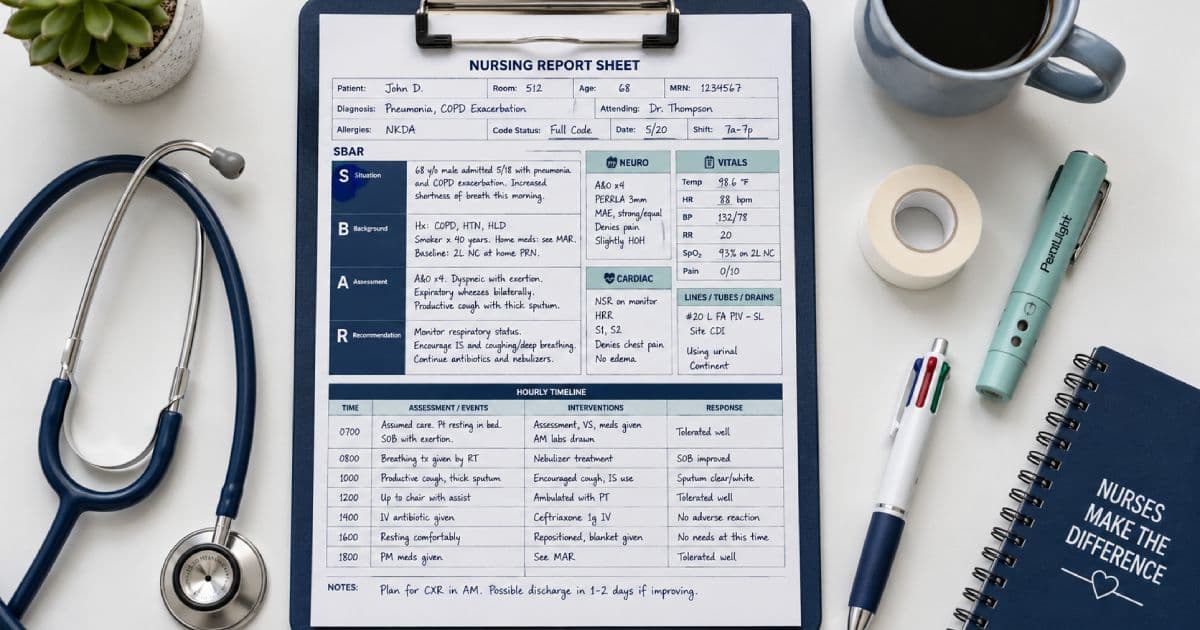
A nursing shift can fall apart fast if you do not have a system.
You may start with four, five, or six patients.
Then one patient goes to CT.
One needs blood.
One family wants an update.
One IV infiltrates.
One provider rounds early.
One patient is trying to climb out of bed.
Your report sheet is the tool that helps you keep the shift in front of you.
Nurses call it a report sheet, brain sheet, nurse brain, handoff sheet, or shift worksheet.
The name does not matter.
The purpose does.
A good nursing report sheet helps you:
- Receive report without missing key details
- Prioritize safety checks
- Track meds, labs, tests, and tasks
- Notice changes in patient condition
- Give a clean handoff at the end of shift
- Avoid relying on memory during a busy day
What is a nursing report sheet?
A nursing report sheet is a personal worksheet nurses use during a shift.
It helps organize patient information, scheduled tasks, safety risks, assessment findings, and changes that need to be passed to the next nurse.
It is usually not part of the permanent medical record.
It is usually not meant to be taken home.
It should be handled like protected health information.
Common names for a report sheet
You may hear nurses call it:
- Report sheet
- Brain sheet
- Nurse brain
- Shift sheet
- Handoff sheet
- Patient worksheet
- Rounds sheet
- Task sheet
- SBAR sheet
New nurses often think there is one perfect template.
There is not.
The best template is the one that fits your unit, patient load, and brain.
Why nurses still use report sheets in the EHR era
Even with a strong electronic health record, nurses still need a fast working tool.
The EHR is the official chart.
Your report sheet is your shift command center.
It helps you quickly see:
Who is unstable?
Who has meds due?
Who needs labs?
Who has a procedure?
Who is a fall risk?
Who needs pain reassessment?
Who needs discharge teaching?
What must be passed to the next nurse?Why report sheets improve shift organization
A good report sheet reduces mental clutter.
It does not make the shift easy.
It makes the shift visible.
It protects working memory
Nurses carry too many details to remember everything.
A report sheet offloads details so your mind can focus on clinical judgment.
It supports safer handoff
Handoff is a known patient-safety risk point.
Structured communication helps the sending and receiving nurse share the right information in the right order.
SBAR is one common framework.
AHRQ defines SBAR as Situation, Background, Assessment, and Recommendation or Request. It gives teams a structured way to communicate patient information clearly.
It helps you prioritize
A report sheet lets you compare patients quickly.
Example:
Room 401:
K+ 2.9, furosemide due, telemetry PVCs

Room 402:
Pain 7/10, oral pain med available

Room 403:
Discharge paperwork pending

Room 404:
Stable, waiting for PT
Your first priority is not the discharge paperwork.
Your first priority is the patient with a dangerous potassium and cardiac rhythm concern.
It helps you give better end-of-shift report
The end-of-shift report should not be a random story.
It should answer:
- Why is the patient here?
- What is the current status?
- What changed this shift?
- What needs follow-up?
- What is unsafe to miss?
A structured report sheet helps you give that clearly.
What to include on a nursing report sheet
Keep it useful.
Do not turn it into a second chart.
Patient identifiers
Use the minimum information needed for your workflow and facility policy.
Common elements:
- Room number
- Bed number
- Patient initials
- Age
- Sex if clinically relevant
- Attending provider or service
- Admission date
- Hospital day or post-op day
Avoid writing more identifiers than you need.
Safety flags
This section should be easy to see.
Include:
- Code status
- Allergies
- Isolation precautions
- Fall risk
- Aspiration risk
- Seizure precautions
- Bleeding precautions
- Neutropenic precautions
- Elopement risk
- Suicide precautions
- Restraints
- DNR/DNI status if applicable
- Blood refusal or special consent issues if relevant
Admission and diagnosis
Write the reason the patient is here in plain clinical language.
Examples:
CHF exacerbation with SOB and edema
Pneumonia, IV antibiotics, O2 at 2 L NC
Post-op day 1 right total knee
DKA, insulin drip discontinued overnight
GI bleed, trending Hgb, possible EGD
Do not write only abbreviations if they will confuse you later.
Relevant history
Keep this short.
Write history that affects nursing care today.
Examples:
- CHF
- COPD
- CKD
- Diabetes
- Stroke history
- Seizures
- Dementia
- A-fib
- Anticoagulant use
- Falls
- Pressure injuries
- Dialysis
- Substance use disorder if relevant to care
- Major surgeries
- Baseline mobility or cognition
Current assessment snapshot
You do not need to rewrite a full head-to-toe note.
You need the baseline and changes.
Include quick sections for:
- Neuro
- Cardiac
- Respiratory
- GI
- GU
- Skin
- Wounds
- Mobility
- Pain
- IV access
- Tubes and drains
- Diet
- Activity
- Precautions
Medications
You do not need to copy every medication.
Focus on:
- Scheduled med pass times
- IV antibiotics
- Insulin
- Anticoagulants
- Pain meds
- High-alert meds
- PRNs you may need
- Drips
- New meds
- Held meds
- Meds requiring labs or vital signs
Examples:
0900: metoprolol, lisinopril, furosemide
AC/HS: blood glucose + insulin scale
1300: vancomycin trough before dose
PRN: oxycodone q4h, last 0615
Heparin drip: next anti-Xa 1200
Labs
Track labs that change decisions.
Examples:
- Potassium
- Sodium
- Creatinine
- BUN
- Glucose
- Hemoglobin and hematocrit
- Platelets
- WBC
- INR
- aPTT or anti-Xa
- Troponin
- Lactate
- BNP
- ABGs
- Cultures
- Drug levels
- Magnesium
- Calcium
For lab interpretation practice, use NurseZee’s NCLEX lab values cheat sheet.
Diagnostics and procedures
Include anything that affects timing, transport, diet, meds, or safety.
Examples:
- CT
- MRI
- X-ray
- Echo
- Ultrasound
- Stress test
- Dialysis
- Surgery
- EGD/colonoscopy
- IR procedure
- Blood transfusion
- Wound care
- PT/OT
- Speech evaluation
- Discharge planning
- Case management consult
Provider communication
Leave space for:
- Who you called
- Time
- Reason
- New orders
- Follow-up needed
Example:
1045: Notified Dr. Lee K+ 2.9 + PVCs. New order KCl PO + repeat BMP 1600.Then document official provider notification in the EHR according to facility policy.
Shift timeline
This is the part that keeps the day organized.
Make an hour-by-hour grid.
For a 12-hour day shift:
0700:
0800:
0900:
1000:
1100:
1200:
1300:
1400:
1500:
1600:
1700:
1800:
1900:
For each hour, add:
- Meds
- Vitals
- Glucose checks
- Lab draws
- Reassessments
- Turns
- Dressing changes
- Drains
- Procedures
- Calls
- Discharge steps
- Patient teaching
- Documentation
Simple nursing report sheet template
Use this as a basic med-surg or clinical rotation template.
ROOM/BED:
INITIALS:
AGE:
CODE STATUS:
ALLERGIES:
ISOLATION/PRECAUTIONS:
FALL RISK:
ADMIT DX:
PMH:
PROVIDER/SERVICE:

SITUATION:
Current reason for admission/status:

BACKGROUND:
Pertinent history, surgery/procedure, hospital day/post-op day:

ASSESSMENT:
Neuro:
Cardiac:
Resp:
GI:
GU:
Skin/Wounds:
Pain:
Mobility:
Diet:
IV access/fluids:
Tubes/drains:
Labs to watch:

RECOMMENDATION / PLAN:
Pending tests:
Consults:
Discharge plan:
Needs follow-up:
Provider concerns:

MEDS / HIGH-RISK MEDS:
0900:
1200:
1400:
1700:
PRN:
Drips:

TASK TIMELINE:
0700:
0800:
0900:
1000:
1100:
1200:
1300:
1400:
1500:
1600:
1700:
1800:

SHIFT EVENTS / NOTES:
Time:
Time:
Time:

HANDOFF PRIORITIES:
1.
2.
3.Med-surg report sheet template
Med-surg nurses often carry several patients.
The best sheet is usually compact.
What med-surg nurses need most
Med-surg report sheets should emphasize:
- Diagnosis
- Code status
- Allergies
- Isolation
- Mobility
- Diet
- IV access
- Wounds
- Drains
- Oxygen
- Blood glucose
- Scheduled meds
- PRNs
- Pending tests
- Discharge barriers
- Safety risks
Med-surg 4-patient mini-template
PATIENT 1
Rm:
Initials:
Code:
Allergies:
Dx:
PMH:
Neuro:
Resp/O2:
Cardiac:
GI/GU:
Skin/wounds:
Mobility:
Diet:
IV:
Meds/PRNs:
Labs:
Tests/plan:
Safety:
To-do:

PATIENT 2
Rm:
Initials:
Code:
Allergies:
Dx:
PMH:
Neuro:
Resp/O2:
Cardiac:
GI/GU:
Skin/wounds:
Mobility:
Diet:
IV:
Meds/PRNs:
Labs:
Tests/plan:
Safety:
To-do:

PATIENT 3
Rm:
Initials:
Code:
Allergies:
Dx:
PMH:
Neuro:
Resp/O2:
Cardiac:
GI/GU:
Skin/wounds:
Mobility:
Diet:
IV:
Meds/PRNs:
Labs:
Tests/plan:
Safety:
To-do:

PATIENT 4
Rm:
Initials:
Code:
Allergies:
Dx:
PMH:
Neuro:
Resp/O2:
Cardiac:
GI/GU:
Skin/wounds:
Mobility:
Diet:
IV:
Meds/PRNs:
Labs:
Tests/plan:
Safety:
To-do:
Med-surg quick example
Rm 412 | J.S. | 68M | Full code | NKDA | Fall risk
Dx: CHF exacerbation
PMH: CHF, HTN, DM2, CKD3
Neuro: A&O x4
Resp: 2 L NC, crackles bases
Cardiac: NSR, BLE edema +2
GI/GU: low sodium diet, voids urinal
Skin: intact, sacral foam prevention
Mobility: 1 assist walker
IV: 20g L FA, saline lock
Meds: 0900 furosemide/lisinopril/metoprolol; AC/HS insulin
Labs: K+ 3.3, Cr 1.5, BNP high
Tasks: daily weight, I&O, recheck BMP 1500, CHF teaching
Handoff: monitor K+, response to diuresis, discharge likely tomorrow
Telemetry report sheet template
Telemetry nurses need rhythm and cardiac trends front and center.
Add these sections
- Rhythm
- Rate
- Telemetry changes
- Chest pain
- Troponins
- Electrolytes
- Potassium and magnesium
- Anticoagulants
- Cardiac meds
- Pacemaker/ICD
- Oxygen
- Activity tolerance
- Procedure plan
Telemetry template
ROOM:
INITIALS:
CODE:
ALLERGIES:
DX:
CARDIAC HISTORY:

RHYTHM:
Rate:
Ectopy:
Pacemaker/ICD:
Chest pain:
Troponins:
K:
Mg:
Anticoag:
Cardiac meds:

RESP:
O2:
Breath sounds:
SOB:

NEURO:
GI/GU:
SKIN:
MOBILITY:
IV:
DIET:
PLAN:
TASKS:
HANDOFF:
Telemetry example
Rm 506 | L.M. | 74F | Full code | Allergy: penicillin
Dx: A-fib with RVR, now rate controlled
Rhythm: A-fib 80s-90s
Cardiac: on diltiazem PO, apixaban started
Labs: K 4.0, Mg 1.9, troponin negative x2
Resp: RA, denies SOB
Mobility: standby assist
Plan: echo today, cardiology following
Tasks: monitor HR/BP, fall/bleed precautions, echo pickup pending
Handoff: new anticoag teaching started; reinforce bleeding precautions
ICU report sheet template
ICU nurses usually need one or two patients per sheet.
The sheet must support detail.
ICU sections to add
- Airway
- Ventilator settings
- Drips
- Sedation
- RASS/CPOT
- Pressors
- Lines
- Tubes
- Drains
- Neuro checks
- Hemodynamics
- I&O
- Labs and ABGs
- Restraints
- Family contacts
- Goals for the day
ICU template
PATIENT:
ROOM:
CODE:
ALLERGIES:
ADMIT DX:
ICU DAY:
PMH:

AIRWAY/VENT:
ETT/trach:
Mode:
FiO2:
PEEP:
Rate:
TV:
ABG:
Secretions:

NEURO:
RASS:
Sedation:
Pupils:
Movement:
Pain/CPOT:
Restraints:

CARDIAC:
Rhythm:
BP/MAP goal:
Pressors:
Pulses:
Edema:

RESP:
Lung sounds:
Chest tubes:
O2/vent changes:

GI/GU:
Diet/tube feeds:
Bowel:
Foley:
Urine output:
I&O goal:

SKIN/WOUNDS:
Turns:
Dressings:

LINES:
PIV:
Central line:
A-line:
Drains:

DRIPS:
Medication/rate:
Medication/rate:
Medication/rate:

LABS:
K:
Mg:
Cr:
Hgb:
WBC:
Lactate:
Coags:

PLAN:
Rounds goals:
Tests:
Consults:
Family:
Handoff:OB/postpartum report sheet template
OB and postpartum nurses need maternal and newborn safety cues.
Maternal sections
- Gravida/para
- Delivery type
- Postpartum day
- Fundus
- Lochia
- Perineum/incision
- Pain
- Voiding
- Ambulation
- Feeding method
- Rh status
- Rubella status
- Blood pressure concerns
- Magnesium sulfate if applicable
- Hemorrhage risk
Newborn sections
- Gestational age
- Birth weight
- Feeding
- Voids/stools
- Blood glucose if indicated
- Bilirubin
- Circumcision status
- Newborn screens
- Car seat test if needed
- Safety teaching
Postpartum template
MOTHER:
Room:
Code/allergies:
G/P:
Delivery:
PP day:
Fundus:
Lochia:
Perineum/incision:
Pain:
Voiding:
Ambulation:
Feeding:
Rh/Rubella:
Labs:
Risks:
Teaching:
Plan:

BABY:
Name/initials:
GA:
Birth weight:
Feeding:
Voids/stools:
Glucose:
Bili:
Screens:
Safety:
Plan:
Pediatric report sheet template
Pediatric nurses need developmental and family context.
Add these sections
- Weight in kg
- Allergies
- Code status
- Guardian
- Developmental stage
- Isolation
- Weight-based meds
- IV access
- Intake and output
- Feeding
- Pain scale
- Parent/caregiver teaching
- Safety concerns
Pediatric template
ROOM:
INITIALS:
AGE:
WEIGHT KG:
ALLERGIES:
GUARDIAN:
DX:
PMH:
ISOLATION:
NEURO/DEVELOPMENT:
RESP:
CARDIAC:
GI/GU:
SKIN:
PAIN SCALE:
IV:
DIET/FEEDS:
MEDS:
LABS:
I&O:
FAMILY TEACHING:
SAFETY:
PLAN:How to receive handoff report
Receiving report is active work.
Do not just copy words.
Organize the information while you listen.
Before report starts
Arrive ready.
If your facility allows it:
- Print or open your census
- Check assignments
- Pull blank templates
- Review code status and isolation
- Note major overnight changes
- Check pending labs and procedures
- Identify high-risk patients
Follow your unit policy.
Do not access charts before you are authorized to care for those patients.
During report
Listen for safety first.
Write:
- Code status
- Allergies
- Isolation
- Major diagnosis
- Baseline mentation
- Oxygen
- IV access
- Drips
- Tubes/drains
- Wounds
- Critical labs
- Scheduled procedures
- Pain plan
- Mobility
- Fall risk
- Discharge plan
- What changed last shift
- What is pending now
Questions to ask during report
Use these when something is unclear:
What is the patient's baseline mental status?
What changed overnight?
What are we most worried about today?
Any critical labs or trends?
Are there pending tests or procedures?
Any meds held or refused?
Any provider calls still pending?
What does the family need to know?
What is the discharge barrier?
What to do after report
Take five minutes if you can.
Do not rush blindly into rooms unless a patient is unstable.
Review your sheet.
Mark:
- First safety rounds
- First med pass
- Blood glucose checks
- Pain reassessments
- Antibiotic times
- Labs
- Procedures
- Turns
- Wound care
- Discharges
- Calls
The first hour of your shift
The first hour sets the tone.
Your goal is not to complete everything.
Your goal is to identify who is safe and who is not.
0700-0715: Receive report
Get the essential story.
Do not chase every detail.
0715-0730: Scan the assignment
Look for:
- Unstable vitals
- New oxygen needs
- Critical labs
- Confusion/fall risk
- Drips
- Blood products
- Procedures
- Pain crises
- Missing IV access
- Isolation
- NPO status
0730-0800: Quick safety rounds
Do a quick visual check on each patient.
Check:
- Breathing
- Color
- Mentation
- Lines
- Oxygen
- Bed alarm
- Call light
- Drips
- IV sites
- Pain or distress
- Fall hazards
This is not a full assessment.
It is a safety sweep.
How to organize a 12-hour nursing shift
Every unit is different.
This sample schedule is a starting point.
0645-0715: Prepare and receive report
Tasks:
- Get assignment
- Set up report sheet
- Receive SBAR handoff
- Mark urgent items
- Identify highest-risk patient
0715-0800: Quick rounds and safety checks
Tasks:
- See every patient
- Check oxygen and IVs
- Confirm bed alarms and safety equipment
- Address urgent pain, toileting, or distress
- Verify critical meds or procedures
0800-1000: Assessments and morning med pass
Tasks:
- Complete focused assessments
- Give scheduled meds safely
- Check vital sign parameters
- Check blood glucose
- Assess before high-risk meds
- Start documentation as able
1000-1200: Follow-up and charting
Tasks:
- Reassess pain
- Follow up abnormal vitals
- Call providers
- Complete assessments in EHR
- Prepare patients for tests
- Update your timeline
1200-1400: Midday meds, meals, reassessments
Tasks:
- Blood glucose checks
- Insulin and meal coordination
- Noon meds
- Wound care if scheduled
- I&O updates
- Ambulation or turns
- Family updates as appropriate
1400-1600: Afternoon tasks
Tasks:
- Review labs
- Follow up results
- Prepare discharges
- Complete teaching
- Coordinate with PT/OT/case management
- Check pending orders
1600-1800: Final med pass and loose ends
Tasks:
- Evening meds
- Pain reassessments
- Final documentation
- Update care plans as needed
- Confirm follow-up labs/tests
- Communicate unresolved issues
1800-1930: Prepare and give handoff
Tasks:
- Update each patient summary
- Note what changed
- Clarify pending tasks
- Give concise SBAR report
- Dispose of report sheet securely per policy
How to use a report sheet during med pass
Your report sheet should not replace the MAR.
But it can help you stay organized.
Before med pass
Check:
- Who has time-sensitive meds
- Who needs blood glucose first
- Who needs vitals before meds
- Who needs labs before meds
- Who is NPO
- Who has swallowing issues
- Who refused meds earlier
- Who has new orders
During med pass
Use the MAR for official medication administration.
Use your sheet to remember:
- PRN follow-up times
- Held meds
- Provider clarifications
- Patient teaching
- Pain reassessment
- Response to high-risk meds
After med pass
Update:
Pain med given 0835 → reassess 0935
Metoprolol held HR 52 → provider notified
Insulin given with breakfast
Antibiotic complete 1010
K replacement started → recheck BMP 1600
How to give end-of-shift report
End-of-shift report should be clear and focused.
Do not recite the entire chart.
Use SBAR.
Situation
Answer:
Who is the patient and why are they here right now?Example:
Room 412 is J.S., 68-year-old male, full code, admitted for CHF exacerbation with shortness of breath and fluid overload.Background
Answer:
What history or hospital events matter?Example:
History includes CHF, CKD stage 3, diabetes, and hypertension. He is hospital day 2 and has been receiving IV diuresis.Assessment
Answer:
What is the current nursing picture?Example:
He is alert and oriented, on 2 L nasal cannula, crackles at the bases, +2 bilateral leg edema. Urine output improved after furosemide. Potassium was 3.3 this morning and replacement was given.Recommendation
Answer:
What needs follow-up?Example:
Repeat BMP is pending at 1900. Continue strict I&O and daily weight. Watch potassium and oxygen needs overnight.SBAR handoff template
Use this for bedside report, provider calls, or shift handoff.
S - Situation
Patient:
Room:
Code status:
Admitting diagnosis:
Current concern:

B - Background
Relevant history:
Hospital day/post-op day:
Recent procedure:
Baseline status:
Important meds:

A - Assessment
Neuro:
Cardiac:
Respiratory:
GI/GU:
Skin/wounds:
Pain:
Mobility:
Lines/tubes/drains:
Labs:
Current stability:

R - Recommendation
What needs follow-up:
Pending tests:
Provider notifications:
Safety concerns:
Next meds/labs:
Discharge plan:
SBAR example for provider call
S: This is Michelle, RN on 4 West. I am calling about Room 412, J.S., admitted for CHF exacerbation. He is having increased shortness of breath.

B: He has CHF and CKD stage 3. He received IV furosemide this morning. He is currently on 2 L nasal cannula.

A: His oxygen saturation dropped from 95% to 88% on 2 L. Respirations are 26. He has increased crackles bilaterally and is using accessory muscles. BP is 164/88, HR 112.

R: I need you to evaluate him and advise whether you want additional diuresis, chest x-ray, respiratory therapy, or other orders.
Bedside report tips
Many units use bedside shift report.
Done well, it improves safety and includes the patient.
Done poorly, it becomes awkward or too long.
What to verify at bedside
Check:
- Patient identity
- Lines
- IV fluids
- Drips
- Oxygen
- Tubes and drains
- Wounds if appropriate
- Bed alarm
- Call light
- Pain
- Safety risks
- Patient concerns
- Whiteboard or plan of care
What not to discuss loudly at bedside
Use judgment and privacy.
Avoid discussing sensitive information in front of visitors unless the patient agrees.
Examples:
- New diagnosis not yet discussed with patient
- Domestic violence concerns
- Substance use details not relevant to bedside exchange
- Psychiatric details
- Confidential family conflict
- HIV/STI information
- Legal concerns
- Safety concerns that require private handoff
How to customize your report sheet by unit
Your report sheet should fit your specialty.
Med-surg
Prioritize:
- Diagnosis
- Mobility
- Diet
- IV access
- Wounds
- Drains
- Blood glucose
- Scheduled meds
- Discharge plan
Telemetry
Prioritize:
- Rhythm
- Rate
- Electrolytes
- Chest pain
- Troponins
- Anticoagulants
- Cardiac meds
- Procedures
ICU
Prioritize:
- Airway
- Vent
- Drips
- Lines
- Neuro
- Pressors
- Sedation
- I&O
- ABGs
- Labs
ED
Prioritize:
- Chief complaint
- Triage acuity
- Vitals
- Pain
- Allergies
- IV access
- Labs
- Imaging
- Provider orders
- Disposition
Pediatrics
Prioritize:
- Weight in kg
- Guardian
- Developmental level
- Feeding
- I&O
- Safety
- Weight-based meds
- Family teaching
OB/postpartum
Prioritize:
- Gravida/para
- Delivery type
- Fundus
- Lochia
- Incision/perineum
- Blood pressure
- Feeding
- Newborn status
Long-term care
Prioritize:
- Baseline cognition
- Mobility
- Diet
- Fall risk
- Wounds
- Behavior changes
- Bowel/bladder
- Scheduled meds
- Family concerns
Symbols and shorthand for report sheets
Use symbols only if you understand them and your facility allows them.
Your shorthand should not create confusion.
Common symbols
↑ = increased
↓ = decreased
Δ = change
c/o = complains of
SOB = shortness of breath
RA = room air
NC = nasal cannula
A&O = alert and oriented
BM = bowel movement
Foley = indwelling urinary catheter
SL = saline lock
PRN = as needed
NPO = nothing by mouth
AC/HS = before meals/at bedtime
Better than messy shorthand
Use short plain language when safety is involved.
Instead of:
bad respWrite:
SOB, RR 28, O2 88% on 2 LInstead of:
confusedWrite:
A&O x1, new from baseline x4Avoid dangerous abbreviations
Do not invent unclear medication abbreviations.
Do not use shorthand that could be misread.
For official charting, follow your facility’s approved abbreviation policy.
Privacy and HIPAA rules for report sheets
Your report sheet may contain protected health information.
Treat it like confidential patient information.
Keep it secure during the shift
Do:
- Keep it with you
- Fold it or cover it when not using it
- Avoid leaving it at a workstation
- Avoid placing it where visitors can see it
- Use only needed identifiers
- Follow unit policy for printed census sheets
Do not:
- Take it home
- Throw it in regular trash
- Photograph it
- Text it
- Post it
- Leave it in your car
- Use it as scrap paper
- Save it in personal cloud storage
Dispose of it correctly
At the end of shift, follow facility policy.
Usually this means:
Place the sheet in a secure shredding bin or approved confidential disposal container.Minimum necessary mindset
HIPAA’s minimum necessary standard means covered entities should limit uses and disclosures of protected health information to what is needed for the purpose.
For report sheets, that means do not write unnecessary identifiers or details you do not need to provide care.
Common report sheet mistakes
Mistake 1: Writing too much
A report sheet should not be a full chart copy.
If every box is packed, you will not be able to scan it.
Mistake 2: Missing safety flags
Code status, allergies, isolation, fall risk, and high-risk meds should be obvious.
Mistake 3: No timeline
A report sheet without a task timeline is just a patient summary.
You need both.
Mistake 4: Not updating it
A report sheet is only useful if it changes with the shift.
Update it after:
- New orders
- New labs
- Provider calls
- Procedures
- Patient deterioration
- Medication holds
- Transfers
- Discharge changes
Mistake 5: Depending on memory
Do not say, “I’ll remember that.”
Write it down.
Mistake 6: Taking it home
Do not take patient information home.
Use secure disposal.
Mistake 7: Giving a story instead of report
The next nurse needs the current clinical picture and pending risks.
Keep it focused.
What to do when your shift gets chaotic
Your report sheet will not stay perfect.
That is normal.
Clinical safety comes first.
If a patient deteriorates
Do this:
Assess the patient.
Call for help.
Follow ABCs and facility protocol.
Notify provider or rapid response as appropriate.
Jot time-stamped quick notes when safe.
Update official documentation after the patient is stable.
Update your report sheet later.
If you fall behind
Reset.
Take two minutes.
Ask:
Who is unstable?
What meds are time-sensitive?
What labs are critical?
What can be delegated?
What can wait safely?
Who needs help now?
If your sheet is messy
Draw a line.
Start a mini reset box.
SHIFT RESET 1430
- 412: BMP pending 1600, K replacement done
- 414: pain reassess 1500
- 416: discharge after ride arrives
- 418: wound dressing still needed
If you get a new admission
Add an admission checklist.
New admit:
Vitals:
Weight:
Allergies:
Code:
Med rec:
Orders:
IV:
Labs:
Skin check:
Fall risk:
Belongings:
Provider:
Family:
Report sheet examples
Example 1: Medical-surgical patient
Rm 418 | A.P. | 59F | Full code | Allergy: sulfa
Dx: Cellulitis LLE
PMH: DM2, HTN, obesity
Neuro: A&O x4
Resp: RA, lungs clear
Cardiac: HR 80s, BP stable
GI/GU: diabetic diet, voids BR
Skin: LLE redness/warmth, marked border, dressing dry
Mobility: standby assist
IV: 22g R hand
Meds: IV cefazolin 0900/1700, AC/HS insulin
Labs: WBC 14 → 11, glucose 180s
Tasks: wound photo per policy, elevate leg, monitor redness, glucose checks
Handoff: improving, watch for fever/spreading redness, discharge possible tomorrow
Example 2: Post-op patient
Rm 502 | T.R. | 72M | Full code | NKDA
Dx: POD 1 left hip replacement
PMH: OA, HTN
Neuro: A&O x4
Resp: 1 L NC overnight, RA trial today
Cardiac: NSR, BP stable
GI/GU: regular diet, voids urinal, no BM
Skin: left hip dressing clean/dry/intact
Mobility: WBAT, PT today, walker + 1 assist
IV: 20g L FA SL
Pain: oxycodone PRN, last 0610
Meds: anticoag prophylaxis 0900
Labs: Hgb 10.2
Tasks: pain reassess, PT at 1000, incentive spirometer, fall precautions
Handoff: monitor pain before PT, watch dressing, discharge planning started
Example 3: Telemetry patient
Rm 610 | B.K. | 64M | Full code | Allergy: codeine
Dx: Chest pain, rule out ACS
PMH: CAD, stent 2021, HLD
Neuro: A&O x4
Resp: RA
Cardiac: NSR 70s, no chest pain currently
Labs: troponin negative x2, third due 1100
Meds: aspirin, atorvastatin, metoprolol if HR/BP ok
IV: 18g R AC
Diet: NPO until cardiology rounds
Tests: stress test possible
Tasks: monitor chest pain, ECG if pain returns, troponin 1100, cardiology plan
Handoff: if pain returns, get vitals/ECG and notify provider
Giving a concise report: examples
Too much detail
He came in two days ago and his daughter was really upset because he had been swelling for a while and he does not like taking his water pills. He has been kind of needy but nice. I gave his meds and he ate lunch.Better report
Room 412 is a 68-year-old male, full code, admitted for CHF exacerbation. History of CHF, CKD3, diabetes, and hypertension. He is A&O x4, on 2 L nasal cannula, crackles at bases, +2 bilateral lower extremity edema. He received IV furosemide with 900 mL urine output this shift. Potassium was 3.3 and was replaced; repeat BMP is pending at 1900. Continue strict I&O, daily weight, and monitor oxygen needs.Too vague
She had a rough day.Better report
She had increased abdominal pain at 1400, rated 8/10 with guarding. Provider assessed at bedside. CT abdomen completed at 1600; results still pending. Morphine 2 mg IV given at 1630; pain decreased to 4/10 by 1700. Keep NPO until CT results are reviewed.How students should use report sheets in clinical
Nursing students need report sheets too.
But student sheets should match school and facility policy.
Student priorities
Track:
- Diagnosis
- Pathophysiology link
- Medications
- Labs
- Assessment findings
- Nursing priorities
- Safety risks
- Care plan goals
- Patient teaching
- Instructor questions
For diagnosis and care planning, use NurseZee’s nursing diagnosis guide.
Student clinical template
Patient initials/room:
Age:
Admit diagnosis:
Pathophysiology:
Relevant history:
Code/allergies/isolation:
Priority assessments:
Abnormal labs:
High-risk meds:
Nursing diagnoses:
Interventions:
Patient teaching:
Safety risks:
Questions for instructor:
Reflection:
Student privacy reminder
Do not take patient-identifying information home.
Follow school and facility rules exactly.
How report sheets connect to NCLEX clinical judgment
A report sheet is not just a work habit.
It trains clinical judgment.
The NCLEX clinical judgment model expects you to:
- Recognize cues
- Analyze cues
- Prioritize hypotheses
- Generate solutions
- Take action
- Evaluate outcomes
A strong report sheet helps with that.
Example
Cue: K+ 2.9, furosemide due, telemetry PVCs
Analysis: Hypokalemia increases dysrhythmia risk and may worsen with furosemide
Priority: Medication safety and cardiac monitoring
Action: Hold/question diuretic per policy, notify provider, anticipate replacement
Evaluation: Repeat K+, rhythm, symptoms
This is not just organization.
This is nursing judgment.
For more exam practice, see NurseZee’s NCLEX prioritization guide and practice questions.
Build your own report sheet
Use this process.
Step 1: Pick your patient load
Choose layout:
- 1 patient per page for ICU or complex patients
- 2 patients per page for stepdown or high-acuity
- 4 patients per page for med-surg
- 6 patients per page only if your patients are stable and your unit workflow fits it
Step 2: Add safety flags at the top
Make these impossible to miss:
Code:
Allergies:
Isolation:
Fall risk:
O2:
High-risk meds:
Step 3: Add body systems
Use small spaces for:
Neuro:
Cardiac:
Resp:
GI/GU:
Skin:
Mobility:
Pain:
IV:
Step 4: Add timeline
Do not skip this.
A timeline turns a report sheet into a shift plan.
Step 5: Test it for one week
After each shift, ask:
What did I keep rewriting?
What did I never use?
What did I forget?
What needed more space?
What needed less space?
Then adjust.
Frequently asked questions about nursing report sheets
What is a nursing report sheet?
A nursing report sheet is a personal shift organization tool used to track patient information, safety risks, tasks, medications, labs, and handoff notes. Nurses often call it a brain sheet.
Is a nursing report sheet part of the medical record?
Usually no. It is typically a temporary worksheet, not the official chart. The EHR and required documentation remain the official record. Follow your facility policy.
What should be on a nursing report sheet?
Include room, initials, code status, allergies, isolation, diagnosis, relevant history, assessment snapshot, meds, labs, IV access, wounds, mobility, diet, procedures, pending tasks, and an hour-by-hour timeline.
Should I use paper or digital report sheets?
Use whatever your facility and school allow. Many nurses prefer paper because it is fast and portable. Digital tools may create privacy risks if they are not approved by your organization.
Can I take my nursing report sheet home?
No. Report sheets may contain protected health information. Dispose of them according to facility policy, usually in a secure shredding bin.
What is the best nursing brain sheet for new grads?
Start with a simple med-surg template that includes safety flags, diagnosis, body systems, meds, labs, and a timeline. After a few weeks, customize it to your unit.
How do I organize a 12-hour nursing shift?
After report, identify safety risks, make quick rounds, plan medication times, mark labs and procedures, complete assessments, reassess pain and interventions, update documentation, and prepare handoff throughout the shift.
What is SBAR in nursing report?
SBAR stands for Situation, Background, Assessment, and Recommendation. It is a structured communication method used to organize handoff, provider calls, and urgent updates.
What should I say during handoff report?
Give the reason for admission, relevant history, current assessment, what changed during your shift, pending tasks, safety concerns, and what the next nurse needs to follow up.
How do I stop rambling during report?
Use the same order every time. Start with diagnosis and code status. Then give background, assessment, changes, and pending tasks. Avoid unrelated stories.
What if the outgoing nurse gives a disorganized report?
Listen for safety details first. Ask focused questions about code status, allergies, isolation, baseline, current concerns, pending labs/tests, and what needs follow-up.
What if my report sheet gets messy?
Reset it. Draw a line, write the current time, and list the remaining priorities. Patient safety matters more than a perfect worksheet.
Do nursing students need report sheets?
Yes. Students should use report sheets to organize clinical data, meds, labs, care plans, and questions. They must follow school and facility privacy rules.
Should I include full patient names on my report sheet?
Use the minimum information needed and follow facility policy. Many nurses use room number and initials rather than full names to reduce privacy risk.
How is a report sheet different from progress notes?
A report sheet is a temporary shift worksheet. A progress note is official documentation in the medical record. For documentation rules, see NurseZee’s nursing progress notes guide.
Final thoughts
A report sheet will not make nursing easy.
But it can make the shift manageable.
Use it to organize safety risks, tasks, labs, meds, and handoff.
Keep it simple.
Update it often.
Protect patient privacy.
Then use it to guide your thinking, not replace it.
A strong nursing report sheet helps you do what matters most:
Notice changes.
Prioritize care.
Communicate clearly.
Keep patients safe.
Sources and references
- AHRQ TeamSTEPPS: SBAR Tool
- The Joint Commission: Sentinel Event Alert 58, Inadequate Hand-off Communication
- AHRQ PSNet: Inadequate Hand-off Communication
- WHO Collaborating Centre for Patient Safety Solutions: Communication During Patient Hand-Overs
- HHS: HIPAA Minimum Necessary Requirement
- HHS: Summary of the HIPAA Privacy Rule
- NCLEX: Clinical Judgment Measurement Model
- NCSBN: 2026 NCLEX-RN Test Plan
- NurseZee: Nursing Progress Notes
- NurseZee: SOAP Notes for Nurses
- NurseZee: DAR Charting for Nurses
- NurseZee: Nursing Diagnosis Guide
- NurseZee: NCLEX Lab Values Cheat Sheet
- NurseZee: NCLEX Prioritization Questions
- NurseZee Practice Questions