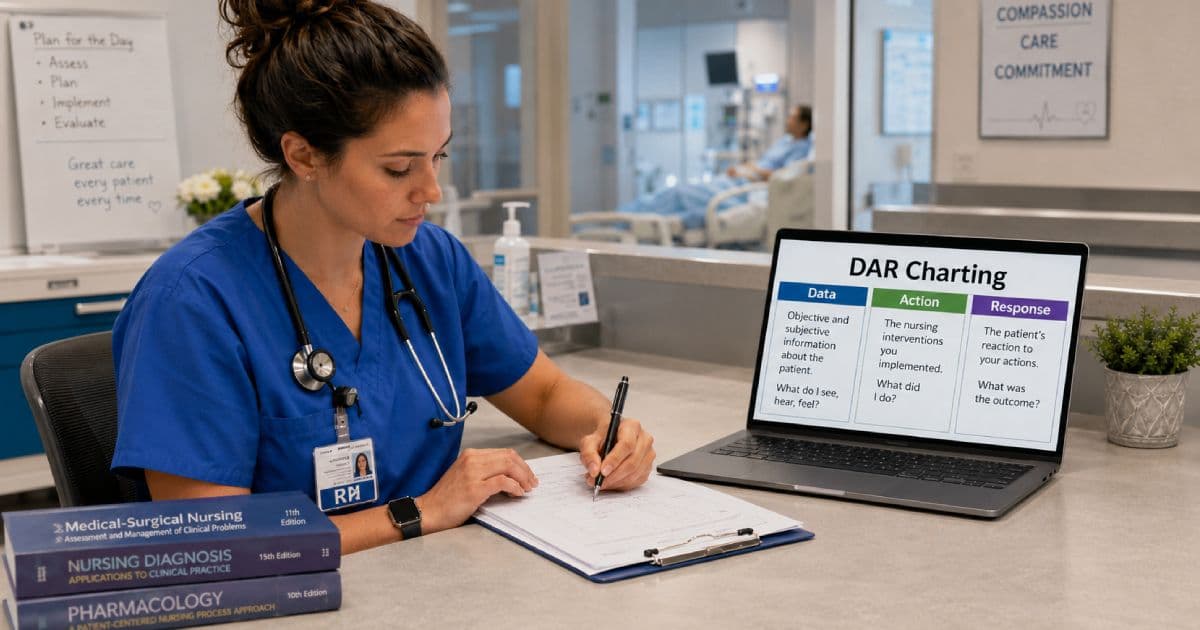
DAR charting is a simple way to write focused nursing notes.
It helps you organize what you saw, what you did, and how the patient responded.
That is the whole point.
A strong DAR note should answer three questions:
What is the focus?
What patient data supports the note?
What did the nurse do?
How did the patient respond?
DAR stands for:
- Data
- Action
- Response
You may also hear it called focus charting because each note starts with a focus such as pain, wound drainage, fall risk, nausea, patient teaching, respiratory status, anxiety, medication reaction, or provider notification.
What is DAR charting?
DAR charting is a nursing documentation format that organizes a note into three parts.
D: Data
Data includes what the patient says and what you assess.
It can include:
- Symptoms
- Pain score
- Vital signs
- Lung sounds
- Wound appearance
- Drainage
- Neuro status
- Intake and output
- Skin findings
- Blood glucose
- Fall or safety risk
- Patient behavior
- Family statement when relevant
- Relevant lab or monitor data
- Your focused nursing assessment
Data may include subjective and objective information.
Subjective data comes from the patient.
Objective data comes from your assessment, measurements, monitoring, and observations.
A: Action
Action includes what the nurse did.
It can include:
- Positioning
- Medication administration
- Nonpharmacologic interventions
- Wound care
- Patient education
- Safety interventions
- Provider notification
- Rapid response activation
- Reassessment
- Oxygen or protocol-based interventions
- IV assessment
- Fall precautions
- Infection prevention steps
- Specimen collection
- Care coordination
- Discharge teaching
Write actions in a way that shows nursing judgment.
Do not write only:
Will continue to monitor.That is weak by itself.
Better:
Placed client in high-Fowler's position, encouraged slow breathing, checked SpO2, stayed with client, notified respiratory therapy and provider per unit protocol.R: Response
Response includes what happened after the action.
It can include:
- Pain improved or did not improve
- Breathing improved or worsened
- Patient verbalized understanding
- Wound bleeding decreased
- Provider gave new orders
- Family agreed with plan
- Patient refused intervention
- Patient tolerated treatment
- Vital signs changed
- Safety risk decreased
- More escalation was needed
This is the part students forget.
It is also the part that proves whether the intervention worked.
Why nurses use DAR notes
DAR notes are useful because bedside nursing moves fast.
You do not always need a long narrative note.
You need a focused note that shows the problem and the nursing care.
DAR charting can help you document:
- A change in condition
- Pain reassessment
- Patient teaching
- Safety risk
- Provider notification
- Wound care
- IV complication
- Medication response
- Behavioral concern
- Refusal of care
- Fall event
- New symptoms
- Discharge readiness
- Care plan progress
A good DAR note is easy for the next nurse to read.
It should make the handoff safer.
It should also match what actually happened.
DAR charting vs SOAP notes
DAR and SOAP are both structured notes.
They are not the same.
SOAP stands for:
- Subjective
- Objective
- Assessment
- Plan
DAR stands for:
- Data
- Action
- Response
SOAP is often used for clinical reasoning, progress notes, outpatient notes, and provider-style documentation.
DAR is often used for focused nursing documentation in acute care, long-term care, behavioral health, home health, rehab, and student clinical paperwork.
For SOAP examples, see NurseZee's SOAP notes for nurses guide.
Quick comparison
| Format | Best for | Main structure |
|---|---|---|
| DAR | Focused nursing event or problem | Data, Action, Response |
| SOAP | Clinical assessment and plan | Subjective, Objective, Assessment, Plan |
| PIE | Nursing problem and response | Problem, Intervention, Evaluation |
| Narrative | Chronological story | Free-text sequence of events |
| SBAR | Handoff or escalation communication | Situation, Background, Assessment, Recommendation |
What is focus charting?
Focus charting means each note centers on a specific focus.
The focus is not always a nursing diagnosis.
It can be:
- A symptom
- A patient concern
- A change in condition
- A behavior
- A nursing intervention
- A response to treatment
- A safety issue
- A teaching topic
- A discharge need
- A care plan goal
Examples:
Focus: Acute pain
Focus: Nausea
Focus: Fall prevention
Focus: Wound drainage
Focus: Shortness of breath
Focus: Medication education
Focus: Refusal of insulin
Focus: Provider notification
Focus: Blood glucose 58 mg/dL
Focus: Anxiety before procedure
The focus should be specific enough that another nurse knows why you wrote the note.
Weak focus:
Focus: StatusBetter focus:
Focus: Post-op pain after ambulationWeak focus:
Focus: TeachingBetter focus:
Focus: Discharge teaching for new insulin penWhen to use DAR charting
Use DAR charting when your facility, instructor, or EHR supports it.
It works well for focused notes.
DAR works well for pain notes
Pain notes need more than a pain score.
They need assessment, intervention, and reassessment.
DAR makes that easy.
DAR works well for patient teaching
A good teaching note should show what you taught and how the patient responded.
DAR works well for provider notifications
If you call a provider, chart the clinical data, who you notified, time of communication if required, what was ordered, and the patient's response.
DAR works well for changes in condition
A change in condition needs clear data and clear action.
DAR works well for refusals
A refusal note needs facts, teaching, provider notification when appropriate, and what the patient did after refusal.
DAR works well for safety events
Falls, near-falls, unsafe behavior, line removal, elopement risk, restraints, and sitter needs can be documented in a focused format.
When DAR may not be enough
DAR charting is not always the full answer.
You may need other documentation too.
Examples:
- Medication administration record
- Flowsheets
- Wound assessment tool
- Fall risk tool
- Restraint flowsheet
- Care plan update
- Incident reporting system
- Transfer form
- Discharge instructions
- Provider order entry
- Patient education record
- Procedure checklist
A DAR note should not duplicate everything in the chart.
But it should summarize the clinical story when the event matters.
The DAR charting format
Use this template.
Date/time:
Focus:
D - Data:
A - Action:
R - Response:
Signature/credentials:
Many EHRs do not show the letters D, A, and R.
That is okay.
You can still organize the note that way.
DAR template for nursing students
Date/time: [date and time]
Focus: [specific patient problem, symptom, teaching topic, or event]

D - Data:
[Subjective data: what the patient reports]
[Objective data: what you assess, measure, observe, or review]

A - Action:
[Nursing interventions]
[Teaching]
[Safety steps]
[Provider notification or escalation if done]
[Orders carried out if applicable]

R - Response:
[Patient response]
[Reassessment findings]
[Outcome]
[Plan for continued monitoring or follow-up]
DAR template for bedside nurses
Focus: [specific focus]
D: [relevant subjective/objective data]
A: [interventions, communication, safety measures, orders carried out]
R: [response/reassessment/outcome/next step]
DAR template for provider notification
Focus: Provider notification for [clinical concern]
D: [assessment findings, vitals, symptoms, trend, relevant lab/monitor data]
A: [provider notified, SBAR report given, orders received or no new orders, interventions completed]
R: [patient response, current status, reassessment, follow-up plan]
DAR template for patient teaching
Focus: Patient teaching - [topic]
D: [learning need, patient question, readiness, barrier, current understanding]
A: [teaching provided, demonstration, written materials, teach-back used]
R: [patient response, teach-back result, remaining learning needs]
DAR template for refusal of care
Focus: Refusal of [medication/treatment/procedure]
D: [what was offered, patient statement, assessment data, relevant risk]
A: [education provided, questions answered, provider/charge nurse notified if appropriate, alternative offered if available]
R: [patient decision, current status, follow-up plan]
How to write the Data section
The Data section should include relevant facts.
Do not dump every assessment finding.
Choose what supports the focus.
Include subjective data
Subjective data is what the patient says.
Examples:
Client states, "My pain is 8 out of 10."Client reports nausea after breakfast.Client states, "I feel dizzy when I stand."Use quotation marks when exact wording matters.
Exact wording matters when documenting:
- Threats
- Refusals
- Pain descriptions
- Symptoms
- Patient concerns
- Safety statements
- Teaching response
- Discharge concerns
Include objective data
Objective data is what you assess or measure.
Examples:
BP 88/54, HR 122, RR 26, SpO2 89% on room air.Incision edges approximated. Scant serosanguineous drainage noted on dressing.Client ambulated 40 feet with walker and one-person assist. Gait slow but steady.Include trends when they matter
Trends matter more than isolated numbers.
Weak:
Urine output low.Better:
Urine output 20 mL over last 2 hours, decreased from 45 mL/hr earlier in shift.Weak:
Oxygen low.Better:
SpO2 decreased from 96% on 2 L nasal cannula at 0800 to 88% on 2 L at 1030.Avoid judgmental language
Do not chart labels.
Weak:
Patient being dramatic and noncompliant.Better:
Client crying, pacing in room, and states, "I am scared of the procedure." Client declined scheduled pre-op teaching at this time.Weak:
Patient refused for no reason.Better:
Client declined insulin dose and states, "I do not want insulin because I am afraid my sugar will drop." Blood glucose 286 mg/dL.How to write the Action section
The Action section should document nursing care.
It should show what you did in response to the data.
Actions may include independent nursing interventions, dependent interventions, collaborative actions, and communication.
Examples of nursing actions
Repositioned client to high-Fowler's position.Administered acetaminophen as ordered.Applied fall-risk bracelet and placed bed in low position.Provided wound care per order using sterile technique.Reviewed signs of hypoglycemia and insulin pen use with client.Notified provider using SBAR.Activated rapid response per facility policy.Stayed with client and initiated seizure precautions.Be specific about communication
Weak:
MD aware.Better:
Notified Dr. Patel at 1410 of BP 88/54, HR 122, dizziness, and urine output 20 mL over 2 hours. New order received for 500 mL normal saline bolus.Weak:
Charge nurse informed.Better:
Charge nurse notified of increased fall risk after client attempted to stand without assistance twice within 30 minutes.Do not chart before you do it
Do not document an action until it is completed.
Wrong:
Will give medication.Better after the action is done:
Administered ondansetron 4 mg IV per PRN order at 0915.If you need to document a plan, make it clear it is a plan and follow up after it happens.
Example:
Plan to reassess pain within 60 minutes per unit protocol.Then chart the reassessment.
Include patient safety actions
If the focus is safety, chart the safety steps.
Examples:
Bed in low position, call light within reach, nonskid socks on, fall-risk signage in place, room free of clutter.One-to-one observation continued per order.Suicide precautions maintained per facility protocol.Client instructed to call before getting out of bed. Client verbalized understanding.How to write the Response section
The Response section shows what happened next.
It may be the most important part of the DAR note.
Include reassessment
Reassessment is required after many interventions.
Examples:
Pain decreased from 8/10 to 3/10 45 minutes after medication.SpO2 increased from 89% to 95% on 2 L nasal cannula after repositioning and coughing/deep breathing.Client tolerated dressing change without dizziness or increased pain.Client correctly demonstrated use of incentive spirometer.If the response is poor, document that too
Not every intervention works.
That matters.
Example:
Pain remains 8/10 60 minutes after medication. Client guarding abdomen and reports pain worsens with movement. Provider notified.Example:
SpO2 remains 88-90% on 4 L nasal cannula. Respiratory therapy and provider at bedside. Rapid response activated per policy.Avoid vague response phrases
Weak:
Patient tolerated well.Better:
Client tolerated dressing change without dizziness, nausea, or increased pain. Pain 2/10 after dressing secured.Weak:
Will monitor.Better:
Client resting in bed, call light within reach. Plan to reassess pain and sedation level within 60 minutes per unit protocol.DAR charting examples
Use these examples as learning tools.
Follow your facility format and instructor requirements.
Do not copy examples into a real chart unless they match the actual patient event.
Example 1: Acute pain
Focus: Acute pain after abdominal surgery
D: Client reports incisional pain 8/10 and states, "It hurts when I move." Client guarding abdomen. Incision dressing clean, dry, and intact. BP 138/82, HR 96, RR 18.
A: Assisted client to splint incision with pillow. Repositioned in semi-Fowler's. Administered prescribed oxycodone 5 mg PO at 0910. Reviewed use of call light and instructed client to request assistance before ambulating.
R: At 1000, client reports pain decreased to 3/10. Client resting in bed, respirations even and unlabored. No dizziness or nausea reported.
Why this works
The note includes pain data, related assessment, medication and nonmedication actions, and reassessment after the intervention.Example 2: Pain not relieved
Focus: Pain not relieved by PRN medication
D: Client reports left hip pain 9/10 one hour after hydrocodone/acetaminophen. Client grimacing and unable to tolerate repositioning. Surgical dressing dry and intact. Left pedal pulse palpable, capillary refill less than 3 seconds, toes warm.
A: Reassessed surgical site and neurovascular status. Applied ice pack per order and supported left leg with pillow. Notified orthopedic provider of uncontrolled pain and current neurovascular findings.
R: New order received for IV pain medication. Client informed of plan and states, "I just need it to ease up." Will reassess pain after medication per policy.
Why this works
The note shows that the nurse reassessed for complications, tried ordered comfort measures, escalated uncontrolled pain, and documented the outcome of the provider call.Example 3: Shortness of breath
Focus: Shortness of breath
D: Client reports, "I cannot catch my breath." RR 30, SpO2 88% on room air, HR 118. Client sitting upright, using accessory muscles, and speaking in short phrases. Lung sounds diminished bilaterally.
A: Assisted client to high-Fowler's position. Applied oxygen per unit protocol. Encouraged slow breathing. Stayed with client and notified respiratory therapy and provider using SBAR.
R: SpO2 increased to 94% on 2 L nasal cannula after 5 minutes. RR decreased to 24. Provider at bedside to evaluate client.
Why this works
The note focuses on respiratory status, immediate nursing action, escalation, and objective reassessment.Example 4: Fall prevention
Focus: Fall risk
D: Client attempted to get out of bed unassisted twice within 30 minutes. Client states, "I forgot I need help." Gait unsteady with walker. Morse Fall Scale score high risk per flowsheet.
A: Reoriented client to room and call light. Placed bed in low position, nonskid socks on, bed alarm activated, call light and personal items within reach. Moved client closer to nurses' station after charge nurse notified.
R: Client remained in bed for remainder of hour and used call light once for toileting assistance. No fall or injury occurred.
Why this works
The note avoids blame and documents observed behavior, safety interventions, and outcome.Example 5: Wound dressing change
Focus: Abdominal wound dressing change
D: Dressing with moderate serosanguineous drainage. Wound edges approximated. No odor noted. Periwound skin intact. Client reports pain 2/10 before dressing change.
A: Removed old dressing using clean technique. Performed hand hygiene. Cleansed wound and applied new sterile dressing per order. Educated client to report increased drainage, odor, fever, or opening of incision.
R: Client tolerated dressing change without dizziness or increased pain. New dressing clean, dry, and intact. Client verbalized two signs to report.
Why this works
The note documents wound data, dressing action, education, tolerance, and patient understanding.Example 6: Nausea after medication
Focus: Nausea
D: Client reports nausea after breakfast and states, "I feel like I might throw up." No emesis noted. Abdomen soft, bowel sounds present in all quadrants. BP 124/76, HR 84.
A: Offered emesis basin. Encouraged slow deep breathing. Reduced strong food odors in room. Administered ondansetron 4 mg IV per PRN order at 0835.
R: At 0905, client reports nausea improved and denies vomiting. Client sipping water without difficulty.
Why this works
The note includes symptom data, assessment, nursing comfort steps, medication, and reassessment.Example 7: Hypoglycemia
Focus: Blood glucose 58 mg/dL
D: Client reports shakiness and sweating. Blood glucose 58 mg/dL at 1130. Client awake, alert, and able to swallow. Skin cool and moist.
A: Treated hypoglycemia per facility protocol with 15 g rapid-acting carbohydrate. Stayed with client and rechecked blood glucose after 15 minutes.
R: Blood glucose 82 mg/dL at 1145. Client states shakiness improved. Lunch tray provided. Provider notified per protocol.
Why this works
The note captures the cue, safety assessment, protocol-based treatment, repeat glucose, and patient response.Example 8: Hyperglycemia teaching
Focus: Diabetes teaching - sick day blood glucose monitoring
D: Client with type 2 diabetes asks, "Do I still check my sugar if I am not eating much?" Blood glucose trends reviewed with client. Client states current home routine is checking once daily.
A: Reviewed provider instructions for blood glucose monitoring, hydration, medication plan, and when to call the clinic. Used teach-back to confirm understanding. Provided written discharge instructions.
R: Client correctly states when to check blood glucose and identifies two symptoms that require calling the provider. Client requests family member be included in next teaching session.
Why this works
The note documents the learning need, teaching action, teach-back, and remaining need.Example 9: Refusal of medication
Focus: Refusal of scheduled insulin
D: Blood glucose 286 mg/dL before dinner. Client declines scheduled insulin and states, "Insulin made my sugar drop before, and I do not want it." Client alert and oriented.
A: Explained purpose of insulin, current blood glucose, ordered dose, and risks of untreated hyperglycemia. Asked client about prior hypoglycemia experience and answered questions. Notified provider of refusal and blood glucose result.
R: Client continues to decline insulin at this time and states, "I understand my sugar may stay high." Provider aware. Blood glucose monitoring to continue per order.
Why this works
The note documents the refusal, patient reason, education, provider notification, and patient response without judgmental language.Example 10: Provider notification
Focus: Provider notification - low blood pressure and dizziness
D: Client reports dizziness when sitting at edge of bed. BP 86/50, HR 118. Skin pale and cool. Urine output 25 mL over past 2 hours. Morning BP was 122/74.
A: Assisted client back to supine position and raised side rails. Rechecked BP manually. Notified Dr. Nguyen at 1435 using SBAR and reported vitals, symptoms, urine output, and trend.
R: New order received for 500 mL normal saline bolus and CBC. Client states dizziness improved while lying supine. BP 94/56 after repositioning, provider aware.
Why this works
The note documents the clinical change, immediate safety actions, specific communication, orders, and response.Example 11: New confusion
Focus: New confusion
D: Client oriented to person and place but not time. Client repeatedly asks where they are. Family states, "This is not normal for her." Temp 38.4 C, HR 112, RR 24, BP 104/62. Urine dark amber with strong odor.
A: Completed focused neuro and safety assessment. Placed call light within reach and activated bed alarm. Notified provider of new confusion, vital signs, and family report. Encouraged fluids as allowed by order.
R: Provider ordered urinalysis, CBC, and blood cultures. Client remains in bed with safety measures in place. Family at bedside and instructed to call staff before assisting client out of bed.
Why this works
The note treats new confusion as a significant change and includes family data, objective findings, action, and outcome.Example 12: IV infiltration
Focus: IV infiltration
D: Right forearm IV site swollen and cool to touch. Client reports tightness at site. IV pump alarming occlusion. No redness or drainage noted.
A: Stopped IV infusion. Removed IV catheter with tip intact. Elevated right arm and applied warm compress per facility policy. Notified provider/pharmacy per policy due to medication infusing at time of infiltration.
R: Client reports decreased tightness after elevation. Swelling outlined and measured per policy. New IV access established in left forearm by IV team.
Why this works
The note documents assessment, stopping infusion, site care, escalation, and reassessment.Example 13: Patient education before discharge
Focus: Discharge teaching - heart failure daily weights
D: Client scheduled for discharge today after heart failure admission. Client states, "I have a scale but I do not weigh myself every day." Spouse present for teaching.
A: Reviewed daily weights, same time each morning, same scale, and recording results. Reviewed provider instructions for weight gain requiring a call. Provided written discharge instructions and used teach-back.
R: Client states, "I will weigh myself every morning after I use the bathroom." Client and spouse correctly identify when to call provider based on discharge instructions.
Why this works
The note shows the learning gap, teaching content, teach-back, and discharge readiness.Example 14: Anxiety before procedure
Focus: Anxiety before procedure
D: Client states, "I am scared I will not wake up after the procedure." Client tearful and gripping bed rail. HR 104, RR 22. Consent form signed and in chart.
A: Stayed with client and encouraged expression of concerns. Reviewed what to expect before transport within nursing scope. Notified procedural nurse that client has questions about anesthesia risks.
R: Client states, "I feel better knowing I can ask them before we go." Client calmer, RR 18, and agrees to wait for procedural team questions.
Why this works
The note supports emotional care, stays within nursing scope, and documents follow-up for questions outside nursing scope.Example 15: Fever and possible infection concern
Focus: Fever and tachycardia
D: Temp 38.8 C, HR 124, RR 24, BP 100/58. Client reports chills and increased fatigue. Surgical incision with increased redness compared with morning assessment. Client received acetaminophen at 0600.
A: Rechecked vital signs, assessed incision, and notified provider of fever, tachycardia, BP, symptoms, and incision change. Encouraged oral fluids as tolerated and maintained ordered IV fluids.
R: Provider ordered CBC and wound culture. Client resting in bed with call light within reach. Temp 38.5 C on reassessment 30 minutes later.
Why this works
The note documents a concerning cue cluster, not just a fever. It includes escalation and follow-up.Example 16: Blood transfusion reaction concern
Focus: Possible transfusion reaction
D: Fifteen minutes after blood transfusion started, client reports chills and lower back pain. Temp increased from 37.0 C to 38.1 C. HR 116. Client appears flushed.
A: Stopped transfusion immediately. Maintained IV access with normal saline using new tubing per facility policy. Stayed with client. Notified provider and blood bank per protocol.
R: Client reports chills continue. Provider at bedside. Transfusion reaction workup initiated per policy.
Why this works
The note documents the timing, symptoms, urgent action, policy-based steps, and ongoing response.Example 17: Post-fall nursing note
Focus: Unwitnessed fall
D: Client found sitting on floor beside bed at 0210. Client states, "I was trying to go to the bathroom." No visible bleeding noted. Client reports right hip pain 5/10. Alert and oriented to person and place. Bed alarm sounding.
A: Stayed with client and assessed for injury before moving. Notified charge nurse and provider. Obtained vital signs and neuro checks per fall protocol. Assisted client back to bed using mechanical lift and staff assistance after assessment.
R: Provider ordered right hip x-ray. Client resting in bed with bed alarm on and call light within reach. Family notified per policy.
Why this works
The note documents facts, assessment, safety actions, provider notification, and follow-up. It does not mention an incident report in the medical record unless facility policy requires it.Example 18: No change after intervention
Focus: Persistent nausea
D: Client reports nausea remains 7/10 thirty minutes after ondansetron. No emesis. Abdomen distended compared with morning assessment. Bowel sounds hypoactive. Client reports no bowel movement for 3 days.
A: Held oral intake pending provider instructions. Assessed abdomen and reviewed last bowel movement. Notified provider of persistent nausea, distention, hypoactive bowel sounds, and constipation history.
R: Provider ordered abdominal x-ray and NPO status. Client informed of plan and verbalizes understanding.
Why this works
The note shows clinical judgment when symptoms do not improve. It includes reassessment, escalation, and new orders.DAR charting for common nursing situations
Pain
Include:
- Location
- Intensity
- Quality
- Onset
- Aggravating factors
- Relief measures
- Sedation or respiratory concerns when opioids are used
- Intervention
- Reassessment
Example focus:
Focus: Acute pain - right knee after physical therapyDo not chart only:
Pain med given.Chart the response.
Respiratory concerns
Include:
- Patient statement
- Respiratory rate
- SpO2
- Oxygen device and flow rate
- Work of breathing
- Lung sounds
- Position
- Interventions
- Provider or respiratory therapy notification if needed
- Response
Example focus:
Focus: Increased work of breathingWounds
Include:
- Location
- Appearance
- Drainage
- Odor
- Periwound skin
- Pain
- Dressing type if appropriate
- Care completed
- Tolerance
- Teaching
Example focus:
Focus: Sacral pressure injury dressing changePatient teaching
Include:
- Topic
- Learning need
- Barrier
- Teaching method
- Teach-back
- Remaining needs
Example focus:
Focus: Teaching - new anticoagulant precautionsMedication response
Include:
- Medication given
- Reason given
- Time
- Assessment before and after
- Side effects or adverse reaction
- Patient response
Example focus:
Focus: Response to PRN pain medicationBehavioral health or safety
Include:
- Exact patient statements when relevant
- Observed behavior
- Safety risk
- Interventions
- Team notification
- Response
Avoid judgmental wording.
Example focus:
Focus: Verbal threat toward staffRefusal of care
Include:
- What was refused
- Patient's stated reason
- Capacity/mental status if relevant and within scope
- Education provided
- Provider notification when required
- Alternative offered if appropriate
- Patient response
Example focus:
Focus: Refusal of wound dressing changeProvider notification
Include:
- Time if required
- Provider name or role per policy
- Reason for call
- Key clinical data
- Orders received or no new orders
- Patient response
Example focus:
Focus: Provider notification - potassium 2.9 mEq/LDAR charting do's and don'ts
Do chart in a timely manner
Chart as close to the event as possible.
Late notes happen, but they should be clearly labeled according to policy.
Do use patient quotes when helpful
Quotes are useful for:
- Refusals
- Threats
- Pain descriptions
- Safety concerns
- Discharge barriers
- Patient education responses
Example:
Client states, "I do not have anyone to drive me home."Do chart abnormal findings and actions
If you found a new abnormal finding, chart what you did.
Data without action can leave the clinical story incomplete.
Example:
D: BP 82/48, HR 126, client dizzy.
A: Assisted client supine, rechecked BP manually, notified provider.
R: New orders received. Client reports dizziness improved while supine.
Do chart reassessment
Pain, nausea, respiratory distress, hypoglycemia, anxiety, and safety interventions often require reassessment.
Do write objectively
Objective charting protects the patient and the nurse.
Avoid opinions, blame, sarcasm, and labels.
Do use approved abbreviations only
Use facility-approved abbreviations.
Avoid dangerous abbreviations and medication shortcuts that can be misread.
Do document patient response
The response shows whether care worked.
It also helps the next nurse know what to do next.
Do not chart for someone else
Chart only your own assessment and care unless facility policy allows co-signing or student documentation workflows.
Do not copy forward without checking
Copy-forward can spread errors.
Only carry forward information you verified.
Do not include blame
Wrong:
Previous shift failed to change dressing.Better:
At 0730, dressing saturated with serosanguineous drainage. Dressing changed per order and provider notified of drainage amount.Do not write vague notes
Weak:
Patient okay.Better:
Client denies pain, dizziness, or shortness of breath. Ambulated 100 feet with walker and standby assist. Gait steady.Do not document incident report details in the chart unless policy requires it
The medical record should document patient assessment, care, notification, and outcome.
Incident report procedures vary by facility.
Follow policy.
Do not alter a chart entry improperly
If you make an error, correct it according to facility policy.
Never delete, hide, or change a record to make it look like the original entry never happened.
Common DAR charting mistakes
Mistake 1: Forgetting the focus
DAR notes need a clear focus.
Weak:
Focus: NoteBetter:
Focus: Nausea after breakfastMistake 2: Writing data that does not match the focus
If the focus is pain, do not write a full head-to-toe assessment unless relevant.
Stay focused.
Mistake 3: Charting actions without data
Weak:
A: Gave pain medication.Better:
D: Client reports incisional pain 8/10 and guarding abdomen.
A: Administered prescribed pain medication and repositioned client.
Mistake 4: Charting data without action
Weak:
D: Client SpO2 88% and short of breath.Better:
D: Client SpO2 88% and short of breath.
A: Positioned high-Fowler's, applied oxygen per protocol, notified provider.
R: SpO2 improved to 94%.
Mistake 5: Forgetting reassessment
If you give pain medication and never reassess, the note is incomplete.
Mistake 6: Using unsafe abbreviations
Medication abbreviations can be misread.
Use approved terms.
When in doubt, write it out.
Mistake 7: Writing "will continue to monitor" as the whole response
Monitoring is not a response.
A response should show current patient status or follow-up findings.
Mistake 8: Sounding judgmental
Wrong:
Patient lazy and refuses to walk.Better:
Client declined ambulation and states, "I am too tired right now." Education provided on benefits of ambulation after surgery. Client agrees to try again after lunch.Mistake 9: Waiting until the end of the shift to chart everything
Late charting increases the risk of missing details.
Chart significant events promptly.
Mistake 10: Duplicating flowsheet data without context
Flowsheets capture routine assessment data.
Narrative notes explain important events, changes, interventions, and responses.
DAR charting and the nursing process
DAR charting lines up with the nursing process.
Assessment
Data captures assessment findings.
Diagnosis or clinical problem
The focus identifies the problem, need, or event.
Planning
The note may include the immediate plan, especially after reassessment or provider communication.
Implementation
Action documents interventions.
Evaluation
Response documents evaluation.
This is why DAR charting helps nursing students.
It forces you to connect what you assessed with what you did and whether it worked.
For a deeper care-plan structure, see NurseZee's nursing diagnosis guide.
DAR charting and NCLEX clinical judgment
DAR charting also connects to clinical judgment.
The Next Gen NCLEX tests whether you can recognize cues, analyze cues, prioritize hypotheses, generate solutions, take action, and evaluate outcomes.
DAR notes follow a similar bedside pattern.
Data: Recognize and analyze cues.
Action: Take the safest nursing action.
Response: Evaluate outcomes.
This is not just paperwork.
It is how you show nursing thinking.
For exam strategy, review NurseZee's NCLEX prioritization guide and NCLEX prep guide.
You can also practise clinical judgment questions at NurseZee Practice.
DAR note examples by focus
Focus: Pain
Focus: Pain
D: Client reports headache 7/10 and states pain began one hour ago. BP 132/78, HR 88. No vision changes or nausea reported.
A: Reduced room lighting, provided cool cloth, and administered acetaminophen per PRN order.
R: Client reports headache decreased to 3/10 after 45 minutes and is resting with eyes closed.
Focus: Mobility
Focus: Ambulation after surgery
D: Client states, "I feel weak but I can try." Pain 3/10. BP 118/70 sitting, HR 86. No dizziness reported.
A: Assisted client to stand with gait belt and walker. Ambulated 60 feet in hallway with one-person assist. Reinforced call-light use before future ambulation.
R: Client tolerated ambulation without dizziness or shortness of breath. Returned to chair with call light within reach.
Focus: Nutrition
Focus: Poor oral intake
D: Client ate less than 25% of breakfast and states, "Nothing tastes good." Mucous membranes slightly dry. Denies nausea.
A: Offered preferred fluids within diet order. Encouraged small frequent bites. Notified dietitian per unit process.
R: Client drank 240 mL water and agreed to try soup at lunch. Dietitian consult pending.
Focus: Skin integrity
Focus: Redness over sacrum
D: Sacral area red and nonblanchable. Skin intact. Client reports discomfort when lying supine. Braden risk score documented in flowsheet.
A: Repositioned client to left side with pillows. Applied barrier cream per policy. Educated client on turning schedule. Notified wound care nurse per protocol.
R: Client reports sacral discomfort improved after repositioning. Wound care consult placed.
Focus: Medication reaction
Focus: Itching after antibiotic infusion
D: Client reports itching of arms 10 minutes after antibiotic infusion started. Fine red rash noted on forearms. BP 122/74, HR 92, RR 18, SpO2 97% room air. No shortness of breath reported.
A: Stopped infusion and maintained IV access per policy. Notified provider and pharmacy. Monitored airway and vital signs.
R: Itching decreased after infusion stopped. Provider ordered medication to treat reaction and antibiotic held pending further instruction.
Focus: Intake and output
Focus: Decreased urine output
D: Foley catheter output 30 mL over past 2 hours. Urine dark amber. Client reports thirst. BP 100/60, HR 104. Catheter tubing without kinks; drainage bag below bladder level.
A: Assessed catheter system and intake. Encouraged oral fluids as allowed. Notified provider of urine output, vitals, and assessment.
R: Provider ordered fluid bolus. Urine output to be reassessed after bolus per policy.
Focus: Infection prevention teaching
Focus: Central line infection prevention teaching
D: Client asks, "Can I shower with this line?" Central line dressing clean, dry, and intact. Client scheduled for discharge with home health follow-up.
A: Reviewed discharge instructions for keeping dressing dry, hand hygiene, signs of infection, and when to call provider. Used teach-back.
R: Client correctly states to call provider for fever, redness, drainage, or dressing lifting. Client requests written instructions for spouse.
Focus: Mental health safety
Focus: Suicidal statement
D: Client states, "I do not want to be alive anymore." Client tearful and sitting on edge of bed. No self-harm objects observed at bedside.
A: Stayed with client. Notified charge nurse and provider immediately. Initiated safety precautions per facility policy. Removed potentially unsafe items from room according to protocol.
R: Client remains under direct observation. Provider evaluating client at bedside. Client states, "I am scared," and agrees to remain in room with staff.
Focus: Family concern
Focus: Family concern about discharge plan
D: Daughter states, "I do not think he can manage stairs at home." Client lives alone in second-floor apartment. Client ambulated 20 feet with walker and required rest break.
A: Notified case manager and physical therapy of family concern and home setup. Reviewed current discharge planning process with client and daughter.
R: Case manager to meet with client and daughter this afternoon. Client states, "I want to know my options before I leave."
Focus: Procedure preparation
Focus: Pre-procedure checklist concern
D: Client scheduled for procedure at 1000. Consent not found in chart. Client states, "The doctor explained it yesterday, but I still have questions."
A: Notified procedural team and provider that consent is not in chart and client has questions. Maintained NPO status per order.
R: Procedure nurse states provider will come to bedside before transport. Client waiting in room and verbalizes understanding.
How to chart a late DAR note
Late entries happen.
Examples:
- Emergency situation
- Patient care took priority
- EHR downtime
- Off-unit procedure
- Rapid response or code
Follow facility policy.
A late entry should usually include the actual time of the event and the time you entered the note.
Example:
Late entry entered at 1515 for event at 1330.
Focus: Provider notification - chest pain
D: At 1330, client reported chest pressure 8/10 and nausea. BP 150/88, HR 112, SpO2 95% on 2 L nasal cannula.
A: Stayed with client, obtained focused assessment and vital signs, notified provider, and activated chest pain protocol per unit policy.
R: Provider at bedside at 1340. Client transferred to monitored unit at 1415.
Do not make late entries look like they were written earlier.
Do not backdate.
How to correct an error
Follow facility policy.
In general:
- Do not delete or hide the original entry.
- Do not alter another person's entry.
- Add a correction or addendum according to EHR process.
- State facts clearly.
- Avoid blaming language.
Example:
Addendum at 1710: Previous note stated left arm IV. Correct site was right forearm IV. Remaining assessment and interventions unchanged.DAR charting for nursing students
Students often over-chart.
That is normal while you are learning.
But your goal is not to write the longest note.
Your goal is to write the clearest note.
Student DAR charting checklist
Before submitting a DAR note, ask:
Did I write a specific focus?
Did I include relevant subjective data?
Did I include relevant objective data?
Did my action match the data?
Did I document the patient response?
Did I avoid judgmental wording?
Did I avoid unsafe abbreviations?
Did I follow instructor and facility rules?
Student example: weak vs strong
Weak note:
Focus: Pain
D: Patient in pain.
A: Gave med.
R: Better.
Strong note:
Focus: Incisional pain after coughing
D: Client reports incisional pain 7/10 after coughing. Client guarding abdomen. Dressing clean, dry, and intact.
A: Assisted client to splint incision with pillow, repositioned to semi-Fowler's, and administered prescribed PRN pain medication with RN supervision.
R: Client reports pain decreased to 3/10 after 45 minutes and demonstrates splinting technique.
Do students chart in the real medical record?
That depends on the clinical site, nursing program, instructor, state rules, and EHR access.
Some students chart directly with instructor review.
Some students submit separate clinical paperwork.
Some students document only in a simulated chart.
Follow your program and facility policy.
DAR charting in the EHR
Many EHRs use flowsheets, structured fields, and free-text notes.
DAR charting may appear as:
- Focus note
- Progress note
- Nursing note
- Clinical note
- Event note
- Problem-based note
- Interdisciplinary note
Use flowsheets and notes together
Flowsheets are good for routine data.
DAR notes are good for the clinical story.
Example:
Flowsheet: vital signs, pain score, oxygen device, wound measurements.
DAR note: new shortness of breath, actions taken, provider notification, response.
Avoid copying forward blindly
Copy-forward can save time.
It can also carry errors.
Only reuse text that you personally verified.
Use templates carefully
Templates help structure your thinking.
They can also create inaccurate notes if you leave in details that do not apply.
Before signing, check every line.
Chart exceptions clearly
If the patient did not respond as expected, chart that.
If education was not understood, chart that.
If the patient refused, chart that.
If you escalated care, chart that.
DAR charting and privacy
Nursing documentation includes protected health information.
Keep notes clinically necessary and professional.
Do not include unnecessary personal details.
Do not include gossip, blame, or irrelevant family conflict.
Do not chart in the wrong patient's record.
Do not access charts without a care-related reason.
Do not share screenshots or patient information outside approved systems.
What not to write in a DAR note
Avoid these phrases unless your facility specifically instructs otherwise.
"Patient is noncompliant"
Better:
Client declined ordered medication after education and states, "I do not want to take it because it made me dizzy yesterday.""Doctor notified"
Better:
Notified Dr. Smith at 1015 of BP 88/50, HR 120, and new dizziness. New order received for CBC and 500 mL normal saline bolus."Patient tolerated well"
Better:
Client tolerated dressing change without dizziness, increased pain, or bleeding."No complaints"
Better:
Client denies pain, shortness of breath, nausea, dizziness, or new concerns at this time."Will monitor"
Better:
Client resting in bed with call light within reach. Pain will be reassessed within 60 minutes per unit protocol."Family is difficult"
Better:
Client's spouse asked repeated questions about discharge medications and states, "I am worried I will give them wrong." Medication teaching reviewed and pharmacist consult requested."Patient fell because bed alarm was off"
Better:
Client found sitting on floor beside bed. Bed alarm not sounding on entry to room. Client assessed for injury, provider notified, and fall protocol initiated.DAR charting quick reference
Strong Data section includes
- Patient statement
- Relevant assessment
- Vital signs when relevant
- Objective measurements
- Trends
- Safety risk
- Clinical context
Strong Action section includes
- Nursing interventions
- Medication or treatment given
- Teaching
- Safety measures
- Provider notification
- Team communication
- Orders carried out
- Protocol steps
Strong Response section includes
- Reassessment
- Patient tolerance
- Symptom change
- Teach-back result
- Provider orders
- Current status
- Next step
Avoid
- Vague language
- Judgmental labels
- Unsafe abbreviations
- Charting before care is done
- Copy-forward errors
- Missing reassessment
- "Provider aware" without details
- "Will monitor" without a current response
Practice: turn these into DAR notes
Use these to practise.
Scenario 1
A client reports pain 8/10 after coughing. Incision dressing is clean, dry, and intact. You help the client splint the incision and administer prescribed pain medication. Forty-five minutes later, pain is 3/10.
Possible DAR note:
Focus: Incisional pain after coughing
D: Client reports incisional pain 8/10 after coughing. Client guarding abdomen. Incision dressing clean, dry, and intact.
A: Assisted client to splint incision with pillow and administered prescribed PRN pain medication.
R: Pain decreased to 3/10 after 45 minutes. Client resting in bed and demonstrates splinting technique.
Scenario 2
A client is dizzy when standing. BP is 88/52 and HR is 120. You assist the client back to bed, recheck the BP manually, and notify the provider. Provider orders a fluid bolus.
Possible DAR note:
Focus: Dizziness with low blood pressure
D: Client reports dizziness when standing. BP 88/52, HR 120. Skin pale and cool.
A: Assisted client back to bed, placed in supine position, rechecked BP manually, and notified provider of vitals and symptoms.
R: Provider ordered IV fluid bolus. Client reports dizziness improved while lying supine.
Scenario 3
A client refuses a dressing change because it hurt yesterday. You explain the purpose and offer pain medication before the dressing change. The client agrees to try after medication.
Possible DAR note:
Focus: Refusal of dressing change
D: Client declined scheduled dressing change and states, "It hurt too much yesterday." Current dressing dry and intact.
A: Explained purpose of dressing change and offered prescribed pain medication before procedure. Answered client's questions.
R: Client agrees to take pain medication and attempt dressing change after medication has time to work.
Scenario 4
A patient asks how to take a new anticoagulant at home. You teach about dose timing, bleeding precautions, and when to call the provider. The patient uses teach-back correctly.
Possible DAR note:
Focus: Anticoagulant discharge teaching
D: Client asks how to take new anticoagulant at home. Client states, "I am worried I will miss a dose."
A: Reviewed medication schedule, bleeding precautions, missed-dose instructions per discharge paperwork, and when to call provider. Used teach-back.
R: Client correctly explains dose timing and identifies bleeding signs to report. Written instructions provided.
Frequently asked questions about DAR charting
What does DAR stand for in nursing?
DAR stands for Data, Action, and Response. It is a focused nursing documentation format used to chart assessment findings, nursing interventions, and patient response.
What is the difference between DAR and focus charting?
DAR is the structure used in focus charting. The focus names the patient problem, event, symptom, or teaching topic. The note then follows Data, Action, and Response.
What goes in the Data section of a DAR note?
The Data section includes relevant subjective and objective information. That may include what the patient says, vital signs, pain score, assessment findings, behavior, trends, or other clinical cues.
What goes in the Action section of a DAR note?
The Action section includes what the nurse did. This may include medication administration, assessment, safety steps, teaching, communication, provider notification, protocol-based care, or other nursing interventions.
What goes in the Response section of a DAR note?
The Response section includes the patient's outcome after the nursing action. It may include reassessment findings, symptom improvement, lack of improvement, teach-back results, provider orders, or the next step.
Is DAR charting the same as SOAP charting?
No. SOAP uses Subjective, Objective, Assessment, and Plan. DAR uses Data, Action, and Response. SOAP often emphasizes assessment and plan, while DAR emphasizes focused nursing data, intervention, and patient response.
Is DAR charting only for hospitals?
No. DAR charting can be used in many settings if allowed by policy, including hospitals, long-term care, rehab, behavioral health, clinics, home health, and student clinical documentation.
Do I need to include vital signs in every DAR note?
No. Include vital signs when they are relevant to the focus. A note about shortness of breath, dizziness, fever, pain medication, or a change in condition usually needs vital signs. A simple teaching note may not.
Can a DAR note include patient quotes?
Yes. Use patient quotes when the exact wording matters, such as refusals, threats, symptoms, concerns, pain descriptions, or teach-back responses.
What is a good focus for a DAR note?
A good focus is specific. Examples include acute pain, nausea after breakfast, fall risk, provider notification for low blood pressure, wound dressing change, refusal of insulin, or discharge teaching for new medication.
Should I write "will continue to monitor" in a DAR note?
You can include a follow-up plan when appropriate, but do not use "will continue to monitor" as the whole response. Document the current patient response and what specifically will be reassessed.
How do I chart provider notification in DAR format?
Use Data to document the clinical concern, Action to document who you notified and what you reported, and Response to document orders received, no new orders, patient status, and follow-up.
How do I chart a patient refusal in DAR format?
Document what was refused, the patient's stated reason, relevant assessment data, education provided, provider notification if required, and the patient's final decision or follow-up plan.
Can nursing students use DAR charting?
Yes, if the instructor and clinical site allow it. Nursing students often use DAR notes to practise connecting assessment data, nursing interventions, and patient outcomes.
What is the biggest mistake in DAR charting?
The biggest mistake is leaving out the Response section. If you document an action, you usually need to document what happened after the action.
Final thoughts
DAR charting is not complicated.
But it does require discipline.
Start with a clear focus.
Write the relevant data.
Document what you did.
Then document how the patient responded.
That structure helps the next nurse understand the patient's condition, the care already provided, and what still needs follow-up.
Good charting does not need to be fancy.
It needs to be accurate, timely, objective, and useful.
Sources and references
- American Nurses Association: Principles for Nursing Documentation
- HHS: HIPAA Minimum Necessary Requirement
- CMS: HIPAA Basics for Providers: Privacy, Security, and Breach Notification Rules
- Electronic Code of Federal Regulations: 42 CFR 482.24 Medical Record Services
- CMS: Conditions for Coverage and Conditions of Participation
- AHRQ TeamSTEPPS: SBAR Tool
- AHRQ TeamSTEPPS: Closed-Loop Communication
- NCSBN: Clinical Judgment Measurement Model
- The Joint Commission: Do Not Use List of Abbreviations
- ISMP: List of Error-Prone Abbreviations, Symbols, and Dose Designations
- NurseZee: SOAP Notes for Nurses
- NurseZee: Nursing Diagnosis Guide
- NurseZee: NCLEX Prioritization Questions
- NurseZee: NCLEX Prep
- NurseZee Practice Questions