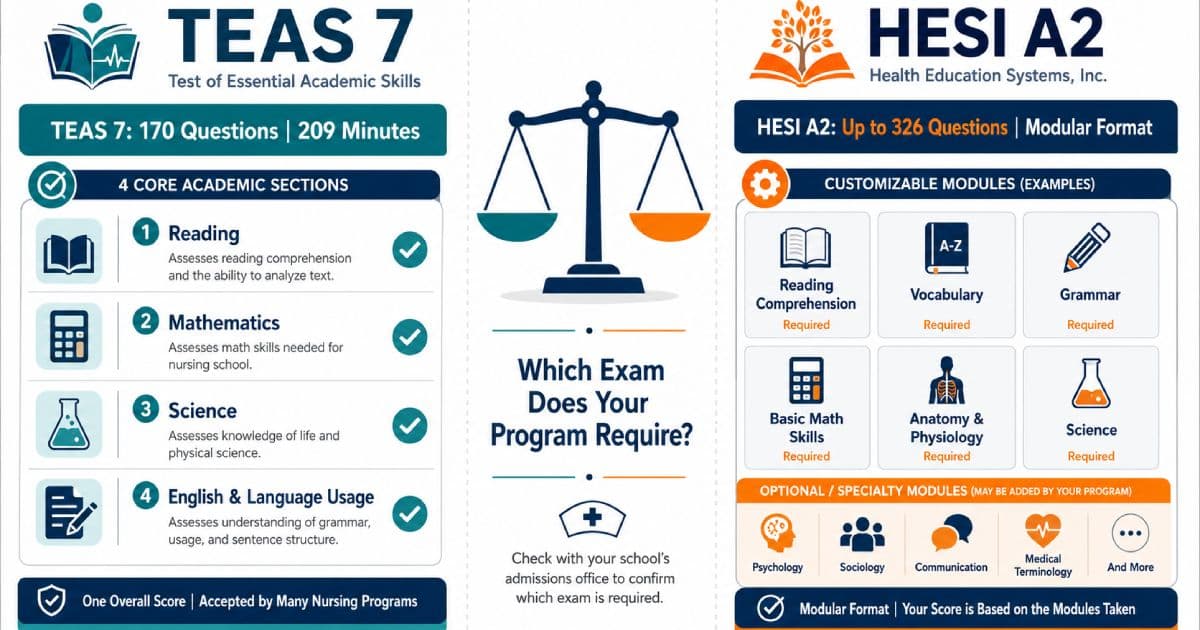
The TEAS and HESI A2 are nursing school entrance exams.
They are not the same test.
They are not interchangeable.
And you usually do not get to choose based on which one sounds easier.
Your nursing program decides which exam it accepts, what score you need, how many attempts you get, and how old your score can be.
What are nursing entrance exams?
Nursing entrance exams help schools estimate whether applicants are ready for nursing coursework.
They usually test:
- Reading comprehension
- Math skills
- Science foundation
- English and grammar
- Vocabulary
- Critical thinking
- Basic academic readiness
They do not prove you will be a great nurse.
They do not replace grades, prerequisites, interviews, essays, or healthcare experience.
But they can affect whether your application moves forward.
Some nursing programs use entrance exam scores as a minimum screen.
Others use them as part of a points-based ranking system.
That means a low score can block your application even if your GPA is decent.
It also means a strong score can help you compete when a program has more qualified applicants than seats.
For prerequisite planning, review NurseZee's nursing school prerequisites guide.
TEAS vs HESI at a glance
| Feature | ATI TEAS 7 | HESI A2 |
|---|---|---|
| Full name | Test of Essential Academic Skills | Health Education Systems, Inc. Admission Assessment |
| Publisher | ATI | Elsevier / HESI |
| Main use | Nursing and allied health admissions | Nursing and health professions admissions |
| Format | Fixed core sections | Modular sections chosen by the school |
| Main sections | Reading, Math, Science, English and Language Usage | Often Math, Reading, Vocabulary, Grammar, A&P, Biology, Chemistry, Critical Thinking, and other school-selected modules |
| Total questions | 170 total questions, including scored and unscored items | Varies by school because schools choose required modules |
| Time | 209 minutes of allocated testing time | Varies by school/testing setup |
| Question style | Multiple choice, multiple select, fill in the blank, ordered response, hot spots | Mostly multiple choice, with some fill-in-style items depending on setup |
| Score use | Composite and section scores | Individual section scores and sometimes composite/average scores |
| Best for | Schools that want one standardized academic-readiness exam | Schools that want to customize required content areas |
| Biggest student mistake | Studying generally instead of drilling TEAS science and reading pacing | Studying every possible HESI section instead of the exact modules your school requires |
The most important difference
The TEAS is standardized across four core areas.
The HESI A2 is customizable.
That difference changes how you study.
For TEAS, every student should prepare for all four major sections.
For HESI A2, you should prepare for the exact modules your program requires.
This is why one student may say HESI was easy and another may say it was exhausting.
They may not have taken the same set of sections.
Which exam do you need?
You need the exam your nursing school requires.
Check each program's admissions page.
Look for words like:
ATI TEAS required
TEAS Version 7 required
HESI A2 required
HESI Admission Assessment required
Entrance exam required
Nursing admission exam
Nursing program application checklist
Then write down the details.
Do not rely on old student forums.
Do not rely on a friend who applied last year.
Do not assume the requirement is the same for ADN, BSN, LPN, accelerated BSN, and transfer applicants.
Programs can change entrance exam rules from cycle to cycle.
How to make a nursing entrance exam tracker
Use a simple spreadsheet.
Include these columns:
School:
Program type:
Exam required:
Required sections:
Minimum composite score:
Minimum section scores:
Preferred competitive score:
Deadline to test:
Score expiration:
Retake waiting period:
Maximum attempts:
Where to test:
How to send scores:
Cost:
Notes:
Example tracker entry
School: Example Community College
Program type: ADN
Exam required: ATI TEAS 7
Required sections: Full TEAS exam
Minimum composite score: 65%
Minimum section scores: Reading 70%, Science 60%
Deadline to test: February 1
Score expiration: 2 years
Retake waiting period: 30 days
Maximum attempts: 2 per application cycle
Where to test: School testing center or ATI remote option
How to send scores: Official ATI transcript required
Cost: Check ATI/school registration page
Notes: Highest score accepted
Example HESI tracker entry
School: Example University
Program type: Traditional BSN
Exam required: HESI A2
Required sections: Reading, Grammar, Vocabulary, Math, Anatomy and Physiology
Minimum score: 80% on each required section
Deadline to test: March 15
Score expiration: 1 year
Retake waiting period: 60 days
Maximum attempts: 2 total
Where to test: Prometric or campus testing center
How to send scores: Follow school-specific Elsevier/Evolve instructions
Cost: Varies by testing site
Notes: Biology and Chemistry not requiredATI TEAS 7 overview
The ATI TEAS 7 is a fixed nursing entrance exam.
ATI lists the exam as 170 total questions with 209 minutes of allocated testing time.
The exam includes four sections:
- Reading
- Mathematics
- Science
- English and Language Usage
ATI also lists multiple question types, including multiple choice, multiple select, fill in the blank, ordered response, and hot spots.
TEAS 7 section breakdown
| TEAS section | Questions | Time limit | What it tests |
|---|---|---|---|
| Reading | 45 | 55 minutes | Main ideas, details, structure, inference, charts, academic passages |
| Mathematics | 38 | 57 minutes | Numbers, algebra, measurement, data interpretation |
| Science | 50 | 60 minutes | Anatomy and physiology, biology, chemistry, scientific reasoning |
| English and Language Usage | 37 | 37 minutes | Grammar, punctuation, sentence structure, vocabulary, standard English |
TEAS Reading
The Reading section tests whether you can understand and analyze written material.
Expect skills such as:
- Finding the main idea
- Identifying supporting details
- Making inferences
- Understanding author purpose
- Interpreting text structure
- Comparing sources
- Reading charts, graphs, and directions
- Distinguishing fact from opinion
- Following multi-step written information
Why TEAS Reading matters for nursing
Nursing school is reading-heavy.
You will read:
- Textbook chapters
- Medication information
- Clinical guidelines
- Patient education materials
- Provider orders
- Electronic health record notes
- Case studies
- Research summaries
If you struggle with reading speed and accuracy, nursing exams can feel harder than the content itself.
TEAS Reading study tips
Practice with timed passages.
Do not only read the passage.
Practice finding the answer in the text.
For each missed question, ask:
Did I miss the main idea?
Did I misread the question?
Did I choose an answer that was true but not supported?
Did I run out of time?
Did I overthink a simple detail?
TEAS Math
The Mathematics section tests basic math and data skills.
Expect topics such as:
- Fractions
- Decimals
- Percentages
- Ratios
- Proportions
- Algebra
- Measurement
- Unit conversion
- Interpreting tables and charts
Why TEAS Math matters for nursing
Nurses use math for medication safety.
You need enough math confidence to handle:
- Dosage calculations
- IV flow rates
- Intake and output
- Weight-based dosing
- Unit conversions
- Lab trends
- Fluid balance
The TEAS is not a medication-dosage exam, but the math foundation matters.
TEAS Math study tips
Memorize common conversions your program expects.
Practice without skipping steps.
Write units with your work.
Use proportion setups until they feel automatic.
Example:
Order: 500 mg
Available: 250 mg per tablet

500 mg / 250 mg per tablet = 2 tablets
TEAS Science
The Science section is often the section students fear most.
It can test:
- Human anatomy and physiology
- Biology
- Chemistry
- Scientific reasoning
The biggest piece for many nursing applicants is anatomy and physiology.
High-yield TEAS Science topics
Review:
- Cell structure and function
- Tissues
- Integumentary system
- Skeletal system
- Muscular system
- Nervous system
- Endocrine system
- Cardiovascular system
- Respiratory system
- Digestive system
- Urinary system
- Reproductive system
- Immune system
- Basic genetics
- Atoms and molecules
- Chemical bonds
- Acids and bases
- Scientific method
- Experimental design
TEAS Science study tips
Do not memorize disconnected facts only.
Connect structure to function.
Ask:
What does this organ do?
What happens if it fails?
Which body system helps regulate it?
Which lab value or vital sign would change?
This approach also helps later with NCLEX-style clinical judgment.
TEAS English and Language Usage
This section tests whether you can use standard written English.
Expect:
- Grammar
- Punctuation
- Sentence structure
- Spelling patterns
- Word meaning
- Vocabulary
- Formal academic writing conventions
Why TEAS English matters for nursing
Nurses document.
They write notes.
They communicate with providers.
They teach patients.
Clear writing prevents confusion.
For clinical documentation help later, see NurseZee's nursing progress notes guide.
TEAS English study tips
Review:
- Subject-verb agreement
- Pronoun agreement
- Sentence fragments
- Run-on sentences
- Comma use
- Apostrophes
- Commonly confused words
- Prefixes and suffixes
- Context clues
Do short daily drills.
English improves fastest when you review mistakes immediately.
HESI A2 overview
The HESI A2 is the HESI Admission Assessment.
It is commonly used for nursing and health professions admissions.
Unlike the TEAS, HESI A2 is modular.
Elsevier's HESI Admission Assessment review materials cover topics such as:
- Math
- Reading comprehension
- Vocabulary
- Grammar
- Biology
- Chemistry
- Anatomy and physiology
Some schools also require:
- Physics
- Critical Thinking
- Learning Style
- Personality Profile
Not every school uses every section.
That is the key.
Common HESI A2 academic sections
| HESI A2 section | Common focus | What to verify |
|---|---|---|
| Math | Fractions, decimals, ratios, proportions, conversions, basic algebra | Calculator policy, scratch paper policy, minimum section score |
| Reading Comprehension | Main ideas, details, inference, meaning in context | Required score and retake policy |
| Vocabulary | General and healthcare-related vocabulary | Whether this section is required |
| Grammar | Standard English rules and sentence structure | Whether grammar is scored separately |
| Anatomy and Physiology | Body systems, structure, function, basic physiology | Whether A&P is weighted heavily |
| Biology | Cells, genetics, metabolism, biological processes | Whether your school requires it |
| Chemistry | Atoms, molecules, reactions, acids/bases, conversions | Whether your school requires it |
| Physics | Basic physics concepts | Less common for many nursing programs; verify |
| Critical Thinking | Clinical-style reasoning and prioritization | Some programs require it for admissions |
| Learning Style / Personality | Advising and student support | Usually not treated like core academic sections, but follow school policy |
HESI Math
HESI Math often emphasizes practical arithmetic.
Expect:
- Fractions
- Decimals
- Percentages
- Ratios
- Proportions
- Basic algebra
- Unit conversions
- Military time
- Basic dosage-style calculations
HESI Math study tips
Build accuracy first.
Then build speed.
Many students lose points because they rush simple calculations.
Use this review routine:
Step 1: Redo every missed problem without looking at the answer.
Step 2: Identify the mistake type.
Step 3: Write the correct setup.
Step 4: Do 5 similar problems the same day.
Step 5: Redo the same topic 48 hours later.
HESI Reading Comprehension
This section tests reading accuracy.
Expect:
- Main idea
- Details
- Inference
- Context clues
- Summaries
HESI Reading study tips
Do not choose answers based on what sounds medically reasonable.
Choose what the passage supports.
Nursing entrance exams often reward precise reading, not outside knowledge.
HESI Vocabulary
Vocabulary is one reason some students find HESI harder than TEAS.
The section may include healthcare-related terms and general academic words.
Study:
- Medical prefixes
- Medical suffixes
- Directional terms
- Common anatomy vocabulary
- Common healthcare communication words
- Words with similar meanings but different use
Example:
Benign: not harmful or not cancerous in a clinical context.
Malignant: harmful, invasive, or cancerous in a clinical context.
Distal: farther from the point of attachment.
Proximal: closer to the point of attachment.
HESI Grammar
Grammar questions may test:
- Sentence structure
- Verb tense
- Subject-verb agreement
- Pronoun use
- Word choice
- Punctuation
- Complete sentences
The section can feel simple until answer choices are close.
Read every answer choice.
Do not choose the first one that sounds okay.
HESI Anatomy and Physiology
A&P is one of the most important HESI sections for nursing applicants when required.
Review the major systems:
- Cardiovascular
- Respiratory
- Nervous
- Endocrine
- Renal/urinary
- Digestive
- Musculoskeletal
- Immune
- Reproductive
- Integumentary
Focus on function.
Nursing school cares less about trivia and more about what happens when a body system is disrupted.
HESI Biology and Chemistry
Some programs require Biology and Chemistry.
Others do not.
If your school requires them, do not ignore them until the last week.
Biology topics may include:
- Cells
- Cellular respiration
- Genetics
- Mitosis and meiosis
- Macromolecules
- Basic biological processes
Chemistry topics may include:
- Atomic structure
- Chemical bonds
- Reactions
- Acids and bases
- Solutions
- Conversions
- Scientific notation
HESI Critical Thinking
Some schools require a HESI Critical Thinking section.
This may test reasoning in clinical-style scenarios.
It is not the NCLEX.
But it can feel closer to nursing judgment than basic academic sections.
Prepare by practicing:
- Prioritization
- Safety-first thinking
- Recognizing urgent cues
- Basic patient-centered decisions
For future NCLEX reasoning, review NurseZee's NCLEX prioritization guide.
TEAS vs HESI: which is harder?
There is no universal answer.
The harder exam depends on:
- Your reading level
- Your math background
- Your science foundation
- Whether you recently took A&P
- Which HESI sections your school requires
- How well you handle timed testing
- Your retake limit
- Your program's minimum score
Why some students find TEAS harder
Students may find TEAS harder because:
- Everyone takes the full fixed exam.
- Science is broad.
- Reading can be dense.
- The timing can feel tight.
- Newer item types can feel unfamiliar.
- You cannot skip entire subject areas.
TEAS can punish weak science preparation.
It can also punish slow reading.
Why some students find HESI harder
Students may find HESI harder because:
- Some programs require many modules.
- Vocabulary can feel specific.
- Grammar may be more detailed than expected.
- A&P may be heavily weighted.
- The testing session can feel long if many sections are required.
- Retake rules may be strict.
HESI can punish students who fail to check required modules early.
Which exam is better for you?
You may prefer TEAS if:
- You like a predictable format.
- You want one fixed exam plan.
- You are comfortable with broad science.
- Your target schools mostly require TEAS.
You may prefer HESI if:
- Your target schools require fewer sections.
- You are strong in vocabulary and grammar.
- You recently completed A&P.
- You like studying section by section.
But preference is secondary.
School requirement comes first.
TEAS vs HESI scoring
Scoring policies are program-specific.
This matters more than students realize.
One school may require:
TEAS composite score of 65% or higher.Another may require:
TEAS composite score of 75% or higher, with Reading and Science at 70% or higher.One HESI program may require:
80% average across all required sections.Another may require:
80% or higher on every required HESI section, including Anatomy and Physiology.Those are very different standards.
Minimum score vs competitive score
Minimum score means you can apply.
Competitive score means you have a realistic chance.
Those are not always the same.
A school may post a minimum of 70%, while accepted students often score much higher.
Ask admissions:
What is the minimum entrance exam score?
What was the average score for recently admitted students?
Do you rank by composite score, section score, GPA, or points?
Do you use the highest score, most recent score, or first attempt?
Section scores matter
Do not focus only on your composite score.
A high overall score can hide a weak section.
Example:
Composite score: 82%
Reading: 90%
Math: 88%
English: 84%
Science: 66%
If the school requires Science at 70%, this applicant may not qualify even with a good composite score.
Cost and registration
Costs vary.
Testing method, location, proctoring setup, school fees, transcripts, and retakes can all change the final price.
TEAS registration basics
TEAS may be taken through:
- ATI
- A PSI testing center
- A school testing center
- Remote proctoring, if allowed
ATI's registration page states that one free transcript is included with exam registration, but transcript submission varies by how you take the TEAS.
Check:
- Whether your school accepts remote proctored TEAS
- Whether your school requires TEAS at a specific testing location
- Whether your score is automatically sent
- Whether you must purchase additional transcripts
- Whether your name on the exam account matches your ID
- Whether your test date leaves enough time before the application deadline
HESI A2 registration basics
HESI A2 may be taken through:
- School testing centers
- Elsevier/Evolve instructions provided by the school
- Prometric in-person testing
- Prometric remote testing, if allowed
Prometric notes that HESI Admission Assessment exams may be available in person at a testing center or virtually through remote proctoring.
Your school may provide a department ID, payment ID, exam code, or registration instructions.
Follow them exactly.
What to budget for
Budget for:
- Exam fee
- Testing-center fee
- Remote proctoring fee, if any
- Official score transcript
- Retake fee
- Study guide
- Practice tests
- Transportation or parking
- Time off work
- Application fee
Do not assume the listed exam price is the total cost.
Retake rules and score expiration
Retake rules vary by school.
Score expiration also varies by school.
Common policies include:
- Scores valid for 1 year
- Scores valid for 2 years
- Two attempts per application cycle
- Waiting period between attempts
- Highest score accepted
- Most recent score accepted
- Section retake allowed
- Full exam retake required
Do not guess.
Ask before you test.
Questions to ask about retakes
How many times can I take the exam?
How long must I wait between attempts?
Do you accept the highest score or the most recent score?
Can I retake one section, or must I retake the full exam?
Do retakes have to occur before the application deadline?
Is there a lifetime attempt limit?
Do old attempts count if I tested for a different school?
Score expiration
Ask:
How old can my entrance exam score be?
Does the score expiration date apply to the application deadline or program start date?
Do transferred scores expire differently from scores taken at your testing center?
This matters if you are applying to multiple cycles.
How to choose if your schools require different exams
Some applicants apply to schools with mixed requirements.
One school may require TEAS.
Another may require HESI A2.
This is annoying, but manageable.
Step 1: List deadlines
Put the earliest deadline first.
Do not schedule the second exam so close that a retake becomes impossible.
Step 2: Study overlap first
TEAS and HESI overlap in:
- Reading
- Math
- Anatomy and physiology
- Grammar
- Basic science
- Test-taking stamina
Start there.
Step 3: Add test-specific work
TEAS-specific work:
- TEAS Science breadth
- TEAS item types
- TEAS timing
- TEAS full-length practice
HESI-specific work:
- Required HESI modules
- Vocabulary
- Grammar
- A&P module
- School-specific score requirements
Step 4: Take the exam with the earliest deadline first
Do not assume the harder exam should come first.
The deadline matters.
Step 5: Leave retake space
Build your calendar so you can retake if needed.
A perfect study plan is not useful if your retake date falls after the application deadline.
8-week TEAS study plan
Use this if you have two months and can study most days.
Adjust for your baseline score.
Week 1: Diagnostic and planning
Tasks:
- Take a full diagnostic or official-style practice test.
- Identify your two weakest sections.
- Create a study calendar.
- Review school score requirements.
- Register for the exam if dates fill quickly.
Focus:
Do not start by rereading everything. Start by finding your weak points.Week 2: Reading and math foundation
Study:
- Main idea
- Inference
- Passage structure
- Fractions
- Decimals
- Percentages
- Ratios
- Proportions
Practice:
30 minutes reading practice
30 minutes math practice
10 minutes error review
Week 3: A&P systems
Study:
- Cardiovascular
- Respiratory
- Nervous
- Endocrine
- Renal
- Digestive
Practice:
Use system-by-system review.
Connect organs to function.
Make flashcards only for facts you miss repeatedly.
Week 4: Biology and chemistry
Study:
- Cells
- Genetics
- Macromolecules
- Chemical bonds
- Acids and bases
- Scientific reasoning
Practice:
Do mixed science questions.
Track whether you miss content, wording, or timing.
Week 5: English and language usage
Study:
- Grammar rules
- Punctuation
- Sentence structure
- Word meaning
- Prefixes and suffixes
Practice:
Complete short daily grammar sets.
Review every explanation.
Week 6: Timed section drills
Tasks:
- Timed Reading drill
- Timed Math drill
- Timed Science drill
- Timed English drill
Goal:
Build pacing before the final week.Week 7: Full-length practice
Take one full-length practice exam.
Review deeply.
For each missed question, write:
Topic:
Why I missed it:
Correct rule:
How I will recognize it next time:
Week 8: Final review
Tasks:
- Review weak topics.
- Do light mixed practice.
- Confirm test-day rules.
- Check ID requirements.
- Sleep the night before.
Avoid:
- Starting brand-new content the day before the exam
- Taking multiple full tests back-to-back without review
- Staying up all night
8-week HESI A2 study plan
Use this only after confirming your required sections.
Week 1: Build the HESI checklist
Tasks:
- Confirm required modules.
- Confirm minimum scores.
- Confirm retake rules.
- Confirm score expiration.
- Take a diagnostic for required sections.
Week 2: Math
Study:
- Fractions
- Decimals
- Ratios
- Proportions
- Percentages
- Conversions
- Basic algebra
Practice:
Do math by hand.
Use units.
Check for simple arithmetic mistakes.
Week 3: Reading
Study:
- Main idea
- Details
- Inference
- Context clues
- Summaries
Practice:
Answer from the passage, not from personal opinion.Week 4: Vocabulary and grammar
Study:
- Medical vocabulary
- Common healthcare terms
- Prefixes and suffixes
- Grammar rules
- Sentence structure
Practice:
Make a missed-word list.
Review it daily.
Week 5: Anatomy and physiology
Study:
- Body systems
- Organ functions
- Hormones
- Blood flow
- Gas exchange
- Kidney function
- Digestive function
- Immune response
Practice:
Focus on function, not trivia.Week 6: Biology and chemistry if required
If your school does not require these, use the week for weak sections.
If required, study:
- Cells
- Genetics
- Metabolism
- Atoms
- Bonds
- Acids and bases
- Reactions
Week 7: Required-section practice
Take practice sets only for required modules.
Do not waste major time on optional sections unless your school requires them.
Week 8: Exam readiness
Tasks:
- Review weak areas.
- Check registration instructions.
- Confirm testing location or remote setup.
- Confirm ID.
- Confirm calculator rules.
- Confirm score reporting.
TEAS and HESI study mistakes to avoid
Mistake 1: Studying before checking requirements
This is the biggest mistake.
A student may spend six weeks studying TEAS, then discover the target program requires HESI A2.
Or they may study all HESI sciences when the program only requires A&P.
Check first.
Mistake 2: Ignoring section minimums
A composite score can look good while one section fails the program requirement.
Track section scores.
Mistake 3: Waiting too long to schedule
Testing seats can fill.
Remote proctoring problems can happen.
Scores may take time to post.
Leave buffer time.
Mistake 4: Studying only what you like
Most students over-study their favorite section.
That does not raise the score enough.
Attack weak areas early.
Mistake 5: Taking practice tests without reviewing them
Practice tests are not magic.
The learning happens in review.
Your review should take longer than the test.
Mistake 6: Ignoring reading
Students often study science and math but neglect reading.
That is risky.
Reading affects entrance exams, nursing school exams, and NCLEX-style questions.
Mistake 7: Trusting unofficial score rumors
Do not build your application plan around "I heard they accept 70."
Ask admissions or read the current handbook.
Mistake 8: Not checking remote testing rules
Remote exams can have strict rules about:
- Room scan
- Webcam
- Microphone
- Browser lockdown
- Scratch paper
- Calculator
- Breaks
- ID
- Internet connection
Check before test day.
Sample scenarios
Scenario 1: You are applying to one ADN program
Your target program requires TEAS.
Your deadline is April 1.
You have not taken A&P II yet.
Best plan:
Take a TEAS diagnostic now.
Study Reading and Math immediately.
Schedule the TEAS at least 6 weeks before the deadline.
Use A&P II study time to support TEAS Science.
Leave room for one retake before April 1.
Scenario 2: You are applying to three BSN programs
Program A requires TEAS.
Program B requires HESI A2.
Program C does not require an entrance exam but has a high science GPA cutoff.
Best plan:
Build a spreadsheet.
List deadlines and score rules.
Study overlap first: math, reading, A&P, grammar.
Take the exam with the earliest deadline first.
Do not neglect prerequisite grades because Program C may rank science GPA heavily.
Scenario 3: You scored well overall but failed one section
Your TEAS composite is 78%.
Your Science score is 58%.
The program requires Science at 65%.
Best next step:
Ask whether the school accepts retakes and whether it uses the highest attempt or most recent attempt.
If retakes are allowed, rebuild your science plan around A&P, biology, chemistry, and scientific reasoning.
Do not retake immediately without correcting the weak section.
Scenario 4: Your school requires only some HESI modules
The program requires:
Math
Reading
Vocabulary
Grammar
Anatomy and Physiology
It does not require Biology or Chemistry.
Best plan:
Study the five required modules first.
Do not spend major time on Biology and Chemistry unless admissions confirms they are required or you need them for another program.
What score should you aim for?
Aim above the minimum.
Minimum scores vary by program.
Common student targets include:
- Meeting every published minimum
- Scoring comfortably above section cutoffs
- Matching or exceeding recent admitted-student averages if available
- Building enough margin to avoid being hurt by one weak section
Ask the program for recent applicant data when available.
Use careful wording:
Can you share the average TEAS or HESI scores for students admitted in the most recent cycle?
Are applicants ranked by entrance exam score, GPA, prerequisite GPA, or a point system?
Some schools will answer.
Some will not.
But it is worth asking.
How entrance exams fit with GPA
Entrance exams are only one part of admission.
Schools may also evaluate:
- Cumulative GPA
- Science GPA
- Prerequisite GPA
- Repeated courses
- Withdrawals
- CNA or healthcare experience
- Essay
- Interview
- Residency status
- Prior degree
- Letters of recommendation
- Completion of prerequisites
- Background check readiness
A strong entrance exam can help.
It usually cannot erase a weak application by itself.
For GPA strategy, see NurseZee's nursing school prerequisites guide.
If your GPA is strong
Use the entrance exam to protect your ranking.
Do not coast.
A weak entrance exam can still hurt a strong GPA applicant.
If your GPA is average
A strong TEAS or HESI score may help you compete.
Prioritize weak sections.
Show academic readiness.
If your GPA is low
Talk to admissions before applying.
Ask whether retakes, fresh science grades, or a high entrance exam score can improve your ranking.
Do not assume.
Every program scores applicants differently.
Test-day rules
Bring the right ID
Your name must match your registration.
Bring the ID type required by the testing vendor or school.
Common examples include:
- Driver's license
- State ID
- Passport
- Military ID
Do not bring only a photo of your ID unless the testing instructions specifically allow it.
Check calculator rules
Both exams may involve calculator policies.
Do not bring your own calculator unless allowed.
Many testing systems provide an on-screen calculator.
Check your program and vendor instructions.
Know scratch paper rules
Some testing centers provide scratch paper.
Remote proctoring may require a whiteboard or may restrict scratch paper.
Check before test day.
Arrive early
For in-person testing, arrive early.
For remote testing, log in early and complete system checks.
Do not start troubleshooting at the exam time.
Protect your score report
After testing, save:
- Score report
- Exam date
- Section scores
- Composite score
- Testing location
- Score transcript confirmation
You may need them for applications or advising.
How to prepare if you have test anxiety
Test anxiety is common.
It does not mean you are not nursing-school material.
But you need a plan.
Use realistic timed practice
Do not make your first timed experience test day.
Take timed sections at home.
Practice with a clock.
Practice recovering after a hard question.
Build a reset routine
Use the same routine during practice and test day.
Example:
Pause.
Exhale slowly.
Drop shoulders.
Read the question stem again.
Identify what it is asking.
Eliminate two wrong answers.
Choose the best remaining answer.
Move on.
Do not overuse caffeine
Too much caffeine can worsen anxiety, shakiness, and urgency.
Use the amount your body already tolerates.
Do not experiment on test day.
Sleep matters
Your brain needs sleep for reading accuracy and working memory.
The night before the exam is not the time to cram until 3 a.m.
TEAS vs HESI: choosing study resources
Use official materials when possible.
For TEAS, start with ATI resources because ATI writes the exam.
For HESI A2, start with Elsevier/HESI resources because Elsevier publishes the HESI Admission Assessment review.
Third-party resources can help, but they should not replace the official exam blueprint.
Resource checklist
Before buying a study product, ask:
Is it updated for TEAS 7 or current HESI A2 content?
Does it match my required sections?
Does it include rationales?
Does it include timed practice?
Does it include full-length practice?
Does it show section scores?
Does it teach strategy, not just facts?
Do not buy everything
More resources do not automatically improve your score.
Too many resources can scatter your focus.
Pick:
- One main study guide
- One question bank or practice-test source
- Your own error log
- Your school requirements tracker
Sample error log
Use this after practice questions.
Date:
Exam:
Section:
Question topic:
My answer:
Correct answer:
Why I missed it:
Content gap or careless error:
Rule to remember:
Similar question to practice:
Review date:
Example:
Date: June 8
Exam: TEAS
Section: Science
Question topic: Blood flow through the heart
My answer: Left atrium to right ventricle
Correct answer: Right atrium to right ventricle
Why I missed it: Mixed up right and left side sequence
Content gap or careless error: Content gap
Rule to remember: Vena cava to right atrium to tricuspid valve to right ventricle to pulmonary valve to lungs
Similar question to practice: Cardiac circulation diagrams
Review date: June 10TEAS vs HESI for different program types
ADN programs
ADN programs may use TEAS or HESI A2.
Community college programs often have clear point systems.
You may be ranked by:
- Prerequisite GPA
- Entrance exam score
- Science grades
- Completed credits
- Residency points
- Healthcare experience
Do not assume the entrance exam is the only competitive factor.
Traditional BSN programs
BSN programs may use TEAS, HESI A2, or no entrance exam.
They may weigh:
- Cumulative GPA
- Science GPA
- Essay
- Interview
- Healthcare experience
- Transfer credits
- Entrance exam score
Large universities may have separate lower-division and upper-division nursing admission steps.
Accelerated BSN programs
Accelerated BSN programs may use TEAS, HESI A2, interviews, or no entrance exam.
Because ABSN programs move fast, schools may care heavily about:
- Science grades
- Recent prerequisites
- Time management
- Prior degree GPA
- Academic readiness
For a broader overview, see NurseZee's accelerated BSN programs guide.
LPN to RN programs
Some LPN to RN bridge programs require TEAS or HESI A2.
Others use a different placement or transition exam.
Check whether the exam is for:
- Admission
- Placement
- Advanced standing
- Challenge credit
- Transition course eligibility
For pathway planning, review NurseZee's LPN to RN programs guide.
Red flags when reviewing exam requirements
Be careful if:
- The program page is outdated.
- The catalog and admissions page disagree.
- The school accepts "any entrance exam" without clear rules.
- The program does not list score deadlines.
- Retake rules are unclear.
- Score-sending instructions are missing.
- The testing vendor says one thing and the nursing department says another.
- The program is not approved by the state board of nursing.
- The program's NCLEX pass rates are not posted or are consistently weak.
- The school pushes you to enroll before answering licensure questions.
Questions to ask admissions
Email or call the nursing department.
Ask:
Which entrance exam do you require for my program track?
Which version do you accept?
Which sections are required?
What minimum score is required?
Do you require minimum section scores?
What score is considered competitive?
How long are scores valid?
How many attempts are allowed?
How long must I wait between attempts?
Do you accept remote-proctored exams?
Where should I test?
How do I send official scores?
Do you accept scores from another institution?
Can I apply with a pending score?
What is the final score deadline?
Keep the response.
Save it in your application folder.
Email template to confirm TEAS or HESI requirements
Use this if the website is unclear.
Subject: Nursing entrance exam requirement for [program name]

Hello,

I am preparing to apply to the [ADN/BSN/LPN-to-RN/ABSN] program for the [term/year] admission cycle.

Could you please confirm the current entrance exam requirement for this program?

Specifically, I would like to confirm:

1. Whether the program requires ATI TEAS, HESI A2, or another exam
2. Which version or sections are required
3. The minimum composite and section scores
4. How long scores remain valid
5. The retake policy and maximum number of attempts
6. The deadline for official scores
7. How official scores should be sent

Thank you for your help.

Best,
[Your name]
Common myths about TEAS and HESI
Myth 1: HESI is always easier than TEAS
Not always.
HESI may feel easier if your school requires fewer sections.
It may feel harder if your school requires many modules or high section scores.
Myth 2: TEAS is only science
No.
TEAS includes Reading, Math, Science, and English.
Ignoring reading or English can lower your composite score.
Myth 3: You can send either exam
Usually no.
Schools decide which exam they accept.
Do not assume scores transfer between exam types.
Myth 4: A passing score guarantees admission
No.
Passing the exam usually means you are eligible to apply.
Admission may still depend on ranking, GPA, seats, deadlines, and program capacity.
Myth 5: You should retake immediately after a low score
Not unless you know why you missed points.
Retaking without targeted review can produce the same result.
Myth 6: Online proctored exams are easier
Not necessarily.
Remote testing adds technical rules.
Internet problems, ID issues, room scans, and browser lockdowns can create stress.
What to do after you get your score
If you passed comfortably
Next steps:
- Save your score report.
- Send official scores as required.
- Confirm receipt with the school.
- Continue prerequisite work.
- Finish the application early.
If you barely passed
Ask:
Is this score competitive?
Can I retake to improve?
Will the school use my highest score or most recent score?
Is retaking worth the risk?
Sometimes retaking helps.
Sometimes it is unnecessary.
If you did not meet the minimum
Do not panic.
Do this:
- Print the score report.
- Identify weak sections.
- Confirm retake rules.
- Build a 3- to 6-week targeted plan.
- Focus on the lowest section first.
- Retest only when practice scores are consistently above the requirement.
If you missed only one section
Ask if the school allows section retakes.
Many policies require the full exam retake, but not always.
Do not assume.
Quick comparison cheat sheet
Choose TEAS prep if your school says:
- ATI TEAS
- TEAS Version 7
- TEAS score required
- TEAS transcript required
- TEAS at ATI
- TEAS at PSI
- TEAS at institution
Choose HESI prep if your school says:
- HESI A2
- HESI Admission Assessment
- Evolve
- Elsevier HESI
- HESI A2 with Critical Thinking
- HESI sections required
TEAS high-yield focus
Study:
- A&P systems
- Reading passages
- Ratios and proportions
- Scientific reasoning
- Grammar and punctuation
- Timed full-length practice
HESI high-yield focus
Study:
- Required modules only
- Math accuracy
- Vocabulary
- Grammar
- A&P
- Reading comprehension
- Critical Thinking if required
Best shared study areas
Both exams reward:
- Reading accuracy
- Basic math
- A&P foundation
- Grammar
- Time management
- Careful attention to directions
- Score-policy awareness
Frequently asked questions about TEAS vs HESI
What is the difference between TEAS and HESI?
The TEAS is a fixed ATI exam with Reading, Math, Science, and English and Language Usage. The HESI A2 is a modular Elsevier/HESI admissions exam, and schools choose which sections applicants must take.
Which exam do nursing schools prefer?
It depends on the school. Some require TEAS. Some require HESI A2. Some use another entrance exam or no entrance exam. Always check the current admissions page for your program.
Is TEAS harder than HESI?
Not automatically. TEAS can feel harder because every student takes the full fixed exam and the science section is broad. HESI can feel harder if your school requires many modules, high section scores, or a heavy vocabulary and A&P focus.
Is HESI easier than TEAS?
Some students find HESI easier because their school requires fewer sections. Others find it harder because of vocabulary, grammar, or the number of required modules. Difficulty depends on your strengths and your school's required HESI setup.
Can I take both TEAS and HESI?
Yes, if different schools on your list require different exams. Study the overlapping content first, then add test-specific practice for TEAS item types or HESI required modules.
Can I send a TEAS score to a school that requires HESI?
Usually no. TEAS and HESI are different exams from different publishers. A school that requires HESI A2 usually will not accept TEAS unless its admissions policy says so.
Can I send a HESI score to a school that requires TEAS?
Usually no. If the school requires ATI TEAS, follow the TEAS score-sending instructions. Do not assume HESI can substitute.
How long should I study for TEAS or HESI?
Many applicants study for 6 to 8 weeks. You may need more time if you have been out of school, have weak science grades, or need a high competitive score. You may need less time if your diagnostic score is already above the requirement.
What score do I need on TEAS?
The required score depends on the nursing program. Some schools require only a minimum composite score. Others require minimum section scores. Ask the program what score is competitive, not only what score is allowed.
What score do I need on HESI A2?
The required score depends on the school and required sections. Some programs require a minimum average. Others require a minimum score on each required module.
How many times can I retake TEAS?
Retake rules are set by the school or testing policy. Some schools limit attempts per application cycle or require a waiting period. Check before retesting.
How many times can I retake HESI A2?
Retake rules vary by program. Some schools allow two attempts. Some set waiting periods. Some use the highest score, while others use the most recent score.
Do TEAS and HESI scores expire?
Often yes. Many programs accept scores for a limited period, such as 1 or 2 years, but policies vary. Confirm whether the expiration date applies to the application deadline or program start date.
Are calculators allowed on TEAS and HESI?
Calculator policies depend on the exam and testing setup. Many tests provide an on-screen calculator for math. Do not bring your own calculator unless your testing instructions clearly allow it.
Should I take TEAS or HESI before finishing prerequisites?
It depends. If you have not taken anatomy and physiology, science sections may be harder. But if your application deadline is approaching, you may need to test while finishing prerequisites. Check your program timeline.
What is the best way to study for TEAS?
Start with a diagnostic, review ATI's current exam format, focus on weak sections, practice timed reading and science, and review every missed question. Use TEAS 7-specific resources.
What is the best way to study for HESI A2?
Confirm your required modules first. Then study those sections only unless another target school requires more. Prioritize math, reading, vocabulary, grammar, and A&P if they are required.
Do nursing schools care more about TEAS/HESI or GPA?
Many schools consider both. Some use a point system. Others use GPA first and entrance exam scores as a cutoff. A strong test score helps, but it usually does not replace prerequisite performance.
Should I apply to schools that do not require TEAS or HESI?
Maybe. Entrance exam policy is only one factor. Also compare cost, approval status, accreditation, NCLEX pass rates, clinical placements, program length, and support services.
Final thoughts
TEAS and HESI are not the real goal.
Nursing school admission is the goal.
The safest strategy is simple:
Check every school.
Write down exact requirements.
Study the exam you actually need.
Leave room for a retake.
Send scores correctly.
And do not let entrance exam prep distract you from prerequisites, GPA, program approval, and application deadlines.
The students who do best are usually not the ones who buy the most resources.
They are the ones who study the right exam, the right sections, at the right time.
Sources and references
- ATI: TEAS Exam Details
- ATI: TEAS Exam Registration
- Elsevier: Admission Assessment Exam Review, 6th Edition
- Prometric: Elsevier HESI Admission Assessment Testing Options
- NurseZee: Nursing School Prerequisites
- NurseZee: Accelerated BSN Programs
- NurseZee: LPN to RN Programs
- NurseZee: NCLEX Prioritization Questions
- NurseZee: Nursing Progress Notes