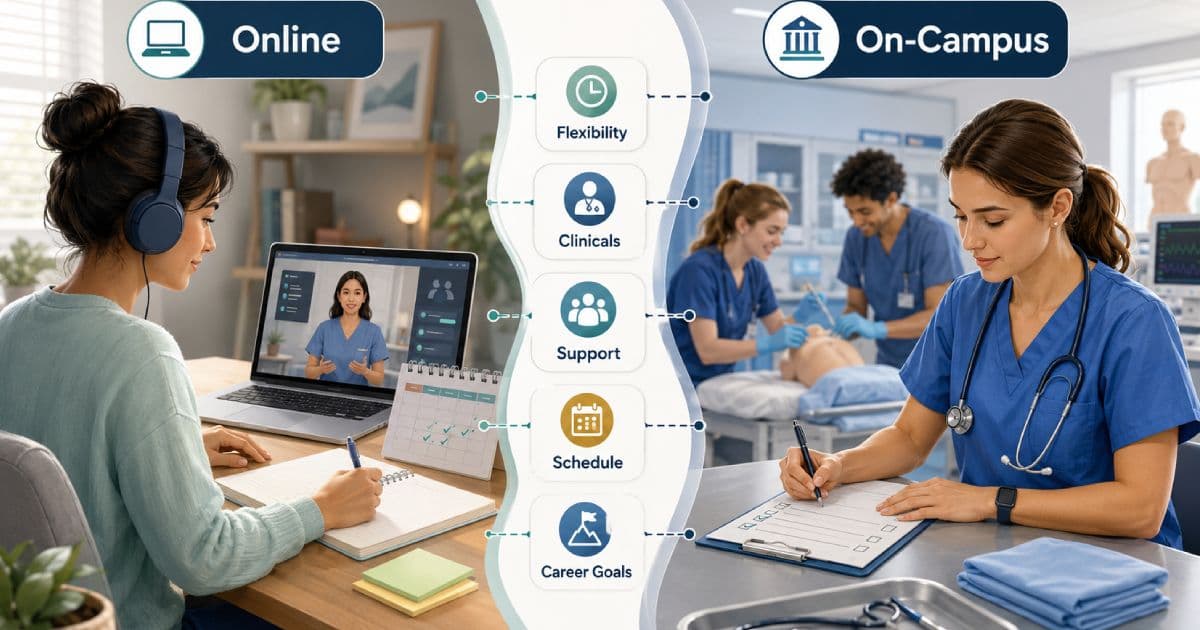
The biggest myth about online nursing school is also the easiest one to clear up:
You cannot become a safe new nurse through screen time alone.
Lectures can be online. Quizzes can be online. Discussion boards can be online. But prelicensure nursing education still requires hands-on skills, simulation, and supervised clinical practice. Patients are real. IV pumps are real. Assessments are real. Communication under pressure is real.
So the better question is not, “Are online nursing programs real?”
The better question is:
Does this program give you the right mix of flexibility, clinical support, state approval, accreditation, faculty access, and hands-on practice for the license and job you want?
The first rule: nursing is hands-on
Nursing education has three broad parts:
- Didactic coursework — theory, pathophysiology, pharmacology, leadership, ethics, research, population health, and care concepts.
- Skills and simulation — physical assessment, sterile technique, medication administration, catheterization, IV skills where applicable, communication, emergency scenarios, and clinical judgment practice.
- Clinical practice experiences — supervised patient-care learning in hospitals, clinics, long-term care, community health, behavioral health, public health, or other approved settings.
Online learning can work well for the first part. It can support the second part with virtual preparation and simulation technology. But it cannot erase the need for hands-on practice.
NCSBN’s distance-education guidance says prelicensure and APRN nursing programs increasingly offer distance education outside their home state, and that host states may have their own rules the program must follow. NCSBN also provides state board requirements for prelicensure and APRN distance education.
Official source:
Online, hybrid, and on-campus: what the labels really mean
Nursing schools do not always use these words consistently. Ask what the program actually requires.
Fully online
For nursing, “fully online” usually applies to post-licensure programs such as RN-to-BSN, some MSN tracks, leadership programs, informatics programs, or non-clinical graduate study.
Even then, some programs may require:
- Practicum hours
- Project hours
- Campus intensives
- Proctored exams
- Local preceptor experiences
- On-site skills checks for certain specialties
Hybrid
Hybrid programs mix online coursework with required in-person experiences.
This is common for:
- ABSN programs
- Some prelicensure BSN programs
- Some entry-level master’s programs
- Some graduate nursing programs
Hybrid may mean:
- Online lectures
- Weekly live Zoom sessions
- On-campus skills intensives
- Local clinical rotations
- Simulation days
- Occasional campus weekends
- In-person exams or skills checkoffs
On-campus
On-campus programs deliver most instruction in person. Students usually attend lectures, labs, simulation, exams, faculty office hours, and cohort activities on or near campus.
On-campus programs may still use:
- Online modules
- Recorded lectures
- Learning-management systems
- Virtual simulation
- Online quizzes
- Electronic case studies
Online vs on-campus nursing programs: side-by-side comparison
| Factor | Online / hybrid nursing programs | On-campus nursing programs |
|---|---|---|
| Flexibility | Stronger for lectures and assignments; may offer asynchronous content | Fixed class and lab schedule |
| Clinicals | In person; may be local, regional, or arranged by the school | Usually arranged through established school partnerships |
| Skills labs | Required in person or during intensives for prelicensure programs | Built into the campus schedule |
| Faculty access | Email, LMS, scheduled video meetings, virtual office hours | In-person office hours, hallway questions, lab coaching |
| Peer support | Requires intentional effort through chats, discussion boards, study groups | Easier to form study groups and cohort relationships |
| Best fit | RN-to-BSN, working RNs, rural learners, disciplined students | New nursing students, students needing structure, hands-on learners |
| Main risk | Weak clinical-placement support, state authorization problems, isolation | Less flexibility, commute, campus fees, fixed schedule |
| Credibility | Strong if properly accredited, approved, and outcome-supported | Strong if properly accredited, approved, and outcome-supported |
The biggest decision point: clinical placement
Clinical placement is where many online and hybrid nursing students run into trouble.
Before enrolling, get written answers to these questions:
- Does the school arrange clinical sites, or do students find them?
- Are clinical placements guaranteed?
- Are there approved clinical sites in my state or region?
- How far might I travel?
- Who verifies that a site meets state board and accreditation requirements?
- Who verifies that preceptors are qualified?
- What happens if a clinical site cancels?
- What happens if I move states during the program?
- Does the program meet licensure requirements in the state where I plan to practise?
- Can I complete all required clinical hours before graduation?
State approval and state authorization matter more than marketing
Nursing is licensed state by state. That means online and hybrid programs must be evaluated through the lens of where the school is located, where you are located, and where you want to become licensed.
NCSBN notes that U.S. Department of Education regulations implemented July 1, 2024 apply to PN, RN, and APRN programs that participate in Title IV funding and are designed to meet educational requirements for licensure or certification. NCSBN says programs must determine that their curriculum satisfies educational requirements where the institution is located and, for distance education students, the state where the student is located at enrollment or intends to seek employment.
Official source:
In plain English:
- A program may be legal in one state but not acceptable for licensure in another.
- A school may not be allowed to enroll students from every state.
- A state may have extra rules for out-of-state distance nursing programs.
- Moving during school can create licensing or placement problems.
- A professional-licensure disclosure page is useful, but you should still verify with your state board.
Accreditation still matters
Accreditation is not the same thing as state board approval, but both matter.
State board approval
For prelicensure nursing programs, state board approval is usually the key pathway to NCLEX eligibility in that state.
Programmatic accreditation
Programmatic nursing accreditation is external quality review by a recognized nursing accreditor.
Common accreditors include:
- ACEN
- CCNE
- NLN CNEA, in some cases
CCNE’s 2024 standards for baccalaureate and graduate nursing programs went into effect January 1, 2025. ACEN’s standards describe accreditation expectations used to evaluate educational quality.
Official sources:
- CCNE Standards, Procedures & Guidelines
- CCNE accredited programs directory
- ACEN Standards and Criteria
- ACEN accredited program search
For a deeper breakdown, see NurseZee’s guide to ACEN vs CCNE accreditation.
Can simulation replace clinical hours?
Simulation is important, but it is not a loophole that makes nursing fully online.
NCSBN’s National Simulation Guidelines for Prelicensure Nursing Programs are intended to guide nursing regulatory bodies and nursing education programs in evaluating simulation as a substitute for traditional clinical experience. NCSBN notes that all programs in the National Simulation Study had at least 600 clinical hours and says no evidence is available about substitution outcomes when programs have fewer than 600 hours.
Official source:
The safe takeaway:
- Simulation can be valuable.
- High-quality simulation requires trained faculty, realistic scenarios, and meaningful debriefing.
- State rules vary.
- Simulation does not eliminate the need for hands-on clinical learning.
- You should ask how many hours are simulation, how many are direct clinical, and whether the state board has approved that structure.
Which format fits your degree plan?
Prelicensure ADN or BSN students
If you are not already an RN, be cautious with programs marketed as online.
A hybrid prelicensure program can work if it has:
- State board approval
- Clear NCLEX eligibility
- Strong clinical placement support
- Required in-person labs and simulation
- Transparent travel expectations
- Strong student support
- Strong NCLEX pass rates
- Accreditation or a clear accreditation status
- Permission to serve students in your state
On-campus programs often make the first nursing degree simpler because labs, simulation, faculty support, and clinical placements are built into the local structure.
Online/hybrid may fit if:
- You live in a state the program is approved to serve
- You can travel for intensives
- The school arranges clinicals or has strong local partners
- You are highly self-directed
- You have reliable technology and study space
- You can handle ambiguity and scheduling complexity
On-campus may fit if:
- You need structure
- You learn better face to face
- You want regular lab access
- You want easier access to faculty
- You want school-managed local clinicals
- You need built-in peer support
- You are new to healthcare
RN-to-BSN students
Online often shines for RN-to-BSN.
Why?
You are already licensed. You already completed hands-on prelicensure training. RN-to-BSN programs usually focus on:
- Leadership
- Population health
- Evidence-based practice
- Quality improvement
- Community health
- Policy
- Informatics
- Professional writing
- Care coordination
Some RN-to-BSN programs include practicum or project hours, but they are usually different from prelicensure bedside clinical rotations.
Online RN-to-BSN may fit if:
- You are working as an RN
- You need asynchronous coursework
- Your employer offers tuition reimbursement
- You want to finish while earning RN income
- You are comfortable with writing-heavy courses
On-campus RN-to-BSN may fit if:
- You want face-to-face support
- You are transitioning back to school after a long break
- You prefer in-person accountability
- Your local university has strong transfer agreements
ABSN and second-degree students
Accelerated BSN programs are intense whether online, hybrid, or on campus.
Online/hybrid ABSN programs may advertise flexibility, but the workload is often full-time and fast-moving. Expect:
- Heavy weekly reading
- Proctored exams
- Skills intensives
- Simulation days
- In-person clinicals
- Limited ability to work
- Fast medication-math and pharmacology pace
- Strict progression rules
Ask:
- How many days per week are in person?
- Are clinicals local or far away?
- Can students work during the program?
- What is the attrition rate?
- What is the first-time NCLEX pass rate?
- What happens if a student fails a course?
- Are clinical placements arranged by the school?
Graduate nursing students
Online and hybrid MSN/DNP programs can work well, but clinical placement becomes the major issue.
This is especially true for:
- Nurse practitioner programs
- Nurse-midwifery programs
- Nurse anesthesia programs
- CNS programs
- Post-graduate APRN certificates
Ask:
- Does the school secure preceptors?
- Are students expected to find their own?
- Does the school approve sites before enrollment?
- Are there enough preceptors in my state?
- Does the program meet APRN licensure requirements in my target state?
- Are faculty licensed or authorized where needed?
- How many campus intensives are required?
- Are skills checkoffs in person?
Learning style: who thrives online?
Online nursing students often thrive when they are:
- Self-directed
- Organized
- Comfortable with technology
- Strong readers
- Good at written communication
- Comfortable asking for help early
- Able to build their own weekly schedule
- Willing to participate in discussion boards and virtual groups
- Able to study without external structure
Online may be harder if you:
- Procrastinate without fixed class times
- Need live explanations
- Learn best through hands-on demonstration
- Feel isolated easily
- Struggle with reading-heavy courses
- Need immediate faculty feedback
- Have unreliable internet
- Do not have a quiet study space
Learning style: who thrives on campus?
On-campus nursing students often thrive when they need:
- Routine
- Live lectures
- In-person accountability
- Faculty office hours
- Skills-lab practice
- Peer study groups
- Campus tutoring
- Easier access to simulation labs
- A cohort feeling
On campus may be harder if you:
- Work irregular shifts
- Have childcare constraints
- Live far from campus
- Need to avoid commute costs
- Prefer asynchronous learning
- Have family obligations during class hours
Cost: online is not always cheaper
Online programs can reduce some costs, but not all.
Potential online savings:
- Less commuting
- Less parking
- Fewer campus housing costs
- Ability to keep working
- Fewer relocation costs
- More flexible scheduling
Potential online costs:
- Technology fees
- Proctoring fees
- Travel for intensives
- Hotel stays
- Flights
- Clinical-site onboarding fees
- Background checks in multiple systems
- Lost work hours during clinicals
- Extra childcare during intensives
Potential on-campus costs:
- Transportation
- Parking
- Housing
- Campus fees
- Fixed schedule reducing work hours
- Lab fees
- Simulation fees
Potential on-campus advantages:
- More campus-based scholarships
- More tutoring and student services
- Established clinical contracts
- More predictable in-person access
- Easier relationship building with faculty
Credibility: what employers actually care about
Employers usually do not care that you watched lectures online if the program is legitimate and you can practise safely.
They do care about:
- RN license status
- State approval
- Program accreditation
- NCLEX pass rates
- Clinical preparation
- Reputation with local employers
- New-grad residency eligibility
- References
- Communication skills
- Safety and judgment
- Prior healthcare experience
- Ability to function on a team
For RN-to-BSN and many graduate programs, online coursework is common. For prelicensure programs, employers may look more closely at clinical preparation and school reputation.
Red flags in online nursing programs
Be careful if a program says:
- “100% online RN program” for first-time licensure
- “No clinicals required”
- “No labs required”
- “Guaranteed NCLEX eligibility in all states”
- “Find your own clinicals” without support
- “Accreditation pending” without clear status
- “State approval pending”
- “Enroll now before seats close” with pressure tactics
- “No need to check your state board”
- “Self-paced clinicals”
- “Transfer anywhere” without agreements
- “Fastest program in the country” but weak outcomes
Questions to ask before choosing online or on-campus
State approval and licensure
- Is the program approved by the state board of nursing?
- Does the program meet licensure requirements in my state?
- Does the program meet licensure requirements in the state where I plan to work?
- Can the school enroll students from my state?
- What happens if I move during the program?
- Where is the professional licensure disclosure page?
Accreditation
- Is the nursing program accredited by ACEN, CCNE, NLN CNEA, or another recognized accreditor?
- Is my exact campus and program covered?
- Is accreditation current, initial, continuing, candidate, or pending?
- When is the next review?
Clinicals and labs
- Are clinicals arranged by the school?
- Are sites guaranteed?
- How far can placements be?
- Are weekend, evening, or overnight clinicals required?
- How many in-person lab or simulation days are required?
- What travel is required?
- Who pays for clinical onboarding?
Outcomes
- What is the first-time NCLEX pass rate for the last three years?
- What is the completion or graduation rate?
- What is the attrition rate?
- What percentage of students get delayed because of clinical placement?
- What support exists for students who fail a course?
Support
- How quickly do faculty respond?
- Are office hours live or recorded?
- Is tutoring available?
- Are skills labs open for practice?
- Is there NCLEX prep?
- Are advisors nursing-specific?
- Can I speak with current students or alumni?
Online vs on-campus decision checklist
Best fit by student type
| Student type | Better starting point |
|---|---|
| New student with no healthcare background | On-campus or strong hybrid prelicensure program |
| Rural student without a nearby nursing school | Hybrid program with approved local clinical placement |
| Working LPN/LVN moving toward RN | Hybrid or campus bridge, depending on clinical support |
| Licensed RN completing BSN | Online RN-to-BSN |
| Parent/caregiver needing flexibility | Online/hybrid if clinical schedule is workable |
| Student who needs structure | On-campus |
| Second-degree career changer | ABSN or entry-level master’s; compare hybrid vs campus carefully |
| Future APRN student | Online/hybrid can work, but clinical-placement support is critical |
| Student who struggles with online learning | On-campus or synchronous hybrid |
| Cost-sensitive student | Local ADN plus RN-to-BSN plan |
Frequently asked questions about online vs on-campus nursing programs
Are online nursing programs legitimate?
Yes, if they are properly accredited, state board approved where needed, authorized to serve your state, and able to provide required in-person clinical and lab experiences. The format alone does not make a program good or bad.
Can I become an RN 100% online?
No legitimate prelicensure RN pathway should be understood as fully online. ADN, BSN, ABSN, and entry-level master’s programs require in-person clinical practice and hands-on learning. Some didactic coursework may be online.
Are online RN-to-BSN programs respected?
Often, yes. RN-to-BSN programs are a strong fit for online learning because students are already licensed RNs. Verify accreditation, employer acceptance, cost, practicum requirements, and transfer policies.
Are online ABSN programs really online?
Usually not fully. Many online or hybrid ABSN programs deliver coursework online but require in-person labs, simulation, exams, and clinical rotations.
Do online nursing students have clinicals?
Yes. Prelicensure and clinical graduate nursing students must complete approved in-person clinical experiences. The key question is who arranges them and where they happen.
Do online nursing programs find clinical placements for you?
It depends. Some schools arrange placements. Some help but expect student involvement. Some graduate programs place much of the preceptor search on the student. Get the policy in writing.
Can simulation replace all clinical hours?
No. Simulation can support clinical education and may replace some traditional clinical hours when approved and done well, but it does not eliminate the need for hands-on clinical learning. State rules vary.
Are online programs cheaper than campus programs?
Sometimes, but not always. Online programs may reduce commute or housing costs, but travel for intensives, technology fees, proctoring, clinical onboarding, and lost work time can add up.
Do employers care if my nursing degree was online?
Employers usually care more about your license, accreditation, clinical readiness, communication, safety, and school reputation. For prelicensure programs, clinical preparation and NCLEX outcomes matter a lot.
What is the biggest risk of online nursing school?
For prelicensure and graduate clinical programs, the biggest risks are weak clinical-placement support, state licensure mismatch, isolation, and lack of hands-on faculty access.
What should I verify before enrolling?
Verify state board approval, licensure eligibility in your target state, programmatic accreditation, clinical-placement support, simulation/lab requirements, NCLEX pass rates, completion rates, total cost, and student support.
Is hybrid nursing school better than fully on-campus?
It depends. Hybrid can be ideal for students who need flexibility but still want structured in-person skills and clinical experiences. On-campus may be better if you need routine, face-to-face teaching, and easier access to labs and faculty.
Is on-campus nursing school still the gold standard?
On-campus remains a strong route, especially for first-time nursing students who need structure and hands-on support. But a well-designed hybrid or online program can be legitimate and rigorous if it meets approval, accreditation, clinical, and licensure requirements.
What is the best online nursing program?
The best program depends on your license status, state, schedule, budget, and career goal. For already licensed RNs, an accredited online RN-to-BSN may be ideal. For prelicensure students, the best online/hybrid program is the one with state approval, strong clinical placement, strong outcomes, and clear in-person requirements.
Final thoughts
Online and on-campus nursing programs are not rivals. They are tools.
A strong online or hybrid program can open doors for working RNs, parents, rural students, and career changers. A strong on-campus program can give new nursing students structure, lab access, faculty relationships, and smoother clinical logistics.
The right choice is the one that protects your license pathway and matches how you actually learn.
Before you enroll, check the state board. Verify accreditation. Ask who handles clinical placement. Look at NCLEX and completion outcomes. Calculate total cost. Then choose the format you can finish — not just the one that looks easiest on a website.
Sources and references
- NCSBN: Distance Education
- NCSBN: Board of Nursing Licensure Requirements
- NCSBN: National Simulation Guidelines for Prelicensure Nursing Programs
- CCNE Standards, Procedures & Guidelines
- CCNE accredited programs directory
- ACEN Standards and Criteria
- ACEN accredited program search
- NurseZee: ACEN vs CCNE Accreditation