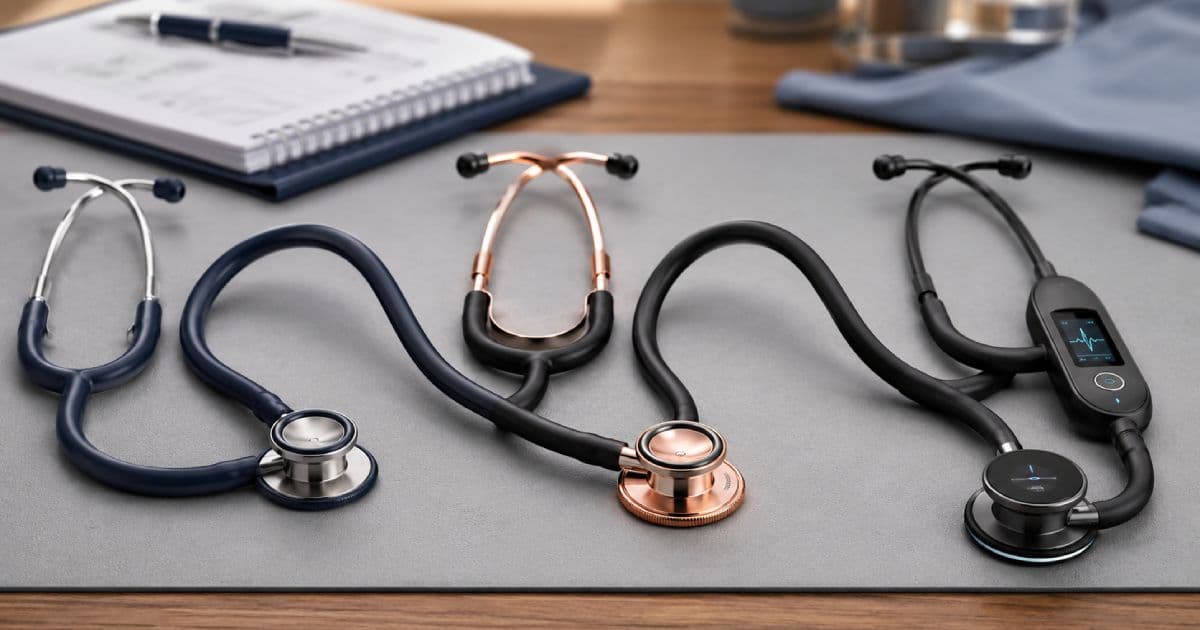
A stethoscope is one of the first clinical tools most nursing students buy.
It is also one of the few tools you may still use years after graduation.
You will use it for:
- Lung sounds
- Heart sounds
- Bowel sounds
- Blood pressure checks
- Vascular checks
- Focused assessments
- Change-of-condition assessments
- Clinical skills checkoffs
- Daily bedside care
You do not need the most expensive stethoscope on the market.
You do need one that lets you hear clearly, fits comfortably, cleans easily, and survives nursing school.
This guide compares the best stethoscopes for nursing students, new nurses, and specialty nurses.
No affiliate links.
No hype.
Just practical buying advice.
What makes a good nursing stethoscope?
A good nursing stethoscope should help you hear body sounds clearly in real clinical settings.
That means:
- Clear acoustics
- Good eartip seal
- Comfortable headset
- Durable tubing
- Easy-to-clean chestpiece
- Reliable diaphragm
- Appropriate chestpiece size
- Reasonable weight
- Warranty or replacement parts
- Fit for your unit
A stethoscope that looks nice but sounds weak will frustrate you in clinical.
A stethoscope that is too expensive for your actual needs may also be a poor choice.
Do nursing students need a "fancy" stethoscope?
Usually, no.
Most nursing students need a dependable clinical stethoscope that works well for adult assessments.
You need to hear:
- Normal and abnormal breath sounds
- Apical pulse
- Basic heart sounds
- Bowel sounds
- Manual blood pressure
- Diminished sounds
- Crackles
- Wheezes
- Rhonchi
- Bruits if taught
- Basic pediatric sounds if your clinicals include pediatrics
You do not need a high-end cardiology or digital stethoscope for most first-semester skills labs.
When a better stethoscope matters
A better stethoscope may help when:
- The unit is noisy
- The patient has a large body habitus
- Breath sounds are faint
- Heart sounds are difficult to hear
- You work in ICU, ED, stepdown, cardiology, respiratory care, or pediatrics
- You have hearing difficulty
- You precept students and want clearer teaching moments
- You use auscultation heavily every shift
How we chose these stethoscopes
This guide focuses on nursing use, not only product specs.
We considered:
- Acoustic performance for bedside assessment
- Fit for nursing school
- Clinical versatility
- Comfort during long shifts
- Durability
- Cleaning and maintenance
- Warranty and replacement parts
- Specialty usefulness
- Digital features when relevant
- Cost-to-value ratio
- Official manufacturer specifications
We avoided ranking only by popularity.
We also avoided assuming every student needs a premium model.
Best stethoscopes for nursing students and nurses: comparison table
| Stethoscope | Best for | Price tier | Key strength | Main drawback |
|---|---|---|---|---|
| 3M Littmann Classic III | Nursing students, med-surg, general nursing | Midrange | Best overall balance of acoustics, durability, and versatility | Not as acoustically strong as cardiology models |
| 3M Littmann Cardiology IV | ICU, ED, stepdown, cardiology | Premium | Stronger acoustics and dual-lumen tubing | Heavier and more expensive |
| 3M Littmann Lightweight II S.E. | Budget-conscious students, basic adult assessments | Budget-mid | Lightest Littmann adult model and comfortable for long shifts | Limited compared with Classic III/Cardiology IV |
| MDF MD One | Value-focused students and nurses | Midrange | Strong build, warranty, replacement parts | Can feel heavier than some alternatives |
| ADC Adscope 615 | Budget-to-midrange clinical use | Midrange | Tunable-style single-sided chestpiece and strong warranty reputation | Less common on nursing school supply lists |
| 3M Littmann CORE Digital | Digital amplification with cardiology-style build | Premium digital | Up to 40x amplification and active noise cancellation | Needs charging and app workflow |
| Eko CORE 500 | Advanced digital use, hearing support, telehealth-adjacent workflows | Premium digital | Amplification, noise cancellation, display, ECG features | Expensive and may be unnecessary for students |
| 3M Littmann Classic II Pediatric/Infant | Pediatrics and neonatal care | Specialty | Chestpiece sized for smaller patients | Not practical as your only adult stethoscope |
Best overall: 3M Littmann Classic III
The 3M Littmann Classic III is the safest recommendation for most nursing students.
It is widely used in nursing school and bedside nursing because it balances sound quality, durability, price, and versatility.
Why it works for nursing students
The Classic III gives you:
- Dual-sided chestpiece
- Tunable diaphragms
- Adult and pediatric assessment flexibility
- Good acoustic sensitivity
- Soft-sealing eartips
- Many color and finish options
- Replacement parts availability
- Strong brand recognition
3M describes the Classic III as a two-sided stethoscope with tunable diaphragms used by students and medical professionals for heart, lung, and other body sounds.
Best for
Choose the Classic III if you are:
- Starting nursing school
- Buying your first real stethoscope
- Working med-surg
- Working telemetry
- Working outpatient clinic
- Working long-term care
- Working home health
- Unsure of your future specialty
- Trying to avoid overbuying
Pros
- Works for most nursing school needs
- More versatile than entry-level scopes
- Strong enough for general assessment
- Lighter than many cardiology stethoscopes
- Adult and pediatric sides add flexibility
- Durable enough for nursing school and early practice
- Easy to find replacement parts
Cons
- Not as sensitive as the Cardiology IV
- Single-lumen tubing is not the highest-end acoustic design
- More expensive than very basic models
- Easy to misplace because many classmates may have the same model
NurseZee take
Most nursing students should buy the Littmann Classic III unless the school requires something else.
It is the "buy once for school and early nursing practice" choice.
Best use:
Nursing school, med-surg, telemetry, clinic, long-term care, general bedside nursing.

Skip if:
You already know you need digital amplification or cardiology-level acoustics.Best high-acuity upgrade: 3M Littmann Cardiology IV
The 3M Littmann Cardiology IV is the upgrade pick for nurses who need stronger acoustics.
It is popular among ICU, ED, stepdown, cardiology, rapid response, and advanced assessment users.
Why it stands out
The Cardiology IV offers:
- High-sensitivity acoustics
- Dual-sided chestpiece
- Tunable diaphragms
- Dual-lumen tubing
- Soft-sealing eartips
- Adjustable headset
- Non-chill rim
- Better sound isolation than basic scopes
3M describes the Cardiology IV as offering outstanding high-sensitivity acoustics and dual-lumen tubing that eliminates rubbing noise from traditional double tubes.
Best for
Choose the Cardiology IV if you:
- Work in ICU
- Work in ED
- Work in stepdown
- Work in cardiology
- Want stronger sound isolation
- Hear faint lung sounds often
- Need to assess in noisy environments
- Plan to keep the same scope for years
Pros
- Excellent acoustic clarity
- Better for faint or subtle sounds
- Strong choice for high-acuity units
- Dual-lumen tubing improves sound transmission
- Durable and professional
- Good long-term investment if you use it heavily
Cons
- More expensive
- Heavier than Classic III
- May be unnecessary for first-semester nursing students
- Can be overkill for basic vital signs and routine checks
Classic III vs Cardiology IV
| Feature | Littmann Classic III | Littmann Cardiology IV |
|---|---|---|
| Best for | Students and general nursing | High-acuity and advanced assessment |
| Acoustic level | Strong general clinical acoustics | Higher sensitivity |
| Tubing | Single lumen | Dual lumen |
| Weight | Lighter | Heavier |
| Cost | Lower | Higher |
| Student-friendly | Very | Good, but more than most students need |
| ICU/ED fit | Good | Better |
NurseZee take
If you are a nursing student on a budget, the Classic III is enough.
If you are entering ICU, ED, stepdown, cardiology, or respiratory-heavy care, the Cardiology IV is a reasonable upgrade.
Best use:
ICU, ED, stepdown, cardiology, rapid response, high-acuity adult assessment.

Skip if:
You need a basic school stethoscope and cost matters.
Best lightweight budget Littmann: 3M Littmann Lightweight II S.E.
The Littmann Lightweight II S.E. is the budget-friendly Littmann option.
It is designed for blood pressure monitoring and limited adult physical assessments.
3M lists it as an entry-level instrument with a tunable diaphragm, double-sided chestpiece, adjustable headset, and a 118 g weight.
Best for
Choose the Lightweight II S.E. if you:
- Need a lower-cost Littmann
- Want a very light stethoscope
- Mostly need manual blood pressures
- Are in CNA, LPN, or early nursing school settings
- Want a backup scope
- Work in lower-acuity environments
Pros
- Lightest Littmann adult model
- Comfortable for long wear
- More affordable than Classic III
- Good for blood pressure checks
- Tunable diaphragm
- Adjustable headset
Cons
- Designed for limited adult assessment
- Not ideal for complex cardiac or pulmonary assessment
- Less versatile than Classic III
- Not the best long-term choice if you want one scope for nursing school and ICU/ED later
NurseZee take
The Lightweight II S.E. can work for basic student needs if budget is tight.
But if you can afford the Classic III, choose the Classic III.
Best use:
Basic adult assessments, BP checks, budget-conscious students, backup stethoscope.

Skip if:
You want one stethoscope to carry through nursing school, med-surg, and higher-acuity practice.
Best value alternative: MDF MD One
The MDF MD One is a strong alternative to Littmann for students and nurses who want durability and value.
MDF is known for replacement parts support and warranty coverage.
The MD One line is commonly chosen by students who want something reliable without paying for a premium cardiology model.
Why it stands out
Depending on model, MDF MD One stethoscopes may offer:
- Stainless steel or titanium chestpiece options
- Dual-head chestpiece
- Thick tubing
- Soft eartips
- Lifetime warranty
- Free replacement parts program
- Many colors and finishes
MDF's official materials highlight lifetime warranty and Free-Parts-For-Life support for the MD One Epoch series.
Best for
Choose MDF MD One if you:
- Want a Littmann alternative
- Like strong warranty support
- Want color/style options
- Prefer a heavier, solid-feeling chestpiece
- Want value without going ultra-cheap
Pros
- Durable build
- Strong warranty/parts support
- Good price-to-performance balance
- Many design options
- Often less expensive than premium Littmann models
Cons
- Can feel heavier than comparable options
- Less commonly required by nursing schools
- Acoustic preferences vary by user
- Some models may be more than a student needs
NurseZee take
MDF MD One is a good pick if you want strong value and do not need a Littmann label.
Best use:
Nursing school, general bedside nursing, students who want value and warranty support.

Skip if:
Your program specifically requires a Littmann or you want the most familiar school-recommended option.
Strong budget-to-midrange option: ADC Adscope 615
The ADC Adscope 615 is another strong option for students and nurses who want a clinician-grade stethoscope outside the Littmann ecosystem.
ADC describes the Adscope 615 as having an oversized one-sided chestpiece with adjustable frequency diaphragm technology for both high- and low-frequency response.
Best for
Choose ADC Adscope 615 if you:
- Want a good value clinical stethoscope
- Like a single-sided chestpiece
- Want an alternative to Littmann and MDF
- Want warranty support
- Prefer midrange pricing
Pros
- Good value
- Adjustable frequency diaphragm design
- Strong warranty reputation
- Clinical-grade alternative
- Good for general assessments
Cons
- Less common on nursing school lists
- Some nurses prefer a traditional dual-sided design
- Not as well-known among classmates and instructors as Littmann
NurseZee take
ADC Adscope 615 is worth considering if you want a non-Littmann option with solid features and value.
Best use:
General nursing assessment, nursing school, clinical rotations, budget-conscious new nurses.

Skip if:
You want the most universally recognized nursing school stethoscope.
Best digital upgrade: 3M Littmann CORE Digital
The 3M Littmann CORE Digital Stethoscope is a digital upgrade built around the familiar Littmann cardiology-style platform.
3M describes it as offering up to 40x amplification at peak frequency, active noise cancellation, and sound wave visualization through a companion app.
Best for
Choose Littmann CORE Digital if you:
- Need amplification
- Work in noisy environments
- Want a digital mode and analog-style use
- Want to record or visualize sounds when appropriate
- Are an advanced student, preceptor, or experienced nurse
- Have hearing challenges and need a digital solution
Pros
- Up to 40x amplification
- Active noise cancellation
- Digital and analog-style use
- Useful for teaching and sound visualization
- Strong acoustic foundation
Cons
- Expensive
- Requires charging
- App use may be restricted by facility policy
- Recording patient sounds can raise privacy and consent issues
- Usually unnecessary for first-semester students
NurseZee take
The Littmann CORE Digital is excellent for the right user.
It is not the best default nursing school purchase.
Best use:
Hearing support, noisy environments, teaching, advanced assessment.

Skip if:
You only need a reliable first stethoscope for nursing school.
Best advanced digital option: Eko CORE 500
The Eko CORE 500 is a premium digital stethoscope.
Eko describes it as combining digital auscultation with a full-color display and ECG features. Official product materials list a 3-lead ECG function, rechargeable battery, app features, and digital listening support.
Eko's European product page also describes TrueSound technology with active noise cancellation and up to 40x sound amplification.
Best for
Choose Eko CORE 500 if you:
- Need strong amplification
- Work in very noisy settings
- Have hearing difficulty
- Use digital auscultation in approved workflows
- Want ECG-related display features
- Are an experienced nurse or clinician who will use advanced features often
Pros
- Digital amplification
- Active noise cancellation
- Full-color display
- ECG-related features
- App ecosystem
- Useful for some hearing-support needs
- Strong technology platform
Cons
- Very expensive
- Requires charging
- More technology than most nursing students need
- Facility policy may restrict recording, app use, or data storage
- Can distract beginners from learning basic auscultation technique
- Not always ideal for school skills checkoffs
NurseZee take
The Eko CORE 500 is a specialty tool.
It can be powerful for the right nurse, but it is not the practical first choice for most nursing students.
Best use:
Digital auscultation, hearing support, advanced users, approved tech-enabled workflows.

Skip if:
You are buying your first nursing school stethoscope and need simple, durable, affordable equipment.Best pediatric and infant stethoscope: 3M Littmann Classic II Pediatric or Infant
If you work primarily with children or newborns, a dedicated pediatric or infant stethoscope can help you get a better seal on smaller bodies.
3M describes Littmann Classic II Pediatric and Infant models as two-sided stethoscopes designed and sized for children and infants.
Pediatric vs infant
The pediatric model is designed for smaller children.
The infant model is designed for the smallest patients.
The smaller chestpiece helps create a better seal on small chests.
Best for
Choose a pediatric or infant scope if you:
- Work pediatrics
- Work NICU
- Work newborn nursery
- Work pediatric clinic
- Work pediatric cardiac, respiratory, or emergency care
- Need a dedicated scope for small patients
Pros
- Proper chestpiece size for smaller patients
- Better fit than adult chestpieces on infants
- Useful in pediatric assessment
- Non-chill features improve comfort
- Strong choice for specialty units
Cons
- Too specialized as your only stethoscope
- Not practical for adult nursing
- Most nursing students can start with Classic III and upgrade later if they specialize
NurseZee take
Do not buy a pediatric-only stethoscope as your only nursing school stethoscope unless your program or job specifically requires it.
Best use:
Pediatrics, newborn nursery, NICU, pediatric specialty care.

Skip if:
You need one general stethoscope for adult clinical rotations.
Best stethoscope by nursing role
Nursing student
Best pick:
3M Littmann Classic IIIBudget alternative:
3M Littmann Lightweight II S.E. or ADC Adscope 615Why:
You need a reliable all-purpose stethoscope that works for skills lab and most clinical rotations.
New grad med-surg nurse
Best pick:
3M Littmann Classic IIIUpgrade:
3M Littmann Cardiology IVWhy:
Med-surg nurses need to assess lung sounds, bowel sounds, heart sounds, edema, pain, oxygen needs, and condition changes quickly.
ICU nurse
Best pick:
3M Littmann Cardiology IVDigital option:
3M Littmann CORE DigitalWhy:
ICU nurses often assess subtle changes in breath sounds, heart sounds, fluid status, and patient deterioration in noisy environments.
ED nurse
Best pick:
3M Littmann Cardiology IVAlternative:
3M Littmann Classic IIIWhy:
ED nurses need durability, fast assessments, and better sound isolation in a loud setting.
Pediatric nurse
Best pick:
3M Littmann Classic II PediatricGeneral backup:
3M Littmann Classic IIIWhy:
Smaller chestpieces help with pediatric patients, but many nurses still keep an adult/general stethoscope.
NICU nurse
Best pick:
3M Littmann Classic II InfantWhy:
Neonatal assessment requires a very small chestpiece and good seal.
Clinic nurse
Best pick:
3M Littmann Classic IIIBudget option:
3M Littmann Lightweight II S.E.Why:
Clinic nurses often use stethoscopes for focused assessments, BP checks, respiratory complaints, and follow-up visits.
Long-term care nurse
Best pick:
3M Littmann Classic IIIBudget option:
ADC Adscope 615 or MDF MD OneWhy:
Long-term care nurses need reliable lung, heart, bowel, and blood pressure assessment across many residents.
Nurse with hearing difficulty
Best pick:
3M Littmann CORE Digital or Eko CORE 500Why:
Digital amplification and noise cancellation may help some clinicians. Check school, employer, and privacy rules before buying.
Key stethoscope features explained
Acoustic sensitivity
Acoustic sensitivity means how well the stethoscope transmits sound.
Better acoustic sensitivity can help you hear subtle sounds such as:
- Faint crackles
- Diminished breath sounds
- Murmurs
- Gallops
- Rubs
- Bruits
- Very quiet bowel sounds
Most nursing students need good general acoustic sensitivity.
High-acuity nurses may benefit from stronger cardiology-level acoustics.
Single-lumen vs dual-lumen tubing
Single-lumen tubing has one sound pathway.
Dual-lumen tubing has two sound pathways, one for each ear, inside a single tube.
Dual-lumen designs can improve sound quality and reduce rubbing noise compared with traditional separate double tubes.
The Littmann Cardiology IV uses dual-lumen tubing.
Tunable diaphragm
A tunable diaphragm lets you hear different frequency sounds by changing pressure.
Light pressure can help pick up lower-frequency sounds.
Firm pressure helps pick up higher-frequency sounds.
This is common in Littmann models and similar technologies from other brands.
Bell vs diaphragm
The diaphragm is the flat side used for higher-pitched sounds.
Common uses:
- Breath sounds
- Bowel sounds
- Normal heart sounds
- Some vascular sounds
The bell is the cup-shaped side used for lower-pitched sounds.
Common uses:
- Some murmurs
- S3 and S4 gallops
- Bruits in some assessment contexts
Many modern stethoscopes use tunable diaphragms instead of a traditional open bell.
Chestpiece size
Adult chestpieces work well for most adult assessments.
Pediatric and infant chestpieces are smaller.
A chestpiece that is too large may not seal well on a small child or neonate.
A chestpiece that is too small may be inefficient for adult assessments.
Eartip seal
Poor eartip seal is one of the most common reasons students think they cannot hear.
Soft-sealing eartips help block ambient noise.
Make sure the eartips are:
- Proper size
- Pointed forward into your ear canals
- Fully attached
- Clean
- Not cracked
- Comfortable
Headset angle
The eartubes should angle forward.
If they point backward, sound will be poor and the stethoscope will feel uncomfortable.
Weight
Heavier stethoscopes may have stronger chestpieces and acoustics.
They can also feel annoying over a 12-hour shift.
If neck comfort matters, compare weights before buying.
Tubing length
Longer tubing can help with comfort and positioning.
Very long tubing may slightly affect sound transmission depending on model.
Most nursing students can use standard lengths.
How much should nursing students spend on a stethoscope?
Most students should avoid both extremes.
Do not buy the cheapest no-name stethoscope if you cannot hear well with it.
Do not buy a premium digital model unless you have a clear reason.
Practical budget tiers
| Budget tier | What it usually gets you | Best for |
|---|---|---|
| Low budget | Basic BP and limited assessment | Backup, early skills, tight budget |
| Midrange | Good clinical acoustics and durability | Most nursing students |
| Premium | Stronger acoustics and specialty use | ICU, ED, cardiology, advanced users |
| Premium digital | Amplification, noise cancellation, app features | Hearing support, digital workflows, teaching |
Best spending rule
Buy the least expensive stethoscope that still lets you hear clearly and meets your school or unit requirements.
For most students, that means a midrange model like the Classic III or a comparable MDF/ADC option.
What not to buy
Do not buy a toy-quality stethoscope
Very cheap stethoscopes can make learning harder.
If you cannot hear clearly, you may blame yourself when the tool is the problem.
Do not buy pediatric-only as your first scope
Unless your school requires it, a pediatric-only scope is too specialized for general nursing school.
Do not buy digital before checking school rules
Some programs may not allow digital stethoscopes during skills checkoffs or exams.
Some facilities may restrict recording or app features.
Do not buy based only on color
Color matters less than acoustics, comfort, cleaning, and durability.
That said, a unique color can help you identify your scope quickly.
Do not buy from suspicious sellers
Counterfeit stethoscopes exist.
Buy from:
- Manufacturer site
- Authorized dealer
- Trusted medical supplier
- Campus bookstore if reasonably priced
Check warranty registration and packaging.
Stethoscope accessories worth buying
Name tag or engraving
Stethoscopes disappear.
Engraving or an ID tag helps.
Put your name somewhere visible.
Spare eartips
Eartips can fall off or wear out.
Keep a spare set.
Spare diaphragm
A cracked diaphragm hurts sound quality.
Replacement diaphragms are usually inexpensive.
Case
A case protects your stethoscope in a backpack.
It also keeps it cleaner.
Clip or holster
A clip can help if you do not like wearing the scope around your neck.
Alcohol wipes
Clean between patients according to facility policy.
Avoid unnecessary accessories
You do not need:
- Decorative charms that interfere with cleaning
- Heavy add-ons
- Unapproved electronic attachments
- Accessories that touch patients but cannot be cleaned properly
How to clean and care for your stethoscope
Your stethoscope touches patients.
Clean it regularly.
3M recommends cleaning stethoscope parts with 70% isopropyl alcohol or mild soapy water, drying parts thoroughly before reassembly.
3M cleaning guidance also says the diaphragm or bell surface should be wiped with 70% isopropyl alcohol between patients and ideally immediately before use.
Basic cleaning steps
1. Wipe diaphragm and bell/chestpiece with approved disinfectant.
2. Wipe tubing if contaminated or between patient care per policy.
3. Clean eartips regularly.
4. Let surfaces dry.
5. Inspect diaphragm and eartips.
6. Replace damaged parts.
What not to do
Do not:
- Submerge the stethoscope
- Steam sterilize it unless manufacturer says it is safe
- Use harsh chemicals not approved by the manufacturer
- Leave it in extreme heat
- Leave it in direct sunlight for long periods
- Stretch tubing excessively
- Fold it tightly in your pocket
- Store it loose with pens, scissors, and sharps
Skin oil and tubing
Skin oils can affect tubing over time.
Avoid wearing your stethoscope directly against bare skin for long periods.
Wear it over a collar or use a clip.
Inspect your stethoscope
Check:
- Diaphragm cracks
- Loose retaining ring
- Missing eartip
- Cracked tubing
- Bent headset
- Poor seal
- Sound loss
- Sticky tubing
- Battery level if digital
How to use a stethoscope correctly
A good scope only helps if you use it correctly.
Put the eartips in the right direction
The eartips should point forward, toward your nose.
If they point backward, sound will be muffled.
Create a full seal
Press the chestpiece flat against skin.
Avoid listening over thick clothing when you need accurate sounds.
Reduce noise
Try to:
- Turn down TV if appropriate
- Ask the patient not to talk during auscultation
- Warm the chestpiece if needed
- Move tubing away from rubbing surfaces
- Close the door or curtain when possible
- Listen in a consistent pattern
Know what you are listening for
Do not just place the scope and hope.
Ask:
Am I listening to lung sounds, heart sounds, bowel sounds, or blood pressure?
What is normal here?
What would be abnormal?
Is this finding new for this patient?
Do I need to compare sides?
Do I need to notify someone?
Practice often
Practice on classmates, simulation mannequins, family members if appropriate, and clinical patients under supervision.
The more normal sounds you hear, the easier abnormal sounds become.
Stethoscope buying guide by budget
Tight budget
Start here if money is the biggest concern.
Options to consider:
- 3M Littmann Lightweight II S.E.
- ADC Adscope 615
- MDF entry-level or MD One models if priced well
- Used premium scope only if clean, authentic, and in good condition
Avoid:
- No-name scopes with poor reviews
- Broken used scopes
- Missing diaphragms or eartips
- Pediatric-only scopes for adult clinicals
Best value
Start here for most students.
Options:
- 3M Littmann Classic III
- MDF MD One
- ADC Adscope 615
These can usually cover nursing school and early RN practice.
Premium acoustic
Start here for high-acuity plans.
Options:
- 3M Littmann Cardiology IV
- ADC Adscope 600
- Comparable cardiology-grade models
Premium digital
Start here only with a clear need.
Options:
- 3M Littmann CORE Digital
- Eko CORE 500
Digital scopes are not default student purchases.
How to choose your first nursing school stethoscope
Use this decision tree.
Does your school require a specific model?
Yes -> Buy the required model.
No -> Continue.

Do you have hearing difficulty or need amplification?
Yes -> Ask school/facility if digital scopes are allowed, then compare Littmann CORE or Eko.
No -> Continue.

Is your budget very tight?
Yes -> Compare Littmann Lightweight II S.E., ADC Adscope 615, and MDF options.
No -> Continue.

Do you want one safe choice for nursing school and early practice?
Yes -> Buy Littmann Classic III.
No -> Continue.

Are you already committed to ICU, ED, stepdown, or cardiology?
Yes -> Consider Littmann Cardiology IV.
No -> Buy Classic III or a comparable midrange model.
Common mistakes students make
Mistake 1: Buying before checking the supply list
Some schools require a dual-head acoustic stethoscope.
Some prohibit digital models during checkoffs.
Check first.
Mistake 2: Wearing it backward
If you cannot hear, check eartip direction before blaming the scope.
Mistake 3: Listening over clothing
For accurate assessment, listen on skin when appropriate and culturally respectful.
Mistake 4: Never cleaning it
A stethoscope moves from patient to patient.
Clean it.
Mistake 5: Leaving it unattended
Stethoscopes get lost fast.
Label it.
Mistake 6: Overbuying
A $400+ digital scope is not required for most nursing students.
Mistake 7: Underbuying
A poor-quality scope can make assessment harder than it needs to be.
Mistake 8: Ignoring comfort
If the eartips hurt, you will avoid using it.
Try different eartip sizes if possible.
Best stethoscope recommendations by scenario
"I am starting nursing school and want one safe choice."
Buy:
3M Littmann Classic IIIWhy:
It works for most adult and basic pediatric assessments, is widely recognized, and should last beyond graduation.
"I am broke but need something acceptable."
Consider:
3M Littmann Lightweight II S.E.
ADC Adscope 615
MDF option within your budget
Why:
These can cover basic assessment needs better than very cheap no-name options.
"I want ICU or ED right after graduation."
Consider:
3M Littmann Cardiology IVWhy:
Higher acoustic sensitivity and dual-lumen tubing help in noisy, high-acuity settings.
"I have hearing difficulty."
Consider:
3M Littmann CORE Digital
Eko CORE 500
Also:
Check school/facility policy.
Try before buying.
Ask about reasonable accommodations if needed.
"I am going into pediatrics."
Start with:
3M Littmann Classic IIIThen add:
3M Littmann Classic II Pediatricif your job truly focuses on children.
"I am going into NICU."
Consider:
3M Littmann Classic II InfantBut confirm with your unit.
Many NICUs have unit-specific equipment and infection control rules.
Stethoscope comparison: Classic III vs Cardiology IV
This is the most common student upgrade question.
Choose Classic III if
- You are in nursing school
- You work med-surg
- You work clinic
- You want a lighter model
- You want strong value
- You are still deciding your specialty
Choose Cardiology IV if
- You work ICU, ED, stepdown, or cardiology
- You want stronger acoustic performance
- You assess in noisy environments
- You frequently listen for subtle sounds
- You are comfortable with the higher price and weight
Simple answer
Classic III is enough for most nursing students.
Cardiology IV is a strong upgrade for high-acuity nurses.
Stethoscope comparison: Littmann vs MDF
Both can work.
Littmann strengths
- Widely recognized
- Common on nursing school supply lists
- Strong replacement part availability
- Strong acoustic reputation
- Many models by acuity level
MDF strengths
- Strong warranty/parts support
- Durable build
- Good value
- Many colors and finishes
- Good alternative for students who do not want Littmann
Simple answer
Choose Littmann Classic III if you want the safest school-friendly pick.
Choose MDF MD One if you want a durable alternative with strong value and parts support.
Stethoscope comparison: acoustic vs digital
Acoustic stethoscope
Best for:
- Most nursing students
- Skills checkoffs
- General bedside care
- No charging
- Simple cleaning
- Lower cost
- Fewer privacy concerns
Digital stethoscope
Best for:
- Hearing support
- Noisy environments
- Sound amplification
- Teaching with visualization
- Approved recording workflows
- Specialty users
Simple answer
Start acoustic unless you have a specific reason to buy digital.Frequently asked questions about stethoscopes for nursing students and nurses
What is the best stethoscope for nursing students?
The 3M Littmann Classic III is the best overall choice for most nursing students because it offers strong general acoustics, a dual-sided chestpiece, tunable diaphragms, and enough versatility for most clinical rotations.
Is the Littmann Classic III good enough for nursing school?
Yes. The Classic III is more than enough for most nursing school skills labs and clinical rotations unless your program requires a different model.
Is the Littmann Cardiology IV worth it for nursing students?
It can be worth it if you have the budget and expect to work in ICU, ED, stepdown, or cardiology. For most first-semester students, the Classic III is the better value.
What is the difference between Littmann Classic III and Cardiology IV?
The Classic III is a midrange general clinical stethoscope. The Cardiology IV has stronger acoustic performance and dual-lumen tubing, making it better for subtle sounds and noisy environments. It is also heavier and more expensive.
Is a cheap stethoscope okay for nursing school?
A low-cost stethoscope can work if it has decent sound quality and meets school requirements. Very cheap no-name scopes may make learning harder because faint sounds can be difficult to hear.
What is the best budget stethoscope for nursing students?
The Littmann Lightweight II S.E., ADC Adscope 615, and MDF options are reasonable budget-to-midrange choices. If you can afford it, the Littmann Classic III remains the safer long-term student pick.
Are MDF stethoscopes good for nursing students?
Yes, MDF stethoscopes can be good options for nursing students, especially if you value durability, warranty support, and replacement parts. Check your school supply list before buying.
Are digital stethoscopes allowed in nursing school?
Sometimes, but not always. Some schools restrict digital scopes during checkoffs or testing. Ask before buying one.
Who should buy a digital stethoscope?
Digital stethoscopes may be useful for nurses with hearing difficulty, clinicians working in noisy environments, preceptors teaching auscultation, or approved digital workflows. Most students do not need one.
What is the best stethoscope for ICU nurses?
The 3M Littmann Cardiology IV is a strong ICU choice because of its acoustic sensitivity and dual-lumen tubing. Digital options may help if amplification is needed.
What is the best stethoscope for ED nurses?
The Littmann Cardiology IV is a strong ED choice because the ED is noisy and assessments can be high-acuity. The Classic III is still acceptable for many ED nurses.
What is the best stethoscope for pediatric nurses?
The Littmann Classic II Pediatric is a strong dedicated pediatric choice. Nursing students should usually start with Classic III unless they are specifically assigned to pediatric or neonatal practice.
Do I need a pediatric stethoscope for nursing school?
Usually no. A general adult stethoscope like the Classic III is enough for most nursing school rotations. Buy a pediatric or infant scope later if your specialty requires it.
How long should a stethoscope last?
A high-quality stethoscope can last years with proper cleaning, storage, and part replacement. Tubing, eartips, and diaphragms may need replacement before the whole scope does.
How do I clean a stethoscope?
Follow manufacturer and facility policy. For Littmann stethoscopes, 3M recommends 70% isopropyl alcohol or mild soapy water for stethoscope parts and drying thoroughly before reassembly.
Can I use bleach wipes on my stethoscope?
Check the manufacturer instructions and facility policy. Some harsh chemicals may damage tubing or finish. Alcohol wipes are commonly recommended for many models.
Should I engrave my stethoscope?
Yes, if possible. Engraving or an ID tag helps prevent loss and mix-ups, especially if many students use the same model.
Should I wear my stethoscope around my neck?
You can, but avoid prolonged direct contact with bare skin because skin oils can affect tubing over time. Wearing it over a collar or using a clip can help.
What color stethoscope should I buy?
Choose a color you like and can identify easily. Dark colors may show less staining. Bright or uncommon colors may be easier to spot.
Can nurses use cardiology stethoscopes?
Yes. Nurses can use cardiology stethoscopes. They are especially useful in high-acuity, cardiac, respiratory, ED, and ICU settings.
Final thoughts
Most nursing students do not need the most expensive stethoscope.
They need a dependable one.
For most students, the Littmann Classic III is the best first choice.
If you are going into ICU, ED, stepdown, or cardiology, the Cardiology IV is a strong upgrade.
If budget is tight, compare the Littmann Lightweight II S.E., MDF MD One, and ADC Adscope 615 before buying a no-name scope.
If you need hearing support or advanced digital features, look at Littmann CORE or Eko CORE 500 after checking school and facility rules.
The right stethoscope should help you hear better, assess more confidently, and focus on the patient instead of fighting your equipment.
Sources and references
- 3M Littmann: Classic III Stethoscope
- 3M Littmann: Cardiology IV Diagnostic Stethoscope
- 3M Littmann: Lightweight II S.E. Stethoscope
- 3M Littmann: CORE Digital Stethoscope
- 3M Littmann: Classic II Infant Stethoscope
- 3M Littmann: Classic II Pediatric Stethoscope
- 3M Littmann: Cleaning and Care
- 3M Littmann: Cleaning and Care Tips PDF
- MDF Instruments: MD One Epoch Titanium Stethoscopes
- ADC: Adscope 615
- ADC: Adscope 600
- Eko Health: CORE 500 Digital Stethoscope
- Eko Health Europe: CORE 500 Digital Stethoscope
- NurseZee: Nursing Report Sheet Template
- NurseZee: How to Get Your First Nursing Job After Graduation
- NurseZee: New Grad Nurse Resume
- NurseZee: New Grad Nurse Interview Questions and Answers
- NurseZee: NCLEX Lab Values Cheat Sheet