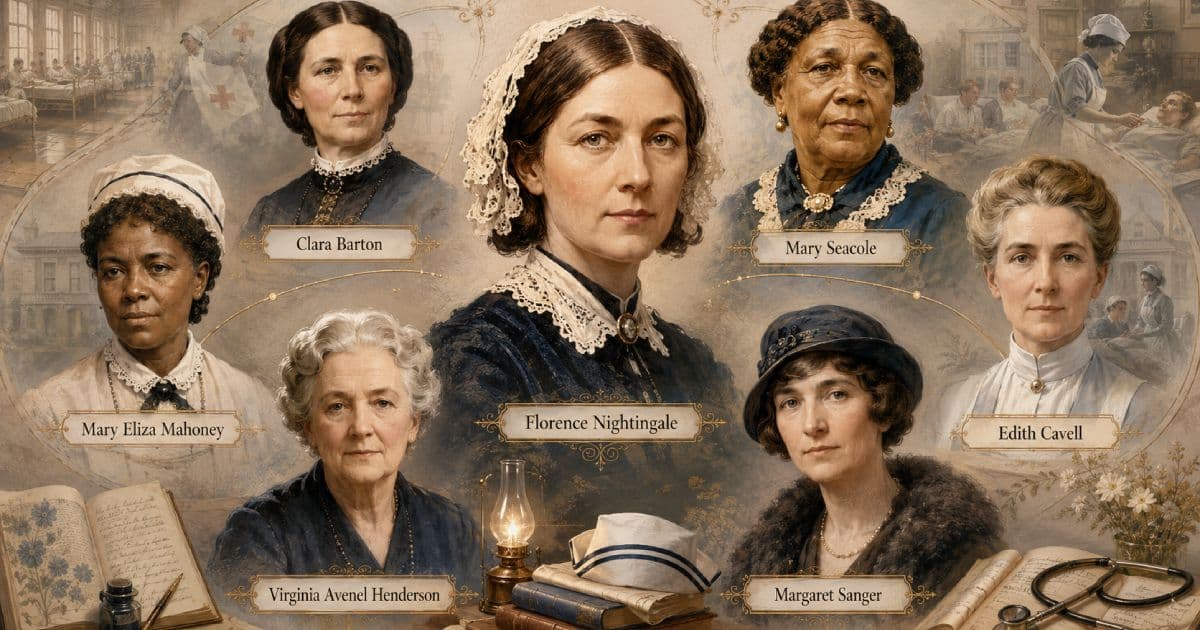
Nursing was not built by one person, one school, or one war.
It was shaped by people who cleaned wards, counted deaths, challenged racism, organized relief systems, trained nurses, defended human dignity, and pushed public health into uncomfortable political territory.
The seven women in this guide did not all practise nursing in the same way. Some were bedside caregivers. Some were educators, theorists, organizers, or activists. One has a legacy that remains deeply debated. But each changed how nurses think about care, evidence, equity, courage, autonomy, and systems.
1. Florence Nightingale: the nurse who made data impossible to ignore
Dates: 1820-1910 Best known for: Crimean War nursing, sanitation reform, statistics, and professional nursing education Core lesson for nurses: Compassion matters more when it is paired with evidence.
Florence Nightingale is often remembered as “the Lady with the Lamp,” but that nickname can make her sound softer and less disruptive than she was.
During the Crimean War, Nightingale arrived at Scutari and found filthy conditions, poor ventilation, overcrowding, inadequate supplies, and preventable suffering. Her reforms focused on environmental basics that still matter in health care: cleanliness, ventilation, nutrition, observation, and sanitation.
After the war, Nightingale used statistics to make the case for reform. Her polar area diagrams, sometimes called coxcomb diagrams, helped show that preventable disease killed far more soldiers than battle wounds. The point was not just to describe suffering. It was to persuade military and political leaders to change conditions.
Nightingale later helped establish formal nurse training through the Nightingale Training School at St Thomas’ Hospital, shaping nursing as a disciplined, educated profession.
Official and historical sources:
- The National Archives: Florence Nightingale
- Science Museum: Florence Nightingale, the pioneer statistician
2. Clara Barton: the organizer who turned relief into a national mission
Dates: 1821-1912 Best known for: Civil War relief work and founding the American Red Cross Core lesson for nurses: When the system does not reach people in need, build a better response.
Clara Barton did not wait for a perfect job title before acting.
During the U.S. Civil War, she brought supplies and support to soldiers in the field, often close to the fighting. Her work earned her the nickname “Angel of the Battlefield.” After the war, she helped identify missing soldiers and communicate with families seeking news of loved ones.
Barton later studied the Red Cross movement in Europe and founded the American Red Cross in 1881. The American Red Cross says she led the organization for 23 years. Under her leadership, the Red Cross expanded beyond wartime relief and became a force in disaster response.
Barton’s legacy is not only battlefield courage. It is logistics, persistence, advocacy, and the belief that organized relief can reduce suffering at scale.
Official source:
3. Mary Seacole: the Jamaican healer who made her own path to the Crimea
Dates: 1805-1881 Best known for: Crimean War care, the British Hotel, and her memoir Core lesson for nurses: Care can come from community knowledge, courage, and persistence, even when institutions exclude you.
Mary Seacole was born in Jamaica and learned healing practices from her mother, who cared for people at a boarding house. When the Crimean War began, Seacole tried to join the official British nursing effort but was rejected. Racial prejudice shaped the barriers she faced.
She did not stop.
Seacole paid her own way to Crimea and, with Thomas Day, established the British Hotel near Balaclava. It served as a storehouse, canteen, and place of care and recovery for soldiers. She also went onto the battlefield to provide food, medicine, and comfort.
Her 1857 memoir, Wonderful Adventures of Mrs. Seacole in Many Lands, remains one of the most important first-person accounts by a Black woman in nineteenth-century British history.
Historical sources:
4. Mary Eliza Mahoney: the first professionally trained Black nurse in the United States
Dates: 1845-1926 Best known for: Becoming the first professionally trained Black nurse in the U.S. and advocating for Black nurses Core lesson for nurses: Representation without structural change is not enough.
Mary Eliza Mahoney entered the New England Hospital for Women and Children training program in 1878. The program was rigorous, and only a small number of students graduated. Mahoney completed the program in 1879 and became the first professionally trained Black nurse in the United States.
She built a respected private-duty nursing career, but her legacy extends beyond individual excellence. In 1908, she co-founded the National Association of Colored Graduate Nurses, an organization created to raise standards, open doors, and fight exclusion in nursing.
Mahoney also lived long enough to see women gain the constitutional right to vote. The National Women’s History Museum notes that she was one of the first women in Boston to register after the 19th Amendment.
Historical sources:
- National Women’s History Museum: Mary Eliza Mahoney
- American Nurses Association Hall of Fame: Mary Eliza Mahoney
5. Edith Cavell: the nurse who chose humanity in wartime
Dates: 1865-1915 Best known for: Treating wounded soldiers in World War I and helping Allied soldiers escape occupied Belgium Core lesson for nurses: Ethical courage may demand more than professional competence.
Edith Cavell was a British nurse working in Belgium during World War I. As matron of a nursing school and hospital, she treated wounded soldiers without discrimination.
During the German occupation of Belgium, Cavell became involved in helping Allied soldiers escape. She was arrested, tried under German military law, and executed by firing squad on October 12, 1915.
Her death became a major international symbol, but the most enduring part of her story may be what she reportedly said before her execution:
“Patriotism is not enough. I must have no hatred or bitterness towards anyone.”
Cavell’s life is a difficult reminder that nursing ethics can become most visible when politics, violence, and human suffering collide.
Historical sources:
- UK Government History Blog: The execution of Edith Cavell
- National WWI Museum and Memorial: Edith Cavell
6. Virginia Henderson: the theorist who clarified nursing’s unique function
Dates: 1897-1996 Best known for: Defining the unique function of nursing and developing Need Theory Core lesson for nurses: Nursing is not a lesser version of medicine. It has its own purpose.
Virginia Avenel Henderson helped give nursing a clear professional identity.
Her famous definition says the unique function of the nurse is to assist the individual, sick or well, in activities that contribute to health, recovery, or peaceful death that the person would perform unaided if they had the necessary strength, will, or knowledge — and to do so in a way that helps the person gain independence as rapidly as possible.
That definition still resonates because it separates nursing from simply “following orders.” Henderson framed nursing as person-centered assistance that supports independence, dignity, and recovery.
Her Need Theory also influenced nursing education by organizing care around fundamental human needs, including breathing, eating, elimination, movement, rest, hygiene, safety, communication, worship, work, recreation, and learning.
Historical source:
7. Margaret Sanger: the nurse whose reproductive health legacy remains powerful and contested
Dates: 1879-1966 Best known for: Birth-control advocacy and opening the first U.S. birth-control clinic Core lesson for nurses: Public health advocacy can change lives, but legacies must be examined honestly.
Margaret Sanger is one of the most influential and controversial figures in the history of reproductive health.
As a visiting nurse on New York’s Lower East Side, Sanger saw the toll of repeated pregnancies, poverty, unsafe abortions, and limited access to reproductive information. In 1916, she opened a birth-control clinic in Brooklyn. It was shut down within days, and Sanger was arrested, but the public debate around contraception had shifted.
Her advocacy helped push birth control into the public-health conversation and influenced organizations that later became Planned Parenthood.
But Sanger’s legacy cannot be discussed responsibly without noting controversy. Her associations with the eugenics movement and some of her rhetoric and alliances remain deeply criticized. The National Women’s History Museum describes her as an important birth-control advocate while also noting that her association with eugenics tarnished her reputation.
Historical sources:
- National Women’s History Museum: Margaret Sanger
- Embryo Project Encyclopedia: First American Birth Control Clinic
What these seven women teach modern nurses
These stories are different, but several themes repeat.
1. Nursing needs evidence
Nightingale showed that data can change policy. Today, nurses use evidence in infection prevention, staffing, quality improvement, fall prevention, wound care, medication safety, and patient education.
2. Nursing needs systems thinking
Barton showed that supplies, coordination, disaster response, and communication are part of care. Nurses still see this every day when discharge planning, staffing, transport, insurance, and public health shape patient outcomes.
3. Nursing needs equity
Mahoney’s career shows that excellence does not erase discrimination. Nursing still has work to do on representation, racism, pay equity, education access, and leadership opportunity.
4. Nursing needs moral courage
Cavell’s story is extreme, but every nurse faces smaller ethical choices: when to speak up, document clearly, question unsafe practice, protect a vulnerable patient, or challenge a harmful policy.
5. Nursing needs its own identity
Henderson gave nursing a definition that still matters: the nurse helps people do what they would do for themselves if they had the strength, will, or knowledge.
6. Nursing needs honest history
Seacole and Sanger remind us that nursing history is not clean. Some people were excluded because of racism. Some advocates advanced important work while carrying harmful ideas. Honest history helps nurses think more clearly about the present.
Other nursing pioneers worth learning about
No list of seven can cover nursing history fully. Students and nurses should also learn about:
- Lillian Wald, public health nursing and the Henry Street Settlement
- Dorothea Dix, mental health reform and Civil War nursing leadership
- Mabel Keaton Staupers, desegregation of nursing and military nursing advocacy
- Hazel Johnson-Brown, first Black chief of the U.S. Army Nurse Corps
- Susie King Taylor, Civil War nurse, educator, and memoirist
- Lavinia Dock, nursing education, labor, and suffrage activism
- Mary Breckinridge, Frontier Nursing Service and nurse-midwifery access
Frequently asked questions about nursing pioneers
Who are the seven pioneers featured in this guide?
This guide features Florence Nightingale, Clara Barton, Mary Seacole, Mary Eliza Mahoney, Edith Cavell, Virginia Henderson, and Margaret Sanger.
Why is Florence Nightingale important?
Florence Nightingale helped professionalize nursing, advanced sanitation reform, and used statistics to show that preventable disease was killing soldiers during the Crimean War. Her data work helped connect nursing, public health, and policy.
What was Nightingale’s polar area diagram?
Nightingale’s polar area diagram was a visual way of showing causes of death among soldiers. It helped communicate that preventable disease, not only battle wounds, caused large numbers of deaths.
What did Clara Barton do for nursing and public health?
Clara Barton provided battlefield relief during the U.S. Civil War and founded the American Red Cross in 1881. She helped make organized relief and disaster response part of American humanitarian life.
Why is Mary Seacole important?
Mary Seacole was a Jamaican healer who traveled to Crimea after being rejected by official British channels. She established the British Hotel near Balaclava and cared for soldiers through food, medicine, comfort, and battlefield support.
Who was Mary Eliza Mahoney?
Mary Eliza Mahoney was the first professionally trained Black nurse in the United States. She graduated in 1879 and later co-founded the National Association of Colored Graduate Nurses.
What did Edith Cavell do?
Edith Cavell was a British nurse in Belgium during World War I. She treated wounded soldiers from both sides and helped Allied soldiers escape occupied Belgium. She was executed by German authorities in 1915.
What is Virginia Henderson’s nursing theory?
Virginia Henderson’s Need Theory focuses on helping individuals perform activities they would do unaided if they had the strength, will, or knowledge. Her work emphasized independence, dignity, and nursing’s unique role.
Why is Margaret Sanger included?
Margaret Sanger was a nurse and reproductive-health advocate whose work helped expand public discussion and access to birth control. She is also controversial because of her associations with eugenics, so her legacy should be taught with care.
Was Margaret Sanger born in 1897?
No. Margaret Sanger was born in 1879 and died in 1966. The 1897 date is incorrect.
What do these nursing pioneers have in common?
They changed more than individual patient encounters. They influenced education, public health, evidence, disaster relief, civil rights, nursing theory, reproductive health, or wartime ethics.
How can nurses apply these lessons today?
Nurses can use data, speak up for safety, challenge inequity, protect patient dignity, teach patients clearly, support public health, and remember that nursing has always been both bedside care and system change.
Final thoughts
These women were not simply symbols in nursing history. They were workers, thinkers, organizers, reformers, and challengers.
Some carried lamps. Some carried supplies. Some carried medicine across battlefields. Some carried whole professions through closed doors. Some left legacies that still require debate.
Modern nursing is stronger when it remembers all of that.
The best tribute is not memorizing names. It is practising with evidence, courage, humility, and a willingness to improve the systems patients depend on.
Sources and references
- The National Archives: Florence Nightingale
- Science Museum: Florence Nightingale, the pioneer statistician
- American Red Cross: Clara Barton
- The National Archives: Mary Seacole source
- British Library: Mary Seacole
- National Women’s History Museum: Mary Eliza Mahoney
- American Nurses Association Hall of Fame: Mary Eliza Mahoney
- UK Government History Blog: The execution of Edith Cavell
- National WWI Museum and Memorial: Edith Cavell
- PMC: Virginia Henderson definition of nursing
- National Women’s History Museum: Margaret Sanger
- Embryo Project Encyclopedia: First American Birth Control Clinic