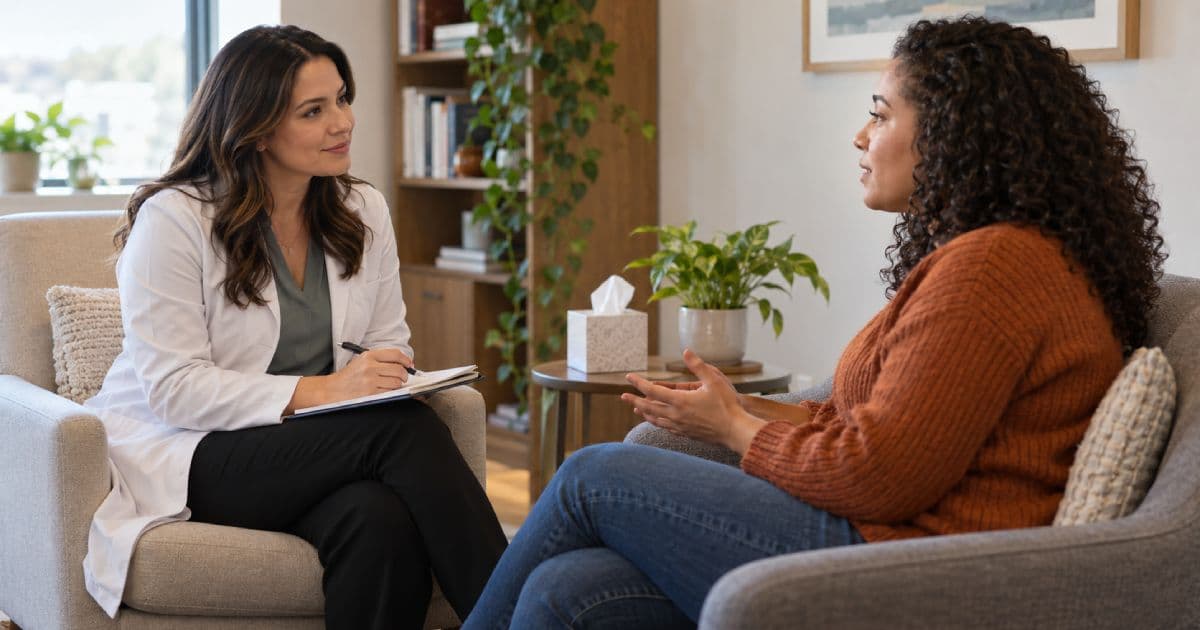
To become a psychiatric nurse practitioner, qualify as an RN, complete an accredited psychiatric-mental health nurse practitioner program, earn national certification, and obtain state APRN authorization. Prescribing requires any additional state approvals and federal registration that apply to the medications and practice setting.
A psychiatric-mental health nurse practitioner, or PMHNP, assesses, diagnoses, and treats psychiatric and substance use disorders. The role combines therapeutic relationships, medical assessment, psychotherapy, and medication management.
It can offer meaningful work in communities with limited access to care. It also carries substantial responsibility: a prescribing credential does not remove diagnostic uncertainty, crisis risk, or the need for consultation.
This guide explains how to become a PMHNP in the United States, including degree choices, psychiatric RN experience, clinical preceptors, certification, state rules, and realistic salary comparisons.
At a Glance: The PMHNP Career Path
| Requirement | What to expect |
|---|---|
| Starting qualification | RN preparation and licensure; a BSN is a common graduate-entry route |
| Graduate education | PMHNP-focused MSN, DNP, or an eligible post-graduate certificate |
| Time after a BSN | Often about 2–4 years of graduate study; part-time schedules and placements can extend this |
| Prior psychiatric RN experience | Program-specific; valuable preparation but not a universal national requirement |
| National certification | ANCC awards PMHNP-BC; another certification pathway is also available |
| Practice authorization | State APRN/NP authorization plus applicable prescribing approvals |
| Salary benchmark | $132,300 median annual wage for all NPs, May 2025; not a PMHNP-only figure |
| Settings | Outpatient, inpatient, community, substance use treatment, consultation, and telehealth services |
What Does a Psychiatric-Mental Health Nurse Practitioner Do?
APNA describes psychiatric advanced practice nursing as graduate-prepared care for people with psychiatric and substance use disorders, including prevention and mental health promotion.
Core responsibilities may include:
- Conducting psychiatric interviews, mental status examinations, and differential diagnoses using current diagnostic criteria, including DSM-5-TR.
- Assessing suicide risk, substance use, trauma exposure, function, and relevant medical conditions.
- Prescribing and monitoring medications within authorized scope.
- Ordering appropriate laboratory tests and following up on results and adverse effects.
- Providing psychotherapy and coordinating care with therapists, primary care clinicians, and other specialists.
- Responding to crises and arranging a more appropriate level of care when needed.
Psychotherapy is integral to the role, according to APNA’s psychotherapy position statement. However, graduation does not establish expertise in every modality. Advanced CBT, comprehensive DBT, and specialized family interventions may require further supervised training.
PMHNPs may serve children, adults, older adults, veterans, people in correctional settings, and patients with co-occurring disorders. Settings include community clinics, hospitals, private practices, emergency consultation services, and telepsychiatry. Actual assignments must match preparation, competence, state law, and organizational privileges.
Step 1: Choose Your Route Into Nursing
A traditional BSN commonly takes four years and provides a straightforward foundation for graduate nursing admission. It is not the only route.
| Starting point | Potential pathway | Question to ask |
|---|---|---|
| No nursing qualification | Approved prelicensure BSN or ADN, followed by any required bridge | Does the program meet the intended state's RN licensing requirements? |
| ADN-prepared RN | RN-to-BSN followed by graduate study, or a suitable RN-to-MSN bridge | Does the bridge actually lead into a PMHNP track? |
| Non-nursing bachelor's degree | Accelerated BSN or an eligible graduate-entry nursing pathway | Is the final outcome RN preparation only, or PMHNP preparation too? |
| Graduate-prepared nurse or another NP specialty | Accredited PMHNP post-graduate certificate or another qualifying graduate pathway | What coursework and clinical experience remain after a formal gap analysis? |
“Direct-entry MSN” does not always mean direct entry into NP practice. Some programs prepare generalist RNs; others combine initial nursing preparation with a specialty track. For example, Yale describes a three-year Graduate Entry Prespecialty in Nursing pathway combining basic nursing and advanced specialty preparation.
Check the exact degree sequence, RN licensing milestones, accreditation, and certification eligibility. A generic nursing master's or leadership DNP does not, by itself, qualify someone as a PMHNP.
Step 2: Pass the NCLEX-RN and Obtain RN Licensure
Complete the nursing regulatory body's requirements, register for the NCLEX-RN, and receive authorization to test. The official NCLEX registration guide explains the separate board and testing steps.
Passing the exam is not the same as receiving a license. Confirm license issuance, any restrictions, and requirements for clinical placements before proceeding.
An eligible multistate RN license may support RN practice under the Nurse Licensure Compact. It does not confer multistate APRN prescribing or practice authority. Being licensed in a compact state also does not automatically mean you hold a multistate license.
Students building their RN foundation can use NurseZee's nursing and NCLEX study tools alongside their program's resources.
Step 3: Build Relevant Clinical Experience
Is psychiatric RN experience mandatory?
There is no universal national rule requiring every PMHNP applicant to complete one, two, or three years of psychiatric RN employment. Schools set admission requirements, and employers may set additional hiring expectations.
That does not make experience irrelevant. Psychiatric nursing can develop therapeutic communication, de-escalation, observation, medication monitoring, interdisciplinary handoffs, and an understanding of recovery over time.
Experience may also expose gaps between textbook scenarios and practice: uncertain histories, overlapping medical and psychiatric symptoms, inconsistent follow-up, and complex family or social circumstances.
How should you evaluate direct-entry pathways?
The concern is whether the graduate receives enough supervised preparation for the work expected—not whether every clinician followed the same route.
An applicant without psychiatric experience should examine clinical breadth, direct observation, psychotherapy supervision, faculty access, and support after graduation. An experienced psychiatric RN must still learn a new diagnostic and prescribing role; years at the bedside do not replace graduate education.
Emergency, ICU, and medical-surgical experience can contribute valuable skills, but cannot be assumed equivalent to psychiatric specialty preparation. Treat one to three years of relevant work as a possible development plan, not a proven universal threshold or a guarantee of competence.
Before enrolling, seek approved observation opportunities, speak with practicing PMHNPs, and assess whether the daily work fits your interests beyond its advertised salary.
Step 4: Complete an Accredited PMHNP Graduate Program
MSN vs. DNP PMHNP Programs
APNA's graduate education overview distinguishes professional graduate pathways. For applicants, the central question is whether the program prepares you for the PMHNP role and your intended jurisdiction.
| Consideration | MSN PMHNP | BSN-to-DNP PMHNP |
|---|---|---|
| Planning timeline | Often about 2–3 years | Often about 3–4 years |
| Main preparation | Graduate psychiatric assessment, treatment, and supervised specialty practice | PMHNP preparation plus doctoral work in evidence implementation, quality, systems, and leadership |
| Cost comparison | May involve fewer credits; compare total cost | Often more credits and time; funding can change the comparison |
| Practice eligibility | Can qualify graduates when all certification and state requirements are met | Can qualify graduates when all certification and state requirements are met |
These are planning ranges, not promises. Part-time attendance and clinical delays change timelines. A DNP is a practice doctorate; a PhD principally prepares researchers. Neither the degree title nor a higher credit total automatically grants broader legal scope.
A DNP is not a universal legal requirement for PMHNP entry. Current ANCC eligibility includes qualifying master's and post-graduate certificate pathways.
Check accreditation and curriculum
ANCC's eligibility page currently recognizes qualifying programs accredited by CCNE, ACEN, or NLN CNEA. Post-graduate certificate applicants must meet the specific certificate-program accreditation requirement.
Confirm the exact program—not merely the university—and obtain written confirmation that it meets requirements where you plan to practice. Online enrollment availability does not necessarily establish authorization for clinical placement or licensure in your state.
Review advanced pathophysiology, health assessment, and pharmacology coursework; psychiatric differential diagnosis; lifespan preparation; and supervised psychotherapy education.
Understand 500 versus 750 clinical hours
ANCC currently lists at least 500 faculty-supervised clinical hours for PMHNP certification eligibility. Separately, the 2022 National Task Force education standards specify 750 direct patient care hours for NP population-focused preparation and exclude simulation from that total.
These are different standards, not interchangeable numbers. Programs and accrediting requirements may exceed a certifier's minimum. Ask which requirements govern your cohort and how the school separates direct care, simulation, and doctoral project hours. Total DNP practice hours should not be presented as though every hour involved direct psychiatric patient care.
The Preceptor Problem: Questions to Ask Before Paying Tuition
Limited preceptor availability can delay clinical progression. A school that advertises flexible online coursework may still require substantial travel, weekday attendance, or relocation for clinical experiences.
National Task Force standards assign programs responsibility for securing suitable sites and preceptors and for faculty approval of placements, including those students identify. A directory of names is not equivalent to an arranged placement.
Ask each program:
- Who secures placements? Request the written policy and responsibilities, not a verbal reassurance.
- Where will I travel? Clarify the geographic area and whether a placement near home is promised.
- What happens if a preceptor cancels? Ask about replacement arrangements, delays, and additional tuition.
- Who arranges pediatric and psychotherapy experiences? Confirm that difficult-to-find rotations are covered.
- Are there extra fees? Include travel, lodging, compliance checks, and any approved placement charges in your budget.
- How is supervision evaluated? Ask about direct observation, feedback, patient diversity, and faculty contact.
The University of Washington PMHNP track, for example, explicitly states that the school arranges clinical placements in Washington. This illustrates the specificity to seek; it is not a ranking or a guarantee about another school.
If asked to identify potential preceptors, begin early through approved faculty, alumni, and professional networks. Send a concise request with dates, course objectives, required hours, and faculty contact details. Never send patient information or pay an intermediary before confirming school approval, terms, and safeguards.
Step 5: Earn National PMHNP Certification
For ANCC PMHNP certification, qualifying applicants must meet RN, education, clinical, and curriculum requirements. ANCC also requires clinical training in at least two psychotherapeutic modalities.
The current exam contains 175 questions: 150 scored and 25 unscored, with 3.5 hours allowed. Successful eligible candidates receive PMHNP-BC, a lifespan credential. Certification normally operates on a five-year renewal cycle with ongoing requirements.
Use ANCC's current test outline and application instructions before buying preparation materials. Certification preparation should consolidate graduate learning, not substitute for missing clinical education.
ANCC is not the only option. The Nurse Practitioner Certification Board also offers a PMHNP examination. Confirm your state board's acceptance, the correct credential designation, and employer requirements before selecting an exam. AANP, the professional association, and a certification board are distinct organizations.
Keep transcripts and clinical records organized. Passing a national exam does not itself authorize independent practice or prescribing.
Step 6: Obtain APRN Authorization and Prescribing Approvals
Apply through the relevant state nursing regulator and any other required authority. Terminology varies: a state may use APRN licensure, NP certification, recognition, or a related designation.
Your checklist may include:
- Active RN authorization and verified graduate education.
- Accepted national specialty certification.
- State APRN/NP approval and any separate prescriptive authorization.
- A required collaboration, delegation, or transition arrangement.
- State controlled-substance registration, where applicable.
- Appropriate DEA registration for controlled-substance practice, unless a valid exemption applies.
- Prescription monitoring program enrollment and required database checks.
A DEA registration does not expand state scope or automatically authorize every Schedule II–V medication. Multistate practice may introduce additional registration requirements; verify the actual arrangement rather than assuming one number covers everything.
DEA's MATE guidance describes a one-time eight-hour substance use training requirement, satisfied through applicable pathways, for covered registrants. SAMHSA's training resources explain qualifying options. This is not an eight-hour course repeated at every renewal.
Employer privileges, malpractice coverage, and payer enrollment also matter before starting work. NurseZee's APRN licensure guide explains these regulatory layers.
Psychiatric Nurse Practitioner Scope of Practice by State
AANP's current practice-environment map is a useful starting point. It does not replace state statutes, board guidance, or individual eligibility requirements.
| Environment | General meaning |
|---|---|
| Full practice | State law permits NP assessment, diagnosis, testing, treatment, and prescribing under nursing-board authority; transition requirements may still apply. |
| Reduced practice | At least one practice element is limited through a regulated collaborative relationship or a restriction on setting or function. |
| Restricted practice | At least one element requires ongoing supervision, delegation, or team management under state law. |
“Restricted” does not universally mean a physician must stand beside the NP for every encounter.
Three examples of why details matter
| State | Important qualification |
|---|---|
| New York | Under current law, exemption from specified physician collaboration, written-agreement, and protocol requirements applies after more than 3,600 qualifying NP practice hours. New graduates should not assume immediate exemption. |
| Texas | Prescriptive authority depends on physician delegation and applicable agreements or facility-based arrangements. Controlled-substance limits require separate review. |
| California | AB 890 created 103 and 104 NP pathways with distinct eligibility and setting conditions. Ordinary NP certification does not automatically establish either status. |
Sources: New York Education Law, Texas Board of Nursing, and California Board of Registered Nursing.
Before signing a contract or opening a practice, verify current rules for your population, setting, collaboration, prescribing, and business structure. Full practice authority does not eliminate consultation, referral, or competence limits.
PMHNP Salary, Demand, and Loan Repayment
BLS does not publish separate national medians for PMHNPs, FNPs, and adult-gerontology acute care NPs. Avoid treating an all-NP figure as a psychiatric specialty salary.
| Official benchmark | Figure and scope |
|---|---|
| Median annual NP wage | $132,300, May 2025, across NP specialties |
| Projected NP employment growth | 41%, 2025–2035, across NP specialties |
| PMHNP-specific national BLS median | Not separately reported |
Source: BLS Occupational Outlook Handbook. National growth does not guarantee a desirable local position or a particular starting salary.
Compare base pay, patient volume, appointment lengths, benefits, paid documentation time, call coverage, mentorship, malpractice terms, and contractor expenses. Remote work and private ownership do not automatically pay more. Practice revenue is not personal income after operating costs.
The 2026 NHSC Loan Repayment Program lists up to $50,000 for eligible mental/behavioral health clinicians completing a full-time, two-year service commitment, with separate enhancement provisions. Eligibility depends on discipline, loans, site approval, service terms, and program selection; future cycles may differ.
Public Service Loan Forgiveness can forgive a remaining qualifying Direct Loan balance after 120 qualifying payments while meeting employment and other requirements. Check the employer and repayment rules rather than assuming every clinical job qualifies.
Telepsychiatry: Opportunity With Additional Responsibilities
Telepsychiatry can improve access and reduce travel. For a new graduate, however, an isolated role with short appointments and no available consultant can be a poor learning environment.
Ask about case review, emergency backup, in-person referrals, laboratory follow-up, and protected supervision. Verify the patient's physical location at each visit and establish a local emergency plan. Telehealth requires clinical suitability, privacy, and the same attention to assessment quality as other care.
HHS explains cross-state licensing options. You generally need authorization where the patient is located; exceptions and telehealth registrations vary. An RN compact license does not replace APRN authorization.
As checked September 27, 2026, DEA and HHS have extended specified controlled-medication telemedicine flexibilities through December 31, 2026. These permit certain prescribing without a prior in-person evaluation when the applicable conditions are met. They do not cancel state law, registration duties, or legitimate-medical-purpose requirements.
The Ryan Haight Act and its exceptions remain relevant. Do not assume an audio-only visit qualifies for every controlled medication, or that temporary rules will continue unchanged after their expiration date.
Frequently Asked Questions
How long does it take to become a PMHNP?
Starting without a degree, a four-year BSN plus roughly two to four years of graduate study gives a planning range of six to eight years before licensing and hiring delays. Adding one to three years of RN experience sequentially makes approximately seven to eleven years. Work and study may overlap; alternate-entry routes differ.
Can I enter PMHNP school without psychiatric RN experience?
Some programs allow it; others require experience. Admission is not proof of readiness for autonomous practice. Evaluate supervised clinical depth, psychiatric exposure, faculty support, and the quality of your first job's transition plan.
Is PMHNP school harder than FNP school?
There is no objective universal ranking. The specialties have different diagnostic, therapeutic, and population demands. Choose based on the work you want to perform and the preparation you need, rather than an assumed easier route.
Can a PMHNP treat children and adults?
Lifespan PMHNP preparation includes pediatric through older-adult populations. Actual practice still requires competence, state authorization, and appropriate privileges. Complex child psychiatry may warrant additional mentoring, training, or referral.
Can a PMHNP prescribe independently?
Potentially, where state law permits and the clinician meets all requirements. Full practice authority may include transition conditions. Controlled substances introduce additional state and federal obligations; certification alone is insufficient.
What is the difference between a psychiatrist and a PMHNP?
Psychiatrists are physicians who complete medical school and typically four years of psychiatry residency, with optional further specialization. PMHNPs complete nursing and graduate specialty preparation. Both may diagnose, prescribe, and provide psychotherapy within their respective authorization and competence; their training pathways are distinct.
Can an FNP become a PMHNP through a short course?
A continuing education course alone does not establish PMHNP preparation. An eligible nurse typically needs a qualifying graduate or post-graduate PMHNP pathway, appropriate clinical training, certification, and updated state authorization.
Next Steps for Aspiring PMHNPs
Identify your starting qualification, intended practice state, and realistic budget. Compare three programs using written accreditation, curriculum, and placement policies. Then plan experience, funding, certification, and a first position with accessible consultation.
The strongest pathway prepares you to recognize uncertainty, build therapeutic relationships, and make safe decisions with appropriate support.
References
Requirements and data checked September 27, 2026. Consult the linked organizations for subsequent changes.
- APNA: About Psychiatric Advanced Practice Nurses
- APNA: Graduate Programs
- ANCC: PMHNP-BC Certification
- National Task Force: Standards for Quality Nurse Practitioner Education
- AANP: State Practice Environment
- SAMHSA: MATE Act Training Resources
- BLS: Nurse Practitioners and Other APRN Occupations
- NHSC: Loan Repayment Program
<!-- Publishing notes: Use seo_title for the HTML title tag and description for the meta description. Keep the longer title for the H1. The featured_image field is intentionally empty until an actual image is selected. Use only verified author credentials and actual review information; this draft does not claim independent clinical review. Retain Callout and key-box components using the existing NurseZee renderer. Use Article/BlogPosting and BreadcrumbList markup populated from actual CMS fields. The FAQPage JSON-LD payload below matches the visible FAQs and is provided for CMS insertion, separate from the rendered article; Google retired FAQ rich results beginning May 7, 2026, so do not promise FAQ rich-result eligibility. Official source: https://developers.google.com/search/updates/ (May–June 2026 entries). -->
<!-- FAQPage JSON-LD for CMS insertion; this comment prevents publication as visible article copy. <script type="application/ld+json"> { "@context": "https://schema.org", "@type": "FAQPage", "mainEntity": [ { "@type": "Question", "name": "How long does it take to become a PMHNP?", "acceptedAnswer": { "@type": "Answer", "text": "Starting without a degree, a four-year BSN plus roughly two to four years of graduate study gives a planning range of six to eight years before licensing and hiring delays. Adding one to three years of RN experience sequentially makes approximately seven to eleven years. Work and study may overlap; alternate-entry routes differ." } }, { "@type": "Question", "name": "Can I enter PMHNP school without psychiatric RN experience?", "acceptedAnswer": { "@type": "Answer", "text": "Some programs allow it; others require experience. Admission is not proof of readiness for autonomous practice. Evaluate supervised clinical depth, psychiatric exposure, faculty support, and the quality of your first job's transition plan." } }, { "@type": "Question", "name": "Is PMHNP school harder than FNP school?", "acceptedAnswer": { "@type": "Answer", "text": "There is no objective universal ranking. The specialties have different diagnostic, therapeutic, and population demands. Choose based on the work you want to perform and the preparation you need, rather than an assumed easier route." } }, { "@type": "Question", "name": "Can a PMHNP treat children and adults?", "acceptedAnswer": { "@type": "Answer", "text": "Lifespan PMHNP preparation includes pediatric through older-adult populations. Actual practice still requires competence, state authorization, and appropriate privileges. Complex child psychiatry may warrant additional mentoring, training, or referral." } }, { "@type": "Question", "name": "Can a PMHNP prescribe independently?", "acceptedAnswer": { "@type": "Answer", "text": "Potentially, where state law permits and the clinician meets all requirements. Full practice authority may include transition conditions. Controlled substances introduce additional state and federal obligations; certification alone is insufficient." } }, { "@type": "Question", "name": "What is the difference between a psychiatrist and a PMHNP?", "acceptedAnswer": { "@type": "Answer", "text": "Psychiatrists are physicians who complete medical school and typically four years of psychiatry residency, with optional further specialization. PMHNPs complete nursing and graduate specialty preparation. Both may diagnose, prescribe, and provide psychotherapy within their respective authorization and competence; their training pathways are distinct." } }, { "@type": "Question", "name": "Can an FNP become a PMHNP through a short course?", "acceptedAnswer": { "@type": "Answer", "text": "A continuing education course alone does not establish PMHNP preparation. An eligible nurse typically needs a qualifying graduate or post-graduate PMHNP pathway, appropriate clinical training, certification, and updated state authorization." } } ] } </script> -->