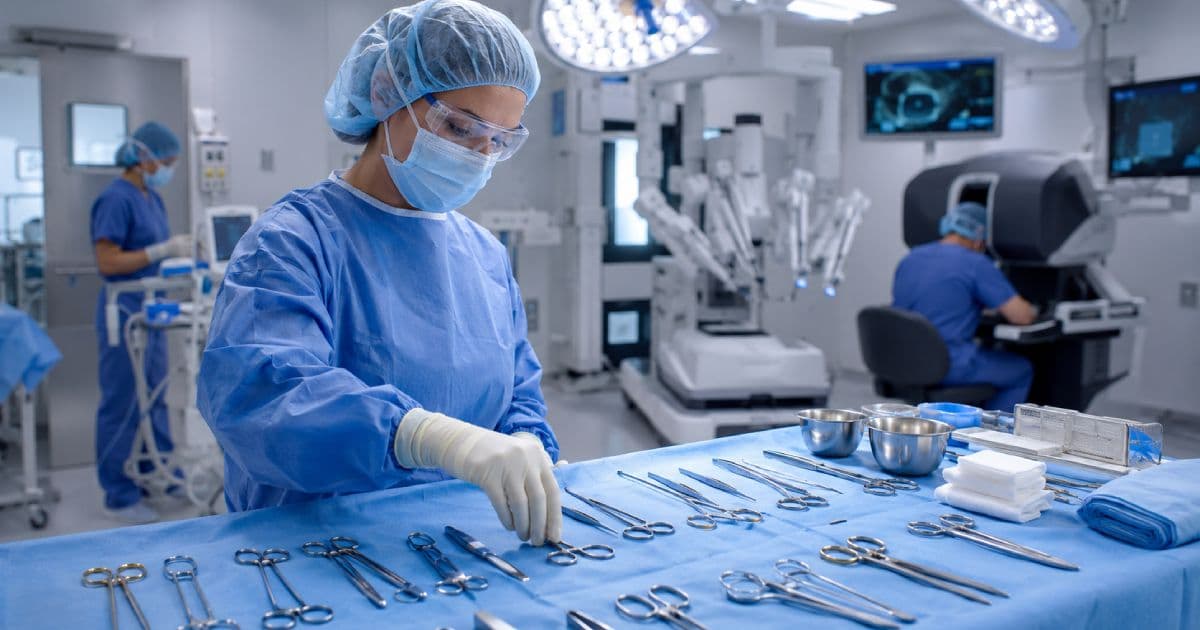
The operating room is unlike almost every other nursing environment.
Instead of managing four or five awake patients across a shift, an operating room nurse may focus on one surgical patient at a time while coordinating a highly technical environment around them.
That patient may be unable to speak, move, protect their airway, identify a wrong-site concern, or report an injury after anesthesia begins.
The operating room nurse becomes a critical patient advocate.
OR nurses verify readiness, protect positioning, maintain aseptic practice, coordinate the surgical team, manage specimens, document the procedure, anticipate emergencies, and help ensure that the correct patient receives the correct procedure at the correct site.
This specialty requires more than learning instrument names.
It combines nursing assessment, clinical judgment, communication, technology, infection prevention, emergency response, and attention to detail.
This guide explains:
- How to become an OR nurse step by step
- What circulating and scrub nurses do
- Whether new graduates can enter the OR
- How perioperative orientation and AORN Periop 101 work
- What employers look for
- Current CNOR eligibility requirements
- How much OR nurses earn
- The benefits and challenges of perioperative nursing
- Career options after gaining experience
What Is an OR Nurse?
An OR nurse is a registered nurse who cares for patients undergoing operative or other invasive procedures.
The broader professional term is perioperative registered nurse.
Perioperative nursing can include care during:
- Preoperative preparation
- The intraoperative procedure
- Immediate postoperative transition
- Ambulatory surgery
- Endoscopy or procedural areas
- Surgical education, management, research, or quality improvement
When people say “OR nurse,” they usually mean an RN working inside the operating room as a circulator, scrub nurse, or both.
What Does “Perioperative” Mean?
The perioperative period surrounds surgery.
It includes three phases:
| Phase | Timing | Nursing focus |
|---|---|---|
| Preoperative | Before the procedure | Assessment, preparation, verification, education, consent status, allergies, tests, and readiness |
| Intraoperative | During the procedure | Patient advocacy, safety, asepsis, positioning, documentation, counts, specimens, equipment, and team coordination |
| Postoperative | After the procedure | Safe transfer, handoff, immediate assessment, pain and nausea management, airway and hemodynamic monitoring |
An OR nurse mainly practices during the intraoperative phase, but safe intraoperative care depends on understanding the full continuum.
OR Nurse Versus Surgical Nurse
“Surgical nurse” can describe several roles.
It may refer to:
- An operating room nurse
- A preoperative nurse
- A post-anesthesia care unit nurse
- A medical-surgical nurse caring for postoperative patients
- A registered nurse first assistant
Read the job description rather than relying on the title alone.
An “OR RN” position is more specific than “surgical nurse.”
OR Nurse Versus Surgical Technologist
OR nurses and surgical technologists work closely, but their education, licensure, scope, and responsibilities differ.
| OR registered nurse | Surgical technologist |
|---|---|
| Holds an RN license | Usually completes a surgical technology education pathway and may hold certification depending on employer or jurisdiction |
| Uses the nursing process and clinical judgment | Focuses heavily on sterile-field preparation and technical support |
| May function as the RN circulator | Does not replace the RN's independent nursing role |
| May perform the scrub role when trained | Commonly performs the scrub role |
| Assesses, plans, implements, and evaluates nursing care | Works within the technologist's defined role and facility policy |
| Coordinates and documents nursing care | Manages instruments, supplies, and the sterile field within role expectations |
AORN states that circulating functions requiring independent, specialized nursing knowledge, skill, or judgment cannot be delegated.
The scrub role may be performed by an appropriately trained RN, surgical technologist, or—in some jurisdictions and settings—an LPN/LVN under applicable scope, delegation, supervision, and facility requirements.
Main OR Nursing Roles
1. RN Circulator
The circulating nurse works outside the sterile field and coordinates nursing care throughout the procedure.
The circulator has a broad view of the patient, room, team, documentation, and safety process.
Responsibilities may include:
- Reviewing the chart and preoperative assessment
- Verifying patient identity and procedure information
- Participating in the preprocedure verification and time-out
- Confirming allergies and relevant risks
- Assessing skin integrity
- Assisting with safe transfer and positioning
- Applying prevention measures for pressure, nerve, thermal, and other injuries
- Ensuring required equipment and implants are available
- Supporting aseptic practice
- Performing and documenting counts with the scrub person
- Managing specimens correctly
- Documenting intraoperative care
- Communicating with family according to policy
- Coordinating additional supplies and personnel
- Advocating for the anesthetized or sedated patient
- Responding to emergencies
- Giving a structured handoff after the procedure
The circulator is not simply a “runner.”
They are the perioperative RN responsible for coordinating nursing care and protecting the patient when the patient is most vulnerable.
2. Scrub Nurse
A scrub nurse is an RN trained to work within the sterile field.
The scrub role may also be performed by a surgical technologist or another qualified team member according to law and policy.
Scrub responsibilities may include:
- Performing surgical hand antisepsis
- Gowning and gloving
- Preparing the sterile field
- Organizing instruments and supplies
- Checking package integrity and indicators
- Anticipating the procedural sequence
- Passing instruments, sutures, and supplies
- Managing sharps safely
- Maintaining awareness of sterile boundaries
- Performing counts with the circulator
- Handling specimens according to policy
- Communicating contamination or count concerns immediately
An RN who scrubs uses nursing knowledge as well as technical skill.
3. Registered Nurse First Assistant
The registered nurse first assistant (RNFA) works directly with the surgeon in an expanded perioperative nursing role.
Depending on scope, education, privileges, and facility policy, RNFA functions may include:
- Providing exposure of the surgical site
- Handling tissue
- Supporting hemostasis
- Suturing
- Applying wound dressings
- Assisting with other technical surgical functions
RNFA practice requires additional education, competency verification, and compliance with state law and credentialing requirements.
Becoming an RNFA is not an entry-level route into the OR.
4. Preoperative Nurse
The pre-op nurse prepares patients for surgery.
Responsibilities may include:
- Completing admission assessment
- Verifying NPO status
- Reviewing allergies and medications
- Confirming required testing
- Starting IV access
- Completing ordered preparations
- Providing education
- Confirming that consent is present and addressing discrepancies through the appropriate process
- Communicating changes to anesthesia and the surgical team
The nurse witnesses signatures or verifies documentation according to policy; the provider performing the procedure remains responsible for the informed-consent discussion.
5. PACU Nurse
Post-anesthesia care unit nurses receive patients after anesthesia and surgery.
They focus on:
- Airway and ventilation
- Hemodynamic stability
- Level of consciousness
- Pain
- Nausea and vomiting
- Surgical-site assessment
- Drains and lines
- Emergence complications
- Readiness for discharge or transfer
PACU nursing and intraoperative nursing are related specialties, but orientation and competency requirements differ.
Where OR Nurses Work
OR nurses may work in:
- Academic medical centers
- Community hospitals
- Trauma centers
- Children's hospitals
- Ambulatory surgery centers
- Specialty surgical hospitals
- Outpatient procedural clinics
- Military and federal facilities
- Plastic surgery centers
- Ophthalmology centers
- Endoscopy departments
- Labor and delivery operating rooms
The schedule, acuity, case mix, call expectations, and staffing model vary substantially by setting.
Surgical Specialties
An OR nurse may train across multiple services or specialize.
Common services include:
- General surgery
- Orthopedics
- Neurosurgery
- Cardiothoracic surgery
- Vascular surgery
- Urology
- Gynecology
- Obstetric surgery
- Otolaryngology
- Ophthalmology
- Plastic and reconstructive surgery
- Transplant surgery
- Trauma surgery
- Pediatric surgery
- Robotics
Large hospitals may use specialty teams.
Smaller facilities may expect nurses to cover a wider range.
What Is a Typical OR Nurse Shift Like?
No two facilities use the same schedule.
Common arrangements include:
- Five 8-hour shifts
- Four 10-hour shifts
- Three 12-hour shifts
- Evening or overnight coverage
- Weekend programs
- Rotating on-call coverage
- Scheduled shifts plus call-back
A day may include:
- Reviewing the assignment and preference information
- Preparing the room and equipment
- Receiving and assessing the patient
- Participating in verification and team briefing
- Positioning and skin preparation
- Coordinating care during the operation
- Managing counts and specimens
- Completing documentation
- Transferring the patient and giving handoff
- Turning over the room for the next case
Emergency cases, delays, equipment problems, staffing changes, and case overruns can disrupt the schedule.
Is OR Nursing Bedside Nursing?
Yes, although it looks different from inpatient bedside care.
The OR nurse performs direct patient assessment, plans nursing care, implements interventions, evaluates outcomes, documents care, and advocates for the patient.
The interaction may be brief before anesthesia, but the responsibility is substantial.
Is OR Nursing Less Stressful?
Not necessarily.
OR nursing may involve fewer simultaneous patients, but it includes:
- High-consequence safety checks
- Strict aseptic requirements
- Complex technology
- Emergencies
- Time pressure
- Strong personalities
- Unpredictable case length
- On-call obligations
- Physical demands
- Limited margin for communication failure
The stress is different—not absent.
Skills OR Nurses Need
Attention to Detail
The nurse must notice discrepancies involving:
- Patient identity
- Site and side
- Consent documentation
- Allergies
- Implant details
- Medication labels
- Specimen labels
- Counts
- Positioning
- Sterility
Situational Awareness
OR nurses monitor what is happening now and what is likely to happen next.
They anticipate:
- Equipment needs
- Procedural steps
- Blood loss
- Position changes
- Additional implants
- Specimen handling
- Emergency conversion
- Team needs
Communication
The OR requires concise, closed-loop communication.
The nurse must speak up when:
- Verification is incomplete
- The site is unclear
- A count is incorrect
- Sterility is compromised
- An implant is not verified
- A specimen label is unclear
- Positioning creates risk
- Equipment fails
- The patient's condition changes
Aseptic Practice
Sterile technique is a continuous process.
The nurse must recognize contamination, communicate it, and correct it according to policy.
Organization
The nurse coordinates multiple details without losing the patient-centered plan.
Emotional Regulation
The OR can become tense quickly.
The nurse must remain clear enough to communicate, follow emergency roles, and advocate under pressure.
Physical Stamina
OR nurses may stand for long periods, move equipment, assist with positioning, wear lead, and work in restricted postures.
Use safe patient-handling equipment and team assistance rather than relying on strength alone.
Step 1: Complete an Approved Nursing Program
The usual route is to become an RN through:
- Associate Degree in Nursing (ADN)
- Bachelor of Science in Nursing (BSN)
- Hospital diploma program where available
- An approved entry-to-practice pathway for candidates who already hold another degree
The nursing program must meet the requirements for licensure in the jurisdiction where you plan to practice.
An ADN can qualify a graduate for RN licensure.
However, some hospitals prefer or require a BSN, particularly large academic or Magnet-recognized organizations.
Review local OR job listings before choosing a program solely around the minimum national path.
Step 2: Pass the NCLEX-RN and Obtain RN Licensure
After completing the education requirements:
- Apply to the board of nursing.
- Register for the NCLEX-RN.
- Complete background or other jurisdiction-specific requirements.
- Receive authorization to test.
- Pass the NCLEX-RN.
- Obtain authorization to practice as an RN.
Licensure requirements vary by state.
Use the board of nursing and NCSBN's licensure guidance rather than assuming another state's process applies.
Step 3: Obtain Required Life-Support Credentials
Most employers require current Basic Life Support certification.
Depending on the role and population, an employer may also require:
- Advanced Cardiovascular Life Support
- Pediatric Advanced Life Support
- Neonatal Resuscitation Program
These credentials do not replace perioperative education.
Complete only courses accepted by the employer.
Step 4: Apply for a Perioperative Residency or OR Training Position
Search titles such as:
- New graduate OR nurse residency
- Perioperative nurse residency
- OR RN fellowship
- Perioperative transition program
- Operating room nurse internship
- Periop 101 RN position
- OR RN trainee
Read eligibility carefully.
Some programs accept new graduates.
Others are designed for experienced RNs moving from another specialty.
Do You Need Medical-Surgical Experience First?
No universal rule requires one or two years of medical-surgical nursing before the OR.
Some employers prefer prior bedside experience.
Others hire new graduates directly into structured perioperative residencies.
The safer question is:
Does the employer provide a sufficiently structured orientation for a nurse with my current experience?
A direct-entry OR program should include didactic education, skills practice, supervised clinical experience, trained preceptors, competency evaluation, and progressive independence.
Step 5: Complete Perioperative Orientation
OR orientation is usually longer and more specialized than a brief unit transfer.
Length varies by:
- Facility
- Case complexity
- Number of specialties
- Circulator-only versus circulator-and-scrub preparation
- Previous OR experience
- Individual progress
- Program design
Many programs last several months.
High-acuity or multi-specialty programs may take longer.
Do not select a program only because it promises the shortest orientation.
What OR Orientation Should Cover
A comprehensive program may include:
- Perioperative assessment
- Patient identification and verification
- Informed-consent documentation processes
- Surgical time-out
- Aseptic technique
- Surgical hand antisepsis
- Gowning and gloving
- Room setup
- Instrument and supply basics
- Positioning and pressure-injury prevention
- Skin preparation
- Electrosurgical safety
- Laser safety
- Fire safety
- Tourniquet safety
- Radiation safety
- Medication labeling
- Specimen management
- Counts and retained-item prevention
- Implant management
- Blood administration
- Documentation
- Emergency procedures
- Malignant hyperthermia response
- Local-anesthetic toxicity response
- Surgical smoke controls
- Handoff and transfer
- Cleaning and turnover workflows
Orientation should connect technical tasks to nursing assessment and clinical judgment.
Step 6: Build Competence Across Cases
Competence develops by progressing from observation to supervised performance.
A typical progression may include:
- Observe the case and workflow.
- Prepare the room with coaching.
- Circulate a basic case with direct guidance.
- Manage routine portions with fewer prompts.
- Lead the case while the preceptor remains available.
- Expand into new specialties and higher complexity.
- Demonstrate emergency and uncommon-event readiness through simulation and review.
Use NurseZee's guide on working with your nursing preceptor to set goals and request specific feedback.
What Is AORN Periop 101?
Periop 101: A Core Curriculum is an AORN education program for novice perioperative nurses.
AORN describes it as a hybrid program combining:
- Online evidence-based learning
- Textbook readings
- Video demonstrations
- Hands-on skills labs
- Clinical practicum
- Preceptor-guided experience
The OR course is intended to prepare nurses who are new to the operating room.
Facilities commonly purchase and administer the program as part of orientation.
Does Every OR Use Periop 101?
No.
An employer may use:
- AORN Periop 101
- An internally developed curriculum
- A university or health-system perioperative course
- A combination of formal modules and clinical orientation
Evaluate the full training structure rather than the brand name alone.
Is Periop 101 a Certification?
No.
Periop 101 is an educational course.
Completion may provide contact hours and document completion of course requirements, but it is not the CNOR credential and does not independently authorize practice beyond RN scope, competency, and facility privileges.
Can You Buy Periop 101 Yourself?
Availability and purchasing models can change.
Periop 101 is designed as a facility-administered hybrid program because online content must be connected with skills labs, clinical practice, preceptors, and competency evaluation.
Before paying for any standalone course, ask employers whether they accept it and whether it changes eligibility for their OR residency.
Do not assume self-funded theory can replace supervised clinical orientation.
How to Evaluate an OR Residency
Ask the recruiter or educator:
- How long is orientation?
- Is the position for new graduates or experienced RNs?
- Does orientation include circulating and scrubbing?
- Which surgical services are included?
- Is AORN Periop 101 or another formal curriculum used?
- How many primary preceptors will I have?
- How is progress evaluated?
- What happens if I need additional orientation?
- When does call begin?
- Is call introduced during or after orientation?
- Is there a work commitment for accepting paid training?
- What are the repayment terms if I leave early?
- Are BLS, ACLS, or PALS required before the start date?
- How are weekend, holiday, and late-running cases handled?
Read any training repayment agreement before signing.
Red Flags in an OR Training Program
Be cautious when:
- Orientation length is vague
- The hospital expects independent practice after minimal observation
- No formal competencies exist
- Preceptors change every shift without coordination
- New nurses are counted as full staff immediately
- Questions are treated as weakness
- Call begins before basic competence is established
- The employer cannot explain supervision for unfamiliar cases
- Safety concerns are dismissed
- Training repayment terms are unclear
- You are expected to learn invasive skills without direct supervision
How to Make Your Application Competitive
Tailor the Resume
Highlight relevant experience such as:
- Surgical clinical rotations
- Capstone in perioperative services
- Sterile technique
- Patient identification and safety checks
- TeamSTEPPS or structured communication
- Emergency simulation
- Prior surgical technology experience
- Anesthesia technician experience
- Procedural-area experience
- Quality-improvement work
- Evidence-based practice projects
Do not claim independent OR competency based on observation alone.
Use Measurable Examples
Weak statement:
Interested in surgery and good at teamwork.Stronger statement:
Completed a 120-hour senior capstone in perioperative services, observing preoperative verification, circulating workflow, specimen handling, counts, positioning, and postoperative handoff across general and orthopedic cases.Only use numbers and activities that are accurate.
Explain Why You Want the OR
Avoid saying only:
- “I do not like bedside nursing.”
- “I want one patient at a time.”
- “The OR seems less stressful.”
- “I do not want to talk to patients.”
Better reasons include:
- Patient advocacy during vulnerability
- Interest in procedural care
- Appreciation for team coordination
- Commitment to asepsis and safety
- Comfort with technical learning
- Desire to develop specialty expertise
Prepare for OR Nurse Interview Questions
You may be asked:
- Why do you want perioperative nursing?
- How do you respond when sterility is compromised?
- Tell us about a time you spoke up for safety.
- How do you handle a strong personality?
- What would you do if a count were incorrect?
- How do you learn complex technical information?
- How do you respond to feedback?
- Are you able to take call?
- How would you prioritize during an emergency?
- What does patient advocacy mean when the patient is anesthetized?
Use specific examples.
Sample Interview Answer
I am interested in perioperative nursing because it combines patient advocacy, structured safety processes, teamwork, and technical learning. During my surgical capstone, I saw how the circulator maintained the whole nursing picture while the rest of the team focused on the procedure. I am looking for a program with formal education, consistent preceptors, and progressive competency evaluation because I understand that OR practice requires substantial specialty preparation.What Is CNOR Certification?
CNOR is a specialty certification for perioperative registered nurses administered by the Competency & Credentialing Institute (CCI).
CCI describes CNOR as the accredited certification for perioperative registered nurses.
The credential indicates that an eligible RN has met experience requirements and passed a specialty certification examination.
It is not an entry-level license.
Current CNOR Eligibility Requirements
According to the CCI CNOR materials and May 2026 candidate handbook, the standard eligibility path includes:
- A current, unrestricted RN license in the country where the nurse practices
- Current full- or part-time work or qualifying volunteer work in perioperative nursing clinical practice, education, administration, or research
- At least two years and 2,400 hours of perioperative nursing experience
- At least 1,200 of those hours in the intraoperative setting
CCI lists modified experience provisions for certain qualifying credential holders and military or accredited surgical-technology education backgrounds.
Always use the current CNOR handbook when applying because eligibility, fees, examination policies, and recertification rules can change.
What Does the CNOR Exam Cover?
CCI's current examination plan organizes content across major perioperative practice areas.
Topics may include:
- Preoperative patient assessment and diagnosis
- Individualized plan of care
- Intraoperative care
- Communication and documentation
- Infection prevention and control
- Emergency situations
- Professional accountability
Use the current CCI handbook and exam outline rather than an old prep book as the authority.
Is CNOR Required?
CNOR is not universally required to begin working as an OR nurse.
An employer may:
- Prefer CNOR
- Require eligible nurses to obtain it within a certain period
- Pay a certification differential
- Reimburse examination or preparation costs
- Include certification in advancement criteria
Ask how certification affects pay and clinical ladder placement before assuming the credential automatically produces a raise.
Why Earn CNOR?
Potential benefits include:
- Formal validation of specialty knowledge
- Professional recognition
- Eligibility for some clinical-ladder roles
- Employer differential or bonus where offered
- Preparation for leadership or educator opportunities
- A structured way to review perioperative practice
Certification does not replace ongoing competency, policy adherence, or employer validation.
CNOR Versus CNAMB
CNOR focuses on perioperative nursing and requires substantial intraoperative experience.
CNAMB is CCI's certification for ambulatory surgery nurses and has its own eligibility and examination requirements.
A nurse working in an outpatient surgery center should compare the current credential descriptions rather than assuming CNOR is always the best fit.
Other Perioperative Credentials
Depending on the career path, nurses may later consider:
- CNAMB for ambulatory surgery nursing
- CSSL for surgical services leadership
- CNS-CP for eligible perioperative clinical nurse specialists
- CRNFA for qualified registered nurse first assistants
- Specialty-specific education or designations
Each has separate education, experience, license, and examination requirements.
How Much Do OR Nurses Make?
The U.S. Bureau of Labor Statistics does not publish a separate national wage category for operating room nurses.
OR nurses are included within the broader Registered Nurses, SOC 29-1141 occupation.
That means a precise national “average OR nurse salary” from a commercial website may reflect job postings, self-reports, proprietary modeling, travel contracts, or a mixture of settings.
Use BLS RN data as the most defensible public baseline, then compare actual OR job postings and union or employer pay scales in your location.
Current National RN Salary Baseline
The May 2025 BLS Occupational Employment and Wage Statistics data—the newest available as of July 2026—reports the following for registered nurses nationally:
| Measure | Hourly wage | Annual wage |
|---|---|---|
| 10th percentile | $33.14 | $68,940 |
| 25th percentile | $38.62 | $80,330 |
| Median | $46.90 | $97,550 |
| Mean | $48.76 | $101,420 |
| 75th percentile | $54.02 | $112,350 |
| 90th percentile | $66.09 | $137,470 |
These figures cover RNs across specialties and settings.
They are not OR-specific starting salaries.
OR Nurse Salary Factors
An OR nurse's actual compensation may depend on:
- State and metro area
- Employer type
- Union contract
- Years of RN experience
- Years of OR experience
- Surgical specialty
- Academic versus community setting
- Hospital versus ambulatory center
- Shift
- Call requirements
- Call-back hours
- Weekend and holiday work
- Certification differential
- Clinical ladder level
- Charge or specialty-team responsibilities
Understand Base Pay, Call Pay, and Call-Back Pay
OR compensation can be difficult to compare because the base hourly rate is only one part.
Base Pay
The regular hourly wage or salary for scheduled hours.
On-Call or Standby Pay
Compensation for remaining available to return to work.
Standby rates may be a flat hourly amount or determined by contract or policy.
Call-Back Pay
Compensation when called into work.
Policies may include a minimum number of paid hours, premium rate, or overtime treatment.
Shift Differential
Additional pay for evenings, nights, or weekends.
Certification Differential
Additional pay for CNOR or another accepted credential where the employer offers it.
Ask for the written compensation policy.
Sample Compensation Comparison
Offer A
Base rate: $48/hour
Call: 4 shifts per month
Standby: $4/hour
Call-back: time-and-a-half, 2-hour minimum
Parking: employee-paid

Offer B
Base rate: $46/hour
Call: 1 shift per month
Standby: $8/hour
Call-back: double time, 3-hour minimum
Parking: free

Conclusion:
The higher base rate does not automatically create the better total package. Compare expected call burden, callback frequency, benefits, commute, and schedule.
Use NurseZee's nurse salary calculator to compare base pay, overtime, and differentials using your actual offer terms.
OR Nurse Job Outlook
BLS projects employment of registered nurses to grow 5% from 2024 to 2034, faster than the average for all occupations.
BLS projects approximately 189,100 RN openings per year, on average, across the decade.
These projections cover all registered nurses, not OR nurses specifically.
Local perioperative demand depends on surgical volume, facility expansion, turnover, population needs, and employer training capacity.
Hospital OR Versus Ambulatory Surgery Center
| Hospital OR | Ambulatory surgery center |
|---|---|
| May handle complex, emergent, and inpatient cases | Often focuses on scheduled outpatient procedures |
| Greater likelihood of nights, weekends, holidays, and call | May offer more weekday or daytime schedules |
| Often broader specialty exposure | May concentrate on selected specialties |
| More emergency resources on site | Leaner staffing and rapid turnover expectations may be common |
| Academic centers may provide extensive training | Orientation resources vary widely |
Ambulatory surgery is not automatically easier.
High case volume, fast turnover, limited backup, and discharge timing can create substantial pressure.
Benefits of OR Nursing
Potential advantages include:
- One primary patient at a time
- Strong interdisciplinary teamwork
- Technical and procedural learning
- Defined safety processes
- Specialty expertise
- Less routine assignment juggling than some inpatient units
- Multiple schedule models
- Career pathways into education, leadership, RNFA, quality, or industry
- Visible connection between preparation and procedure outcome
The fit depends on the nurse and workplace.
Challenges of OR Nursing
Limited Awake Patient Interaction
The nurse may have only minutes to establish trust before anesthesia.
Nurses who want sustained patient relationships may prefer another setting.
On-Call Requirements
Call can disrupt sleep, family plans, and recovery.
Clarify response-time requirements and transportation realities.
Long or Unpredictable Cases
Cases may run past the scheduled shift.
Emergencies can change assignments immediately.
Strong Team Dynamics
The OR is a close environment with clear interdependence.
Communication failures and incivility can affect safety.
Physical Demands
Long standing periods, lead aprons, awkward positioning, equipment movement, and temperature variation can be difficult.
Occupational Hazards
Potential hazards include:
- Sharps injuries
- Bloodborne pathogen exposure
- Surgical smoke
- Waste anesthetic gases
- Ionizing radiation
- Hazardous chemicals
- Musculoskeletal injury
- Noise
- Laser hazards
NIOSH and OSHA identify surgical smoke, contaminated sharps, radiation, and waste anesthetic gases as workplace concerns.
Employers should use engineering controls, safe work practices, training, protective equipment, and applicable exposure-control programs.
Do not accept preventable exposure as “part of the OR.”
OR Nursing and Pregnancy
Pregnant OR nurses may have concerns about:
- Ionizing radiation
- Waste anesthetic gases
- Hazardous medications or chemicals
- Infectious exposures
- Physical demands
Risk depends on the exposure and controls.
Contact occupational health promptly for individualized assessment, monitoring, accommodations, and applicable policy.
Do not rely on informal coworker rules or conceal a concern because you fear inconvenience.
How to Succeed During OR Orientation
Learn the “Why,” Not Only the Preference
Surgeon preference cards support preparation, but they do not replace policy or clinical judgment.
Ask:
- Is this a safety requirement?
- Is this facility policy?
- Is this surgeon preference?
- Is this one acceptable workflow among several?
Knowing the category helps you respond when circumstances change.
Prepare Before the Case
Review:
- Scheduled procedure
- Patient risks
- Position
- Required equipment
- Implants
- Specimens
- Medications and solutions
- Expected procedural sequence
- Special safety considerations
Speak Up Early
Use clear language when something does not match.
The consent lists the left side, but the schedule lists the right side. We need to stop and resolve the discrepancy before proceeding.Or:
The closing count is incorrect. I am notifying the surgeon and following the count-discrepancy procedure.Track Competencies
Use four categories:
- Independent
- Requires check-in
- Requires direct supervision
- Not yet trained
Do not describe yourself globally as “good at ortho” when specific skills differ.
Ask for Specific Feedback
Ask:
- Which part of room preparation did I miss?
- Was my documentation complete and timely?
- Did I identify contamination promptly?
- Did I anticipate the next step?
- What should I lead independently next case?
Study in Focused Blocks
Review one service or skill at a time.
Examples:
- Basic sutures
- Instrument categories
- Positioning risks
- Specimen handling
- Count policy
- Electrosurgical safety
Do not attempt to memorize an entire service line after every shift.
Common Mistakes Aspiring OR Nurses Make
Mistake 1: Waiting for Med-Surg Experience Because “Everyone Says It Is Required”
Check actual job requirements.
Structured new-graduate OR programs exist.
Mistake 2: Paying for a Course Without Checking Employer Recognition
Education may be useful, but it may not replace the employer's residency or improve hiring eligibility.
Ask first.
Mistake 3: Calling Periop 101 a Certification
It is a core education program, not CNOR certification.
Mistake 4: Applying for CNOR Too Early
CNOR requires qualifying experience.
Use the current CCI eligibility rules.
Mistake 5: Assuming One Patient Means Low Stress
The OR concentrates risk, technology, and team coordination around that patient.
Mistake 6: Focusing Only on Instruments
Instrument knowledge matters, but the RN role includes assessment, planning, advocacy, documentation, communication, and evaluation.
Mistake 7: Ignoring Call Requirements
Call may substantially affect quality of life and total earnings.
Ask detailed questions before accepting.
Mistake 8: Comparing Salaries Without Total Compensation
Review differentials, call, callback, benefits, parking, commute, retirement, and training repayment.
Mistake 9: Staying Silent Around Strong Personalities
Respectful speaking up is a core OR safety behavior.
Mistake 10: Treating Occupational Hazards as Inevitable
Use smoke evacuation, sharps safety, radiation controls, safe handling, and exposure reporting systems.
Career Growth for OR Nurses
With experience and additional preparation, an OR nurse may become:
- Specialty team leader
- Charge nurse
- RN first assistant
- Perioperative educator
- Clinical nurse specialist
- Surgical services manager
- Director of perioperative services
- Quality or infection-prevention specialist
- Clinical informatics nurse
- Device or medical-technology educator
- Research nurse
- Advanced practice registered nurse
Some nurses pursue graduate education in administration, education, informatics, clinical nurse specialist practice, or nurse anesthesia.
Each path has separate admission, licensure, certification, and practice requirements.
Is OR Nursing a Good Fit for You?
OR nursing may fit you if you:
- Enjoy team-based procedural care
- Can follow detailed safety processes
- Speak up when something is wrong
- Like technical learning
- Adapt to changing case needs
- Can remain focused for long periods
- Value patient advocacy
- Tolerate limited awake-patient interaction
- Can meet the physical and schedule demands
- Want to build deep specialty expertise
It may be less satisfying if you strongly prefer:
- Long-term therapeutic relationships
- A predictable end time
- Minimal call
- A quiet environment
- Independent work with limited team coordination
- Frequent verbal interaction with awake patients
Shadowing can help, but observation does not fully reproduce the responsibility of the role.
Step-by-Step OR Nurse Roadmap
Questions to Ask Before Accepting an OR Job
Training
[ ] How long is orientation?
[ ] Is a formal curriculum used?
[ ] Will I learn circulating, scrubbing, or both?
[ ] How many preceptors will I have?
[ ] How is competence evaluated?
[ ] Can orientation be extended?

Schedule
[ ] What shifts are available?
[ ] How often is call required?
[ ] What is the callback response time?
[ ] How are weekends and holidays assigned?
[ ] What happens when a case runs late?

Compensation
[ ] What is the base rate?
[ ] What are standby and callback rates?
[ ] Is there a minimum callback guarantee?
[ ] Are differentials cumulative?
[ ] Is there CNOR reimbursement or differential?

Commitment
[ ] Is there a training repayment agreement?
[ ] What amount is owed if I leave early?
[ ] Does repayment decrease over time?
[ ] Are transfers within the health system treated as separation?
Frequently Asked Questions
What degree do you need to become an OR nurse?
You need education that qualifies you for RN licensure, such as an ADN, BSN, or approved diploma pathway, followed by the NCLEX-RN and board authorization to practice. Some employers prefer or require a BSN even though an ADN can qualify a graduate for RN licensure.
Can a new graduate become an OR nurse?
Yes. Some hospitals hire new graduates into structured perioperative residencies. Other employers require prior RN experience. Look for programs that combine formal education, skills labs, trained preceptors, supervised cases, competency validation, and gradual independence.
Do you need med-surg experience before working in the OR?
No universal rule requires med-surg experience first. Prior bedside experience may be preferred by some employers, but new-graduate OR residencies provide a direct path in many health systems.
How long does it take to become an OR nurse?
The timeline includes completing an RN program, obtaining licensure, and completing employer-based perioperative orientation. Nursing education commonly takes roughly two to four years depending on the pathway. OR orientation often lasts several months and varies by specialty breadth, facility, and individual progress.
What is AORN Periop 101?
Periop 101 is AORN's core curriculum for nurses new to perioperative practice. The facility-administered hybrid program combines online learning, readings, videos, skills labs, clinical practice, and preceptor guidance.
Is Periop 101 the same as CNOR?
No. Periop 101 is an education program for novice perioperative nurses. CNOR is a professional certification for experienced, eligible perioperative RNs who pass the CCI examination.
What is the difference between a circulating nurse and scrub nurse?
The RN circulator works outside the sterile field and coordinates nursing care, safety, documentation, positioning, counts, specimens, supplies, and team communication. The scrub nurse works within the sterile field, prepares instruments and supplies, maintains the field, passes items, and participates in counts.
Can an OR nurse both circulate and scrub?
Yes. Many RNs are trained in both roles, although some facilities hire circulator-only RNs or use surgical technologists primarily in the scrub role. When an RN scrubs, another perioperative RN must fulfill the circulating role according to applicable requirements and policy.
What are the current CNOR certification requirements?
The standard path requires a current unrestricted RN license, current qualifying perioperative work or volunteer activity, at least two years and 2,400 hours of perioperative nursing, and at least 1,200 intraoperative hours. Confirm the current CCI handbook before applying.
How much does an OR nurse make?
BLS does not publish OR nurses separately. In May 2025, the national RN median was $97,550 annually, or $46.90 per hour. OR compensation varies with location, experience, setting, shift, call, callback, certification, and union or employer pay scales.
Do OR nurses take call?
Many hospital OR positions require evening, night, weekend, or holiday call. Ambulatory centers may have less call, but schedules vary. Ask about frequency, response time, standby pay, callback pay, and transportation before accepting.
Is CNOR required to work in the operating room?
Usually not for an entry-level OR position. Employers may prefer CNOR, require eligible nurses to earn it later, reimburse costs, or offer a differential. The credential requires experience and cannot normally be obtained before starting perioperative practice.
What is the hardest part of OR nursing?
Common challenges include learning complex workflows, speaking up around strong personalities, maintaining continuous situational awareness, taking call, standing for long cases, managing emergencies, and mastering multiple specialty-specific systems.
Can an OR nurse become an RN first assistant?
Yes, after gaining appropriate perioperative experience and completing recognized RNFA education, supervised clinical preparation, competency verification, credentialing, and any certification or state-specific requirements. RNFA is an expanded role, not an entry-level OR position.
Final Takeaway
Becoming an OR nurse starts with RN education and licensure—not CNOR.
The critical career step is finding a perioperative orientation that treats OR nursing as a specialty requiring formal education, supervised practice, and measurable competency.
New graduates can enter the OR when an appropriate residency exists. Experienced nurses can transition through fellowship or employer training. Periop 101 may form part of that education, but it is not a professional certification.
After building qualifying experience, CNOR can validate specialty knowledge and support professional growth.
Compare salary offers using current RN wage data, local employer scales, call burden, callback pay, differentials, and benefits. The highest base rate is not always the best OR job.
Most importantly, choose a program that will teach you to protect the patient—not merely turn over a room quickly.
References
- Association of periOperative Registered Nurses. Perioperative Nursing: Scope and Standards of Practice. Accessed July 16, 2026.
- Association of periOperative Registered Nurses. Periop 101: A Core Curriculum. Accessed July 16, 2026.
- Association of periOperative Registered Nurses. Periop 101 OR. Accessed July 16, 2026.
- Association of periOperative Registered Nurses. Position Statement on Perioperative Registered Nurse Circulator Dedicated to Every Patient Undergoing an Operative or Other Invasive Procedure. Accessed July 16, 2026.
- Competency & Credentialing Institute. CNOR Certification. Accessed July 16, 2026.
- Competency & Credentialing Institute. CNOR Candidate Handbook. Updated May 2026.
- U.S. Bureau of Labor Statistics. May 2025 National Occupational Employment and Wage Estimates. Released May 15, 2026.
- U.S. Bureau of Labor Statistics. Registered Nurses: Occupational Outlook Handbook. Accessed July 16, 2026.
- National Council of State Boards of Nursing. Nurse Licensure Guidance. Accessed July 16, 2026.
- National Institute for Occupational Safety and Health. Surgical Smoke Inhalation: Dangerous Consequences for the Surgical Team. Accessed July 16, 2026.
- Occupational Safety and Health Administration. Hospitals eTool: Surgical Suite. Accessed July 16, 2026.
- National Institute for Occupational Safety and Health. About Anesthetic Gases and Reproductive Health. Accessed July 16, 2026.
Career and practice disclaimer: This guide provides general U.S. career information and does not replace board of nursing rules, facility policy, AORN guidelines, CCI eligibility decisions, occupational-health advice, employment agreements, or legal guidance. Requirements and compensation change by jurisdiction and employer.