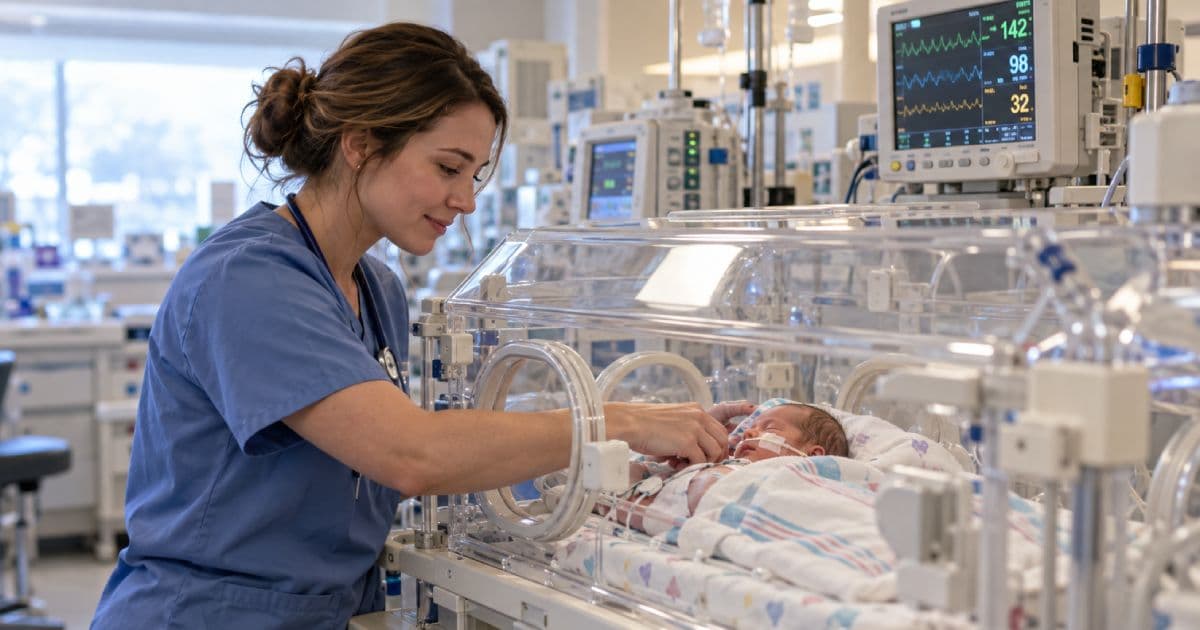
To become a NICU nurse in the United States, complete an approved RN education program, pass the NCLEX-RN, obtain RN licensure, and secure a neonatal position with supervised specialty orientation. Complete employer-required resuscitation training, then pursue specialty certification after gaining qualifying experience.
Yes, new graduates can enter the neonatal intensive care unit. You do not universally need a year of medical-surgical nursing first. However, openings, degree requirements, and support vary by hospital. The strongest opportunity is a unit that can teach you safely—not simply the highest-acuity hospital that offers an interview.
This guide explains how to become a NICU nurse from nursing school or another RN specialty, with realistic timelines, credential distinctions, and salary context.
At a Glance: Becoming a NICU Nurse
| Question | Practical answer |
|---|---|
| Education | An approved RN pathway, commonly an ADN or BSN; employer requirements vary |
| Timeline from starting school | Commonly about 2–4 years, potentially longer with prerequisites, admissions delays, and job searches |
| Legal credential | RN license or valid multistate privilege for the practice state |
| New graduate entry | Possible through NICU hiring and neonatal nurse residency opportunities |
| Initial training | Unit orientation, BLS, and employer-specified neonatal resuscitation education |
| Later specialty credentials | RNC-NIC or CCRN (Neonatal), once eligibility requirements are met |
| Pay benchmark | BLS reports a $97,550 national RN median for May 2025; this is not a NICU-specific median |
Licensure, hiring, and certification rules are separate. Verify requirements with your state board, prospective employer, and credentialing organization before paying for a program or course. This is career education, not a neonatal treatment protocol.
What Does a NICU Nurse Do?
A NICU nurse provides specialized care for newborns who need intensive monitoring or treatment. Some remain hospitalized well beyond the first month of life. NANN’s neonatal nursing overview describes a specialty serving infants with prematurity, infections, congenital conditions, and surgical needs.
Depending on the unit, patients may include extremely preterm infants born before 28 weeks, infants with respiratory distress, surgical conditions, or hypoxic-ischemic encephalopathy. Some eligible infants receive therapeutic hypothermia under specialist protocols. Extremely low birth weight means less than 1,000 grams; it describes weight, not gestational age.
Neonatal opioid withdrawal syndrome, or NOWS, is opioid-specific; neonatal abstinence syndrome, or NAS, is broader terminology. Not every infant with withdrawal requires NICU admission.
Daily work can involve:
- Tracking breathing, temperature, feeding tolerance, perfusion, and subtle behavioral changes.
- Administering precisely calculated medications and monitoring IV nutrition and vascular access.
- Caring for infants receiving CPAP or mechanical ventilation alongside respiratory therapists and the neonatal team.
- Protecting sleep and development with positioning and individualized, cue-based care.
- Supporting feeding, parent participation, skin-to-skin care when appropriate, and discharge education.
The Cleveland Clinic’s NICU nurse overview emphasizes both technical care and family support. Neonatal intensive care nursing also includes documentation, infection prevention, communication, and recognizing when to ask for help. Equipment responsibilities depend on training and hospital policy.
Understanding the Four Levels of Neonatal Care
NICU levels of care describe facility capabilities, not nurse seniority. Level I is a newborn nursery, rather than an intensive care unit. The table summarizes the AAP framework and its 2023 standards for Levels II–IV.
| Level | Typical scope | Applicant takeaway |
|---|---|---|
| I: Well newborn nursery | Routine newborn care; stabilization of sick infants pending transfer | Builds newborn assessment and family-teaching skills |
| II: Special care nursery | Selected infants with physiologic immaturity or mild-to-moderate illness; convalescent care and defined respiratory support | Offers neonatal experience with clear transfer limits |
| III: NICU | Comprehensive care across gestational ages and birth weights, including critical illness and sustained life support | Requires extensive preparation in neonatal intensive care |
| IV: Regional NICU | Level III capabilities plus complex surgical care and broad subspecialty resources | Ask about actual surgical populations and advanced therapies |
AAP’s 2023 Level II standards describe selected infants born at least 32 weeks or weighing at least 1,500 grams, with additional clinical criteria. Gestational age or weight alone does not establish placement.
Level IV facilities may provide ECMO or maintain arrangements for transfer to an ECMO center. State designations and individual services vary. Ask which patients the unit admits, retains, and transfers.
Five Steps to Become a NICU Nurse
Step 1: Choose an Approved RN Program
You usually do not need an undergraduate “NICU nursing degree.” Start with an RN education pathway and develop neonatal expertise through clinical placements and employment.
| Pathway | Planning considerations |
|---|---|
| ADN | Commonly about two years of nursing coursework; prerequisites may extend the total. Compare local NICU hiring policies before enrolling. |
| BSN | A traditional program generally takes four years. It may meet more employers’ entry requirements. |
| Accelerated BSN | An option for eligible applicants with a previous non-nursing degree; admission requirements and duration vary. |
| RN-to-BSN | For an existing RN who wants to meet degree preferences; it does not replace neonatal orientation. |
State board approval and nursing program accreditation are different checks. Confirm the program meets your intended state’s licensure requirements. Verify relevant programmatic accreditation, such as ACEN or CCNE, rather than relying only on the college’s institutional accreditation.
Compare total tuition, prerequisites, completion rates, NCLEX outcomes, clinical placements, and transferability. Ask whether NICU capstones are available and how students are selected; availability is not a placement guarantee.
A BSN is not a universal legal requirement for bedside NICU nursing. Nor does an ADN automatically limit a nurse to Level I or II. Hospitals set hiring criteria: for example, Children’s Hospital Colorado’s residency lists NICU opportunities and requires at least a bachelor’s degree in nursing. Read actual job postings rather than inferring eligibility from a hospital’s Magnet designation.
Step 2: Pass the NCLEX-RN and Obtain Licensure
Follow the official NCLEX registration process: apply to your nursing regulatory body, register for the exam, obtain eligibility and authorization to test, and pass the NCLEX-RN. Complete all remaining board requirements before practicing under an RN license.
Passing the exam is not itself license issuance. Employers may accept applications before graduation or make contingent offers; confirm their license deadline.
Prepare for clinical judgment questions across the RN curriculum, not just maternal-child content. NurseZee’s nursing and NCLEX tools can supplement your study plan.
Under the Nurse Licensure Compact, eligible nurses with a multistate license can practice in participating jurisdictions. Living or attending school in a compact state does not automatically grant multistate privileges. Check your license status and the rules for relocation or noncompact states.
Step 3: Apply for Supported NICU Entry
Route A: New graduate hiring. Search hospital career sites for “NICU new graduate RN,” “neonatal nurse residency,” and “RN residency neonatal.” Check each cohort’s participating units; a hospital-wide residency does not guarantee NICU placement.
Children’s Hospital Colorado provides one verified example of a year-long residency that lists NICU hiring units. Openings change between cohorts. Track application windows, graduation eligibility, references, transcripts, and NCLEX deadlines.
Residency and orientation are different. Residency may include seminars and professional development across the first year. Bedside orientation provides supervised clinical practice and competency assessment. Its duration and progression depend on the unit, previous experience, and your learning needs.
Route B: Transfer from another specialty. Mother-baby, pediatrics, labor and delivery, adult ICU, or other RN work can develop useful skills. None is a universal prerequisite or guaranteed bridge. Some employers offer experienced-nurse fellowships or specialty transition programs.
Before accepting another role solely as a stepping-stone, ask about minimum time before transfer, internal application rules, and whether experienced RNs receive protected NICU orientation. See NurseZee’s nurse residency guide for broader offer comparisons.
Step 4: Complete Required Resuscitation and Stabilization Education
BLS: NICU employers generally require current Basic Life Support training. Confirm the accepted course provider, skills assessment, and deadline.
NRP: The Neonatal Resuscitation Program is developed by the AAP and American Heart Association. Although applicants commonly search for NRP certification, AAP awards provider course completion status; it is not a nursing license or specialty board credential.
The AAP provider page distinguishes Essentials and Advanced training. Your employer determines the appropriate level. The traditional pathway combines online learning with a hands-on instructor-led event; an unaffiliated online-only certificate is not an official AAP/AHA completion card.
There is no universal requirement to finish NRP within 90 days of hiring. AAP’s 90-day interval concerns completing the instructor-led event after the online portion. Confirm employer deadlines and course funding before purchasing training.
S.T.A.B.L.E.: This post-resuscitation and pretransport education program covers Sugar, Temperature, Airway, Blood pressure, Lab work, and Emotional support. Employers may require or recommend it. It complements resuscitation education rather than replacing it.
Step 5: Pursue Specialty Certification After Experience
An entry-level applicant does not need to arrive with every neonatal credential. Build supervised competence first.
| Credential | Organization | Key distinction |
|---|---|---|
| RNC-NIC | National Certification Corporation, or NCC | Core neonatal intensive care nursing certification |
| CCRN (Neonatal) | AACN Certification Corporation | Acute/critical care certification for the neonatal population |
| C-ELBW | NCC | Subspecialty knowledge concerning extremely low birth weight neonates |
| C-NNIC | NCC | Subspecialty knowledge in neonatal neuro-intensive care |
For RNC-NIC certification, NCC requires a current, active, unencumbered US or Canadian RN license; 24 months of specialty experience comprising at least 2,000 hours; and specialty employment sometime in the preceding 24 months. Both the months and hours must be met.
For CCRN (Neonatal), direct care pathway, the practice options are 1,750 qualifying hours in the preceding two years, including 875 in the latest year, or 2,000 hours over five years, including 144 in the latest year. Additional license and practice-verification conditions apply.
NCC’s neonatal subspecialty credentials have their own eligibility rules. Do not assume RNC-NIC requirements apply to every exam. Ask about reimbursement, renewal costs, and whether certification affects pay.
How Nursing Students Can Stand Out
A useful application demonstrates safe learning, reliable communication, and a specific interest in neonatal care—not simply that you enjoy babies.
Ask early about capstones. Contact your clinical placement coordinator before assignments are finalized. Explain your NICU interest, request selection criteria, and name acceptable alternatives such as special care nursery or pediatrics. Honor school and hospital placement procedures.
Seek realistic exposure. Approved externships, internships, or support roles can introduce hospital workflows. A unit secretary or technician role is valuable experience, but does not confer RN responsibilities. An observation opportunity may help you assess fit even if direct neonatal placements are unavailable.
Use membership purposefully. NANN offers student membership. Educational participation and thoughtful questions give you more to discuss than membership alone. Joining is optional, not a hiring requirement.
Make the resume specific. State clinical hours, supervision, and your actual contribution. Use terms such as family education, developmental care, and medication safety only where supported by experience. A truthful example might be: “Practiced weight-based calculations in simulation and explained verification steps to the instructor.” Do not claim independent ventilator management after observation. Use NurseZee’s new graduate resume guide to organize your evidence.
Prepare three interview examples: receiving difficult feedback, escalating uncertainty, and supporting an anxious family. Use the situation–task–action–result structure. For an unfamiliar neonatal scenario, explain how you would recognize your limits and obtain help rather than inventing a treatment answer.
Transitioning From Adult Nursing to the NICU
Experienced RNs bring prioritization, communication, and emergency-response skills. However, adult reference ranges, dosing habits, and equipment familiarity do not automatically transfer to neonates.
Build a learning plan around neonatal physiology, gestational-age differences, thermoregulation, feeding, developmental cues, medication concentrations, and family partnership. Request an approved observation shift and ask the educator which preparatory resources match that unit. Confirm NRP requirements before paying independently.
During interviews, ask:
- How is orientation adapted for RNs without neonatal experience?
- Will I have consistent preceptors and scheduled progress reviews?
- What support remains after orientation ends?
- Which competencies must I demonstrate before higher-acuity assignments?
Present yourself as an experienced nurse who is ready to become a supervised beginner in a new specialty. Asking for neonatal-specific preparation is sound professional judgment.
NICU Nurse Salary and Job Outlook
There is no separate national NICU nurse salary median in the BLS Occupational Outlook Handbook. Its registered nurse data provide a comparison benchmark, not a neonatal pay guarantee.
| BLS measure | Latest figure checked September 27, 2026 |
|---|---|
| All-RN median annual wage | $97,550, May 2025 |
| RN median in state, local, and private hospitals | $100,220, May 2025 |
| Projected RN employment growth | 6%, 2025–2035 |
| Average annual RN openings | 180,800, 2025–2035 |
These figures cover RNs across specialties and experience levels. National RN growth does not predict the number of local NICU vacancies.
Compare written offers by base hourly rate, guaranteed hours, benefits, differentials, overtime rules, parking costs, and any repayment obligations. Night, weekend, charge, and certification payments are employer-specific. Use NurseZee’s nurse salary calculator to compare schedules using your actual offer terms.
Travel NICU nursing generally requires recent, independently competent specialty practice. Ask the agency and hospital for their minimum experience and competency requirements; there is no universal national minimum. Relevant acuity and skills matter more than time alone. Compare taxable wages, reimbursements, benefits, cancellation terms, and housing costs rather than treating a quoted weekly package as take-home pay.
Later options include education, leadership, transport, research, or advanced practice. Becoming a neonatal nurse practitioner requires appropriate graduate preparation, national certification, and state APRN authorization; RNC-NIC alone does not authorize that role.
The Reality Check: Is NICU Nursing Right for You?
Long admissions can create meaningful relationships with families. Progress may be gradual: improved feeding, less respiratory support, or parents becoming more confident participants in care. The work can also involve uncertainty, disability, bereavement, and disagreement about goals of care.
Small patient assignments do not necessarily mean light workloads. Alarms, rapidly changing conditions, precise preparation, documentation, and family education can compete for attention. Repeated reaching into incubators can create physical strain.
Before accepting, ask how the unit handles breaks, acuity changes, unsafe assignments, preceptor availability, and debriefing after difficult events. Ask whether the charge nurse routinely carries patients and how staff access ethics, bereavement, and mental health support. A credible answer includes specific processes, not only assurances that the team is “like a family.”
Frequently Asked Questions
Can a new grad work in the NICU?
Yes. Some hospitals recruit new graduates directly into neonatal units. Eligibility and vacancies vary by cohort. Evaluate the quality of supervised orientation and continuing support, not only whether a hospital will hire you.
How long does it take to become a NICU nurse?
A traditional route commonly includes about two to four years of nursing education, followed by licensure and hiring. Prerequisites may extend that timeline. Bedside orientation adds supervised learning; a year-long residency does not necessarily mean a full year with a preceptor on every shift.
Do I need a BSN to work in the NICU?
Not universally. Some employers accept ADN-prepared RNs; others require a BSN or a completion commitment. Check each posting. Facility level alone does not determine which degree an employer accepts.
What is the nurse-to-patient ratio in the NICU?
There is no single nationwide NICU ratio. Assignments may involve one or two critically ill infants, while some convalescent assignments include more. State rules, acuity, procedures, and staffing standards govern the actual assignment. Some situations require multiple nurses for one infant.
Is working in the NICU hard?
Yes. It combines detailed assessment, technical care, family communication, and emotionally difficult situations. Competence develops through education, supervised practice, feedback, and team support. Do not confuse fearlessness with readiness to practice independently.
Should I pay for NRP before applying?
Only after checking employer expectations. Some hospitals provide it during onboarding. Ask which course level and training pathway they accept, whether current status is required at application or hire, and whether costs are reimbursed.
Is RNC-NIC required for my first NICU job?
Generally, no. It requires qualifying specialty experience and is a later career credential. Your first priorities are RN authorization, employer-required training, and safe completion of unit competencies.
Your Next Steps
Choose three hospitals and compare their NICU entry requirements, application windows, orientation structure, and degree policies. Students can then request relevant clinical exposure; new graduates can prepare residency applications; experienced RNs can ask about specialty transition opportunities.
A strong start depends on a unit where you can learn, speak up, and build competence with reliable support.
Sources and Verification
Primary credential, employer, and workforce sources were checked September 27, 2026. Requirements and openings can change; linked organizations control their own rules.