Infection control is one of the safest points you can earn on the NCLEX.
It is also one of the easiest places to lose points if you mix up contact, droplet, airborne, and protective precautions.
The exam wants to know if you can prevent transmission.
That means you need to choose the right room, the right PPE, the right hand hygiene, the right transport steps, and the safest client assignment.
This guide breaks it down in a way you can use on practice questions and clinical.
Why infection control is heavily tested on NCLEX
Infection prevention is basic nursing safety.
A new nurse must know how to:
- Use standard precautions
- Select PPE
- Prevent healthcare-associated infections
- Place clients safely
- Handle contaminated equipment
- Break the chain of infection
- Protect immunocompromised clients
- Educate patients and families
- Prevent exposure during transport
- Delegate safely without spreading pathogens
The NCLEX test plan includes safety and infection prevention content because these decisions affect every care setting.
You may see infection control in:
- Multiple-choice questions
- Select-all-that-apply
- Matrix questions
- Case studies
- Bow-tie questions
- Client assignment questions
- PPE sequence questions
- Prioritization questions
- Delegation questions
For broader exam strategy, use NurseZee’s NCLEX prep guide, NCLEX prioritization guide, and practice questions.
What this guide covers
You will learn:
- Standard precautions
- Contact precautions
- Droplet precautions
- Airborne precautions
- Protective/neutropenic precautions
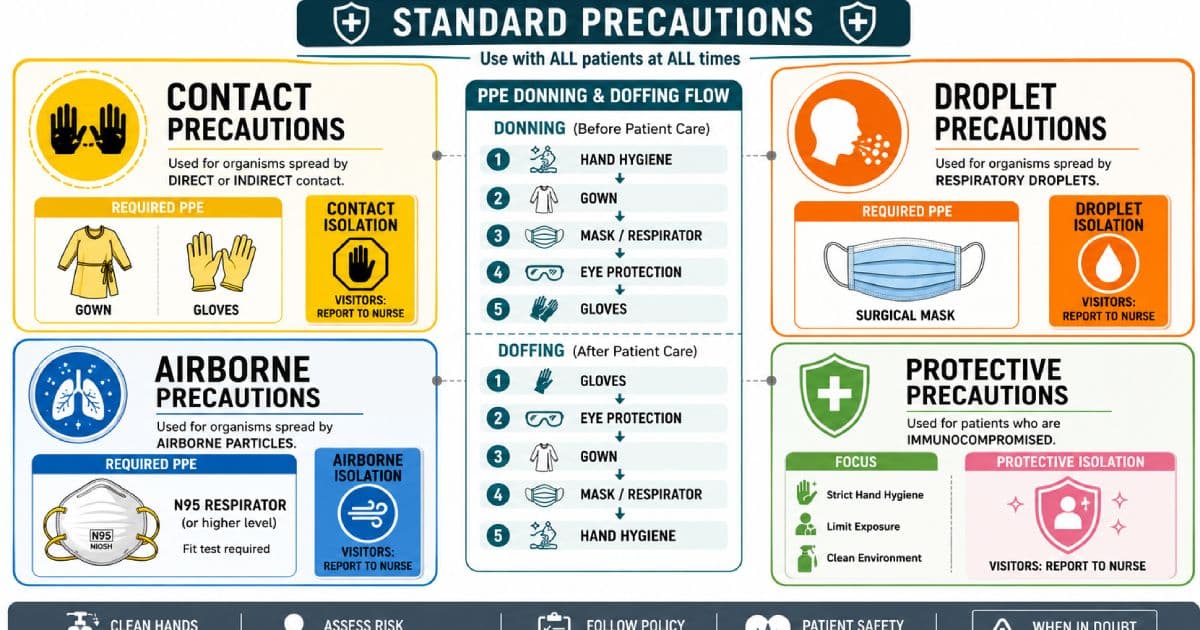
- PPE donning order
- PPE doffing order
- Airborne room rules
- C. diff rules
- Varicella and shingles rules
- Client placement
- Cohorting
- Safe assignments
- Common NCLEX traps
- Practice questions with rationales
The chain of infection
Infection control questions usually test how to break the chain of infection.
The chain includes:
- Infectious agent
- Reservoir
- Portal of exit
- Mode of transmission
- Portal of entry
- Susceptible host
Nursing actions break the chain.
Examples:
| Chain link | Nursing action |
|---|---|
| Infectious agent | Antimicrobials, cleaning, disinfection |
| Reservoir | Dedicated equipment, environmental cleaning |
| Portal of exit | Mask on coughing patient, wound dressing |
| Mode of transmission | PPE, isolation, hand hygiene |
| Portal of entry | Aseptic technique, line care, wound care |
| Susceptible host | Vaccination, protective precautions, nutrition |
Standard precautions
Standard precautions apply to every patient.
You use them regardless of diagnosis, lab results, room assignment, or appearance.
Standard precautions concept
Assume that blood, body fluids, secretions, excretions, non-intact skin, and mucous membranes may contain infectious agents.
Standard precautions protect:
- The nurse
- The patient
- Other patients
- Visitors
- The healthcare environment
Standard precautions include
- Hand hygiene
- Gloves when touching blood, body fluids, mucous membranes, non-intact skin, or contaminated items
- Gown when clothing may be exposed to blood or body fluids
- Mask, eye protection, or face shield when splashing or spraying is possible
- Respiratory hygiene and cough etiquette
- Safe injection practices
- Sharps safety
- Cleaning and disinfection of reusable equipment
- Proper linen and waste handling
- Aseptic technique for invasive procedures
Standard precautions examples
Use gloves when:
- Starting an IV
- Drawing blood
- Emptying a Foley catheter
- Cleaning stool
- Handling wound drainage
- Touching mucous membranes
- Handling contaminated linens
Use gown when:
- Bathing a patient with draining wounds
- Cleaning large amounts of stool
- Suctioning with heavy secretions
- Risk of clothing contamination exists
Use mask/eye protection when:
- Suctioning
- Irrigating wounds
- Assisting with procedures that may splash
- Handling blood or body fluids with splash risk
NCLEX standard precautions trap
Standard precautions do not mean “wear everything for everyone.”
You choose PPE based on anticipated exposure.
Example:
Taking an oral temperature on a stable patient:
Hand hygiene before and after. Gloves only if contact with saliva or mucous membranes is expected by policy or situation.

Emptying a urinary drainage bag:
Gloves required. Gown if splash or clothing contamination is likely.Hand hygiene for NCLEX
Hand hygiene appears simple.
It is heavily tested because it prevents transmission.
When to perform hand hygiene
Perform hand hygiene:
- Before touching a patient
- Before clean or aseptic procedures
- After body fluid exposure risk
- After touching a patient
- After touching patient surroundings
- Before donning PPE
- After removing PPE
- Before medication preparation
- Before eating
- After using the restroom
- When moving from contaminated to clean body sites
- After contact with blood, body fluids, or contaminated items
Alcohol-based hand sanitizer
Alcohol-based hand rub is appropriate in many routine situations when hands are not visibly soiled.
It is fast and effective against many organisms.
Soap and water
Use soap and water when:
- Hands are visibly dirty
- Hands are visibly contaminated with blood or body fluids
- After using the restroom
- After caring for patients with known or suspected C. difficile when possible
- When facility policy requires it
C. difficile hand hygiene rule
C. difficile forms spores.
Alcohol-based hand sanitizer does not reliably kill spores.
For NCLEX, choose soap and water after caring for a patient with C. diff when the answer choices include it.
Best NCLEX answer after C. diff care:
Wash hands with soap and water.
PPE donning sequence
Donning means putting PPE on.
The standard sequence commonly tested is:
1. Gown
2. Mask or respirator
3. Goggles or face shield
4. Gloves
Perform hand hygiene before donning PPE.
Step 1: Hand hygiene
Clean your hands first.
You do not want to contaminate clean PPE before putting it on.
Step 2: Gown
Fully cover:
- Torso
- Arms to wrists
- Neck to knees as appropriate
- Back closure
Tie securely.
Step 3: Mask or respirator
Use the right respiratory protection.
- Surgical/procedure mask for droplet precautions
- Fit-tested N95 or higher-level respirator for airborne precautions
For an N95:
- Place correctly
- Mold nosepiece
- Fit snugly
- Perform seal check
Step 4: Goggles or face shield
Place eye protection over eyes and face.
Use when splash, spray, or mucous membrane exposure is possible.
Eye protection may also be required by facility policy for some respiratory precautions.
Step 5: Gloves
Pull gloves over the gown cuffs.
No skin should be exposed between glove and gown.
PPE doffing sequence
Doffing means taking PPE off.
This is where self-contamination often happens.
The NCLEX usually wants you to remove the most contaminated items first and protect your face and mucous membranes.
A commonly tested CDC sequence is:
1. Gloves
2. Goggles or face shield
3. Gown
4. Mask or respirator
5. Hand hygiene
Another acceptable CDC example removes gloves, then gown, then exits and removes respirator after leaving the room and closing the door if a respirator was worn.
Because facilities may use variations, the NCLEX usually gives answer choices where only one sequence clearly follows contamination principles.
Key doffing rules
The exact local sequence may vary, but these rules are high-yield:
- Gloves are highly contaminated.
- The front of the gown is contaminated.
- The front of the mask or respirator is contaminated.
- The front of goggles or face shield may be contaminated.
- Remove PPE without touching contaminated fronts.
- Perform hand hygiene after removal.
- If hands become contaminated during removal, perform hand hygiene immediately.
- Remove respirator outside the airborne room after leaving and closing the door, unless facility policy uses an anteroom process.
NCLEX doffing shortcut
Think:
Dirty hands first.
Protect face.
Respirator last for airborne.
Hand hygiene always.
How to remove gloves
Grasp outside of one glove with the opposite gloved hand.
Peel it off.
Hold removed glove in gloved hand.
Slide fingers of ungloved hand under remaining glove at wrist.
Peel off inside-out.
Discard.
How to remove gown
Unfasten ties.
Pull gown away from neck and shoulders.
Touch inside of gown only.
Turn contaminated outside inward.
Roll into bundle.
Discard.
How to remove goggles or face shield
Remove from the back or side.
Do not touch the front.
Clean reusable eye protection per policy.
How to remove mask or respirator
Do not touch the front.
Remove bottom tie or strap first.
Remove top tie or strap last.
Discard or handle according to policy.
Airborne exception
For airborne precautions, remove the N95 or higher-level respirator after leaving the patient room and closing the door, or in the anteroom if the facility uses one.
This matters for TB, measles, chickenpox, and disseminated shingles.
Standard vs contact vs droplet vs airborne vs protective
Use this table as your quick comparison.
| Precaution | Who it protects | Room | Main PPE | Examples |
|---|---|---|---|---|
| Standard | Everyone | Any room | Based on anticipated exposure | All patients |
| Contact | Staff and other patients from direct/indirect contact spread | Private room preferred or cohort | Gown and gloves | C. diff, MRSA wounds, scabies |
| Droplet | Staff and other patients from large respiratory droplets at close range | Private room preferred | Surgical/procedure mask; eye protection as indicated | Influenza, pertussis, mumps |
| Airborne | Staff and others from airborne particles | AIIR/negative pressure | Fit-tested N95 or higher-level respirator | TB, measles, varicella |
| Protective | Immunocompromised patient | Varies; may include positive pressure for select patients | Protect patient from organisms | Severe neutropenia, transplant |
Contact precautions
Contact precautions prevent spread by direct or indirect contact.
Direct contact:
Touching the patient.Indirect contact:
Touching contaminated equipment, surfaces, linens, or patient environment.Contact precautions PPE
Usually:
Gown and gloves.Use dedicated equipment when possible:
- Stethoscope
- BP cuff
- Thermometer
- Pulse oximeter
If equipment must be shared, clean and disinfect it before using it on another patient.
Contact precautions room
Use:
- Private room when available
- Cohorting only with same organism and infection status when facility policy allows
- Dedicated equipment
- Enhanced environmental cleaning
Contact precautions examples
High-yield NCLEX examples:
- C. difficile
- MRSA wound infection
- VRE
- CRE
- Draining wounds not contained
- Scabies
- Lice
- Impetigo
- RSV in many settings
- Rotavirus
- Norovirus
- Some adenovirus infections depending on syndrome
- Diapered or incontinent patients with enteric infections
Mnemonic: MRS WEE
Use this as a memory tool, not a substitute for thinking.
M - Multidrug-resistant organisms: MRSA, VRE, CRE
R - Respiratory infections with contact spread risk: RSV
S - Skin infections: scabies, lice, impetigo, draining herpes lesions

W - Wound infections
E - Enteric infections: C. diff, rotavirus, norovirus
E - Eye infections: conjunctivitis
C. difficile NCLEX rules
For C. diff:
- Contact precautions
- Gown and gloves
- Private room preferred
- Dedicated equipment
- Soap and water after care when possible
- Sporicidal disinfectant per facility policy
- Do not rely on alcohol sanitizer as the best answer after care
- Do not use antidiarrheals unless ordered and appropriate
Contact precautions practice phrase
Contact = gown + gloves + dedicated equipment.Droplet precautions
Droplet precautions prevent spread through respiratory droplets generated by coughing, sneezing, talking, or procedures.
Droplet particles generally travel short distances.
The older NCLEX teaching shortcut is “within 3 feet,” but clinical guidance may use broader close-contact masking rules and facility policy.
On NCLEX, focus on:
Mask for close respiratory droplet exposure.
Patient wears mask during transport.
Private room preferred.
No negative pressure required.
Droplet precautions PPE
Usually:
Surgical or procedure mask upon room entry or when within close range per policy.Use eye protection if splashing or respiratory secretion exposure is likely or if facility policy requires it.
Droplet precautions room
Use:
- Private room if possible
- Cohort only with same infection when allowed
- Maintain spatial separation if private room unavailable
- Patient mask during medically necessary transport
Droplet precautions examples
High-yield NCLEX examples:
- Influenza
- Pertussis
- Mumps
- Rubella
- Diphtheria pharyngeal infection
- Meningococcal meningitis or sepsis
- Mycoplasma pneumonia
- Streptococcal pharyngitis or pneumonia for certain periods
- Pneumonic plague
- Epiglottitis caused by Haemophilus influenzae type b
- Some adenovirus respiratory infections may require droplet plus contact
Mnemonic: SPIDERMAN
Use with caution because actual CDC Appendix A can vary by disease, syndrome, and duration.
S - Streptococcal pharyngitis, scarlet fever, sepsis in some contexts
P - Pertussis, pneumonia, plague
I - Influenza
D - Diphtheria, pharyngeal
E - Epiglottitis
R - Rubella
M - Meningitis, mumps, mycoplasma
A - Adenovirus respiratory disease may need droplet plus contact
N - Neisseria meningitidis
Droplet transport rule
If the patient must leave the room:
Put a surgical/procedure mask on the patient if tolerated.
Limit transport to medically necessary purposes.
Use respiratory hygiene/cough etiquette.
Droplet practice phrase
Droplet = surgical mask + patient mask for transport.Airborne precautions
Airborne precautions prevent spread of organisms that remain infectious while suspended in air.
These require special room placement and respiratory protection.
Airborne precautions PPE
Use:
Fit-tested N95 or higher-level respirator.For varicella and disseminated shingles, add contact precautions:
N95 + gown + gloves.For splash risk, add eye protection.
Airborne room
The patient should be placed in an airborne infection isolation room.
An AIIR is a single-patient room with monitored negative pressure relative to surrounding areas and required air exchanges.
Airborne examples
High-yield NCLEX examples:
- Tuberculosis
- Measles/rubeola
- Chickenpox/varicella
- Disseminated herpes zoster
- Localized herpes zoster in an immunocompromised patient, per many guidance pathways
Mnemonic: My Chicken Has TB
My - Measles
Chicken - Chickenpox
Has - Herpes zoster, disseminated
TB - Tuberculosis
Airborne transport rule
If transport is medically necessary:
- Limit movement outside room
- Patient wears a surgical mask if tolerated
- Cover infectious skin lesions if present
- Notify receiving department
- Use direct route if possible
Airborne room door rule
Keep the door closed.
Airborne respirator removal rule
Remove the N95 after leaving the room and closing the door, or in an anteroom according to facility policy.
Airborne practice phrase
Airborne = N95 + negative pressure + door closed.Airborne plus contact precautions
Some infections need more than one type of transmission-based precaution.
Varicella
Chickenpox/varicella requires:
Airborne + contact precautions.PPE:
N95 respirator
Gown
Gloves
Eye protection if splash risk
Room:
AIIR/negative pressure.Disseminated herpes zoster
Disseminated shingles requires:
Airborne + contact precautions.This is high-yield for NCLEX.
Localized shingles
Localized shingles in an immunocompetent patient with lesions that can be covered may follow contact/standard guidance depending on facility policy.
Localized shingles in an immunocompromised patient is treated more cautiously, often with airborne plus contact until dissemination is ruled out.
For NCLEX, if the question says “disseminated,” choose airborne plus contact.
Measles
Measles requires airborne precautions.
Susceptible healthcare personnel should avoid entering the room if immune staff are available.
Tuberculosis
TB requires airborne precautions.
Use:
- AIIR
- N95 or higher respirator
- Door closed
- Patient mask during transport
- Limit transport
Protective precautions / neutropenic precautions
Protective precautions are different.
Contact, droplet, and airborne precautions protect others from the infected patient.
Protective precautions protect the immunocompromised patient from organisms carried by others.
Who may need protective precautions
Examples:
- Severe neutropenia
- Active chemotherapy with low ANC
- Hematopoietic stem cell transplant
- Bone marrow transplant
- Certain transplant patients
- Some oncology patients
- Patients with profound immune suppression
Protective precautions room
Room requirements depend on the patient and facility policy.
Some high-risk transplant patients may require a protective environment with positive pressure and HEPA filtration.
Not every neutropenic patient automatically needs the same room setup.
For NCLEX, expect simplified protective isolation rules.
Protective precautions actions
Common NCLEX actions:
- Strict hand hygiene
- Screen visitors for illness
- No sick visitors
- No fresh flowers or live plants
- Avoid standing water
- Avoid raw or undercooked foods per policy
- Avoid unwashed fruits and vegetables
- Use private room when possible
- Patient wears mask when leaving room if ordered/policy
- Avoid assigning nurse to both neutropenic patient and highly infectious patient when possible
- Monitor for fever
- Report fever promptly
- Use aseptic technique for lines and procedures
Protective precautions PPE
PPE depends on:
- Facility policy
- Patient condition
- Exposure risk
- Whether staff/visitors have symptoms
- Type of protective environment
Do not assume gown, gloves, and mask for every interaction unless policy or the question states it.
Protective precautions practice phrase
Protective = protect the patient from us.Client placement rules
NCLEX loves room assignment questions.
Use these rules.
Rule 1: Private room when transmission risk is high
Private room preferred for:
- Contact precautions when hygiene or drainage cannot be contained
- Droplet precautions when available
- Airborne precautions always require AIIR if available
- Protective isolation for severe immunocompromise
Rule 2: Cohort only with the same organism
Cohorting means placing two patients with the same infection in the same room.
Safe cohorting requires the same organism and compatible status.
Example:
Two patients with confirmed influenza may be cohorted if facility policy allows.Unsafe:
A patient with MRSA and a patient with VRE.They are both contact precautions, but not the same organism.
Rule 3: Do not place immunocompromised patients with infectious patients
Avoid placing or assigning an immunocompromised patient near a patient with active infection.
Example:
Do not place a chemotherapy patient with neutropenia in a room with a patient who has influenza.Rule 4: Airborne needs AIIR
TB, measles, varicella, and disseminated shingles need airborne isolation.
If no AIIR is available, follow facility policy for temporary placement and transfer.
Rule 5: Transport only when necessary
For patients in isolation:
- Limit transport
- Notify receiving department
- Use appropriate mask/PPE
- Cover wounds or lesions
- Use clean linens
- Clean equipment after use
Staffing assignment rules
NCLEX may ask which assignment is unsafe.
Avoid cross-contamination assignments
Do not assign the same nurse to:
Patient with active contagious infection + severely immunocompromised patientif another staffing option exists.
Pregnant staff considerations
Pregnant healthcare personnel may need assignment considerations for certain infections depending on immunity, exposure, and policy.
High-yield examples include:
- Rubella
- Varicella
- Parvovirus B19
- CMV
- Measles
- Some high-risk emerging infections
For NCLEX, if a pregnant nurse is not immune and the patient has rubella or varicella, choose a different assignment.
Immune status considerations
For measles and varicella, susceptible healthcare personnel should avoid entering if immune personnel are available.
Delegation considerations
UAP may assist with care for patients in isolation if trained in PPE and within scope.
The RN remains responsible for assessment, teaching, clinical judgment, and evaluation.
For delegation practice, see NurseZee’s NCLEX delegation questions guide.
Disease-specific NCLEX cheat sheet
Contact precautions
| Disease or condition | Precaution | NCLEX cue |
|---|---|---|
| C. difficile | Contact | Soap and water after care; gown/gloves |
| MRSA wound | Contact | Dedicated equipment |
| VRE | Contact | Gown/gloves |
| CRE | Contact | Multidrug-resistant organism |
| Scabies | Contact | Skin-to-skin/contact spread |
| Lice | Contact | Contact spread |
| RSV | Contact, sometimes droplet per policy | Infants/children; respiratory secretions |
| Rotavirus | Contact | Diarrhea/diapered children |
| Norovirus | Contact | Vomiting/diarrhea outbreaks |
| Draining wound not contained | Contact | Drainage contaminates environment |
Droplet precautions
| Disease or condition | Precaution | NCLEX cue |
|---|---|---|
| Influenza | Droplet | Surgical mask |
| Pertussis | Droplet | Severe coughing |
| Mumps | Droplet | Parotitis |
| Rubella | Droplet | Pregnant staff concern |
| Meningococcal meningitis | Droplet | N. meningitidis |
| Diphtheria, pharyngeal | Droplet | Respiratory spread |
| Mycoplasma pneumonia | Droplet | Atypical pneumonia |
| Streptococcal pharyngitis | Droplet for certain period | First 24 hr antibiotics often tested |
| Pneumonic plague | Droplet | Severe respiratory infection |
| Adenovirus respiratory disease | Droplet + contact in many guidance settings | Respiratory plus environmental spread |
Airborne precautions
| Disease or condition | Precaution | NCLEX cue |
|---|---|---|
| Tuberculosis | Airborne | N95, AIIR |
| Measles/rubeola | Airborne | N95, immune staff preferred |
| Varicella/chickenpox | Airborne + contact | N95 + gown/gloves |
| Disseminated shingles | Airborne + contact | N95 + gown/gloves |
| Localized shingles in immunocompromised patient | Airborne + contact until ruled out | More cautious approach |
Protective precautions
| Patient | Main goal | NCLEX cue |
|---|---|---|
| Severe neutropenia | Protect patient from infection | Fever urgent |
| Bone marrow/stem cell transplant | Protective environment may be needed | HEPA/positive pressure in select cases |
| Chemotherapy with low ANC | Reduce exposure | No sick visitors, no fresh flowers |
| Profound immune suppression | Reduce pathogen exposure | Strict hand hygiene |
Common NCLEX infection control traps
Trap 1: Using surgical mask for TB
Wrong.
TB is airborne.
Use N95 or higher respirator and AIIR.
Trap 2: Using alcohol sanitizer as best answer for C. diff
Wrong when soap and water is an option.
Use soap and water after C. diff care when possible.
Trap 3: Putting MRSA and VRE together
Wrong.
Both may require contact precautions, but they are different organisms.
Trap 4: Removing N95 inside airborne room
Wrong in classic NCLEX logic.
Remove the respirator after exiting and closing the door, or in an anteroom per policy.
Trap 5: Thinking protective precautions protect staff
Wrong.
Protective precautions protect the patient.
Trap 6: Forgetting patient mask during transport
For droplet and airborne patients, if transport is necessary, mask the patient if tolerated.
Trap 7: Thinking gloves replace hand hygiene
Wrong.
Hand hygiene is still required.
Trap 8: Choosing “private room” for every question without considering priority
Private room is important.
But the highest priority may be airborne room for TB, or protecting a neutropenic patient from an infectious roommate.
Trap 9: Ignoring eye protection
Eye protection is not always required for every isolation type.
It is required when splash, spray, or mucous membrane exposure is anticipated, and it may be required by facility policy for some respiratory care situations.
Trap 10: Mixing up measles and mumps
Measles/rubeola = airborne.
Mumps = droplet.
PPE and isolation quick reference
Standard precautions
All patients.
Hand hygiene.
PPE based on anticipated exposure.
Contact precautions
Gown + gloves.
Dedicated equipment.
Private room preferred.
C. diff = soap and water.
Droplet precautions
Surgical/procedure mask.
Private room preferred.
Patient wears mask during transport.
No negative pressure required.
Airborne precautions
N95 or higher respirator.
AIIR/negative pressure.
Door closed.
Patient wears surgical mask during transport.
Remove respirator after exiting room.
Protective precautions
Protect patient.
Strict hand hygiene.
No sick visitors.
No fresh flowers/live plants.
Avoid raw/unsafe foods per policy.
Report fever promptly.
How to answer NCLEX infection control questions
Use this 5-step process.
Step 1: Identify the organism or syndrome
Look for:
- TB
- Measles
- Varicella
- C. diff
- Influenza
- Meningitis
- MRSA
- VRE
- Neutropenia
- Disseminated shingles
- Draining wound
Step 2: Identify the route
Ask:
Contact?
Droplet?
Airborne?
Protective?
Combination?
Step 3: Choose PPE
Use:
Contact = gown/gloves
Droplet = surgical mask
Airborne = N95
Protective = depends; protect patient
Step 4: Choose room placement
Ask:
Private room?
AIIR?
Cohort?
Protective environment?
Step 5: Add transport and hand hygiene
Ask:
Does the patient need a mask?
Do lesions/wounds need covering?
Is soap and water required?
Does equipment need to stay in the room?Practice questions
Question 1: Select all that apply
The nurse is preparing to enter the room of a client diagnosed with disseminated herpes zoster. Which PPE should the nurse don before entry? Select all that apply.
A. N95 respirator B. Surgical mask only C. Gown D. Gloves E. Eye protection if splash risk is present
Answer
A, C, D, and E.Rationale
Disseminated herpes zoster requires airborne plus contact precautions. Airborne requires an N95 or higher-level respirator. Contact requires gown and gloves. Eye protection is added if splash or spray exposure is anticipated. A surgical mask alone is not adequate for airborne precautions.Question 2: Multiple choice
The nurse is caring for a client with active pulmonary tuberculosis in a negative pressure room. Which action is correct?
A. Remove the N95 respirator before leaving the room. B. Keep the room door open to improve airflow. C. Wear a fit-tested N95 respirator before entering the room. D. Place the client in a room with another client who has influenza.
Answer
C. Wear a fit-tested N95 respirator before entering the room.Rationale
Pulmonary tuberculosis requires airborne precautions. The nurse should use an N95 or higher-level respirator before entering the room. The door should remain closed. The client should not be placed with a client who has a different infection.Question 3: Multiple choice
A client with C. difficile diarrhea is on contact precautions. After providing care, which hand hygiene action is best?
A. Use alcohol-based hand sanitizer only. B. Wash hands with soap and water. C. Wipe gloves with alcohol before leaving. D. Remove gloves and skip hand hygiene if no stool was visible.
Answer
B. Wash hands with soap and water.Rationale
C. difficile spores are difficult to remove with alcohol-based sanitizer alone. Soap and water is the best NCLEX answer after C. diff care when available. Gloves never replace hand hygiene.Question 4: Multiple choice
Which client should be assigned to the private airborne infection isolation room first?
A. Client with influenza B. Client with pulmonary tuberculosis C. Client with MRSA wound infection D. Client with C. difficile diarrhea
Answer
B. Client with pulmonary tuberculosis.Rationale
Tuberculosis requires airborne precautions and placement in an airborne infection isolation room. Influenza is droplet. MRSA wound infection and C. difficile are contact precautions.Question 5: Select all that apply
Which infections commonly require droplet precautions? Select all that apply.
A. Influenza B. Mumps C. Pulmonary tuberculosis D. Meningococcal meningitis E. Measles
Answer
A, B, and D.Rationale
Influenza, mumps, and meningococcal meningitis are high-yield droplet precautions examples. Pulmonary tuberculosis and measles require airborne precautions.Question 6: Multiple choice
A nurse is planning care for a client with neutropenia after chemotherapy. Which intervention is appropriate?
A. Place fresh flowers in the room to improve mood. B. Assign the same nurse caring for a client with active influenza. C. Screen visitors for illness before entering. D. Encourage raw fruits and vegetables from home.
Answer
C. Screen visitors for illness before entering.Rationale
Protective precautions reduce the immunocompromised client’s exposure to pathogens. Sick visitors, fresh flowers/live plants, and unsafe foods may increase infection risk. Avoid assigning the same nurse to highly infectious and severely immunocompromised clients when alternatives exist.Question 7: Ordered response
Place the PPE donning sequence in order.
A. Gloves B. Gown C. Goggles or face shield D. Mask or respirator
Answer
B, D, C, A.Rationale
The standard donning sequence is gown, mask or respirator, goggles or face shield, then gloves. Hand hygiene is performed before donning PPE.Question 8: Multiple choice
The nurse is transporting a client on droplet precautions to radiology. Which action is appropriate?
A. Have the client wear a surgical mask during transport if tolerated. B. Have the nurse wear an N95 for the entire transport. C. Remove the client’s mask once outside the room. D. Transport is never allowed for droplet precautions.
Answer
A. Have the client wear a surgical mask during transport if tolerated.Rationale
Transport should be limited to medically necessary reasons. If the client must leave the room, the client should wear a mask if tolerated and follow respiratory hygiene.Question 9: Multiple choice
A nurse is caring for a client with measles. Which room is required?
A. Positive pressure room B. Airborne infection isolation room C. Regular semi-private room D. Contact precautions room only
Answer
B. Airborne infection isolation room.Rationale
Measles is airborne. The client should be placed in an AIIR/negative pressure room with appropriate airborne precautions.Question 10: Select all that apply
Which clients may require contact precautions? Select all that apply.
A. Client with C. difficile diarrhea B. Client with scabies C. Client with active pulmonary TB D. Client with draining wound not contained by dressing E. Client with measles
Answer
A, B, and D.Rationale
C. difficile, scabies, and uncontained draining wounds are contact precautions examples. Active pulmonary TB and measles require airborne precautions.Question 11: Multiple choice
Which room assignment is safest?
A. Client with MRSA wound infection placed with client with VRE. B. Client with neutropenia placed with client with influenza. C. Two clients with confirmed influenza placed together if policy allows. D. Client with active TB placed in a standard room with door open.
Answer
C. Two clients with confirmed influenza placed together if policy allows.Rationale
Cohorting may be appropriate when clients have the same confirmed infection and facility policy allows. MRSA and VRE are different organisms. Neutropenic clients should not be placed with infectious clients. TB requires airborne isolation.Question 12: Multiple choice
Which action by a student nurse requires correction?
A. Wearing gown and gloves for C. difficile care B. Removing gloves first during PPE removal C. Wearing a surgical mask for measles D. Washing hands with soap and water after C. difficile care
Answer
C. Wearing a surgical mask for measles.Rationale
Measles is airborne and requires an N95 or higher-level respirator and AIIR placement. A surgical mask is used for droplet precautions, not airborne protection for staff.Question 13: Multiple choice
A client has localized shingles with lesions that are completely covered. The client is immunocompetent. Which action is most appropriate?
A. Use airborne precautions for all care no matter what. B. Follow facility policy; standard precautions may be sufficient if lesions are contained. C. Place the client with a neutropenic roommate. D. Use droplet precautions only.
Answer
B. Follow facility policy; standard precautions may be sufficient if lesions are contained.Rationale
Localized shingles in an immunocompetent patient with lesions that can be covered is handled differently than disseminated shingles. Disseminated shingles requires airborne plus contact. Facility policy and patient factors guide precautions.Question 14: Multiple choice
A client with pertussis is admitted. Which PPE is most important for staff entering the room?
A. Surgical/procedure mask B. Sterile gloves only C. N95 respirator only D. Shoe covers
Answer
A. Surgical/procedure mask.Rationale
Pertussis is a droplet precautions infection. Staff should wear a surgical/procedure mask according to droplet precautions and facility policy.Question 15: Multiple choice
Which action best protects a client in protective precautions?
A. Place live plants at the bedside. B. Allow visitors with mild cough if they wear gloves. C. Perform hand hygiene before entering the room. D. Assign the client to a nurse caring for active varicella.
Answer
C. Perform hand hygiene before entering the room.Rationale
Protective precautions focus on protecting the immunocompromised patient. Hand hygiene is essential. Live plants, sick visitors, and cross-assignment with contagious infections increase risk.Question 16: Multiple choice
The nurse has completed care for a client on airborne precautions and is wearing gloves, gown, goggles, and N95 respirator. Which action is most appropriate?
A. Remove N95 first inside the room. B. Remove contaminated PPE carefully, exit, close the door, then remove the N95 according to policy. C. Keep all PPE on until reaching the nurses’ station. D. Remove gloves and keep the gown for the next isolation room.
Answer
B. Remove contaminated PPE carefully, exit, close the door, then remove the N95 according to policy.Rationale
For airborne precautions, the respirator is removed after leaving the patient room and closing the door, or in an anteroom according to facility policy. PPE is not worn from room to room.NGN-style mini case
Case
A 42-year-old client is admitted with fever, cough, night sweats, weight loss, and hemoptysis. The provider suspects pulmonary tuberculosis.
The client is currently in a standard room with the door open. The nurse enters wearing gloves only.
Recognize cues
Fever
Cough
Night sweats
Weight loss
Hemoptysis
Suspected TB
Standard room with door open
No respirator
Analyze cues
Suspected pulmonary TB is an airborne transmission risk.
The current room and PPE are unsafe.
Prioritize hypothesis
Risk of airborne transmission to staff, patients, and visitors.Take action
Place the client in an airborne infection isolation room as soon as possible.
Keep the door closed.
Use fit-tested N95 or higher-level respirator.
Place surgical mask on client if transport is necessary.
Notify infection prevention and receiving departments as needed.
Evaluate outcomes
Client is in AIIR.
Staff use respirators correctly.
Transport is limited.
Exposed staff follow facility policy.
Quick NCLEX cheat sheet
Standard
All patients.
Hand hygiene.
PPE based on exposure.
Contact
Gown and gloves.
Dedicated equipment.
Private room preferred.
Examples: C. diff, MRSA wound, VRE, scabies.
Droplet
Surgical mask.
Private room preferred.
Patient mask during transport.
Examples: influenza, pertussis, mumps, rubella, meningococcal meningitis.
Airborne
N95 or higher.
AIIR/negative pressure.
Door closed.
Patient mask during transport.
Examples: TB, measles, varicella, disseminated shingles.
Airborne + contact
N95 + gown + gloves.
Examples: varicella, disseminated shingles.
Protective
Protect immunocompromised patient.
No sick visitors.
No fresh flowers/live plants.
Strict hand hygiene.
Report fever.
PPE donning
Hand hygiene
Gown
Mask or respirator
Goggles or face shield
Gloves
PPE doffing
Remove contaminated PPE carefully.
Gloves usually first.
Avoid touching contaminated fronts.
Respirator last for airborne after exiting/closing door.
Hand hygiene after removal.
Frequently asked questions about NCLEX infection control precautions
What infection control precautions are most important for NCLEX?
Know standard, contact, droplet, airborne, and protective precautions. Also know PPE donning and doffing, C. diff hand hygiene, airborne room rules, and client placement.
What are standard precautions?
Standard precautions apply to every patient. They include hand hygiene, PPE based on exposure risk, sharps safety, respiratory hygiene, safe injection practices, and proper handling of contaminated equipment.
What PPE is used for contact precautions?
Contact precautions usually require gown and gloves. Dedicated equipment should be used when possible.
What diseases require contact precautions on NCLEX?
High-yield examples include C. difficile, MRSA wound infection, VRE, CRE, scabies, lice, impetigo, rotavirus, norovirus, RSV in many settings, and draining wounds not contained by dressing.
What PPE is used for droplet precautions?
Droplet precautions usually require a surgical or procedure mask. Eye protection may be needed for splash risk or per facility policy.
What diseases require droplet precautions on NCLEX?
High-yield examples include influenza, pertussis, mumps, rubella, meningococcal meningitis, mycoplasma pneumonia, diphtheria pharyngeal infection, and pneumonic plague.
What PPE is used for airborne precautions?
Airborne precautions require a fit-tested N95 or higher-level respirator for healthcare personnel and an airborne infection isolation room when available.
What diseases require airborne precautions on NCLEX?
Memorize tuberculosis, measles, chickenpox/varicella, and disseminated herpes zoster.
What is the difference between droplet and airborne precautions?
Droplet precautions protect against respiratory droplets that usually spread at close range and use a surgical mask. Airborne precautions protect against smaller particles that can remain suspended in air and require an AIIR and N95 or higher-level respirator.
What is a negative pressure room?
A negative pressure room, or airborne infection isolation room, keeps air flowing into the room instead of out to surrounding areas. It is used for airborne infections such as TB, measles, varicella, and disseminated shingles.
When should an N95 be removed?
For airborne precautions, the N95 or higher-level respirator is usually removed after leaving the patient room and closing the door, or in an anteroom according to facility policy.
What is the correct PPE donning order?
The common order is gown, mask or respirator, goggles or face shield, then gloves. Perform hand hygiene before donning.
What is the correct PPE doffing order?
Doffing sequences can vary by facility, but contaminated PPE is removed carefully, gloves are commonly removed first, contaminated fronts are not touched, the respirator is removed last for airborne precautions after exiting, and hand hygiene is performed after removal.
Why is C. diff different?
C. difficile produces spores. For NCLEX, use contact precautions and wash hands with soap and water after care when possible.
Can two isolation patients share a room?
Only if they have the same confirmed organism and facility policy allows cohorting. Do not place patients with different organisms together just because they both require the same type of isolation.
What is protective isolation?
Protective isolation protects a severely immunocompromised patient from infection. It may include strict hand hygiene, visitor screening, no fresh flowers or live plants, food safety rules, and special room features for some high-risk patients.
What is the difference between protective isolation and airborne isolation?
Airborne isolation protects others from airborne pathogens carried by the patient. Protective isolation protects the patient from organisms carried by others.
When can chickenpox precautions stop?
For varicella, precautions usually continue until lesions are dry and crusted. Follow facility and public health guidance, especially for immunocompromised patients.
Is COVID-19 droplet or airborne on NCLEX?
NCLEX-style questions usually give you the needed precaution cues. Follow the wording in the question. If it says airborne or aerosol-generating procedure, choose N95/airborne-level protection. If it describes routine droplet precautions, choose mask and standard respiratory precautions. Always follow current facility and public health policy in real practice.
Do gloves replace hand hygiene?
No. Hand hygiene is required before and after glove use.
Final thoughts
Infection control questions are pattern questions.
Do not memorize random lists without the transmission route.
Ask:
How does it spread?
What PPE blocks that route?
What room does the patient need?
What hand hygiene is safest?
How do I prevent exposing the next patient?
If you can answer those five questions, you can handle most NCLEX infection control items.
Keep it simple.
Standard for everyone.
Contact for touch.
Droplet for close respiratory droplets.
Airborne for TB, measles, chickenpox, and disseminated shingles.
Protective for the vulnerable patient.
That is the core.
Sources and references
- CDC: Sequence for Putting On and Removing Personal Protective Equipment PDF
- CDC: Transmission-Based Precautions
- CDC: Isolation Precautions Guideline
- CDC: Precautions to Prevent Transmission of Infectious Agents
- CDC: Appendix A, Type and Duration of Precautions Recommended for Selected Infections and Conditions
- CDC: PPE 101
- CDC: Hand Hygiene in Healthcare Settings
- CDC: Guideline for Hand Hygiene in Health-Care Settings
- CDC: Clinical Guidance for C. diff Infection
- CDC: Preventing C. diff
- CDC: Infection Control Basics
- NCLEX: 2026 Test Plans
- NCSBN: 2026 NCLEX-RN Test Plan
- NCSBN: Clinical Judgment Measurement Model
- NurseZee: NCLEX Prep
- NurseZee: NCLEX Prioritization Questions
- NurseZee: NCLEX Delegation Questions
- NurseZee: NCLEX Lab Values Cheat Sheet
- NurseZee Practice Questions