NCLEX delegation questions test whether you know what the nurse can safely give to another team member.
They are not only asking, “Who can do this task?”
They are asking whether you can protect the patient, stay within scope, match the task to the right person, give clear directions, and follow up.
That is why delegation questions feel tricky.
A task may sound simple.
But if the patient is unstable, the task requires assessment, or the outcome is unpredictable, the safest answer changes.
Why delegation matters on NCLEX
Delegation is part of safe nursing practice.
It also shows up in NCLEX questions because new nurses do not work alone.
You may need to decide:
- Which task can the RN delegate to UAP?
- Which client can be assigned to an LPN/VN?
- Which client should stay with the RN?
- Which assignment is unsafe?
- Which instruction should the nurse give to UAP?
- Which action by UAP requires follow-up?
- Which task should the nurse perform personally?
- Which client should the charge nurse assign to a float nurse?
- Which delegation decision shows appropriate supervision?
Delegation is closely tied to prioritization.
If you need help deciding who is most urgent, review NurseZee’s NCLEX prioritization guide.
If you are building your full study plan, use the NCLEX prep guide.
You can also practice mixed NCLEX-style questions at NurseZee Practice.
Delegation vs assignment vs supervision
Students often use these words like they mean the same thing.
They do not.
Delegation
Delegation means the nurse transfers responsibility for doing a task to another person while keeping accountability for the outcome.
The nurse still must choose the right task, right person, right patient situation, right communication, and right supervision.
Example
The RN asks UAP to obtain routine vital signs on a stable post-op client and report temperature above 38°C, heart rate above 110, systolic blood pressure below 100, or oxygen saturation below 92%.This is delegation.
The UAP performs the task.
The RN remains accountable for using the information.
Assignment
Assignment means distributing care responsibilities based on role, licensure, workload, and patient needs.
A charge nurse may assign patients to an RN, LPN/VN, or float nurse.
Example
The charge nurse assigns the LPN/VN to care for a stable client with pneumonia who is receiving oral antibiotics and routine respiratory treatments.This is assignment.
The LPN/VN accepts care for a client who is stable and predictable.
Supervision
Supervision means monitoring, directing, evaluating, and following up after a task is delegated.
Supervision does not mean hovering.
It means the nurse confirms that the task was completed safely and that abnormal findings were reported.
Example
After delegating ambulation of a stable post-op client to UAP, the RN asks whether the client tolerated ambulation, had dizziness, reported pain, or needed help returning to bed.This is supervision.
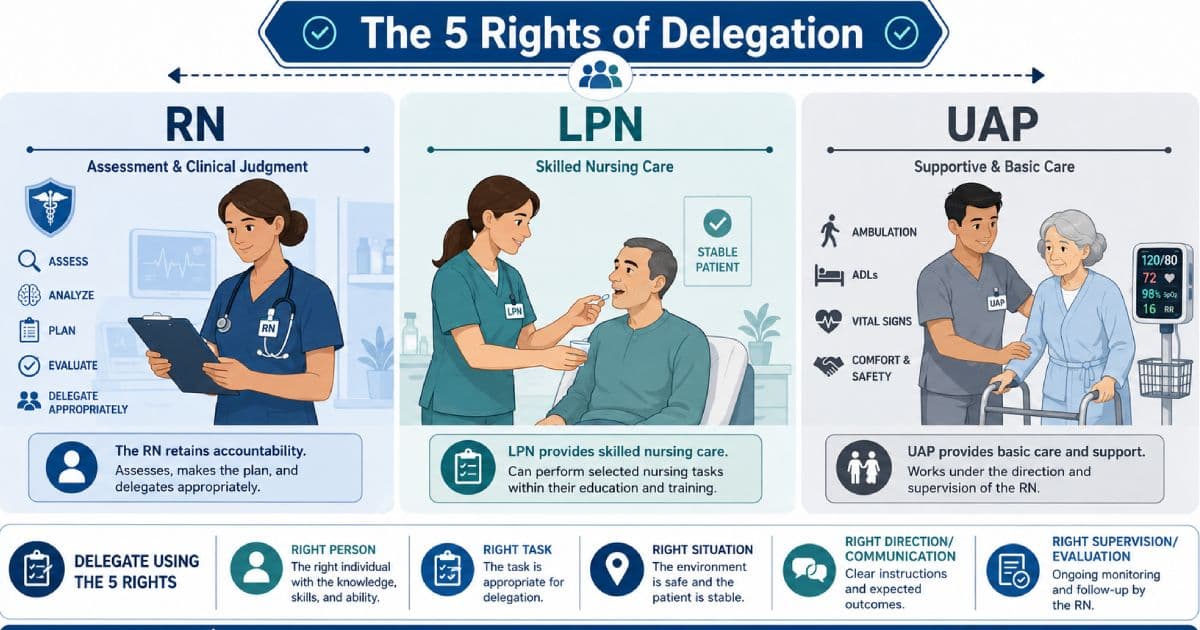
The five rights of delegation
The five rights are the backbone of NCLEX delegation questions.
Use them when two answer choices both sound reasonable.
Right task
The task must be appropriate to delegate.
It should be routine, safe, predictable, and within the other person’s role.
Usually appropriate:
- Bathing a stable client
- Ambulating a stable client
- Feeding a stable client without aspiration risk
- Measuring intake and output
- Obtaining routine vital signs on a stable client
- Transporting a stable client
- Collecting a routine urine specimen
- Repositioning a stable client
- Making an occupied or unoccupied bed
- Assisting with toileting
Usually not appropriate:
- Initial assessment
- Focused assessment for a new symptom
- Clinical judgment
- Nursing diagnosis
- Care planning
- Teaching
- Evaluation
- Triage
- Unstable-client care
- Medication administration by UAP
- Sterile procedures by UAP
- Interpreting vital signs, labs, or symptoms
Right circumstance
The patient situation must be stable and predictable.
The same task may be safe in one situation and unsafe in another.
Safe circumstance
UAP obtains routine morning vital signs on a stable client awaiting discharge.Unsafe circumstance
UAP obtains vital signs on a client who just reported chest pressure, diaphoresis, and shortness of breath while the RN goes to lunch.The task is the same.
The circumstance is not.
Right person
The person must have the correct role, training, competency, and permission under facility policy and state rules.
On NCLEX, do not assume every person can do every task.
A nursing assistant, patient care technician, or UAP may have different facility skills.
The exam usually expects broad scope principles unless the question gives a specific policy.
Right direction and communication
Delegation must include clear instructions.
Tell the person:
- What to do
- Which client
- When to do it
- What to report
- What findings are urgent
- What limits apply
Weak delegation
Check room 212.Better delegation
Please obtain room 212's blood pressure, pulse, respiratory rate, temperature, and oxygen saturation now. Report oxygen saturation below 92%, systolic blood pressure below 100, respiratory rate above 24, or any new shortness of breath.Right supervision and evaluation
The nurse must follow up.
The nurse cannot delegate and forget.
Follow-up matters most when:
- The task can affect safety
- The patient has risk factors
- The result may change the plan of care
- The delegatee reports an abnormal finding
- The nurse gave reporting parameters
RN, LPN/VN, and UAP: the big picture
NCLEX expects you to understand role boundaries.
The exact scope varies by state and facility.
But the exam uses common safe-practice principles.
RN role on NCLEX
The RN is responsible for comprehensive nursing judgment.
The RN usually handles:
- Initial assessment
- Admission assessment
- Unstable clients
- Triage
- Nursing diagnosis
- Care planning
- Patient education
- Evaluation of outcomes
- Complex clinical judgment
- Delegation decisions
- Supervision of delegated care
- IV push medications and complex IV therapy when allowed by policy
- Blood transfusion assessment and reaction response
- Critical changes in condition
- New, acute, or unpredictable findings
The RN may delegate tasks.
The RN may assign stable, predictable patients to LPN/VN when appropriate.
The RN must keep accountability for nursing judgment.
LPN/VN role on NCLEX
LPN stands for licensed practical nurse.
VN stands for vocational nurse.
The NCLEX-PN uses the practical/vocational nursing role.
LPN/VN scope varies by state.
On NCLEX, the LPN/VN is usually appropriate for stable, predictable clients and focused nursing tasks.
The LPN/VN may commonly do tasks such as:
- Collect data on stable clients
- Monitor stable clients
- Reinforce teaching already provided by the RN
- Perform routine wound care for stable wounds
- Administer many medications depending on scope and policy
- Provide basic nursing care
- Report changes to the RN or provider
- Care for clients with expected outcomes
- Perform procedures within LPN/VN scope and competency
The LPN/VN is usually not the best choice for:
- Initial assessment
- Admission assessment
- Unstable clients
- New acute changes
- Initial teaching
- Care planning
- Independent evaluation of outcomes
- Triage
- Complex IV medication decisions
- Blood transfusion management unless specifically allowed by law and policy
- High-acuity clients requiring frequent RN judgment
UAP role on NCLEX
UAP means unlicensed assistive personnel.
This may include nursing assistant, patient care technician, patient care assistant, aide, or similar roles.
UAP can help with routine, nonjudgment tasks for stable clients.
UAP may commonly perform:
- Bathing
- Grooming
- Oral care
- Toileting assistance
- Repositioning stable clients
- Ambulation of stable clients
- Bed making
- Feeding stable clients without aspiration risk
- Transporting stable clients
- Measuring intake and output
- Collecting routine specimens
- Obtaining routine vital signs on stable clients
- Reporting observations to the nurse
UAP should not perform:
- Assessment
- Interpretation of findings
- Nursing diagnosis
- Patient teaching
- Evaluation
- Triage
- Medication administration
- Sterile procedures
- Care for unstable clients
- Clinical decision-making
- Independent interventions for abnormal findings
- Invasive procedures unless specifically trained and allowed by policy
The safest NCLEX delegation hierarchy
When deciding who should do a task, think this way:
RN: unstable, new, complex, teaching, assessment, evaluation, judgment
LPN/VN: stable, predictable, focused nursing care, reinforcement, routine meds/treatments within scope
UAP: stable, routine, nonjudgment personal care and measurements
This hierarchy will not answer every question.
But it will eliminate many unsafe choices.
What the RN should do personally
The RN should usually keep tasks that require nursing judgment.
Initial assessment
Initial assessment means the first complete nursing assessment or the first assessment of a new problem.
Do not delegate it.
Example
A client arrives from the emergency department with new shortness of breath and chest pain.The RN should assess.
Do not assign this client first to UAP or LPN/VN.
Focused assessment of a new symptom
A focused assessment also requires nursing judgment when the symptom is new, worsening, or potentially serious.
Example
A client reports new numbness and weakness in the left arm.The RN should assess.
This could be a neurologic emergency.
Teaching
Teaching is not the same as reminding.
Initial teaching requires assessment of learning needs, planning, and evaluation.
Do not delegate it to UAP.
Usually do not assign it to LPN/VN as independent initial teaching.
Example
Teach a new diagnosis of diabetes and insulin administration.This is RN-level teaching.
Evaluation
Evaluation means deciding whether a treatment worked or whether the care plan needs to change.
Do not delegate evaluation.
Example
Evaluate whether IV morphine relieved a client's pain and whether respiratory status is safe.The RN should evaluate.
Care planning
Care planning requires nursing diagnosis, goals, interventions, and evaluation.
Do not delegate it.
Example
Revise the care plan for a client with worsening heart failure.The RN should do this.
Unstable-client care
Unstable clients require RN judgment.
Examples:
- New chest pain
- New shortness of breath
- Hypotension
- Acute confusion
- Active bleeding
- Seizure activity
- New neurologic change
- Sepsis concern
- Severe allergic reaction
- Airway compromise
- Rapid vital-sign changes
- Post-op complication
- New low oxygen saturation
For broader priority rules, review the NCLEX prioritization guide.
What can usually be assigned to an LPN/VN
LPN/VN assignments should be stable and predictable.
The client should have expected outcomes.
The task should match LPN/VN scope and competency.
Usually appropriate LPN/VN assignments
- Stable client with pneumonia on oral antibiotics
- Stable client with diabetes needing routine glucose monitoring
- Stable client with a long-term feeding tube and established plan
- Stable client with chronic wound dressing changes
- Stable post-op client with expected recovery
- Stable client receiving routine oral medications
- Stable client needing reinforcement of prior teaching
- Stable client with chronic hypertension receiving scheduled medication
- Stable client with urinary catheter requiring routine care
- Stable client with COPD at baseline oxygen status
Usually inappropriate LPN/VN assignments
- New admission requiring full assessment
- Client with new chest pain
- Client with new neurologic deficit
- Client with sepsis concern
- Fresh post-op client with unstable vital signs
- Client requiring initial discharge teaching
- Client needing complex care-plan changes
- Client receiving titratable vasoactive drips
- Client needing frequent independent assessment
- Client in active labor with complications
- Client with active hemorrhage
- Client with blood transfusion reaction
LPN/VN example
Which client is most appropriate for the RN to assign to the LPN/VN?
- Client admitted 20 minutes ago with chest pain and diaphoresis
- Client with stable cellulitis receiving scheduled oral antibiotics
- Client with new confusion and fever
- Client after surgery with blood pressure 82/48
Answer
2. Client with stable cellulitis receiving scheduled oral antibioticsRationale
The client is stable and predictable. The other clients require RN assessment and urgent clinical judgment.What can usually be delegated to UAP
UAP delegation should be stable, routine, and nonjudgment.
UAP can collect information.
UAP cannot interpret that information.
Usually appropriate UAP tasks
- Obtain routine vital signs for a stable client
- Measure urine output
- Assist a stable client with bathing
- Reposition a stable client
- Ambulate a stable post-op client after the RN assesses readiness
- Feed a stable client without swallowing problems
- Collect a clean-catch urine specimen
- Transport a stable client to radiology
- Stock supplies
- Change bed linens
- Assist with toileting
- Report patient statements or observations to the nurse
Usually inappropriate UAP tasks
- Assess a client with new pain
- Teach incentive spirometer use
- Evaluate response to pain medication
- Interpret oxygen saturation trends
- Decide whether a client can ambulate after a fall
- Give medications
- Adjust oxygen based on symptoms
- Perform sterile wound care
- Triage call lights
- Decide if a provider should be notified
- Feed a client with aspiration risk
- Ambulate a client with dizziness or unstable vital signs
- Care for a client with active seizure activity
UAP example
Which task can the RN safely delegate to UAP?
- Teach a client how to use crutches
- Assess a client who reports new chest pain
- Obtain routine vital signs for a stable client before breakfast
- Evaluate whether pain medication relieved incisional pain
Answer
3. Obtain routine vital signs for a stable client before breakfastRationale
Routine vital signs for a stable client may be delegated. Teaching, assessment, and evaluation require nursing judgment.Stable vs unstable is the heart of delegation
Most delegation questions can be solved by asking whether the client is stable.
Stable means the client is predictable, not changing quickly, and does not require complex nursing judgment right now.
Unstable means the client may deteriorate or needs urgent nursing assessment.
Stable clues
- Chronic condition at baseline
- Expected post-op finding
- Routine scheduled care
- Normal or unchanged vital signs
- Discharge teaching already completed
- Established treatment plan
- No new symptoms
- No acute safety concern
Unstable clues
- New
- Sudden
- Worsening
- Acute
- Severe
- Unresponsive
- Confused
- Diaphoretic
- Hypotensive
- Hypoxic
- Bleeding
- Chest pain
- Shortness of breath
- Neuro change
- Seizure
- Fall with possible injury
- Critical lab
- Allergic reaction
- Post-op complication
The nursing process and delegation
The nursing process helps you decide what can and cannot be delegated.
Assessment
Assessment requires nursing judgment.
Do not delegate assessment.
UAP can collect data, such as vital signs or output.
The nurse assesses what the data mean.
Diagnosis and analysis
Nursing diagnosis and analysis stay with the nurse.
Do not delegate clinical interpretation.
Planning
Planning care stays with the nurse.
Do not delegate deciding the care plan.
Implementation
Some implementation tasks can be delegated.
Examples:
- Bathing
- Ambulation
- Repositioning
- Routine vital signs
- Specimen collection
- Stable-client feeding
Implementation is the step where delegation most often happens.
Evaluation
Evaluation stays with the nurse.
Do not delegate whether a treatment worked.
Do not delegate whether the client improved or deteriorated.
Nursing process shortcut
Assess, analyze, plan, and evaluate: nurse.
Routine implementation for stable clients: may be delegated.
Common NCLEX delegation wording
NCLEX questions may not always say “delegate.”
Look for these phrases:
- Which task is appropriate for UAP?
- Which client can be assigned to the LPN/VN?
- Which action should the RN perform?
- Which task should not be delegated?
- Which assignment requires intervention?
- Which statement by UAP requires follow-up?
- Which client should the charge nurse assign to the float nurse?
- Which task can the nurse ask the nursing assistant to complete?
- Which team member should care for this client?
- Which action by the LPN/VN requires the RN to intervene?
The safest answer often includes reporting parameters
Delegation is stronger when instructions include what to report.
Example
Assist the client to ambulate in the hallway and report dizziness, shortness of breath, chest pain, weakness, or refusal to ambulate.This is clearer than:
Walk the client.RN delegation rules for NCLEX-RN candidates
RN candidates should expect delegation questions in Management of Care.
This includes delegation, supervision, continuity of care, advocacy, legal responsibilities, and safe assignment.
Rule 1: Keep unstable clients with the RN
The RN should assess and manage unstable clients.
Example
Which client should the RN keep rather than assign to the LPN/VN?
- Client with stable hypothyroidism awaiting morning medication
- Client with chronic wound needing a scheduled dressing change
- Client with new shortness of breath and oxygen saturation 86%
- Client with stable diabetes needing routine fingerstick glucose
Answer
3. Client with new shortness of breath and oxygen saturation 86%Rationale
New hypoxia requires RN assessment and urgent intervention.Rule 2: Do not delegate teaching
Teaching requires assessment of knowledge, planning, and evaluation.
Example
Which task should the RN perform personally?
- Reinforce previously taught coughing and deep-breathing exercises for a stable client
- Teach a newly diagnosed client how to inject insulin
- Obtain a routine urine specimen
- Assist a stable client to the chair
Answer
2. Teach a newly diagnosed client how to inject insulinRationale
Initial teaching requires RN judgment. LPN/VN may reinforce teaching, and UAP may assist with routine tasks.Rule 3: Do not delegate evaluation
Evaluation answers: did it work?
Example
Which action should not be delegated to UAP?
- Report the amount of breakfast eaten
- Measure urine output
- Evaluate pain relief after medication
- Assist with bathing
Answer
3. Evaluate pain relief after medicationRationale
Evaluation requires nursing judgment.Rule 4: Match patient acuity to staff role
A stable client can often be assigned to LPN/VN.
An unstable client should stay with RN.
A routine task for a stable client may be delegated to UAP.
Rule 5: Supervise delegated tasks
The RN must follow up.
This includes reviewing abnormal findings and checking that the task was completed safely.
PN/VN delegation rules for NCLEX-PN candidates
PN candidates should think about coordinated care and safe reporting.
The practical/vocational nurse often works under the direction of an RN, provider, or other authorized clinician depending on state rules and setting.
On NCLEX-PN, expect questions about:
- Recognizing changes that must be reported
- Reinforcing teaching
- Assigning routine tasks to UAP when allowed
- Caring for stable clients
- Knowing when to ask the RN for help
- Following the established plan of care
- Staying within PN/VN scope
PN/VN rule 1: Report new or worsening findings
The PN/VN should report changes that suggest instability.
Examples:
- New chest pain
- New shortness of breath
- New confusion
- New weakness
- Low blood pressure
- High fever with tachycardia
- Decreased urine output
- Bleeding
- Seizure activity
- Allergic reaction
- Change in level of consciousness
PN/VN rule 2: Reinforce, do not create initial teaching plans
The PN/VN may reinforce teaching already provided.
The RN usually performs initial teaching and evaluates learning.
Example
The RN teaches a client about low-sodium diet. Later, the LPN/VN reviews the written handout and reminds the client to choose low-sodium foods.This is reinforcement.
PN/VN rule 3: Stable and predictable fits PN/VN care
Stable chronic care and routine treatments are often appropriate.
Unstable and complex care requires RN involvement.
PN/VN rule 4: UAP delegation depends on policy
In many settings, LPN/VN may direct UAP for routine tasks.
On NCLEX, choose the answer that keeps UAP tasks routine and nonjudgment.
UAP rules that show up again and again
UAP questions are common because they test whether you know the difference between task completion and nursing judgment.
UAP can collect, not analyze
UAP may collect vital signs.
The nurse interprets them.
Example
Appropriate instruction:
Obtain the client's blood pressure and pulse and report systolic blood pressure below 100 or pulse above 110.Inappropriate instruction:
Check whether the blood pressure is safe enough to give medication.UAP can report, not decide
UAP can report what they see.
The nurse decides what it means.
Example
Appropriate instruction:
Tell me if the client becomes dizzy, short of breath, weak, or refuses to walk.Inappropriate instruction:
Decide whether the client can continue walking.UAP can assist stable clients, not unstable clients
A client who is stable and walking daily may be appropriate for UAP ambulation.
A client with new dizziness, chest pain, or low blood pressure is not.
UAP can feed some clients, but not high aspiration risk clients
Feeding is not always simple.
Do not delegate feeding if the client has:
- New dysphagia
- Aspiration precautions requiring judgment
- New stroke symptoms
- Decreased level of consciousness
- Recent choking
- Need for swallow assessment
- Complex feeding tubes requiring nursing assessment
UAP can measure intake and output, but the nurse interprets it
UAP can record urine output.
The nurse decides whether the output is low and what action is needed.
What not to delegate: high-yield NCLEX list
Do not delegate tasks that require:
- Initial assessment
- Focused assessment of a new symptom
- Nursing judgment
- Clinical interpretation
- Patient education
- Evaluation of response
- Care plan development
- Triage
- Sterile judgment
- Medication judgment
- Unstable-client care
- Complex communication with provider about clinical changes
- Consent explanation
- Discharge teaching
- Post-fall assessment
- Blood transfusion reaction response
- Suicide risk assessment
- Seclusion/restraint assessment and evaluation
- Neuro checks requiring interpretation
Delegation by clinical area
Medical-surgical nursing
Usually appropriate for UAP:
- Routine vital signs on stable clients
- Bathing
- Toileting
- Ambulation of stable clients
- Intake and output
- Transport
Usually appropriate for LPN/VN:
- Stable clients with expected outcomes
- Routine medication administration within scope
- Wound care for stable wounds
- Reinforcing teaching
- Monitoring and reporting changes
RN should keep:
- New admissions
- Unstable post-op clients
- New chest pain
- New dyspnea
- New neurologic changes
- Complex discharge teaching
- Care-plan changes
Pediatrics
Usually appropriate for UAP:
- Routine hygiene for stable children
- Measuring intake and output
- Obtaining routine vital signs if trained
- Transporting stable patients
RN should keep:
- Initial assessment
- Parent teaching for new diagnosis
- Medication teaching
- Unstable respiratory distress
- Suspected abuse assessment
- New seizure activity
- High-risk infant changes
Maternity
Usually appropriate for UAP:
- Transporting stable postpartum clients
- Assisting with hygiene
- Routine vital signs on stable postpartum clients if trained
Usually appropriate for LPN/VN:
- Stable postpartum care within scope
- Reinforcing teaching
- Routine medication administration within scope
RN should keep:
- Initial labor assessment
- Fetal monitoring interpretation
- Heavy bleeding
- Severe headache with hypertension
- Seizure activity
- Magnesium sulfate assessment and toxicity concerns
- Newborn respiratory distress
Mental health
Usually appropriate for UAP:
- Observing and reporting behavior
- Assisting with hygiene
- Routine safety checks according to policy
RN should keep:
- Suicide risk assessment
- Violence risk assessment
- De-escalation requiring clinical judgment
- Medication assessment
- Evaluation of restraints or seclusion
- Therapeutic communication for crisis assessment
Critical care
Critical care clients are often unstable.
Delegation is more limited.
Usually appropriate for UAP only when the patient is stable and policy allows:
- Stocking supplies
- Turning assistance with RN direction
- Basic hygiene with RN awareness
- Measuring output if the RN interprets changes
RN should keep:
- Hemodynamic assessment
- Titrating drips
- Ventilator assessment
- Neuro changes
- Complex IV medications
- Family teaching about critical changes
- Evaluation of response to interventions
Delegation and infection control
Infection control questions may include delegation.
The task may be fine, but the PPE or isolation situation changes the answer.
Appropriate delegation example
Ask UAP to assist a stable client on contact precautions with bathing after confirming the UAP understands gown and glove use.Unsafe delegation example
Ask UAP to teach a family member how to apply airborne isolation PPE for a client with suspected tuberculosis.Teaching is nursing responsibility.
UAP may follow PPE directions but should not provide initial teaching.
Delegation and medication safety
Medication administration is a common trap.
UAP generally do not administer medications on NCLEX unless the question gives a very specific role and policy.
Do not delegate:
- Giving medications to UAP
- Deciding whether to hold a medication
- Assessing medication side effects
- Evaluating medication response
- Teaching medication use
- Checking whether a medication is safe based on vital signs
Medication example
Which task should the RN perform?
- Ask UAP to record oral intake
- Ask UAP to assist a stable client to the bathroom
- Ask UAP to check whether the blood pressure is safe before metoprolol
- Ask UAP to collect a routine urine specimen
Answer
3. Ask UAP to check whether the blood pressure is safe before metoprololRationale
UAP may obtain blood pressure if delegated, but the nurse decides whether medication is safe to administer.Delegation and patient teaching
Teaching traps show up often.
Initial teaching
Initial teaching is RN responsibility.
Examples:
- New insulin administration
- New anticoagulant teaching
- Discharge teaching after surgery
- New ostomy care
- New heart failure diet plan
- New inhaler technique
- New wound care instructions
Reinforcement
LPN/VN may reinforce prior teaching within scope.
Examples:
- Review signs of infection after RN teaching
- Remind client to use incentive spirometer as taught
- Review written discharge instructions already taught by RN
- Reinforce use of walker after physical therapy teaching
UAP and teaching
UAP should not teach.
UAP can remind clients about simple established routines if allowed.
But do not choose UAP for teaching answer choices.
Delegation and float nurses
Assignment questions may involve a float nurse.
The safest assignment is stable and familiar.
Do not assign a float nurse to high-acuity specialty care unless the question says the nurse has competency.
Float nurse example
A nurse from a medical-surgical unit floats to the ICU. Which client is most appropriate to assign to the float nurse?
- Client receiving titrated norepinephrine infusion
- Client with unstable ventilator settings and frequent desaturation
- Client awaiting transfer to the step-down unit after stable recovery
- Client with fresh post-op bleeding after cardiac surgery
Answer
3. Client awaiting transfer to the step-down unit after stable recoveryRationale
A float nurse should receive the most stable, predictable assignment that matches competency.Delegation and new graduate nurses
New graduate nurses are licensed nurses, but they still need support.
On NCLEX, avoid giving the newest or least experienced nurse the most unstable client if a safer assignment exists.
New graduate example
Which client is best for a new graduate RN on orientation?
- Client with septic shock requiring titrated vasopressors
- Client with new chest pain and ST changes
- Client with stable pneumonia receiving IV antibiotics
- Client with active GI bleeding and hypotension
Answer
3. Client with stable pneumonia receiving IV antibioticsRationale
The client is more stable and predictable than the others.Delegation and patient refusal
If a client refuses care from UAP, the nurse must assess the situation.
Do not tell UAP to force care.
Do not ignore refusal.
Example
UAP tells the RN that a client refuses to ambulate after surgery. What should the RN do?
- Tell UAP to return later and make the client walk
- Ask UAP to document refusal only
- Assess the client’s reason for refusing
- Call the provider immediately without seeing the client
Answer
3. Assess the client’s reason for refusingRationale
The nurse should assess for pain, dizziness, fear, shortness of breath, fatigue, or other barriers before deciding next steps.Delegation and abnormal findings
When UAP reports an abnormal finding, the nurse must follow up.
Do not delegate the follow-up assessment back to UAP.
Example
UAP reports a stable post-op client has oxygen saturation 88%. What should the RN do first?
- Ask UAP to recheck in one hour
- Assess the client’s respiratory status
- Document the finding
- Ask UAP to teach deep breathing
Answer
2. Assess the client’s respiratory statusRationale
A low oxygen saturation requires nursing assessment. UAP can report the value but cannot interpret or manage it.How to answer NCLEX delegation questions
Use this step-by-step process.
Step 1: Identify the role in the question
Ask:
Am I answering as the RN, LPN/VN, charge nurse, or PN candidate?The safest action depends on the role.
Step 2: Identify the task
Ask:
Is this assessment, teaching, evaluation, judgment, or routine implementation?Keep assessment, teaching, evaluation, and judgment with the nurse.
Step 3: Identify the patient condition
Ask:
Is the client stable and predictable, or unstable and changing?Unstable stays with RN.
Stable may be assigned or delegated.
Step 4: Match the task to scope
Ask:
Can this person perform this task within role, training, and policy?Do not delegate beyond scope.
Step 5: Check communication and supervision
Ask:
Did the nurse give clear instructions and reporting parameters?A safe delegation answer often includes follow-up.
Step 6: Eliminate unsafe distractors
Unsafe distractors often include:
- Delegate assessment
- Delegate teaching
- Delegate evaluation
- Give unstable client to UAP
- Assign fresh unstable post-op client to LPN/VN
- Give vague instructions
- Fail to supervise
- Ignore abnormal findings
- Document before assessing a change
Practice questions: NCLEX delegation
Question 1
The RN is caring for four clients. Which task is appropriate to delegate to UAP?
- Assess a client with new shortness of breath
- Teach a client how to use a walker
- Obtain routine vital signs for a stable client before breakfast
- Evaluate pain relief after IV medication
Answer
3. Obtain routine vital signs for a stable client before breakfastRationale
Routine vital signs for a stable client may be delegated. Assessment, teaching, and evaluation require nursing judgment.Question 2
Which client is most appropriate for the RN to assign to an LPN/VN?
- Client with new chest pain and diaphoresis
- Client with stable COPD at baseline oxygen saturation
- Client with suspected stroke and new facial droop
- Client admitted from the emergency department 10 minutes ago
Answer
2. Client with stable COPD at baseline oxygen saturationRationale
The client is stable and predictable. New chest pain, stroke symptoms, and new admission assessment require RN judgment.Question 3
UAP reports that a client who was ambulating became dizzy. What should the RN do first?
- Tell UAP to return the client to bed and document
- Assess the client
- Ask UAP to obtain lunch tray
- Notify the provider before seeing the client
Answer
2. Assess the clientRationale
Dizziness during ambulation may indicate instability. The nurse should assess before deciding further action.Question 4
Which task should the RN perform personally?
- Measure urine output for a stable client
- Feed a stable client with no swallowing difficulty
- Teach a client newly prescribed warfarin
- Transport a stable client to x-ray
Answer
3. Teach a client newly prescribed warfarinRationale
Initial medication teaching requires nursing judgment.Question 5
The charge nurse is making assignments. Which assignment requires intervention?
- LPN/VN assigned to a stable client receiving oral antibiotics
- UAP assigned to assist a stable client with bathing
- RN assigned to assess a new admission with shortness of breath
- UAP assigned to evaluate a client's response to pain medication
Answer
4. UAP assigned to evaluate a client's response to pain medicationRationale
Evaluation requires nursing judgment and cannot be delegated to UAP.Question 6
Which instruction to UAP is best?
- “Check the client sometime this morning.”
- “Ambulate the client and decide if they tolerate it.”
- “Help the client walk to the door and back now. Report dizziness, shortness of breath, chest pain, weakness, or refusal.”
- “Teach the client to walk safely with the walker.”
Answer
3. “Help the client walk to the door and back now. Report dizziness, shortness of breath, chest pain, weakness, or refusal.”Rationale
The instruction is clear and includes reporting parameters. UAP should not evaluate tolerance or teach walker use.Question 7
Which client should the RN not assign to the LPN/VN?
- Client with chronic hypertension receiving scheduled medication
- Client with stable cellulitis needing a dressing change
- Client with new confusion and fever
- Client with chronic urinary retention and an indwelling catheter
Answer
3. Client with new confusion and feverRationale
New confusion and fever may signal infection, sepsis, hypoxia, medication effect, or another acute change. The RN should assess.Question 8
The RN delegates morning care for a stable client to UAP. Which action by UAP requires follow-up?
- UAP raises the bed to working height during care
- UAP asks for help moving a heavy client
- UAP reports the client has new shortness of breath
- UAP teaches the client how to change a surgical dressing
Answer
4. UAP teaches the client how to change a surgical dressingRationale
Teaching wound care is a nursing responsibility. Reporting shortness of breath is appropriate, though the nurse must assess it.Question 9
Which task is appropriate for UAP?
- Perform sterile tracheostomy suctioning
- Assess a client's swallowing after a stroke
- Assist a stable client with oral hygiene
- Decide whether a client needs oxygen
Answer
3. Assist a stable client with oral hygieneRationale
Oral hygiene for a stable client is routine care. The other tasks require nursing judgment or skilled nursing care.Question 10
A client reports pain 8/10 one hour after receiving oral pain medication. Which action should the RN delegate to UAP?
- Determine whether the medication was effective
- Ask the provider for a stronger medication
- Reassess the pain characteristics
- Bring the client a fresh water pitcher if not restricted
Answer
4. Bring the client a fresh water pitcher if not restrictedRationale
Evaluation and reassessment of pain require the nurse. Bringing water to a stable client is a routine task if not contraindicated.Question 11
Which client should the charge nurse assign to a float nurse from an adult medical-surgical unit?
- Pediatric client receiving chemotherapy for the first time
- Laboring client with recurrent late decelerations
- Stable adult client admitted for dehydration and receiving IV fluids
- ICU client on a ventilator with titratable sedation
Answer
3. Stable adult client admitted for dehydration and receiving IV fluidsRationale
The assignment should match the nurse's competency and be stable and predictable.Question 12
The RN asks UAP to obtain vital signs for a stable client. UAP reports blood pressure 84/48. What should the RN do first?
- Ask UAP to give fluids
- Assess the client
- Document the value as reported
- Ask UAP to notify the provider
Answer
2. Assess the clientRationale
An abnormal blood pressure requires nursing assessment and follow-up.Question 13
Which task is appropriate for the LPN/VN?
- Complete the admission assessment for a client with chest pain
- Reinforce teaching about coughing and deep breathing with a stable post-op client
- Develop a care plan for a client with heart failure
- Triage clients arriving in the emergency department
Answer
2. Reinforce teaching about coughing and deep breathing with a stable post-op clientRationale
LPN/VN may reinforce teaching for stable clients. Admission assessment, care planning, and triage require RN judgment.Question 14
Which task should the nurse avoid delegating to UAP?
- Record oral intake
- Empty a urinary drainage bag
- Assess a client after a fall
- Assist a stable client to the chair
Answer
3. Assess a client after a fallRationale
Post-fall assessment requires nursing judgment.Question 15
Which statement by UAP shows correct understanding of delegation?
- “I can teach the client if the nurse is busy.”
- “I will tell you if the client becomes dizzy while walking.”
- “I can decide whether the oxygen should be increased.”
- “I will evaluate whether the pain medication worked.”
Answer
2. “I will tell you if the client becomes dizzy while walking.”Rationale
UAP should report abnormal observations. Teaching, oxygen adjustment decisions, and evaluation require nursing judgment.Practice questions: assignment and delegation
Question 16
The RN receives report on four clients. Which client is best to assign to the LPN/VN?
- Client with pneumonia and respiratory rate 32/min
- Client with new onset atrial fibrillation and dizziness
- Client with stable diabetes needing scheduled insulin within facility policy
- Client with active gastrointestinal bleeding and hypotension
Answer
3. Client with stable diabetes needing scheduled insulin within facility policyRationale
The client is stable and predictable. The other clients are unstable or require RN assessment.Question 17
The charge nurse observes UAP feeding a client who has new coughing and wet voice after a stroke. What should the charge nurse do first?
- Tell UAP to feed the client more slowly
- Stop the feeding and assess the client
- Document that UAP fed the client
- Ask dietary to send thickened liquids
Answer
2. Stop the feeding and assess the clientRationale
New coughing and wet voice suggest aspiration risk. Feeding should stop and the nurse should assess.Question 18
Which task can the RN delegate to UAP for a client with heart failure who is stable and awaiting discharge?
- Teach daily weights
- Evaluate understanding of low-sodium diet
- Obtain a standing weight and report it
- Adjust diuretic dose based on weight
Answer
3. Obtain a standing weight and report itRationale
Obtaining weight is a task. Teaching, evaluation, and medication adjustment require nursing judgment or provider orders.Question 19
Which assignment should the charge nurse question?
- RN caring for a client with new stroke symptoms
- LPN/VN caring for a stable client with chronic wound care
- UAP assisting a stable client with a bath
- UAP assessing a client who reports chest pain
Answer
4. UAP assessing a client who reports chest painRationale
Chest pain requires nursing assessment.Question 20
Which task can be delegated to UAP for a stable client with pneumonia?
- Teach incentive spirometer use
- Assess lung sounds after coughing
- Assist the client to sit in a chair for lunch
- Evaluate response to antibiotic therapy
Answer
3. Assist the client to sit in a chair for lunchRationale
Assisting a stable client to a chair is a routine task. Teaching, assessment, and evaluation require nursing judgment.Question 21
The RN has delegated intake and output measurement to UAP. Which UAP report requires immediate RN follow-up?
- Client drank 240 mL of water
- Client voided 30 mL over 4 hours
- Client ate 75% of breakfast
- Client had one formed stool
Answer
2. Client voided 30 mL over 4 hoursRationale
Low urine output may indicate poor perfusion, kidney injury, dehydration, obstruction, or worsening status. The RN should assess.Question 22
The RN is caring for a client receiving a blood transfusion. Which task may be delegated to UAP?
- Start the blood transfusion
- Assess for transfusion reaction symptoms
- Obtain routine vital signs as directed and report abnormal findings
- Determine whether the transfusion should continue
Answer
3. Obtain routine vital signs as directed and report abnormal findingsRationale
UAP may obtain vital signs if trained and delegated, but the nurse assesses, interprets, and manages transfusion reactions.Question 23
Which task is best for the RN to delegate to UAP?
- Perform neurological checks after a head injury
- Assist a stable client with toileting
- Assess a client with new slurred speech
- Teach fall precautions after discharge
Answer
2. Assist a stable client with toiletingRationale
Toileting assistance for a stable client is routine. Neuro checks, assessment of new symptoms, and teaching require nursing judgment.Question 24
The practical nurse is caring for a stable client. Which finding should the PN report to the RN immediately?
- Client reports mild incisional pain when coughing
- Client asks when lunch will arrive
- Client has new oxygen saturation of 88% on room air
- Client requests help adjusting the pillow
Answer
3. Client has new oxygen saturation of 88% on room airRationale
New hypoxia requires RN/provider follow-up according to role and setting.Question 25
Which task should the RN assign to the most experienced nurse?
- Stable client awaiting discharge teaching already completed
- Client with septic shock requiring frequent assessment
- Stable client needing routine medication pass
- Client with chronic pain requesting repositioning
Answer
2. Client with septic shock requiring frequent assessmentRationale
The most unstable client should go to the nurse with the skill and experience to manage complex care.NGN-style delegation case
Case: Post-op orthopedic unit
Nurses’ note
0700: The RN receives report for four clients on an orthopedic unit.
Client A: 2 days post-op hip replacement. Vital signs stable. Needs assistance ambulating after breakfast.
Client B: 8 hours post-op knee replacement. Reports sudden shortness of breath and sharp chest pain. SpO2 88% on room air.
Client C: Scheduled discharge after wrist surgery. Needs new anticoagulant teaching.
Client D: Stable ankle fracture. Requests help bathing.
Available team members
RN
LPN/VN
UAP
Question 1: Which client should the RN assess first?
- Client A
- Client B
- Client C
- Client D
Answer
2. Client BRationale
Sudden shortness of breath, sharp chest pain, and SpO2 88% suggest an acute respiratory or circulatory complication. The RN should assess immediately.Question 2: Which task can be delegated to UAP?
- Assess Client B’s respiratory status
- Teach Client C about anticoagulant precautions
- Assist Client D with bathing
- Evaluate Client A’s gait stability after ambulation
Answer
3. Assist Client D with bathingRationale
Bathing a stable client is routine. Assessment, teaching, and evaluation require nursing judgment.Question 3: Which task may be appropriate for the LPN/VN?
- Reinforce previously taught post-op exercises with Client A after RN assessment
- Create Client C’s discharge teaching plan
- Triage Client B’s shortness of breath
- Evaluate whether Client B has improved after oxygen
Answer
1. Reinforce previously taught post-op exercises with Client A after RN assessmentRationale
LPN/VN may reinforce teaching for a stable client. Triage, care planning, and evaluation require RN judgment.Question 4: Which instruction is safest for UAP?
- “Walk Client A and decide whether the client is ready for stairs.”
- “Assist Client A to ambulate after breakfast. Report dizziness, shortness of breath, chest pain, weakness, or refusal.”
- “Teach Client A how to prevent hip dislocation.”
- “Assess Client A’s surgical incision while bathing.”
Answer
2. “Assist Client A to ambulate after breakfast. Report dizziness, shortness of breath, chest pain, weakness, or refusal.”Rationale
The instruction gives a clear task and reporting parameters. UAP should not teach, assess, or decide readiness for stairs.Question 5: Which outcome shows appropriate supervision?
- The RN assumes UAP completed the bath because the room is quiet
- The RN asks UAP whether Client D tolerated bathing and whether any skin concerns were observed
- The RN asks UAP to chart Client C’s understanding of anticoagulants
- The RN asks UAP to tell Client B whether chest pain is expected
Answer
2. The RN asks UAP whether Client D tolerated bathing and whether any skin concerns were observedRationale
The RN follows up on delegated care. UAP may report observations, but the nurse interprets and acts on them.Common NCLEX delegation traps
Trap 1: Delegating the task but ignoring the patient
A task may look routine.
But the patient may not be stable.
Example
Ambulation may be appropriate for UAP if the client is stable.
Ambulation is not appropriate for UAP if the client has new dizziness, chest pain, or shortness of breath.
Trap 2: Confusing data collection with assessment
UAP may collect vital signs.
The nurse assesses what they mean.
Do not choose an answer that asks UAP to decide whether findings are safe.
Trap 3: Letting UAP teach
UAP cannot teach.
Even if the topic seems simple, teaching requires nursing judgment.
Trap 4: Assigning unstable clients to LPN/VN
LPN/VN can provide important care.
But unstable clients with changing conditions require RN assessment and clinical judgment.
Trap 5: Forgetting supervision
Delegation requires follow-up.
The RN must review abnormal findings and evaluate outcomes.
Trap 6: Choosing the busiest answer
NCLEX does not reward dumping tasks.
It rewards safe task matching.
Trap 7: Ignoring scope language
Words like initial, new, unstable, evaluate, teach, assess, triage, and develop are clues.
They usually point to RN responsibility.
Trap 8: Over-delegating because of workload
Busy does not mean unsafe delegation becomes safe.
Even during a busy shift, the nurse cannot delegate nursing judgment.
How delegation connects to NGN clinical judgment
Delegation questions are clinical judgment questions.
You must recognize cues, analyze risk, choose the right person, take action, and evaluate whether care was safe.
The NCSBN Clinical Judgment Measurement Model includes steps such as recognizing cues, analyzing cues, prioritizing hypotheses, generating solutions, taking action, and evaluating outcomes.
Delegation can appear in several of those steps.
Recognize cues
Notice instability.
New shortness of breath, SpO2 88%, chest pain, diaphoresisAnalyze cues
Decide what the cues mean.
This client may be unstable and needs RN assessment.Prioritize hypotheses
Decide what problem is most urgent.
Oxygenation and possible embolic/cardiac complication are priority.Generate solutions
Choose who should do what.
RN assesses the unstable client. UAP assists the stable client with bathing.Take action
Delegate only appropriate tasks.
Give clear instructions and reporting parameters.Evaluate outcomes
Follow up.
Review abnormal findings and determine whether the client improved.For more NGN strategy, review NurseZee’s Next Gen NCLEX case studies guide.
Delegation cheat sheet
RN should do
- Initial assessment
- Admission assessment
- Focused assessment for new symptoms
- Triage
- Care planning
- Nursing diagnosis
- Teaching
- Discharge teaching
- Evaluation
- Clinical judgment
- Unstable-client care
- Complex IV therapy decisions
- Medication safety decisions
- Provider communication about unstable changes
- Supervision of delegated care
LPN/VN can often do
- Stable-client care
- Predictable routine treatments
- Routine wound care within scope
- Medication administration within scope and policy
- Data collection
- Reinforcement of teaching
- Monitoring stable clients
- Reporting abnormal findings
- Following established plans of care
UAP can often do
- Bathing
- Grooming
- Toileting
- Repositioning stable clients
- Ambulating stable clients
- Feeding stable clients without aspiration risk
- Routine vital signs for stable clients
- Intake and output
- Routine specimen collection
- Transporting stable clients
- Bed making
- Reporting observations
Do not delegate to UAP
- Assessment
- Teaching
- Evaluation
- Medication administration
- Triage
- Care planning
- Sterile procedures
- Clinical interpretation
- Unstable-client care
- Independent decision-making
Best clients for LPN/VN
- Stable
- Predictable
- Expected outcomes
- Established plan
- Routine treatment
- No new serious symptoms
Best clients for UAP tasks
- Stable
- Low risk
- Routine personal care needs
- Clear instructions
- Clear reporting parameters
Worst clients to delegate or assign away from RN
- New admission needing assessment
- New chest pain
- New shortness of breath
- New neurologic change
- Hypotension
- Active bleeding
- Sepsis concern
- New confusion
- Seizure
- Severe allergic reaction
- Fresh post-op instability
- Critical lab with symptoms
Mini-drill: can you delegate it?
Use this quick drill.
Scenario 1
UAP obtains a routine blood pressure on a stable client.Can delegate?
Yes.Why?
Routine measurement for a stable client may be delegated.Scenario 2
UAP decides whether to hold blood pressure medication based on the reading.Can delegate?
No.Why?
Medication safety decisions require nursing judgment.Scenario 3
LPN/VN reinforces prior teaching about coughing and deep breathing with a stable post-op client.Can assign?
Usually yes.Why?
Reinforcement of teaching for a stable client is commonly within LPN/VN role, depending on scope and policy.Scenario 4
LPN/VN completes initial discharge teaching for a new anticoagulant.Can assign?
No.Why?
Initial teaching and evaluation of understanding require RN judgment.Scenario 5
UAP feeds a stable client with no swallowing problems.Can delegate?
Usually yes.Why?
Feeding a stable client without aspiration risk is routine care.Scenario 6
UAP feeds a client with new coughing after a stroke.Can delegate?
No.Why?
New swallowing concern requires nursing assessment and aspiration precautions.How to study delegation questions
Delegation improves when you practice with rationales.
Do not only memorize lists.
Ask why the task is safe or unsafe.
20-minute practice routine
- Do 10 mixed NCLEX questions.
- Do 5 prioritization/delegation questions.
- Mark each answer as RN, LPN/VN, or UAP.
- Write why each wrong answer is unsafe.
- Redo missed questions after 48-72 hours.
Remediation template
Use this after every missed delegation question.
Question type:
Role in question:
Task:
Patient stability:
Correct team member:
Why task was safe or unsafe:
Scope rule:
Cue I missed:
Rule to remember:
Similar scenario to practice:
Common error patterns
Track which mistake you make most often.
- Delegated assessment
- Delegated teaching
- Delegated evaluation
- Missed unstable client
- Assigned new admission to LPN/VN
- Gave UAP too much judgment
- Ignored reporting parameters
- Forgot supervision
- Confused reinforcement with teaching
- Focused on task instead of patient condition
Frequently asked questions about NCLEX delegation questions
What are NCLEX delegation questions?
NCLEX delegation questions ask whether a nurse can safely give a task or client assignment to another team member. They test scope, patient stability, task complexity, communication, and supervision.
What is the most important rule for delegation questions?
Do not delegate nursing judgment. Assessment, teaching, evaluation, triage, clinical interpretation, care planning, and unstable-client care should stay with the nurse.
What can an RN delegate to UAP on NCLEX?
The RN can usually delegate routine tasks for stable clients, such as bathing, toileting, ambulation, intake and output, routine vital signs, feeding stable clients without aspiration risk, specimen collection, and transport.
What should the RN never delegate to UAP?
The RN should not delegate assessment, teaching, evaluation, medication administration, triage, clinical judgment, sterile procedures, care planning, or care of unstable clients to UAP.
Can UAP take vital signs on NCLEX?
Usually yes for stable clients if trained and delegated. The nurse still interprets abnormal results and decides what action is needed.
Can UAP report abnormal findings?
Yes. UAP should report observations and abnormal findings. The nurse assesses, interprets, and follows up.
Can UAP feed patients?
UAP may feed stable clients who do not have swallowing problems or aspiration risk. Do not delegate feeding when the client has new stroke symptoms, coughing, wet voice, decreased level of consciousness, or other aspiration concerns.
What can an LPN/VN do on NCLEX?
The LPN/VN can often care for stable, predictable clients; perform routine treatments; administer medications within scope and policy; collect data; reinforce teaching; and report changes. Exact scope varies by state.
What should not be assigned to an LPN/VN?
Avoid assigning unstable clients, new admissions needing initial assessment, new acute symptoms, care planning, initial teaching, triage, complex evaluation, and high-acuity clients requiring frequent RN judgment.
What is the difference between teaching and reinforcing teaching?
Teaching introduces new information, assesses learning needs, and evaluates understanding. Reinforcement reviews information already taught by the RN or authorized clinician. LPN/VN may reinforce teaching within scope; UAP should not teach.
What is the difference between assignment and delegation?
Assignment distributes client care responsibility based on role, license, competency, and acuity. Delegation transfers performance of a task while the nurse remains accountable for appropriate direction and supervision.
Are delegation rules the same in every state?
No. Real-world delegation depends on state nurse practice acts, facility policy, job description, and verified competency. NCLEX uses broad safe-practice principles unless the question provides specific policy details.
How do I answer “which assignment requires intervention?” questions?
Look for a mismatch between the client’s acuity and the team member’s role. Unsafe assignments often involve unstable clients, new symptoms, initial assessment, teaching, evaluation, or UAP being asked to use nursing judgment.
How does delegation connect to NCLEX prioritization?
Both test safety. Prioritization decides who or what needs attention first. Delegation decides who can safely perform a task or care for a client. If the client is unstable, prioritize RN assessment before delegation.
Where can I practice NCLEX delegation questions?
Use mixed NCLEX-style practice with rationales. NurseZee’s question bank includes NCLEX-style practice questions, and you can review priority rules in the NCLEX prioritization guide.
Final thoughts
Delegation questions are not about doing less work.
They are about safe teamwork.
The nurse must know the patient, know the task, know the team member’s role, give clear instructions, and follow up.
When you are stuck, ask:
Does this task require nursing judgment?
Is the client stable?
Is the outcome predictable?
Is this person allowed and competent to do it?
Did the nurse give clear directions?
Will the nurse follow up?
If the answer involves assessment, teaching, evaluation, triage, instability, or interpretation, keep it with the nurse.
If the task is routine, the client is stable, the role fits, and directions are clear, delegation may be safe.
That is the pattern NCLEX wants you to recognize.
Sources and references
- NCSBN: 2026 NCLEX-RN Test Plan PDF
- NCSBN: 2026 NCLEX-PN Test Plan PDF
- NCLEX: Test Plans
- NCLEX: Clinical Judgment Measurement Model
- NCLEX: 2026 Candidate Bulletin PDF
- NCSBN: Delegation
- NCSBN and ANA: National Guidelines for Nursing Delegation PDF
- American Nurses Association: Joint Statement on Delegation
- American Nurses Association: Delegation in Nursing
- American Nurses Association: Nursing Scope and Standards of Practice
- ANA Code of Ethics for Nurses: Provision 4.4 Assignment and Delegation
- NCSBN: Scope of Practice Decision-Making Framework
- OpenStax: Nursing Standards of Delegation
- NurseZee: NCLEX Prioritization Questions
- NurseZee: Next Gen NCLEX Case Studies
- NurseZee: NCLEX Prep
- NurseZee Practice Questions