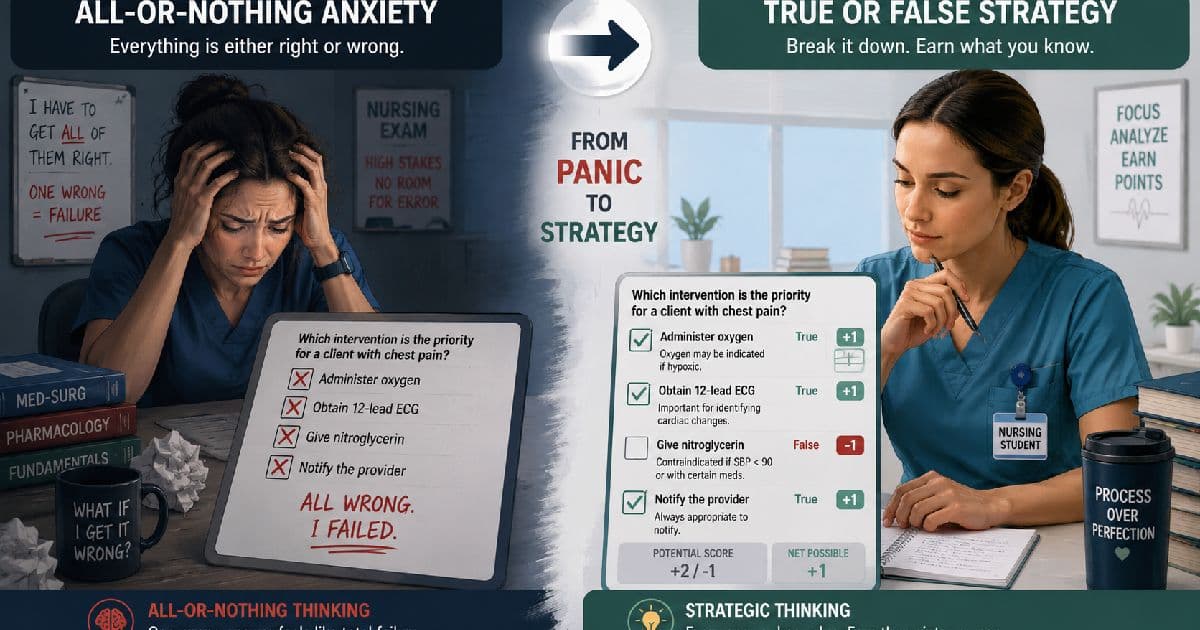
Select-all-that-apply NCLEX questions make nursing students nervous because there may be more than one correct answer.
That is exactly why they matter.
The exam is not asking whether one option sounds familiar. It is asking whether you can judge each option independently, connect it to the client data, and avoid unsafe assumptions.
You may hear these questions called:
- SATA questions
- Select-all-that-apply questions
- Multiple response questions
- Multiple select questions
- Extended multiple response questions
- NGN select-all questions
The wording may change, but the core skill stays the same.
You must decide whether each option is safe, expected, relevant, and supported by the question stem.
What are select-all-that-apply NCLEX questions?
Select-all-that-apply questions ask you to choose every option that is correct.
A standard multiple-choice question has one best answer.
A SATA question may have several correct answers.
On NCLEX, these questions may test:
- Assessment findings
- Priority cues
- Nursing actions
- Client teaching
- Medication safety
- Infection control
- Delegation
- Contraindications
- Expected outcomes
- Complications
- Lab interpretation
- Discharge instructions
- Clinical judgment in case studies
A SATA item usually looks like this:
The nurse is teaching a client with heart failure. Which statements indicate understanding? Select all that apply.Or:
Which findings require immediate follow-up? Select all that apply.Or:
Which actions should the nurse include in the plan of care? Select all that apply.The trap is simple.
More than one option may sound partly right.
Your job is to choose the options that are fully correct for the question being asked.
Why SATA questions feel harder
SATA questions feel harder because they remove the comfort of choosing one answer and moving on.
You must make several small decisions inside one question.
That means one careless assumption can cost points.
Common reasons students miss SATA questions:
- They rush the stem.
- They assume the number of answers.
- They select options because they are true in general, not true for the case.
- They miss words like “first,” “priority,” “requires follow-up,” or “understanding.”
- They mix up assessment, implementation, teaching, and evaluation.
- They choose unsafe options that contain one familiar phrase.
- They forget scope of practice.
- They overselect because they are afraid of missing an answer.
- They underselect because they are afraid of being penalized.
SATA and the Next Generation NCLEX
The NCLEX now includes both traditional item formats and newer NGN item types.
Students still say “SATA,” but the exam may present select-all logic in different ways.
You may see:
- Traditional multiple response
- Extended multiple response
- Matrix/grid select-all
- Case-study questions
- Highlighting items
- Bow-tie items
- Trend items
- Ordered response items
The official NCLEX test plans say candidates may receive stand-alone items and case studies written in multiple formats. The NCLEX Candidate Bulletin also states that partial credit scoring applies to items with more than one key.
That matters because older advice about SATA being “all or nothing” is outdated for current NCLEX preparation.
Still, do not try to game the scoring.
Use safe nursing judgment.
The safest SATA strategy
Use a repeatable method every time.
Do not change your strategy based on anxiety.
Do not pick answers by “vibe.”
Do not compare options too early.
The strongest method is option-by-option testing.
Step 1: Read the stem twice
Before you look at the options, answer these questions:
What is the topic?
What is the nurse being asked to choose?
Is the question asking for correct actions, incorrect actions, priority findings, teaching statements, or complications?
Is the client stable or unstable?
Is this RN scope, PN/LVN scope, UAP scope, or client teaching?
The stem controls the answer.
Do not let the options pull you away from it.
Example stem
The nurse is caring for a client who is 8 hours post-op after thyroidectomy. Which findings require immediate follow-up? Select all that apply.Before reading options, predict the topic:
Post-thyroidectomy complications: airway compromise, bleeding, hypocalcemia, laryngeal nerve injury.That prediction protects you from distractors.
Step 2: Identify the command words
Command words tell you what kind of answer is needed.
“Requires immediate follow-up”
Look for danger.
Choose abnormal, unexpected, or unstable findings.
“Indicates understanding”
Choose correct client statements.
Avoid statements that are partly correct but unsafe.
“Needs further teaching”
Choose wrong client statements.
This is a reverse-style question.
“Include in the plan of care”
Choose nursing actions that are appropriate for the client.
“Which prescriptions should the nurse question?”
Choose unsafe orders.
“Which tasks can be delegated?”
Choose stable, predictable tasks that match the role.
For delegation strategy, review the NCLEX delegation questions guide.
Step 3: Predict before looking at options
Prediction keeps you focused.
You do not need to write a full lecture in your head.
Just name the likely rule.
Examples:
Question: Client has digoxin.
Prediction: Check apical pulse, monitor potassium, toxicity signs, avoid double dose, report visual changes.Question: Client has neutropenia.
Prediction: Infection prevention, hand hygiene, avoid sick visitors, avoid raw foods if ordered by facility policy, monitor fever.Question: Client has suspected stroke.
Prediction: Time last known well, neuro assessment, airway, glucose, rapid response/stroke protocol, do not give food or fluids until swallow screen.Prediction does not replace reading.
It gives your brain a target.
Step 4: Turn each option into true/false
This is the main SATA skill.
Cover the other options mentally.
Ask:
Is this one option correct for this one question?Then decide:
Yes: select it.
No: leave it.
Unsure: mark it and come back after reviewing the stem.
Do not ask, “Does this sound familiar?”
Ask, “Is this safe and supported?”
Step 5: Use the safety test
For every selected answer, run a safety check.
Ask:
Could this harm the client?
Does this delay urgent care?
Is this outside nursing scope?
Does this contradict the diagnosis, medication, procedure, or lab value?
Does it ignore airway, breathing, circulation, neuro change, bleeding, infection, or safety?
If the option fails the safety test, do not select it.
Step 6: Use the “always true for this client” rule
Some options are true in general but wrong for the situation.
General truth
Clients should be encouraged to ambulate after surgery.Not always safe
A client with sudden shortness of breath, chest pain, and calf swelling should not be encouraged to ambulate.NCLEX rewards context.
Context beats memorized statements.
Step 7: Recheck for reverse wording
Reverse wording turns the question upside down.
Watch for:
- Needs further teaching
- Incorrect statement
- Contraindicated
- Should question
- Requires clarification
- Not appropriate
- Avoid
- Follow-up needed
Example
Which statement by the client requires further teaching? Select all that apply.This asks for wrong statements.
If you choose correct teaching statements, you miss the question.
The 8 SATA rules that help most
Rule 1: Each answer must stand alone
A correct option does not need help from another option.
If an option is only correct when you add missing assumptions, leave it out.
Weak reasoning
Maybe this option is right if the provider ordered it.Strong reasoning
The option is safe and correct based on the information given.Rule 2: Do not choose vague answers
NCLEX often uses vague options as traps.
Be careful with phrases like:
- Monitor as needed
- Encourage fluids without context
- Continue to observe
- Reassure the client
- Document only
- Teach later
- Notify provider before assessment when assessment is needed
- Ask another nurse to decide
Vague does not always mean wrong.
But vague options are weak when a specific safety action is available.
Rule 3: Do not choose options outside the nurse’s role
Nurses assess, intervene within scope, teach, monitor, evaluate, advocate, and communicate.
Nurses do not independently diagnose medical conditions, prescribe medications, or perform provider-only procedures.
Usually unsafe wording
Prescribe an antibiotic.
Diagnose pulmonary embolism.
Discontinue a provider-prescribed medication without protocol or urgent safety reason.
Tell the client the biopsy is definitely cancer.
Usually safer wording
Assess respiratory status.
Hold medication and notify the provider according to policy.
Prepare to administer prescribed therapy.
Report concerning findings.
Follow facility protocol.
Rule 4: Assessment comes before action when data are missing
If the client is stable and the problem is unclear, assess first.
If the client is unstable, take immediate safe action.
This same rule matters in NCLEX prioritization questions.
Choose assessment first when:
- Symptoms are vague
- You need more data
- No immediate danger is described
- The option gives a focused assessment
Choose action first when:
- Airway is compromised
- Breathing is unsafe
- Circulation is failing
- The client is actively bleeding
- The client is seizing
- A dangerous infusion or reaction is occurring
- The client is at immediate risk of harm
Rule 5: Teaching answers must be specific and safe
Client teaching SATA questions often include options that are partly true.
The right teaching statements are clear, safe, and connected to the condition.
Good teaching option
“I will call my provider if I gain 3 lb in 2 days.”Weak teaching option
“I will stop taking my medication when I feel better.”Partly true but unsafe option
“I can take extra potassium whenever I feel weak.”Weakness can happen for many reasons.
The client should not self-dose potassium.
Rule 6: Avoid absolute answers unless they are truly absolute
Words like “always,” “never,” “only,” and “all” are often suspicious.
But they are not automatically wrong.
Some nursing rules are absolute enough for exam purposes.
Often correct absolutes
Never recap a used needle.
Always verify client identity before medication administration.
Never delegate assessment to UAP.
Often wrong absolutes
Always restrict fluids for heart failure.
Never give opioids after surgery.
All clients with COPD should receive high-flow oxygen.
Think clinically.
Do not use shortcuts blindly.
Rule 7: Normal findings can be correct answers if the question asks for expected findings
Not every SATA question asks for danger.
Some ask for expected findings.
Example
Which findings are expected during the first 24 hours after an uncomplicated vaginal birth? Select all that apply.The correct answers may include expected postpartum findings, not emergencies.
Read the command words.
Rule 8: If you cannot defend it, do not select it
This is the rule that prevents overselecting.
Before you submit, ask:
Can I give a one-sentence rationale for this option?If not, remove it.
Common SATA question types
Type 1: Assessment findings
These questions ask which findings matter.
They may say:
Which findings require follow-up?
Which findings are expected?
Which findings indicate improvement?
Which findings suggest a complication?
Strategy:
- Identify the condition or procedure.
- Predict expected vs unexpected findings.
- Choose findings that match the command.
- Prioritize new, sudden, worsening, or unstable findings.
Example
A client is 12 hours post-op after abdominal surgery. Which findings require immediate follow-up? Select all that apply.
- Pain rated 4/10 at the incision
- Respiratory rate 30/min with shallow breathing
- Urine output 15 mL/hr for 3 hours
- Small amount of serosanguineous drainage
- New confusion
- Mild nausea after opioid pain medication
Answer
2, 3, 5Rationale
Respiratory rate 30/min with shallow breathing may indicate respiratory compromise. Urine output 15 mL/hr for 3 hours suggests poor perfusion, dehydration, obstruction, or kidney injury. New confusion is an acute change and may signal hypoxia, infection, medication effect, or other deterioration. Mild incisional pain, a small amount of serosanguineous drainage, and mild nausea after opioids may be expected but still require routine care.Type 2: Client teaching
Teaching questions ask which statements show understanding or misunderstanding.
Watch the wording.
Indicates understanding
Choose correct statements.
Needs further teaching
Choose incorrect statements.
Example
The nurse teaches a client newly prescribed warfarin. Which statements indicate understanding? Select all that apply.
- “I will use an electric razor.”
- “I should keep my intake of vitamin K consistent.”
- “I will stop the medication when my bruising improves.”
- “I will report black, tarry stools.”
- “I can take aspirin whenever I have a headache.”
- “I will tell my dentist I take this medication.”
Answer
1, 2, 4, 6Rationale
Warfarin increases bleeding risk. The client should use bleeding precautions, keep vitamin K intake consistent, report bleeding signs such as black stools, and inform health care providers. The client should not stop warfarin independently or take aspirin without provider guidance because aspirin can increase bleeding risk.Type 3: Medication safety
Medication SATA questions often test adverse effects, contraindications, monitoring, and teaching.
Strategy:
- Identify the drug class.
- Predict major safety concerns.
- Match options to assessment, labs, vitals, and teaching.
- Eliminate options that ignore safety.
Common medication SATA topics
- Insulin
- Heparin
- Warfarin
- Digoxin
- Opioids
- Diuretics
- ACE inhibitors
- Beta blockers
- Antibiotics
- Antipsychotics
- Anticonvulsants
- Magnesium sulfate
- Oxytocin
Example
The nurse prepares to administer digoxin to an adult client. Which actions are appropriate? Select all that apply.
- Check the apical pulse before administration
- Monitor potassium level
- Teach the client to report yellow-green vision changes
- Give an extra dose if one dose is missed
- Monitor for nausea, vomiting, and anorexia
- Hold the medication because digoxin is never given with heart failure
Answer
1, 2, 3, 5Rationale
Digoxin requires pulse assessment and monitoring for toxicity. Hypokalemia increases risk for digoxin toxicity. Visual changes and gastrointestinal symptoms can be toxicity cues. The client should not double doses. Digoxin may be prescribed for some clients with heart failure, so it is not automatically held for that reason.Type 4: Infection control
Infection control SATA questions test isolation precautions, PPE, hand hygiene, and transmission.
Strategy:
- Identify the organism or disease.
- Choose the correct precaution type.
- Add PPE and room rules that match transmission.
- Avoid over-isolating or under-isolating.
Quick infection control review
Standard precautions: all clients.
Contact precautions: organisms spread by direct contact, such as C. difficile, MRSA wounds, scabies.
Droplet precautions: large respiratory droplets, such as influenza, pertussis, meningococcal meningitis.
Airborne precautions: small particles, such as tuberculosis, measles, varicella.
Example
The nurse cares for a client with suspected active tuberculosis. Which actions are appropriate? Select all that apply.
- Place the client in an airborne infection isolation room
- Wear an N95 respirator or facility-approved respiratory protection
- Keep the door closed
- Use only standard precautions because TB is spread by contact
- Place a surgical mask on the client during transport if transport is necessary
- Assign the client to a room with a client recovering from appendectomy
Answer
1, 2, 3, 5Rationale
Suspected active tuberculosis requires airborne precautions. The client should be placed in an airborne infection isolation room, staff should use appropriate respiratory protection, the door should remain closed, and the client should wear a surgical mask during necessary transport. TB is not managed with standard precautions only, and the client should not be cohorted with a non-TB client.Type 5: Priority and safety
Priority SATA questions ask which findings or actions matter most.
They may connect to airway, breathing, circulation, neuro status, bleeding, sepsis, or safety.
For a full framework, use the NCLEX prioritization guide.
Example
The nurse receives report on a client with pneumonia. Which findings require immediate follow-up? Select all that apply.
- SpO2 decreased from 95% to 88%
- Productive cough with yellow sputum
- New confusion
- Respiratory rate 32/min
- Temperature 38.1°C
- Speaking in one- to two-word phrases
Answer
1, 3, 4, 6Rationale
The urgent cues are worsening oxygen saturation, new confusion, tachypnea, and inability to speak in full sentences. Productive cough and fever can be expected with pneumonia, although they still require routine care and monitoring.Type 6: Delegation and assignment
Delegation SATA questions ask which tasks match the role.
Strategy:
- Identify the role: RN, PN/LVN, or UAP.
- Check client stability.
- Check whether the task requires assessment, teaching, evaluation, or judgment.
- Select only stable, predictable tasks for UAP.
Example
Which tasks may the RN delegate to UAP? Select all that apply.
- Obtain routine vital signs for a stable client
- Teach a client how to use an incentive spirometer
- Ambulate a stable client after discharge teaching has been completed
- Evaluate pain relief after IV morphine
- Assist a stable client with a bed bath
- Report a new blood pressure of 82/46 to the provider
Answer
1, 3, 5Rationale
Routine vital signs, ambulation of a stable client, and hygiene care may be delegated to UAP depending on policy. Teaching, evaluation, and provider communication about an unstable finding require nursing judgment.Type 7: Lab and diagnostic interpretation
Lab SATA questions ask you to identify abnormal values, complications, or needed actions.
Strategy:
- Know the client context.
- Decide whether the lab is expected or dangerous.
- Look for trends.
- Choose actions that match the lab and client condition.
Example
A client with chronic kidney disease has the following labs. Which findings require follow-up? Select all that apply.
- Potassium 6.1 mEq/L
- Creatinine 4.8 mg/dL
- BUN elevated from baseline
- Hemoglobin 10.5 g/dL
- Peaked T waves on ECG
- Calcium 9.4 mg/dL
Answer
1, 5Rationale
Potassium 6.1 mEq/L with peaked T waves suggests dangerous hyperkalemia and requires urgent follow-up. Elevated creatinine and BUN may be expected in chronic kidney disease depending on baseline. Hemoglobin 10.5 g/dL may reflect chronic anemia and needs monitoring, but it is not as urgent as hyperkalemia with ECG changes. Calcium 9.4 mg/dL is within typical reference range.Type 8: Maternal-newborn SATA
Maternal-newborn SATA questions often test expected vs unexpected findings.
Strategy:
- Identify pregnancy, labor, postpartum, or newborn stage.
- Know normal changes.
- Look for hemorrhage, infection, hypertension, fetal distress, hypoglycemia, or respiratory distress.
- Choose findings or actions that match the command.
Example
The nurse cares for a client receiving magnesium sulfate for preeclampsia. Which findings should the nurse report? Select all that apply.
- Respiratory rate 10/min
- Absent deep tendon reflexes
- Urine output 20 mL/hr
- Client reports feeling warm
- Blood pressure improving from 168/104 to 142/88
- Fetal heart rate monitoring in place
Answer
1, 2, 3Rationale
Respiratory depression, absent deep tendon reflexes, and low urine output can indicate magnesium toxicity or increased risk for toxicity. Feeling warm can be expected. Improved blood pressure and fetal monitoring are not toxicity findings.Type 9: Pediatric SATA
Pediatric SATA questions often test safety, developmental stage, dehydration, respiratory distress, and family teaching.
Strategy:
- Use age-specific safety.
- Watch respiratory cues closely.
- Check hydration and weight-based medication safety.
- Include caregivers in teaching.
Example
The nurse teaches parents of an infant with bronchiolitis. Which statements indicate understanding? Select all that apply.
- “I will offer small, frequent feedings.”
- “I will watch for fewer wet diapers.”
- “I will call for help if breathing becomes faster or harder.”
- “I will give aspirin for fever.”
- “I will use a bulb syringe or suction as instructed before feedings.”
- “I will smoke outside the home and change clothing before holding the baby.”
Answer
1, 2, 3, 5, 6Rationale
Small frequent feedings, monitoring wet diapers, watching work of breathing, using suction as instructed, and reducing smoke exposure are appropriate. Aspirin should not be given to children unless specifically prescribed because of safety concerns.Type 10: Mental health SATA
Mental health SATA questions often test safety, therapeutic communication, suicide precautions, restraints, withdrawal, medication effects, and de-escalation.
Strategy:
- Prioritize safety.
- Use therapeutic communication.
- Avoid judgmental or why-based questions.
- Choose least restrictive interventions when appropriate.
- Escalate immediate threats.
Example
A client states, “I do not want to live anymore.” Which responses or actions are appropriate? Select all that apply.
- “Are you thinking about killing yourself?”
- Stay with the client and ensure safety
- Ask whether the client has a plan
- Promise not to tell anyone
- Remove access to potential means according to policy
- Tell the client they have many reasons to live and leave to call the family
Answer
1, 2, 3, 5Rationale
The nurse should directly assess suicidal ideation, stay with the client, assess for plan and means, and reduce access to harm according to policy. The nurse should not promise secrecy. Minimizing the client’s feelings or leaving the client alone is unsafe.How to avoid overselecting
Overselecting means choosing too many options.
It usually happens when you think:
This might be right.“Might be right” is not enough.
Use these filters.
Filter 1: Is it directly answering the stem?
If the stem asks for teaching, do not choose assessment findings.
If the stem asks for immediate follow-up, do not choose routine expected findings.
If the stem asks for delegation, do not choose RN-only tasks.
Filter 2: Is it safe?
Unsafe options may include:
- Giving oral fluids to a client with decreased level of consciousness
- Ambulating a client with suspected pulmonary embolism
- Massaging a calf with suspected DVT
- Delaying care for documentation
- Delegating assessment to UAP
- Encouraging coughing during active airway obstruction instead of appropriate emergency action
- Ignoring severe abnormal vital signs
Filter 3: Is it supported by the scenario?
Do not add your own facts.
If the question does not mention a provider order, standing protocol, facility policy, or assessment finding, be careful about assuming one.
Filter 4: Is one word making the option wrong?
A long option can sound perfect until one word makes it unsafe.
Example
Encourage the client with dysphagia to drink thin liquids quickly.“Encourage” and “drink liquids” may sound like hydration.
But “thin liquids quickly” is unsafe for dysphagia.
Filter 5: Is it too broad?
Broad options can be traps.
Weak
Restrict all fluids.Stronger
Follow the prescribed fluid restriction and monitor intake and output.NCLEX prefers precise, safe nursing actions.
How to avoid underselecting
Underselecting means choosing too few options.
It happens when you are afraid of selecting wrong answers.
Use these habits.
Habit 1: Force a decision for every option
Do not skip.
Label each option:
Correct
Incorrect
Unsure
Then return to the unsure options.
Habit 2: Separate familiar from correct
A familiar answer may still be wrong.
But an unfamiliar answer may be correct.
Judge the option, not your comfort level.
Habit 3: Reword the option simply
Long options become easier when simplified.
Original option
Instruct the client to notify the provider if shortness of breath, swelling, or rapid weight gain occurs.Simple version
Report heart failure worsening signs.Now decide whether it fits.
Habit 4: Look for categories
SATA questions often have answer categories.
For example, a heart failure teaching question may include:
- Diet
- Daily weight
- Medication adherence
- Symptom reporting
- Activity pacing
- Follow-up care
Several categories may be correct.
Do not choose only one because the first correct answer looked strong.
SATA traps students miss
Trap 1: Selecting every abnormal finding
Abnormal does not always mean priority.
A chronic abnormal may be expected.
A mild abnormal may be less urgent than a changing vital sign.
Example
A client with COPD may have a baseline SpO2 of 90%.
That is not automatically more urgent than new confusion or sudden chest pain.
Trap 2: Ignoring the word “expected”
If the question asks for expected findings, do not choose complications.
Trap 3: Missing the timeframe
Time matters.
A finding may be expected at one stage and dangerous at another.
Examples:
- Mild incisional pain after surgery may be expected.
- Severe sudden pain with rigid abdomen is not expected.
- Lochia rubra is expected early postpartum.
- Saturating a pad in 15 minutes is not expected.
- Pink-tinged urine may occur after urinary catheter insertion.
- No urine output for hours is not expected.
Trap 4: Choosing provider actions as nursing actions
If the question asks what the nurse should do, choose nursing actions.
The nurse may notify the provider, prepare for prescriptions, or question unsafe orders.
The nurse does not independently prescribe.
Trap 5: Choosing documentation first
Documentation matters.
But it is rarely the first answer when the client needs assessment or intervention.
Trap 6: Missing “further teaching”
“Further teaching” means the client is wrong.
Many students accidentally select the correct statements.
Trap 7: Picking answers from another disease
A distractor may be correct for a similar condition but wrong here.
Examples:
- Asthma vs COPD
- DKA vs HHS
- Hyperthyroidism vs hypothyroidism
- SIADH vs diabetes insipidus
- Hyperkalemia vs hypokalemia
- Left-sided vs right-sided heart failure
Trap 8: Ignoring client age
Safe care changes with age.
Pediatric dosing, fall risk, aspiration risk, and developmental teaching all depend on age.
Trap 9: Choosing the answer that sounds most technical
Technical language does not make an option correct.
NCLEX often rewards simple safe actions.
Trap 10: Changing answers without a reason
Change an answer only if you found a specific clue you missed.
Do not change because of panic.
SATA decision checklist
Use this before submitting.
1. Did I answer the exact wording of the stem?
2. Did I check whether the question asks for correct or incorrect options?
3. Did I test each option independently?
4. Did I avoid adding facts that are not in the question?
5. Did I eliminate unsafe or outside-scope options?
6. Can I give a one-sentence rationale for every selected option?
7. Did I avoid counting answers?
8. Did I recheck any option with absolute wording?
9. Did I use client data instead of memorized phrases?
10. Did I submit only the options I can defend?
How to approach SATA in NGN case studies
NGN case studies often use select-all logic across a client record.
You may need to review:
- Nurses’ notes
- Provider prescriptions
- Vital signs
- Lab results
- Medication administration record
- History and physical
- Intake and output
- Progress notes
Do not read the whole case passively.
Read with clinical judgment.
The NCSBN Clinical Judgment Measurement Model includes:
- Recognize cues
- Analyze cues
- Prioritize hypotheses
- Generate solutions
- Take action
- Evaluate outcomes
SATA can appear at several of those steps.
Recognize cues SATA
The question may ask:
Which findings require follow-up? Select all that apply.Choose the relevant abnormal or high-risk cues.
Analyze cues SATA
The question may ask:
Which findings support the nurse’s concern? Select all that apply.Choose cues that cluster together.
Generate solutions SATA
The question may ask:
Which interventions should the nurse anticipate? Select all that apply.Choose actions that match the likely problem and scope.
Take action SATA
The question may ask:
Which actions should the nurse take now? Select all that apply.Choose immediate, safe, priority actions.
Evaluate outcomes SATA
The question may ask:
Which findings indicate the client is improving? Select all that apply.Choose outcomes that match the intervention goal.
For more NGN practice, review the Next Gen NCLEX case studies guide.
Worked example: heart failure teaching
Question
The nurse teaches a client with heart failure about home care. Which statements indicate understanding? Select all that apply.
- “I will weigh myself every morning.”
- “I will call my provider if I gain 3 lb in 2 days.”
- “I will take my diuretic only when my ankles swell.”
- “I will follow the sodium limit prescribed for me.”
- “I will sleep flat to make breathing easier.”
- “I will report increasing shortness of breath.”
Step-by-step thinking
Stem task
Choose correct client statements that show understanding of heart failure home care.Predict
Daily weights, sodium restriction, medication adherence, symptom reporting, fluid guidance if prescribed, follow-up care.Option testing
1. Daily weight: correct.
2. Rapid weight gain: correct reporting cue.
3. Takes diuretic only when swelling occurs: incorrect unless specifically prescribed that way.
4. Sodium limit: correct.
5. Sleep flat to breathe easier: incorrect. Orthopnea may worsen flat.
6. Increasing shortness of breath: correct reporting cue.
Answer
1, 2, 4, 6Rationale
Heart failure teaching includes daily weight monitoring, reporting rapid weight gain, following prescribed sodium limits, taking medications as prescribed, and reporting worsening shortness of breath. The client should not take a prescribed diuretic only when swelling is present unless instructed. Sleeping flat can worsen breathing for some clients with heart failure.Worked example: neutropenia precautions
Question
The nurse cares for a client with neutropenia after chemotherapy. Which actions are appropriate? Select all that apply.
- Perform hand hygiene before entering the room
- Screen visitors for illness
- Place fresh flowers at the bedside
- Monitor temperature
- Teach the client to report chills
- Encourage the client to clean the cat litter box to stay active
Step-by-step thinking
Stem task
Choose appropriate actions for infection prevention in neutropenia.Predict
Prevent infection, monitor fever, avoid sick contacts, avoid potential pathogen exposure, teach when to report symptoms.Option testing
1. Hand hygiene: correct.
2. Screen visitors: correct.
3. Fresh flowers: usually avoided due to infection risk in many oncology/neutropenia settings.
4. Monitor temperature: correct.
5. Report chills: correct.
6. Cat litter box: incorrect due to pathogen exposure.
Answer
1, 2, 4, 5Rationale
Neutropenia increases infection risk. Hand hygiene, visitor screening, temperature monitoring, and reporting chills are appropriate. Fresh flowers and cleaning litter boxes can increase exposure to organisms and are not appropriate precautions.Worked example: suspected stroke
Question
The nurse assesses a client with sudden right-sided weakness and slurred speech. Which actions should the nurse take? Select all that apply.
- Determine the time the client was last known well
- Perform a focused neurologic assessment
- Provide oral fluids to check swallowing
- Check blood glucose
- Activate stroke protocol or rapid response according to facility policy
- Tell the family to wait until shift change for an update
Step-by-step thinking
Stem task
Choose actions for a client with sudden stroke symptoms.Predict
Time last known well, neuro assessment, glucose, airway/safety, stroke protocol, do not give food or fluids until swallow safety is addressed.Option testing
1. Last known well: correct.
2. Focused neuro assessment: correct.
3. Oral fluids: unsafe before swallow screening.
4. Blood glucose: correct because hypoglycemia can mimic neurologic symptoms.
5. Activate protocol/rapid response: correct.
6. Delay communication: incorrect.
Answer
1, 2, 4, 5Rationale
Sudden weakness and slurred speech require urgent stroke assessment and facility protocol. Time last known well affects treatment decisions. Blood glucose helps rule out hypoglycemia as a mimic. The client should not receive oral fluids until swallowing is evaluated.Worked example: post-op complication
Question
A client is 8 hours post-op after hip replacement. Which findings require immediate follow-up? Select all that apply.
- Sudden shortness of breath
- Pain 4/10 at the incision
- New chest pain with inspiration
- SpO2 87% on room air
- Right calf warmth and swelling
- Requests help repositioning
Step-by-step thinking
Stem task
Choose immediate follow-up findings.Predict
Post-op complications: PE, DVT, bleeding, infection, neurovascular compromise, respiratory problems.Option testing
1. Sudden shortness of breath: urgent.
2. Pain 4/10: expected routine care.
3. Chest pain with inspiration: urgent.
4. SpO2 87%: urgent oxygenation problem.
5. Calf warmth/swelling: concerning for DVT.
6. Repositioning request: routine need.
Answer
1, 3, 4, 5Rationale
Sudden shortness of breath, pleuritic chest pain, hypoxia, and calf warmth/swelling suggest possible thromboembolic complication and require immediate follow-up. Incisional pain 4/10 and help repositioning require care but are not the urgent findings.Worked example: needs further teaching
Question
The nurse teaches a client prescribed alendronate. Which statements require further teaching? Select all that apply.
- “I will take this medication with a full glass of water.”
- “I can lie down right after taking the medication.”
- “I will take it before eating breakfast.”
- “I will chew the tablet if it is hard to swallow.”
- “I will tell my provider if I develop new trouble swallowing.”
- “I will take it at the same time as calcium to protect my bones.”
Step-by-step thinking
Stem task
Choose incorrect statements.Predict
Alendronate teaching: take with water, take before food, stay upright, swallow whole, separate from calcium/other meds, report esophageal symptoms.Option testing
1. Full glass water: correct, not selected.
2. Lie down after taking: incorrect, select.
3. Before breakfast: correct, not selected.
4. Chew tablet: incorrect, select.
5. Report trouble swallowing: correct, not selected.
6. Take with calcium: incorrect because calcium can reduce absorption, select.
Answer
2, 4, 6Rationale
The question asks for statements requiring further teaching. The client should stay upright after taking alendronate, swallow it whole, and avoid taking it with calcium or other medications that interfere with absorption.Practice questions: select-all-that-apply NCLEX
Question 1
The nurse cares for a client with left-sided heart failure. Which findings should the nurse expect? Select all that apply.
- Crackles in the lungs
- Dyspnea on exertion
- Peripheral edema only, without respiratory symptoms
- Orthopnea
- Pink frothy sputum in severe cases
- Bradycardia as the main expected finding
Answer
1, 2, 4, 5Rationale
Left-sided heart failure commonly causes pulmonary congestion, dyspnea, orthopnea, and in severe pulmonary edema, pink frothy sputum. Peripheral edema is more associated with right-sided heart failure, although clients can have both. Bradycardia is not the main expected finding.
Question 2
The nurse teaches a client about using an incentive spirometer after surgery. Which instructions are appropriate? Select all that apply.
- Sit upright if possible
- Seal lips around the mouthpiece
- Inhale slowly and deeply
- Cough after using the device if instructed
- Use it only when shortness of breath occurs
- Exhale forcefully into the device as fast as possible
Answer
1, 2, 3, 4Rationale
The client should sit upright, seal lips around the mouthpiece, inhale slowly and deeply, and cough after use if instructed. Incentive spirometry is used regularly as prescribed, not only during shortness of breath. The client inhales through the device rather than forcefully exhaling into it.
Question 3
Which findings in a client receiving a blood transfusion require the nurse to stop the transfusion and follow protocol? Select all that apply.
- Chills
- Back pain
- Fever
- Mild hunger
- Dyspnea
- Urticaria
Answer
1, 2, 3, 5, 6Rationale
Chills, back pain, fever, dyspnea, and urticaria can signal a transfusion reaction. The nurse should stop the transfusion and follow facility protocol. Mild hunger is unrelated.
Question 4
The nurse reviews discharge teaching for a client with a new tracheostomy. Which statements indicate understanding? Select all that apply.
- “I will keep emergency equipment nearby as instructed.”
- “I will wash my hands before tracheostomy care.”
- “I will call for help if I have trouble breathing.”
- “I will use small amounts of water to clean as instructed.”
- “I can remove the tracheostomy tube whenever mucus is present.”
- “I will follow the suctioning instructions I was taught.”
Answer
1, 2, 3, 4, 6Rationale
Emergency equipment, hand hygiene, reporting breathing difficulty, proper cleaning, and following suction instructions are appropriate. The client should not remove the tracheostomy tube whenever mucus is present unless specifically trained and instructed for a particular device and situation.
Question 5
The nurse cares for a client with diabetic ketoacidosis. Which findings should the nurse expect? Select all that apply.
- Hyperglycemia
- Ketones
- Metabolic acidosis
- Kussmaul respirations
- Fruity breath odor
- Severe hypoglycemia as the defining feature
Answer
1, 2, 3, 4, 5Rationale
DKA is associated with hyperglycemia, ketones, metabolic acidosis, Kussmaul respirations, and fruity breath odor. Severe hypoglycemia is not the defining feature of DKA.
Question 6
Which actions are appropriate when caring for a client with seizure precautions? Select all that apply.
- Keep suction equipment available
- Pad side rails according to facility policy
- Place the bed in a low position
- Put a tongue blade in the client’s mouth during a seizure
- Time the seizure
- Turn the client to the side when safe
Answer
1, 2, 3, 5, 6Rationale
Seizure precautions include airway and safety measures, suction availability, bed safety, timing the seizure, and positioning to protect the airway when safe. Do not place objects in the client’s mouth during a seizure.
Question 7
The nurse teaches a client prescribed an ACE inhibitor. Which information should the nurse include? Select all that apply.
- Report swelling of the lips or tongue
- Report persistent cough
- Rise slowly from sitting to standing
- Potassium levels may need monitoring
- Take potassium supplements without provider guidance
- Stop the medication when blood pressure improves
Answer
1, 2, 3, 4Rationale
ACE inhibitors can cause angioedema, cough, hypotension, and potassium changes. The client should not take potassium supplements or stop the medication without provider guidance.
Question 8
The nurse cares for a client with C. difficile infection. Which actions are appropriate? Select all that apply.
- Use contact precautions
- Perform hand hygiene according to facility policy, with soap and water emphasized when caring for C. difficile
- Use dedicated equipment when possible
- Teach visitors about PPE
- Use airborne precautions in a negative-pressure room for all care
- Clean the room using facility-approved sporicidal disinfectant
Answer
1, 2, 3, 4, 6Rationale
C. difficile requires contact precautions, appropriate hand hygiene, dedicated equipment when possible, visitor PPE teaching, and environmental cleaning with appropriate sporicidal products. Airborne precautions are not the standard precaution category for C. difficile.
Question 9
Which findings suggest hypoglycemia? Select all that apply.
- Sweating
- Tremors
- Confusion
- Palpitations
- Hunger
- Slow, deep Kussmaul respirations as the main finding
Answer
1, 2, 3, 4, 5Rationale
Hypoglycemia can cause sweating, tremors, confusion, palpitations, and hunger. Kussmaul respirations are more associated with metabolic acidosis, such as DKA.
Question 10
The nurse teaches a client with a new cast. Which statements require further teaching? Select all that apply.
- “I will report increasing pain not relieved by medication.”
- “I will put a coat hanger inside the cast if it itches.”
- “I will keep the cast dry as instructed.”
- “I will report numbness or tingling.”
- “I will apply heat to dry the cast quickly.”
- “I will elevate the extremity as instructed.”
Answer
2, 5Rationale
The question asks for statements requiring further teaching. The client should not insert objects into the cast or use heat to dry it. Reporting pain, numbness, or tingling; keeping the cast dry; and elevating as instructed are appropriate.
Question 11
The nurse cares for a client taking opioids after surgery. Which findings require follow-up? Select all that apply.
- Respiratory rate 8/min
- Difficult to arouse
- Oxygen saturation decreasing
- Constipation
- Pain decreased from 8/10 to 4/10
- Pinpoint pupils with sedation
Answer
1, 2, 3, 6Rationale
Respiratory depression, decreased level of consciousness, decreasing oxygen saturation, and pinpoint pupils with sedation are concerning for opioid toxicity/over-sedation. Constipation is common and needs prevention and management, but it is not the same urgency as respiratory depression. Improved pain is expected.
Question 12
A client has a prescription for restraints. Which nursing actions are appropriate? Select all that apply.
- Use the least restrictive method that maintains safety
- Assess circulation and skin according to policy
- Release restraints and provide range of motion according to policy
- Tie restraints to the side rail for quick access
- Document assessment and ongoing need
- Use restraints for staff convenience when the unit is busy
Answer
1, 2, 3, 5Rationale
Restraints require least-restrictive use, frequent assessment, release and range of motion according to policy, and documentation. Restraints should not be tied to side rails or used for staff convenience.
Question 13
The nurse reviews teaching for a client with asthma. Which statements indicate understanding? Select all that apply.
- “I will use my rescue inhaler for sudden wheezing as prescribed.”
- “I will rinse my mouth after using my inhaled corticosteroid.”
- “I will seek help if my rescue inhaler is not relieving symptoms.”
- “I will stop my controller medication when I have no symptoms.”
- “I will avoid known triggers when possible.”
- “I should ignore increasing shortness of breath if I am not coughing.”
Answer
1, 2, 3, 5Rationale
Correct asthma teaching includes appropriate rescue inhaler use, mouth rinsing after inhaled corticosteroids, seeking help for worsening symptoms, and avoiding triggers. Controller medications should not be stopped without guidance. Increasing shortness of breath should not be ignored.
Question 14
Which actions should the nurse take for a client who begins choking and cannot speak? Select all that apply.
- Activate emergency response according to policy
- Perform abdominal thrusts if appropriate for the client
- Encourage the client to drink water quickly
- Leave the client alone to get the chart
- Continue until the obstruction is relieved or the client becomes unresponsive
- Begin CPR if the client becomes unresponsive and follow emergency protocol
Answer
1, 2, 5, 6Rationale
A client who cannot speak while choking has severe airway obstruction. The nurse should activate emergency response, perform appropriate obstruction relief measures, continue until relieved or the client becomes unresponsive, and begin CPR if needed. Oral fluids and leaving the client alone are unsafe.
Question 15
The nurse cares for a client with a chest tube. Which findings require immediate follow-up? Select all that apply.
- Sudden shortness of breath
- Chest tube dislodgement
- Continuous bubbling in the water seal chamber when not expected
- Tidaling with respirations in the water seal chamber early after insertion
- Dressing saturated with blood
- Mild discomfort at the insertion site
Answer
1, 2, 3, 5Rationale
Sudden shortness of breath, dislodgement, unexpected continuous bubbling, and saturated bloody dressing require immediate follow-up. Tidaling may be expected early depending on the system and client status. Mild insertion-site discomfort requires routine pain management and assessment.
NGN-style SATA case practice
Case: Respiratory deterioration
Nurses’ note
Client admitted with pneumonia 18 hours ago. At 0800, client was alert and speaking in full sentences. At 1200, client appears restless and states, “I cannot catch my breath.” Client speaks in short phrases. Skin is cool and diaphoretic.Vital signs
| Vital sign | 0800 | 1200 |
|---|---|---|
| Temp | 38.0°C | 38.4°C |
| HR | 96 | 124 |
| RR | 22 | 34 |
| BP | 132/78 | 100/58 |
| SpO2 | 94% on 2 L NC | 86% on 2 L NC |
Question 1: Which findings require immediate follow-up?
Select all that apply.
- Restlessness
- Speaks in short phrases
- SpO2 86% on 2 L NC
- Respiratory rate 34/min
- Temperature 38.4°C
- Blood pressure decreased from 132/78 to 100/58
Answer
1, 2, 3, 4, 6Rationale
Restlessness can indicate hypoxia. Speaking in short phrases, worsening oxygen saturation, tachypnea, and falling blood pressure are urgent deterioration cues. Fever is relevant to pneumonia but is not the most immediate cue compared with respiratory compromise and hemodynamic change.
Question 2: Which actions should the nurse take first?
Select all that apply.
- Stay with the client and assess airway and breathing
- Increase oxygen according to protocol or prescription
- Activate rapid response or notify appropriate emergency support according to policy
- Teach the client about completing antibiotics
- Place the client in a position that supports breathing
- Document the findings before intervening
Answer
1, 2, 3, 5Rationale
The client is deteriorating with hypoxia and respiratory distress. The nurse should stay with the client, support oxygenation according to protocol or prescription, escalate urgently, and position for breathing. Teaching and documentation can wait until the immediate safety issue is addressed.
Question 3: Which findings would indicate improvement after interventions?
Select all that apply.
- SpO2 increases to 94%
- Respiratory rate decreases to 22/min
- Client speaks in full sentences
- Client remains restless and diaphoretic
- Blood pressure improves to 122/74
- Client has no urine output for 4 hours
Answer
1, 2, 3, 5Rationale
Improved oxygen saturation, lower respiratory rate, ability to speak in full sentences, and improved blood pressure suggest better oxygenation and perfusion. Persistent restlessness/diaphoresis and no urine output are concerning.
High-yield SATA content areas
You cannot memorize every SATA question.
But you can master the topics that appear often.
Safety
Know:
- Fall precautions
- Seizure precautions
- Suicide precautions
- Aspiration precautions
- Restraint safety
- Fire safety
- Medication safety
- Oxygen safety
- Pediatric safety
- Older adult safety
Infection control
Know:
- Standard precautions
- Contact precautions
- Droplet precautions
- Airborne precautions
- PPE sequence basics
- Hand hygiene
- Sharps safety
- Isolation transport rules
- Neutropenia precautions
Pharmacology
Know:
- High-alert medications
- Anticoagulants
- Insulin
- Opioids
- Digoxin
- Diuretics
- Cardiac medications
- Psych meds
- Antibiotics
- Maternal-newborn medications
Prioritization
Know:
- ABCs
- Stable vs unstable
- Acute vs chronic
- Expected vs unexpected
- Actual vs potential
- Nursing process
- Safety first
- Trends
Delegation
Know:
- RN responsibilities
- PN/LVN role limits
- UAP tasks
- Stable vs unstable clients
- Assessment vs data collection
- Teaching vs reinforcing teaching
- Evaluation vs reporting observations
Maternal-newborn
Know:
- Preeclampsia
- Magnesium sulfate
- Postpartum hemorrhage
- Newborn hypoglycemia
- Fetal monitoring basics
- Labor complications
- Rh incompatibility basics
- Breastfeeding teaching
Pediatrics
Know:
- Respiratory distress signs
- Dehydration
- Medication safety
- Developmental safety
- Fever teaching
- Immunization teaching
- Family-centered care
Mental health
Know:
- Suicide risk
- Therapeutic communication
- De-escalation
- Withdrawal syndromes
- Medication adverse effects
- Restraints and seclusion principles
SATA answer patterns that are often safe
These are not automatic answers.
They are patterns that often point to safe nursing care.
Assessment and monitoring
Often safe when focused and relevant:
- Assess respiratory status
- Check vital signs
- Assess pain characteristics
- Monitor intake and output
- Monitor labs tied to the medication or condition
- Assess neuro status
- Reassess after intervention
Escalation
Often safe when client is unstable:
- Notify provider after urgent nursing assessment/action
- Activate rapid response according to policy
- Follow facility protocol
- Prepare for prescribed diagnostics or treatment
Teaching
Often safe when specific:
- Report worsening symptoms
- Take medication as prescribed
- Do not stop medication abruptly unless instructed
- Use safety precautions
- Keep follow-up appointments
- Avoid known contraindications
Prevention
Often safe when matched to risk:
- Hand hygiene
- Fall precautions
- Skin care and repositioning
- VTE prevention as prescribed
- Aspiration precautions
- Pressure injury prevention
SATA answer patterns that are often wrong
Again, not automatic.
But slow down when you see these.
Unsafe delay
Examples:
Document the finding and continue rounds.
Tell the client the provider will come later.
Wait until the family arrives.
Reassess at the end of the shift.
Outside scope
Examples:
Prescribe medication.
Diagnose a medical condition.
Perform a procedure without training, order, or protocol.
False reassurance
Examples:
“That is normal. Do not worry.”
“You are fine.”
“Everyone feels that way.”
Risky absolutes
Examples:
Never use oxygen for COPD.
Always restrict fluids for kidney disease.
All post-op pain is expected.
Ignoring red flags
Examples:
Encourage ambulation with suspected PE.
Massage a painful swollen calf.
Give oral intake to a client with decreased level of consciousness.
Leave a suicidal client alone.
How to review SATA rationales
Do not only check whether you got the question right.
Review every option.
That is where the learning happens.
Use this template:
Question topic:
Stem command:
Correct options:
Why each selected option is correct:
Why each unselected option is wrong:
Cue I missed:
Rule I need to remember:
Similar content area to review:
Example remediation
Question topic: Warfarin teaching
Stem command: Indicates understanding
Correct options: bleeding precautions, consistent vitamin K, report black stools, tell dentist
Cue I missed: aspirin increases bleeding risk
Rule: Avoid OTC NSAIDs/aspirin unless provider-approved when taking anticoagulants
Content to review: anticoagulants and bleeding precautions
Track your SATA error type
Most students repeat the same error.
Track your pattern.
Common SATA error types:
- Misread the stem
- Missed reverse wording
- Overselected vague options
- Underselected correct teaching
- Did not know the content
- Chose a general truth that did not fit the client
- Missed scope of practice
- Missed expected vs unexpected findings
- Missed a trend
- Chose documentation too early
- Forgot infection control category
- Confused two similar conditions
How to practise SATA without burning out
You need repetition, but you also need focused review.
Doing 100 SATA questions without reviewing rationales will not help much.
20-minute SATA routine
- Do 8-10 SATA or NGN multiple-response questions.
- Do not check answers until the end.
- Review each option, not just each question.
- Write one rule from every missed question.
- Repeat the hardest topic after 48-72 hours.
Weekly SATA plan
Day 1
Medication SATA.
Day 2
Infection control SATA.
Day 3
Priority and safety SATA.
Day 4
Maternal-newborn and pediatric SATA.
Day 5
Delegation and scope SATA.
Day 6
NGN case-study SATA.
Day 7
Mixed review and remediation.
For broader planning, use the NCLEX prep guide.
For more questions, use NurseZee practice questions.
What to do when you are stuck between two options
SATA questions often come down to one uncertain option.
Use this sequence.
1. Return to the stem
Ask:
What exactly am I selecting?2. Compare the option to the client data
Ask:
Where is the cue that supports this option?3. Check safety
Ask:
Could this hurt the client or delay urgent care?4. Check scope
Ask:
Can the nurse do this? Can UAP do this? Does this require provider prescription?5. Check wording
Ask:
Is there one word that makes this wrong?6. Decide and move on
Do not spend five minutes fighting one SATA option.
Make the safest decision you can with the data given.
SATA mini-cheat sheet by wording
“Which findings require immediate follow-up?”
Choose:
- New hypoxia
- Respiratory distress
- Chest pain
- New neuro deficit
- New confusion
- Severe bleeding
- Signs of shock
- Sepsis cues
- Decreased urine output
- Severe allergic reaction
- Dangerous lab values
- Unexpected post-op changes
Do not choose routine expected findings unless they are severe, new, or worsening.
“Which statements indicate understanding?”
Choose client statements that are:
- Correct
- Safe
- Specific
- Consistent with teaching
- Within the care plan
Do not choose statements that include stopping medication, ignoring red flags, unsafe self-treatment, or risky absolutes.
“Which statements require further teaching?”
Choose client statements that are:
- Incorrect
- Unsafe
- Incomplete in a dangerous way
- Contradicting instructions
- Suggesting nonadherence
“Which actions should the nurse take?”
Choose actions that:
- Match the priority problem
- Are within nursing scope
- Are safe
- Follow the nursing process
- Include escalation when needed
- Include reassessment after interventions
“Which tasks can be delegated?”
Choose tasks that are:
- Stable
- Predictable
- Routine
- Clear
- Within the delegatee’s role
Do not choose tasks involving initial assessment, teaching, evaluation, triage, unstable clients, or clinical judgment.
“Which prescriptions should the nurse question?”
Choose orders that are unsafe because of:
- Allergy
- Contraindication
- Critical lab
- Unsafe vital sign
- Wrong route
- Wrong dose
- Dangerous interaction
- Pregnancy concern
- Kidney/liver impairment
- Duplicate therapy
- Procedure conflict
Frequently asked questions about select-all-that-apply NCLEX questions
What does select all that apply mean on NCLEX?
Select all that apply means more than one option may be correct. You must choose every option that correctly answers the question stem.
Are SATA questions still on the NCLEX?
Yes. NCLEX uses multiple item formats, including items with more than one correct answer. Students often call these SATA questions, though official language may include multiple response or extended multiple response.
Does the NCLEX give partial credit for SATA questions?
Current NCLEX materials state that partial credit scoring applies to items for which more than one key exists. The scoring methods include plus/minus, zero/one, and rationale scoring.
Should I select at least three answers on SATA questions?
No. There is no reliable minimum or maximum number of correct answers to guess. Choose only the options that are correct for the stem.
Is it better to overselect or underselect on SATA?
Neither. Overselecting can add wrong answers. Underselecting leaves correct answers behind. The safest strategy is to test each option independently and select only what you can defend.
How do I stop changing SATA answers?
Change an answer only when you find a specific clue that proves your first choice was wrong. Do not change answers because of anxiety.
What is the best SATA strategy?
Read the stem, identify the command, predict the content, test each option as true/false, apply safety and scope rules, and recheck reverse wording before submitting.
Why do I keep missing SATA questions even when I know the content?
You may be missing the question task. Many SATA misses come from misreading “requires further teaching,” “priority,” “expected,” or “immediate follow-up.” Slow down on the stem before looking at options.
Are SATA questions harder than regular multiple-choice questions?
They can feel harder because each option requires a separate decision. But the same nursing rules apply: safety, assessment, scope, expected vs unexpected, and clinical judgment.
How should I study for SATA questions?
Practice by topic, review every option, track your error type, and write a rule for each miss. Mix SATA with NGN case studies so you can apply the same logic to client records.
Can SATA questions include normal findings?
Yes. If the question asks for expected findings or signs of improvement, normal or improving findings may be correct answers.
How do I answer “needs further teaching” SATA questions?
Choose the incorrect client statements. Reword the stem as “Which statements are wrong?” before reading the options.
Are SATA questions always clinical judgment questions?
Not always, but they often require clinical judgment because you must decide which cues, actions, or teaching points are relevant and safe.
Where can I practise NCLEX SATA questions?
Use mixed NCLEX-style questions with rationales and NGN formats. NurseZee’s practice site includes NCLEX-style practice questions.
Final thoughts
SATA questions are not random.
They reward disciplined thinking.
Read the stem.
Predict the topic.
Test each option by itself.
Choose only what is safe, correct, supported, and within scope.
When you review, do not just ask why the right answers were right.
Ask why the wrong answers were wrong.
That is how SATA questions become less intimidating.
You are training yourself to think like a safe entry-level nurse: recognize cues, reject unsafe choices, take appropriate action, and evaluate outcomes.
Sources and references
- 2026 NCLEX-RN Test Plan
- 2026 NCLEX-RN Test Plan PDF
- 2026 NCLEX-PN Test Plan
- NCLEX Test Plans
- NCLEX Candidate Bulletin April 2026 PDF
- NCLEX Frequently Asked Questions
- Next Generation NCLEX
- NCSBN Clinical Judgment Measurement Model
- NCLEX Prepare
- NurseZee: NCLEX Prioritization Questions
- NurseZee: NCLEX Delegation Questions
- NurseZee: Next Gen NCLEX Case Studies
- NurseZee: NCLEX Prep
- NurseZee Practice Questions