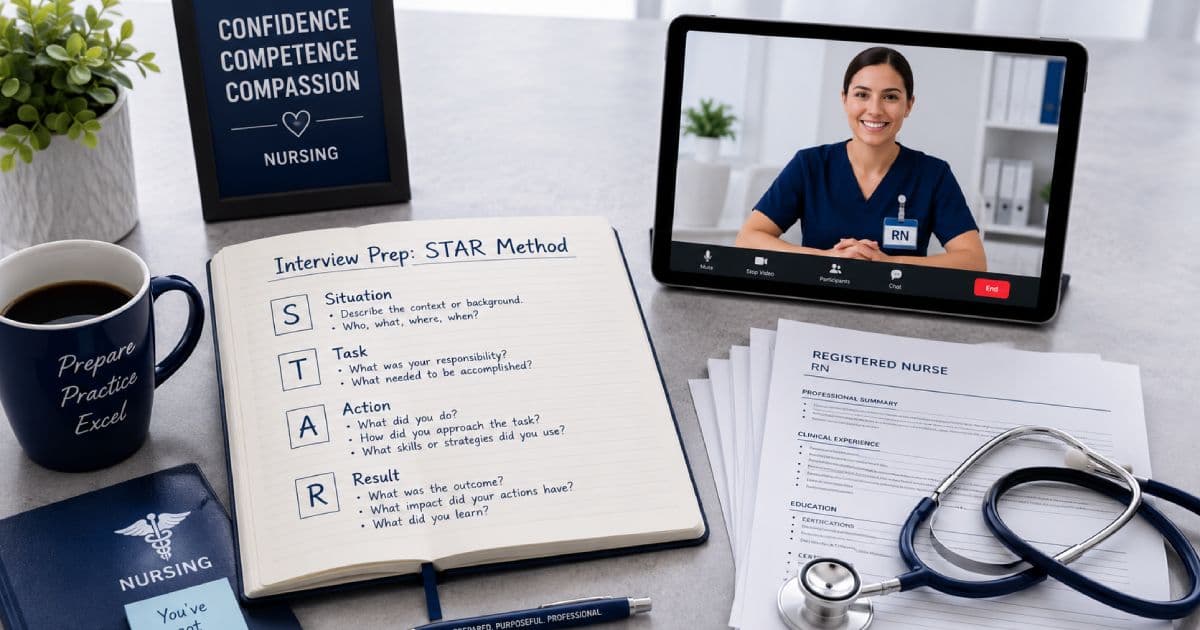
Your first nursing interview can feel strange.
You are not an expert yet.
You may not have your license number yet.
You may be applying to units where every job posting asks for experience you do not have.
That does not mean you have nothing to offer.
New grad nurse interviews are not about proving you can work like a nurse with ten years of experience.
Hiring managers are looking for something different.
They want to see whether you are safe, teachable, honest, professional, and ready to grow.
They want to know how you think when a patient changes, how you ask for help, how you handle feedback, and whether you understand the reality of nursing work.
This guide gives you the interview questions, sample answers, and preparation framework you need before your first new grad RN interview.
What hiring managers want from new grad nurses
Most managers do not expect you to know every medication, manage a full assignment independently on day one, or handle every crisis without support.
They do expect you to be safe.
They want to know that you will:
- Assess before acting
- Recognize changes in condition
- Escalate concerns appropriately
- Communicate clearly
- Ask for help before a situation becomes unsafe
- Accept feedback
- Protect patient dignity
- Work with the team
- Follow policy
- Document accurately
- Keep learning after graduation
New graduate nurses need support during the transition into practice. NCSBN has emphasized that transition-to-practice support matters because poor transition can affect safety and retention.
Nurse residency programs and structured orientation help bridge the gap between school and independent practice.
If you are applying to a residency, read NurseZee's nurse residency programs guide before your interview.
Common new grad interview formats
You may see one or more of these interview types.
Phone screen
Usually short.
They may ask:
- Graduation date
- NCLEX status
- License status
- Unit preference
- Shift availability
- Work authorization
- Why you applied
- Basic behavioral question
Video interview
May be live or recorded.
Recorded interviews often show one question at a time and give you a limited response window.
Practice short answers before you record.
Panel interview
You may interview with:
- Nurse manager
- Assistant nurse manager
- Clinical educator
- Charge nurse
- Staff nurse
- HR representative
- Nurse residency coordinator
Panel interviews test communication and professionalism.
Make eye contact with the person asking the question, but include the group as you answer.
Peer interview
Staff nurses may ask what it would be like to work with you.
They want to know:
- Are you respectful?
- Will you ask for help?
- Will you help others?
- Are you realistic about the unit?
- Can you handle feedback?
Shadow interview
Some units let candidates shadow.
Treat this as part of the interview.
Be curious.
Do not gossip.
Do not criticize the unit.
Do not stand around on your phone.
Ask thoughtful questions about workflow, orientation, teamwork, patient population, and support.
The STAR method for nursing interviews
Behavioral questions usually begin with:
Tell me about a time when...
Describe a situation where...
Give me an example of...
How did you handle...
Use STAR.
S: Situation
Set the scene quickly.
During my final med-surg clinical, I was assigned to a post-op patient who had been stable overnight.T: Task
Explain what you needed to do.
My role was to complete morning vitals and assessment, then report changes to my clinical instructor and the primary nurse.A: Action
Say what you did.
This is the most important part.
I noticed the patient's oxygen saturation had dropped, raised the head of the bed, completed a focused respiratory assessment, checked the oxygen setup, and immediately notified my instructor and the primary nurse.R: Result
Explain what happened and what you learned.
The nurse contacted the provider, and the patient received further evaluation. I learned not to dismiss small changes from baseline, especially in post-op patients.Bad STAR answer pattern
Avoid answers that sound like this:
We had a difficult patient, but the nurse handled it and everything was fine. I learned teamwork is important.That answer is too vague.
It does not show what you did.
Better STAR answer pattern
During my senior practicum, a patient became frustrated because discharge was delayed. My task was to help maintain safety while the primary nurse clarified the plan. I used a calm voice, acknowledged the patient's frustration, asked what concern was most important to them, and offered to update the whiteboard with the next steps after the nurse spoke with case management. The patient stopped yelling and agreed to wait for the update. I learned that clear communication can reduce escalation when patients feel ignored.This answer is stronger because it shows your actions.
How to prepare before the interview
Do not wait until the night before.
Research the organization
Look up:
- Mission and values
- Services offered
- Patient population
- Magnet or Pathway to Excellence status if relevant
- Nurse residency program
- Specialty units
- New grad orientation length
- Recent hospital news
- Community served
Do not overdo flattery.
Use research to show fit.
Research the unit
If you know the unit, learn:
- Typical diagnoses
- Patient ratio range
- Common medications
- Common skills
- Shift structure
- Discharge flow
- Interdisciplinary team members
- Safety risks
- Whether it is acute care, stepdown, specialty, or outpatient
Prepare 6 to 8 stories
You do not need one story for every possible question.
You need flexible stories.
Prepare examples about:
- Patient change in condition
- Difficult patient or family
- Conflict with peer
- Mistake or near miss
- Feedback you received
- Prioritization
- Teamwork
- Leadership
- Stressful clinical day
- Patient education
- Cultural humility
- Advocacy
Build a story bank
Use this template.
Story title:
Setting:
Patient/unit type:
Situation:
Task:
Action I took:
Result:
What I learned:
Which questions this story can answer:
Review your resume
Anything on your resume is fair game.
Be ready to talk about:
- Clinical rotations
- Senior practicum
- Capstone
- CNA/PCT/MA work
- Volunteer work
- Leadership
- Certifications
- Skills
- Awards
- GPA if you included it
- Gaps or career changes
Use NurseZee's new grad nurse resume guide if your resume needs work before interviews.
Know your NCLEX and license status
Be ready to answer:
When did you graduate?
Have you taken the NCLEX?
When are you scheduled?
Do you have an active RN license?
What state are you licensed in?
Are you eligible for a compact license?
If you are still preparing, see NurseZee's NCLEX prep guide.
New grad nurse interview questions and sample answers
Use these examples as models.
Change details so they match your real experience.
1. Tell me about yourself.
What they are asking
They want a short professional introduction.
They do not want your whole life story.
What to include
Mention:
- Nursing school
- Clinical interests
- Relevant experience
- Why this role
- What kind of nurse you are becoming
Sample answer
I recently graduated from nursing school and completed my senior practicum on a medical-surgical telemetry unit. During clinicals, I found that I enjoy patient education, prioritization, and working with patients who have complex needs. I also worked as a patient care technician, which helped me get comfortable with bedside care, communication, and team workflow.

I am applying for this new grad RN position because I want a strong foundation in acute care and a unit where I can keep building safe habits with support from experienced nurses. I know I still have a lot to learn, but I am organized, teachable, and willing to ask for help early.
Why this works
It is concise.
It sounds professional.
It shows readiness without pretending to be an expert.
2. Why did you choose nursing?
What they are asking
They want your motivation.
They also want to know whether you understand nursing beyond the idea of helping people.
Sample answer
I chose nursing because I wanted a career that combines science, communication, and direct patient care. During clinicals, I saw how much nurses influence patient safety by recognizing changes early, educating families, and coordinating care with the team. I like that nursing requires both clinical judgment and human connection.

One moment that confirmed my decision was caring for a patient with a new diabetes diagnosis. I watched the nurse explain insulin in a way the patient could actually understand. That showed me how much nurses can reduce fear through education and advocacy.
Avoid saying only
I like helping people.That is true for many nurses.
But it is too general.
3. Why do you want to work on this unit?
What they are asking
They want to know whether you applied intentionally.
Sample answer for med-surg
I want to start on med-surg because I know it will give me a strong foundation in assessment, time management, prioritization, discharge education, and coordination with the healthcare team. During clinicals, I saw how much med-surg nurses manage at once, and I think that environment would help me grow into a safe, well-rounded nurse.

I am especially interested in this unit because it cares for a broad adult population and has a structured new grad orientation. I want to build strong basics before specializing further.
Sample answer for ICU
I am interested in ICU because I enjoy detailed assessment, pathophysiology, and close monitoring of small changes in patient condition. During my critical care observation, I saw how ICU nurses connect hemodynamics, medications, ventilator settings, labs, and family communication.

I know ICU is a steep learning curve for a new grad. That is why I am looking for a unit with a strong residency, preceptor support, and a culture where asking questions is expected.
Sample answer for pediatrics
I am interested in pediatrics because I enjoy caring for both the child and family system. During my pediatric clinical, I learned how important it is to communicate at the child's developmental level while also supporting parents who are scared or overwhelmed.

This unit interests me because of its focus on family-centered care and patient education. I know pediatric nursing requires strong safety habits, especially with weight-based medications, so I am looking for a supportive environment where I can develop those skills carefully.
4. What are your strengths as a new grad nurse?
What they are asking
They want self-awareness.
Pick strengths that matter in nursing.
Strong options
- Organization
- Communication
- Asking for help
- Attention to detail
- Patient education
- Calm under pressure
- Teamwork
- Accountability
- Follow-through
- Learning quickly
Sample answer
One of my strengths is that I ask for clarification early. In clinical, I learned that guessing is unsafe. If I did not understand an order, medication, or change in a patient's condition, I checked the chart, reviewed the policy if appropriate, and brought the concern to my instructor or primary nurse.

I also think I am organized. I use a report sheet and timeline to track meds, labs, reassessments, and patient concerns. I know organization will be even more important when I have a full assignment.
For shift organization, see NurseZee's nursing report sheet template.
5. What is your biggest weakness?
What they are asking
They want honesty and growth.
Do not use a fake weakness.
Do not say something unsafe like:
I have trouble paying attention to details.Better answer structure
Use:
Weakness + what I am doing about it + evidence of improvementSample answer
My biggest area for growth is confidence with delegation. In school, I understood delegation questions for exams, but in clinical I sometimes hesitated because I wanted to be helpful and did not want to seem demanding.

I have been working on that by learning the scope of each team member, using clear communication, and asking my preceptor how they decide what to delegate. I know safe delegation protects patients and helps the whole team, so I want to keep improving that during orientation.
For exam-style delegation review, see NurseZee's NCLEX delegation questions guide.
6. Describe a time you noticed a change in a patient's condition.
What they are asking
They want clinical judgment.
Use a safety-focused STAR story.
Sample answer
Situation: During my med-surg clinical, I was assigned to a post-op day 1 patient who had been alert, comfortable, and on room air earlier in the morning.

Task: My responsibility was to obtain vital signs, complete a focused assessment, and report any changes to my instructor and the primary nurse.

Action: When I entered the room, the patient looked more short of breath. Their oxygen saturation had dropped from the mid-90s to 89% on room air, and they were using accessory muscles. I raised the head of the bed, encouraged slow breathing, checked that the pulse oximeter was reading correctly, completed a quick lung assessment, and notified my clinical instructor and the primary nurse immediately.

Result: The primary nurse came to the room, applied oxygen per protocol, and notified the provider. The patient received further evaluation and treatment. I learned that even a small change from baseline can be important, especially after surgery, and that early escalation is safer than waiting.
Why this works
It shows:
- Cue recognition
- Assessment
- Basic intervention
- Escalation
- Respect for student nurse limits
- Learning
7. What would you do if a provider ordered a medication you believed was unsafe?
What they are asking
They want medication safety and advocacy.
Sample answer
I would not give a medication that I believed was unsafe until the concern was clarified. First, I would review the order, patient allergies, diagnosis, relevant labs, vital signs, and medication history. I would also check the MAR and facility policy if needed.

As a new grad, I would involve my preceptor or charge nurse early. Then I would contact the provider using a clear SBAR format, explain the specific concern, and ask for clarification. I would document according to policy and continue monitoring the patient.

Patient safety would be the priority, but I would communicate respectfully and focus on the clinical data.
Strong phrase to include
I would clarify before administering.8. Tell me about a time you made a mistake.
What they are asking
They want accountability.
Pick a low-harm learning example.
Do not describe a major unsafe act unless you can explain it professionally.
Sample answer
Situation: Early in clinical, I realized I had not written down a scheduled wound care time on my report sheet.

Task: I needed to make sure the task was completed on time and communicate with my instructor.

Action: As soon as I noticed, I checked the order, told my instructor, and completed the wound care with supervision within the appropriate window. After that, I changed my system. I started transferring all scheduled tasks onto an hourly timeline immediately after report.

Result: I did not miss the wound care, and my organization improved. The experience taught me that relying on memory is not safe, even for small tasks.
Why this works
It shows:
- Honesty
- Timely correction
- No blame
- System improvement
9. Tell me about a time you received difficult feedback.
What they are asking
They want to know whether you are coachable.
Sample answer
During my first adult health clinical, my instructor told me that my patient reports were too detailed and not focused enough on priority issues. At first, I felt embarrassed because I had prepared a lot, but I realized the issue was not effort. It was organization.

I asked my instructor to show me what information mattered most for report. I started using SBAR and practiced summarizing the diagnosis, current status, abnormal findings, and pending tasks. By the end of the rotation, my reports were shorter and more useful.

That feedback helped me understand that good communication is not just giving more information. It is giving the right information clearly.
10. How do you prioritize when you have multiple patients or tasks?
What they are asking
They want safe triage thinking.
Sample answer
I prioritize by safety and acuity first. I look at airway, breathing, circulation, level of consciousness, abnormal vital signs, critical labs, pain, fall risk, and time-sensitive medications. I also think about what can safely wait, what can be delegated, and what needs reassessment.

For example, if one patient has new chest pain, another needs a routine dressing change, and another is asking for water, I would assess the chest pain first, notify the appropriate team, and then return to the routine tasks when the urgent concern is addressed.
For more examples, read NurseZee's NCLEX prioritization questions guide.
11. How would you handle a difficult patient or family member?
What they are asking
They want therapeutic communication and safety.
Sample answer
I would first try to understand what is driving the frustration. I would use a calm voice, listen without interrupting, and acknowledge the concern without making promises I cannot keep. If the issue is pain, waiting, confusion about the plan, or fear, I would try to address the specific need or involve the right team member.

If behavior becomes threatening or unsafe, I would set a clear boundary and call for help. For example, I might say, “I want to help, but I cannot continue this conversation while you are threatening staff. I am going to step out and return with my charge nurse.”

I think it is important to be compassionate without ignoring safety.
For safety context, see NurseZee's workplace violence in nursing guide.
12. Tell me about a conflict with a classmate or coworker.
What they are asking
They want maturity and conflict resolution.
Do not gossip.
Do not make yourself sound perfect.
Sample answer
Situation: During a group project in nursing school, one team member was not completing their part by the agreed deadlines.

Task: I wanted to address it before the project became rushed or the group became resentful.

Action: I asked to speak with the classmate privately and used specific examples instead of blaming. I said that we were worried about meeting the deadline and asked whether there was a barrier we could solve. The classmate shared that they were confused about their section, so we divided the remaining work more clearly and set a check-in time.

Result: We submitted the project on time, and the group dynamic improved. I learned that direct, respectful communication is better than complaining to everyone else.
13. Describe a time you advocated for a patient.
What they are asking
They want to know whether you speak up.
Sample answer
During clinical, I cared for an older adult patient who kept saying they did not understand why they were being discharged with a new medication. The patient was nodding during teaching but later told me they were confused and worried about taking it incorrectly.

I told my clinical instructor and the primary nurse, and I asked whether we could review the teaching again with the patient and family member present. The nurse agreed, and we used simpler language and the teach-back method.

The patient was then able to explain when to take the medication and what side effects to report. I learned that advocacy can be as simple as noticing when a patient does not really understand the plan.
14. How do you handle stress?
What they are asking
They want coping skills that do not compromise safety.
Sample answer
In the moment, I handle stress by slowing down enough to prioritize. I make a quick list, identify the most urgent safety issue, and ask for help if I am reaching the limit of what I can safely manage.

Outside of work, I try to protect sleep, meal prep when possible, and debrief difficult shifts with trusted peers instead of carrying everything alone. I know nursing is stressful, so I am trying to build habits now that help me stay safe and sustainable.
For longer-term support, see NurseZee's nurse burnout strategies and self-care for nurses.
15. What would you do if you were overwhelmed during orientation?
What they are asking
They want to know whether you will hide problems.
Sample answer
I would speak up early rather than waiting until I was unsafe. I would first identify what specifically felt overwhelming, such as medication timing, charting, prioritization, or a certain skill. Then I would talk with my preceptor and ask for feedback and a plan.

For example, if I was struggling with time management, I would ask my preceptor to review how I organize report, cluster care, and plan the med pass. I would also use the unit educator or residency resources if available.

I expect orientation to be challenging, but I do not think struggling silently is safe.
16. Where do you see yourself in five years?
What they are asking
They want to know whether your goals make sense.
Do not say this job is only a stepping stone.
Sample answer
In five years, I hope to be a confident bedside nurse who is active on the unit, possibly as a preceptor or resource nurse. Right now, my focus is building a strong foundation in safe patient care, communication, and clinical judgment.

I am open to specialty certification or graduate education later, but I want to earn that next step by becoming strong in my first RN role first.
17. Why should we hire you?
What they are asking
They want your closing argument.
Sample answer
You should hire me because I am teachable, safety-focused, and realistic about the transition from student to nurse. I know I will need support and feedback, but I also know how to prepare, ask questions, and follow through.

My clinical experiences and patient care work helped me understand the pace of bedside nursing. I would bring strong communication, organization, and a willingness to learn from the experienced nurses on this unit.
18. What would you do if you saw another nurse make a mistake?
What they are asking
They want patient safety and professionalism.
Sample answer
I would first focus on patient safety. If the mistake could harm the patient immediately, I would speak up right away and involve the nurse, preceptor, or charge nurse. I would avoid blaming language and focus on the concern.

For example, I might say, “I may be missing something, but this patient has a documented allergy to that medication. Can we pause and verify it?”

After the immediate safety concern was addressed, I would follow facility policy for reporting or documentation if needed.
19. What would you do if a patient refused medication?
What they are asking
They want respect for autonomy and safety.
Sample answer
I would first assess why the patient is refusing. They may not understand the medication, may have side effects, may be worried about cost, or may have cultural or personal concerns. I would explain the purpose and risks of refusing in plain language, then notify the provider if the refusal could affect care.

I would not force the medication. I would document the refusal and education according to policy and continue to monitor the patient.
20. How do you handle working with nursing assistants or UAPs?
What they are asking
They want teamwork and delegation.
Sample answer
I see nursing assistants as essential team members. As a new nurse, I want to communicate clearly, respect their workload, and follow up on delegated tasks. I also know that delegation does not remove my responsibility for patient outcomes.

If I delegate vital signs, ambulation, or hygiene care, I would give clear instructions, explain what changes to report, and check back. I would also help when I can because teamwork affects patient safety and unit culture.
21. Tell me about a time you worked as part of a team.
Sample answer
During clinical, my patient needed discharge teaching, medication review, and mobility clearance before leaving. I worked with the primary nurse, physical therapy, and my instructor to help coordinate the timing. I reviewed the teaching points with my instructor, helped the patient practice safe transfer techniques after PT cleared them, and made sure the nurse knew the patient's family had arrived for teaching.

The discharge went more smoothly because everyone knew what still needed to happen. I learned that teamwork depends on communication, not just being willing to help.
22. How do you respond when you do not know something?
Sample answer
I am comfortable saying, “I do not know, but I will find out.” I think pretending to know is unsafe. In clinical, if I was unsure about a medication, skill, or policy, I checked the chart, reviewed the medication information or policy, and asked my instructor or primary nurse before acting.

As a new grad, I expect to have questions. My goal is to ask early, learn the correct process, and become more independent safely.
23. How would you handle a patient fall?
Sample answer
I would first stay with the patient and assess for injury without moving them until it is safe. I would call for help, check vital signs and neuro status as appropriate, notify the charge nurse and provider, and follow facility fall protocol.

After the immediate assessment and orders, I would document the clinical facts, complete the incident report according to policy, notify family if required by policy, and update the fall prevention plan.
24. How would you handle a medication error?
Sample answer
First, I would assess the patient. Then I would notify the appropriate nurse leader, provider, and pharmacy if needed, depending on the medication and patient status. I would follow facility policy, monitor for adverse effects, document the clinical facts, and complete the required safety report.

I would also reflect on what contributed to the error, such as interruption, unclear labeling, or a missed check, because preventing the next error is part of patient safety.
25. Describe a time you provided patient education.
Sample answer
During clinical, I cared for a patient newly prescribed an incentive spirometer after surgery. The patient said they had used it “a few times” but did not understand why it mattered.

I explained that it helps expand the lungs and reduce complications like atelectasis. I demonstrated how to use it, watched the patient return-demonstrate, and encouraged them to use it regularly while awake as instructed by the nurse.

The patient was able to explain the purpose back to me and used it correctly. I learned that patient education works better when patients understand the reason behind the task.
26. Tell me about a time you had to communicate with a provider.
Sample answer
As a student, I did not independently call providers, but I practiced preparing SBAR with my clinical instructor and primary nurse. One example was a patient with new shortness of breath and an oxygen saturation drop.

I organized the information using SBAR: the situation, relevant history, my assessment findings, and what the nurse needed from the provider. The primary nurse made the call, and I listened to how they communicated the concern clearly.

That experience taught me to organize data before contacting a provider so the conversation is focused and useful.
AHRQ defines SBAR as Situation, Background, Assessment, and Recommendation or Request. It is a useful communication framework for nursing interviews and real practice.
27. How do you handle a patient from a different culture or background?
Sample answer
I try to avoid assumptions. I would ask respectful questions about the patient's preferences, beliefs, language needs, family involvement, and concerns about care. If language is a barrier, I would use approved interpreter services rather than relying on family for medical interpretation.

I think cultural humility means recognizing that I may not know what matters to the patient until I ask.
28. How would you handle unsafe staffing or an assignment that concerns you?
Sample answer
As a new grad, I would use the chain of command early. I would first clarify the assignment and identify the specific safety concerns. Then I would speak with my charge nurse or preceptor and ask for guidance.

I would not just say, “This is too much.” I would be specific: “I am concerned because I have not been validated on this skill,” or “This patient is unstable and I do not yet have the support to manage them safely.”

My goal would be to protect patients while communicating professionally.
29. What does patient-centered care mean to you?
Sample answer
Patient-centered care means seeing the patient as a person, not just a diagnosis. It means explaining care in a way they understand, involving them in decisions when possible, respecting their values, and noticing barriers such as fear, health literacy, transportation, cost, or family stress.

It also means balancing patient preferences with safety. If a patient refuses something important, I need to listen, educate, notify the team when needed, and document appropriately.
30. Why are you leaving your current role?
This applies if you worked as a CNA, PCT, medical assistant, or in another field.
Sample answer
I have appreciated my current role because it gave me direct patient care experience and helped me understand the pace of healthcare. Now that I have completed nursing school, I am ready to move into the RN role and take on more responsibility for assessment, care planning, education, and clinical decision-making.Do not bash your current employer.
31. What type of preceptor helps you learn best?
Sample answer
I learn best with a preceptor who explains their thinking, gives direct feedback, and gradually lets me take more responsibility as I am ready. I do not need feedback to be sugarcoated, but I do appreciate knowing what I did well and what I should change next time.

I also learn well when I can debrief after a complex patient situation and connect what happened to priorities, policies, and clinical reasoning.
32. How do you stay organized during clinical or work?
Sample answer
I use a report sheet and an hourly task list. After report, I identify safety concerns, time-sensitive medications, labs, procedures, and reassessments. I update the sheet during the shift and use it to prepare handoff.

I also try to cluster care when appropriate, but I know that patient changes can disrupt the plan. When that happens, I reset by identifying the most urgent safety priorities first.
33. Tell me about a time you showed leadership.
Sample answer
In my final semester, a group of students in my clinical group were confused about expectations for pre-conference. I offered to create a shared checklist based on the instructor's rubric, and I confirmed it with the instructor before we used it.

It helped our group arrive better prepared and reduced repeated questions. I learned that leadership is not always a formal title. Sometimes it is noticing confusion and helping create structure.
34. How would you manage a patient who is angry because care is delayed?
Sample answer
I would first listen and acknowledge the frustration. I would explain what I can honestly explain, avoid making promises I cannot control, and update the patient when I have new information.

For example, I might say, “I understand waiting is frustrating. I am going to check on the status of your medication and come back with an update by 10:30.” Then I would follow through.

If the behavior escalated into threats or unsafe actions, I would set a clear boundary and call for help.
35. What would you do if you had a question during a procedure?
Sample answer
I would pause and ask before continuing, as long as the patient was safe. I would rather ask a question than perform a skill incorrectly. If the procedure was urgent, I would call for assistance immediately.

During orientation, I expect to need supervision for skills I have not performed independently. I would follow policy, use my preceptor, and make sure I am competent before doing the skill alone.
36. Describe a time you had competing priorities.
Sample answer
During my senior practicum, I had one patient needing discharge teaching, another due for blood glucose and insulin before lunch, and another reporting new dizziness when standing.

I prioritized the patient with dizziness first because it was a safety and fall risk. I assessed them, helped them sit, checked vital signs, and notified my preceptor. Then I completed the time-sensitive glucose and insulin task, and after that returned to discharge teaching.

That experience helped me understand that prioritization is not just doing tasks in order. It is deciding what is unsafe to delay.
37. What would you do if a patient complained of chest pain?
Sample answer
I would assess immediately. I would check vital signs, pain characteristics, oxygen status, and the patient's appearance, then notify the nurse/preceptor or provider according to my role and facility protocol. I would anticipate interventions such as ECG, oxygen if indicated, medications per order, labs, or rapid response depending on the situation.

As a new grad, I would not delay escalation. New chest pain can be life-threatening.
38. What would you do if you disagreed with your preceptor?
Sample answer
If it was a preference issue, I would listen and try to understand their workflow. If it was a safety concern, I would respectfully ask for clarification and use policy or clinical data.

For example, I might say, “Can you help me understand this? I thought the policy said we needed to verify the rate with another RN.” If I still believed there was a safety issue, I would use the chain of command.

I want to learn from my preceptor while still speaking up when safety is involved.
39. What questions do you have for us?
Never say:
No, I think you answered everything.Ask thoughtful questions.
See the full question list below.
40. Is there anything else we should know?
Use this as a closing statement.
Sample answer
I would just add that I am very serious about starting my nursing career in a supportive environment where I can become safe and competent. I know the first year is a major transition, and I am prepared to work hard, ask questions, and take feedback. I appreciate the chance to interview and learn more about the unit.Nurse residency interview questions
Nurse residency interviews often focus on transition, learning style, support, and commitment.
The ANCC Practice Transition Accreditation Program sets standards for residency and fellowship programs that transition nurses into new practice settings.
The Vizient/AACN Nurse Residency Program also focuses on helping newly licensed nurses transition from academic preparation into practice.
Common nurse residency questions
You may be asked:
Why are you interested in our nurse residency program?
How do you learn best?
What support do you need as a new nurse?
Tell us about a time you used clinical judgment.
Tell us about a time you handled feedback.
How will you manage stress during your first year?
What specialty interests you and why?
How do you plan to grow during orientation?
What does professionalism mean to you?
What would make you stay on this unit after residency?
Sample answer: Why this residency?
I am interested in this residency because I want a structured transition into practice, not just a short orientation. I am looking for preceptor support, feedback, skills development, and time to connect what I learned in school with real patient care.

I also like that this program includes professional development and peer support. I know the first year can be challenging, and I want to start in an environment that expects new grads to keep learning.
Sample answer: What support do you need?
I need clear expectations, direct feedback, and opportunities to debrief after complex situations. I do not expect my preceptor to do everything for me, but I do want guidance on how to organize my shift, recognize priorities, and build independence safely.

I also learn well when someone explains the reasoning behind a decision, especially with time management, delegation, and escalation.
Specialty-specific new grad nurse interview questions
Different units look for different qualities.
Your core themes stay the same:
- Safety
- Teachable attitude
- Communication
- Prioritization
- Teamwork
- Realistic expectations
But your examples should match the unit.
Med-surg interview questions
Common questions:
How do you manage multiple patients?
Why start in med-surg?
How do you prioritize a busy assignment?
How do you handle discharges and admissions?
How would you manage a patient who is a high fall risk?
Strong themes:
- Organization
- Time management
- Foundational skills
- Safe medication administration
- Discharge teaching
- Delegation
- Reassessment
ICU interview questions
Common questions:
Why ICU as a new grad?
How do you handle high-pressure situations?
Tell me about a time you noticed a subtle change.
How do you respond when you do not understand something?
How comfortable are you with technology and detailed assessment?
Strong themes:
- Humility
- Details
- Pathophysiology
- Escalation
- Team communication
- Learning from preceptors
- Family communication
ED interview questions
Common questions:
How do you handle unpredictability?
How do you prioritize patients quickly?
How would you manage an angry patient or family?
What does teamwork mean in the ED?
How do you handle stress?
Strong themes:
- Triage thinking
- Calm communication
- Flexibility
- Safety
- De-escalation
- Team-based care
Pediatrics interview questions
Common questions:
Why pediatrics?
How do you communicate with children and parents?
How do you handle anxious families?
What safety issues are unique in pediatrics?
How do you prevent medication errors in children?
Strong themes:
- Family-centered care
- Developmental communication
- Weight-based medication safety
- Patience
- Teaching
- Safety checks
Labor and delivery interview questions
Common questions:
Why labor and delivery?
How do you support a patient in pain or fear?
How do you handle emergencies?
How do you communicate with families during stressful moments?
What does patient advocacy mean in birth care?
Strong themes:
- Calm presence
- Patient autonomy
- Fetal/maternal safety
- Team communication
- Rapid escalation
- Respectful care
Behavioral health interview questions
Common questions:
How do you set boundaries?
How do you handle verbal aggression?
How do you build therapeutic rapport?
How do you maintain safety during escalation?
How do you avoid taking behavior personally?
Strong themes:
- Boundaries
- Therapeutic communication
- De-escalation
- Safety awareness
- Trauma-informed care
- Team support
OR interview questions
Common questions:
Why perioperative nursing?
How do you maintain sterile technique?
How do you handle a fast-paced team environment?
How do you respond to correction?
What interests you about the OR?
Strong themes:
- Attention to detail
- Sterility
- Teamwork
- Anticipation
- Communication
- Willingness to learn
Questions to ask the nursing interviewer
The interview is also your chance to evaluate the unit.
A job offer is not automatically a good job.
Ask questions that reveal support, safety, culture, and expectations.
Best questions to ask
What does orientation look like for a new graduate on this unit?
How long is orientation, and how is readiness evaluated?
Will I have one primary preceptor or multiple preceptors?
What does a successful new grad look like after 6 months on this unit?
What are the most common diagnoses on this unit?
What is the typical nurse-to-patient ratio on days and nights?
How does the unit support new nurses who are struggling?
What opportunities are there for skills practice or simulation?
How does the team handle admissions, discharges, and rapid changes?
What is the unit culture around asking for help?
How often do new grads receive feedback during orientation?
What is the retention rate for new grads after the first year?
What are the biggest challenges new grads face on this unit?
How are schedules, weekends, and holidays handled?
Are there opportunities for specialty certification later?
Questions for nurse residency programs
How is the residency structured?
How often do residents meet as a cohort?
What topics are covered during residency sessions?
Is the residency accredited or based on a national model?
How does the residency support transition to independent practice?
What happens if a new grad needs more orientation time?
Questions that reveal red flags
How many new grads started on the unit last year, and how many stayed?
How often do nurses float during orientation?
What support is available on night shift?
How does leadership respond to workplace violence or unsafe assignments?
What is the process for escalating staffing concerns?Interview red flags for new grad nurses
You are trying to get hired.
But you are also trying to avoid an unsafe first job.
Red flag 1: Very short orientation
Be cautious if orientation seems too short for the unit acuity.
Ask what happens if you need more time.
Red flag 2: No clear preceptor plan
A vague answer may mean inconsistent support.
Red flag 3: Blaming new grads
Listen for comments like:
New grads just do not want to work anymore.That may signal poor support.
Red flag 4: Avoiding ratio questions
Ratios vary by shift and acuity.
But the manager should be able to describe typical staffing.
Red flag 5: High turnover with no explanation
Turnover happens.
But leadership should know why and what they are doing about it.
Red flag 6: Floating during orientation without support
Floating can happen.
But new grads should not be used to fill gaps without appropriate supervision.
Red flag 7: Unsafe culture around reporting
Be careful if the unit minimizes medication errors, workplace violence, or safety concerns.
What to bring to a new grad nurse interview
Bring a professional folder.
Include:
- Copies of resume
- Cover letter if used
- References list
- Letters of recommendation if requested
- Clinical rotation summary
- Senior practicum details
- Certifications
- BLS card
- License number if available
- NCLEX date if not yet licensed
- Transcript if requested
- Questions for interviewer
- Pen and notebook
Clinical rotation summary example
Senior practicum: 180 hours, adult med-surg telemetry
Clinical focus: cardiac monitoring, diabetes education, discharge planning, wound care, IV antibiotics, interdisciplinary rounds
Skills observed/performed with supervision: focused assessments, medication administration, patient education, Foley care, wound dressing changes, blood glucose monitoring, SBAR report
What to wear to a new grad nurse interview
Wear professional interview clothing.
You do not need designer clothes.
You need to look clean, prepared, and serious.
Good options
- Blazer
- Dress pants
- Professional blouse or shirt
- Closed-toe shoes
- Simple dress
- Suit if appropriate
- Minimal jewelry
- Neat hair
- Clean nails
Avoid
- Scrubs unless instructed
- Heavy perfume or cologne
- Distracting jewelry
- Casual sandals
- Jeans
- Wrinkled clothes
- Clubwear
- Graphic T-shirts
Virtual nursing interview tips
Virtual interviews still count.
Prepare like it is in person.
Before the interview
Do this:
Test camera and microphone.
Charge laptop.
Use stable internet.
Choose a quiet location.
Use a clean background.
Place notes near the camera.
Close extra tabs.
Silence phone.
Check lighting.
Log in early.
During the interview
- Look at the camera when answering
- Smile naturally
- Speak clearly
- Pause before answering
- Keep notes brief
- Do not read scripts
- Avoid multitasking
- Keep water nearby
Recorded video interview tip
Practice answering in 60 to 90 seconds.
Recorded platforms may cut you off.
Thank-you email after a nursing interview
Send a thank-you email within 24 hours if you have the interviewer's contact information.
Keep it short.
Template
Subject: Thank you - New Graduate RN Interview

Dear [Name],

Thank you for taking the time to speak with me today about the New Graduate RN position on [unit name]. I appreciated learning more about the unit's patient population, orientation process, and team culture.

Our conversation reinforced my interest in joining [hospital/unit name]. I am especially excited about the opportunity to build strong clinical judgment with support from experienced nurses and a structured orientation.

Thank you again for your time and consideration. I look forward to the next steps.

Sincerely,
[Your Name]
[Phone]
[Email]
If you interviewed with a panel
You can send one email to the recruiter or manager and ask them to share your thanks with the panel.
How to answer if you do not have healthcare experience
You can still be a strong candidate.
Use clinical, school, volunteer, or work examples.
Translate non-healthcare experience
Examples:
| Experience | Nursing-relevant skill |
|---|---|
| Restaurant work | Prioritization, customer service, teamwork, stress management |
| Retail | Communication, conflict management, reliability |
| Childcare | Safety, patience, family communication |
| Military | Discipline, teamwork, accountability |
| Teaching/tutoring | Patient education, communication |
| Office work | Organization, documentation, follow-through |
Sample answer
I do not have paid hospital experience yet, but I have built transferable skills through my previous work in customer service and my clinical rotations. In customer service, I learned how to stay calm when people were upset, communicate clearly, and manage competing demands.

In nursing school, I connected those skills to patient care through clinical experiences, SBAR communication, and patient education. I know I still need to grow clinically, but I bring reliability, communication, and a strong willingness to learn.
How to answer if your GPA was low
Do not panic.
Do not lead with it unless asked.
If asked, be direct.
Sample answer
My earlier GPA does not fully reflect the student I became later in the program. I struggled early with time management and study methods, and I had to change my approach. I started using active recall, weekly planning, tutoring, and earlier communication with instructors.

My later clinical feedback and stronger course performance showed improvement. I learned from that experience, and I now use structure and early help-seeking instead of waiting until I am behind.
For application strategy, see NurseZee's how to get into nursing school with a low GPA guide.
How to answer salary questions
New grad nurse pay is often set by HR or union scale.
If asked about salary expectations, do not guess wildly.
Sample answer
I understand that new graduate RN compensation is usually based on the organization's new grad rate, shift differentials, and experience policies. I am open to discussing the full compensation package, including orientation, differentials, benefits, tuition support, and scheduling.If they require a number, research local new grad rates beforehand.
Do not base your answer on national averages alone.
BLS wage data is useful for context, but it is not the same as a new grad starting rate.
How to answer shift and schedule questions
Be honest.
Nursing schedules matter.
Sample answer
I understand that new graduate roles may require nights, weekends, and holidays. I am open to the schedule required for the position, and I would like to understand how scheduling works on the unit, including weekend rotation, holiday expectations, and self-scheduling if available.If you have a hard limitation, say it professionally.
Do not promise availability you cannot keep.
New grad interview preparation checklist
Use this before interview day.
One week before
Review job posting.
Research hospital and unit.
Prepare 6-8 STAR stories.
Update resume.
Print resume copies.
Prepare references.
Review NCLEX/license status.
Practice answers out loud.
Prepare questions for interviewer.
Plan outfit.
Day before
Confirm interview time and location.
Check parking or video link.
Pack folder.
Set out clothes.
Review your story bank.
Sleep.
Day of
Arrive early or log in early.
Bring resume copies.
Speak clearly.
Use STAR.
Ask thoughtful questions.
Thank the interviewer.
Send follow-up email.
Quick answer bank: one-line themes
Use these to stay focused.
If asked about safety
I would assess first, use the data, and escalate early if the patient is unstable.If asked about mistakes
I would assess the patient, notify the right people, follow policy, document facts, and learn from the system issue.If asked about teamwork
Clear communication and follow-up matter. Delegation does not remove RN responsibility.If asked about stress
I reset by prioritizing safety, asking for help early, and using the resources around me.If asked about learning
I learn best with clear expectations, direct feedback, repetition, and debriefing after complex situations.If asked why new grad on specialty unit
I know the learning curve is steep, so I am looking for a structured orientation and a team that supports safe growth.Common mistakes new grads make in interviews
Mistake 1: Saying you work well under pressure without an example
Give a story.
Mistake 2: Pretending you know everything
Confidence is good.
Overconfidence is unsafe.
Mistake 3: Speaking negatively about instructors, classmates, or previous employers
Stay professional.
Mistake 4: Giving vague answers
Use real examples.
Mistake 5: Forgetting patient safety
Every answer should protect the patient.
Mistake 6: Not asking questions
Ask about orientation, ratios, preceptors, support, and retention.
Mistake 7: Ignoring unit fit
A job offer is only helpful if the unit can support a new nurse.
Mistake 8: Memorizing internet answers
Interviewers hear generic answers all day.
Use your own experiences.
Frequently asked questions about new grad nurse interviews
What are the most common new grad nurse interview questions?
Common questions include “Tell me about yourself,” “Why nursing?” “Why this unit?” “Describe a time a patient changed condition,” “How do you prioritize?” “Tell me about a conflict,” “What is your weakness?” and “What questions do you have for us?”
How should I answer behavioral nursing interview questions?
Use the STAR method: Situation, Task, Action, Result. Keep the answer focused on what you did, what happened, and what you learned.
How long should my interview answers be?
Most answers should be about 60 to 120 seconds. Complex STAR answers may run a little longer, but avoid rambling.
What do nurse managers look for in new grads?
They look for safety, teachability, communication, accountability, teamwork, emotional maturity, willingness to ask for help, and realistic expectations about the transition into practice.
What should I wear to a new grad nurse interview?
Wear professional business attire unless told otherwise. A blazer, dress pants, professional shirt or blouse, simple dress, and closed-toe shoes are appropriate. Avoid scrubs unless the employer specifically requests them.
Should I bring a portfolio to a nursing interview?
Yes, bring a professional folder with resume copies, references, clinical rotation summary, certifications, license or NCLEX status, and questions for the interviewer.
What questions should I ask a nurse manager?
Ask about orientation length, preceptor structure, feedback, typical ratios, new grad support, residency structure, retention, scheduling, unit culture, and how the team handles struggling new nurses.
How do I answer “What is your weakness?”
Choose a real but manageable growth area, then explain what you are doing to improve. Good examples include delegation confidence, time management as a new nurse, or becoming more concise in report.
How do I answer “Why should we hire you?”
Summarize your strongest qualities: teachable, safety-focused, organized, professional, and ready to learn. Connect your clinical or patient care experience to the unit.
What if I have not passed the NCLEX yet?
Be honest. Share your graduation date, scheduled NCLEX date, and when you expect licensure. Many employers make offers contingent on passing NCLEX and obtaining licensure.
What if I have no CNA or healthcare work experience?
Use clinical rotations and transferable experience from other jobs. Emphasize communication, teamwork, reliability, prioritization, and willingness to learn.
How do I prepare for a virtual nursing interview?
Test your camera and microphone, use a quiet space, check lighting, keep notes near the camera, log in early, and practice concise answers before the interview.
Should I send a thank-you email after a nursing interview?
Yes, if you have contact information. Send a short thank-you email within 24 hours. Mention the unit, your appreciation, and your continued interest.
How do I stand out in a nurse residency interview?
Show that you understand the first year is a transition. Talk about learning style, feedback, patient safety, teamwork, and why a structured residency matters to you.
Can I ask about nurse-to-patient ratios in an interview?
Yes. Ask professionally: “What is the typical nurse-to-patient ratio on this unit for days and nights?” This is a reasonable safety and workflow question.
What should I avoid saying in a nursing interview?
Avoid blaming others, saying you never make mistakes, focusing only on pay, saying you hate bedside care, exaggerating skills, or claiming you do not need much orientation.
How many stories should I prepare?
Prepare 6 to 8 flexible STAR stories. You can adapt them to questions about teamwork, conflict, patient safety, prioritization, feedback, stress, advocacy, and mistakes.
Final thoughts
A strong new grad nurse interview does not require perfect clinical experience.
It requires honest, safe thinking.
Use real examples.
Speak like a beginner who takes responsibility.
Show that you can recognize changes, ask for help, communicate clearly, and learn from feedback.
The first year of nursing is hard.
A good interview helps you find more than a job.
It helps you find a unit where you can become safe, supported, and strong.
Sources and references
- ANA: Nurse Interview Tips
- ANA Career Center
- NCSBN: Transition to Practice
- ANCC: Practice Transition Accreditation Program
- Vizient/AACN Nurse Residency Program
- AACN: Nurse Residency Program
- AACN: Transition to Practice
- AHRQ TeamSTEPPS: SBAR Tool
- NCLEX: Clinical Judgment Measurement Model
- BLS: Registered Nurses Occupational Outlook Handbook
- NurseZee: Nurse Residency Programs
- NurseZee: First Nursing Job After Graduation
- NurseZee: New Grad Nurse Resume
- NurseZee: NCLEX Prep
- NurseZee: NCLEX Prioritization Questions
- NurseZee: NCLEX Delegation Questions
- NurseZee: Nursing Report Sheet Template
- NurseZee: Workplace Violence in Nursing
- NurseZee: Nurse Burnout Strategies
- NurseZee: Self-Care for Nurses
- NurseZee Practice Questions