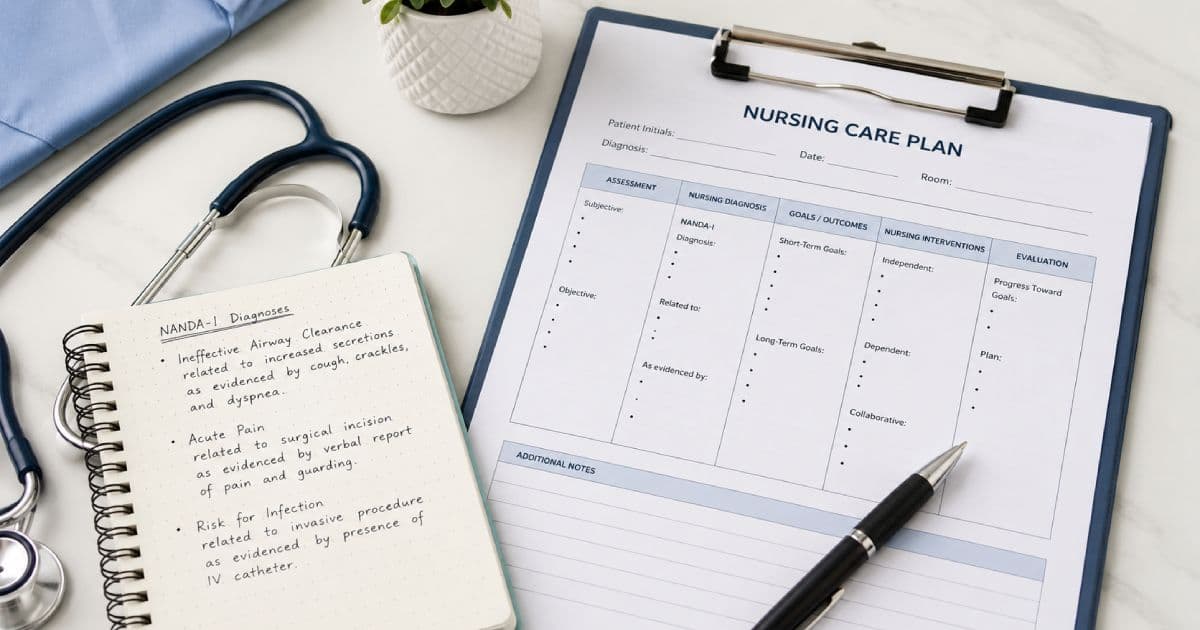
Writing nursing diagnoses feels harder than it should at first.
You assess the patient.
You see abnormal data.
Then your instructor asks for a NANDA-I diagnosis, related factors, evidence, goals, interventions, rationales, and evaluation.
That is a lot when you are still learning how to think like a nurse.
This guide breaks the process down.
You will learn what a nursing diagnosis is, how it differs from a medical diagnosis, how to use the PES format, and how to build a care plan that actually matches the patient.
What is a nursing diagnosis?
A nursing diagnosis is a clinical judgment about how a person, family, group, or community responds to a health condition, life process, risk, or readiness for improved health.
It is not the medical disease.
It is not a provider diagnosis.
It is not a task list.
It is the nursing problem you identify from assessment data.
A good nursing diagnosis answers this question:
What patient response needs nursing care now?Examples of patient responses include:
- Shortness of breath
- Ineffective coughing
- Acute pain
- Fear
- Anxiety
- Poor nutrition
- Impaired mobility
- Risk for falls
- Risk for infection
- Knowledge deficit
- Impaired skin integrity
- Readiness for enhanced self-management
The medical diagnosis may explain part of the story.
The nursing diagnosis tells you what the nurse will focus on.
Nursing diagnosis vs medical diagnosis
A medical diagnosis identifies a disease, injury, pathophysiologic condition, or medical problem.
A nursing diagnosis identifies a human response to an actual or potential health problem.
Both matter.
They serve different purposes.
| Comparison point | Medical diagnosis | Nursing diagnosis |
|---|---|---|
| Focus | Disease or pathology | Patient response |
| Written by | Licensed provider | Nurse |
| Example | Pneumonia | Impaired gas exchange |
| Example | Femur fracture | Acute pain |
| Example | Stroke | Impaired physical mobility |
| Example | Diabetes mellitus | Risk for unstable blood glucose level |
| Changes when | Disease changes | Patient response changes |
| Guides | Medical treatment | Nursing care plan |
Example difference
Medical diagnosis:
PneumoniaPossible nursing diagnoses:
Impaired gas exchange
Ineffective airway clearance
Activity intolerance
Hyperthermia
Deficient knowledge
Risk for deficient fluid volume
The same medical diagnosis can lead to different nursing diagnoses.
That depends on the patient's assessment data.
A patient with pneumonia and SpO2 86% may need an oxygenation-focused diagnosis.
A patient with pneumonia, thick secretions, and weak cough may need an airway clearance diagnosis.
A patient with pneumonia who is improving but does not understand antibiotics may need a teaching-focused diagnosis.
Why nursing diagnoses matter
Nursing diagnoses are not busywork.
They help you organize care.
They connect assessment data to goals, interventions, rationales, and evaluation.
They also help you explain nursing judgment.
A strong diagnosis helps you answer:
- What is the priority problem?
- What cues support it?
- What can nursing do about it?
- What outcome should improve?
- How will we know the plan worked?
That is the same thinking used in clinical judgment questions on NCLEX.
For NCLEX-style prioritization, review NurseZee's NCLEX prioritization guide.
For broader exam planning, use the NCLEX prep guide.
You can also build your reasoning with practice questions.
What NANDA-I means
NANDA-I stands for NANDA International.
NANDA-I is the major standardized nursing diagnosis classification used in nursing education and many clinical documentation systems.
The current English edition for many programs is NANDA International Nursing Diagnoses: Definitions and Classification, 2024-2026.
That edition includes updated labels, definitions, and diagnostic indicators.
The official NANDA-I text should be your source for exact labels.
This guide gives examples and rules.
It does not replace the current NANDA-I book.
The basic nursing diagnosis formula
Most nursing students learn nursing diagnoses through PES.
PES means:
- P: Problem
- E: Etiology
- S: Signs and symptoms
The standard student format is:
Problem related to Etiology as evidenced by Signs and Symptoms.P: Problem
The problem is the nursing diagnosis label.
It should be a NANDA-I diagnosis label when required by your program.
Examples:
- Acute pain
- Impaired gas exchange
- Ineffective airway clearance
- Impaired physical mobility
- Risk for infection
- Deficient knowledge
- Imbalanced nutrition: less than body requirements
- Impaired skin integrity
The problem tells the reader what patient response needs care.
E: Etiology
The etiology is the cause, contributing factor, or related factor.
It explains why the problem is happening.
Good etiologies are specific.
Good etiologies point toward nursing interventions.
Examples:
- Decreased lung expansion
- Retained secretions
- Surgical incision
- Limited range of motion
- Impaired sensation
- Inadequate knowledge of medication regimen
- Imbalanced intake and output
- Decreased mobility
Weak etiologies are vague.
Examples:
Related to disease
Related to surgery
Related to hospitalization
Related to being sick
Related to medical diagnosis
These do not guide nursing care well.
S: Signs and symptoms
Signs and symptoms are the evidence.
They are also called defining characteristics.
They must come from the assessment.
They can include subjective and objective data.
Subjective data:
- Patient reports pain 8/10
- Patient states, "I cannot catch my breath"
- Patient reports nausea
- Patient states, "I do not know how to take this medication"
Objective data:
- SpO2 86% on room air
- Respiratory rate 30/min
- Grimacing
- Guarding incision
- Crackles in lung bases
- Blood glucose 58 mg/dL
- Unsteady gait
- Redness over sacrum
PES format examples
Actual diagnosis example
Acute pain related to tissue trauma from surgical incision as evidenced by patient rating pain 8/10, guarding abdomen, facial grimacing, and heart rate 112/min.Why it works:
The problem is a nursing diagnosis label. The etiology explains why the pain is occurring. The evidence includes subjective and objective assessment findings.Respiratory diagnosis example
Ineffective airway clearance related to retained secretions and weak cough as evidenced by coarse crackles, productive cough with thick sputum, respiratory rate 28/min, and difficulty clearing secretions.Why it works:
The patient response is airway clearance. The related factors point toward nursing interventions such as cough support, hydration as appropriate, positioning, and respiratory assessment.Mobility diagnosis example
Impaired physical mobility related to pain and decreased strength as evidenced by need for two-person assist, limited weight bearing, and inability to ambulate more than 10 feet.Why it works:
The diagnosis focuses on mobility, not only the fracture or surgery. The evidence shows functional limitation.Teaching diagnosis example
Deficient knowledge related to lack of previous exposure to insulin administration as evidenced by incorrect return demonstration and verbalized confusion about timing of doses.Why it works:
The problem is knowledge. The evidence shows the learning gap. The plan should include focused teaching and evaluation of understanding.Two-part nursing diagnoses
Not every diagnosis uses full PES.
Risk diagnoses do not have signs and symptoms because the problem has not happened yet.
Risk diagnosis format:
Risk for Problem related to Risk Factors.Example:
Risk for infection related to impaired skin integrity and presence of an indwelling urinary catheter.Health promotion diagnoses may be written differently depending on your program.
Common student format:
Readiness for enhanced Problem as evidenced by expressed desire to improve health behavior.Example:
Readiness for enhanced health self-management as evidenced by patient asking for a written medication schedule and stating desire to prevent readmission.Always follow your instructor's required format.
Types of nursing diagnoses
NANDA-I nursing diagnoses are commonly taught in four major types.
The names may vary slightly by source or edition, but students usually need these categories:
- Actual or problem-focused diagnosis
- Risk diagnosis
- Health promotion diagnosis
- Syndrome diagnosis
Actual nursing diagnosis
An actual diagnosis describes a patient response that is currently present.
It needs evidence.
It uses signs and symptoms.
Format:
Problem related to Etiology as evidenced by Signs and Symptoms.Examples:
Acute pain related to tissue trauma as evidenced by patient rating pain 8/10, guarding, and facial grimacing.Impaired gas exchange related to alveolar-capillary membrane changes as evidenced by SpO2 86%, dyspnea, restlessness, and crackles.Impaired skin integrity related to pressure over bony prominence as evidenced by open area over sacrum and surrounding erythema.Actual diagnoses usually take priority over risk diagnoses when both are clinically important.
Exception: a risk diagnosis can be urgent if the risk is immediate and life-threatening.
For example, risk for aspiration may be high priority in a patient with decreased level of consciousness.
Risk nursing diagnosis
A risk diagnosis describes a problem that has not occurred but could occur because risk factors are present.
It does not use "as evidenced by" signs and symptoms.
The patient does not have evidence of the problem yet.
Format:
Risk for Problem related to Risk Factors.Examples:
Risk for infection related to surgical incision, hyperglycemia, and presence of a central venous catheter.Risk for falls related to impaired balance, sedating medication, and unfamiliar environment.Risk for impaired skin integrity related to immobility, moisture, and decreased sensation.Risk diagnoses are useful because prevention is nursing care.
A strong risk diagnosis identifies why the patient is vulnerable.
That makes the interventions easier to choose.
Health promotion nursing diagnosis
A health promotion diagnosis describes readiness to improve health.
The patient may not be sick.
The patient may be stable but ready to improve self-management, nutrition, coping, parenting, or health behaviors.
Format often begins with:
Readiness for enhanced...Examples:
Readiness for enhanced nutrition
Readiness for enhanced self-care
Readiness for enhanced health self-management
Readiness for enhanced coping
Readiness for enhanced breastfeeding
Use health promotion diagnoses when the patient shows motivation, interest, or readiness.
Assessment cues may include:
- Asking questions
- Requesting resources
- Stating a goal
- Seeking coaching
- Demonstrating partial knowledge
- Expressing desire to change
Example:
Readiness for enhanced health self-management as evidenced by patient asking for a medication schedule and identifying two personal goals for blood glucose control.Syndrome nursing diagnosis
A syndrome diagnosis groups related nursing diagnoses that occur together.
It is used when a cluster of responses is best described as one pattern.
Students see these less often than actual and risk diagnoses.
Examples may include diagnoses related to frailty, post-trauma responses, or stress-related syndromes depending on the current NANDA-I edition.
Use a syndrome diagnosis only when your reference supports it and the patient's cues match the definition.
Do not choose a syndrome label just because it sounds more serious.
How to write a nursing diagnosis correctly
Use this sequence.
Do not start by hunting for a label.
Start with the patient.
Step 1: Collect assessment data
Use all relevant data.
Include:
- Vital signs
- Pain rating
- Respiratory assessment
- Cardiovascular assessment
- Neurologic status
- Skin assessment
- Mobility status
- Intake and output
- Lab trends
- Medication effects
- Nutrition data
- Sleep data
- Psychosocial cues
- Patient statements
- Family or caregiver concerns
- Safety risks
Assessment is the foundation.
A diagnosis without assessment evidence is a guess.
Step 2: Cluster the cues
Group related findings together.
Example cue cluster:
SpO2 86%, RR 30/min, dyspnea, restlessness, crackles, cyanosis around lipsPossible meaning:
Oxygenation problemPossible diagnosis:
Impaired gas exchangeAnother cue cluster:
Pain 8/10, guarding abdomen, shallow breathing, refuses to cough, grimacingPossible meaning:
Pain is limiting breathing and mobilityPossible diagnosis:
Acute painStep 3: Identify the patient response
Ask:
What is the patient doing, feeling, lacking, unable to do, or at risk for?Examples:
- Unable to clear secretions
- Cannot ambulate safely
- Reports severe pain
- Has poor oxygenation
- Has impaired tissue integrity
- Lacks knowledge for home medication use
- Is at risk for infection
- Is at risk for falls
This keeps the diagnosis nursing-focused.
Step 4: Match the response to a NANDA-I label
Use your approved reference.
Look up the label.
Then check:
- Definition
- Defining characteristics
- Related factors
- Risk factors
- Associated conditions
- At-risk populations
Do not stop at the label.
The label has to fit the definition and the evidence.
Step 5: Choose the etiology
The etiology should explain the problem.
It should also guide interventions.
Weak:
Acute pain related to surgery.Stronger:
Acute pain related to tissue trauma from surgical incision.Weak:
Impaired physical mobility related to hip fracture.Stronger:
Impaired physical mobility related to pain, decreased strength, and weight-bearing restriction.Weak:
Deficient knowledge related to diabetes.Stronger:
Deficient knowledge related to lack of previous instruction about insulin administration.Step 6: Add evidence
For actual diagnoses, include the evidence.
Use specific cues.
Avoid vague wording.
Weak evidence:
As evidenced by abnormal breathing.Stronger evidence:
As evidenced by SpO2 86% on room air, respiratory rate 30/min, dyspnea at rest, and bilateral crackles.Weak evidence:
As evidenced by pain.Stronger evidence:
As evidenced by patient rating pain 8/10, guarding incision, facial grimacing, and refusing to deep breathe.Step 7: Prioritize the diagnosis
Students often write too many diagnoses.
Start with the priority.
Priority usually goes to:
- Airway
- Breathing
- Circulation
- New neurologic change
- Severe pain affecting function
- Infection or sepsis concern
- Safety threat
- Bleeding
- Acute change from baseline
- Problem blocking discharge readiness
Use the same logic you use for NCLEX prioritization.
Review the NCLEX prioritization guide if you need a full priority framework.
Step 8: Check if nursing can act
A nursing diagnosis should lead to nursing interventions.
Ask:
Can the nurse assess, monitor, teach, reposition, prevent, coordinate, support, evaluate, or implement ordered/protocol care for this problem?If yes, it may be a useful nursing diagnosis.
If the only action is "the provider fixes it," rethink the diagnosis.
Nursing diagnosis grammar rules
Use these rules to avoid common care plan mistakes.
Rule 1: Do not use a medical diagnosis as the problem
Incorrect:
Pneumonia related to infection as evidenced by cough and fever.Better:
Ineffective airway clearance related to retained secretions as evidenced by productive cough, coarse crackles, and difficulty clearing sputum.Rule 2: Do not use a medical diagnosis as the only etiology
Weak:
Impaired gas exchange related to pneumonia.Better:
Impaired gas exchange related to alveolar-capillary membrane changes and ventilation-perfusion imbalance as evidenced by SpO2 86%, dyspnea, and restlessness.Some schools allow medical diagnoses after "secondary to."
Example:
Impaired gas exchange related to alveolar-capillary membrane changes secondary to pneumonia as evidenced by SpO2 86%, dyspnea, and restlessness.Follow your instructor's rule.
Rule 3: Do not use another nursing diagnosis as the etiology
Incorrect:
Activity intolerance related to impaired gas exchange.Better:
Activity intolerance related to imbalance between oxygen supply and demand as evidenced by dyspnea and SpO2 drop from 94% to 88% with ambulation.Rule 4: Do not use "as evidenced by" for risk diagnoses
Incorrect:
Risk for infection related to surgical incision as evidenced by redness.Problem:
Redness may mean infection or impaired skin integrity is already present. A risk diagnosis has no evidence of the problem.Better if infection is not present:
Risk for infection related to surgical incision and hyperglycemia.Better if infection cues are present:
Use an actual diagnosis supported by the assessment and report findings according to policy.Rule 5: Avoid circular statements
Incorrect:
Acute pain related to pain.Better:
Acute pain related to tissue trauma from surgical incision.Rule 6: Do not write interventions into the diagnosis
Incorrect:
Impaired gas exchange related to need for oxygen.Better:
Impaired gas exchange related to ventilation-perfusion imbalance as evidenced by SpO2 86%, dyspnea, and restlessness.Rule 7: Be specific enough to guide care
Weak:
Risk for injury related to weakness.Stronger:
Risk for falls related to impaired balance, orthostatic dizziness, and sedating medication.Specific diagnoses lead to better interventions.
Common NANDA-I nursing diagnosis examples by clinical area
This is not a complete NANDA-I list.
It is a student-friendly list of common nursing diagnosis labels and categories you may see in care plans.
Verify exact wording in your current NANDA-I reference.
Respiratory nursing diagnoses
Common respiratory diagnoses include:
- Impaired gas exchange
- Ineffective airway clearance
- Ineffective breathing pattern
- Risk for aspiration
- Activity intolerance
- Anxiety
- Deficient knowledge
Use respiratory diagnoses when the data show oxygenation, ventilation, airway, or breathing pattern problems.
Common cues:
- Low SpO2
- Dyspnea
- Tachypnea
- Crackles
- Wheezes
- Cyanosis
- Restlessness
- Weak cough
- Thick secretions
- Abnormal ABGs if provided
- Increased work of breathing
Example:
Impaired gas exchange related to ventilation-perfusion imbalance as evidenced by SpO2 88%, dyspnea, tachypnea, and restlessness.Cardiovascular and perfusion nursing diagnoses
Common cardiovascular or perfusion-related diagnoses include:
- Decreased cardiac output
- Ineffective peripheral tissue perfusion
- Risk for decreased cardiac output
- Excess fluid volume
- Deficient fluid volume
- Activity intolerance
- Fatigue
- Risk for shock
Common cues:
- Hypotension
- Tachycardia
- Weak pulses
- Cool extremities
- Edema
- Jugular venous distention
- Decreased urine output
- Chest discomfort
- Shortness of breath with activity
- New dysrhythmia if provided
Example:
Decreased cardiac output related to altered heart rhythm as evidenced by hypotension, weak peripheral pulses, dizziness, and decreased urine output.Neurologic nursing diagnoses
Common neurologic diagnoses include:
- Acute confusion
- Chronic confusion
- Impaired memory
- Impaired verbal communication
- Impaired physical mobility
- Self-care deficit
- Risk for falls
- Risk for aspiration
- Risk for injury
Common cues:
- New confusion
- Altered level of consciousness
- Slurred speech
- Weakness
- Unsteady gait
- Seizure activity
- Difficulty swallowing
- Decreased sensation
- Poor safety awareness
Example:
Impaired verbal communication related to neuromuscular impairment as evidenced by slurred speech and inability to form complete words.Pain nursing diagnoses
Common pain diagnoses include:
- Acute pain
- Chronic pain
- Labor pain
- Comfort impairment depending on reference and program expectations
- Anxiety related to pain experience
- Impaired physical mobility related to pain
Common cues:
- Patient pain rating
- Guarding
- Grimacing
- Restlessness
- Diaphoresis
- Increased heart rate
- Shallow breathing
- Decreased movement
- Sleep disturbance
Example:
Acute pain related to tissue trauma from surgical incision as evidenced by pain rating 8/10, guarding, grimacing, and reluctance to deep breathe.Skin and wound nursing diagnoses
Common skin and wound diagnoses include:
- Impaired skin integrity
- Impaired tissue integrity
- Risk for impaired skin integrity
- Risk for pressure injury depending on reference and policy
- Risk for infection
- Acute pain
- Impaired physical mobility
Common cues:
- Open wound
- Pressure injury
- Redness
- Drainage
- Edema
- Delayed healing
- Moisture exposure
- Immobility
- Poor nutrition
- Decreased sensation
Example:
Impaired skin integrity related to pressure over bony prominence and moisture exposure as evidenced by open area over sacrum and surrounding erythema.Mobility and musculoskeletal nursing diagnoses
Common mobility diagnoses include:
- Impaired physical mobility
- Impaired walking
- Activity intolerance
- Risk for falls
- Self-care deficit
- Acute pain
- Risk for disuse syndrome
Common cues:
- Limited range of motion
- Weakness
- Pain with movement
- Need for assistive device
- Unsteady gait
- Weight-bearing restriction
- Decreased endurance
- Contractures
- Fear of falling
Example:
Impaired physical mobility related to pain and decreased muscle strength as evidenced by inability to ambulate without two-person assist.Infection and immune nursing diagnoses
Common infection-related diagnoses include:
- Risk for infection
- Hyperthermia
- Deficient fluid volume
- Acute pain
- Fatigue
- Impaired skin integrity
- Risk for sepsis depending on clinical terminology and facility policy
Common cues:
- Fever
- Chills
- Redness
- Purulent drainage
- Elevated white blood cell count if provided
- Invasive lines
- Surgical incision
- Immunosuppression
- Hyperglycemia
- Poor wound healing
Example risk diagnosis:
Risk for infection related to surgical incision, hyperglycemia, and presence of an indwelling urinary catheter.Fluid and electrolyte nursing diagnoses
Common fluid and electrolyte diagnoses include:
- Deficient fluid volume
- Excess fluid volume
- Risk for deficient fluid volume
- Risk for electrolyte imbalance
- Diarrhea
- Nausea
- Imbalanced nutrition: less than body requirements
Common cues:
- Poor intake
- Vomiting
- Diarrhea
- Dry mucous membranes
- Tachycardia
- Hypotension
- Edema
- Crackles
- Daily weight changes
- Intake/output imbalance
- Abnormal electrolyte values if provided
Example:
Deficient fluid volume related to active fluid loss from vomiting as evidenced by dry mucous membranes, tachycardia, dizziness, and decreased urine output.Nutrition nursing diagnoses
Common nutrition diagnoses include:
- Imbalanced nutrition: less than body requirements
- Imbalanced nutrition: more than body requirements depending on current reference wording
- Risk for unstable blood glucose level
- Nausea
- Impaired swallowing
- Deficient knowledge
- Readiness for enhanced nutrition
Common cues:
- Poor intake
- Weight loss
- Difficulty chewing
- Difficulty swallowing
- Nausea
- Vomiting
- Tube feeding intolerance
- Low albumin if provided and clinically relevant
- Blood glucose trends
- Diet misunderstanding
Example:
Imbalanced nutrition: less than body requirements related to decreased appetite and nausea as evidenced by intake less than 50% of meals and unintentional weight loss.Elimination nursing diagnoses
Common elimination diagnoses include:
- Urinary retention
- Impaired urinary elimination
- Functional urinary incontinence
- Constipation
- Diarrhea
- Bowel incontinence
- Risk for constipation
- Deficient fluid volume
Common cues:
- No bowel movement
- Abdominal distention
- Hard stool
- Loose stools
- Urinary frequency
- Urgency
- Bladder distention
- Low urine output
- Dysuria
- Incontinence
Example:
Constipation related to decreased mobility and opioid use as evidenced by no bowel movement for 4 days, abdominal distention, and hard stool.Psychosocial nursing diagnoses
Common psychosocial diagnoses include:
- Anxiety
- Fear
- Ineffective coping
- Interrupted family processes
- Grieving
- Powerlessness
- Social isolation
- Disturbed sleep pattern
- Risk for suicide
- Risk for other-directed violence depending on assessment data and current reference
Common cues:
- Restlessness
- Tearfulness
- Verbalized fear
- Panic symptoms
- Withdrawal
- Poor concentration
- Sleep changes
- Hopeless statements
- Threats of harm
- Inability to use coping strategies
Example:
Anxiety related to change in health status and unfamiliar hospital environment as evidenced by restlessness, repeated questions, and patient stating, "I am scared something is wrong."Teaching and self-management nursing diagnoses
Common teaching-related diagnoses include:
- Deficient knowledge
- Readiness for enhanced knowledge
- Ineffective health self-management
- Readiness for enhanced health self-management
- Ineffective medication self-management depending on current reference
- Nonadherence depending on current reference and program use
Common cues:
- Incorrect medication use
- Incorrect return demonstration
- Missed follow-up appointments
- Misunderstanding discharge instructions
- Unable to name warning signs
- Requests for more information
- Expressed desire to improve self-care
Example:
Deficient knowledge related to lack of previous instruction about wound care as evidenced by incorrect dressing-change technique and inability to state signs of infection.Safety nursing diagnoses
Common safety diagnoses include:
- Risk for falls
- Risk for injury
- Risk for aspiration
- Risk for bleeding
- Risk for infection
- Risk for poisoning depending on context and current reference
- Risk for suicide
- Risk for impaired skin integrity
Common cues:
- Confusion
- Weakness
- Poor balance
- Sedating medication
- Anticoagulant therapy
- Dysphagia
- Seizure history
- Poor vision
- Unfamiliar environment
- Unsafe home setup
Example:
Risk for falls related to impaired balance, orthostatic dizziness, sedating medication, and unfamiliar environment.Maternal-newborn nursing diagnoses
Common maternal-newborn diagnoses include:
- Acute pain
- Risk for bleeding
- Risk for infection
- Ineffective breastfeeding
- Readiness for enhanced breastfeeding
- Deficient knowledge
- Anxiety
- Risk for impaired parent-infant attachment depending on current reference
- Risk for unstable blood glucose level in the newborn depending on case data
Common cues:
- Postpartum bleeding
- Incisional pain
- Perineal pain
- Fever
- Breastfeeding latch difficulty
- Nipple pain
- Newborn poor feeding
- Parent anxiety
- Need for discharge teaching
Example:
Ineffective breastfeeding related to difficulty achieving latch as evidenced by infant slipping off breast, maternal nipple pain, and infant feeding for less than 5 minutes per attempt.Pediatric nursing diagnoses
Common pediatric diagnoses include:
- Hyperthermia
- Deficient fluid volume
- Risk for deficient fluid volume
- Ineffective airway clearance
- Impaired gas exchange
- Acute pain
- Anxiety
- Fear
- Caregiver role strain depending on context
- Deficient knowledge for caregiver teaching
Common cues:
- Fever
- Poor intake
- Fewer wet diapers
- Retractions
- Nasal flaring
- Crying
- Irritability
- Parent concern
- Developmental limits
- Medication teaching needs
Example:
Risk for deficient fluid volume related to decreased oral intake, fever, and vomiting.Older adult nursing diagnoses
Common older-adult diagnoses include:
- Risk for falls
- Acute confusion
- Chronic confusion
- Impaired physical mobility
- Self-care deficit
- Risk for impaired skin integrity
- Imbalanced nutrition: less than body requirements
- Disturbed sleep pattern
- Social isolation
- Caregiver role strain
Common cues:
- Polypharmacy
- Orthostatic hypotension
- Weakness
- Frailty
- Poor intake
- Cognitive changes
- Incontinence
- Pressure injury risk
- Limited support
- Unsafe home setup
Example:
Risk for falls related to impaired balance, orthostatic hypotension, poor vision, and use of sedating medication.How to build a nursing care plan step by step
A care plan is the written map of nursing care.
It connects:
Assessment → Diagnosis → Planning → Implementation → EvaluationThis is the nursing process.
Use the process every time.
Step 1: Assessment
Collect subjective and objective data.
Subjective data are what the patient says.
Objective data are what you observe, measure, or verify.
Good care plans include both when available.
Example assessment data:
Subjective: Patient states, "I feel short of breath." Patient reports fatigue with walking to bathroom.
Objective: SpO2 86% on room air, RR 30/min, crackles bilaterally, restless, using accessory muscles.
Do not write a care plan from one cue.
Cluster cues.
Trends matter.
Step 2: Diagnosis
Choose the best nursing diagnosis.
The diagnosis must match the data.
It must be more than a label.
Use the current NANDA-I reference to confirm:
- Definition
- Defining characteristics
- Related factors
- Risk factors
- Associated conditions
Then write the diagnosis in the correct format.
Example:
Impaired gas exchange related to ventilation-perfusion imbalance as evidenced by SpO2 86% on room air, dyspnea, restlessness, crackles, and respiratory rate 30/min.Step 3: Planning
Planning means writing goals and expected outcomes.
A goal describes the desired patient status.
An expected outcome describes measurable evidence that the goal was met.
Weak goal:
Patient will breathe better.Stronger goal:
Patient will maintain SpO2 at or above prescribed goal, respiratory rate 12-20/min or improved from baseline, and report decreased dyspnea within 4 hours.Use patient-specific targets.
For patients with chronic lung disease, the ordered oxygen saturation goal may differ.
Follow provider orders, facility policy, and patient baseline.
Step 4: Implementation
Implementation means doing the nursing interventions.
Interventions should match the diagnosis, etiology, and outcomes.
They may include:
- Assessment
- Monitoring
- Positioning
- Safety precautions
- Teaching
- Medication administration as prescribed
- Oxygen therapy as prescribed or protocol-based
- Wound care as ordered
- Mobility assistance
- Nutrition support
- Fluid management
- Infection prevention
- Collaboration with the health care team
Each intervention needs a reason.
That reason is the rationale.
Step 5: Evaluation
Evaluation asks:
Did the patient improve, stay the same, or get worse?Do not write "goal met" without evidence.
Weak evaluation:
Goal met.Stronger evaluation:
Goal partially met. SpO2 improved from 86% to 92% on prescribed oxygen, respiratory rate decreased from 30/min to 24/min, but patient still reports dyspnea with ambulation.Then revise the plan.
Evaluation is not the end.
It is how you decide the next step.
SMART goals for nursing care plans
SMART goals are:
- Specific
- Measurable
- Achievable
- Relevant
- Time-bound
They help you write outcomes that can be evaluated.
Specific
Say exactly what should improve.
Weak:
Patient will improve mobility.Specific:
Patient will ambulate 50 feet with walker and one-person assist.Measurable
Use numbers or observable behaviors.
Weak:
Patient will have less pain.Measurable:
Patient will report pain decreased from 8/10 to 3/10 within 60 minutes after intervention.Achievable
Keep the outcome realistic for the patient's condition.
Weak:
Patient will ambulate independently after hip surgery today.Better:
Patient will transfer from bed to chair with walker and one-person assist by end of shift.Relevant
The goal must match the diagnosis.
For acute pain, pain reduction and improved function are relevant.
For risk for infection, absence of infection signs and correct wound care are relevant.
For impaired gas exchange, oxygenation and respiratory effort are relevant.
Time-bound
Include a deadline.
Examples:
- Within 30 minutes
- Within 1 hour
- By end of shift
- Within 24 hours
- Before discharge
- At follow-up visit
Time frames help you evaluate the plan.
SMART goal examples by diagnosis
Impaired gas exchange
Patient will maintain SpO2 at or above the prescribed target, demonstrate decreased work of breathing, and report dyspnea no worse than 2/10 within 4 hours.Acute pain
Patient will report pain decreased from 8/10 to 3/10 or less within 60 minutes of intervention and will deep breathe without guarding by end of shift.Risk for infection
Patient will remain afebrile, incision will remain without purulent drainage or spreading redness, and patient will verbalize three signs of infection to report before discharge.Impaired physical mobility
Patient will transfer from bed to chair with walker and one-person assist by 1400 and will use call light before ambulation throughout shift.Deficient knowledge
Patient will correctly describe medication purpose, dose timing, and two adverse effects to report before discharge.Risk for falls
Patient will remain free from falls during shift and will use call light before getting out of bed on every attempt.Common nursing interventions by diagnosis category
Interventions should be individualized.
Do not copy generic interventions without matching them to the patient.
The examples below are starting points.
Always follow orders, policy, scope, and patient condition.
Respiratory interventions
Common interventions:
- Assess respiratory rate, depth, pattern, and work of breathing.
- Monitor SpO2 and trends.
- Position patient to support lung expansion, often high Fowler's if tolerated.
- Encourage coughing and deep breathing when appropriate.
- Encourage incentive spirometry when ordered or per protocol.
- Maintain airway patency.
- Administer oxygen as prescribed or per protocol.
- Administer respiratory medications as prescribed.
- Encourage fluids if not contraindicated and if appropriate.
- Collaborate with respiratory therapy.
- Escalate new or worsening respiratory distress.
Rationale example:
Frequent respiratory assessment identifies deterioration early and helps evaluate response to interventions.Pain interventions
Common interventions:
- Assess pain location, quality, intensity, onset, duration, and aggravating factors.
- Use an age-appropriate pain scale.
- Assess sedation and respiratory status when opioids are used.
- Administer analgesics as prescribed.
- Reassess pain after intervention.
- Splint incision during coughing or movement.
- Position for comfort and function.
- Use nonpharmacologic measures such as ice, heat if ordered, relaxation, distraction, or guided breathing.
- Teach patient to report pain before it becomes severe.
- Evaluate whether pain limits mobility, breathing, sleep, or self-care.
Rationale example:
Pain reassessment shows whether the intervention worked and whether the plan needs adjustment.Infection prevention interventions
Common interventions:
- Perform hand hygiene.
- Use aseptic technique for wound and line care.
- Monitor temperature and trends.
- Assess wound appearance, drainage, odor, and surrounding skin.
- Monitor ordered labs and cultures when available.
- Maintain catheter and line care according to policy.
- Remove unnecessary invasive devices when ordered and appropriate.
- Encourage adequate nutrition and hydration as appropriate.
- Teach signs of infection to report.
- Administer antimicrobials as prescribed.
- Follow isolation precautions when indicated.
Rationale example:
Aseptic technique reduces introduction of microorganisms into vulnerable tissue or invasive device sites.Skin integrity interventions
Common interventions:
- Inspect skin at least once per shift or per policy.
- Reposition immobile patients at ordered or policy-based intervals.
- Keep skin clean and dry.
- Manage moisture from incontinence, perspiration, or drainage.
- Use pressure-redistribution surfaces as indicated.
- Protect bony prominences.
- Encourage nutrition and protein intake as appropriate.
- Monitor wound size, depth, color, drainage, and odor.
- Consult wound care nurse when indicated.
- Teach patient and caregiver skin inspection.
Rationale example:
Regular skin assessment detects early breakdown before deeper tissue injury occurs.Mobility interventions
Common interventions:
- Assess strength, gait, balance, pain, and activity tolerance.
- Use ordered assistive devices.
- Assist with range-of-motion exercises as appropriate.
- Premedicate for pain before activity when ordered and needed.
- Collaborate with physical therapy.
- Encourage progressive mobility within restrictions.
- Use safe transfer techniques.
- Apply fall precautions.
- Teach weight-bearing restrictions.
- Monitor response to activity.
Rationale example:
Progressive mobility helps prevent deconditioning while respecting safety limits and surgical or injury restrictions.Fluid volume interventions
Common interventions:
- Monitor intake and output.
- Assess mucous membranes, skin turgor, edema, lung sounds, and daily weight.
- Monitor vital signs and orthostatic changes.
- Monitor lab trends as ordered.
- Encourage oral fluids if appropriate.
- Administer IV fluids or diuretics as prescribed.
- Restrict fluids if ordered.
- Assess for signs of dehydration or overload.
- Teach patient fluid plan when needed.
- Report significant changes promptly.
Rationale example:
Daily weight is a sensitive indicator of fluid status changes when measured consistently.Nutrition interventions
Common interventions:
- Assess usual intake, recent weight change, appetite, and barriers to eating.
- Monitor meal intake.
- Offer small frequent meals if appropriate.
- Manage nausea as prescribed.
- Provide oral care before meals.
- Collaborate with dietitian.
- Monitor swallowing safety when indicated.
- Assist with feeding if needed.
- Teach diet plan in plain language.
- Evaluate understanding with teach-back.
Rationale example:
Identifying barriers to intake helps the nurse select targeted interventions instead of simply telling the patient to eat more.Elimination interventions
Common interventions:
- Assess bowel and bladder patterns.
- Monitor intake, output, and stool characteristics.
- Encourage fluids and fiber if appropriate.
- Promote mobility if safe.
- Provide privacy and routine toileting.
- Administer bowel regimen or urinary medications as prescribed.
- Assess for urinary retention after surgery or catheter removal.
- Monitor for diarrhea-related dehydration.
- Teach medication and diet factors affecting elimination.
- Report acute changes.
Rationale example:
Bowel and bladder pattern assessment helps distinguish expected variation from retention, constipation, diarrhea, or infection concerns.Safety interventions
Common interventions:
- Assess fall risk.
- Keep call light within reach.
- Keep bed low and locked.
- Use nonskid footwear.
- Remove clutter.
- Use alarms according to policy.
- Assist with ambulation.
- Review medications that increase fall risk.
- Implement seizure, aspiration, bleeding, or suicide precautions when indicated.
- Teach patient to request help before getting up.
- Reassess after condition or medication changes.
Rationale example:
Fall prevention requires matching precautions to the patient's actual risks, not just applying a generic checklist.Teaching interventions
Common interventions:
- Assess baseline knowledge.
- Ask what the patient already understands.
- Use simple language.
- Teach one topic at a time.
- Provide written instructions when helpful.
- Demonstrate skills.
- Ask for return demonstration.
- Use teach-back.
- Include caregiver when appropriate and permitted.
- Address barriers such as vision, language, literacy, pain, anxiety, or fatigue.
Rationale example:
Teach-back checks understanding and helps the nurse correct gaps before discharge.Mistakes students make with nursing diagnoses
Mistake 1: Picking the diagnosis before reading the assessment
Students often search a NANDA list first.
That leads to forced diagnoses.
Fix:
Cluster patient cues first. Then choose the diagnosis that best matches the cues.Mistake 2: Writing the medical diagnosis as the nursing diagnosis
Incorrect:
Heart failure related to fluid overload.Fix:
Use a patient response such as excess fluid volume, decreased cardiac output, activity intolerance, or deficient knowledge if supported by data.Mistake 3: Using vague evidence
Weak:
As evidenced by patient looks bad.Fix:
Use measurable cues: SpO2, respiratory rate, pain rating, wound appearance, gait, intake, output, patient statement.Mistake 4: Using "risk for" when the problem already exists
If the patient has an open wound, do not only write risk for skin breakdown.
The breakdown is already present.
Use an actual diagnosis if the evidence supports it.
Mistake 5: Using "as evidenced by" for risk diagnoses
A risk diagnosis has risk factors, not defining characteristics.
Fix:
Risk for falls related to impaired balance and sedating medication.Mistake 6: Choosing too many diagnoses
A long list is not always better.
Start with the most important diagnosis.
Use priority logic.
Ask:
What problem could harm the patient fastest or block recovery most right now?Mistake 7: Writing goals that cannot be measured
Weak:
Patient will feel better.Fix:
Patient will report pain 3/10 or less within 60 minutes and ambulate to chair with one-person assist by end of shift.Mistake 8: Choosing interventions that do not match the cause
If the etiology is lack of knowledge, teaching is central.
If the etiology is retained secretions, airway clearance interventions matter.
If the etiology is pressure and moisture, repositioning and moisture control matter.
Fix:
Match each intervention to the related factor and outcome.Mistake 9: Forgetting rationales
A rationale explains why the intervention helps.
Do not write random rationales.
Tie the rationale to physiology, safety, learning, prevention, or evaluation.
Mistake 10: Evaluating without data
Weak:
Patient improved.Fix:
Pain decreased from 8/10 to 3/10 within 45 minutes, and patient ambulated 30 feet with walker.Mistake 11: Ignoring patient priorities
A care plan is not only about numbers.
Ask what matters to the patient.
A patient may prioritize walking to the bathroom, holding a baby, sleeping, returning to work, or managing medication at home.
Use those priorities when writing goals.
Mistake 12: Copying care plans without individualizing them
Copying creates mismatches.
Example mismatch:
Teaching coughing and deep breathing for a patient whose main issue is urinary retention.Fix:
Use the patient's assessment data, not a template alone.Mistake 13: Choosing a low-priority diagnosis first
Teaching is important.
But if the patient is hypoxic, oxygenation comes first.
Comfort matters.
But if the patient is actively bleeding, circulation comes first.
Use the NCLEX prioritization guide to practice this reasoning.
Mistake 14: Writing goals for the nurse instead of the patient
Weak:
Nurse will educate patient about wound care.Better:
Patient will demonstrate wound care using clean technique and state three signs of infection to report before discharge.The goal belongs to the patient.
The intervention belongs to the nurse.
Mistake 15: Not revising the diagnosis
Patient status changes.
A diagnosis that was correct yesterday may not be the priority today.
Example:
Yesterday:
Impaired gas exchangeToday after improvement:
Activity intolerance or deficient knowledge may become the priority.Keep the care plan current.
Worked care plan example 1: Impaired gas exchange
Case
A 72-year-old patient is admitted with pneumonia.
The patient reports shortness of breath and fatigue.
Assessment findings:
- SpO2 86% on room air
- Respiratory rate 30/min
- Bilateral crackles
- Restlessness
- Productive cough
- Temperature 38.6°C
- Heart rate 114/min
Cue cluster
Low SpO2, tachypnea, dyspnea, restlessness, crackles, productive coughMeaning:
Oxygenation and airway concerns are present.Priority:
Breathing problem. Address before lower-priority teaching or discharge needs.Nursing diagnosis
Impaired gas exchange related to ventilation-perfusion imbalance and alveolar-capillary membrane changes as evidenced by SpO2 86% on room air, respiratory rate 30/min, dyspnea, restlessness, and bilateral crackles.Why this diagnosis fits
The patient has evidence of impaired oxygenation.
SpO2 is low.
Respiratory rate is high.
Restlessness can be a cue of hypoxia.
Crackles and pneumonia support impaired gas exchange.
Priority goal
Patient will maintain SpO2 at or above the prescribed target, demonstrate decreased work of breathing, and report decreased dyspnea within 4 hours.Expected outcomes
- SpO2 improves to prescribed target.
- Respiratory rate decreases toward baseline.
- Patient reports less shortness of breath.
- Restlessness decreases.
- Breath sounds improve or do not worsen.
Nursing interventions and rationales
| Intervention | Rationale |
|---|---|
| Assess respiratory rate, rhythm, depth, work of breathing, lung sounds, and mental status at ordered intervals and with changes. | Respiratory status can decline quickly; frequent assessment detects deterioration and response to care. |
| Monitor SpO2 continuously or intermittently as ordered and compare with baseline and prescribed target. | Oxygen saturation trends help evaluate gas exchange and response to interventions. |
| Position patient in high Fowler's or position of comfort if tolerated. | Upright positioning supports lung expansion and may reduce work of breathing. |
| Administer oxygen as prescribed or per protocol. | Supplemental oxygen can improve oxygen delivery when gas exchange is impaired. |
| Encourage cough, deep breathing, and incentive spirometry if appropriate and ordered. | Lung expansion and secretion mobilization can support oxygenation and prevent atelectasis. |
| Encourage fluid intake if not contraindicated. | Hydration may help thin secretions, making them easier to clear. |
| Administer prescribed antibiotics, bronchodilators, antipyretics, or other medications as ordered. | Ordered therapies treat infection, airway narrowing, fever, or inflammation contributing to respiratory compromise. |
| Collaborate with respiratory therapy and notify provider of worsening distress, decreasing SpO2, or altered mental status. | Escalation is needed when nursing interventions do not stabilize oxygenation. |
Evaluation
Goal partially met. SpO2 improved from 86% to 92% on prescribed oxygen, respiratory rate decreased from 30/min to 24/min, and patient reports dyspnea decreased from 7/10 to 4/10. Continue respiratory monitoring, prescribed therapies, positioning, and reassess after next intervention.Common student mistake in this case
Weak diagnosis:
Pneumonia related to infection as evidenced by low oxygen.Why it is wrong:
Pneumonia is the medical diagnosis, not the nursing diagnosis. The nursing diagnosis should name the patient response: impaired gas exchange or ineffective airway clearance depending on the strongest data.Worked care plan example 2: Acute pain
Case
A 45-year-old patient is 8 hours post-op after abdominal surgery.
Assessment findings:
- Pain 8/10 at incision
- Guarding abdomen
- Facial grimacing
- Heart rate 112/min
- Shallow breathing
- Refuses to cough because "it hurts too much"
Cue cluster
Pain 8/10, guarding, grimacing, tachycardia, shallow breathing, refusing to coughMeaning:
Pain is severe and is affecting breathing and recovery behaviors.Nursing diagnosis
Acute pain related to tissue trauma from surgical incision as evidenced by pain rating 8/10, guarding abdomen, facial grimacing, heart rate 112/min, shallow breathing, and refusal to cough due to pain.Why this diagnosis fits
The patient reports severe pain.
Objective cues support pain.
Pain is interfering with coughing and deep breathing.
That raises risk for respiratory complications.
Priority goal
Patient will report pain 3/10 or less within 60 minutes of intervention and will demonstrate deep breathing and splinted coughing by end of shift.Expected outcomes
- Pain decreases to target level.
- Patient uses splinting during movement and coughing.
- Respiratory effort improves.
- Patient can participate in turning, coughing, deep breathing, and early mobility as ordered.
- Heart rate decreases toward baseline if elevated due to pain.
Nursing interventions and rationales
| Intervention | Rationale |
|---|---|
| Assess pain location, intensity, quality, onset, duration, and aggravating factors. | A focused pain assessment guides safe and targeted pain management. |
| Assess vital signs, sedation level, respiratory rate, and oxygenation before and after opioid administration if prescribed. | Opioids can reduce respiratory drive and sedation must be monitored for safety. |
| Administer prescribed analgesics and non-opioid adjuncts as ordered. | Multimodal pain management can reduce pain and improve function. |
| Reassess pain within the expected medication response time. | Reassessment evaluates effectiveness and identifies need for plan changes. |
| Teach incision splinting with pillow during coughing, deep breathing, and movement. | Splinting reduces strain on incision and can improve participation in respiratory exercises. |
| Position for comfort while maintaining safety and surgical precautions. | Positioning can decrease tension and improve comfort. |
| Encourage nonpharmacologic measures such as relaxation breathing, distraction, and guided imagery if appropriate. | Nonpharmacologic strategies can support pain control along with prescribed medication. |
| Cluster care but avoid delaying pain treatment when pain limits recovery activities. | Rest supports healing, but untreated pain can delay mobility and deep breathing. |
Evaluation
Goal met. Patient reports pain decreased from 8/10 to 3/10 45 minutes after prescribed analgesic. Patient demonstrates splinted coughing and completes incentive spirometry with coaching. Continue pain assessment and reassess before ambulation.Common student mistake in this case
Weak goal:
Patient will not have pain.Why it is weak:
A pain-free goal may not be realistic immediately after surgery. A measurable functional goal is stronger: pain 3/10 or less and able to cough, deep breathe, and move safely.Worked care plan example 3: Risk for infection
Case
A 60-year-old patient is post-op after colon surgery.
Assessment findings:
- Midline abdominal incision with dressing intact
- Peripheral IV in place
- Blood glucose 228 mg/dL
- Foley catheter present
- Temperature 37.2°C
- No purulent drainage
- No redness spreading from incision
Cue cluster
Surgical incision, Foley catheter, IV access, hyperglycemia, no current infection signsMeaning:
The patient has infection risk factors, but infection is not currently evident in the provided data.Nursing diagnosis
Risk for infection related to surgical incision, hyperglycemia, Foley catheter, and peripheral IV access.Why this diagnosis fits
The patient has risk factors.
There are no signs and symptoms proving infection in the case data.
That makes this a risk diagnosis.
Do not add "as evidenced by" because the infection has not occurred.
Priority goal
Patient will remain free from signs of infection during hospitalization, and patient will state three signs of infection to report before discharge.Expected outcomes
- Temperature remains within expected range or does not trend upward.
- Incision remains without purulent drainage, spreading redness, warmth, or increasing pain.
- IV and catheter sites remain without redness, swelling, drainage, or pain.
- Blood glucose is monitored and managed according to orders.
- Patient explains hand hygiene and infection warning signs before discharge.
Nursing interventions and rationales
| Intervention | Rationale |
|---|---|
| Perform hand hygiene before and after patient contact and procedures. | Hand hygiene reduces transmission of microorganisms. |
| Assess incision, dressing, IV site, and catheter site according to policy. | Early recognition of redness, drainage, swelling, warmth, or pain supports prompt intervention. |
| Use aseptic technique for dressing changes, catheter care, and IV access. | Aseptic technique reduces contamination of vulnerable sites. |
| Monitor temperature, heart rate, pain changes, and drainage characteristics. | Trends may show early infection before severe symptoms occur. |
| Maintain glucose monitoring and administer therapy as prescribed. | Hyperglycemia can impair immune function and wound healing. |
| Remove invasive devices as soon as ordered and clinically appropriate. | The longer invasive devices remain in place, the longer the exposure risk continues. |
| Teach patient signs of infection to report after discharge. | Early reporting can prevent delayed treatment of post-op infection. |
Evaluation
Goal partially met. Patient remains afebrile, incision dressing is dry and intact, IV site without redness, and urine is clear. Patient correctly states fever and purulent drainage as signs to report but needs reinforcement about spreading redness and increasing incisional pain.Common student mistake in this case
Incorrect diagnosis:
Risk for infection related to incision as evidenced by Foley catheter and IV.Why it is wrong:
A Foley catheter and IV are risk factors, not evidence that infection exists. Use "related to" for risk factors and do not use "as evidenced by" in a risk diagnosis.Mini care plan example 4: Risk for falls
Case
A 78-year-old patient is admitted for dehydration and weakness.
Assessment findings:
- Dizziness when standing
- Unsteady gait
- Uses cane at home
- New sedating medication ordered at bedtime
- Needs assistance to bathroom
- No fall during admission
Nursing diagnosis
Risk for falls related to orthostatic dizziness, unsteady gait, weakness, sedating medication, and unfamiliar environment.Goal
Patient will remain free from falls during hospitalization and will use call light before getting out of bed throughout shift.Interventions
- Assess orthostatic symptoms and gait before ambulation.
- Keep call light and personal items within reach.
- Keep bed low and locked.
- Provide nonskid footwear.
- Assist with toileting and ambulation.
- Review medication timing and sedation effects with the care team.
- Reinforce call-light use.
- Reassess fall risk after medication changes.
Evaluation
Goal met for shift. Patient remained free from falls and used call light before toileting three times. Continue fall precautions and reassess after bedtime medication.Mini care plan example 5: Deficient knowledge
Case
A patient newly prescribed warfarin is preparing for discharge.
Assessment findings:
- Patient cannot state medication purpose
- Patient says, "I can take extra if I miss a dose"
- Patient does not know bleeding warning signs
- Patient asks whether INR testing is still needed
Nursing diagnosis
Deficient knowledge related to lack of previous instruction about warfarin therapy as evidenced by incorrect statements about missed doses, inability to state bleeding warning signs, and questions about INR monitoring.Goal
Patient will correctly explain warfarin purpose, dose timing, missed-dose instructions, INR follow-up, and three bleeding signs to report before discharge.Interventions
- Assess baseline understanding of medication.
- Teach medication purpose and dosing schedule using plain language.
- Explain missed-dose instructions according to discharge prescription and policy.
- Teach bleeding precautions and signs to report.
- Review interactions only within discharge teaching scope and facility materials.
- Provide written instructions.
- Use teach-back.
- Include caregiver if appropriate and patient agrees.
Evaluation
Goal met. Patient correctly explains medication purpose, states not to double dose unless specifically instructed, identifies black stools, unusual bruising, and prolonged bleeding as reportable signs, and states date of INR follow-up.How nursing diagnosis connects to NCLEX clinical judgment
Nursing diagnosis is clinical judgment in written form.
The Next Generation NCLEX measures clinical judgment through cue recognition, analysis, prioritization, action, and evaluation.
Care plans use the same thinking.
Recognize cues
In care plans, this is assessment.
Ask:
What data matter most?Examples:
- SpO2 86%
- New confusion
- Pain 8/10
- Purulent wound drainage
- Blood pressure falling
- Patient cannot explain insulin use
Analyze cues
In care plans, this is interpreting the cue cluster.
Ask:
What do these findings mean together?Example:
SpO2 86%, dyspnea, tachypnea, and restlessness suggest impaired oxygenation.Prioritize hypotheses
In care plans, this is choosing the priority nursing diagnosis.
Ask:
Which patient response is most urgent or most important right now?Airway, breathing, circulation, neuro changes, safety, sepsis, bleeding, and acute deterioration usually come before teaching or routine comfort.
Generate solutions
In care plans, this is planning interventions.
Ask:
What nursing actions can improve this response or prevent harm?Examples:
- Position for ventilation
- Monitor oxygenation
- Administer prescribed medications
- Teach wound care
- Use fall precautions
- Reassess pain
- Collaborate with the team
Take action
In care plans, this is implementation.
Do the interventions safely.
Stay within scope.
Follow orders and protocols.
Escalate when findings are unsafe.
Evaluate outcomes
In care plans, this is evaluation.
Ask:
Did the patient reach the goal? What evidence proves it?Example:
SpO2 improved from 86% to 92%, respiratory rate decreased from 30/min to 24/min, and patient reports less dyspnea.How to choose the priority nursing diagnosis
When you have several diagnoses, rank them.
Use safety and physiology first.
Priority cues include:
- Airway obstruction
- Low oxygen saturation
- Severe shortness of breath
- Signs of shock
- Active bleeding
- New chest pain
- New neurologic deficit
- New confusion
- Seizure
- Sepsis concern
- Suicide risk
- Violence risk
- Severe pain blocking breathing or mobility
- Aspiration risk
- Rapid deterioration
Lower-priority but still important diagnoses may include:
- Routine knowledge deficit
- Stable chronic pain
- Mild constipation
- Discharge teaching when patient is unstable
- Long-term lifestyle change while acute needs are unresolved
Example priority order:
1. Impaired gas exchange
2. Ineffective airway clearance
3. Acute pain
4. Activity intolerance
5. Deficient knowledge
This order may change when the patient's condition changes.
How to write rationales
A rationale explains why the intervention is appropriate.
It should be specific.
It should connect to the patient's diagnosis, outcome, or safety.
Weak rationale:
This is good for the patient.Stronger rationale:
Upright positioning promotes lung expansion and can decrease work of breathing.Weak rationale:
Nurses always do this.Stronger rationale:
Reassessing pain after analgesic administration evaluates effectiveness and detects adverse effects.Weak rationale:
Patient needs education.Stronger rationale:
Teach-back verifies the patient's understanding and reveals gaps before discharge.How to evaluate a care plan
Evaluation must compare the goal with actual patient data.
Use one of these labels:
- Goal met
- Goal partially met
- Goal not met
Then explain with evidence.
Goal met example
Goal met. Patient reports pain 2/10 within 45 minutes after intervention and ambulates 50 feet with walker and one-person assist.Goal partially met example
Goal partially met. Patient's SpO2 improved from 86% to 91%, but respiratory rate remains 28/min and patient still reports dyspnea with activity.Goal not met example
Goal not met. Patient reports pain remains 8/10 one hour after intervention and continues guarding incision. Notify provider according to policy and revise pain plan.Evaluation should lead to a next step.
Do not stop at the label.
Nursing diagnosis templates
Use these templates when practicing.
Replace the placeholders with patient-specific data.
Actual diagnosis template
[Problem] related to [etiology/related factor] as evidenced by [specific assessment cues].Actual diagnosis with secondary factor template
[Problem] related to [nursing-focused etiology] secondary to [medical condition if allowed by instructor] as evidenced by [specific assessment cues].Risk diagnosis template
Risk for [problem] related to [risk factors].Health promotion diagnosis template
Readiness for enhanced [problem/health behavior] as evidenced by [patient's expressed desire, behavior, or readiness cues].Syndrome diagnosis template
[Syndrome diagnosis] related to [contributing factors] as supported by [cluster of defining characteristics], if required by program format.Verify format with your instructor.
Nursing diagnosis practice examples
Use these to check your reasoning.
Example 1
Assessment cues:
Patient reports shortness of breath. SpO2 87% on room air. Respiratory rate 32/min. Patient is restless and using accessory muscles.Best nursing diagnosis:
Impaired gas exchange related to ventilation-perfusion imbalance as evidenced by SpO2 87% on room air, respiratory rate 32/min, restlessness, and use of accessory muscles.Rationale:
The cues show impaired oxygenation. This is more urgent than teaching or comfort needs.Example 2
Assessment cues:
Patient has thick secretions, weak cough, coarse crackles, and states, "I cannot cough it up."Best nursing diagnosis:
Ineffective airway clearance related to retained secretions and weak cough as evidenced by coarse crackles, thick secretions, weak cough, and verbalized inability to expectorate sputum.Rationale:
The main patient response is inability to clear secretions.Example 3
Assessment cues:
Patient is 1 day post-op. Pain 8/10. Guarding incision. Grimacing. Refuses to deep breathe because of pain.Best nursing diagnosis:
Acute pain related to tissue trauma from surgical incision as evidenced by pain 8/10, guarding, grimacing, and refusal to deep breathe due to pain.Rationale:
Pain is present and is interfering with recovery behaviors.Example 4
Assessment cues:
Patient has unsteady gait, dizziness on standing, sedating medication, and needs help walking to bathroom. No fall has occurred.Best nursing diagnosis:
Risk for falls related to unsteady gait, orthostatic dizziness, sedating medication, and need for assistance with ambulation.Rationale:
The patient has risk factors but no current fall injury in the data.Example 5
Assessment cues:
Patient cannot explain new insulin dose, draws up incorrect amount during return demonstration, and states, "I do not know when to check my sugar."Best nursing diagnosis:
Deficient knowledge related to lack of previous instruction about insulin administration and glucose monitoring as evidenced by incorrect return demonstration and verbalized uncertainty about blood glucose checks.Rationale:
The cues show a knowledge and skill gap that nursing teaching can address.Example 6
Assessment cues:
Patient has Foley catheter, central line, surgical incision, and blood glucose 240 mg/dL. Temperature is 37.1°C. Incision has no redness or drainage.Best nursing diagnosis:
Risk for infection related to invasive devices, surgical incision, and hyperglycemia.Rationale:
The patient has risk factors but no signs of infection in the data.Example 7
Assessment cues:
Patient has open sacral wound, surrounding redness, moisture from incontinence, and limited ability to reposition independently.Best nursing diagnosis:
Impaired skin integrity related to pressure, moisture exposure, and decreased mobility as evidenced by open sacral wound and surrounding erythema.Rationale:
Skin breakdown is already present, so an actual diagnosis is more accurate than only a risk diagnosis.Example 8
Assessment cues:
Patient reports nausea, eats less than 25% of meals, has unintentional weight loss, and states, "Food makes me sick."Best nursing diagnosis:
Imbalanced nutrition: less than body requirements related to nausea and decreased appetite as evidenced by intake less than 25% of meals, unintentional weight loss, and verbalized food intolerance.Rationale:
The cues support inadequate nutritional intake.Example 9
Assessment cues:
Patient asks for help making a medication schedule, states desire to avoid readmission, and correctly identifies two barriers to taking medications on time.Best nursing diagnosis:
Readiness for enhanced health self-management as evidenced by request for a medication schedule, stated desire to prevent readmission, and identification of barriers to medication adherence.Rationale:
The patient shows readiness to improve self-management.Example 10
Assessment cues:
Patient cries during dressing change, says, "I cannot look at my body now," and avoids looking at the surgical site.Possible nursing diagnosis:
Disturbed body image related to change in physical appearance as evidenced by crying, verbalized distress, and avoidance of looking at surgical site.Rationale:
The cues reflect a psychosocial response to body changes. Verify the exact label and defining characteristics in the current NANDA-I reference.Quick reference: nursing diagnosis cheat sheet
Actual diagnosis
Format:
Problem related to Etiology as evidenced by Signs and Symptoms.Use when:
- Problem is present now.
- Assessment data prove it.
- Patient has defining characteristics.
Example:
Acute pain related to tissue trauma as evidenced by pain 8/10, guarding, and grimacing.Risk diagnosis
Format:
Risk for Problem related to Risk Factors.Use when:
- Problem has not happened.
- Risk factors are present.
- Prevention is needed.
Example:
Risk for infection related to surgical incision and hyperglycemia.Health promotion diagnosis
Format:
Readiness for enhanced Problem as evidenced by readiness cues.Use when:
- Patient wants to improve health.
- Patient shows motivation.
- Nursing can coach, teach, or support.
Example:
Readiness for enhanced health self-management as evidenced by request for medication schedule and stated goal to prevent readmission.Syndrome diagnosis
Use when:
- A cluster of related responses matches a NANDA-I syndrome diagnosis.
- Your reference supports the label.
- The patient's cues match the definition.
Etiology check
A good etiology is:
- Specific
- Patient-centered
- Nursing-actionable
- Supported by assessment
- Not just a medical diagnosis
- Not another nursing diagnosis
Evidence check
Good evidence is:
- Measurable
- Observed
- Reported by patient
- Relevant to the diagnosis
- Specific enough to prove the problem
Goal check
A good goal is:
- Patient-focused
- Specific
- Measurable
- Achievable
- Relevant
- Time-bound
Intervention check
A good intervention is:
- Within nursing scope
- Matched to the diagnosis
- Matched to the etiology
- Matched to the outcome
- Safe for the patient
- Supported by rationale
Evaluation check
A good evaluation states:
- Met, partially met, or not met
- Actual patient data
- What changed
- What still needs work
- What the nurse will do next
Frequently asked questions about nursing diagnoses
What is a nursing diagnosis?
A nursing diagnosis is a clinical judgment about a patient response to an actual or potential health problem, life process, risk, or readiness for improved health. It guides nursing care.
What is the difference between a nursing diagnosis and a medical diagnosis?
A medical diagnosis names a disease or pathology. A nursing diagnosis names the patient response. Pneumonia is a medical diagnosis. Impaired gas exchange or ineffective airway clearance may be nursing diagnoses if supported by assessment data.
What does NANDA-I mean?
NANDA-I refers to NANDA International, the standardized nursing diagnosis classification used in many nursing programs and clinical settings. Use the current NANDA-I reference for exact labels and definitions.
What is PES format in nursing diagnosis?
PES means Problem, Etiology, and Signs/Symptoms. The format is: problem related to etiology as evidenced by signs and symptoms.
Do risk diagnoses use PES format?
Risk diagnoses usually use a two-part format: risk for problem related to risk factors. They do not use signs and symptoms because the problem has not occurred yet.
Can I use a medical diagnosis in the related-to part?
Many instructors prefer that you avoid using a medical diagnosis as the only etiology. Use a nursing-focused cause such as decreased lung expansion, retained secretions, impaired mobility, tissue trauma, or knowledge deficit. Some programs allow "secondary to" medical diagnoses. Follow your program's rule.
Can a patient have more than one nursing diagnosis?
Yes. Most patients have several possible nursing diagnoses. Your care plan should prioritize the diagnoses that matter most now.
How do I know which nursing diagnosis is priority?
Prioritize airway, breathing, circulation, neurologic changes, safety, bleeding, infection/sepsis risk, and acute deterioration. Then consider pain, mobility, education, coping, and discharge needs.
What is an actual nursing diagnosis?
An actual nursing diagnosis describes a problem that is present and supported by signs and symptoms. Acute pain with a pain rating, guarding, and grimacing is an actual diagnosis.
What is a risk nursing diagnosis?
A risk nursing diagnosis describes a problem the patient is vulnerable to developing. Risk for infection related to surgical incision and hyperglycemia is a risk diagnosis.
What is a health promotion diagnosis?
A health promotion diagnosis describes readiness to improve health. These often begin with "Readiness for enhanced..." and are supported by patient motivation or desire to improve.
What are defining characteristics?
Defining characteristics are the cues that support an actual nursing diagnosis. They are the signs and symptoms used after "as evidenced by."
What are related factors?
Related factors are causes or contributors to the nursing diagnosis. They go after "related to" and should guide nursing interventions.
What are risk factors?
Risk factors are conditions that make a patient vulnerable to a problem. They support risk diagnoses.
How many nursing diagnoses should I include in a care plan?
Follow your assignment instructions. In practice, focus on the priority diagnoses that drive care. For school, instructors often ask for one to three diagnoses with full goals, interventions, rationales, and evaluation.
What is the most common nursing diagnosis?
There is no single universal diagnosis for every patient. Common student care plan diagnoses include acute pain, impaired gas exchange, ineffective airway clearance, risk for infection, risk for falls, impaired skin integrity, impaired physical mobility, and deficient knowledge.
Is "deficient knowledge" still used?
Many programs still teach knowledge-focused nursing diagnoses, but exact wording can change by NANDA-I edition and school policy. Verify the current label and definition in your approved reference.
Can I write "Risk for infection as evidenced by incision"?
No. Do not use "as evidenced by" with a risk diagnosis. Write: risk for infection related to surgical incision, invasive device, immunosuppression, hyperglycemia, or another risk factor.
What makes a nursing goal SMART?
A SMART goal is specific, measurable, achievable, relevant, and time-bound. "Patient will report pain 3/10 or less within 60 minutes" is stronger than "patient will have less pain."
How do nursing diagnoses help with NCLEX?
Nursing diagnoses train you to recognize cues, analyze patient responses, prioritize problems, choose interventions, and evaluate outcomes. That matches NGN clinical judgment.
Final thoughts
Nursing diagnosis is not about memorizing a list.
It is about seeing the patient clearly.
Start with assessment.
Cluster the cues.
Name the patient response.
Choose a NANDA-I label that fits.
Write the diagnosis in the correct format.
Set SMART outcomes.
Choose interventions that match the cause.
Evaluate with real data.
That is how care plans become more than paperwork.
They become a record of your nursing judgment.
Sources and references
- NANDA-I Nursing Diagnoses: Definitions and Classification, 2024-2026
- NANDA International Nursing Diagnoses: Definitions & Classification, 2024-2026, 13th Edition
- Herdman, T. H., Kamitsuru, S., & Lopes, C. T. (Eds.). NANDA International Nursing Diagnoses: Definitions and Classification, 2024-2026. Thieme.
- American Nurses Association: The Nursing Process
- NCSBN: Clinical Judgment Measurement Model
- Makic, M. B. F., & Martinez-Kratz, M. R. (Eds.). Ackley and Ladwig's Nursing Diagnosis Handbook: An Evidence-Based Guide to Planning Care, 13th ed. Elsevier.
- Gulanick, M., & Myers, J. L. Nursing Care Plans: Diagnoses, Interventions, and Outcomes, 10th ed. Elsevier.
- Doenges, M. E., Moorhouse, M. F., & Murr, A. C. Nurse's Pocket Guide: Diagnoses, Prioritized Interventions, and Rationales, 16th ed. F.A. Davis.
- NurseZee: NCLEX Prioritization Questions
- NurseZee: NCLEX Prep
- NurseZee Practice Questions