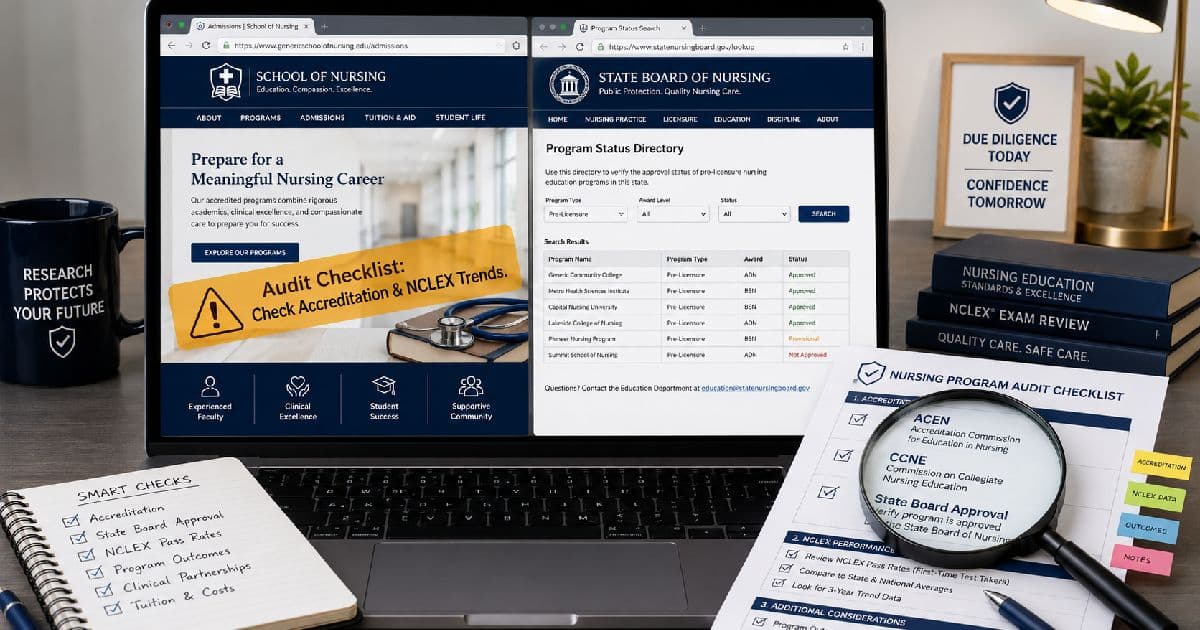
Choosing a nursing program is not just an academic decision.
It is a licensure decision.
It is a financial decision.
It is a career decision.
The wrong program can leave you with debt, untransferable credits, delayed graduation, weak NCLEX preparation, limited job options, or no clear path to licensure.
That sounds dramatic.
But it happens.
Students enroll in programs because an admissions representative sounded confident, the website looked polished, the start date was soon, or there was no waitlist.
Then they learn the program has low NCLEX pass rates, probationary approval, weak clinical placements, missing accreditation, poor faculty support, or a reputation local employers already know.
This guide shows you how to audit a nursing program before you apply, pay a deposit, or sign student loan papers.
Why nursing program red flags matter
Nursing education is tightly connected to public safety.
A prelicensure nursing program is not just a degree path.
It prepares graduates for the NCLEX-RN or NCLEX-PN and eventual nursing practice.
NCSBN explains that nursing regulatory bodies approve nursing programs because graduates need evidence of completing an approved program to be eligible to take the NCLEX.
That means board approval is not optional.
If you choose poorly, you may face:
- ineligibility for NCLEX
- delayed graduation
- program closure
- lost tuition
- repeated courses
- credits that do not transfer
- weak clinical preparation
- difficulty entering RN-to-BSN or graduate programs
- employer limitations
- higher debt than your first nursing salary can support
- licensing complications in another state
- stress, burnout, and lost time
Operation Nightingale and why students must verify credentials
Nursing education fraud is not theoretical.
In 2023, HHS-OIG and federal law enforcement announced Operation Nightingale, a multi-state enforcement action involving fake and fraudulent nursing diplomas and transcripts. HHS-OIG said the scheme involved more than 7,600 fake nursing diplomas and transcripts from now-closed schools.
The lesson for prospective students is not that every private or for-profit school is fraudulent.
The lesson is that credentials matter.
You need to verify:
- the school exists legally
- the program is board-approved
- the program has real clinical training
- the degree is legitimate
- the accrediting status is real
- graduates are eligible for licensure
- graduates are actually passing NCLEX
- the program is not under serious regulatory action
Do not assume a program is safe because it has a website, a campus tour, or a fast start date.
Approval vs accreditation: the most important distinction
This is the number one concept every nursing applicant must understand.
Board approval and national accreditation are not the same.
You need to check both.
State board of nursing approval
State board approval is the legal approval that allows a prelicensure nursing program to operate under that state’s nursing education rules.
For an LPN/LVN, ADN, diploma, BSN, or entry-level pathway, this approval is usually what makes graduates eligible to apply for licensure and sit for NCLEX.
If the program is not approved by the nursing regulatory body that controls that jurisdiction, you may not be eligible for NCLEX.
National nursing accreditation
National nursing accreditation is a quality review by a nursing accreditor.
The two major nursing programmatic accreditors are:
- ACEN
- CCNE
NCSBN describes approval as part of the state licensure process, while national accreditation assesses nursing program quality from a national perspective.
The key difference
| Question | Board approval | National nursing accreditation |
|---|---|---|
| Who controls it? | State board of nursing or nursing regulatory body | National nursing accreditor |
| Is it tied to NCLEX eligibility? | Usually yes | Sometimes required by state; often important for transfer/employment/graduate school |
| Is it state-specific? | Yes | National |
| Can a program be approved but not accredited? | Yes | Yes |
| Can a program be accredited but lose state approval? | Possible; state rules still control licensure eligibility | |
| Should you check both? | Yes | Yes |
Red flag 1: The program is not approved by the state board of nursing
This is the biggest red flag.
If a prelicensure nursing program is not approved by the appropriate state board of nursing or nursing regulatory body, stop.
Do not enroll.
Do not accept verbal reassurance.
Do not believe “approval is coming soon.”
Do not assume another state will accept it.
What to check
Go to the official state board of nursing website.
Search:
approved nursing programs
prelicensure nursing programs
NCLEX pass rates by program
board approved RN programs
board approved LPN programs
Confirm:
School name:
Campus:
Program type:
ADN, diploma, BSN, LPN/LVN, direct-entry:
Approval status:
Full approval or equivalent:
Probation/conditional/warning status:
Current enrollment status:
NCLEX eligibility:
Red flag phrases
Be cautious if you see:
approval pending
initial approval only
conditional approval
probationary approval
warning status
teach-out
voluntary closure
new program not yet approved
not accepting new students
under review
board action
restricted admission
Some of these statuses are not automatic disqualifiers.
But they require deeper investigation.
What to ask the school
Are graduates currently eligible to sit for the NCLEX?
What is your current board approval status?
Has the program ever been on probation, warning, or conditional approval?
Do you have a copy of the latest board approval letter?
Is this approval for this exact campus and pathway?
Are there any restrictions on admission, enrollment, or graduation?
What to ask the board
Is this program currently approved?
Is the program in good standing?
Are graduates eligible for NCLEX?
Are there recent board actions against this program?
Is the campus/program I am considering included in approval?Red flag 2: The school confuses approval and accreditation
Some schools blur the language.
They may say:
We are licensed.
We are approved.
We are accredited.
We are authorized.
We are recognized.
We are nationally accepted.
Those words can mean different things.
Questions that force clarity
Ask:
Are you approved by the state board of nursing for this exact program?
Are you accredited by ACEN or CCNE for this exact program?
Is the institution accredited by a U.S. Department of Education-recognized institutional accreditor?
Is the nursing program itself programmatically accredited?
Are you eligible to participate in Title IV federal student aid?
Why this matters
A school may be:
- state-approved but not nursing-accredited
- institutionally accredited but not programmatically nursing-accredited
- programmatically accredited but under state board scrutiny
- authorized to operate but not approved for NCLEX eligibility
- approved for one campus but not another
- approved for RN but not LPN, or vice versa
- approved for teach-out only
You need precision.
Safer wording
Use this when communicating with schools:
Please confirm in writing that the exact prelicensure nursing program I am applying to is currently approved by the state board of nursing and that graduates are eligible to apply for the NCLEX.Red flag 3: Missing ACEN or CCNE accreditation when you need it
National nursing accreditation can affect your future.
ACEN provides specialized accreditation for all levels of nursing education programs.
CCNE accredits baccalaureate, graduate, and residency/fellowship programs in nursing.
ACEN vs CCNE
| Accreditor | Common scope |
|---|---|
| ACEN | Practical, diploma, associate, baccalaureate, master's, clinical doctorate, DNP specialist certificate, and post-master's certificate programs |
| CCNE | Baccalaureate, graduate, and nurse residency/fellowship programs |
Why programmatic accreditation matters
Missing nursing programmatic accreditation may affect:
- RN-to-BSN admission
- MSN admission
- DNP admission
- CRNA admission
- NP program eligibility
- transfer credits
- employer preference
- military nursing options
- VA hiring competitiveness or eligibility
- out-of-state licensure mobility
- scholarship eligibility
- reputation with local hospitals
Be precise about federal aid
Do not confuse programmatic nursing accreditation with institutional Title IV eligibility.
Federal student aid generally depends on the institution being eligible, state authorized, and accredited by a recognized accrediting agency, not necessarily on the nursing program being ACEN or CCNE accredited.
However, if the entire institution is not properly eligible, federal aid may not be available.
Ask both questions:
Is the institution Title IV eligible?
Is the nursing program ACEN or CCNE accredited?
VA and federal employment note
The VA nurse qualification standard gives priority to candidates who meet the basic education requirement of graduating from an ACEN- or CCNE-accredited nursing program before considering accreditation deviations.
That does not mean no exception can ever exist.
It does mean ACEN/CCNE accreditation can matter for federal nursing employment pathways.
What to check
Search official directories:
ACEN accredited programs directory
CCNE accredited programs directory
Confirm:
School name:
Program level:
Campus:
Accreditation status:
Accreditation dates:
Next review date:
Warnings or adverse actions:
Red flag 4: Low or declining NCLEX pass rates
NCLEX pass rate is not the only measure of program quality.
But it is one of the most important.
NCSBN says NCLEX pass rates are a useful indicator of how many new nurses are entering the profession and provides pass-rate data by candidate type, including first-time vs repeater and domestic vs internationally educated candidates.
State boards often publish program-level pass rates.
What to look for
Check at least three years.
A strong program usually shows:
stable pass rates
pass rates above state average
pass rates near or above national first-time averages
clear support for students
transparent candidate counts
Red flag patterns
Be cautious if you see:
2023: 91%
2024: 82%
2025: 74%
or:
consistently below state average
large unexplained drop
pass rates hidden from website
school only shares “overall pass rate” not first-time rate
school combines RN and PN data
school combines multiple campuses
school reports internal predictor scores instead of NCLEX outcomes
small candidate count used to market a big percentage
Why candidate count matters
A 100% pass rate can be excellent.
But ask:
100% of how many students?Example:
5/5 passed = 100%
95/100 passed = 95%
Both are positive.
But the second gives more confidence because the sample is larger.
What pass rate is “good”?
There is no single national cutoff for students.
State board thresholds vary.
Some boards require programs to meet or exceed a set percentage, state average, national average, or a multi-year benchmark.
For students, a practical rule is:
85%+ first-time NCLEX pass rate: generally reassuring
90%+ first-time NCLEX pass rate: strong signal
Below state average: ask hard questions
Below 80% or declining for multiple years: serious caution
Do not use one year alone.
Use trend plus context.
Questions to ask about NCLEX results
What is your first-time NCLEX pass rate for the last 3 years?
How many candidates tested each year?
How do your results compare with state and national averages?
What changed if pass rates declined?
What NCLEX prep is included?
What happens if students score low on readiness exams?
Are students delayed from testing if they do not meet benchmarks?
What is the graduation rate for students who start the nursing sequence?
Red flag 5: Probationary, conditional, warning, or restricted approval
State boards may place nursing programs under monitoring or restrictions.
Terms vary by state.
Common phrases include:
probationary approval
conditional approval
warning status
notice of deficiency
approval with conditions
full approval with warning
restricted approval
teach-out plan
denied continuing approval
voluntary closure
withdrawal of approval
Why programs get flagged
Common reasons include:
- low NCLEX pass rates
- insufficient faculty
- unqualified faculty
- inadequate clinical hours
- weak curriculum
- unsafe student practice concerns
- poor documentation
- leadership instability
- inadequate resources
- lack of clinical placements
- failure to meet board reporting requirements
- complaints or investigations
What probation means for students
A program on probation may still operate.
It may still graduate students.
But it is under scrutiny.
If the program fails to correct issues, it may face restrictions or closure.
What to ask before enrolling
Why is the program on probation or conditional status?
What corrective action plan is in place?
How long has the program been under this status?
What happens if the program loses approval?
Will current students be eligible for NCLEX?
Is there a teach-out agreement?
Can credits transfer if the program closes?Red flag 6: Vague or weak clinical placements
Nursing cannot be learned entirely online.
Prelicensure nursing requires clinical learning.
A weak clinical-placement structure is one of the most serious red flags.
Strong programs can explain clinicals clearly
A reputable program should be able to describe:
- clinical partners
- types of units
- approximate travel distance
- whether nights/weekends are required
- how placements are assigned
- simulation use
- skills lab requirements
- preceptor expectations
- clinical faculty ratios
- what happens if a placement cancels
- whether students ever need to secure their own placement
Red flags
Be cautious if the school says:
Students are responsible for finding their own core clinical placements.
Clinical sites vary and cannot be guaranteed.
You may need to travel several hours.
You may need overnight travel.
We are still finalizing clinical agreements.
Preceptors are your responsibility.
Simulation replaces most clinical hours.
We cannot disclose clinical partners yet.
Some graduate programs require students to help identify preceptors.
That is different from a prelicensure RN or PN program lacking core clinical sites.
Why clinical placement matters
Poor clinical placement can cause:
- delayed graduation
- limited skill exposure
- weak confidence
- poor readiness for practice
- extra travel costs
- scheduling chaos
- unsafe student-to-instructor ratios
- missed specialty requirements
- higher stress
Questions to ask
Where did students complete med-surg clinicals last semester?
Where did students complete OB, peds, psych, and community clinicals?
What is the farthest clinical site from campus?
Are weekends, nights, or 12-hour shifts required?
Are clinical sites guaranteed?
How many students are assigned per instructor?
Do students ever have to find their own placement?
What happens if a clinical site cancels?
Red flag 7: High faculty and leadership turnover
Faculty stability matters.
A program with constant turnover may struggle with curriculum consistency, grading fairness, clinical coordination, student support, and NCLEX preparation.
Signs of instability
Look for:
- multiple program directors in a short period
- many faculty vacancies
- heavy reliance on adjuncts
- cancelled courses
- delayed clinical placements
- inconsistent grading
- poor student advising
- repeated schedule changes
- unclear remediation process
- faculty not responding to students
- high instructor turnover in clinical groups
What to ask
How long has the nursing program director been in role?
How many full-time nursing faculty are there?
What percentage of courses are taught by adjuncts?
What is the faculty-to-student ratio in clinical?
How many faculty vacancies exist?
What support exists if a student fails a course?
Why this matters
Nursing school is hard even in a stable program.
When leadership and faculty are unstable, students may pay the price through:
- inconsistent expectations
- poor communication
- weak clinical experiences
- delayed progression
- low morale
- poor NCLEX readiness
Red flag 8: Predatory pricing and high-pressure admissions
Nursing school is expensive.
But cost should be transparent.
Admissions should feel informative, not coercive.
Red flags in admissions
Be cautious if an admissions representative:
- pressures you to sign today
- says seats are disappearing without proof
- avoids written answers
- minimizes accreditation concerns
- will not share NCLEX pass rates
- pushes private loans before explaining total cost
- discourages you from comparing schools
- promises guaranteed employment
- guarantees NCLEX passage
- downplays clinical placement questions
- calls repeatedly like a sales office
- tells you “all nursing programs are basically the same”
- says accreditation does not matter
Cost red flags
Be cautious if:
- tuition is much higher than comparable programs
- fees are unclear
- nursing fees appear after enrollment
- refund policy is hard to understand
- transfer credits are limited
- the school encourages high-interest private loans
- scholarships sound large but are small compared with total cost
- NCLEX prep, uniforms, clinical travel, or testing fees are not included
- the school will not provide total program cost in writing
For-profit does not automatically mean bad
A for-profit school is not automatically unsafe.
A nonprofit school is not automatically safe.
Judge by:
- approval
- accreditation
- outcomes
- cost
- clinical placements
- student support
- transparency
- employer reputation
Red flag 9: “No waitlist” but no selectivity or support
No waitlist sounds attractive.
It can be legitimate.
It can also be a warning sign.
Why no waitlist may be fine
A program may have no waitlist because:
- it has enough faculty and clinical sites
- it offers multiple cohorts
- it is new but properly approved
- it uses a competitive direct-entry model
- it has strong capacity planning
Why no waitlist may be risky
A program may have no waitlist because:
- tuition is high
- reputation is weak
- students drop out quickly
- admission standards are low
- clinical slots are not secure
- local employers avoid graduates
- NCLEX outcomes are weak
- students discover problems after enrollment
What to ask
How many students start each cohort?
How many graduate on time?
How many fail or withdraw?
What is the first-semester attrition rate?
What GPA and entrance exam scores are typical?
How are clinical seats guaranteed for everyone admitted?
Red flag 10: Credits do not transfer
Nursing credits often transfer poorly.
But some programs create especially high risk.
Ask before enrolling
Will my prerequisites transfer to other schools?
Will nursing courses transfer if I leave?
Do you have articulation agreements?
Can graduates enter RN-to-BSN programs?
Can graduates enter MSN or DNP programs?
Do local universities accept your credits?
Why transfer matters
Life happens.
You may need to move.
The school may lose approval.
You may fail a course.
Your finances may change.
A family emergency may interrupt school.
If credits do not transfer, you may have to restart.
Red flag phrase
Be careful if a school says:
Our credits are unique to our institution.
Other schools may not accept our nursing credits.
We do not have transfer agreements.
You do not need to worry about transfer.
Red flag 11: Graduation and attrition data are hidden
NCLEX pass rates only show students who made it to the exam.
They do not show how many students started and never graduated.
A program can have a high NCLEX pass rate and still lose many students before graduation.
Ask for retention data
Ask:
How many students started the nursing sequence?
How many graduated on time?
How many graduated eventually?
How many withdrew?
How many failed a course?
How many repeated a course?
How many were dismissed?
Why attrition matters
High attrition may signal:
- weak admissions screening
- poor teaching support
- unclear expectations
- financial stress
- unrealistic schedule
- poor advising
- punitive progression policies
- lack of remediation
- disorganized clinicals
Good programs can discuss support
Ask:
What tutoring is available?
What remediation is available?
What happens after a failed exam?
Can students repeat a course?
How many times?
Is there an early alert system?
Red flag 12: Unrealistic program timeline
Be cautious with programs that promise very fast completion without explaining prerequisites, clinical hours, and schedule intensity.
Timeline reality
Common timelines:
- LPN/LVN: often about 12 months full time, varies
- ADN: often 2 years of nursing coursework after prerequisites
- traditional BSN: about 4 years
- accelerated BSN: often 12 to 18 months after a prior bachelor's degree and prerequisites
- direct-entry MSN: often 2 to 3 years, varies widely
A shorter program may be legitimate if it is intensive and properly structured.
But it should still include required clinical learning.
Ask
How many clinical hours are required?
How many days per week are class and clinical?
Can students work during the program?
What is the weekly time commitment?
What percentage of students finish on time?
Red flag 13: Weak student support and remediation
Nursing school is demanding.
Students need support.
Support to look for
A strong program should have:
- faculty office hours
- tutoring
- skills lab practice
- simulation support
- remediation plans
- NCLEX readiness resources
- academic advising
- mental health resources
- disability services
- test-taking support
- clinical performance feedback
- early alert systems
Red flag answers
Be cautious if the school says:
Students are adults; they figure it out.
We do not offer tutoring.
We do not have formal remediation.
If you fail, you are dismissed.
You can hire a private tutor.
NCLEX prep is your responsibility.
Nursing students must be accountable.
But programs should still provide structured support.
Red flag 14: Poor local employer reputation
Local employers often know which programs prepare students well.
You cannot rely only on gossip.
But employer reputation matters.
How to research
Ask:
- nurse managers
- hospital recruiters
- recent graduates
- nurse residency coordinators
- clinical instructors
- local nurses
- RN-to-BSN advisors
- state nurses association contacts
Questions:
Do local hospitals hire graduates from this program?
Do graduates enter nurse residencies?
Do employers require additional support for these graduates?
Are students from this program welcomed at clinical sites?
Warning signs
Be cautious if you hear repeated concerns about:
- poor clinical preparation
- professionalism issues
- weak medication knowledge
- unsafe students
- high failure rates
- graduates struggling to pass NCLEX
- employer reluctance to hire from the school
Red flag 15: The school avoids written answers
A legitimate program should put key claims in writing.
Get written confirmation of
board approval
accreditation
clinical placement structure
total program cost
refund policy
transfer policy
NCLEX pass rates
graduation rates
admission requirements
program length
course sequence
Be cautious if
The school says:
Just trust us.
The website is outdated.
We are updating that soon.
I cannot send that by email.
The board website is wrong.
You do not need accreditation.
Everyone passes.
Hospitals love our graduates.
Verbal promises are not enough.
Diploma mills and fraud warning signs
Most nursing schools are legitimate.
But students should know fraud warning signs.
Serious fraud red flags
Be alarmed if a school or person offers:
- a nursing diploma without classes
- credit for clinical hours you did not complete
- transcript changes for money
- “life experience” replacing core nursing clinicals
- guaranteed NCLEX eligibility without approved education
- fake clinical documents
- out-of-state shortcuts
- backdated transcripts
- degree completion in an impossible timeline
- payment through unusual methods
- no campus, no faculty, no clinical sites
- no state board listing
If you see these, walk away.
You can also report concerns to the state board, accreditor, state attorney general, federal student aid complaint system, or law enforcement depending on the issue.
How to audit a nursing program before applying
Use this step-by-step process.
Step 1: Verify state board approval
Go to the official board of nursing website.
Confirm:
Program name:
Campus:
Program type:
Approval status:
NCLEX eligibility:
Any board actions:
Step 2: Check NCLEX pass rates
Find the official state report.
Record:
Year 1:
Year 2:
Year 3:
State average:
National average:
Candidate count:
Step 3: Check ACEN or CCNE accreditation
Search official directories.
Confirm:
Accreditor:
Program level:
Campus:
Status:
Effective dates:
Next review:
Warnings:
Step 4: Check institutional accreditation and federal aid
Use official federal or institutional accreditation tools.
Ask:
Is the institution Title IV eligible?
Is the accreditor recognized?
Can students use federal loans or grants?
Step 5: Review clinical placement structure
Ask for specifics.
Core clinical sites:
Travel distance:
Nights/weekends:
Student-to-instructor ratio:
Preceptor responsibility:
Cancellation backup:
Step 6: Ask for completion and attrition data
Ask:
How many start?
How many finish?
How many finish on time?
How many sit for NCLEX?
Step 7: Calculate total cost
Include:
tuition
fees
books
testing package
uniforms
supplies
background check
drug screen
immunizations
CPR/BLS
clinical travel
parking
housing
loan interest
lost wages
Step 8: Talk to current students and recent graduates
Ask:
Are clinicals organized?
Are instructors supportive?
Are expectations clear?
Do students feel prepared for NCLEX?
Would you choose this program again?
What surprised you about the cost?
Step 9: Check employer reputation
Ask local nurse residency programs:
Do you regularly hire graduates from this school?
Are graduates competitive?
Do you require BSN completion?
Step 10: Compare at least three programs
Do not fall in love with one school before comparing outcomes.
Nursing program audit worksheet
Use this before applying.
School:
Campus:
Program:
Pathway:
Start date:

BOARD APPROVAL
State board listing found:
Approval status:
Any probation/warning:
Graduates NCLEX-eligible:
Date verified:
Link:

ACCREDITATION
ACEN:
CCNE:
Institutional accreditation:
Title IV eligible:
Date verified:
Links:

NCLEX OUTCOMES
Year 1 pass rate:
Candidate count:
Year 2 pass rate:
Candidate count:
Year 3 pass rate:
Candidate count:
State average:
National average:
Trend:

COMPLETION
Students admitted:
Graduated on time:
Graduated eventually:
Attrition:
Repeat policy:
Remediation:

CLINICALS
Clinical sites:
Travel distance:
Nights/weekends:
Student-to-instructor ratio:
Students find own placements?:
Simulation use:
Backup if site cancels:

COST
Tuition:
Fees:
Books/testing:
Uniforms/supplies:
Clinical travel:
Total estimated cost:
Aid:
Loans:
Net cost:

CAREER FIT
Local employer reputation:
Nurse residency eligibility:
RN-to-BSN transfer:
Graduate school eligibility:
VA/military/federal fit:
My risk level:
Questions to ask admissions before signing anything
Use these exact questions.
Is this exact program currently approved by the state board of nursing?

Are graduates currently eligible to apply for the NCLEX?

Is the program on full approval, conditional approval, probation, warning, or any other restricted status?

Is the nursing program accredited by ACEN or CCNE?

Is the institution accredited by a U.S. Department of Education-recognized institutional accreditor?

Is the institution Title IV eligible for federal student aid?

What are the first-time NCLEX pass rates for the last three years?

How many students tested each year?

How many students start the program, and how many graduate on time?

Where are clinical placements?

Do students ever have to find their own clinical placements?

What is the total program cost, including fees?

What costs are not included in tuition?

What happens if I fail a nursing course?

What credits transfer if I leave?

What RN-to-BSN or graduate programs accept your graduates?

Which employers hire your graduates?
How to read NCLEX pass-rate reports
State reports vary.
Some list:
- first-time candidates
- repeat candidates
- RN and PN separately
- program type
- campus
- candidate count
- pass number
- fail number
- percentage
- state average
- national average
- multi-year averages
What matters most
For program evaluation, prioritize:
first-time pass rate
candidate count
program-specific data
campus-specific data
three-year trend
comparison to state average
comparison to national first-time rate
Watch for data games
Be cautious if a school advertises:
100% pass ratebut does not say:
- first-time or repeat?
- which year?
- how many candidates?
- RN or PN?
- which campus?
- which pathway?
- how many students never graduated?
Stronger metric set
Ask for:
NCLEX first-time pass rate
on-time graduation rate
program completion rate
employment rate
student debt
licensure rate
student satisfaction
clinical placement consistency
What if your program loses approval or accreditation while you are enrolled?
This is stressful.
Act quickly.
If the program loses board approval
Contact:
- state board of nursing
- program director
- school dean
- financial aid office
- accreditor if applicable
- another school advisor
- state attorney general or consumer protection office if needed
Ask:
Can current students complete the program?
Are graduates still NCLEX-eligible?
Is there a teach-out plan?
Can credits transfer?
Are refunds available?
What is the timeline?
If the program loses programmatic accreditation
Ask:
Does state board approval remain intact?
Will graduates remain NCLEX-eligible?
Will RN-to-BSN or graduate schools accept the degree?
Will employers be affected?
Is there an appeal?
Is there a teach-out or accreditation restoration plan?
Do not rely on rumors
Get written answers from the board, accreditor, and school.
What if you already graduated from a risky program?
Do not panic.
Start gathering documents.
Steps
Verify license eligibility with your board.
Keep transcripts.
Keep course syllabi.
Keep clinical hour documentation if available.
Keep accreditation/approval letters from your attendance period.
Ask RN-to-BSN or graduate programs about eligibility.
Ask employers directly about education requirements.
Consult board guidance if moving states.
If fraud or misrepresentation is involved, seek advice from the board, legal aid, or consumer protection resources.
Special notes by pathway
LPN/LVN programs
Check:
- state practical nursing approval
- NCLEX-PN pass rates
- clinical hours
- transfer/bridge options
- employer acceptance
- cost versus local LPN wages
ADN programs
Check:
- board approval
- ACEN accreditation if available
- NCLEX-RN pass rates
- RN-to-BSN agreements
- local employer hiring patterns
- clinical placements
- total cost
BSN programs
Check:
- board approval
- CCNE or ACEN accreditation
- NCLEX-RN outcomes
- direct-entry versus pre-nursing admission
- clinical network
- graduate school preparation
- total debt
Accelerated BSN programs
Check:
- intensity and weekly schedule
- prerequisites
- completion rate
- clinical placement
- NCLEX outcomes for ABSN specifically
- ability to work during program
- total cost
Direct-entry MSN programs
Check:
- when you become NCLEX-eligible
- whether the prelicensure portion is board-approved
- whether the program is CCNE or ACEN accredited as applicable
- total debt
- whether it prepares for RN only or advanced practice later
- clinical placement structure
Red flag scorecard
Use this as a quick screen.
Give one point for each red flag.
Not listed as approved by state board:
Approval is probationary/conditional/warning:
NCLEX pass rate below state average:
NCLEX trend declining:
Candidate count hidden:
No ACEN/CCNE accreditation:
Institutional accreditation unclear:
Federal aid eligibility unclear:
Clinical sites vague:
Students find own core clinical placements:
High faculty turnover:
No completion/attrition data:
Admissions pressure:
Total cost unclear:
Private loans pushed aggressively:
Credits do not transfer:
No RN-to-BSN/graduate pathway clarity:
Poor employer reputation:
Guaranteed NCLEX claims:
Unrealistic timeline:
Score interpretation
0-2 points:
Still verify, but risk may be manageable.

3-5 points:
Proceed only after getting strong written answers.

6-9 points:
High caution. Compare alternatives carefully.

10+ points:
Do not enroll without independent regulatory confirmation and a serious backup plan.
Safer signs of a strong nursing program
A stronger program usually has:
- full state board approval
- clear ACEN or CCNE accreditation if applicable
- transparent NCLEX results
- pass rates above state average
- stable leadership
- qualified faculty
- organized clinical placements
- realistic admissions standards
- clear total cost
- student support
- published handbook
- fair progression policy
- strong local employer relationships
- transfer agreements
- clear licensure guidance
- no high-pressure sales tactics
Frequently asked questions about nursing program red flags
What is the biggest nursing program red flag?
The biggest red flag is lack of state board of nursing approval. Without proper approval, graduates may not be eligible for NCLEX or licensure.
What is the difference between board approval and accreditation?
Board approval is state regulatory approval tied to licensure eligibility. Accreditation is a national quality review by an accrediting body such as ACEN or CCNE. You should check both.
Can I take the NCLEX if my nursing program is not accredited?
It depends on state rules. In many cases, state board approval is the key NCLEX eligibility requirement, but some boards require national nursing accreditation. Even if NCLEX eligibility exists, lack of accreditation may limit employment, transfer, or graduate school options.
Can I take the NCLEX if my school is not board-approved?
Usually no. Prelicensure graduates generally need to complete a board-approved or otherwise recognized nursing education program to be eligible for NCLEX and licensure. Verify with your state board.
Is ACEN better than CCNE?
Not exactly. ACEN and CCNE serve different program scopes. ACEN accredits all levels of nursing education. CCNE accredits baccalaureate, graduate, and residency/fellowship programs. The right accreditor depends on your program level.
What does ACEN accredit?
ACEN provides specialized accreditation for all levels of nursing education programs, including practical, diploma, associate, baccalaureate, master's, and doctoral nursing programs.
What does CCNE accredit?
CCNE accredits baccalaureate, graduate, and nursing residency/fellowship programs.
Is a state-approved but unaccredited nursing school safe?
It may be legal and NCLEX-eligible in some states, but it carries risk. You need to check transfer, employment, RN-to-BSN, graduate school, federal employment, and out-of-state licensure implications before enrolling.
Does nursing accreditation affect federal financial aid?
Federal aid generally depends on institutional eligibility, state authorization, and accreditation by a recognized institutional accreditor. Nursing programmatic accreditation is separate. Ask whether the institution is Title IV eligible and whether the nursing program is ACEN or CCNE accredited.
What NCLEX pass rate is a red flag?
A first-time pass rate below the state average, below 80%, or declining over multiple years is a red flag. Always check candidate counts and multi-year trends.
Should I trust a school that says it has a 100% NCLEX pass rate?
Verify it. Ask which year, which campus, which pathway, first-time or repeat candidates, and how many students tested.
What does probationary approval mean?
Probationary approval means the board has identified problems and is monitoring or restricting the program. Students may still be able to graduate, but the risk is higher.
Can a nursing school close while students are enrolled?
Yes. Programs can close voluntarily or lose approval. Ask about teach-out plans, transfer options, and refund policies if a program has warning signs.
Is a for-profit nursing school always bad?
No. For-profit status alone does not prove a program is bad. But you should examine approval, accreditation, NCLEX outcomes, cost, clinical placement, student support, and employer reputation carefully.
Why do some nursing schools have no waitlist?
Some have enough seats and clinical capacity. Others have no waitlist because cost is high, reputation is weak, or attrition is high. Ask about graduation rates and clinical placement.
Should students have to find their own clinical placements?
For prelicensure nursing programs, core clinical placements should generally be organized by the program. If a school expects students to secure core clinical placements independently, treat that as a major red flag.
How do I check if a nursing program is approved?
Go to the official state board of nursing website and search the approved nursing program directory. Verify the exact school, campus, program type, and approval status.
How do I check if a nursing program is accredited?
Search the official ACEN and CCNE directories. Do not rely only on school marketing materials.
What questions should I ask current students?
Ask whether clinicals are organized, faculty are supportive, expectations are clear, students feel prepared for NCLEX, schedules change often, and whether they would choose the program again.
What should I do before signing an enrollment agreement?
Verify board approval, accreditation, NCLEX pass rates, candidate counts, completion rates, clinical placements, total cost, transfer policy, refund policy, and local employer reputation.
Final thoughts
A nursing program can change your life.
It can also waste your time and money if you choose blindly.
Do not let a polished website or friendly admissions call replace due diligence.
Before enrolling, verify:
State board approval.
ACEN or CCNE accreditation.
Institutional accreditation.
NCLEX pass-rate trend.
Candidate count.
Clinical placements.
Graduation rate.
Total cost.
Transfer options.
Employer reputation.
Good nursing programs can answer hard questions.
Good nursing programs show their outcomes.
Good nursing programs do not pressure you to ignore red flags.
Protect your future before you sign.
Sources and references
- NCSBN: Approval of Nursing Education Programs
- NCSBN: Evidence-Based Nursing Education Program Approval
- NCSBN: NCLEX Pass Rates
- NCSBN: Board of Nursing Licensure Requirements
- ACEN: Accreditation
- ACEN: Search Accredited Programs
- ACEN: Standards and Criteria
- CCNE: Accreditation
- CCNE: Accredited Programs Directory
- CCNE: Standards, Procedures, and Guidelines
- Federal Student Aid Handbook: Institutional Eligibility
- Council for Higher Education Accreditation: About Accreditation
- HHS-OIG: 2023 Operation Nightingale Enforcement Action
- DOJ: Fraudulent Nursing Diploma Scheme Leads to Federal Convictions
- VA: Nurse Qualification Standard PDF
- NurseZee: Nursing School Prerequisites
- NurseZee: How to Get Into Nursing School With a Low GPA
- NurseZee: TEAS vs HESI
- NurseZee: Accelerated BSN Programs
- NurseZee: Direct-Entry MSN Programs
- NurseZee: LPN to RN Programs
- NurseZee: RN to BSN Programs
- NurseZee: How to Become an RN
- NurseZee: Nursing School Clinicals
- NurseZee Practice Questions