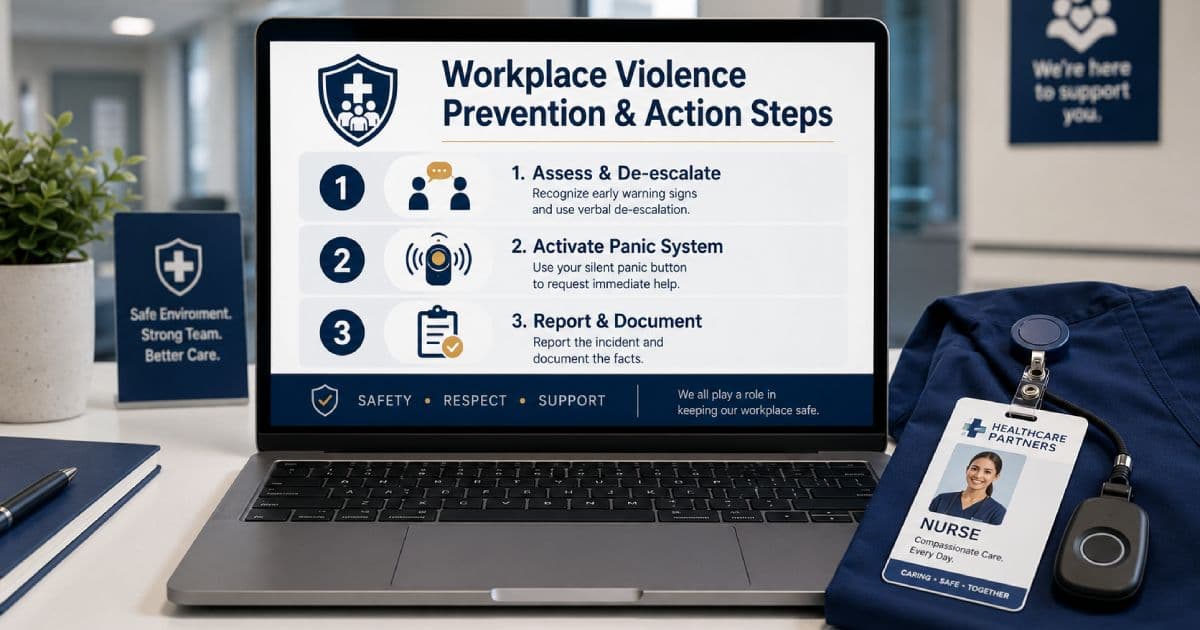
Workplace violence is not part of the job.
Not verbal threats.
Not being grabbed.
Not being shoved.
Not sexual harassment.
Not a family member blocking the door.
Not a patient throwing equipment.
Not a visitor saying they know where you park.
Nurses care for people during pain, fear, confusion, intoxication, grief, psychosis, withdrawal, delirium, and crisis. That context matters.
It does not make violence acceptable.
Workplace violence in nursing is a patient safety issue, a staff safety issue, a staffing issue, and a workplace culture issue.
This guide covers what nurses can do in the moment, how to report incidents, what support to ask for, and what safer organizations should be building.
What is workplace violence in nursing?
Workplace violence is any act or threat of physical violence, harassment, intimidation, or other threatening disruptive behavior that occurs at work.
In nursing, it can come from:
- Patients
- Families
- Visitors
- Coworkers
- Providers
- Supervisors
- Strangers
- Domestic partners who enter the workplace
- Community violence spilling into the hospital
- People under the influence of substances
- People with delirium, dementia, psychosis, or acute medical instability
Workplace violence can happen in any setting.
Common high-risk areas include:
- Emergency departments
- Behavioral health units
- Medical-surgical units
- ICUs
- Labor and delivery
- Pediatrics
- Long-term care
- Home health
- Hospice
- Corrections
- Clinics
- Ambulance bays
- Waiting rooms
- Parking areas
- Security screening points
Why this issue matters now
Healthcare and social assistance workers experience a high burden of workplace violence injuries.
BLS has reported that healthcare and social assistance had the highest counts and annualized incidence rates for workplace violence among private industry sectors in 2021-2022.
Older BLS workplace violence healthcare data also showed healthcare and social service workers were about five times as likely to suffer workplace violence injuries as workers overall.
The numbers match what many nurses already know.
Violence is common.
It is underreported.
It affects staffing, turnover, burnout, trauma, and patient care.
The “part of the job” myth
Many nurses hear some version of this:
They are sick. Do not take it personally.
That is just psych.
That is just the ED.
They did not mean it.
At least you were not badly hurt.
Finish your meds and move on.
Do not make a big deal.
That response is dangerous.
It teaches nurses to minimize harm.
It hides patterns from leadership.
It prevents prevention.
It allows unsafe environments to continue.
A slap, threat, sexual comment, bite attempt, thrown object, or blocked exit may be a warning sign before a more serious incident.
Types of workplace violence nurses may experience
Physical violence
Examples:
- Hitting
- Kicking
- Punching
- Biting
- Scratching
- Spitting
- Pushing
- Pulling hair
- Grabbing wrists or clothing
- Throwing objects
- Choking
- Attempted assault
- Weapon use
Verbal threats
Examples:
“I will kill you.”
“I know where you park.”
“I am coming back for you.”
“You will regret this.”
“I will find your family.”
A verbal threat does not need to become physical before it matters.
Harassment and intimidation
Examples:
- Repeated insults
- Racial or ethnic slurs
- Sexual comments
- Threatening gestures
- Blocking exits
- Following staff
- Filming staff to intimidate them
- Demanding personal information
- Targeting a specific nurse repeatedly
Sexual harassment or assault
Examples:
- Unwanted touching
- Sexual comments
- Exposure
- Requests for sexual contact
- Grabbing
- Threats tied to sex or gender
- Repeated sexualized behavior after boundaries are set
Lateral violence and bullying
Workplace violence is not only patient or visitor behavior.
Coworker bullying can include:
- Threats
- Intimidation
- Humiliation
- Sabotage
- Repeated hostile behavior
- Retaliation for reporting
- Discriminatory harassment
This guide focuses heavily on patient and visitor violence, but nurses also deserve protection from coworker violence.
For related stress and recovery topics, see NurseZee’s nurse burnout strategies, self-care for nurses, compassion fatigue in nursing, and moral distress in nursing.
Warning signs of escalation
Violence is not always predictable.
But many incidents show warning signs.
Body language cues
Watch for:
- Pacing
- Clenched fists
- Tight jaw
- Staring
- Invading personal space
- Blocking the exit
- Rapid movements
- Pointing aggressively
- Taking off clothing or removing objects in agitation
- Hitting walls or furniture
- Throwing small items
- Guarding a bag or pocket
- Looking around for objects to use
Voice and speech cues
Listen for:
- Yelling
- Rapid speech
- Repetitive demands
- Threats
- Refusal to answer basic questions
- Paranoia
- Challenging authority
- Escalating profanity
- “You people never help”
- “No one is listening”
- “I am done waiting”
- “If you do not do this, I will...”
Clinical risk cues
Some clinical situations increase risk.
Examples:
- Delirium
- Dementia
- Withdrawal
- Intoxication
- Hypoxia
- Hypoglycemia
- Uncontrolled pain
- Psychosis
- Mania
- Traumatic brain injury
- Steroid-induced mood changes
- Sleep deprivation
- Long ED wait times
- Bad news
- Involuntary hold
- Search or contraband removal
- Limit setting
- Visitor restriction
- Discharge conflict
- Denial of requested opioids or sedatives
Environmental risk cues
Risk can rise when:
- Staffing is low
- Security is far away
- Rooms are crowded
- Exits are blocked
- Weapons screening is absent
- Visitors are unregulated
- Wait times are long
- Nurses work alone
- Lighting is poor
- Parking areas are isolated
- Staff do not know alarm procedures
- There are no clear behavioral expectations
De-escalation basics for nurses
De-escalation is a skill.
It is not magic.
It does not guarantee safety.
It also should not be used as an excuse to leave nurses alone with dangerous situations.
Goal of de-escalation
The goal is to reduce immediate tension so the person can regain control and staff can maintain safety.
Your goal is not to win an argument.
Your goal is not to prove you are right.
Your goal is not to tolerate abuse indefinitely.
Your goal is safety.
Keep your voice calm and steady
Use a low, clear voice.
Avoid matching the patient’s volume.
Speak slowly.
Use short sentences.
Example:
I can see you are angry. I want to help, and I need us to speak safely.Validate emotion without agreeing to unsafe demands
Validation does not mean agreement.
Example:
I hear that you are frustrated about the wait. I would be frustrated too. I cannot allow yelling or threats toward staff. I can check on the next step for you.Give choices when possible
Choices restore some control.
Example:
We need to check your blood sugar. Would you like me to use your left hand or right hand?Example:
You can sit in the chair or on the bed while we talk. I need you to keep your hands away from staff.Set clear limits
Limits should be calm, specific, and behavior-based.
Example:
I will continue this conversation if you lower your voice and stop threatening staff.Example:
You may be upset. You may not block the doorway or touch staff.Avoid power struggles
Avoid:
- “Calm down”
- “You are being ridiculous”
- “That is not my problem”
- “Because I said so”
- “You cannot talk to me like that” without a clear next step
- Sarcasm
- Threatening back
- Arguing about every detail
- Standing over the patient
- Pointing
- Touching without permission unless clinically necessary and safe
Use team-based de-escalation
Do not manage high-risk escalation alone.
Call for:
- Charge nurse
- Security
- Provider
- Behavioral health team
- Rapid response
- De-escalation response team
- Additional staff
- Interpreter
- Social work
- Patient advocate
- Law enforcement when appropriate and according to policy
Bedside safety tips for nurses
These are practical habits.
They do not replace staffing, security, training, or organizational accountability.
Keep an exit path
Do not let an agitated person stand between you and the door.
When possible:
- Stand near the exit
- Keep your back to an open path
- Avoid corners
- Avoid being trapped between the bed and wall
- Leave the door open if safe and appropriate
- Ask a second staff member to stay nearby
Scan the room
Look for items that could be thrown or used as weapons.
Examples:
- Scissors
- Pens
- Metal utensils
- Sharps
- Cords
- IV poles
- Heavy water pitchers
- Glass objects
- Oxygen tanks
- Personal belongings
- Canes or crutches
- Bedside equipment
- Loose monitors
- Call light cords
Remove or secure hazards according to policy and clinical need.
Do not enter alone if you feel unsafe
Ask for help before entering if:
- The patient threatened staff
- A visitor is escalating
- The patient has a violence flag or behavioral alert
- You are giving limit-setting news
- You must remove contraband
- You must perform a high-stress intervention
- The patient has already assaulted someone
- You feel uneasy
Use chaperones and observers
Use a second staff member when needed for:
- Personal care
- Sensitive exams
- Invasive procedures
- Behavioral health concerns
- Confused or impulsive patients
- Patients with prior sexual misconduct
- Patients who make staff feel unsafe
Know your alarms
Every nurse should know:
Where is the panic button?
How do I call security?
What is the emergency number?
What is the code for violent behavior?
How do I activate a silent alarm?
Does my badge have a duress button?
Where should I stand if security responds?
What should I say on the phone?
Practice before a crisis.
Protect personal information
Avoid sharing:
- Last name if not required by policy
- Personal phone number
- Social media
- Where you live
- Where you park
- Family details
- Schedule details beyond what is required
- Personal beliefs that may escalate conflict
Follow name badge and facility policy.
Be careful in parking areas
Workplace violence risk does not stop at the unit door.
Use safe practices:
- Walk with coworkers when possible
- Use security escort when available
- Park in well-lit areas
- Report suspicious behavior
- Avoid wearing headphones in isolated areas
- Keep keys accessible
- Do not ignore targeted threats
What to do during an escalating situation
Use a simple sequence.
Step 1: Create distance
Move toward the exit.
Increase space.
Do not corner the person.
Avoid sudden movements.
Step 2: Call for help early
Use your facility’s process.
Examples:
Call security.
Call charge nurse.
Activate duress button.
Use emergency code.
Ask a coworker to stay nearby.
Step 3: Use calm limit setting
Example:
I want to help. I cannot continue while you are threatening staff. I am going to step out and return with my charge nurse.Step 4: Do not turn your back on a high-risk person
Back out if needed.
Keep the person in view when safe.
Step 5: Leave if needed
If danger increases, leave.
A nurse cannot provide safe care while being assaulted or trapped.
Step 6: Escalate to the team
Once safe, involve the appropriate team.
This may include:
- Charge nurse
- Security
- Provider
- Behavioral response team
- House supervisor
- Social worker
- Psychiatry
- Ethics
- Risk management
- Law enforcement, depending on the incident
What to do after workplace violence occurs
After an incident, your brain may move fast.
Use a checklist.
Step 1: Get safe
Leave the room if needed.
Move away from the threat.
Call for help.
Step 2: Get medical care
If you were injured, get evaluated.
This includes:
- Bites
- Scratches
- Sprains
- Head injury
- Back injury
- Needlestick or blood exposure
- Strangulation
- Sexual assault
- Psychological trauma
- Pain after being hit, pushed, or restrained
Do not minimize injuries.
Step 3: Notify the right people
Notify:
- Charge nurse
- Unit manager
- House supervisor
- Security
- Provider if patient care is affected
- Occupational health
- Risk management, depending on policy
Step 4: Preserve facts
Write objective details as soon as possible.
Include:
- Date and time
- Location
- Who was involved
- What happened
- Exact words if threats were made
- Patient behavior
- Visitor behavior
- Injuries
- Witnesses
- Security response
- Provider notifications
- Care impact
- Immediate actions taken
Step 5: Complete internal incident report
Use the safety reporting system.
Incident reports help track patterns.
They may support prevention, staffing, security changes, worker's compensation, and regulatory follow-up.
Step 6: Document patient care separately
Do not put blame or incident-report language in the patient chart.
Document clinical facts relevant to patient care.
Example:
At 1435, patient became verbally threatening, yelling, “I will punch you if you touch me.” Patient stood from bed and moved toward staff. Staff exited room and notified charge nurse and security. Provider notified. Patient care resumed with security present.Follow facility policy.
Step 7: Ask about external reporting if needed
Depending on the event and jurisdiction, options may include:
- Workers' compensation claim
- Police report
- OSHA complaint
- State workplace safety agency complaint
- State health department complaint
- Professional association or union support
- Employee relations or HR complaint
- EEOC or civil rights route if harassment/discrimination is involved
This is not legal advice.
Rules vary by state and employer.
How to write an objective incident report
Use facts.
Avoid judgment.
Strong incident report language
At 2140, visitor in Room 612 stood within approximately one foot of RN, blocked the doorway, and stated, “You are not leaving until you give her pain medicine.” RN asked visitor to step away from the doorway. Visitor refused. RN activated staff assist button and called charge nurse. Security arrived at 2145. No physical contact occurred. Patient remained in bed. Provider notified of pain medication request.Weak incident report language
Family was crazy and threatening. They were being dramatic about pain meds. Security finally came.Why the first version is better
It includes:
- Time
- Location
- Behavior
- Exact quote
- Safety concern
- Staff action
- Security response
- Patient status
- Provider notification
It avoids:
- Insults
- Assumptions
- Emotion-based labels
- Blame
- Vague language
Reporting workflow for nurses
Facility policies differ.
This is a general workflow.
1. Emergency response
Use if the threat is immediate.
Leave the room.
Call security or emergency response.
Activate duress alarm.
Call 911 if appropriate and policy supports it.
2. Chain of command
Notify:
Charge nurse
Manager
House supervisor
Security
Provider
Occupational health
3. Incident reporting system
Complete the facility incident or safety report.
Include objective facts.
Do not delay because you feel embarrassed or busy.
4. Medical evaluation
If injured, report to occupational health, ED, urgent care, or approved worker injury process.
Ask how to document workplace injury.
5. Workers' compensation
If injured physically or psychologically, ask about workers' compensation.
Workplace violence can cause both physical and mental health injury.
6. Police report
You may have the option to file a police report.
Facility policies vary.
State laws vary.
Your employer's reluctance does not automatically remove your right to report a crime.
7. OSHA or state agency complaint
If your employer is not addressing a recognized hazard, OSHA allows workers to file safety and health complaints.
OSHA also has whistleblower protections for workers who report injuries, safety concerns, or other protected activities.
8. Follow-up
Ask:
What was done to reduce risk?
Was the patient care plan updated?
Was a behavioral plan added?
Was security notified for future visits?
Was a visitor restriction considered?
Was staffing adjusted?
Was a huddle completed?
Was the event reviewed by safety leadership?OSHA, Joint Commission, and workplace violence standards
Nurses do not need to become regulatory experts.
But you should understand the basics.
OSHA
OSHA recognizes workplace violence as a hazard in healthcare.
In the absence of a specific federal workplace violence standard for healthcare, OSHA may use the General Duty Clause when employers fail to address recognized serious hazards.
OSHA also provides workplace violence prevention guidance and resources for healthcare.
General Duty Clause
The General Duty Clause requires employers to provide a workplace free from recognized hazards likely to cause death or serious physical harm.
Workplace violence can be one of those hazards when it is recognized and preventable.
Joint Commission
The Joint Commission has workplace violence prevention requirements for accredited hospitals.
Its framework includes leadership oversight, policies and procedures, reporting systems, data collection and analysis, post-incident strategies, training, and education.
For bedside nurses, this matters because workplace violence prevention should not be a poster on the wall.
It should show up in:
- Training
- Reporting systems
- Leadership review
- Security planning
- Environmental risk assessment
- Post-incident support
- Data sharing
- Staff involvement
- Corrective action
NIOSH and CDC
NIOSH provides workplace violence prevention resources, including training for nurses and healthcare workers.
The focus is not only what individuals can do.
It also includes organizational prevention.
SAVE Act status
The Save Healthcare Workers Act has been introduced as federal legislation in the 119th Congress.
The House version is H.R. 3178.
The Senate version is S. 1600.
The bills aim to create federal criminal penalties for assaulting hospital personnel and mirror protections similar to those for airline and airport workers.
As of this guide's update, the legislation has been introduced and referred to judiciary committees.
It is not the same thing as enacted federal law.
What the proposed penalties address
Advocacy materials for the bill describe potential penalties such as:
- Up to 10 years for assaulting hospital personnel
- Higher penalties when aggravating factors are involved, such as use of a dangerous weapon or bodily injury
Because bills can change before passage, use official legislative text for final details.
State laws and employer policies
Many states have passed healthcare workplace violence laws or enhanced penalties.
Some states require hospitals to have workplace violence prevention plans.
Others require reporting, signage, training, or security assessments.
State laws can vary widely.
Ask your employer or state nurses association:
Does our state have healthcare workplace violence prevention law?
Are assault penalties enhanced for healthcare workers?
Does the hospital have to report incidents?
Are we required to receive annual workplace violence training?
Does the law protect staff from retaliation for reporting?
Support after workplace violence
The emotional effects can be serious.
Do not dismiss them.
Workplace violence can lead to:
- Anxiety
- Hypervigilance
- Sleep disturbance
- Panic symptoms
- Depression
- Anger
- Shame
- Guilt
- Avoidance
- Burnout
- Moral distress
- Compassion fatigue
- PTSD symptoms
- Fear of returning to work
- Loss of trust in leadership
Physical injuries can heal faster than the nervous system.
Immediate debriefing
A post-incident debrief should be:
- Prompt
- Non-punitive
- Focused on safety
- Supportive
- Clear about next steps
- Not a blame session
Questions may include:
Is everyone physically safe?
Does anyone need medical care?
What happened?
What made the situation worse?
What helped?
Were alarms and security response effective?
What needs to change before this patient/visitor interaction continues?
Who needs follow-up support?
EAP and counseling
Employee Assistance Programs may offer short-term counseling.
For more serious trauma symptoms, ask about:
- Trauma-informed counseling
- Workers' compensation mental health coverage
- Occupational health referral
- Psychiatric support if needed
- Peer support
- Union or professional association support
- Time away from unit or modified duty if appropriate
Peer support
Talking with another nurse who understands can help.
But peer support should not replace professional care when symptoms are severe or persistent.
Reach out if you notice:
- Nightmares
- Flashbacks
- Avoiding work
- Panic before shifts
- Persistent fear
- Thoughts of self-harm
- Emotional numbness
- Drinking or substance use to cope
- Inability to sleep
- Feeling unsafe everywhere
What managers and organizations should do
Workplace violence prevention cannot rest on individual nurses.
Organizations need systems.
Build a prevention program
A strong program includes:
- Written workplace violence prevention policy
- Leadership accountability
- Staff reporting system
- Data review
- Unit-based risk assessment
- Environmental safety assessment
- Training
- Security response plan
- Behavioral response resources
- Visitor management
- Post-incident support
- Anti-retaliation protections
- Staff involvement
Use frontline nurse input
Nurses know where risk lives.
Ask staff:
Which rooms feel unsafe?
Where are the blind spots?
When is security slow?
Which doors are uncontrolled?
Which visitor policies are inconsistent?
Where do we need duress alarms?
Which shifts have the highest risk?
Which patient types need better plans?
Track data
Track:
- Verbal threats
- Physical assaults
- Injuries
- Near misses
- Security calls
- Visitor removals
- Weapons found
- High-risk times
- High-risk locations
- Repeat offenders
- Staff missed work
- Workers' compensation claims
- Post-incident support use
Data should lead to action.
Improve physical security
Possible interventions:
- Controlled access
- Visitor screening
- Weapons detection where appropriate
- Visible security
- Safe room design
- Alarm systems
- Duress badges
- Cameras in public areas
- Better lighting
- Safer parking
- Furniture layout that preserves exit paths
- Secure medication and sharps storage
- Clear signage on behavior expectations
Train staff
Training should include:
- Warning signs
- De-escalation basics
- Alarm use
- Escape routes
- Behavioral emergency response
- Reporting process
- Post-incident support
- Documentation expectations
- Visitor management
- Trauma-informed care
- Bias and equity issues
- How to call for help
Protect staff from retaliation
Staff should not be punished for reporting violence.
Anti-retaliation culture means:
- No blaming the nurse
- No minimizing threats
- No discouraging incident reports
- No schedule punishment after reporting
- No performance retaliation
- No pressure to avoid police reports when legally permitted
- No “you should have handled it better” before facts are reviewed
What nurses can advocate for
You may not control the whole system.
But you can advocate.
At the unit level
Ask for:
- Clear behavioral expectations for patients and visitors
- Unit safety huddles
- Post-incident debriefs
- Better reporting feedback
- Security rounding
- Visitor limits when needed
- Flagging system for known risks
- Behavioral care plans
- Adequate staffing
- Training refreshers
- Working duress buttons
At the committee level
Join or request:
- Workplace violence committee
- Shared governance safety council
- Unit practice council
- Quality and safety committee
- Emergency preparedness committee
- Labor-management safety committee if applicable
At the policy level
Support:
- Strong reporting protections
- Workplace violence prevention plans
- Data transparency
- Staffing and security resources
- State healthcare worker safety laws
- Federal workplace violence prevention standards
- Funding for safety infrastructure
- Support after assault
Refusing unsafe assignments and patient abandonment
This is a common fear.
Nurses worry that stepping away from an abusive or violent patient will be called abandonment.
Patient abandonment rules are state-specific and fact-specific.
But in general, leaving an immediately dangerous situation to get help is not the same as abandoning a patient without handoff.
Safer approach
If a patient or visitor is threatening your safety:
Leave the room if needed.
Notify charge nurse or supervisor immediately.
Request another staff member, security, or team response.
Document objective facts.
Follow chain of command.
Continue care through a safe team plan.
What to avoid
Avoid:
- Disappearing without notifying anyone
- Refusing all care without chain-of-command communication
- Leaving another nurse unaware of the situation
- Failing to document relevant safety facts
- Returning alone into a dangerous room because you feel pressured
If you feel forced into unsafe care
Use chain of command.
Say:
I am not refusing patient care. I am saying it is unsafe for me to enter alone after the patient threatened to hit staff. I need security or another staff member present and a plan before care continues.Home health and community nursing safety
Home health nurses face unique risks because they often work alone.
Before the visit
Check:
- Patient history
- Prior safety alerts
- Address concerns
- Pets
- Weapons concerns
- Substance use concerns
- Domestic violence concerns
- Neighborhood parking
- Phone signal
- Visit time
- Who will be present
During the visit
Safety tips:
- Park for a quick exit
- Keep phone accessible
- Do not let yourself be blocked inside
- Trust your instincts
- Leave if unsafe
- Do not enter if active violence is visible
- Request paired visits when needed
- Follow agency check-in/check-out policy
- Avoid sharing personal information
- Keep supplies organized so you can leave quickly
If unsafe
Use agency policy.
Possible actions:
- Leave the home
- Call supervisor
- Call emergency services if needed
- Request security or law enforcement standby if policy allows
- Reschedule with safety plan
- Transfer care plan if ongoing risk persists
Long-term care and dementia-related aggression
Long-term care nurses face frequent aggression from residents with dementia, delirium, pain, fear, or unmet needs.
This does not make injuries acceptable.
Prevention strategies
Assess for triggers:
- Pain
- Hunger
- Toileting needs
- Overstimulation
- Understimulation
- Fear
- Infection
- Delirium
- Medication side effects
- Sleep disruption
- Staff approach
- Bathing or dressing distress
- Hearing or vision impairment
Care approach
Use:
- Slow approach
- One person speaking
- Simple choices
- Validation
- Familiar routine
- Pain assessment
- Personal space
- Calm environment
- Reapproach later if safe
- Team support for high-risk care
Reporting still matters
Even when aggression is related to dementia, report injuries and near misses.
Facilities need data to improve staffing, care plans, room assignments, and training.
Emergency department and behavioral health safety
ED and behavioral health settings carry high risk.
Common risk points
- Triage delays
- Intoxication
- Withdrawal
- Involuntary hold
- Search procedures
- Denied requests
- Law enforcement handoff
- Family conflict
- Psychosis or mania
- Overcrowding
- Boarding
- Lack of privacy
- Pain crisis
- Bad news
Safety practices
Use:
- Team approach
- Clear roles
- Safe room setup
- Remove hazards
- Security presence when needed
- Trauma-informed language
- Limit setting
- Observation protocols
- Visitor management
- Consistent staff messaging
- Early medication/provider involvement when clinically appropriate
- Debriefs after incidents
Quick reference: what to say
When a visitor is yelling
I can see you are upset. I want to help. I need you to lower your voice so we can talk safely.When someone threatens staff
Threats are not acceptable. I am stepping out and returning with my charge nurse and security.When someone blocks the exit
I need you to move away from the doorway now. I will continue the conversation when I can safely leave the room.When a patient refuses care but is not violent
You have the right to refuse. I want to make sure you understand the risks and options. I can come back in a few minutes.When you need team support
I need assistance in Room 314 now. Patient is escalating, standing near the door, and making threats.When reporting to supervisor
At 1015, the patient grabbed my wrist and stated, “I will hit you if you come back.” I left the room, notified security, and need a safe care plan before re-entry.Workplace violence incident checklist
Use this after an incident.
I am physically safe:
I notified charge nurse:
I notified security:
I received medical evaluation if injured:
I documented clinical facts in the chart if relevant:
I completed the internal incident report:
I listed witnesses:
I preserved evidence if relevant:
I asked about workers' compensation:
I asked about EAP or counseling:
I requested a debrief:
I asked what changes will be made:
I followed up with manager/safety team:
I considered OSHA/state complaint if hazard continues:
Frequently asked questions about workplace violence in nursing
What counts as workplace violence in nursing?
Workplace violence includes physical assault, threats, intimidation, harassment, sexual harassment, verbal abuse, stalking, weapons threats, and disruptive behavior that creates danger or fear at work.
Is verbal abuse considered workplace violence?
It can be. OSHA’s definition includes threats, harassment, intimidation, and other threatening disruptive behavior. Verbal threats and intimidation should be reported, especially when they create fear or affect safe care.
Is workplace violence just part of being a nurse?
No. Caring for sick, frightened, intoxicated, or confused people can increase risk, but violence is not an acceptable part of nursing. Employers still have a duty to reduce recognized hazards and respond to incidents.
What should I do if a patient threatens me?
Create distance, keep an exit path, call for help, notify charge nurse/security, and follow facility policy. Do not stay alone in a room if you believe the threat is credible.
What should I do if a visitor blocks the door?
Ask them to move away from the doorway in a calm, direct way. If they refuse, call for help and do not continue the conversation while trapped.
Should I report minor incidents like grabbing, spitting, or threats?
Yes. Minor incidents can reveal patterns and may escalate later. Reporting helps the organization track risk and improve prevention.
Can I file a police report if a patient or visitor assaults me?
You may have that option, depending on the facts, jurisdiction, and facility process. Ask security, your supervisor, local law enforcement, union/professional representative, or legal counsel if needed.
Can my employer retaliate against me for reporting workplace violence?
Workers have rights to report safety concerns and injuries. OSHA and the Department of Labor describe protections against retaliation for reporting workplace safety issues. State laws and employer policies may add additional protections.
How do I file an OSHA complaint?
OSHA allows workers to file safety and health complaints online, by phone, by mail, by fax, or through a local OSHA office. If the issue is retaliation, OSHA has a separate whistleblower complaint process.
What is the SAVE Act?
The Save Healthcare Workers Act is proposed federal legislation introduced as H.R. 3178 and S. 1600 in the 119th Congress. It aims to create federal criminal penalties for assaulting hospital personnel. As of this guide’s update, it has been introduced and referred to committees, not enacted.
What are the proposed SAVE Act penalties?
Advocacy summaries describe penalties of up to 10 years for assaulting hospital personnel, with higher penalties when aggravating factors such as dangerous weapons or bodily injury are involved. Check the current bill text for final language.
What are Joint Commission workplace violence standards?
The Joint Commission’s workplace violence prevention requirements include elements such as leadership oversight, policies and procedures, reporting systems, data collection, post-incident strategies, training, and education.
Is refusing to care for an abusive patient patient abandonment?
Leaving an unsafe room to get help is not the same as abandoning a patient. Patient abandonment rules vary by state. Use chain of command, notify leadership, request a safe care plan, and document objective safety facts.
What support should I ask for after being assaulted at work?
Ask for medical evaluation, workers’ compensation guidance, EAP or counseling, peer support, a post-incident debrief, security follow-up, and a written safety plan if ongoing care continues.
How can nurses reduce risk during a shift?
Keep an exit path, call for help early, use calm limit setting, avoid entering high-risk rooms alone, know alarm procedures, secure potential weapons, document threats, and report every incident.
What should a hospital do to prevent workplace violence?
Hospitals should use a formal prevention program, staff training, reporting systems, data review, environmental safety assessments, security response, visitor management, post-incident support, and frontline nurse involvement.
Final thoughts
Nurses should not have to normalize violence to prove they are compassionate.
You can care about patients and still expect safety.
You can understand why someone escalated and still report what happened.
You can be trauma-informed and still set limits.
You can be professional and still refuse to be trapped, threatened, hit, or harassed.
Workplace violence prevention is not only a bedside skill.
It is a leadership responsibility.
It is a regulatory issue.
It is a staffing issue.
It is a culture issue.
Report it.
Ask for support.
Push for systems that protect nurses before the next incident happens.
Sources and references
- OSHA: Healthcare Workplace Violence
- OSHA: Workplace Violence SBREFA
- OSHA: Workplace Violence Training and Resources
- OSHA: File a Complaint
- OSHA Whistleblower Protection Program
- Worker.gov: Whistleblower Protections
- BLS: Workplace Violence 2021-2022
- BLS: Workplace Violence in Healthcare 2018
- CDC/NIOSH: Violence and Work
- CDC/NIOSH: Online Workplace Violence Prevention Course for Nurses
- CDC/NIOSH: Common Reasons for Workplace Violence
- The Joint Commission: Preventing Workplace Violence
- The Joint Commission: Workplace Violence Prevention Standards PDF
- AHRQ PSNet: Addressing Workplace Violence and Creating a Safer Workplace
- ANA: Joint Statement on Workplace Violence in Healthcare
- AHA: Joint Statement on Workplace Violence in Health Care
- GovInfo: S. 1600 Save Healthcare Workers Act
- LegiScan: H.R. 3178 Save Healthcare Workers Act
- Emergency Nurses Association: SAVE Healthcare Workers Act One-Pager
- NurseZee: Nurse Burnout Strategies
- NurseZee: Self-Care for Nurses
- NurseZee: Compassion Fatigue in Nursing
- NurseZee: Moral Distress in Nursing