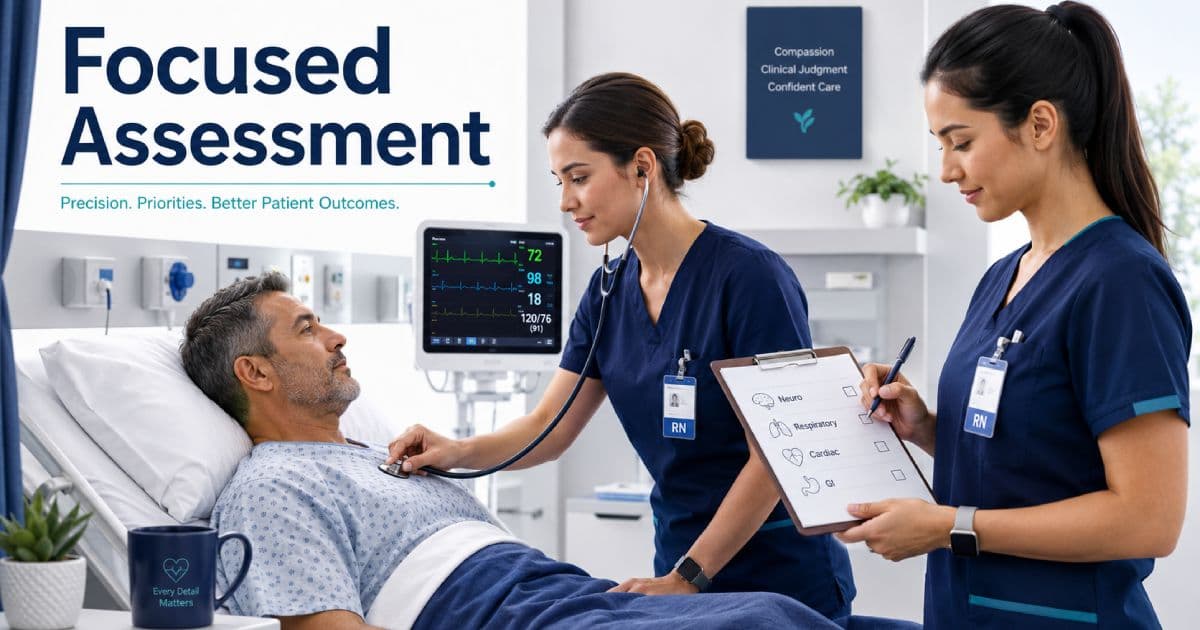
A focused assessment in nursing is a targeted assessment based on a specific complaint, diagnosis, body system, risk, or change in condition.
It is not a shortcut.
It is not a replacement for a full baseline assessment when one is required.
It is a rapid, purposeful way to answer a clinical question:
What is happening with this patient right now?
What data do I need?
What is abnormal?
What should I do next?
If a patient says, “I feel short of breath,” you do not start with a full head-to-toe assessment and save the lungs for later.
You focus on breathing.
If a patient falls, you focus on neuro status, pain, injury, mobility, anticoagulant use, and vital signs.
If a patient reports chest pressure, you focus on airway, breathing, circulation, perfusion, pain, ECG, vital signs, and escalation.
A focused assessment helps nurses recognize cues, act early, and communicate clearly.
What is a focused assessment in nursing?
A focused assessment is a targeted collection of subjective and objective data related to a specific problem.
It may focus on:
- one body system
- one symptom
- one safety concern
- one treatment response
- one abnormal finding
- one diagnosis
- one device, wound, line, drain, or catheter
Examples:
Patient reports chest pain → cardiovascular and respiratory focused assessment.
Patient is newly confused → neurological focused assessment plus glucose, oxygenation, infection, medication review.
Patient has low urine output → GU focused assessment plus fluid status and renal perfusion.
Patient received IV opioid → pain, sedation, and respiratory reassessment.
Patient has abdominal distention after surgery → GI focused assessment.
Focused assessments are common in every setting:
- med-surg
- ICU
- emergency department
- labor and delivery
- pediatrics
- psych
- long-term care
- home health
- outpatient clinics
- school nursing
- community health
Head-to-toe assessment vs focused assessment
A head-to-toe assessment and focused assessment have different goals.
| Assessment type | Purpose | When used | Example |
|---|---|---|---|
| Head-to-toe assessment | Establish broad baseline | Admission, start of shift, routine reassessment | Complete neuro, cardiac, respiratory, GI, GU, skin, mobility, pain, safety review |
| Focused assessment | Investigate a specific problem | Acute change, complaint, diagnosis, intervention reassessment | Respiratory assessment for shortness of breath |
Comprehensive head-to-toe assessment
A comprehensive head-to-toe assessment gives the nurse a broad baseline.
It may include:
- general appearance
- vital signs
- pain
- neurological status
- respiratory status
- cardiovascular status
- GI/GU
- skin
- wounds
- mobility
- lines/tubes/drains
- psychosocial status
- safety risks
For a full baseline assessment guide, see NurseZee’s head-to-toe patient assessment guide.
Focused assessment
A focused assessment narrows the lens.
It is used when:
- a patient reports a new symptom
- the nurse detects an abnormal finding
- a patient’s condition changes
- a treatment needs reassessment
- a diagnosis requires monitoring
- a device or wound needs targeted evaluation
- a provider asks for specific data
- an NCLEX/NGN question asks for the most relevant assessment
Example:
Full assessment finding:
Patient has clear lung sounds, regular apical pulse, soft abdomen, intact skin.

Focused reassessment later:
Patient suddenly reports shortness of breath.
Nurse assesses respiratory rate, work of breathing, lung sounds, SpO2, oxygen device, chest pain, positioning, color, mental status, and vital signs.
When should a nurse perform a focused assessment?
Perform a focused assessment when the patient’s condition gives you a reason to zoom in.
Common triggers
New pain
New confusion
Fall
Shortness of breath
Low oxygen saturation
Chest pain
Palpitations
Blood pressure change
New weakness
Facial droop
Slurred speech
Seizure
Abdominal pain
Vomiting
No bowel movement
Low urine output
Dysuria
Fever
New rash
Wound drainage
Post-op change
Medication side effect
After giving PRN medication
After an intervention
Before calling a provider
Before escalating rapid response
Focused reassessment after interventions
A focused assessment is also how nurses evaluate whether an intervention worked.
Examples:
After pain medication:
Pain score, sedation level, respiratory rate, blood pressure, functional improvement.

After bronchodilator:
Work of breathing, wheezing, respiratory rate, SpO2, patient-reported relief.

After fluid bolus:
Blood pressure, heart rate, lung sounds, urine output, edema, mental status.

After antiemetic:
Nausea score, vomiting, oral intake, hydration, sedation.

After repositioning for dyspnea:
SpO2, respiratory rate, work of breathing, comfort, lung sounds.The focused assessment framework
Use the same structure each time.
Step 1: Start with safety
Before details, ask:
Is the patient breathing?
Is the patient conscious?
Is circulation adequate?
Is this an emergency?
Do I need help now?
If unstable, call for help and follow facility policy.
Step 2: Identify the clinical question
Ask:
What am I trying to rule out?
What changed?
What symptom matters most?
What system is most likely involved?
What system could kill the patient fastest?
Step 3: Collect subjective data
Ask the patient or caregiver.
Examples:
When did it start?
What were you doing?
What does it feel like?
Is it getting better or worse?
What makes it better or worse?
Have you had this before?
Any associated symptoms?
Step 4: Collect objective data
Assess what you can observe, measure, palpate, auscultate, inspect, or verify.
Examples:
Vital signs
Pain score
SpO2
Respiratory effort
Heart rhythm if monitored
Lung sounds
Pulses
Edema
Mental status
Skin color
Urine output
Wound drainage
Labs
Medication timing
Device function
Step 5: Compare to baseline
Ask:
Is this new?
Is this worse?
Is this expected?
Is this different from report?
Is this different from the last assessment?
Step 6: Decide what to do next
Options may include:
- continue monitoring
- reassess sooner
- perform a nursing intervention
- notify provider
- call rapid response
- activate emergency protocol
- request an order
- hold medication per parameters
- document and hand off
Step 7: Document clearly
Document:
What patient reported
What you assessed
Relevant objective findings
Interventions performed
Who you notified
Orders received
Patient response
Follow-up planNeurological focused assessment
A neurological focused assessment evaluates mental status, level of consciousness, speech, pupils, movement, sensation, and signs of neurologic deterioration.
Clinical triggers
Perform a neuro focused assessment for:
- fall
- head injury
- suspected stroke
- sudden confusion
- seizure
- new severe headache
- dizziness
- weakness
- numbness
- facial droop
- slurred speech
- post-op neuro monitoring
- hypoglycemia concerns
- opioid or sedative use
- change in level of consciousness
- high-risk anticoagulant therapy after injury
Step-by-step neurological focused assessment
1. Check level of consciousness
Assess whether the patient is:
Alert
Drowsy
Lethargic
Responds to voice
Responds to pain
Unresponsive
Ask orientation questions:
What is your name?
Where are you right now?
What month/year is it?
Why are you here?
Document clearly:
Alert and oriented x4.
Oriented to self only.
Drowsy, arouses to voice, falls back asleep during conversation.
Unresponsive to verbal stimuli, withdraws from painful stimulus.
2. Assess speech
Listen for:
- slurred speech
- word-finding difficulty
- inability to understand speech
- inappropriate words
- new confusion
- delayed responses
Differentiate:
Dysarthria: slurred or unclear speech.
Aphasia: impaired expression or understanding of language.
3. Assess pupils
Use PERRLA if appropriate:
Pupils Equal, Round, Reactive to Light and Accommodation.Assess:
- size in millimeters
- equality
- reaction to light
- sluggish or nonreactive response
- new asymmetry
Document:
Pupils 3 mm, equal, round, briskly reactive to light bilaterally.4. Check facial symmetry
Ask the patient to:
Smile.
Raise eyebrows.
Stick out tongue.
Look for:
- facial droop
- asymmetry
- tongue deviation
- drooling
5. Assess motor strength
Check both sides.
Upper extremities:
Hand grips equal?
Arm drift?
Can patient lift arms?
Pronator drift?
Lower extremities:
Push/pull feet.
Dorsiflexion.
Plantar flexion.
Leg lift if appropriate.
Document strength per facility system, such as:
5/5 strength bilateral upper extremities.
Right grip weaker than left.
Positive right arm drift.
6. Assess sensation
Ask about:
- numbness
- tingling
- decreased sensation
- new unilateral changes
Test light touch if appropriate and trained.
7. Assess coordination and gait if safe
Only assess gait if safe.
Check:
- balance
- dizziness
- assistive device use
- new weakness
- fall risk
8. Use the Glasgow Coma Scale when indicated
The Glasgow Coma Scale provides a structured way to assess impairment of conscious level by evaluating eye, verbal, and motor responses.
Use it when facility policy or patient condition requires it, such as:
- head injury
- altered consciousness
- trauma
- neuro checks
- ICU monitoring
- post-fall monitoring
Do not replace clinical judgment with a number.
A GCS trend matters.
9. Check glucose if appropriate
Hypoglycemia can look neurological.
If the patient is confused, diaphoretic, weak, altered, or has diabetes risk, check blood glucose per policy.
Emergency neuro cues
Escalate rapidly for:
New facial droop
New unilateral weakness
New slurred speech
Sudden severe headache
Seizure
Acute confusion
Decreased LOC
Unequal pupils
GCS decline
New vision loss
Loss of coordination
Head injury on anticoagulants
Neuro focused assessment documentation example
Patient found increasingly confused at 1430 compared with baseline A&O x4. Currently oriented to self only. Speech clear but delayed. Pupils 3 mm, equal, briskly reactive. No facial droop noted. Hand grips equal bilaterally. Moves all extremities. Blood glucose 62 mg/dL. Hypoglycemia protocol initiated per policy. Provider notified. Patient reassessed after treatment and oriented x3.Respiratory focused assessment
A respiratory focused assessment evaluates breathing, oxygenation, ventilation, lung sounds, work of breathing, and respiratory distress.
Clinical triggers
Perform a respiratory focused assessment for:
- shortness of breath
- low oxygen saturation
- chest tightness
- wheezing
- cough
- increased sputum
- pneumonia
- asthma/COPD exacerbation
- pulmonary edema
- suspected aspiration
- post-op respiratory concern
- opioid or sedative administration
- new cyanosis or pallor
- increased respiratory rate
- respiratory infection symptoms
Step-by-step respiratory focused assessment
1. Look at the patient before touching equipment
Ask:
Can the patient speak full sentences?
Are they using accessory muscles?
Are they tripoding?
Are they restless or confused?
Is breathing noisy?
Is the patient cyanotic or pale?
Immediate visual cues matter.
2. Assess respiratory rate, rhythm, and depth
Observe:
- rate
- rhythm
- depth
- effort
- symmetry
- pauses
- labored breathing
- shallow respirations
Document actual numbers:
RR 28/min, labored, shallow, accessory muscle use noted.3. Assess oxygen saturation and oxygen device
Check:
SpO2
Room air or oxygen?
Device type
Flow rate
Humidification if ordered
Tubing connected?
Cannula positioned correctly?
Mask fit?
Do not document only “on oxygen.”
Document the device and flow:
SpO2 91% on 2 L/min nasal cannula.4. Auscultate lung sounds
Listen anteriorly, posteriorly, and laterally as appropriate.
Compare side to side.
Common abnormal findings:
| Sound | Possible meaning |
|---|---|
| Crackles | Fluid, atelectasis, pneumonia, pulmonary edema |
| Wheezes | Narrowed airways, bronchospasm, asthma/COPD |
| Rhonchi | Coarse secretions or airway congestion |
| Stridor | Upper airway obstruction; emergency finding |
| Diminished sounds | Poor air movement, effusion, pneumothorax, shallow breathing, COPD |
A sound alone does not diagnose.
It tells you what to assess next.
5. Assess cough and sputum
Ask:
Do you have a cough?
Is it new?
Are you coughing anything up?
What color?
How much?
Any blood?
Document:
Productive cough with thick yellow sputum.6. Assess chest pain or tightness
Shortness of breath plus chest pain may be cardiac, pulmonary, or both.
Ask:
Any chest pain, pressure, tightness, or heaviness?
Does it radiate?
When did it start?
What makes it worse?
7. Review related data
Depending on setting, review:
- vital sign trend
- oxygen orders
- respiratory treatments
- chest x-ray result
- ABGs/VBGs
- WBC
- hemoglobin
- BNP
- D-dimer if ordered
- recent opioid/sedative doses
- incentive spirometer use
- mobility
- aspiration risk
Emergency respiratory cues
Escalate for:
SpO2 below ordered goal despite intervention
Severe work of breathing
Stridor
Cyanosis
New confusion with respiratory symptoms
Respiratory rate very high or low
Unable to speak full sentences
Sudden pleuritic chest pain
Absent or severely diminished unilateral breath sounds
Opioid-related sedation with low respirations
Respiratory focused assessment documentation example
Patient reports sudden shortness of breath at 1015. RR 30/min, labored, accessory muscle use noted. SpO2 86% on room air. Crackles auscultated bilateral bases. Patient positioned upright. Oxygen applied per protocol at 2 L/min nasal cannula; SpO2 improved to 92%. Provider notified using SBAR. New orders received for chest x-ray and IV diuretic.Cardiovascular focused assessment
A cardiovascular focused assessment evaluates heart function, perfusion, circulation, rhythm concerns, fluid status, and symptoms such as chest pain or palpitations.
Clinical triggers
Perform a cardiovascular focused assessment for:
- chest pain
- chest pressure
- palpitations
- low blood pressure
- high blood pressure with symptoms
- tachycardia
- bradycardia
- syncope
- dizziness
- new edema
- poor peripheral perfusion
- abnormal heart rhythm
- post-op bleeding concern
- suspected fluid overload
- heart failure exacerbation
- anticoagulant bleeding risk
Step-by-step cardiovascular focused assessment
1. Assess symptoms immediately
Ask:
Do you have chest pain or pressure?
When did it start?
Where is it located?
Does it radiate to arm, jaw, back, or shoulder?
What does it feel like?
What were you doing when it started?
Any shortness of breath?
Any nausea, sweating, dizziness, or palpitations?
Use a pain tool such as PQRST or OPQRST.
2. Obtain vital signs
Check:
- blood pressure
- heart rate
- respiratory rate
- oxygen saturation
- temperature
- pain score
Trend matters.
BP dropped from 132/78 to 88/50.
HR increased from 86 to 124.
3. Assess apical pulse and rhythm
Listen to apical pulse.
Assess:
- rate
- rhythm
- regular or irregular
- missed beats
- very fast or slow rate
Follow facility policy for ECG/telemetry concerns.
4. Auscultate heart sounds
Listen at standard valve areas as trained.
Assess for:
- S1/S2
- murmurs if known/trained
- extra sounds such as S3/S4
- rhythm irregularity
Do not over-document beyond your competence.
It is acceptable to document:
Heart sounds regular, S1/S2 present.5. Assess perfusion
Check:
- skin color
- skin temperature
- diaphoresis
- capillary refill
- level of consciousness
- peripheral pulses
- urine output if relevant
Peripheral vascular assessment includes pulses, capillary refill, edema, skin temperature, and signs of circulatory compromise.
6. Assess pulses bilaterally
Compare:
- radial pulses
- pedal pulses
- posterior tibial pulses if needed
- femoral or central pulses in emergencies per role/policy
Grade per facility policy, such as:
0 absent
1+ weak
2+ normal
3+ increased
4+ bounding
7. Assess edema and fluid status
Check:
- ankles
- feet
- legs
- sacrum if bedbound
- hands
- sudden weight gain
- lung sounds
- jugular venous distention if trained
- intake/output
JVD is typically assessed with the head of bed elevated about 30 to 45 degrees.
8. Review related data
Depending on the situation, review:
- ECG/telemetry
- potassium
- magnesium
- troponin if ordered
- hemoglobin/hematocrit
- renal function
- BNP
- anticoagulants
- cardiac medications
- IV fluids
- diuretics
- recent procedure
Emergency cardiovascular cues
Escalate for:
Chest pain or pressure
New shortness of breath with diaphoresis
Hypotension with symptoms
New severe hypertension with neuro symptoms
New irregular rhythm with instability
Syncope
New unilateral limb coolness/pallor/pulselessness
Sudden severe edema with respiratory distress
Signs of shock
Cardiovascular focused assessment documentation example
Patient reports new chest pressure 7/10 at 0910, radiating to left jaw, with nausea and diaphoresis. BP 158/92, HR 118 irregular, RR 24, SpO2 94% on room air. Skin cool and diaphoretic. Apical rhythm irregular. Charge nurse and provider notified immediately. ECG obtained per protocol. Patient placed on continuous monitoring. Awaiting further orders.Gastrointestinal focused assessment
A GI focused assessment evaluates abdominal symptoms, bowel function, nausea, vomiting, distention, nutrition, and possible GI complications.
Clinical triggers
Perform a GI focused assessment for:
- abdominal pain
- nausea or vomiting
- diarrhea
- constipation
- abdominal distention
- suspected bowel obstruction
- GI bleeding
- post-op return of bowel function
- new ileus concern
- feeding tube concerns
- poor appetite
- new abdominal rigidity or guarding
- abnormal ostomy output
The correct GI assessment order
Abdominal assessment is different from many other body systems.
Use this order:
1. Inspection
2. Auscultation
3. Percussion if trained/required
4. Palpation
In many nursing-focused checklists, the key point is:
Inspect first.
Auscultate before palpation.
Palpate last.
Why?
Palpation can stimulate bowel activity and alter the bowel sounds you are trying to assess.
Step-by-step GI focused assessment
1. Ask focused history questions
Ask:
Where is the pain?
When did it start?
What does it feel like?
Any nausea?
Any vomiting?
What did the vomit look like?
Any blood?
When was your last bowel movement?
Are you passing gas?
Any diarrhea?
Any constipation?
Any abdominal surgery?
Any new medications?
2. Inspect the abdomen
Look for:
- contour: flat, rounded, distended
- symmetry
- visible pulsations
- scars
- incisions
- drains
- tubes
- ostomy
- bruising
- discoloration
- hernias
- visible peristalsis
3. Auscultate bowel sounds
Listen in all four quadrants.
Classify according to facility policy:
Active
Normoactive
Hypoactive
Hyperactive
Absent
Many nursing references teach that before documenting absent bowel sounds, the nurse should listen for a longer period, often up to five minutes depending on facility or instructor policy.
Do not chart absent too quickly.
4. Palpate gently
Palpate last.
Assess:
- tenderness
- guarding
- rigidity
- masses if trained
- rebound tenderness only if within role/policy
Palpate painful areas last.
If the patient has severe pain, rigidity, or guarding, stop and escalate.
5. Assess output
Review:
- stool frequency
- stool color
- stool consistency
- emesis amount and appearance
- ostomy output
- NG tube output
- drain output
- intake and output
6. Review related data
Depending on situation, review:
- WBC
- hemoglobin/hematocrit
- electrolytes
- lactate if ordered
- liver enzymes
- lipase/amylase
- imaging
- bowel regimen
- opioids
- antibiotics
- diet order
- post-op day
Emergency GI cues
Escalate for:
Rigid abdomen
Severe sudden abdominal pain
Rebound tenderness if assessed by provider
Coffee-ground emesis
Bright red blood in stool or emesis
Black tarry stool
Persistent vomiting
Absent bowel sounds with distention and pain
No flatus after surgery with worsening distention
Signs of dehydration or shock
GI focused assessment documentation example
Patient reports new abdominal pain 8/10, cramping, with nausea. Abdomen distended and firm. Bowel sounds hypoactive in all quadrants after auscultation. Tenderness noted in right lower quadrant; palpated painful area last. No bowel movement for 3 days; patient denies flatus today. Provider notified. Patient made NPO per order pending evaluation.Genitourinary focused assessment
A GU focused assessment evaluates urinary symptoms, output, retention, catheter function, hydration, and possible urinary tract complications.
Clinical triggers
Perform a GU focused assessment for:
- low urine output
- no urine output
- dysuria
- urinary frequency
- urinary urgency
- hematuria
- suprapubic pain
- flank pain
- suspected urinary retention
- indwelling Foley catheter
- post-op urinary retention risk
- new incontinence
- kidney injury concern
- UTI symptoms
Step-by-step GU focused assessment
1. Ask urinary history questions
Ask:
When did you last urinate?
Was it painful?
Any burning?
Any urgency or frequency?
Any blood?
Any lower abdominal pain?
Any flank pain?
Any change in urine color or smell?
Is this normal for you?
2. Assess urine output
Check:
- amount
- timing
- trend
- color
- clarity
- odor
- sediment
- blood
Low urine output may be a urinary problem, renal problem, perfusion problem, dehydration problem, obstruction problem, or catheter problem.
3. Palpate suprapubic area if appropriate
Assess for bladder fullness or tenderness.
Use a bladder scanner if available and appropriate.
4. Assess catheter system if present
For an indwelling urinary catheter, check:
- tubing free of kinks
- bag below bladder
- bag off the floor
- securement device in place
- unobstructed flow
- urine appearance
- insertion site/perineal care per policy
- amount in bag
- closed system intact
CDC catheter-associated UTI prevention guidance includes maintaining unobstructed urine flow, keeping the catheter and tubing from kinking, and keeping the collecting bag below bladder level without resting it on the floor.
5. Review related data
Depending on situation, review:
- intake and output
- creatinine
- BUN
- electrolytes
- urinalysis
- urine culture if ordered
- IV fluids
- diuretics
- nephrotoxic medications
- recent surgery
- bladder scan result
- catheter insertion date
Emergency GU cues
Escalate for:
No urine output with symptoms
Sudden hematuria with clots
Severe flank pain with fever
Suprapubic distention with inability to void
Catheter not draining with bladder distention
Low urine output with hypotension or sepsis signs
Acute kidney injury labs
GU focused assessment documentation example
Patient reports suprapubic discomfort and inability to void since 0600. Abdomen soft except suprapubic fullness. Bladder scan 640 mL. Provider notified. Straight catheterization performed per order using sterile technique; 700 mL clear yellow urine returned. Patient reports relief. I&O updated.Integumentary focused assessment
An integumentary focused assessment evaluates skin, wounds, pressure injuries, rashes, incisions, drainage, infection signs, and tissue perfusion.
Clinical triggers
Perform a skin or wound focused assessment for:
- pressure injury risk
- new redness
- rash
- itching
- fever with skin changes
- surgical wound
- wound drainage
- wound odor
- diabetic foot concern
- burn
- cellulitis concern
- IV infiltration/extravasation concern
- immobility
- incontinence
- device-related skin breakdown
Step-by-step integumentary focused assessment
1. Inspect skin color and integrity
Look for:
- redness
- pallor
- cyanosis
- jaundice
- bruising
- rash
- open areas
- blisters
- tears
- pressure injury
- moisture-associated skin damage
- device pressure
- surgical incision
2. Assess bony prominences
Check high-risk areas:
Sacrum
Coccyx
Heels
Elbows
Shoulders
Hips
Ankles
Back of head
Ears from oxygen tubing or masks
Under medical devices
3. Assess wound or incision
Describe:
- location
- size if policy requires
- wound bed
- edges
- surrounding skin
- drainage type
- drainage amount
- odor
- redness
- swelling
- warmth
- pain
- approximation
- dressing condition
4. Use REEDA when appropriate
REEDA is often used for postpartum perineal trauma or incision/wound healing assessment and stands for:
Redness
Edema
Ecchymosis
Discharge or drainage
Approximation of wound edges
It is especially common in OB/perineal assessment, but the logic can help nurses remember key wound-healing features.
5. Assess temperature, moisture, and turgor
Check:
- warmth
- coolness
- diaphoresis
- dry skin
- skin turgor
- edema
- hydration signs
Skin turgor is less reliable in older adults and should be interpreted with other data.
6. Assess pressure injury risk
Use facility-approved tools such as the Braden Scale if required.
Review:
- mobility
- nutrition
- moisture
- friction/shear
- sensory perception
- activity
Emergency skin/wound cues
Escalate for:
Rapidly spreading redness
Fever with wound changes
Purulent drainage
Wound dehiscence
Evisceration
Black tissue/eschar with infection concern
Severe pain out of proportion
Signs of compartment syndrome
IV infiltration with high-risk medication
Integumentary focused assessment documentation example
Surgical incision to lower abdomen approximated with staples. Surrounding skin mildly pink, no warmth, no odor. Scant serosanguineous drainage on dressing. Patient reports pain 3/10 at incision. Dressing changed per order using sterile technique. No dehiscence noted.Musculoskeletal and mobility focused assessment
A musculoskeletal focused assessment evaluates movement, strength, pain, injury, mobility, circulation, and safety.
Clinical triggers
Perform a musculoskeletal focused assessment for:
- fall
- joint pain
- fracture concern
- post-op orthopedic patient
- new weakness
- swelling
- limited range of motion
- difficulty ambulating
- limb injury
- cast or splint
- compartment syndrome concern
- mobility decline
Step-by-step musculoskeletal focused assessment
1. Ask about pain and mechanism
Ask:
Where does it hurt?
When did it start?
Did you fall or twist it?
Can you move it?
Can you bear weight?
Any numbness or tingling?
Is pain worsening?
2. Inspect the area
Look for:
- swelling
- bruising
- deformity
- redness
- open wound
- limb shortening
- abnormal rotation
- cast tightness
- splint pressure
3. Compare both sides
Compare:
- size
- color
- temperature
- range of motion
- strength
- pulses
- sensation
4. Assess circulation, sensation, movement
Use CSM:
Circulation
Sensation
Movement
Or neurovascular checks per facility policy.
5. Assess mobility and fall risk
Check:
- gait
- assistive device
- need for one-person or two-person assist
- dizziness
- orthostatic symptoms
- weight-bearing restrictions
- bed alarm need
Emergency musculoskeletal cues
Escalate for:
Absent pulse
Cool pale limb
Severe pain out of proportion
Numbness or tingling worsening
Unable to move extremity
Tight cast with swelling
New deformity after fall
Suspected fracture
Musculoskeletal documentation example
Patient reports right ankle pain after twisting while ambulating. Right ankle swollen laterally with bruising. Pedal pulse 2+, capillary refill <2 seconds, toes warm, sensation intact, able to wiggle toes. Pain 6/10 with movement. Ice applied and extremity elevated. Provider notified.Pain focused assessment
Pain assessment is often its own focused assessment.
Clinical triggers
Perform a pain focused assessment for:
- new pain
- worsening pain
- post-op pain
- chest pain
- abdominal pain
- trauma
- wound pain
- headache
- pain medication reassessment
- nonverbal pain signs
Pain assessment tools
Use facility-approved tools, such as:
- numeric rating scale
- Wong-Baker FACES
- FLACC for young children or nonverbal patients when appropriate
- CPOT in critical care when appropriate
- PAINAD in dementia when appropriate
PQRST pain assessment
P - Provocation/Palliation: What makes it better or worse?
Q - Quality: What does it feel like?
R - Region/Radiation: Where is it? Does it travel?
S - Severity: How bad is it?
T - Timing: When did it start? Constant or intermittent?
Pain reassessment after medication
Reassess according to facility policy and medication route.
Assess:
- pain score
- sedation
- respiratory rate
- blood pressure
- functional improvement
- side effects
- patient satisfaction with relief
For opioids, respiratory and sedation assessment are essential.
Evidence-based guidance for opioid monitoring emphasizes sedation level, respiratory rate and quality, and oxygen saturation before opioid initiation, before dosing, and at peak effect.
Pain documentation example
Patient reports incisional pain 8/10, sharp, worse with coughing, localized to RLQ incision. Abdomen soft, dressing dry/intact. Oxycodone administered per MAR. Reassessment 60 minutes later: pain 3/10, RR 16/min, awake and conversing, denies nausea, able to cough/deep breathe with splinting.Post-intervention focused assessments
Focused assessments are required after many interventions.
After antihypertensive medication
Assess:
Blood pressure
Heart rate
Dizziness
Orthostatic symptoms
Fall risk
Medication side effects
After insulin
Assess:
Blood glucose trend
Symptoms of hypoglycemia
Food intake
Timing of meals
Mental status
Diaphoresis/shakiness
After blood transfusion starts
Assess per policy:
Vital signs
Temperature
Breathing
Back pain
Rash/itching
Chills
Hypotension
Chest pain
Urine color if reaction suspected
After IV fluid bolus
Assess:
Blood pressure
Heart rate
Lung sounds
Edema
Urine output
Work of breathing
Mental status
After bronchodilator
Assess:
Wheezing
Work of breathing
Respiratory rate
SpO2
Heart rate
Tremor/anxiety
Patient-reported relief
After antiemetic
Assess:
Nausea
Vomiting
Sedation
Hydration
Ability to tolerate oral intake
Focused assessment and NGN clinical judgment
Focused assessment is central to Next Gen NCLEX clinical judgment.
The NCSBN Clinical Judgment Measurement Model includes cognitive skills such as recognizing cues, analyzing cues, prioritizing hypotheses, generating solutions, taking action, and evaluating outcomes.
Focused assessments help with every step.
Recognize cues
You collect data.
Example:
RR 30, SpO2 86%, crackles, new confusion.Analyze cues
You decide what the data suggest.
Possible impaired gas exchange, fluid overload, pneumonia, or respiratory failure.Prioritize hypotheses
You decide what matters most.
Oxygenation problem is priority.Generate solutions
You plan safe actions.
Raise HOB, apply oxygen per protocol/order, stay with patient, notify provider/rapid response as appropriate.Take action
You intervene.
Position upright, oxygen applied, provider notified, orders implemented.Evaluate outcomes
You reassess.
SpO2 improved to 93%, RR decreased to 22, patient reports easier breathing.Focused assessment and delegation
Nursing delegation rules matter.
NCSBN delegation guidance states that licensed nurses cannot delegate activities requiring clinical reasoning, nursing judgment, or critical decision-making.
What the RN must keep
The RN is responsible for:
- initial assessment
- focused assessment requiring judgment
- interpretation of findings
- clinical decision-making
- prioritization
- evaluation of outcomes
- unstable patient reassessment
- deciding whether delegated data require action
What may be delegated depending on state and facility policy
A UAP/CNA may be able to collect certain data on stable patients, such as:
- routine vital signs
- intake and output
- blood glucose in some settings if trained/allowed
- weight
- reporting patient statements
- observing and reporting changes
An LPN/VN may perform more data collection and focused observations depending on scope, patient stability, and facility policy.
But the RN cannot delegate nursing judgment.
Delegation example
Appropriate:
Please obtain a full set of vital signs for Room 214 and tell me immediately if the oxygen saturation is below 92%, systolic BP is below 100, HR is above 120, or the patient reports chest pain.Not appropriate:
Go assess whether this shortness of breath is serious.Focused assessment SBAR examples
A focused assessment often prepares you to call the provider or rapid response team.
AHRQ describes SBAR as Situation, Background, Assessment, and Recommendation or Request.
Respiratory SBAR
S: This is Michelle, RN on 4-East. I am calling about Mr. Lee in 418 for acute shortness of breath.

B: He was admitted with pneumonia and was on room air this morning.

A: He is now RR 30, SpO2 86% on room air, accessory muscle use noted, crackles bilateral bases, temp 101.4°F.

R: I need you to evaluate him now. I have elevated the head of bed and applied oxygen per protocol. Would you like a stat chest x-ray, ABG/VBG, labs, and respiratory treatment orders?
Neuro SBAR
S: This is Michelle, RN on 3-West. I am calling about Ms. Patel in 312 for acute change in mental status.

B: She is usually alert and oriented x4 and was admitted for UTI yesterday.

A: She is now oriented to self only, drowsy, and difficult to keep awake. Blood glucose is 118. Pupils equal and reactive. No facial droop noted. Vitals: BP 92/54, HR 118, temp 101.8°F.

R: I need provider evaluation now for acute change in condition and possible sepsis concern.
GI SBAR
S: This is Michelle, RN on surgical unit. I am calling about Mr. Garcia in 522 for worsening abdominal distention and pain.

B: He is post-op day 2 after bowel resection.

A: Abdomen is firm and distended. Bowel sounds hypoactive in all quadrants. Pain is 8/10. No flatus today. He has vomited twice.

R: I recommend provider evaluation now. Would you like him NPO, abdominal imaging, IV fluids, and antiemetic orders?
Focused assessment quick reference table
| Situation | Priority focused assessment |
|---|---|
| New confusion | Neuro, glucose, oxygenation, infection signs, medication review |
| Shortness of breath | Respiratory, cardiovascular, SpO2, lung sounds, work of breathing |
| Chest pain | Cardiovascular, respiratory, vital signs, ECG per protocol |
| Fall | Neuro, pain, injury, mobility, anticoagulants, vital signs |
| Low urine output | GU, fluid status, catheter patency, perfusion, renal labs |
| Abdominal pain | GI assessment in correct order, pain, vomiting, bowel function |
| New edema | Cardiovascular/peripheral vascular, lung sounds, fluid balance |
| After opioid | Pain, sedation, LOC, RR, respiratory quality, SpO2 |
| Surgical wound drainage | Integumentary/wound, pain, fever, approximation, drainage |
| Dizziness on standing | Cardiovascular, orthostatic vitals if ordered, fall risk |
Common focused assessment mistakes
Mistake 1: Skipping baseline comparison
A finding may be chronic or new.
New changes matter most.
Mistake 2: Documenting vague words
Avoid:
Patient looks bad.
Breathing weird.
Abdomen abnormal.
Use:
RR 32/min, labored, accessory muscle use, SpO2 88% on 2 L nasal cannula.Mistake 3: Assessing too narrowly
Shortness of breath is not only lungs.
Confusion is not only neuro.
Low urine output is not only bladder.
Mistake 4: Forgetting reassessment
After intervention, reassess and document response.
Mistake 5: Delegating judgment
A UAP can collect certain data, but the nurse interprets it and decides what to do.
Mistake 6: Listening to bowel sounds after palpation
For abdominal assessment, auscultate before palpation.
Mistake 7: Not escalating early enough
If your focused assessment shows deterioration, notify the appropriate person promptly.
Focused assessment documentation templates
Basic template
Time:
Reason for focused assessment:
Subjective data:
Objective findings:
Comparison to baseline:
Interventions:
Provider/charge/RRT notified:
Orders received:
Patient response:
Follow-up plan:
Neuro template
Focused neuro assessment performed due to:
LOC:
Orientation:
Speech:
Pupils:
Facial symmetry:
Motor strength:
Sensation:
GCS if used:
Glucose if checked:
Safety measures:
Notifications/interventions:
Reassessment:
Respiratory template
Focused respiratory assessment performed due to:
RR/rhythm/depth:
Work of breathing:
SpO2:
Oxygen device/flow:
Lung sounds:
Cough/sputum:
Chest pain/tightness:
Interventions:
Notifications:
Response:
Cardiovascular template
Focused cardiovascular assessment performed due to:
Chest pain/palpitations:
BP/HR/RR/SpO2:
Apical rhythm:
Skin color/temp/moisture:
Pulses:
Cap refill:
Edema:
ECG/telemetry if applicable:
Interventions:
Notifications:
Response:
GI template
Focused GI assessment performed due to:
Pain/nausea/vomiting:
Inspection:
Auscultation:
Palpation:
Last BM:
Flatus:
Output/emesis:
Diet tolerance:
Interventions:
Notifications:
Response:
GU template
Focused GU assessment performed due to:
Last void:
Symptoms:
Urine amount/color/clarity:
Bladder scan if used:
Suprapubic/flank findings:
Catheter patency if present:
I&O trend:
Interventions:
Notifications:
Response:
Frequently asked questions about focused assessments in nursing
What is a focused assessment in nursing?
A focused assessment is a targeted nursing assessment based on a specific symptom, diagnosis, body system, risk, or change in condition. It collects the data needed to make a safe clinical decision.
What is the difference between a head-to-toe assessment and a focused assessment?
A head-to-toe assessment is comprehensive and establishes a broad baseline. A focused assessment targets a specific complaint or problem, such as shortness of breath, chest pain, abdominal pain, wound drainage, or new confusion.
When should a nurse perform a focused assessment?
Perform a focused assessment when a patient has a new symptom, abnormal finding, change in condition, high-risk diagnosis, device concern, or after an intervention that needs evaluation.
What is an example of a focused assessment?
If a patient reports shortness of breath, the nurse assesses respiratory rate, work of breathing, SpO2, lung sounds, oxygen device, cough, chest pain, color, mental status, and vital signs.
What is included in a neurological focused assessment?
A neurological focused assessment may include level of consciousness, orientation, speech, pupils, facial symmetry, motor strength, sensation, coordination, gait if safe, GCS when indicated, and glucose if appropriate.
What is included in a respiratory focused assessment?
A respiratory focused assessment includes respiratory rate, rhythm, depth, work of breathing, SpO2, oxygen device and flow, lung sounds, cough, sputum, color, chest pain, and response to interventions.
What is included in a cardiovascular focused assessment?
A cardiovascular focused assessment includes chest pain symptoms, vital signs, apical pulse, rhythm, perfusion, skin temperature and moisture, capillary refill, peripheral pulses, edema, JVD if trained, and ECG/telemetry review if applicable.
In what order should I perform a GI focused assessment?
For an abdominal assessment, inspect first, auscultate before palpation, then palpate. Palpating before auscultation can alter bowel sounds.
How long should I listen before documenting absent bowel sounds?
Follow facility or instructor policy. Many nursing references teach that the nurse should listen for an extended period, often up to five minutes, before documenting absent bowel sounds.
What is included in a GU focused assessment?
A GU focused assessment includes urinary symptoms, last void, urine amount, color, clarity, odor, bladder distention, bladder scan if available, catheter patency if present, I&O, and related labs or orders.
What is included in a wound focused assessment?
A wound focused assessment includes location, size if required, wound bed, edges, surrounding skin, drainage type and amount, odor, pain, redness, warmth, swelling, approximation, and dressing condition.
What does REEDA stand for?
REEDA stands for Redness, Edema, Ecchymosis, Discharge or drainage, and Approximation of wound edges. It is commonly used in postpartum perineal or incision healing assessment.
Can a focused assessment be delegated to a CNA or UAP?
No. The nurse cannot delegate nursing judgment, assessment interpretation, or evaluation. A CNA/UAP may collect certain routine data on stable patients depending on policy, but the nurse interprets the data and decides what action is needed.
Can an LPN perform a focused assessment?
It depends on state scope, facility policy, patient stability, and the type of assessment. LPNs may collect data and monitor stable patients in many settings, but the RN remains responsible for assessment interpretation and clinical judgment where required.
What is the priority focused assessment after IV opioid administration?
The priority is pain plus neurological and respiratory reassessment: level of consciousness, sedation, respiratory rate, respiratory quality, SpO2, blood pressure, and patient response.
What focused assessment should be done after a fall?
Assess neurological status, pain, injury, mobility, vital signs, anticoagulant use, head strike, skin tears, limb deformity, and safety needs. Follow facility fall protocol.
What focused assessment should be done for chest pain?
Assess airway, breathing, circulation, pain characteristics, vital signs, SpO2, apical pulse/rhythm, skin color and diaphoresis, lung sounds, ECG per protocol, and associated symptoms such as nausea or radiation.
What focused assessment should be done for new confusion?
Assess level of consciousness, orientation, speech, pupils, motor strength, glucose, oxygenation, vital signs, infection signs, medication effects, pain, urinary retention, and safety risk.
How does focused assessment relate to NGN clinical judgment?
Focused assessment helps nurses recognize cues, analyze findings, prioritize hypotheses, take action, and evaluate outcomes. These steps align with Next Gen NCLEX clinical judgment.
What should I document after a focused assessment?
Document the reason for assessment, subjective report, objective findings, comparison to baseline, interventions, notifications, orders received, patient response, and follow-up plan.
Final thoughts
Focused assessment is one of the most important clinical skills a nurse develops.
It turns vague concern into usable data.
It helps you catch deterioration early.
It prepares you to call the provider clearly.
It helps you answer NGN and NCLEX questions safely.
Most importantly, it keeps the patient in front of you safer.
When you are unsure, slow down and ask:
What changed?
What system is most urgent?
What cues do I need?
What is unsafe right now?
Who needs to know?
How will I reassess?
That is focused assessment.
Sources and references
- OpenStax: Types of Nursing Assessment
- NCBI Bookshelf / Open RN: Respiratory Assessment
- Lippincott NursingCenter: Gastrointestinal Assessment Pocket Card
- Glasgow Coma Scale Official Site
- NCSBN: Clinical Judgment Measurement Model
- NCSBN: Delegation
- NCSBN: National Guidelines for Nursing Delegation PDF
- AHRQ TeamSTEPPS: SBAR Tool
- CDC: CAUTI Summary of Recommendations
- CDC STRIVE: CAUTI Catheter Care and Maintenance PDF
- American Society for Pain Management Nursing Guidelines on Monitoring for Opioid-Induced Sedation and Respiratory Depression
- Peripheral Vascular Focused Assessment – Nursing Physical Assessment
- Focused Cardiovascular Assessment – Health Assessment Guide for Nurses
- REEDA Scale Research: Episiotomy Healing Assessment
- NurseZee: Head-to-Toe Patient Assessment
- NurseZee: Nursing Diagnosis Guide
- NurseZee: Nursing Progress Notes
- NurseZee: SOAP Notes for Nurses
- NurseZee: DAR Charting for Nurses
- NurseZee: Nursing Report Sheet Template
- NurseZee: NCLEX Prioritization Questions
- NurseZee Practice Questions