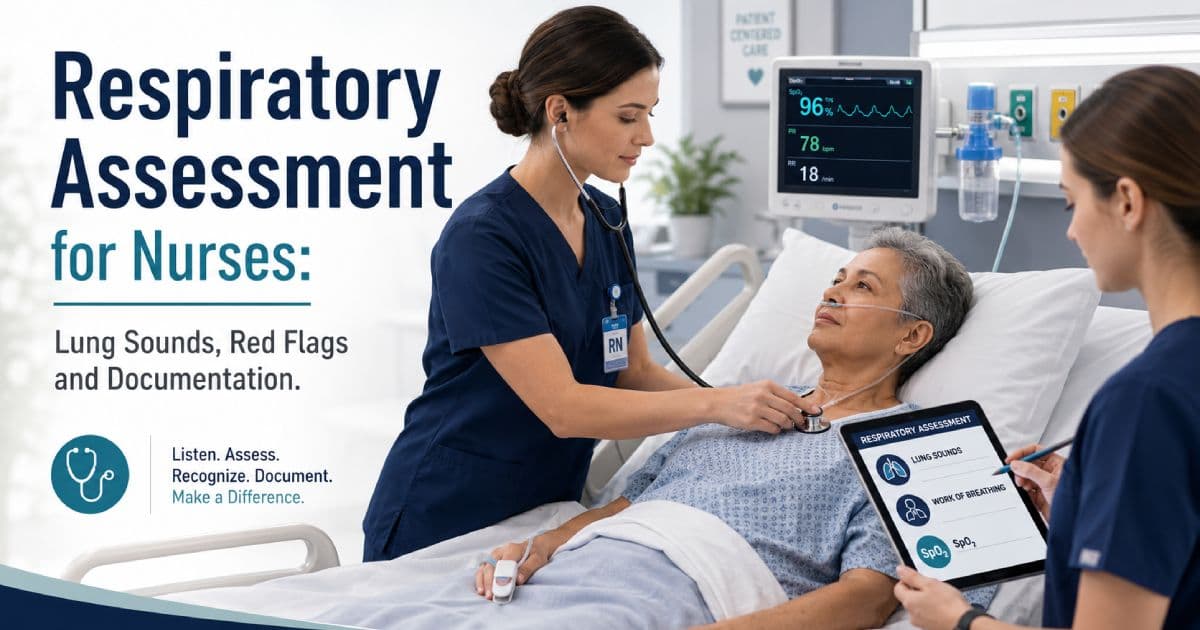
A respiratory assessment is one of the most important bedside skills a nurse learns.
It is not just listening to lungs.
It is not just checking oxygen saturation.
It is the process of deciding whether a patient is moving air, oxygenating, ventilating, tiring out, or heading toward respiratory failure.
A patient can look stable for a few minutes and then deteriorate quickly.
That is why nurses need a systematic respiratory assessment.
What is a respiratory assessment?
A respiratory assessment is the nurse's structured evaluation of how well a patient is breathing, oxygenating, and ventilating.
It may be part of a full head-to-toe assessment or a focused assessment after a respiratory complaint.
A full respiratory assessment may include:
- airway patency
- respiratory rate
- rhythm and depth
- work of breathing
- chest expansion
- breath sounds
- oxygen saturation
- oxygen device and flow rate
- cough
- sputum
- skin color
- mental status
- pain with breathing
- history of lung disease
- smoking or vaping history
- medication use
- response to interventions
For a broader system-by-system assessment guide, see NurseZee's focused assessment in nursing and head-to-toe patient assessment resources.
When to perform a focused respiratory assessment
Perform a focused respiratory assessment when a patient has:
- shortness of breath
- new cough
- productive sputum
- wheezing
- crackles
- chest tightness
- low oxygen saturation
- increased oxygen requirement
- tachypnea
- bradypnea
- cyanosis
- altered mental status
- fever with respiratory symptoms
- aspiration risk
- recent opioid or sedative administration
- post-operative respiratory risk
- COPD or asthma exacerbation
- pneumonia concern
- heart failure concern
- suspected pulmonary embolism
- suspected pneumothorax
- trauma involving chest or ribs
- COVID, influenza, TB, or other respiratory infection concern
Respiratory assessment versus pulse oximetry
Pulse oximetry is helpful.
It is not enough.
SpO2 can be affected by:
- poor perfusion
- cold extremities
- nail polish or artificial nails
- movement
- skin pigmentation and device limitations
- carbon monoxide exposure
- poor waveform
- probe placement
- supplemental oxygen masking deterioration
A patient may have an acceptable SpO2 and still be in trouble because they are tiring out, retaining CO2, using accessory muscles, or becoming confused.
Respiratory assessment sequence
Use a consistent order.
1. Safety and infection control
2. General appearance
3. Airway and ability to speak
4. Respiratory rate, rhythm, and depth
5. Work of breathing
6. Oxygen saturation and oxygen device
7. Color and perfusion clues
8. Chest inspection
9. Palpation
10. Auscultation
11. Cough and sputum
12. Focused history
13. Intervention and reassessment
14. Documentation and escalation
Step 1: Start with safety and infection control
Before entering the room, check:
Isolation status:
Airborne, droplet, contact, or standard precautions:
Required PPE:
Oxygen in use:
Suction available:
Respiratory equipment present:
Fall risk:
Code status if clinically relevant:
If respiratory infection is suspected, follow facility policy for respiratory hygiene, source control, PPE, and transmission-based precautions.
N95, airborne precautions, and negative pressure rooms
The keyword "N95 respirator negative pressure" can cause confusion.
There are two related but different ideas.
N95 respirator
An N95 is a tight-fitting filtering facepiece respirator designed to form a seal around the nose and mouth and filter airborne particles.
A tight-fitting N95 requires:
- proper fit testing according to employer respiratory protection program
- correct donning
- user seal check each time it is worn
- no facial hair that interferes with the seal
- removal according to infection control policy
CDC/NIOSH states that fit testing confirms a respirator fits correctly and that tight-fitting respirators, including N95s, require a user seal check each time they are put on.
OSHA requires a user seal check each time a tight-fitting respirator is put on, using positive and negative pressure checks or the manufacturer's recommended method.
Negative pressure room
A negative pressure room is an airborne infection isolation room designed so air flows into the room rather than out into hallways.
It may be used for suspected or confirmed airborne infections such as tuberculosis, depending on facility policy.
Bedside nursing reminder
Do not enter an airborne isolation room relying on a surgical mask when an N95 or higher-level respirator is required.
Do not assume a regular private room is negative pressure.
Do not skip the seal check.
Step 2: General appearance
Before touching the patient, look.
Ask:
Does the patient look comfortable or distressed?
Can the patient speak full sentences?
Are they sitting upright or tripod positioning?
Are they restless, anxious, confused, or drowsy?
Are they pale, gray, cyanotic, flushed, or diaphoretic?
Are they coughing?
Are they using accessory muscles?
Do they appear exhausted?
A patient in respiratory distress may not be able to give a long history.
Assessment and intervention may need to happen at the same time.
Step 3: Airway and ability to speak
Ask a short question:
How is your breathing right now?Then observe the answer.
A patient who can speak full sentences is usually moving more air than a patient who can only say one or two words.
Document ability to speak clearly:
Speaks in full sentences.
Speaks in short phrases.
Unable to speak due to dyspnea.
Voice hoarse.
Audible stridor noted.
Airway danger signs
Act quickly if you notice:
- stridor
- choking
- drooling with airway concern
- swelling of tongue, lips, or throat
- inability to speak
- severe agitation or somnolence
- foreign body concern
- gurgling with secretions
- absent or minimal air movement
Step 4: Respiratory rate, rhythm, and depth
Count the respiratory rate yourself.
Do not rely only on a monitor.
Assess:
Rate:
Rhythm:
Depth:
Pattern:
Effort:
Common respiratory rate terms
| Term | Meaning |
|---|---|
| Eupnea | Normal breathing |
| Tachypnea | Faster-than-expected respiratory rate |
| Bradypnea | Slower-than-expected respiratory rate |
| Apnea | No breathing |
| Dyspnea | Subjective difficulty breathing |
| Orthopnea | Difficulty breathing when lying flat |
| Hypopnea | Shallow or reduced breathing |
Respiratory patterns to recognize
| Pattern | What it may suggest |
|---|---|
| Shallow respirations | Pain, sedation, fatigue, splinting, neuromuscular weakness |
| Deep rapid respirations | Metabolic acidosis, anxiety, fever, respiratory compensation |
| Irregular respirations | Neurologic concern, medication effect, deterioration |
| Periods of apnea | Sleep apnea, neurologic changes, opioid/sedative effect, impending arrest |
| Grunting | Increased airway pressure attempt, distress, often seen in pediatrics but can occur in adults |
Step 5: Work of breathing
Work of breathing may be more important than the number.
Assess for:
- accessory muscle use
- nasal flaring
- intercostal retractions
- suprasternal retractions
- subcostal retractions
- tripod position
- pursed-lip breathing
- grunting
- diaphoresis
- inability to lie flat
- fatigue
- paradoxical chest movement
MSD/Merck describes signs of respiratory difficulty such as tachypnea, accessory muscle use, intercostal retractions, and paradoxical breathing.
Work of breathing language for charting
Use objective terms:
Respirations even and unlabored.
Mild dyspnea with exertion.
Tachypneic with accessory muscle use.
Intercostal retractions noted.
Tripod positioning observed.
Unable to speak full sentences due to dyspnea.
Step 6: Oxygen saturation and oxygen device
Assess SpO2 with context.
Document:
SpO2 value:
Room air or oxygen:
Device:
Flow rate or FiO2:
Baseline if known:
Trend:
Response to intervention:
Examples:
SpO2 96% on room air.
SpO2 91% on 2 L/min nasal cannula.
SpO2 decreased from 95% to 88% during ambulation on room air.
SpO2 improved from 86% to 93% after oxygen increased per protocol.
Oxygen device examples
| Device | Charting language |
|---|---|
| Room air | SpO2 97% on room air |
| Nasal cannula | 2 L/min via nasal cannula |
| Simple mask | 6 L/min via simple face mask |
| Venturi mask | FiO2 35% via Venturi mask |
| Nonrebreather | 15 L/min via nonrebreather mask |
| High-flow nasal cannula | Flow and FiO2 per device settings |
| Trach collar | Oxygen via tracheostomy collar per ordered settings |
Follow facility policy and provider orders for oxygen titration.
Step 7: Color and perfusion clues
Assess:
- lips
- tongue
- oral mucosa
- nail beds
- skin temperature
- diaphoresis
- pallor
- mottling
Cyanosis can be easier to identify in mucous membranes and nail beds, but visual assessment can be limited by lighting and skin tone.
Do not wait for cyanosis before acting.
Cyanosis is often a late sign.
Step 8: Chest inspection
Inspect the chest for:
- symmetry
- deformity
- scars
- chest tube sites
- surgical incisions
- trauma
- flail segment concern
- uneven expansion
- barrel chest
- kyphosis
- accessory muscle development
- visible respiratory effort
Barrel chest
A barrel-shaped chest may be seen in chronic hyperinflation, such as advanced COPD.
Do not diagnose from shape alone.
Use it as one cue among many.
Step 9: Palpation
Palpation is not always extensive in every quick assessment, but it can add important information.
Assess:
- tenderness
- chest expansion
- crepitus or subcutaneous emphysema if clinically suspected
- tactile fremitus if trained and appropriate
- tracheal position if clinically indicated
Chest expansion
Place hands symmetrically on the posterior lower ribs with thumbs near the spine.
Ask the patient to take a deep breath.
Compare expansion.
Unequal expansion may suggest pneumothorax, atelectasis, pleural effusion, pneumonia, pain, or other causes.
Crepitus
Crepitus under the skin can feel like Rice Krispies or bubble wrap.
It may indicate air in subcutaneous tissue.
Escalate based on clinical context, especially after chest trauma, chest tube placement, surgery, or pneumothorax.
Step 10: Auscultation technique
Auscultation of the lungs is a core part of the focused respiratory assessment.
Use the diaphragm of the stethoscope.
Ask the patient to breathe through the mouth if able.
Listen over skin when possible, not clothing.
Use a side-to-side pattern.
The ladder or Z pattern
Do not listen to one entire lung and then the other.
Compare left and right at the same level.
Example:
Right upper posterior
Left upper posterior
Right mid posterior
Left mid posterior
Right lower posterior
Left lower posterior
This helps identify asymmetry.
How long to listen
At each site, listen through a full respiratory cycle if possible:
one inspiration
one expiration
If you hear an abnormal sound, listen again and compare bilaterally.
Posterior lung fields
Posterior auscultation is often best for lower lobes because most lung tissue is posterior.
Avoid the scapulae because bone blocks sound.
Listen from apices down to bases.
Anterior lung fields
Anterior auscultation helps assess upper lobes and anterior chest sounds.
Listen above the clavicles and down the anterior chest.
Lateral lung fields and right middle lobe
Do not skip the lateral fields.
The right middle lobe is best heard on the right lateral chest, often around the 4th to 6th intercostal space near the midaxillary area.
A common new-nurse mistake is missing the right middle lobe.
Normal breath sounds
Normal breath sounds vary by location.
Vesicular breath sounds
Vesicular sounds are soft, low-pitched, and rustling.
They are normally heard over peripheral lung fields.
Inspiration is usually longer than expiration.
Charting example:
Vesicular breath sounds clear bilaterally over peripheral lung fields.Bronchovesicular breath sounds
Bronchovesicular sounds are medium-pitched and moderate intensity.
They are normally heard over the main bronchi area.
Inspiration and expiration are about equal.
Charting example:
Bronchovesicular sounds auscultated over upper anterior chest near main bronchi.Bronchial breath sounds
Bronchial sounds are loud, high-pitched, and hollow.
They are normally heard over the trachea and larynx.
Expiration is usually longer than inspiration.
If bronchial sounds are heard over peripheral lung fields, that may be abnormal.
Abnormal or adventitious lung sounds
Adventitious lung sounds are added sounds that are not expected during normal breathing.
They do not diagnose a condition by themselves.
They are cues.
Nurses link those cues with the patient history, vital signs, SpO2, work of breathing, labs, imaging, and response to interventions.
Crackles or rales
Crackles are intermittent popping, bubbling, or crackling sounds.
They are often heard on inspiration.
They may suggest fluid, secretions, or opening of collapsed small airways.
Fine crackles
Fine crackles are brief, soft, high-pitched popping sounds.
Students often compare them to hair rubbing near the ear or Velcro being separated.
Possible contexts:
- early heart failure
- pulmonary fibrosis
- atelectasis
- pneumonia
Coarse crackles
Coarse crackles are louder, lower-pitched bubbling sounds.
They may be heard with secretions or fluid in larger airways.
Possible contexts:
- pneumonia
- pulmonary edema
- bronchitis
- fluid overload
Charting crackles
Do not just write "lungs bad."
Chart location and quality:
Fine inspiratory crackles auscultated in bilateral posterior bases.
Coarse crackles noted in right lower posterior lung field, not cleared with cough.
Wheezes
Wheezes are continuous, musical, often high-pitched sounds caused by narrowed airways.
They may occur during expiration, inspiration, or both.
Possible contexts:
- asthma
- COPD exacerbation
- bronchospasm
- airway inflammation
- allergic reaction
Charting example:
Expiratory wheezes auscultated bilaterally in upper and lower lung fields. Patient reports chest tightness and dyspnea.Rhonchi
Rhonchi are low-pitched, snoring, rattling, or coarse sounds often associated with secretions in larger airways.
They may change or clear with coughing.
Possible contexts:
- bronchitis
- pneumonia with secretions
- COPD with mucus
- poor cough clearance
Charting example:
Scattered rhonchi noted bilaterally, improved after productive cough of thick yellow sputum.Wheezes versus rhonchi
| Sound | Pitch | Common mechanism | Cough effect |
|---|---|---|---|
| Wheeze | High-pitched, musical | Narrowed airway/bronchospasm | Usually does not clear with cough |
| Rhonchi | Low-pitched, snoring/rattling | Secretions in larger airways | May clear or shift with cough |
Stridor
Stridor is a harsh, high-pitched sound usually heard on inspiration over the upper airway.
It is an emergency until proven otherwise.
Possible contexts:
- upper airway obstruction
- anaphylaxis
- foreign body
- croup
- epiglottitis
- airway edema
- post-extubation swelling
Nursing action for stridor
Stay with the patient.
Call for immediate help.
Assess airway, breathing, circulation, and SpO2.
Position patient for airway support unless contraindicated.
Prepare for emergency airway intervention.
Follow facility rapid response or emergency protocol.
Do not leave a patient with new stridor alone to find supplies.
Pleural friction rub
A pleural friction rub is a dry, grating, creaking, or leathery sound caused by inflamed pleural surfaces rubbing together.
It may be painful and may not clear with cough.
Possible contexts:
- pleurisy
- pneumonia
- pulmonary embolism
- pleural inflammation
Charting example:
Dry grating pleural rub auscultated over left lower lateral chest; patient reports sharp pain with inspiration.Decreased or absent breath sounds
Decreased or absent sounds can be more concerning than noisy lungs in some cases.
Possible contexts:
- pneumothorax
- pleural effusion
- severe asthma with poor air movement
- mucus plug
- atelectasis
- shallow breathing due to pain
- obesity or poor auscultation conditions
- incorrect stethoscope placement
Always compare bilaterally and reassess technique.
Lung sound quick table
| Sound | How it sounds | Common meaning | Nursing concern |
|---|---|---|---|
| Vesicular | Soft, rustling | Normal peripheral lung sound | Expected |
| Bronchovesicular | Medium pitch | Normal near main bronchi | Expected in correct area |
| Bronchial | Loud, hollow | Normal over trachea | Abnormal if heard peripherally |
| Fine crackles | Brief, soft popping | Fluid/opening small airways | Assess oxygenation and fluid status |
| Coarse crackles | Bubbling, louder popping | Secretions/fluid | Assess cough, sputum, infection/fluid overload |
| Wheeze | Musical, high-pitched | Airway narrowing | Bronchospasm, asthma/COPD, allergic reaction |
| Rhonchi | Snoring/rattling | Large-airway secretions | Cough effectiveness, suction need if ordered/appropriate |
| Stridor | Harsh upper-airway sound | Airway obstruction risk | Emergency |
| Pleural rub | Grating/leathery | Pleural inflammation | Pain, respiratory compromise, provider notification |
| Absent | No air movement heard | Blockage, pneumothorax, severe asthma, effusion | Potential emergency depending on context |
Clinical red flags in respiratory assessment
A respiratory assessment becomes urgent when the patient shows signs of distress or impending failure.
Immediate red flags
Escalate immediately for:
- stridor
- silent chest
- severe accessory muscle use
- inability to speak full sentences
- new central cyanosis
- altered mental status
- severe agitation or somnolence
- SpO2 persistently below ordered goal despite oxygen
- sudden chest pain with shortness of breath
- unilateral absent breath sounds
- tracheal deviation
- rapidly rising respiratory rate
- bradypnea after opioids or sedatives
- hemoptysis with instability
- signs of anaphylaxis
- respiratory fatigue
The silent chest
A silent chest in a patient with severe asthma or respiratory distress can mean very little air is moving.
This is dangerous.
Do not assume the patient improved because wheezing disappeared.
If the patient looks worse and breath sounds are diminished or absent, escalate.
Cyanosis
Central cyanosis of lips, tongue, or oral mucosa is a late and serious finding.
Do not wait for cyanosis before treating respiratory distress.
Tracheal deviation
Tracheal deviation can be a late sign of tension pneumothorax.
If suspected with respiratory distress, unilateral absent breath sounds, hypotension, chest trauma, or sudden deterioration, activate emergency response per policy.
Altered mental status
Restlessness, confusion, agitation, drowsiness, or decreased level of consciousness can occur with hypoxia, hypercapnia, infection, sepsis, medication effects, or neurologic changes.
Do not dismiss sudden agitation as behavioral until physiologic causes are assessed.
Focused assessment: COPD exacerbation
COPD patients may have chronic baseline symptoms, but changes matter.
Assess
Baseline oxygen use:
Current oxygen device and flow:
SpO2 trend:
Respiratory rate and work of breathing:
Pursed-lip breathing:
Tripod position:
Wheezes, rhonchi, diminished breath sounds:
Cough and sputum change:
Sputum color, amount, thickness:
Ability to speak:
Level of consciousness:
Recent fever or infection symptoms:
Smoking/vaping exposure:
Inhaler/nebulizer use:
Steroid or antibiotic orders:
CO2 retention history if known:
Red flags in COPD
- increasing somnolence
- confusion
- severe dyspnea
- cyanosis
- worsening hypoxia
- diminished air movement
- inability to clear secretions
- exhaustion
- rising CO2 if labs available
Charting example
Patient with history of COPD reports increased shortness of breath from baseline. Sitting upright in tripod position. RR 26/min, labored with pursed-lip breathing. SpO2 89% on 2 L/min nasal cannula, baseline per patient 92% on 2 L/min. Expiratory wheezes and diminished breath sounds bilaterally. Productive cough with thick tan sputum. Provider notified; respiratory therapy paged per protocol.Focused assessment: asthma exacerbation
Asthma assessment focuses on airway narrowing, response to bronchodilator therapy, and signs of fatigue.
Assess
Trigger:
Onset:
Shortness of breath severity:
Ability to speak:
Respiratory rate:
Accessory muscle use:
Wheezing or diminished breath sounds:
SpO2:
Peak flow if ordered/available and within policy:
Rescue inhaler/nebulizer use:
Response to treatment:
History of intubation or ICU admission:
Allergy/anaphylaxis symptoms:
Asthma red flags
- silent chest
- inability to speak
- exhaustion
- cyanosis
- altered mental status
- poor response to rescue therapy
- history of severe exacerbations
- rising CO2 if available
Charting example
Patient reports acute chest tightness and shortness of breath after exposure to cat dander. RR 30/min, labored, speaks in 2-3 word phrases. Expiratory wheezes throughout bilateral lung fields. SpO2 90% on room air. HOB elevated. Rescue treatment administered per order. Provider notified; reassessment planned within ordered timeframe.Focused assessment: pneumonia concern
Assess
Fever or chills:
Cough:
Sputum amount, color, odor:
Pleuritic chest pain:
Respiratory rate:
SpO2:
Work of breathing:
Crackles or rhonchi:
Decreased breath sounds:
Mental status:
Hydration:
Recent aspiration risk:
Antibiotic timing if ordered:
Charting example
Patient reports productive cough and right-sided pleuritic chest discomfort. Temp 101.2 F, RR 24/min, SpO2 92% on room air. Coarse crackles auscultated in right lower posterior lung field. Productive cough with thick yellow sputum. Provider notified; sputum specimen obtained per order.Focused assessment: heart failure or fluid overload concern
Respiratory crackles may be pulmonary, cardiac, or mixed.
Assess respiratory findings with fluid status.
Assess
Dyspnea at rest or exertion:
Orthopnea:
Number of pillows:
Paroxysmal nocturnal dyspnea:
SpO2:
Crackles location:
Cough:
Pink frothy sputum if present:
Peripheral edema:
Daily weight trend:
Intake and output:
Diuretic use:
Blood pressure and heart rate:
Chest pain:
Charting example
Patient reports increased shortness of breath when lying flat and states needing 3 pillows overnight. RR 24/min, SpO2 91% on room air. Fine inspiratory crackles noted in bilateral posterior bases. 2+ pitting edema to bilateral ankles. Weight increased 4 lb from prior documented weight. Provider notified.Focused assessment: post-operative respiratory risk
Post-op patients are at risk for atelectasis, pneumonia, opioid-related respiratory depression, aspiration, and pulmonary embolism.
Assess
Respiratory rate and depth:
SpO2:
Pain level and splinting:
Sedation level:
Incentive spirometry use:
Cough ability:
Lung sounds:
Mobility:
Opioid timing:
DVT/PE symptoms:
Fever:
Priority concern after opioids
For a patient receiving IV opioids or sedatives, prioritize:
- level of consciousness
- respiratory rate
- respiratory depth
- SpO2
- sedation scale if used by facility
- pain relief
- ability to stay awake
Do not document only pain score.
Document respiratory safety.
What to do with abnormal findings
Assessment without action is incomplete.
Use this framework:
1. Is the airway open?
2. Is the patient breathing effectively?
3. Is oxygenation adequate?
4. Is work of breathing increasing?
5. Is mental status changing?
6. Is this new, worse, or baseline?
7. What nursing actions are allowed now?
8. Who needs to be notified?
9. What reassessment is needed?
Common nursing actions for respiratory distress
Follow facility policy and orders.
Possible actions may include:
- stay with patient
- call for help
- elevate head of bed
- apply or adjust oxygen per protocol/order
- encourage slow breathing if appropriate
- assess airway
- check vital signs
- verify oxygen equipment and tubing
- ensure pulse ox waveform is reliable
- auscultate lung sounds
- notify provider or rapid response team
- page respiratory therapy
- prepare suction if indicated
- prepare for ordered nebulizer/inhaler treatment
- obtain ordered ECG/labs/imaging
- monitor response to interventions
SBAR for respiratory changes
AHRQ describes SBAR as Situation, Background, Assessment, and Recommendation/Request.
Use it when calling a provider or rapid response for respiratory findings.
Pre-call checklist
Have ready:
Patient name and room:
Primary diagnosis:
Reason for call:
Current vital signs:
SpO2 and oxygen device/flow:
Baseline oxygen need:
Respiratory assessment:
Lung sounds:
Mental status:
Relevant labs:
Recent meds, especially opioids/sedatives:
Relevant history: COPD, asthma, CHF, PE, pneumonia, surgery:
Interventions already done:
What you need:
SBAR example: acute wheezing
S: This is Michelle, RN on 5 West. I am calling about Mr. Harris in 512 for acute shortness of breath and wheezing.

B: He is admitted for pneumonia and has a history of COPD. He is usually on 2 L/min nasal cannula at home.

A: He is now RR 30/min, SpO2 88% on 2 L/min, using accessory muscles, and speaking in short phrases. Expiratory wheezes are present throughout, with diminished breath sounds at the bases. I elevated the head of bed and verified the oxygen tubing.

R: I need you to evaluate him now. Would you like respiratory therapy, a nebulizer treatment, ABG/VBG, chest x-ray, or escalation to rapid response?
SBAR example: post-op opioid concern
S: This is Michelle, RN on surgical. I am calling about Ms. Grant in 418 for decreased respiratory rate after IV opioid medication.

B: She is post-op day 0 after abdominal surgery and received IV hydromorphone 40 minutes ago.

A: She is difficult to arouse, RR 8/min and shallow, SpO2 90% on 2 L/min nasal cannula. Lung sounds are diminished bilaterally. Her pain score is not obtainable because she keeps falling asleep.

R: I need immediate guidance and evaluation. I am holding additional sedating medications and will continue close monitoring. Do you want naloxone per protocol/order set and respiratory therapy at bedside?
Respiratory documentation principles
Good charting is specific.
Avoid vague notes like:
Breathing okay.
Lungs junky.
Sounds wet.
Patient looks bad.
Document:
- patient-reported symptoms
- objective findings
- respiratory rate
- effort
- SpO2 and oxygen device
- lung sound location
- cough and sputum
- color and mental status
- interventions
- provider notifications
- reassessment
- patient response
Normal respiratory charting example
Patient denies shortness of breath, cough, chest pain, or dyspnea on exertion. Respirations 16/min, regular, even, and unlabored. Chest expansion symmetrical. No nasal flaring, retractions, or accessory muscle use observed. Skin warm and dry; no cyanosis noted. SpO2 99% on room air. Lung sounds clear to auscultation bilaterally in anterior, posterior, and lateral fields. No adventitious breath sounds noted.Abnormal respiratory charting example
Patient reports acute shortness of breath x 4 hours and productive cough. Respirations 28/min, labored, with intercostal retractions and accessory muscle use. Skin cool and diaphoretic. SpO2 88% on room air. Coarse crackles auscultated in bilateral posterior bases with scattered expiratory wheezes throughout. Productive cough noted with thick yellow sputum. HOB elevated to high Fowler's. Supplemental oxygen applied at 2 L/min via nasal cannula per protocol/order. Provider notified at 1415; respiratory therapy paged. Reassessment at 1430: SpO2 92% on 2 L/min, RR 24/min, patient reports mild improvement.Post-nebulizer reassessment example
Before treatment: RR 30/min, SpO2 91% on room air, expiratory wheezes throughout, patient reports chest tightness 7/10. Albuterol nebulizer administered per order. After treatment: RR 22/min, SpO2 96% on room air, wheezes decreased bilaterally, patient reports chest tightness improved to 2/10. No tremors or chest pain reported.Oxygen titration reassessment example
SpO2 decreased to 86% on room air during transfer from chair to bed. Patient dyspneic and unable to speak full sentences. HOB elevated; oxygen applied at 2 L/min nasal cannula per protocol. SpO2 improved to 93% after 3 minutes. Provider notified due to new oxygen requirement.Refusal documentation example
Patient reports shortness of breath and refuses ordered oxygen, stating, "I do not want anything on my face." Education provided regarding low oxygen saturation and purpose of oxygen therapy. SpO2 88% on room air, RR 24/min. Provider notified of refusal. Patient remains alert and oriented x4. Continued monitoring.Common documentation mistakes
Avoid:
Lungs clear.Better:
Lung sounds clear to auscultation bilaterally in anterior, posterior, and lateral fields.Avoid:
Pt SOB.Better:
Patient reports shortness of breath at rest; speaks in 3-4 word phrases; RR 28/min with accessory muscle use.Avoid:
O2 applied.Better:
Oxygen applied at 2 L/min via nasal cannula per standing order/protocol; SpO2 improved from 88% to 93% after 4 minutes.Avoid:
Provider aware.Better:
Dr. Smith notified at 1415 of RR 28/min, SpO2 88% room air, coarse crackles bilateral bases, and increased work of breathing. Orders received for chest x-ray and nebulizer treatment.Linking respiratory assessment to NGN clinical judgment
Respiratory assessment maps directly to the NCSBN Clinical Judgment Measurement Model.
Recognize cues
Examples:
SpO2 88% on room air
RR 30/min
Accessory muscle use
New confusion
Stridor
Diminished breath sounds
Coarse crackles
Unable to speak full sentences
Analyze cues
Ask:
Is oxygenation impaired?
Is ventilation impaired?
Is the airway threatened?
Is this fluid, bronchospasm, obstruction, infection, medication effect, or fatigue?
Is this new or baseline?
Prioritize hypotheses
Examples:
Asthma exacerbation
COPD exacerbation
Pneumonia
Pulmonary edema
Opioid-induced respiratory depression
Tension pneumothorax
Airway obstruction
Pulmonary embolism
Generate solutions
Examples:
Position upright
Apply oxygen per order/protocol
Call rapid response
Notify provider using SBAR
Administer ordered bronchodilator
Prepare suction
Page respiratory therapy
Hold sedating medication and notify provider
Take action
Choose the safest first action based on stability.
If a patient is acutely hypoxic and struggling to breathe, do not chart first.
Act.
Evaluate outcomes
Reassess after interventions.
Document response.
Did SpO2 improve?
Did RR decrease?
Did work of breathing improve?
Did lung sounds change?
Did mental status improve?
Did the patient tolerate oxygen or treatment?
Respiratory assessment and NCLEX priorities
NCLEX-style questions often test whether you can identify respiratory cues and choose the priority action.
High-priority respiratory cues
Airway obstruction
Stridor
SpO2 falling
New oxygen requirement
Accessory muscle use
Altered mental status
Absent breath sounds
Silent chest
Cyanosis
Respiratory rate very high or very low
Opioid/sedative with bradypnea
Common correct first actions
Depending on the scenario, priority actions may include:
- assess airway
- raise head of bed
- apply oxygen per protocol/order
- stay with the patient
- call rapid response
- notify provider
- prepare for airway intervention
- administer ordered bronchodilator
- stop an activity causing desaturation
- verify oxygen equipment is working
- reassess after intervention
Common distractors
NCLEX may offer less urgent options:
- document findings
- call family
- give discharge teaching
- continue routine meds
- obtain nonurgent history
- wait and reassess later
Those may be appropriate later, but not before stabilizing breathing.
NurseZee respiratory assessment checklist
Use this quick bedside checklist.
Patient:
Room:
Time:
Reason for assessment:

Subjective:
- Shortness of breath:
- Chest pain/tightness:
- Cough:
- Sputum:
- Fever/chills:
- Baseline oxygen:
- Lung history:

Objective:
- Respiratory rate:
- Rhythm/depth:
- Work of breathing:
- Ability to speak:
- Position:
- Skin/color:
- Mental status:
- SpO2:
- Oxygen device/flow:
- Chest expansion:
- Lung sounds anterior:
- Lung sounds posterior:
- Lung sounds lateral/RML:
- Cough/sputum observed:

Red flags:
- Stridor:
- Silent chest:
- Accessory muscle use:
- Cyanosis:
- Altered mental status:
- Tracheal deviation:
- Unilateral absent sounds:

Actions:
- HOB elevated:
- Oxygen applied/adjusted:
- RT notified:
- Provider notified:
- Rapid response called:
- Meds given per order:
- Reassessment time:
- Response:
Frequently asked questions about respiratory assessment for nurses
What is included in a respiratory assessment?
A respiratory assessment includes inspection of breathing pattern and effort, respiratory rate, SpO2, oxygen delivery, skin color, mental status, chest expansion, palpation when appropriate, lung auscultation, cough, sputum, focused history, interventions, and reassessment.
What is the correct order for respiratory assessment?
A common order is inspection, palpation, percussion if used by your program or setting, and auscultation. In urgent distress, airway, breathing, oxygenation, and escalation come first.
How do nurses auscultate lung sounds correctly?
Use the diaphragm of the stethoscope, listen on skin when possible, ask the patient to breathe through the mouth, and compare side-to-side in a ladder or Z pattern from apices to bases. Include anterior, posterior, and lateral fields.
Why should I compare lung sounds side-to-side?
Side-to-side comparison helps detect asymmetry. A localized pneumonia, pneumothorax, mucus plug, or pleural effusion may be missed if you listen to one whole lung before comparing the other.
Where do I hear the right middle lobe?
The right middle lobe is best assessed on the right lateral chest wall, often around the 4th to 6th intercostal space near the midaxillary line. Do not skip lateral lung fields.
What are normal breath sounds?
Normal breath sounds include vesicular sounds over peripheral lung fields, bronchovesicular sounds near the main bronchi, and bronchial sounds over the trachea.
What are adventitious breath sounds?
Adventitious breath sounds are abnormal added sounds such as crackles, wheezes, rhonchi, stridor, and pleural friction rub.
What is the difference between fine and coarse crackles?
Fine crackles are brief, high-pitched popping sounds. Coarse crackles are louder, lower-pitched bubbling sounds. Both should be documented with location and timing.
What is the difference between rales and crackles?
Rales is an older term often used for crackles. Many current nursing references use crackles. Follow your program or facility terminology.
What causes crackles?
Crackles may occur with fluid, secretions, or small airway/alveolar opening. They can be associated with pneumonia, heart failure, pulmonary edema, atelectasis, or fibrosis depending on the full clinical picture.
Why do rhonchi sometimes clear with coughing?
Rhonchi are often caused by secretions in larger airways. A deep cough may move the secretions and change or clear the sound.
Why do wheezes usually not clear with coughing?
Wheezes are commonly caused by narrowed airways or bronchospasm. Coughing may not resolve the underlying airway narrowing.
What should I do if I hear stridor?
Treat new stridor as an emergency. Stay with the patient, call for immediate help, assess airway and breathing, and prepare for airway intervention according to facility protocol.
What is a silent chest?
A silent chest means little or no air movement is heard. In severe asthma or respiratory distress, this can be life-threatening and may mean the patient is no longer moving enough air to wheeze.
Is SpO2 below 90% always an emergency?
A low SpO2 is concerning, especially with symptoms or a drop from baseline. Some patients have individualized oxygen targets. Follow orders and protocols, but never ignore low oxygen saturation with increased work of breathing or mental status change.
What are the most important signs of respiratory distress?
Key signs include increased work of breathing, accessory muscle use, retractions, inability to speak full sentences, tachypnea, falling SpO2, cyanosis, stridor, silent chest, altered mental status, and exhaustion.
How should I document abnormal lung sounds?
Document the type of sound, location, timing if relevant, associated symptoms, oxygen status, interventions, notification, and reassessment. Example: "Fine inspiratory crackles auscultated in bilateral posterior bases; SpO2 91% on room air; provider notified."
What should I assess after giving opioids?
Assess respiratory rate, depth, level of consciousness, sedation level if used, SpO2, pain relief, and ability to stay awake. Opioids can cause respiratory depression.
What respiratory findings should I report immediately?
Report stridor, silent chest, new or worsening hypoxia, increased oxygen requirement, severe work of breathing, altered mental status, cyanosis, unilateral absent breath sounds, tracheal deviation, and respiratory depression.
What is the role of respiratory therapy?
Respiratory therapists support airway, oxygen, breathing treatments, pulmonary hygiene, ventilatory support, and respiratory assessment. Nurses should collaborate early when patients show respiratory deterioration.
How does respiratory assessment connect to NGN clinical judgment?
Respiratory assessment helps you recognize cues, analyze what they mean, prioritize likely problems, take safe action, and evaluate outcomes. NGN case studies frequently test respiratory cue recognition and priority actions.
Final thoughts
Respiratory assessment is one of the fastest ways to identify a patient who is getting worse.
Do not reduce it to a pulse ox number.
Look at the patient.
Listen side-to-side.
Name the lung sounds accurately.
Recognize distress early.
Escalate when breathing changes.
Then chart what you found, what you did, who you notified, and how the patient responded.
That is how respiratory assessment becomes clinical judgment.
Sources and references
- OpenStax / LibreTexts: Breath Sounds and Lung Assessment
- OpenStax: Types of Assessment
- MSD Manual Professional: Evaluation of the Patient With Pulmonary Issues
- MSD Manual Professional: Overview of Respiratory Arrest
- CDC/NIOSH: Proper N95 Respirator Use for Respiratory Protection Preparedness
- CDC/NIOSH: Healthcare Respiratory Protection
- OSHA: Appendix B-1 to 1910.134 User Seal Check Procedures
- CDC: Preventing Transmission of Viral Respiratory Pathogens in Healthcare Settings
- CDC: Standard Precautions for All Patient Care
- AHRQ TeamSTEPPS: SBAR Tool
- NCLEX: Clinical Judgment Measurement Model
- NurseZee: Focused Assessment in Nursing
- NurseZee: How to Master the Head-to-Toe Patient Assessment
- NurseZee: Nursing Progress Notes
- NurseZee: SOAP Notes for Nurses
- NurseZee: DAR Charting for Nurses
- NurseZee: Nursing Report Sheet Template
- NurseZee: NCLEX Prioritization Questions
- NurseZee: NCLEX Infection Control Precautions
- NurseZee Practice Questions