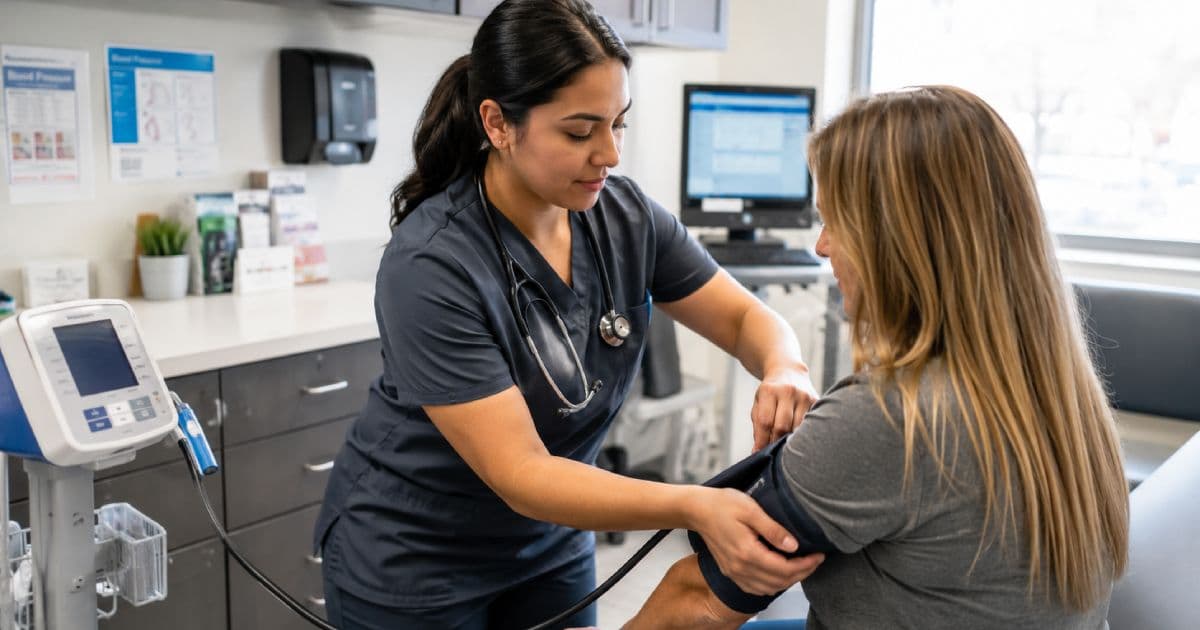
Medical assistants keep clinics moving.
They room patients.
They take vital signs.
They update charts.
They prepare exam rooms.
They handle phone calls, forms, lab specimens, injections, EKGs, and patient questions depending on the setting and state rules.
It is a hands-on healthcare role with a faster training path than nursing.
It is also not the same as being a nurse.
That distinction matters.
If you want patient contact, clinic experience, and a way into healthcare without starting with an RN or LPN program, medical assisting may be a good fit.
If your long-term goal is nursing, medical assisting can also help you build confidence before applying to nursing school.
What is a medical assistant?
A medical assistant is a healthcare worker who performs administrative and certain clinical tasks, usually in outpatient and ambulatory care settings.
Medical assistants work under the direction of licensed providers.
That may include physicians, nurse practitioners, physician assistants, or other authorized clinicians depending on the setting.
Common workplaces include:
- Primary care offices
- Pediatric clinics
- OB-GYN offices
- Internal medicine practices
- Family medicine clinics
- Urgent care centers
- Specialty practices
- Outpatient surgery centers
- Community health clinics
- Occupational health clinics
- Some hospital outpatient departments
Medical assistants help the care team stay organized.
They help patients move through the visit safely.
They also help providers gather information, prepare procedures, and complete documentation.
What medical assistants do
Medical assistant duties vary by employer.
They also vary by state law.
A medical assistant in a family practice clinic may spend most of the day rooming patients and preparing vaccines.
A medical assistant in cardiology may run EKGs and manage device follow-up workflows.
A medical assistant in dermatology may set up minor procedures and handle specimen labeling.
A medical assistant in urgent care may support rapid patient intake, point-of-care testing, and splinting workflows.
Common clinical duties
Medical assistants may perform tasks such as:
- Rooming patients
- Measuring temperature
- Measuring pulse
- Measuring respirations
- Measuring blood pressure
- Measuring height
- Measuring weight
- Recording medication lists
- Recording allergy lists
- Updating medical histories
- Preparing patients for exams
- Assisting with minor procedures
- Preparing exam rooms
- Cleaning exam rooms
- Stocking supplies
- Collecting specimens
- Performing point-of-care testing
- Running EKGs
- Drawing blood if trained and allowed
- Administering injections if trained and allowed
- Removing sutures or staples if delegated and allowed
- Applying basic dressings if trained and allowed
- Explaining routine instructions approved by the provider
- Documenting care in the EHR
Common administrative duties
Medical assistants may also perform tasks such as:
- Scheduling appointments
- Answering phones
- Checking patients in
- Checking patients out
- Updating demographics
- Verifying insurance
- Collecting forms
- Scanning documents
- Managing referrals
- Sending messages to the care team
- Processing prior authorization information
- Maintaining medical records
- Supporting billing workflows
- Coding basic visit information depending on role
- Coordinating lab and imaging paperwork
- Managing patient portal messages within policy
Common patient-facing duties
This is where strong medical assistants stand out.
Patients remember how they were treated.
A good medical assistant can:
- Make nervous patients feel safe
- Explain what will happen next
- Use plain language
- Protect privacy
- Notice when a patient looks worse than expected
- Report concerning changes quickly
- Stay calm during delays
- Keep the provider informed
- Keep the visit moving without making the patient feel rushed
Is a medical assistant the same as a nurse?
No.
A medical assistant is not the same as an RN, LPN, or LVN.
Nurses hold a nursing license.
Medical assistants usually do not hold a state nursing license.
Nurses use nursing judgment, nursing assessment, care planning, patient education, medication administration within scope, delegation, and evaluation.
Medical assistants complete delegated clinical and administrative tasks within their training, employer policy, and state rules.
This does not make medical assistants less important.
It means the roles are different.
Medical assistant vs RN
RNs have a broader legal scope.
RNs assess, plan, implement, evaluate, educate, triage, coordinate care, and use independent nursing judgment within their state nurse practice act.
Medical assistants perform delegated tasks and support the outpatient workflow.
Medical assistant vs LPN/LVN
LPNs/LVNs are licensed nurses.
Their scope varies by state, but they generally provide nursing care under RN, physician, or provider supervision.
Medical assistants are allied health workers and usually function under provider delegation and facility policy.
Medical assistant vs CNA
CNAs support activities of daily living and basic care, often in hospitals, long-term care, and home care.
Medical assistants more often work in clinics and handle a mix of clinical and administrative tasks.
Medical assistant vs patient care technician
Patient care technicians often work in hospitals and may perform direct care tasks such as phlebotomy, EKGs, and patient mobility support depending on employer policy.
Medical assistants usually work in ambulatory care and clinic workflows.
Medical assistant vs phlebotomist
Phlebotomists focus mainly on blood collection and specimen handling.
Medical assistants may draw blood if trained and allowed, but their role is broader.
Medical assistant vs EKG technician
EKG technicians focus on cardiac testing.
Medical assistants may perform EKGs in some settings, but they also handle rooming, documentation, procedures, and administrative work.
Why people choose medical assisting
Medical assisting can make sense if you want a healthcare role with patient contact and a shorter training path.
It can also help you decide whether you want nursing, radiology, respiratory therapy, surgical technology, medical billing, or another healthcare career later.
Common reasons people choose medical assisting:
- Faster entry into healthcare
- High patient contact
- Clinic hours in some jobs
- Opportunity to work in specialties
- Exposure to EHRs and provider workflows
- Entry point before nursing school
- Entry point before PA, NP, or pre-med pathways
- Strong skill overlap with other healthcare roles
- Ability to work while continuing school
How to become a medical assistant step by step
Step 1: Confirm that the role fits your goal
Start with the job you actually want.
Do you want direct patient care?
Do you want clinic hours?
Do you want a stepping-stone role before nursing school?
Do you want to work in pediatrics, cardiology, dermatology, OB-GYN, urgent care, or primary care?
Do you want mostly clinical work?
Do you want mostly administrative work?
Medical assisting can look very different depending on the employer.
Before enrolling in a program, search current jobs near you.
Look for:
- Required education
- Preferred certification
- Required experience
- Skills listed repeatedly
- Pay range if posted
- Schedule
- Weekend or evening expectations
- Specialty requirements
- EHR systems mentioned
- Bilingual preferences
- Injection or phlebotomy expectations
- Travel between clinic sites
Use the job posts as your checklist.
Example local job-post audit
Location searched:
Number of MA job posts reviewed:
Most common required credential:
Most common preferred credential:
Top 5 clinical skills listed:
Top 5 administrative skills listed:
EHR systems mentioned:
Average posted pay range:
Common schedule:
Experience required:
Employers that hire new grads:
Step 2: Finish high school or earn a GED
Most medical assistant pathways require a high school diploma or GED.
Even when an employer offers on-the-job training, they usually expect basic reading, writing, math, computer, and communication skills.
High school courses that help:
- Biology
- Anatomy and physiology
- Health science
- Medical terminology
- Computer applications
- Algebra
- English composition
- Psychology
- Public speaking
If you are still in school, ask whether your district offers a health science pathway, clinical internship, CNA course, phlebotomy course, EKG course, or dual-enrollment medical assisting program.
Step 3: Choose your training route
There is no single route for every student.
Your best option depends on your budget, timeline, state, local employers, and long-term goal.
Route 1: Certificate or diploma program
A certificate or diploma program is one of the most common routes.
These programs often focus on practical medical assisting skills.
They may take months to about a year depending on schedule and school.
They often include classroom work, lab practice, and an externship.
This can be a good route if you want to work quickly.
Route 2: Associate degree program
An associate degree usually takes longer.
It may include general education courses in addition to medical assisting coursework.
This can be useful if you want college credits that may support future education.
It may cost more and take more time.
Ask whether credits transfer before assuming they will.
Route 3: Apprenticeship or work-based learning
Some employers, community colleges, and workforce programs offer apprenticeship or work-based training.
This route may combine paid work with structured education.
It can be strong if you learn best on the job.
The details vary widely.
Ask how the program prepares you for certification.
Route 4: Employer on-the-job training
Some medical assistants start with a high school diploma and learn on the job.
This may work in offices willing to train.
It may be harder in areas where employers require certification.
If you choose this route, keep a skills log and ask about future certification eligibility.
Route 5: Military training
Military medical training may qualify some candidates for certification routes.
Check the certification body’s current eligibility rules before applying.
Step 4: Choose a reputable program
Do not choose a program based only on speed.
A fast program can be useful.
A weak program can waste money.
Your program should prepare you for real clinic work.
It should also prepare you for the credential employers want.
Program questions to ask
Ask these before you enroll:
- Is the program accredited?
- If yes, by whom?
- Does it meet CMA (AAMA) eligibility requirements?
- Does it prepare students for CCMA, RMA, NCMA, or another exam?
- Is an externship included?
- How many externship hours are required?
- Where do students complete externships?
- Are background checks required?
- Are immunizations required?
- Is CPR/BLS included?
- Is phlebotomy included?
- Is EKG training included?
- Is injection training included?
- Are certification exam fees included?
- Are uniforms, books, and supplies included?
- What is the total cost?
- What is the refund policy?
- What is the certification pass rate?
- What is the job placement rate?
- Which employers hire graduates?
- What EHR training is included?
- What happens if you fail a course?
- What happens if you cannot complete externship?
Red flags in a medical assistant program
Be cautious if the program:
- Avoids questions about accreditation
- Guarantees a job without clear employer partnerships
- Promises unusually high pay without evidence
- Hides total cost
- Has no hands-on lab time
- Has no externship or weak clinical placement support
- Does not explain certification eligibility
- Uses outdated equipment
- Has poor student reviews about externship placement
- Pressures you to enroll immediately
- Cannot explain scope of practice
- Cannot tell you which exam graduates take
Step 5: Understand accreditation
Accreditation matters because some credentials require graduation from a program that meets specific standards.
For example, CMA (AAMA) exam eligibility is tied to certain accredited medical assisting programs or approved alternative pathways.
CAAHEP and ABHES are the two names students often see when researching medical assisting programs.
CAAHEP
CAAHEP stands for the Commission on Accreditation of Allied Health Education Programs.
It accredits allied health education programs, including medical assisting programs.
CAAHEP lists currently accredited programs through its student search tools.
ABHES
ABHES stands for the Accrediting Bureau of Health Education Schools.
It accredits health education institutions and programs.
ABHES also provides tools to search accredited institutions and programs.
Why accreditation matters
Accreditation can affect:
- Certification exam eligibility
- Employer trust
- Transfer options
- Program quality review
- Externship standards
- Financial aid eligibility depending on the school
- Your ability to explain your education on a resume
What accreditation does not guarantee
Accreditation does not guarantee that you will pass a certification exam.
It does not guarantee employment.
It does not guarantee that every credit will transfer.
It does not guarantee that every employer will prefer your credential.
It does show that the program met an external review standard.
Step 6: Complete medical assistant coursework
Medical assistant programs usually combine classroom, lab, and clinical practice.
Course names vary.
The content usually includes both clinical and administrative skills.
Common clinical coursework
You may study:
- Medical terminology
- Anatomy and physiology
- Pathophysiology basics
- Infection control
- Vital signs
- Patient positioning
- Assisting with exams
- Medication basics
- Injection technique if allowed
- Pharmacology basics
- Dosage calculation basics
- Specimen collection
- Urinalysis
- Point-of-care testing
- Phlebotomy basics
- EKG basics
- Wound care basics
- Medical asepsis
- Surgical asepsis basics
- Emergency procedures
- CPR/BLS
Common administrative coursework
You may study:
- Medical office procedures
- Appointment scheduling
- Telephone skills
- EHR documentation
- Medical records
- HIPAA and privacy
- Insurance basics
- Billing basics
- Coding basics
- Referral workflows
- Prior authorization basics
- Patient registration
- Professional communication
- Legal and ethical issues
Common professionalism topics
Strong programs also teach:
- Boundaries
- Confidentiality
- Teamwork
- Cultural awareness
- Patient dignity
- Conflict management
- Time management
- Dependability
- Safety reporting
- When to escalate concerns
Step 7: Complete your externship
Many programs include an externship.
This is supervised, on-site experience in a real healthcare setting.
Treat it like a long job interview.
Employers often hire students who perform well during externship.
What to do before externship
Prepare early.
Complete every requirement on time.
Common requirements include:
- Background check
- Drug screen
- Immunization records
- TB testing
- CPR/BLS card
- Flu vaccine if seasonal
- COVID requirements if applicable
- HIPAA training
- OSHA training
- Uniforms
- Name badge
- Transportation plan
- Childcare plan if needed
How to succeed during externship
Show up early.
Stay off your phone.
Ask before doing unfamiliar tasks.
Write down workflow steps.
Take feedback without arguing.
Do not perform a task outside your training.
Do not promise patients anything outside your role.
Report abnormal findings quickly.
Protect patient privacy.
Thank the team.
Externship skills log
Use a skills log like this:
Date:
Location:
Preceptor:
Skill observed:
Skill performed with supervision:
What went well:
What I need to improve:
Safety issue to remember:
Documentation note:
Question for preceptor:
Step 8: Choose a certification path
Certification is not the same as licensure.
Many medical assistants are certified through professional organizations.
Some employers require certification.
Some prefer it.
Some train uncertified candidates.
Requirements vary by employer, state, and role.
Do not assume any one credential is accepted everywhere.
Check your local job posts.
CMA (AAMA)
CMA (AAMA) stands for Certified Medical Assistant through the American Association of Medical Assistants.
This is one of the most recognized medical assisting credentials.
Eligibility often depends on completing a CAAHEP- or ABHES-accredited medical assisting program or meeting another approved pathway.
This credential can be especially valuable when local employers specifically list CMA (AAMA).
RMA (AMT)
RMA stands for Registered Medical Assistant through American Medical Technologists.
AMT offers several eligibility routes, including education, work experience, military, instructor, and work-based learning pathways.
This credential can work well for students whose background fits AMT eligibility.
CCMA (NHA)
CCMA stands for Certified Clinical Medical Assistant through the National Healthcareer Association.
NHA is common in many schools and employer training programs.
This credential is often used for clinical medical assistant roles.
NCMA (NCCT)
NCMA stands for National Certified Medical Assistant through the National Center for Competency Testing.
NCCT offers certification pathways based on education, training, and experience.
This credential may be accepted by employers that list NCCT or NCMA in job postings.
Other helpful credentials
Depending on your goal, you may also see:
- BLS/CPR certification
- Phlebotomy certification
- EKG technician certification
- Medical administrative assistant certification
- Billing and coding certification
- Electronic health records certification
These can help, but do not collect random credentials.
Choose credentials that match the jobs you want.
Step 9: Prepare for the certification exam
Do not wait until the week before the exam.
Start reviewing while you are still in class.
Use the exam content outline from the certification body.
That outline tells you what the exam actually covers.
High-yield exam topics
Expect to review:
- Anatomy and physiology
- Medical terminology
- Infection control
- Vital signs
- Patient intake
- Documentation
- Safety
- Professionalism
- Legal and ethical issues
- HIPAA
- Specimen collection
- Phlebotomy basics
- EKG basics
- Pharmacology basics
- Medication administration rules
- Administrative procedures
- Scheduling
- Insurance and billing basics
- Emergency response
Medical assistant exam study plan
Week 1:
Review exam content outline.
Take a baseline practice test.
List weak topics.

Week 2:
Review medical terminology, anatomy, and physiology.
Make flashcards for prefixes, suffixes, and common abbreviations.

Week 3:
Review infection control, vital signs, and patient intake.
Practice normal ranges and abnormal findings.

Week 4:
Review phlebotomy, specimens, EKG basics, and point-of-care testing.
Focus on safety and order of draw if included in your exam.

Week 5:
Review administrative procedures, scheduling, EHR, insurance, and billing basics.

Week 6:
Review legal/ethical topics, HIPAA, scope, professionalism, and emergency procedures.
Take another practice test.

Final week:
Review missed questions.
Sleep.
Prepare ID and testing details.
Do not cram brand-new topics the night before.
Step 10: Build your resume
Your resume should make it easy for a clinic manager to see that you can work safely, communicate well, and learn quickly.
New medical assistants often make the mistake of writing only classroom topics.
Employers want to see usable skills.
What to include on a medical assistant resume
Include:
- Your certification if earned
- Program name
- Graduation date or expected date
- Externship site
- Externship hours if useful
- Clinical skills
- Administrative skills
- EHR experience
- CPR/BLS status
- Customer service experience
- Bilingual skills if applicable
- Any healthcare experience
- Reliability indicators
Resume summary example
Certified Medical Assistant with 180-hour family medicine externship experience, trained in patient intake, vital signs, EHR documentation, specimen handling, injections, EKG setup, and front-office workflows. Known for calm communication, accurate documentation, and reliable attendance.New medical assistant resume bullets
Completed 180-hour externship in a busy family medicine clinic supporting patient intake, room turnover, vital signs, medication list updates, and EHR documentation.

Prepared exam rooms, stocked supplies, cleaned equipment, and maintained infection-control standards between patient visits.

Recorded patient histories, allergies, medication lists, and chief complaints accurately for provider review.

Assisted with specimen labeling, point-of-care testing, and documentation according to clinic policy.

Supported front-office workflow by scheduling appointments, answering phones, verifying demographics, and routing patient messages.

Used professional communication to support pediatric, adult, and older adult patients during routine and urgent visits.
Resume skills section example
Clinical skills: Vital signs, patient intake, EKG setup, specimen handling, point-of-care testing, injections, phlebotomy basics, exam room preparation, infection control

Administrative skills: Appointment scheduling, EHR documentation, phone triage routing, insurance verification, patient check-in/check-out, referral support, medical records

Professional skills: Patient communication, teamwork, time management, HIPAA, problem-solving, bilingual English/Spanish communication
For more resume strategy, use NurseZee’s new grad nurse resume guide and adapt the same clarity to medical assisting.
Step 11: Apply for medical assistant jobs
Do not apply only to large hospitals.
Medical assistants are heavily used in outpatient care.
Look at a mix of employers.
Where to apply
Apply to:
- Primary care clinics
- Pediatric offices
- Internal medicine offices
- OB-GYN practices
- Dermatology offices
- Cardiology clinics
- Orthopedic clinics
- ENT practices
- Urgent care centers
- Community health centers
- Occupational health clinics
- Outpatient surgery centers
- Hospital outpatient departments
- Federally qualified health centers
- Specialty clinics
Search terms to use
Search for:
- Medical Assistant
- Certified Medical Assistant
- Clinical Medical Assistant
- Registered Medical Assistant
- CCMA
- CMA
- RMA
- NCMA
- Back Office Medical Assistant
- Front Office Medical Assistant
- Patient Care Coordinator
- Clinic Assistant
- Ambulatory Care Assistant
New graduate job-search rule
Apply even if the posting says “one year preferred.”
Preferred is not the same as required.
If you completed an externship, have strong attendance, and can show your skills clearly, you may still be considered.
Step 12: Prepare for interviews
Medical assistant interviews often focus on reliability, patient communication, safety, and clinic flow.
Managers want to know that you will show up, stay professional, protect patient privacy, and ask for help when needed.
Common interview questions
You may be asked:
- Why do you want to be a medical assistant?
- What was your externship like?
- Which clinical skills have you performed?
- Which EHR systems have you used?
- How do you handle a difficult patient?
- How do you protect patient privacy?
- What would you do if a patient reported chest pain?
- What would you do if you made a documentation error?
- How do you manage a busy schedule?
- Are you comfortable with injections, phlebotomy, or EKGs?
- Why do you want this specialty?
- What are your long-term goals?
Interview answer example: difficult patient
I would stay calm, listen without interrupting, and try to understand what the patient needs. I would not argue or make promises outside my role. If the patient was upset about wait time, pain, safety, or a clinical concern, I would update the nurse or provider according to clinic policy. My goal would be to protect the patient, keep the team informed, and remain professional.Interview answer example: abnormal vital sign
I would recheck the vital sign if appropriate, make sure the equipment and technique were correct, and report the abnormal result promptly to the licensed team member or provider according to policy. I would not ignore it or give advice outside my role.Interview answer example: why medical assisting
I want a patient-facing healthcare role where I can support both clinical care and clinic operations. I like the mix of rooming patients, documenting accurately, preparing procedures, and helping the team stay organized. I am also interested in growing in healthcare long term, so I want to build strong habits in safety, communication, and professionalism.Medical assistant salary
Medical assistant pay depends on location, employer, certification, experience, specialty, shift, and local labor market.
Use national salary numbers as a baseline.
Do not assume they represent your first offer.
The Bureau of Labor Statistics reported a median annual wage of $44,200 for medical assistants in May 2024.
The lowest 10 percent earned less than $35,020.
The highest 10 percent earned more than $57,830.
BLS also reported different median wages by industry in May 2024:
| Industry | Median annual wage |
|---|---|
| Outpatient care centers | $47,560 |
| Hospitals; state, local, and private | $45,930 |
| Offices of physicians | $43,880 |
| Offices of other health practitioners | $37,510 |
What affects medical assistant pay
Pay can change based on:
- State
- City
- Cost of living
- Employer type
- Specialty
- Certification
- Experience
- Bilingual skills
- Phlebotomy skills
- EKG skills
- Injection experience
- Prior healthcare experience
- Shift differential
- Weekend requirements
- Union status if applicable
- Benefit package
Salary caution
A higher hourly wage does not always mean a better job.
Compare the full offer.
Look at:
- Health insurance
- PTO
- Retirement match
- Tuition support
- Certification reimbursement
- Paid CE
- Schedule stability
- Commute
- Parking cost
- Uniform allowance
- Overtime expectations
- Growth opportunities
- Training quality
Medical assistant job outlook
The job outlook is strong.
BLS projects medical assistant employment to grow 12 percent from 2024 to 2034.
That is faster than the average for all occupations.
BLS also projects about 112,300 openings for medical assistants each year on average over that decade.
Demand is tied to outpatient care growth, older adult care needs, chronic disease management, and clinics needing support staff for high patient volume.
This does not mean every job is easy.
You still need a strong resume.
You still need solid interview skills.
You still need to choose a program carefully.
But the role has broad demand across outpatient healthcare.
Medical assistant skills employers want
Clinical skills
Employers may look for:
- Accurate vital signs
- Patient intake
- Medication list review
- Allergy list review
- Chief complaint documentation
- Exam room preparation
- Procedure setup
- Injection technique if allowed
- Vaccine handling basics if applicable
- Phlebotomy if applicable
- EKG acquisition if applicable
- Specimen collection
- Point-of-care testing
- Infection control
- PPE use
- Cleaning and disinfection
- Sterile field awareness when assisting
- Safe body mechanics
- Emergency response basics
Administrative skills
Employers may look for:
- EHR documentation
- Scheduling
- Patient check-in
- Patient check-out
- Insurance verification
- Referral coordination
- Phone etiquette
- Portal message routing
- Medical records handling
- Basic billing knowledge
- Basic coding knowledge
- Prior authorization support
- Form completion support
- Fax and document management
- Supply tracking
Communication skills
Employers may look for:
- Clear patient instructions within role
- Calm tone under stress
- Active listening
- Respect for privacy
- Professional boundaries
- Accurate message taking
- Team communication
- Provider updates
- Cultural awareness
- Conflict de-escalation
Safety skills
Employers may look for:
- Recognizing abnormal vital signs
- Reporting urgent symptoms
- Following infection-control policy
- Checking patient identifiers
- Labeling specimens correctly
- Avoiding workarounds
- Asking before performing unfamiliar tasks
- Knowing when to escalate
- Documenting accurately
- Protecting HIPAA information
Technology skills
Employers may look for:
- EHR navigation
- Patient portal workflows
- Appointment scheduling software
- Scanning and uploading documents
- Basic email communication
- Telehealth rooming workflows
- Secure messaging
- E-prescribing support workflows if allowed
- Basic troubleshooting
What medical assistants should not do
Exact rules vary by state and employer.
But in general, medical assistants should be careful with tasks that require independent clinical judgment.
Do not assume you can do something because another clinic allowed it.
Usually outside the medical assistant role
Medical assistants generally should not:
- Diagnose conditions
- Independently assess patients
- Independently triage patients
- Create nursing care plans
- Use the title nurse without a nursing license
- Interpret diagnostic results for patients
- Give independent medical advice
- Change medication doses
- Refill medications without authorized protocol
- Perform tasks not allowed by state law
- Perform tasks not allowed by employer policy
- Perform tasks you were not trained to do
- Ignore abnormal findings
- Document care you did not provide
- Sign another person’s name
- Use another employee’s EHR login
When unsure
Use this rule:
Stop.
Do not guess.
Ask the licensed team member or supervisor.
Follow policy.
Document accurately.
Medical assistant work settings
Primary care
Primary care medical assistants see a wide range of patients.
You may help with wellness visits, chronic disease follow-ups, vaccines, acute visits, and forms.
Skills that matter:
- Rooming efficiency
- Medication list accuracy
- Vaccine workflows
- Patient education support within role
- Chronic disease visit preparation
- Preventive screening reminders
Pediatrics
Pediatric medical assistants work with children and caregivers.
Skills that matter:
- Growth measurements
- Vaccine preparation support
- Calm communication
- Parent questions
- Pediatric vital signs
- Comforting anxious children
- Safety awareness
OB-GYN
OB-GYN medical assistants support sensitive visits.
Skills that matter:
- Privacy
- Chaperone workflows
- Urine testing
- Pregnancy test workflows
- Procedure setup
- Respectful communication
- Trauma-informed awareness
Cardiology
Cardiology medical assistants may work heavily with EKGs and cardiac history.
Skills that matter:
- EKG setup
- Accurate vitals
- Chest pain escalation
- Medication list accuracy
- Device clinic workflow support depending on role
- Clear documentation
Dermatology
Dermatology medical assistants often support procedures.
Skills that matter:
- Procedure trays
- Specimen labeling
- Wound care basics
- Patient positioning
- Sterile technique awareness
- Room turnover
Orthopedics
Orthopedic medical assistants may help with mobility, splints, imaging workflows, and procedure setup.
Skills that matter:
- Safe transfers
- Neurovascular red flags
- Brace or splint support if trained
- Procedure preparation
- Patient instruction reinforcement
Urgent care
Urgent care can be fast-paced.
Skills that matter:
- Quick intake
- Accurate vitals
- Point-of-care testing
- EKGs
- Specimen collection
- Infection control
- Escalation of red flags
- Time management
Community health
Community health centers often serve patients with complex social and healthcare needs.
Skills that matter:
- Respectful communication
- Resource awareness
- Bilingual skills if applicable
- Chronic disease workflows
- Patient navigation support
- Documentation accuracy
A day in the life of a medical assistant
Every clinic is different.
A typical day may include:
- Clocking in
- Checking the schedule
- Reviewing visit types
- Preparing rooms
- Stocking supplies
- Rooming the first patient
- Taking vital signs
- Updating medication lists
- Documenting the chief complaint
- Notifying the provider that the patient is ready
- Cleaning and resetting rooms
- Returning patient calls within policy
- Preparing vaccines or procedure supplies if allowed
- Running point-of-care tests
- Labeling specimens
- Scheduling follow-up visits
- Handling forms
- Supporting urgent add-on visits
- Reporting abnormal findings
- Completing end-of-day cleanup
Good medical assistants think one step ahead.
They know which rooms are open.
They know which patient needs extra time.
They know when a provider is falling behind.
They know when a patient needs escalation.
Medical assistant career growth
Medical assisting can lead to many directions.
Some people stay in the role long term and become expert clinic team members.
Others use it as a starting point.
Growth within medical assisting
Possible growth paths include:
- Lead medical assistant
- Senior medical assistant
- Clinical team lead
- Clinic supervisor
- Specialty medical assistant
- Procedure assistant role
- Population health support
- Patient care coordinator
- Referral coordinator
- Prior authorization specialist
- Quality improvement support
Growth into other healthcare roles
Medical assisting can also build experience for:
- Nursing school
- LPN/LVN programs
- RN programs
- Phlebotomy
- EKG technician roles
- Surgical technology
- Radiologic technology
- Respiratory therapy
- Health information management
- Medical billing and coding
- Healthcare administration
- Public health
- PA school prerequisites and patient care experience depending on program rules
If you are considering nursing, review NurseZee’s NCLEX prep guide and practice questions early so you understand the difference between entry-level patient care experience and licensed nursing judgment.
Medical assistant vs nursing school pathway
Some future nurses work as medical assistants before nursing school.
That can help.
But it does not replace nursing prerequisites, clinical rotations, or licensure.
How medical assisting can help future nurses
It can help you build:
- Patient communication
- Vital sign skills
- EHR familiarity
- Clinic workflow understanding
- Team communication
- Infection-control habits
- Professional confidence
- Basic medical terminology
- Exposure to chronic disease care
- Comfort with patient contact
What nursing school will still require
Nursing school will still require:
- Nursing assessment
- Care planning
- Pharmacology depth
- Pathophysiology depth
- Clinical judgment
- Nursing interventions
- Patient education
- Delegation principles
- Legal nursing scope
- NCLEX preparation
- Licensed practice standards
Medical assisting can give you a head start in confidence.
It does not make you a nurse.
Common mistakes to avoid
Mistake 1: Choosing a program without checking local job posts
Do not guess which credential employers want.
Check the market first.
If most employers near you require CMA (AAMA), choose a path that supports that credential.
If most accept CCMA or RMA, you may have more flexibility.
Mistake 2: Confusing certification with licensure
Certification is a professional credential.
Licensure is legal permission from a state to practice a licensed profession.
Medical assistants are not licensed nurses.
Use accurate language on resumes and in interviews.
Mistake 3: Ignoring scope of practice
Never assume a task is allowed everywhere.
State rules and employer policies differ.
Ask before performing tasks such as injections, medication administration, suture removal, or phlebotomy.
Mistake 4: Underestimating administrative skills
Some students only want clinical tasks.
Most medical assistant roles include documentation, phones, scheduling, records, or patient messages.
Administrative accuracy protects patients too.
Mistake 5: Treating externship casually
Externship is not just a graduation requirement.
It can lead to references and job offers.
Show up like an employee.
Mistake 6: Writing vague resume bullets
Do not write:
Helped in clinic.Write:
Roomed 20-25 patients per shift during externship, including vital signs, medication list updates, chief complaint documentation, and exam room turnover.Mistake 7: Overstating your skills
Do not claim independent competence in a skill you only observed once.
Be honest.
Managers can train gaps.
They cannot trust unsafe exaggeration.
Mistake 8: Focusing only on pay
Pay matters.
But early in your career, training quality matters too.
A chaotic first job can teach bad habits.
Look for support, clear policies, and patient safety.
Mistake 9: Forgetting renewal requirements
Certification is not “done forever.”
Track renewal dates.
Complete continuing education early.
Keep proof of CE.
Mistake 10: Not asking about career ladders
Some health systems have medical assistant levels.
Ask about MA I, MA II, lead MA, tuition reimbursement, and internal transfer options.
Medical assistant resume template
Use this as a starting point.
Customize it for each job.
[First Name Last Name]
[City, State] | [Phone] | [Email] | [LinkedIn if professional]

Certified Medical Assistant

Summary
Certified Medical Assistant with training in patient intake, vital signs, EHR documentation, infection control, specimen handling, and front-office workflows. Completed [number]-hour externship in [setting]. Known for accurate documentation, calm patient communication, and reliable attendance.

Certification
[Credential], [Certifying Organization], [Month Year]
BLS/CPR, [Organization], [Expiration Month Year]

Education
[School Name], [City, State]
Medical Assistant Certificate/Diploma/Associate Degree, [Month Year]
Relevant training: Medical terminology, anatomy and physiology, clinical procedures, administrative procedures, EHR, phlebotomy, EKG, pharmacology basics

Externship
[Clinic Name], [City, State]
Medical Assistant Extern, [Month Year-Month Year]
- Roomed patients and documented chief complaints, vital signs, medication lists, and allergies in the EHR.
- Prepared exam rooms, stocked supplies, cleaned equipment, and followed infection-control procedures.
- Assisted with specimen labeling, point-of-care testing, and procedure setup according to clinic policy.
- Supported front-office workflows including scheduling, phone messages, demographics, and check-in/check-out.

Skills
Clinical: Vital signs, patient intake, EKG setup, specimen handling, injections, phlebotomy basics, infection control, exam room setup
Administrative: EHR documentation, scheduling, patient check-in/check-out, insurance verification, phone communication, referrals, medical records
Professional: HIPAA, teamwork, time management, patient communication, reliability, bilingual [language] if applicable

Work Experience
[Employer Name], [City, State]
[Job Title], [Month Year-Month Year]
- Use action bullet focused on customer service, accuracy, multitasking, communication, or reliability.
- Use action bullet connecting past experience to clinic work.
Medical assistant cover letter structure
Keep it short.
Make it specific.
Do not repeat your whole resume.
Dear Hiring Manager,

I am applying for the Medical Assistant position at [Clinic Name]. I recently completed [program name] and [externship hours] in [setting], where I practiced patient intake, vital signs, EHR documentation, exam room preparation, and patient communication.

I am especially interested in [clinic/specialty] because [specific reason]. My background in [customer service/healthcare/externship/specialty] has prepared me to work calmly with patients, stay organized during busy clinic flow, and follow policy carefully.

I would welcome the opportunity to support your team and continue growing as a medical assistant.

Sincerely,
[Name]
Medical assistant interview checklist
Before the interview:
- Review the clinic website
- Know the specialty
- Review your resume
- Prepare your externship examples
- Review your certification status
- Bring copies of your resume
- Bring certification proof if requested
- Bring BLS/CPR proof if requested
- Prepare questions about training
- Plan your route
- Dress professionally
- Arrive early
Ask the employer:
- How long is orientation?
- Who trains new medical assistants?
- Which EHR do you use?
- What clinical skills are expected in this role?
- Are injections, phlebotomy, or EKGs part of the role?
- What is the patient volume per day?
- Is this mostly back office, front office, or both?
- What are the schedule expectations?
- Are weekends or evenings required?
- Are there MA levels or career ladders?
- Do you reimburse certification renewal or CE?
- What makes someone successful on this team?
Quick reference cheat sheet
Best reasons to become a medical assistant
Choose medical assisting if you want:
- Direct patient contact
- Clinic experience
- A faster healthcare entry point
- A mix of clinical and administrative work
- Specialty exposure
- A stepping stone into nursing or another healthcare program
- A role where communication and organization matter every day
Best program signs
Look for:
- Clear accreditation information
- Strong externship placement
- Transparent tuition
- Certification exam preparation
- Skills lab practice
- EHR training
- CPR/BLS support
- Good graduate outcomes
- Local employer connections
- Clear policies
Best certification strategy
Use this order:
- Check local job posts.
- Identify the credentials employers request most.
- Choose a program that supports that credential.
- Confirm eligibility directly with the certifying body.
- Keep renewal requirements on your calendar.
Skills to build first
Start with:
- Vital signs
- Medical terminology
- Infection control
- EHR documentation
- Patient intake
- HIPAA
- Patient communication
- Specimen handling
- EKG basics if relevant
- Phlebotomy basics if relevant
- Scheduling and phone skills
Red flags to escalate
Report promptly according to policy if a patient has:
- Chest pain
- Shortness of breath
- Fainting
- Severe allergic symptoms
- Confusion
- Severe pain
- Very high or very low blood pressure
- Abnormal pulse with symptoms
- Very high fever
- Bleeding that is not controlled
- Suicidal statements
- Stroke-like symptoms
- Any symptom your clinic policy defines as urgent
Do not do
Do not:
- Diagnose
- Independently triage
- Give independent medical advice
- Change medication directions
- Ignore abnormal findings
- Work outside policy
- Use another person’s EHR login
- Document care you did not provide
- Call yourself a nurse without a nursing license
Frequently asked questions about becoming a medical assistant
How long does it take to become a medical assistant?
It depends on the route.
Some certificate or diploma programs take months to about a year.
Associate degree programs take longer.
Some employers train medical assistants on the job.
The fastest route is not always the best route.
Choose based on employer requirements, certification eligibility, externship quality, cost, and schedule.
Do you need certification to become a medical assistant?
Not always.
Some employers train uncertified candidates.
Many employers prefer or require certification.
Common credentials include CMA (AAMA), RMA (AMT), CCMA (NHA), and NCMA (NCCT).
Check job postings near you before choosing a credential.
What is the best medical assistant certification?
There is no single best credential for every student.
The best credential is the one accepted by the employers you want and supported by your education route.
CMA (AAMA), RMA (AMT), CCMA (NHA), and NCMA (NCCT) are common options.
Is a medical assistant a nurse?
No.
A medical assistant is not a nurse.
RNs, LPNs, and LVNs are licensed nurses.
Medical assistants are allied health workers who perform delegated clinical and administrative tasks within state law and employer policy.
Can a medical assistant give injections?
It depends on state law, employer policy, provider delegation, and training.
Some medical assistants administer injections in certain settings.
Others do not.
Do not perform injections unless you are trained, authorized, and allowed by policy and state rules.
Can a medical assistant draw blood?
Sometimes.
Some medical assistants perform phlebotomy if trained and allowed.
Other employers use phlebotomists or require a separate phlebotomy credential.
Check local job posts and state rules.
Can a medical assistant work in a hospital?
Yes, some hospitals hire medical assistants, especially in outpatient clinics, specialty clinics, and ambulatory departments.
Hospital inpatient units more commonly use CNAs, patient care technicians, LPNs/LVNs, and RNs depending on the unit and state.
What is the difference between CMA and CCMA?
CMA (AAMA) is a Certified Medical Assistant credential from the American Association of Medical Assistants.
CCMA is a Certified Clinical Medical Assistant credential from the National Healthcareer Association.
Employers may prefer one, accept both, or list another credential.
Use exact credential names on your resume.
How much do medical assistants make?
BLS reported a median annual wage of $44,200 for medical assistants in May 2024.
Actual pay depends on state, city, employer, specialty, certification, experience, schedule, and benefits.
Review current job postings in your area for realistic starting pay.
Is medical assisting good before nursing school?
It can be.
Medical assisting can build patient communication, vital signs, documentation, and clinic experience.
It does not replace nursing school, nursing clinicals, or RN/LPN licensure.
If your goal is nursing, choose jobs and programs that support your school schedule and long-term plan.
What skills should a new medical assistant list on a resume?
List skills you can actually perform.
Common skills include vital signs, patient intake, EHR documentation, exam room preparation, infection control, specimen handling, EKG setup, phlebotomy basics, scheduling, phone communication, and HIPAA.
Do not list skills you only watched once.
What should I ask before enrolling in a medical assistant program?
Ask about accreditation, certification eligibility, externship hours, total cost, exam fees, pass rates, job placement support, skills labs, EHR training, and local employer partnerships.
Also ask what happens if you cannot complete externship on the first schedule offered.
Can medical assistants work from home?
Some experienced medical assistants move into remote or hybrid roles such as patient access, referral coordination, prior authorization, population health outreach, or medical records support.
New medical assistants usually need in-person clinical experience first.
What is the hardest part of being a medical assistant?
The hardest parts are often pace, multitasking, patient emotions, documentation accuracy, and knowing when to escalate concerns.
The clinical skills matter, but organization and communication often determine whether you succeed.
What is the best first job for a new medical assistant?
A good first job has structured orientation, supportive preceptors, clear policies, reasonable patient volume, and a manager who values training.
Primary care can be a strong foundation because you see a broad range of patients and workflows.
Specialty clinics can also be excellent if they train new graduates well.
Final thoughts
Medical assisting is a real healthcare role.
It requires accuracy, calm communication, confidentiality, and respect for scope.
Do not choose a program blindly.
Check local job posts.
Verify certification eligibility.
Ask about externships.
Build a resume around skills you can prove.
During interviews, show that you are safe, teachable, organized, and patient-centered.
Those habits matter more than sounding perfect.
A strong medical assistant helps the whole clinic work better.
Patients feel it.
Providers feel it.
Nurses feel it.
And if you later move into nursing or another healthcare career, those habits will follow you.
Sources and references
- U.S. Bureau of Labor Statistics: Medical Assistants Occupational Outlook Handbook
- U.S. Bureau of Labor Statistics: Occupational Employment and Wage Statistics Tables
- AAMA: CMA (AAMA) Exam Eligibility
- AAMA: CAAHEP and ABHES Accredited Programs
- AAMA: State Scope of Practice Laws
- CAAHEP: Medical Assisting
- CAAHEP: Find an Accredited Program
- ABHES: Accredited Institutions and Programs
- American Medical Technologists: Registered Medical Assistant Certification
- National Healthcareer Association: Certified Clinical Medical Assistant
- National Center for Competency Testing: Medical Assistant Certification
- O*NET OnLine: Medical Assistants
- NurseZee: New Grad Nurse Resume
- NurseZee: NCLEX Prep
- NurseZee Practice Questions