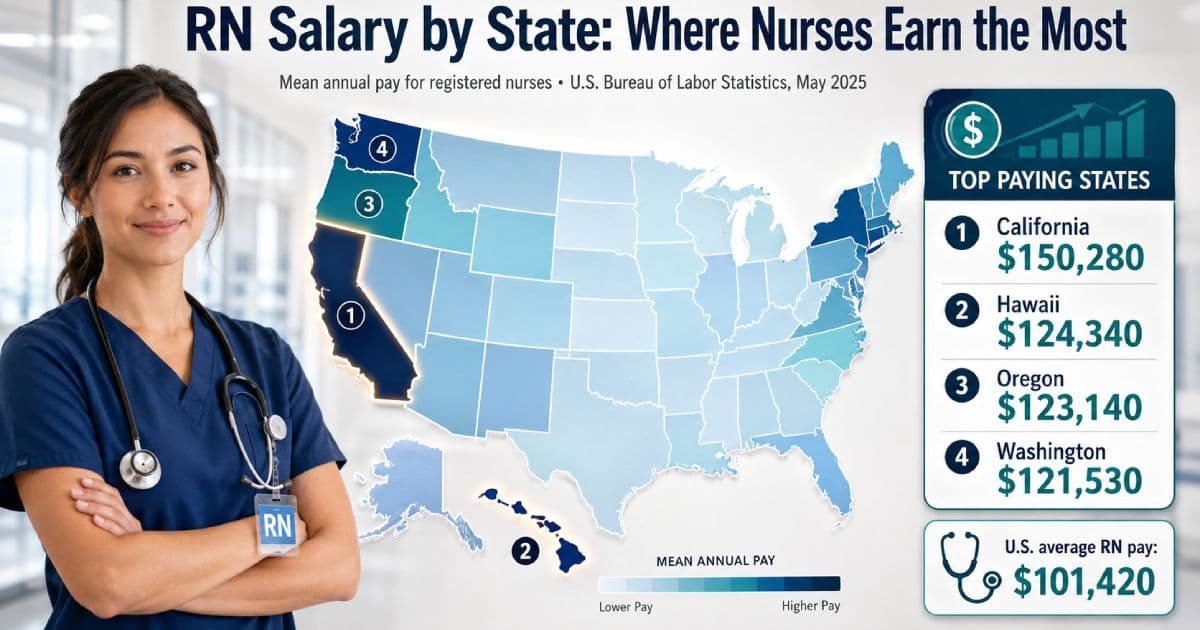
RN salary changes fast by location.
A registered nurse can earn a strong income in one state and still feel squeezed by rent, taxes, commuting costs, benefits, and shift requirements.
Another nurse may earn a lower headline salary but keep more of it because housing and daily expenses are lower.
That is why you should never compare RN salaries by annual pay alone.
Use salary, cost of living, benefits, differential pay, staffing expectations, union contracts, and career growth together.
What this guide covers
This guide breaks down RN salary by state.
It also explains what the numbers mean in real life.
You will learn:
- Which states pay RNs the most
- Which states pay less on average
- Why state averages can mislead you
- How hourly pay compares with annual pay
- How cost of living changes the salary picture
- How hospital systems, unions, and clinical ladders affect pay
- How new grad RN salary differs from experienced RN salary
- What to check before accepting an RN job offer
- How to compare offers without guessing
This guide is written for nursing students, new grads, and working RNs comparing career options.
If you are still building your job search materials, start with NurseZee’s new grad nurse resume guide.
If you are applying to transition programs, review the nurse residency program guide.
RN salary by state: the big picture
Registered nurses are paid differently across the United States because nursing labor markets are local.
Pay depends on:
- State demand for RNs
- Metro area demand
- Hospital competition
- Union contracts
- Staffing laws or staffing pressure
- Cost of living
- Specialty
- Experience level
- Shift
- Weekend requirements
- Degree level
- Certifications
- Float pool or resource pool status
- Per diem status
- Rural vs urban location
- Academic medical center vs community hospital
- Public hospital vs private hospital
- Federal, state, or VA employment
A state average tells you where the market is stronger.
It does not tell you exactly what you will earn.
Highest-paying states for RNs
These are the top states and districts for registered nurse mean annual wage.
| Rank | State or district | Mean hourly wage | Mean annual wage |
|---|---|---|---|
| 1 | California | $71.31 | $148,330 |
| 2 | Hawaii | $59.48 | $123,720 |
| 3 | Oregon | $57.92 | $120,470 |
| 4 | Washington | $55.64 | $115,740 |
| 5 | Massachusetts | $54.14 | $112,610 |
| 6 | Alaska | $53.86 | $112,040 |
| 7 | New York | $53.12 | $110,490 |
| 8 | District of Columbia | $52.52 | $109,240 |
| 9 | New Jersey | $51.44 | $106,990 |
| 10 | Connecticut | $49.84 | $103,670 |
California leads by a wide margin.
The top states are not random.
Many have one or more of these factors:
- High cost of living
- Dense hospital markets
- Strong academic medical centers
- Strong union presence
- Competitive specialty care systems
- High demand in major metro areas
- Higher housing costs that push wages up
- Hard-to-staff rural or remote regions
Lowest-paying states for RNs
Lower-paying states are often in the South and parts of the Midwest.
That does not automatically mean they are bad places to work.
Lower salary may come with lower housing costs, easier commuting, lower taxes, or better schedule stability.
The lowest mean annual wages in this dataset are:
| Rank | State | Mean hourly wage | Mean annual wage |
|---|---|---|---|
| 47 | Kansas | $38.19 | $79,430 |
| 48 | Iowa | $37.39 | $77,780 |
| 49 | Arkansas | $37.36 | $77,720 |
| 50 | Alabama | $36.04 | $74,970 |
| 51 | South Dakota | $34.72 | $72,210 |
Do not use this table to judge a job by itself.
Use it as a starting point.
Then compare actual local offers.
Complete RN salary by state table
The table below lists mean RN wages by state and district.
These are BLS wage estimates for registered nurses.
| Rank | State | Mean hourly wage | Mean annual wage |
|---|---|---|---|
| 1 | California | $71.31 | $148,330 |
| 2 | Hawaii | $59.48 | $123,720 |
| 3 | Oregon | $57.92 | $120,470 |
| 4 | Washington | $55.64 | $115,740 |
| 5 | Massachusetts | $54.14 | $112,610 |
| 6 | Alaska | $53.86 | $112,040 |
| 7 | New York | $53.12 | $110,490 |
| 8 | District of Columbia | $52.52 | $109,240 |
| 9 | New Jersey | $51.44 | $106,990 |
| 10 | Connecticut | $49.84 | $103,670 |
| 11 | Nevada | $49.17 | $102,280 |
| 12 | Rhode Island | $47.96 | $99,770 |
| 13 | Minnesota | $47.82 | $99,460 |
| 14 | Maryland | $46.46 | $96,650 |
| 15 | Colorado | $45.90 | $95,470 |
| 16 | Delaware | $45.89 | $95,450 |
| 17 | Arizona | $45.79 | $95,230 |
| 18 | New Hampshire | $45.49 | $94,620 |
| 19 | New Mexico | $45.37 | $94,360 |
| 20 | Vermont | $44.57 | $92,710 |
| 21 | Georgia | $44.21 | $91,960 |
| 22 | Texas | $44.08 | $91,690 |
| 23 | Illinois | $43.81 | $91,130 |
| 24 | Virginia | $43.72 | $90,930 |
| 25 | Pennsylvania | $43.67 | $90,830 |
| 26 | Michigan | $43.55 | $90,580 |
| 27 | Wisconsin | $43.48 | $90,450 |
| 28 | Idaho | $43.16 | $89,770 |
| 29 | Montana | $42.54 | $88,480 |
| 30 | Utah | $42.42 | $88,240 |
| 31 | Florida | $42.40 | $88,200 |
| 32 | Wyoming | $42.32 | $88,020 |
| 33 | Maine | $42.04 | $87,440 |
| 34 | North Carolina | $41.48 | $86,270 |
| 35 | Ohio | $41.40 | $86,110 |
| 36 | Indiana | $41.27 | $85,850 |
| 37 | Oklahoma | $41.25 | $85,800 |
| 38 | South Carolina | $40.83 | $84,930 |
| 39 | Louisiana | $40.44 | $84,110 |
| 40 | Kentucky | $40.34 | $83,900 |
| 41 | Nebraska | $39.85 | $82,890 |
| 42 | Tennessee | $39.43 | $82,010 |
| 43 | Missouri | $39.40 | $81,950 |
| 44 | North Dakota | $39.38 | $81,900 |
| 45 | West Virginia | $38.77 | $80,650 |
| 46 | Mississippi | $38.21 | $79,470 |
| 47 | Kansas | $38.19 | $79,430 |
| 48 | Iowa | $37.39 | $77,780 |
| 49 | Arkansas | $37.36 | $77,720 |
| 50 | Alabama | $36.04 | $74,970 |
| 51 | South Dakota | $34.72 | $72,210 |
How to read the RN salary table
Start with four questions.
1. Is this number a mean wage or a median wage?
2. Is it state-level or metro-level?
3. Does it include overtime or only standard wages?
4. Is the job offer full-time, part-time, per diem, float pool, or travel?
State averages are useful for comparing markets.
They are not enough for deciding whether to move.
A nurse earning $120,000 in a high-rent city may have less breathing room than a nurse earning $90,000 in a lower-cost area.
A nurse earning a lower base rate may also earn more through nights, weekends, overtime, call pay, charge pay, preceptor pay, or certification differentials.
Mean salary vs median salary
Mean and median are not the same.
Mean salary is the average.
Median salary is the middle point.
If very high earners pull the average upward, the mean may look higher than what a typical nurse sees.
Mean wage
Mean wage adds all wages together and divides by the number of workers.
It can be affected by high earners.
Median wage
Median wage is the middle value.
Half earn more.
Half earn less.
What nursing students should use
For a job decision, use both.
The state mean tells you the broad market.
The job posting tells you the real range.
Your experience level tells you where you may land inside that range.
Hourly RN pay vs annual RN salary
Most bedside RN jobs are hourly.
That matters.
Hourly nurses may earn more through:
- Night shift differential
- Evening shift differential
- Weekend differential
- Holiday pay
- Overtime
- Call pay
- Charge nurse differential
- Preceptor differential
- Float differential
- Crisis or incentive shifts
- Per diem premium rates
Annual salary estimates usually assume full-time work.
A common conversion is 2,080 hours per year.
That equals 40 hours per week for 52 weeks.
Example hourly calculation
Hourly rate: $45.00
Full-time hours: 2,080 per year
Estimated base annual pay: $93,600
Example with shift differential
Base rate: $45.00/hour
Night differential: $5.00/hour
Effective night rate: $50.00/hour
Full-time night estimate: $104,000/year before overtime
Example with overtime
Base rate: $45.00/hour
Overtime rate at 1.5x: $67.50/hour
One 8-hour overtime shift: $540 before taxes
Do not assume overtime will always be available.
Do not build your budget around overtime unless your unit consistently offers it and you are willing to work it.
Why California RN salaries are so high
California is the highest-paying state for RNs by mean wage.
Common reasons include:
- High cost of living
- High housing costs in many metro areas
- Competitive hospital markets
- Unionized nursing contracts in many systems
- Large academic and specialty hospitals
- Complex patient care needs
- State staffing requirements and staffing expectations
California pay can be excellent.
California expenses can also be high.
Look at rent, commute, parking, state taxes, childcare, and whether you need to live near the hospital.
A Bay Area or Los Angeles offer may look huge until you compare housing.
Why Hawaii ranks high but still needs caution
Hawaii has one of the highest RN mean wages.
It also has high living costs.
Housing, groceries, transportation, and travel costs can be significant.
A nurse moving to Hawaii should check:
- Island and city
- Housing availability
- Commute time
- Parking
- Shift schedule
- Differential pay
- Relocation support
- Whether the facility offers housing support
- Whether the job is permanent, contract, or travel
High salary does not always mean high disposable income.
Why Oregon and Washington are strong RN markets
Oregon and Washington both rank near the top.
They have strong hospital systems, growing metro areas, and competitive nurse labor markets.
Portland and Seattle-area jobs may pay well.
But housing and commuting can be expensive.
Rural areas may offer different pay patterns.
Some rural hospitals may use bonuses or incentives to recruit.
Others may pay less than large metro hospitals.
Why Massachusetts and New York pay well
Massachusetts and New York have major academic medical centers, specialty hospitals, and dense healthcare markets.
Boston and New York City can have high wages.
They also have high living costs.
Before accepting an offer, compare:
- Base rate
- Union step scale if applicable
- Differentials
- Pension or retirement plan
- Health insurance cost
- Transit cost
- Parking cost
- Required weekends
- Required holidays
- Floating expectations
Why Alaska ranks high
Alaska often pays more because recruiting and retaining healthcare workers can be harder.
Remote geography matters.
Weather, travel, rural access, and staffing needs can affect compensation.
An Alaska offer may include:
- Higher base pay
- Relocation support
- Housing help
- Rural differential
- Travel support
- Bonus opportunities
Read the terms carefully.
A relocation bonus may require a work commitment.
Why the District of Columbia ranks high
Washington, DC has a high mean RN wage.
It also has high housing and commuting costs.
RNs may compare DC offers with Maryland and Virginia offers because the labor market crosses state lines.
A job in DC may pay more but cost more to reach.
A job in Maryland or Virginia may offer a better commute or lower housing burden.
Cost of living changes everything
BLS wages tell you what RNs earn.
They do not tell you what that pay buys.
For cost-of-living comparisons, the Bureau of Economic Analysis publishes Regional Price Parities.
Regional Price Parities compare state and metro price levels to the national average.
A state above 100 is more expensive than the national average.
A state below 100 is less expensive than the national average.
Example cost-of-living adjustment
Nominal RN salary: $100,000
Regional price level: 110
Purchasing-power estimate: $90,909

Formula:
$100,000 x 100 / 110 = $90,909
This does not replace your personal budget.
It helps you avoid comparing salary numbers blindly.
What BLS salary data includes and does not include
BLS OEWS data is one of the best public sources for occupational wage comparisons.
But you need to know its limits.
BLS data can help you compare:
- State wage levels
- Metro wage levels
- Occupational wage patterns
- Broad employment estimates
- Mean and percentile wages
BLS data does not tell you:
- Your exact starting rate
- Your exact hospital pay step
- Your shift differential
- Your overtime availability
- Your union contract step
- Your specialty premium
- Your sign-on bonus value
- Your benefits cost
- Your after-tax income
- Your unit workload
- Your staffing pattern
- Your call requirement
Use BLS as the baseline.
Use actual job postings and HR offers for decisions.
RN salary by work setting
State matters.
Setting also matters.
RNs work in many settings:
- General medical and surgical hospitals
- Specialty hospitals
- Outpatient clinics
- Ambulatory surgery centers
- Physician offices
- Home health
- Public health
- Schools
- Long-term care
- Skilled nursing facilities
- Rehabilitation facilities
- Correctional health
- Insurance and case management
- Telehealth
- Occupational health
- Government and VA systems
Hospitals often pay more than many outpatient settings.
But outpatient jobs may offer better hours.
A clinic job may have lower pay but no nights.
A hospital job may have higher pay but rotating weekends and holidays.
A per diem job may pay more per hour but offer fewer benefits.
A union job may have clearer raises but less flexibility in starting step.
Hospital systems and RN pay
Large hospital systems often use structured pay models.
A hospital may set RN pay based on:
- Years of experience
- Degree
- Specialty
- Certifications
- Unit acuity
- Union contract
- Clinical ladder level
- Geographic market
- Internal equity
- Weekend or night requirements
- Float pool status
Some systems publish broad benefits pages.
Some include pay ranges in job postings because of state pay transparency laws.
Some use step scales negotiated through union contracts.
Some use internal salary models.
Examples of employer pay factors
Mayo Clinic describes an RN Salary Model that uses market survey data to create salary ranges and pay practices.
Kaiser Permanente has publicly discussed RN wage proposals and hourly RN rates in collective bargaining materials.
Cleveland Clinic describes nursing career paths, specialty tracks, benefits, tuition reimbursement, and loan repayment resources.
Mass General Brigham describes a benefits package focused on health, financial well-being, and life needs.
Stanford Health Care describes nursing career advancement and professional growth opportunities.
The takeaway is not that one hospital is always better.
The takeaway is that pay is only one part of the offer.
What affects your personal RN salary
Two nurses in the same state can earn very different pay.
Your pay may change based on:
- ADN vs BSN vs MSN
- Years of RN experience
- Specialty experience
- ICU, ED, OR, PACU, L&D, NICU, oncology, dialysis, or procedural skills
- Charge nurse experience
- Preceptor experience
- Float pool experience
- Travel or contract experience
- Certifications
- Unit need
- Hospital pay scale
- Local competition
- Shift
- Weekend requirement
- Call requirement
- Negotiation room
High-value specialties
Specialties that may improve pay or bargaining power include:
- ICU
- Emergency department
- Operating room
- PACU
- Cath lab
- Labor and delivery
- NICU
- Pediatric ICU
- Oncology
- Dialysis
- Interventional radiology
- Endoscopy
- Case management
- Informatics
- Quality and safety
Specialty pay varies by employer.
Do not assume a certification automatically increases base pay.
Ask whether the employer pays certification differentials.
New grad RN salary by state
New grads usually do not start at the state mean.
The state mean includes experienced nurses.
It may include charge nurses, specialty nurses, float pool nurses, and nurses with years of raises.
New grad pay depends on:
- Local market
- Hospital system
- Union step scale
- Residency program
- Degree level
- Shift
- Unit
- Geographic location
- Whether you are in a high-demand specialty
New grad salary reality check
State mean RN wage: useful for market comparison
New grad offer: likely based on entry step or residency rate
Experienced RN offer: may land higher on the scale
Specialty/float/per diem offer: may differ significantly
If you are applying as a new grad, compare nurse residency programs, preceptor support, specialty access, and training quality.
A slightly lower first-year rate can be worth it if the program gives you strong transition support.
A higher rate may not be worth it if the unit has unsafe staffing, poor orientation, or high turnover.
For application help, review NurseZee’s new grad nurse resume guide.
RN salary and nurse residency programs
Nurse residency programs may use a fixed new grad rate.
Some increase pay after orientation or after the residency year.
Some place you on a union step scale immediately.
Some have a contract or repayment agreement if you leave early.
Before signing, ask:
What is the starting hourly rate?
When does the rate increase?
Are night and weekend differentials paid during orientation?
Is there a residency completion raise?
Is there a sign-on bonus?
Does the bonus require a commitment?
Is there a repayment clause?
Can I transfer units during or after residency?
What happens if I do not pass NCLEX by the start date?
For more details, use NurseZee’s nurse residency program guide.
Sign-on bonuses: read the fine print
A sign-on bonus can help.
It can also trap you.
Always ask whether the bonus is tied to:
- A one-year commitment
- A two-year commitment
- A specific unit
- Full-time status
- Night shift status
- Repayment if you leave
- Repayment if you transfer
- Repayment if you reduce hours
- Tax withholding
- Payment installments
Bonus example
Sign-on bonus: $10,000
Paid: $5,000 after 90 days and $5,000 after one year
Commitment: 24 months
Repayment: prorated if leaving early
A bonus is not free money.
It is part of the contract.
Shift differentials can change the real salary
Two RNs may have the same base rate and different annual income.
A night-shift nurse may earn more than a day-shift nurse.
A weekend-option nurse may earn more than a standard full-time nurse.
A float pool nurse may earn more but cover multiple units.
Differential questions to ask
What is the night differential?
What is the evening differential?
What is the weekend differential?
Is holiday pay 1.5x or another rate?
Does differential apply during PTO?
Does differential apply during orientation?
Does differential count toward overtime calculations?
Do not rely on verbal estimates.
Ask for the written compensation breakdown.
Benefits can outweigh a higher hourly rate
A higher hourly rate is not always the better offer.
Compare benefits.
Important benefits include:
- Health insurance premiums
- Deductibles
- Out-of-pocket maximums
- Dental and vision coverage
- Retirement match
- Pension
- Tuition reimbursement
- Loan repayment
- Paid time off
- Sick leave
- Parental leave
- Disability coverage
- Life insurance
- Parking or transit support
- Certification reimbursement
- Conference support
- Continuing education funds
- Scrub allowance
- Childcare support
A job paying $2 less per hour may be better if the benefits are much stronger.
A job paying $5 more per hour may be worse if health insurance costs are high and PTO is weak.
Union contracts and RN salary
Union contracts can strongly affect RN pay.
They may define:
- Step increases
- Experience credit
- Shift differentials
- Weekend pay
- Charge pay
- Preceptor pay
- Overtime rules
- Floating rules
- Staffing language
- Break coverage
- Seniority
- Vacation bidding
- Grievance processes
Union pay scales can make compensation more transparent.
They can also limit negotiation because pay is tied to the contract.
If a hospital is unionized, ask for the relevant contract or wage scale.
Pay transparency laws and RN job postings
Some states require employers to include pay ranges in job postings.
A posted range may be broad.
Do not assume you will start at the top.
Ask where your experience places you.
Pay range example
Posted range: $41.00-$72.00/hour
Your experience: new grad
Likely placement: bottom or entry step
Experienced RN example
Posted range: $41.00-$72.00/hour
Your experience: 7 years ICU + CCRN
Likely placement: higher step, depending on policy
The range is a clue.
The written offer is what matters.
How to compare two RN job offers
Use a simple side-by-side review.
Offer A
Base rate:
Shift differential:
Weekend differential:
Estimated annual base:
Estimated annual differential:
Overtime expectation:
PTO:
Health insurance cost:
Retirement:
Tuition support:
Commute:
Parking/transit:
Orientation length:
Patient population:
Staffing pattern:
Float requirement:
Career ladder:

Offer B
Base rate:
Shift differential:
Weekend differential:
Estimated annual base:
Estimated annual differential:
Overtime expectation:
PTO:
Health insurance cost:
Retirement:
Tuition support:
Commute:
Parking/transit:
Orientation length:
Patient population:
Staffing pattern:
Float requirement:
Career ladder:
Then ask one question.
Which offer gives me the best combination of safe practice, income, learning, and long-term career growth?Money matters.
So does safety.
So does support.
RN salary negotiation: what nurses can ask
New grads often have less room to negotiate base pay.
Experienced nurses may have more room.
Either way, you can ask clear questions.
Good salary questions
How is my starting step determined?
How many years of experience are being credited?
Is specialty experience credited differently?
Is there a written wage scale?
Are differentials included in the offer letter?
Is there a clinical ladder increase?
When is the first eligible raise?
Is certification pay available?
Is there tuition reimbursement or loan repayment?
Is relocation assistance available?
Simple negotiation script
Thank you for the offer. I am excited about the role and the unit.

Based on my ICU experience, certification, and preceptor background, can you review whether I qualify for a higher step or additional experience credit?

I would also appreciate a written breakdown of base pay, shift differential, weekend differential, benefits, and any bonus terms before I make a final decision.
New grad script
Thank you for the offer. I am very interested in the nurse residency program.

Can you confirm the hourly rate, shift differential, weekend differential, orientation pay, residency completion raise if applicable, and any repayment terms tied to the program or bonus?
Keep it professional.
Ask for clarification.
Do not bluff.
When a lower-paying RN job may be better
A lower-paying job can be the better choice when it offers:
- Better orientation
- Safer staffing
- Better preceptors
- Lower commute burden
- Better benefits
- Better schedule
- Stronger residency
- Stronger specialty pathway
- Lower burnout risk
- Better leadership
- More predictable hours
- Better tuition support
- Clearer clinical ladder
A high-paying job can become expensive if it burns you out quickly.
A lower-paying job can be smart if it builds skill, confidence, and stability.
When a higher-paying RN job may be worth it
A higher-paying job may be worth it when it offers:
- Strong base pay
- Safe staffing
- Specialty training
- Good differentials
- Strong benefits
- Transparent wage steps
- Good leadership
- Reasonable commute
- Tuition support
- Certification support
- Career ladder opportunity
- Stable schedule
The best offer is not just the highest rate.
It is the highest value.
Top-paying RN states by region
State rankings are useful.
Regional rankings may be more practical if you want to stay near family or school.
West: RN salary highlights
| Rank | State | Mean hourly wage | Mean annual wage |
|---|---|---|---|
| 1 | California | $71.31 | $148,330 |
| 2 | Hawaii | $59.48 | $123,720 |
| 3 | Oregon | $57.92 | $120,470 |
| 4 | Washington | $55.64 | $115,740 |
| 6 | Alaska | $53.86 | $112,040 |
| 11 | Nevada | $49.17 | $102,280 |
| 15 | Colorado | $45.90 | $95,470 |
| 17 | Arizona | $45.79 | $95,230 |
| 19 | New Mexico | $45.37 | $94,360 |
| 28 | Idaho | $43.16 | $89,770 |
| 29 | Montana | $42.54 | $88,480 |
| 30 | Utah | $42.42 | $88,240 |
| 32 | Wyoming | $42.32 | $88,020 |
In the West, the strongest RN salary markets in this dataset are California, Hawaii, Oregon.
Use the state table as a starting point, then compare metro-level wages and specific hospital offers.
Northeast: RN salary highlights
| Rank | State | Mean hourly wage | Mean annual wage |
|---|---|---|---|
| 5 | Massachusetts | $54.14 | $112,610 |
| 7 | New York | $53.12 | $110,490 |
| 9 | New Jersey | $51.44 | $106,990 |
| 10 | Connecticut | $49.84 | $103,670 |
| 12 | Rhode Island | $47.96 | $99,770 |
| 18 | New Hampshire | $45.49 | $94,620 |
| 20 | Vermont | $44.57 | $92,710 |
| 25 | Pennsylvania | $43.67 | $90,830 |
| 33 | Maine | $42.04 | $87,440 |
In the Northeast, the strongest RN salary markets in this dataset are Massachusetts, New York, New Jersey.
Use the state table as a starting point, then compare metro-level wages and specific hospital offers.
South: RN salary highlights
| Rank | State | Mean hourly wage | Mean annual wage |
|---|---|---|---|
| 8 | District of Columbia | $52.52 | $109,240 |
| 14 | Maryland | $46.46 | $96,650 |
| 16 | Delaware | $45.89 | $95,450 |
| 21 | Georgia | $44.21 | $91,960 |
| 22 | Texas | $44.08 | $91,690 |
| 24 | Virginia | $43.72 | $90,930 |
| 31 | Florida | $42.40 | $88,200 |
| 34 | North Carolina | $41.48 | $86,270 |
| 37 | Oklahoma | $41.25 | $85,800 |
| 38 | South Carolina | $40.83 | $84,930 |
| 39 | Louisiana | $40.44 | $84,110 |
| 40 | Kentucky | $40.34 | $83,900 |
| 42 | Tennessee | $39.43 | $82,010 |
| 45 | West Virginia | $38.77 | $80,650 |
| 46 | Mississippi | $38.21 | $79,470 |
| 49 | Arkansas | $37.36 | $77,720 |
| 50 | Alabama | $36.04 | $74,970 |
In the South, the strongest RN salary markets in this dataset are District of Columbia, Maryland, Delaware.
Use the state table as a starting point, then compare metro-level wages and specific hospital offers.
Midwest: RN salary highlights
| Rank | State | Mean hourly wage | Mean annual wage |
|---|---|---|---|
| 13 | Minnesota | $47.82 | $99,460 |
| 23 | Illinois | $43.81 | $91,130 |
| 26 | Michigan | $43.55 | $90,580 |
| 27 | Wisconsin | $43.48 | $90,450 |
| 35 | Ohio | $41.40 | $86,110 |
| 36 | Indiana | $41.27 | $85,850 |
| 41 | Nebraska | $39.85 | $82,890 |
| 43 | Missouri | $39.40 | $81,950 |
| 44 | North Dakota | $39.38 | $81,900 |
| 47 | Kansas | $38.19 | $79,430 |
| 48 | Iowa | $37.39 | $77,780 |
| 51 | South Dakota | $34.72 | $72,210 |
In the Midwest, the strongest RN salary markets in this dataset are Minnesota, Illinois, Michigan.
Use the state table as a starting point, then compare metro-level wages and specific hospital offers.
State-by-state RN salary notes
Use these notes as a quick starting point.
They are not a substitute for local job postings.
California RN salary
BLS mean RN pay for California is $71.31 per hour and $148,330 per year.
California is a top-10 RN pay market in this dataset.
A high salary can still come with high housing costs, competitive units, and expensive commutes. Compare take-home pay before relocating.
Questions to ask local employers:
- What is the entry rate for my experience level?
- What shift and weekend differentials are available?
- Is there a clinical ladder or step scale?
- How long is orientation?
- What benefits affect my take-home value?
Hawaii RN salary
BLS mean RN pay for Hawaii is $59.48 per hour and $123,720 per year.
Hawaii is a top-10 RN pay market in this dataset.
A high salary can still come with high housing costs, competitive units, and expensive commutes. Compare take-home pay before relocating.
Questions to ask local employers:
- What is the entry rate for my experience level?
- What shift and weekend differentials are available?
- Is there a clinical ladder or step scale?
- How long is orientation?
- What benefits affect my take-home value?
Oregon RN salary
BLS mean RN pay for Oregon is $57.92 per hour and $120,470 per year.
Oregon is a top-10 RN pay market in this dataset.
A high salary can still come with high housing costs, competitive units, and expensive commutes. Compare take-home pay before relocating.
Questions to ask local employers:
- What is the entry rate for my experience level?
- What shift and weekend differentials are available?
- Is there a clinical ladder or step scale?
- How long is orientation?
- What benefits affect my take-home value?
Washington RN salary
BLS mean RN pay for Washington is $55.64 per hour and $115,740 per year.
Washington is a top-10 RN pay market in this dataset.
A high salary can still come with high housing costs, competitive units, and expensive commutes. Compare take-home pay before relocating.
Questions to ask local employers:
- What is the entry rate for my experience level?
- What shift and weekend differentials are available?
- Is there a clinical ladder or step scale?
- How long is orientation?
- What benefits affect my take-home value?
Massachusetts RN salary
BLS mean RN pay for Massachusetts is $54.14 per hour and $112,610 per year.
Massachusetts is a top-10 RN pay market in this dataset.
A high salary can still come with high housing costs, competitive units, and expensive commutes. Compare take-home pay before relocating.
Questions to ask local employers:
- What is the entry rate for my experience level?
- What shift and weekend differentials are available?
- Is there a clinical ladder or step scale?
- How long is orientation?
- What benefits affect my take-home value?
Alaska RN salary
BLS mean RN pay for Alaska is $53.86 per hour and $112,040 per year.
Alaska is a top-10 RN pay market in this dataset.
A high salary can still come with high housing costs, competitive units, and expensive commutes. Compare take-home pay before relocating.
Questions to ask local employers:
- What is the entry rate for my experience level?
- What shift and weekend differentials are available?
- Is there a clinical ladder or step scale?
- How long is orientation?
- What benefits affect my take-home value?
New York RN salary
BLS mean RN pay for New York is $53.12 per hour and $110,490 per year.
New York is a top-10 RN pay market in this dataset.
A high salary can still come with high housing costs, competitive units, and expensive commutes. Compare take-home pay before relocating.
Questions to ask local employers:
- What is the entry rate for my experience level?
- What shift and weekend differentials are available?
- Is there a clinical ladder or step scale?
- How long is orientation?
- What benefits affect my take-home value?
District of Columbia RN salary
BLS mean RN pay for District of Columbia is $52.52 per hour and $109,240 per year.
District of Columbia is a top-10 RN pay market in this dataset.
A high salary can still come with high housing costs, competitive units, and expensive commutes. Compare take-home pay before relocating.
Questions to ask local employers:
- What is the entry rate for my experience level?
- What shift and weekend differentials are available?
- Is there a clinical ladder or step scale?
- How long is orientation?
- What benefits affect my take-home value?
New Jersey RN salary
BLS mean RN pay for New Jersey is $51.44 per hour and $106,990 per year.
New Jersey is a top-10 RN pay market in this dataset.
A high salary can still come with high housing costs, competitive units, and expensive commutes. Compare take-home pay before relocating.
Questions to ask local employers:
- What is the entry rate for my experience level?
- What shift and weekend differentials are available?
- Is there a clinical ladder or step scale?
- How long is orientation?
- What benefits affect my take-home value?
Connecticut RN salary
BLS mean RN pay for Connecticut is $49.84 per hour and $103,670 per year.
Connecticut is a top-10 RN pay market in this dataset.
A high salary can still come with high housing costs, competitive units, and expensive commutes. Compare take-home pay before relocating.
Questions to ask local employers:
- What is the entry rate for my experience level?
- What shift and weekend differentials are available?
- Is there a clinical ladder or step scale?
- How long is orientation?
- What benefits affect my take-home value?
Nevada RN salary
BLS mean RN pay for Nevada is $49.17 per hour and $102,280 per year.
Nevada sits in the upper-middle salary range for RNs.
Look closely at metro areas, hospital systems, differentials, and benefits because local variation can be large.
Questions to ask local employers:
- What is the entry rate for my experience level?
- What shift and weekend differentials are available?
- Is there a clinical ladder or step scale?
- How long is orientation?
- What benefits affect my take-home value?
Rhode Island RN salary
BLS mean RN pay for Rhode Island is $47.96 per hour and $99,770 per year.
Rhode Island sits in the upper-middle salary range for RNs.
Look closely at metro areas, hospital systems, differentials, and benefits because local variation can be large.
Questions to ask local employers:
- What is the entry rate for my experience level?
- What shift and weekend differentials are available?
- Is there a clinical ladder or step scale?
- How long is orientation?
- What benefits affect my take-home value?
Minnesota RN salary
BLS mean RN pay for Minnesota is $47.82 per hour and $99,460 per year.
Minnesota sits in the upper-middle salary range for RNs.
Look closely at metro areas, hospital systems, differentials, and benefits because local variation can be large.
Questions to ask local employers:
- What is the entry rate for my experience level?
- What shift and weekend differentials are available?
- Is there a clinical ladder or step scale?
- How long is orientation?
- What benefits affect my take-home value?
Maryland RN salary
BLS mean RN pay for Maryland is $46.46 per hour and $96,650 per year.
Maryland sits in the upper-middle salary range for RNs.
Look closely at metro areas, hospital systems, differentials, and benefits because local variation can be large.
Questions to ask local employers:
- What is the entry rate for my experience level?
- What shift and weekend differentials are available?
- Is there a clinical ladder or step scale?
- How long is orientation?
- What benefits affect my take-home value?
Colorado RN salary
BLS mean RN pay for Colorado is $45.90 per hour and $95,470 per year.
Colorado sits in the upper-middle salary range for RNs.
Look closely at metro areas, hospital systems, differentials, and benefits because local variation can be large.
Questions to ask local employers:
- What is the entry rate for my experience level?
- What shift and weekend differentials are available?
- Is there a clinical ladder or step scale?
- How long is orientation?
- What benefits affect my take-home value?
Delaware RN salary
BLS mean RN pay for Delaware is $45.89 per hour and $95,450 per year.
Delaware sits in the upper-middle salary range for RNs.
Look closely at metro areas, hospital systems, differentials, and benefits because local variation can be large.
Questions to ask local employers:
- What is the entry rate for my experience level?
- What shift and weekend differentials are available?
- Is there a clinical ladder or step scale?
- How long is orientation?
- What benefits affect my take-home value?
Arizona RN salary
BLS mean RN pay for Arizona is $45.79 per hour and $95,230 per year.
Arizona sits in the upper-middle salary range for RNs.
Look closely at metro areas, hospital systems, differentials, and benefits because local variation can be large.
Questions to ask local employers:
- What is the entry rate for my experience level?
- What shift and weekend differentials are available?
- Is there a clinical ladder or step scale?
- How long is orientation?
- What benefits affect my take-home value?
New Hampshire RN salary
BLS mean RN pay for New Hampshire is $45.49 per hour and $94,620 per year.
New Hampshire sits in the upper-middle salary range for RNs.
Look closely at metro areas, hospital systems, differentials, and benefits because local variation can be large.
Questions to ask local employers:
- What is the entry rate for my experience level?
- What shift and weekend differentials are available?
- Is there a clinical ladder or step scale?
- How long is orientation?
- What benefits affect my take-home value?
New Mexico RN salary
BLS mean RN pay for New Mexico is $45.37 per hour and $94,360 per year.
New Mexico sits in the upper-middle salary range for RNs.
Look closely at metro areas, hospital systems, differentials, and benefits because local variation can be large.
Questions to ask local employers:
- What is the entry rate for my experience level?
- What shift and weekend differentials are available?
- Is there a clinical ladder or step scale?
- How long is orientation?
- What benefits affect my take-home value?
Vermont RN salary
BLS mean RN pay for Vermont is $44.57 per hour and $92,710 per year.
Vermont sits in the upper-middle salary range for RNs.
Look closely at metro areas, hospital systems, differentials, and benefits because local variation can be large.
Questions to ask local employers:
- What is the entry rate for my experience level?
- What shift and weekend differentials are available?
- Is there a clinical ladder or step scale?
- How long is orientation?
- What benefits affect my take-home value?
Georgia RN salary
BLS mean RN pay for Georgia is $44.21 per hour and $91,960 per year.
Georgia sits in the upper-middle salary range for RNs.
Look closely at metro areas, hospital systems, differentials, and benefits because local variation can be large.
Questions to ask local employers:
- What is the entry rate for my experience level?
- What shift and weekend differentials are available?
- Is there a clinical ladder or step scale?
- How long is orientation?
- What benefits affect my take-home value?
Texas RN salary
BLS mean RN pay for Texas is $44.08 per hour and $91,690 per year.
Texas sits in the upper-middle salary range for RNs.
Look closely at metro areas, hospital systems, differentials, and benefits because local variation can be large.
Questions to ask local employers:
- What is the entry rate for my experience level?
- What shift and weekend differentials are available?
- Is there a clinical ladder or step scale?
- How long is orientation?
- What benefits affect my take-home value?
Illinois RN salary
BLS mean RN pay for Illinois is $43.81 per hour and $91,130 per year.
Illinois sits in the upper-middle salary range for RNs.
Look closely at metro areas, hospital systems, differentials, and benefits because local variation can be large.
Questions to ask local employers:
- What is the entry rate for my experience level?
- What shift and weekend differentials are available?
- Is there a clinical ladder or step scale?
- How long is orientation?
- What benefits affect my take-home value?
Virginia RN salary
BLS mean RN pay for Virginia is $43.72 per hour and $90,930 per year.
Virginia sits in the upper-middle salary range for RNs.
Look closely at metro areas, hospital systems, differentials, and benefits because local variation can be large.
Questions to ask local employers:
- What is the entry rate for my experience level?
- What shift and weekend differentials are available?
- Is there a clinical ladder or step scale?
- How long is orientation?
- What benefits affect my take-home value?
Pennsylvania RN salary
BLS mean RN pay for Pennsylvania is $43.67 per hour and $90,830 per year.
Pennsylvania sits in the upper-middle salary range for RNs.
Look closely at metro areas, hospital systems, differentials, and benefits because local variation can be large.
Questions to ask local employers:
- What is the entry rate for my experience level?
- What shift and weekend differentials are available?
- Is there a clinical ladder or step scale?
- How long is orientation?
- What benefits affect my take-home value?
Michigan RN salary
BLS mean RN pay for Michigan is $43.55 per hour and $90,580 per year.
Michigan sits in the middle-to-lower salary range for RNs.
A lower state average may still support a strong lifestyle if housing and commuting costs are manageable.
Questions to ask local employers:
- What is the entry rate for my experience level?
- What shift and weekend differentials are available?
- Is there a clinical ladder or step scale?
- How long is orientation?
- What benefits affect my take-home value?
Wisconsin RN salary
BLS mean RN pay for Wisconsin is $43.48 per hour and $90,450 per year.
Wisconsin sits in the middle-to-lower salary range for RNs.
A lower state average may still support a strong lifestyle if housing and commuting costs are manageable.
Questions to ask local employers:
- What is the entry rate for my experience level?
- What shift and weekend differentials are available?
- Is there a clinical ladder or step scale?
- How long is orientation?
- What benefits affect my take-home value?
Idaho RN salary
BLS mean RN pay for Idaho is $43.16 per hour and $89,770 per year.
Idaho sits in the middle-to-lower salary range for RNs.
A lower state average may still support a strong lifestyle if housing and commuting costs are manageable.
Questions to ask local employers:
- What is the entry rate for my experience level?
- What shift and weekend differentials are available?
- Is there a clinical ladder or step scale?
- How long is orientation?
- What benefits affect my take-home value?
Montana RN salary
BLS mean RN pay for Montana is $42.54 per hour and $88,480 per year.
Montana sits in the middle-to-lower salary range for RNs.
A lower state average may still support a strong lifestyle if housing and commuting costs are manageable.
Questions to ask local employers:
- What is the entry rate for my experience level?
- What shift and weekend differentials are available?
- Is there a clinical ladder or step scale?
- How long is orientation?
- What benefits affect my take-home value?
Utah RN salary
BLS mean RN pay for Utah is $42.42 per hour and $88,240 per year.
Utah sits in the middle-to-lower salary range for RNs.
A lower state average may still support a strong lifestyle if housing and commuting costs are manageable.
Questions to ask local employers:
- What is the entry rate for my experience level?
- What shift and weekend differentials are available?
- Is there a clinical ladder or step scale?
- How long is orientation?
- What benefits affect my take-home value?
Florida RN salary
BLS mean RN pay for Florida is $42.40 per hour and $88,200 per year.
Florida sits in the middle-to-lower salary range for RNs.
A lower state average may still support a strong lifestyle if housing and commuting costs are manageable.
Questions to ask local employers:
- What is the entry rate for my experience level?
- What shift and weekend differentials are available?
- Is there a clinical ladder or step scale?
- How long is orientation?
- What benefits affect my take-home value?
Wyoming RN salary
BLS mean RN pay for Wyoming is $42.32 per hour and $88,020 per year.
Wyoming sits in the middle-to-lower salary range for RNs.
A lower state average may still support a strong lifestyle if housing and commuting costs are manageable.
Questions to ask local employers:
- What is the entry rate for my experience level?
- What shift and weekend differentials are available?
- Is there a clinical ladder or step scale?
- How long is orientation?
- What benefits affect my take-home value?
Maine RN salary
BLS mean RN pay for Maine is $42.04 per hour and $87,440 per year.
Maine sits in the middle-to-lower salary range for RNs.
A lower state average may still support a strong lifestyle if housing and commuting costs are manageable.
Questions to ask local employers:
- What is the entry rate for my experience level?
- What shift and weekend differentials are available?
- Is there a clinical ladder or step scale?
- How long is orientation?
- What benefits affect my take-home value?
North Carolina RN salary
BLS mean RN pay for North Carolina is $41.48 per hour and $86,270 per year.
North Carolina sits in the middle-to-lower salary range for RNs.
A lower state average may still support a strong lifestyle if housing and commuting costs are manageable.
Questions to ask local employers:
- What is the entry rate for my experience level?
- What shift and weekend differentials are available?
- Is there a clinical ladder or step scale?
- How long is orientation?
- What benefits affect my take-home value?
Ohio RN salary
BLS mean RN pay for Ohio is $41.40 per hour and $86,110 per year.
Ohio sits in the middle-to-lower salary range for RNs.
A lower state average may still support a strong lifestyle if housing and commuting costs are manageable.
Questions to ask local employers:
- What is the entry rate for my experience level?
- What shift and weekend differentials are available?
- Is there a clinical ladder or step scale?
- How long is orientation?
- What benefits affect my take-home value?
Indiana RN salary
BLS mean RN pay for Indiana is $41.27 per hour and $85,850 per year.
Indiana sits in the middle-to-lower salary range for RNs.
A lower state average may still support a strong lifestyle if housing and commuting costs are manageable.
Questions to ask local employers:
- What is the entry rate for my experience level?
- What shift and weekend differentials are available?
- Is there a clinical ladder or step scale?
- How long is orientation?
- What benefits affect my take-home value?
Oklahoma RN salary
BLS mean RN pay for Oklahoma is $41.25 per hour and $85,800 per year.
Oklahoma sits in the middle-to-lower salary range for RNs.
A lower state average may still support a strong lifestyle if housing and commuting costs are manageable.
Questions to ask local employers:
- What is the entry rate for my experience level?
- What shift and weekend differentials are available?
- Is there a clinical ladder or step scale?
- How long is orientation?
- What benefits affect my take-home value?
South Carolina RN salary
BLS mean RN pay for South Carolina is $40.83 per hour and $84,930 per year.
South Carolina sits in the middle-to-lower salary range for RNs.
A lower state average may still support a strong lifestyle if housing and commuting costs are manageable.
Questions to ask local employers:
- What is the entry rate for my experience level?
- What shift and weekend differentials are available?
- Is there a clinical ladder or step scale?
- How long is orientation?
- What benefits affect my take-home value?
Louisiana RN salary
BLS mean RN pay for Louisiana is $40.44 per hour and $84,110 per year.
Louisiana sits in the middle-to-lower salary range for RNs.
A lower state average may still support a strong lifestyle if housing and commuting costs are manageable.
Questions to ask local employers:
- What is the entry rate for my experience level?
- What shift and weekend differentials are available?
- Is there a clinical ladder or step scale?
- How long is orientation?
- What benefits affect my take-home value?
Kentucky RN salary
BLS mean RN pay for Kentucky is $40.34 per hour and $83,900 per year.
Kentucky sits in the middle-to-lower salary range for RNs.
A lower state average may still support a strong lifestyle if housing and commuting costs are manageable.
Questions to ask local employers:
- What is the entry rate for my experience level?
- What shift and weekend differentials are available?
- Is there a clinical ladder or step scale?
- How long is orientation?
- What benefits affect my take-home value?
Nebraska RN salary
BLS mean RN pay for Nebraska is $39.85 per hour and $82,890 per year.
Nebraska is in the lower salary range for RNs in this state ranking.
Before ruling it out, compare cost of living, benefits, commute, schedule, and realistic overtime or differential opportunities.
Questions to ask local employers:
- What is the entry rate for my experience level?
- What shift and weekend differentials are available?
- Is there a clinical ladder or step scale?
- How long is orientation?
- What benefits affect my take-home value?
Tennessee RN salary
BLS mean RN pay for Tennessee is $39.43 per hour and $82,010 per year.
Tennessee is in the lower salary range for RNs in this state ranking.
Before ruling it out, compare cost of living, benefits, commute, schedule, and realistic overtime or differential opportunities.
Questions to ask local employers:
- What is the entry rate for my experience level?
- What shift and weekend differentials are available?
- Is there a clinical ladder or step scale?
- How long is orientation?
- What benefits affect my take-home value?
Missouri RN salary
BLS mean RN pay for Missouri is $39.40 per hour and $81,950 per year.
Missouri is in the lower salary range for RNs in this state ranking.
Before ruling it out, compare cost of living, benefits, commute, schedule, and realistic overtime or differential opportunities.
Questions to ask local employers:
- What is the entry rate for my experience level?
- What shift and weekend differentials are available?
- Is there a clinical ladder or step scale?
- How long is orientation?
- What benefits affect my take-home value?
North Dakota RN salary
BLS mean RN pay for North Dakota is $39.38 per hour and $81,900 per year.
North Dakota is in the lower salary range for RNs in this state ranking.
Before ruling it out, compare cost of living, benefits, commute, schedule, and realistic overtime or differential opportunities.
Questions to ask local employers:
- What is the entry rate for my experience level?
- What shift and weekend differentials are available?
- Is there a clinical ladder or step scale?
- How long is orientation?
- What benefits affect my take-home value?
West Virginia RN salary
BLS mean RN pay for West Virginia is $38.77 per hour and $80,650 per year.
West Virginia is in the lower salary range for RNs in this state ranking.
Before ruling it out, compare cost of living, benefits, commute, schedule, and realistic overtime or differential opportunities.
Questions to ask local employers:
- What is the entry rate for my experience level?
- What shift and weekend differentials are available?
- Is there a clinical ladder or step scale?
- How long is orientation?
- What benefits affect my take-home value?
Mississippi RN salary
BLS mean RN pay for Mississippi is $38.21 per hour and $79,470 per year.
Mississippi is in the lower salary range for RNs in this state ranking.
Before ruling it out, compare cost of living, benefits, commute, schedule, and realistic overtime or differential opportunities.
Questions to ask local employers:
- What is the entry rate for my experience level?
- What shift and weekend differentials are available?
- Is there a clinical ladder or step scale?
- How long is orientation?
- What benefits affect my take-home value?
Kansas RN salary
BLS mean RN pay for Kansas is $38.19 per hour and $79,430 per year.
Kansas is in the lower salary range for RNs in this state ranking.
Before ruling it out, compare cost of living, benefits, commute, schedule, and realistic overtime or differential opportunities.
Questions to ask local employers:
- What is the entry rate for my experience level?
- What shift and weekend differentials are available?
- Is there a clinical ladder or step scale?
- How long is orientation?
- What benefits affect my take-home value?
Iowa RN salary
BLS mean RN pay for Iowa is $37.39 per hour and $77,780 per year.
Iowa is in the lower salary range for RNs in this state ranking.
Before ruling it out, compare cost of living, benefits, commute, schedule, and realistic overtime or differential opportunities.
Questions to ask local employers:
- What is the entry rate for my experience level?
- What shift and weekend differentials are available?
- Is there a clinical ladder or step scale?
- How long is orientation?
- What benefits affect my take-home value?
Arkansas RN salary
BLS mean RN pay for Arkansas is $37.36 per hour and $77,720 per year.
Arkansas is in the lower salary range for RNs in this state ranking.
Before ruling it out, compare cost of living, benefits, commute, schedule, and realistic overtime or differential opportunities.
Questions to ask local employers:
- What is the entry rate for my experience level?
- What shift and weekend differentials are available?
- Is there a clinical ladder or step scale?
- How long is orientation?
- What benefits affect my take-home value?
Alabama RN salary
BLS mean RN pay for Alabama is $36.04 per hour and $74,970 per year.
Alabama is in the lower salary range for RNs in this state ranking.
Before ruling it out, compare cost of living, benefits, commute, schedule, and realistic overtime or differential opportunities.
Questions to ask local employers:
- What is the entry rate for my experience level?
- What shift and weekend differentials are available?
- Is there a clinical ladder or step scale?
- How long is orientation?
- What benefits affect my take-home value?
South Dakota RN salary
BLS mean RN pay for South Dakota is $34.72 per hour and $72,210 per year.
South Dakota is in the lower salary range for RNs in this state ranking.
Before ruling it out, compare cost of living, benefits, commute, schedule, and realistic overtime or differential opportunities.
Questions to ask local employers:
- What is the entry rate for my experience level?
- What shift and weekend differentials are available?
- Is there a clinical ladder or step scale?
- How long is orientation?
- What benefits affect my take-home value?
How specialty affects RN salary
Specialty can matter as much as state.
A nurse in a high-demand specialty may have stronger options than a general med-surg nurse in the same city.
That does not mean med-surg is low value.
Med-surg builds broad clinical judgment and can lead to many specialties.
But specialty skills often affect bargaining power.
ICU
ICU nurses may qualify for higher-acuity roles, float pools, rapid response pathways, transport teams, and advanced specialty positions.
Certifications such as CCRN may help.
Ask whether the employer pays certification differentials.
Emergency department
ED nurses may earn strong pay where trauma, volume, boarding, and staffing pressure are high.
Experience with triage, trauma, pediatrics, behavioral health, and critical drips can matter.
Operating room
OR nurses can be hard to recruit because orientation is long and specialty skills are specific.
Call pay can change total income.
Ask about call frequency before accepting an OR job.
PACU
PACU nurses often need strong airway, hemodynamic, pain, and post-anesthesia assessment skills.
Some PACU roles require ICU or ED experience.
Call and weekend requirements vary.
Labor and delivery
L&D pay depends on local demand, birth volume, experience, fetal monitoring skill, and high-risk OB exposure.
Ask about orientation length and whether you will rotate through triage, antepartum, OR, recovery, and postpartum.
NICU
NICU jobs can be competitive for new grads.
Higher-acuity Level III and Level IV units may require deeper training.
Experience can improve mobility across pediatric and neonatal systems.
Oncology
Oncology nurses may need chemotherapy/biotherapy training and strong symptom-management skills.
Certification may help depending on employer policy.
Dialysis
Dialysis nurses may work in inpatient acute dialysis, outpatient clinics, or home therapies.
Call expectations can vary widely.
Case management
Case management may pay differently from bedside roles.
It may offer better hours but require utilization review, discharge planning, insurance knowledge, and strong communication skills.
Informatics and quality
Informatics and quality roles may be salaried rather than hourly.
They can be strong long-term pathways for nurses who like systems, data, EHR workflows, patient safety, and process improvement.
How experience affects RN salary
Experience usually increases pay.
But the way experience is credited differs by employer.
A union hospital may use a step scale.
A nonunion hospital may use HR review.
A hospital may credit all RN years.
Another may credit only relevant acute care years.
Another may give partial credit for long-term care, clinic, military, or international nursing experience.
Ask how your experience is counted before accepting.
Experience levels
New grad RN
A new grad is usually placed at the entry step.
New grads should prioritize orientation, preceptor quality, and unit culture.
1-2 years RN experience
At this level, you may qualify for transfer into specialty units or better hospital systems.
You may still be early on the wage scale.
3-5 years RN experience
This range often improves mobility.
You may qualify for charge training, preceptor work, specialty certification, or travel nursing.
5-10 years RN experience
Experienced nurses may have stronger negotiating leverage.
Specialty depth matters.
10+ years RN experience
Long experience can place you higher on wage scales.
But some employers cap credited years.
Ask directly.
How degree level affects RN salary
Many RN salary datasets do not separate ADN and BSN pay.
An ADN-prepared RN and BSN-prepared RN may have the same base rate in some hospitals.
In other employers, BSN may affect hiring, advancement, or clinical ladder eligibility.
A BSN may help with:
- Magnet or academic medical center hiring
- Leadership pathways
- Public health roles
- Case management roles
- Military or federal pathways
- Graduate school admission
- Specialty advancement
Do not assume a BSN automatically means a higher hourly rate.
Ask the employer.
How certifications affect RN salary
Certifications can help your resume.
They may or may not increase pay.
Common RN certifications include:
- CCRN
- CEN
- CFRN
- TCRN
- PCCN
- CNOR
- CAPA
- CPAN
- RNC-OB
- RNC-NIC
- OCN
- CMSRN
- RN-BC certifications
Ask these questions:
Do you pay a certification differential?
Which certifications qualify?
How much is the differential?
Is it hourly or annual?
Do I need full-time status?
Do you reimburse exam fees?
Do you reimburse renewal fees?
Do you pay for continuing education?
Travel nurse salary vs staff RN salary
Travel nursing is different from staff nursing.
Travel pay may include taxable hourly wages and nontaxable stipends if the nurse qualifies under tax rules.
Travel pay changes with market demand.
It can rise quickly and fall quickly.
Travel contracts may also include cancellations, floating, housing complexity, and insurance gaps.
Do not compare a travel contract to a staff salary without comparing risk.
Travel contract questions
What is the taxable hourly rate?
What are the housing and meal stipends?
What are the guaranteed hours?
Can the facility cancel shifts?
Can the contract be canceled early?
What units can I float to?
Is parking included?
Is health insurance included?
When does insurance start?
What happens if census drops?
Per diem RN salary vs full-time RN salary
Per diem rates may be higher.
But per diem work may not include benefits.
You may lose:
- Health insurance
- Paid time off
- Retirement match
- Tuition reimbursement
- Guaranteed hours
- Predictable schedule
- Paid education time
Per diem can work well for some nurses.
It can be risky if you need stable income and benefits.
Float pool RN salary
Float pool jobs may pay more because flexibility is required.
Float nurses may move across units, campuses, or specialties.
Before accepting float pool, ask:
Which units are included?
Can I decline unsafe assignments?
What competencies are required?
How much orientation is given per unit?
Is there a float differential?
Can I be floated to another campus?
How are assignments decided?
What patient ratios are typical?
Higher float pay is not worth unsafe assignments.
Charge nurse pay
Charge nurse differential varies.
Some hospitals pay an hourly differential.
Some do not pay extra for charge duties.
Some rotate charge based on seniority or staffing.
Ask before accepting a role where charge is expected.
Charge responsibilities may include:
- Assignments
- Bed flow
- Staffing coordination
- Escalation
- Conflict management
- Resource support
- Clinical troubleshooting
- Rapid response coordination
- Family concerns
- Provider communication
Charge pay should match responsibility.
Preceptor pay
Preceptor pay also varies.
Some hospitals pay a differential.
Some provide clinical ladder credit.
Some expect precepting without extra compensation.
Ask:
Is preceptor pay available?
How much is it?
Does it apply every precepting shift?
Is formal preceptor training required?
Does precepting count toward clinical ladder advancement?
Overtime and burnout
Overtime can increase income.
It can also increase burnout.
Be careful with overtime-heavy budgeting.
A sustainable RN budget should not require constant overtime.
Overtime may be reasonable during short periods.
It should not be your only way to pay rent.
Taxes and take-home pay
Annual salary is not take-home pay.
Your paycheck may be reduced by:
- Federal income tax
- State income tax where applicable
- Local taxes where applicable
- Social Security
- Medicare
- Health insurance premiums
- Retirement contributions
- Union dues where applicable
- Parking or transit deductions
- Disability or life insurance premiums
A $100,000 salary may not feel like $100,000.
Build a take-home estimate before relocating.
Moving for RN salary: what to check first
Do not move for salary alone.
Check:
- Rent
- Deposit requirements
- Transportation
- Car insurance
- State tax
- License transfer timeline
- Compact license status
- Board of nursing requirements
- Hospital onboarding timeline
- Parking
- Commute safety
- Weather
- Family support
- School or childcare costs
- Availability of jobs in your specialty
- Whether you can switch employers if the job is not a fit
Moving checklist
State license requirement:
Compact status:
Application processing time:
Temporary license option:
Job offer base rate:
Differentials:
Bonus terms:
Relocation terms:
Housing cost:
Commute:
Parking/transit:
Health insurance premium:
Retirement match:
PTO:
Unit orientation:
Staffing pattern:
Contract commitment:
Nurse Licensure Compact and salary mobility
The Nurse Licensure Compact can make it easier for eligible nurses to practice across compact states.
But compact status does not replace every state-specific requirement.
It also does not guarantee a job.
If you plan to move, check the board of nursing and employer requirements early.
Some high-paying states are not compact states.
Some compact states may have lower wages but easier mobility.
Do not assume your current license is enough.
How RN salary connects to career planning
Salary should fit your long-term plan.
Ask yourself:
Do I want bedside specialty growth?
Do I want leadership?
Do I want advanced practice?
Do I want informatics?
Do I want education?
Do I want public health?
Do I want case management?
Do I want travel nursing?
Do I want work-life balance?
A first RN job should build skill.
A second RN job can build income.
A third RN job can build leverage.
That is not a rule.
But it is a useful way to think.
Best states for RN salary: not just the top 10
The highest salary states are not automatically the best states for every nurse.
A better question is:
Where can I earn well, live safely, learn, and avoid burning out?For some nurses, that is California.
For others, it is Texas, Georgia, Minnesota, Pennsylvania, North Carolina, Ohio, or Arizona.
For others, it is a lower-pay state with family support and low housing costs.
Strong salary states for income
These states stand out by wage level:
- California
- Hawaii
- Oregon
- Washington
- Massachusetts
- Alaska
- New York
- District of Columbia
- New Jersey
- Connecticut
Strong practical states for many nurses
These states may offer a mix of pay, employment, and lifestyle depending on city:
- Texas
- Georgia
- Arizona
- Colorado
- Minnesota
- Pennsylvania
- North Carolina
- Virginia
- Illinois
- Michigan
- Wisconsin
- Florida
This is not a ranking.
It is a reminder to compare local markets.
Common mistakes when comparing RN salaries
Mistake 1: Comparing state average to your offer
The state mean is not your offer.
Your offer depends on your experience and the employer’s scale.
Mistake 2: Ignoring cost of living
A high salary in a high-cost city may not stretch far.
Housing is often the biggest difference.
Mistake 3: Ignoring benefits
Benefits can change the real value of a job by thousands of dollars.
Mistake 4: Ignoring differentials
Night, weekend, charge, float, and certification pay can change total compensation.
Mistake 5: Ignoring orientation
A high-paying new grad job with weak orientation may be risky.
Mistake 6: Ignoring contract terms
Sign-on bonuses and relocation packages may require repayment.
Mistake 7: Ignoring commute
A long commute after 12-hour shifts can affect safety and quality of life.
Mistake 8: Ignoring staffing
Pay matters.
So does safe practice.
Ask about ratios, support staff, break coverage, and turnover.
Mistake 9: Assuming travel pay is permanent
Travel rates change.
Do not build long-term plans on a temporary rate.
Mistake 10: Choosing only by brand name
A famous hospital name does not automatically mean better pay, better staffing, or better support.
Compare the specific unit.
How to ask about salary in an RN interview
You do not need to apologize for asking about pay.
Keep it direct and professional.
During recruiter screen
Can you share the hourly range for this role and how experience is credited?After interview
Can you send the full compensation breakdown, including base rate, differentials, benefits, and any bonus terms?Before accepting
Before I accept, I want to confirm the hourly rate, shift differential, weekend differential, orientation schedule, unit commitment, and any repayment requirements.If the offer seems low
Thank you for the offer. Based on my experience and the posted range, can the starting step be reviewed?Do not wait until after you start to ask basic pay questions.
How to research RN salary before applying
Use multiple sources.
Start with official wage data.
Then compare employer-specific information.
Good sources
- BLS OEWS wage data
- BLS Occupational Outlook Handbook
- State workforce data
- State board of nursing information
- Hospital job postings
- Union contracts when available
- Employer benefits pages
- Recruiter written offers
- Pay transparency ranges
- Nurse colleagues in the same market
Be careful with
- Anonymous salary posts
- Outdated salary blogs
- Sponsored school pages
- Job boards with estimated pay
- Recruiter claims not in writing
- Social media screenshots
Job board salary estimates can be useful clues.
They should not be your source of truth.
Quick RN salary cheat sheet
RN salary offer checklist
Use this before you accept any RN offer.
Job title:
Unit:
Facility:
City/state:
Full-time/part-time/per diem:
FTE:
Base hourly rate:
Annual base estimate:
Night differential:
Evening differential:
Weekend differential:
Holiday pay:
Overtime policy:
Call requirement:
Call pay:
Charge pay:
Preceptor pay:
Float pay:
Certification pay:
Sign-on bonus:
Bonus repayment terms:
Relocation assistance:
Relocation repayment terms:
Health insurance premium:
Deductible:
Out-of-pocket max:
Retirement match:
Pension:
PTO accrual:
Sick leave:
Tuition reimbursement:
Loan repayment:
Parking/transit cost:
Uniform/scrub support:
Orientation length:
Preceptor model:
Patient ratios:
Break coverage:
Weekend requirement:
Holiday requirement:
Float requirement:
Transfer policy:
Clinical ladder:
First raise date:
Contract/commitment terms:
Frequently asked questions about RN salary by state
What state pays registered nurses the most?
California pays registered nurses the highest mean annual wage in the BLS state data used for this guide.
What are the top 10 highest-paying states for RNs?
The top 10 are California, Hawaii, Oregon, Washington, Massachusetts, Alaska, New York, District of Columbia, New Jersey, and Connecticut.
Does a higher RN salary mean a better job?
No. A higher salary may come with higher cost of living, heavier commute, more expensive benefits, more floating, or harder staffing conditions. Compare total value, not salary alone.
What is the difference between RN mean wage and median wage?
Mean wage is the average. Median wage is the middle point. Mean wage can be pulled higher by very high earners.
Is BLS RN salary data accurate?
BLS is one of the strongest public sources for occupational wage data. It is best used for market comparison, not for predicting your exact offer.
Do new grad nurses make the state average RN salary?
Often no. New grads usually start at an entry rate or residency rate. The state average includes experienced nurses.
Why do California nurses make so much?
California RN pay is influenced by high cost of living, competitive hospital markets, large metro systems, union presence, and staffing expectations.
Is it worth moving to a high-paying state for nursing?
It can be, but only if the full picture works. Compare rent, taxes, commute, benefits, license requirements, support system, unit culture, and career growth.
Do nurses make more in hospitals or clinics?
Hospital RN jobs often pay more than many clinic roles, but clinic roles may offer better hours and fewer weekends or holidays. Compare the whole offer.
Do night-shift nurses make more?
Often yes. Many hospitals pay night differentials. The amount varies by employer.
Do BSN nurses make more than ADN nurses?
Sometimes, but not always. Some hospitals pay the same base rate for RN licensure regardless of ADN or BSN. A BSN may help with hiring, advancement, or leadership pathways.
Do certifications increase RN salary?
They can, but only if the employer pays certification differentials or uses certifications in clinical ladder advancement. Ask before assuming.
Is travel nursing included in BLS RN salary by state?
BLS occupational wage estimates are not the same as travel contract packages. Travel pay may include stipends, different tax treatment, and contract-specific terms.
How should I compare two RN job offers?
Compare base pay, differentials, benefits, retirement, PTO, bonus terms, commute, orientation, staffing, unit culture, and growth opportunities.
What should I ask before accepting an RN job offer?
Ask for the written compensation breakdown, experience credit, differentials, benefits, bonus terms, orientation length, staffing expectations, and repayment clauses.
Final thoughts
RN salary by state is useful.
It is not the full decision.
California, Hawaii, Oregon, Washington, Massachusetts, Alaska, New York, DC, New Jersey, and Connecticut have the highest RN mean wages in this dataset.
But the best state for you depends on your costs, your goals, your specialty, your support system, and the actual hospital offer.
Use BLS data to understand the market.
Use employer information to understand the offer.
Use your budget to understand your real life.
Then choose the job that gives you safe practice, fair pay, strong support, and room to grow.
Sources and references
- U.S. Bureau of Labor Statistics: Occupational Employment and Wage Statistics Tables
- U.S. Bureau of Labor Statistics: May 2025 State Occupational Employment and Wage Estimates
- U.S. Bureau of Labor Statistics: Occupational Employment and Wages, May 2025
- U.S. Bureau of Labor Statistics: Registered Nurses Occupational Outlook Handbook
- O*NET OnLine: Registered Nurses 29-1141.00
- Bureau of Economic Analysis: Regional Price Parities by State and Metro Area
- Mayo Clinic: Registered Nurse Salary Program
- Kaiser Permanente: Strong offer, stronger future
- Cleveland Clinic: Nursing Jobs and Nurse Recruitment
- Cleveland Clinic Careers: Benefits
- Mass General Brigham: Benefits
- Stanford Health Care: Nursing Careers
- NurseZee: New Grad Nurse Resume
- NurseZee: Nurse Residency Programs
- NurseZee: NCLEX Prep
- NurseZee Practice Questions