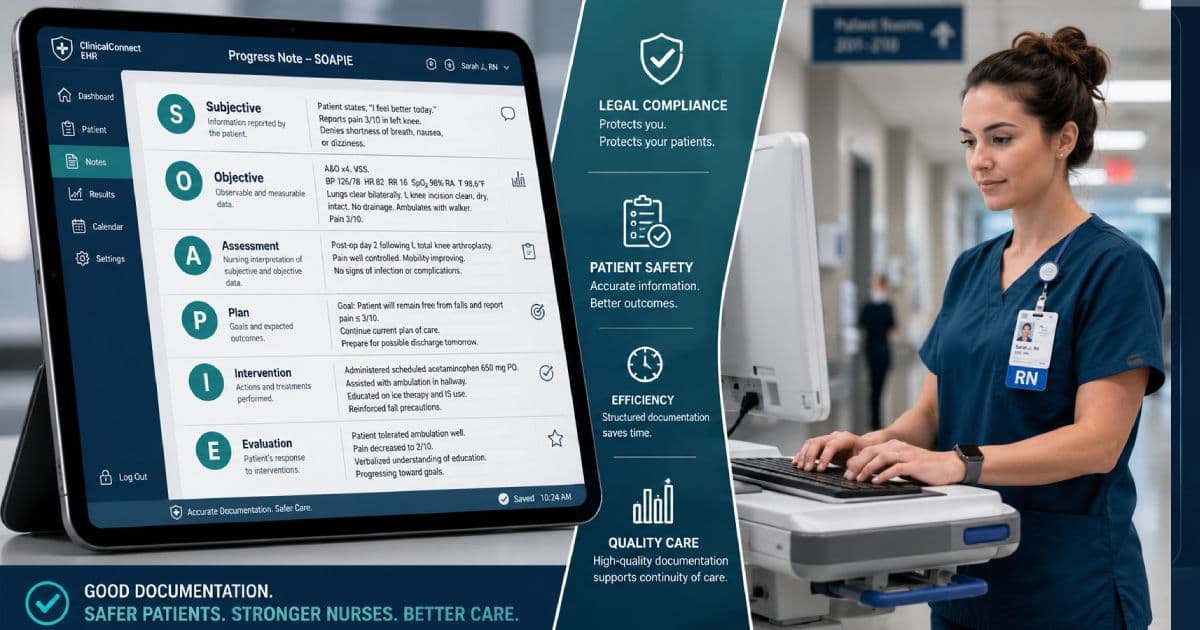
Nursing progress notes are part of the patient’s legal health record.
They show what you assessed, what changed, what you did, who you notified, what the patient said, and how the patient responded.
Good notes protect the patient.
They also protect you.
Poor notes create gaps. They make it harder for the next nurse to understand the patient’s condition. They can also make safe care look incomplete, even when the nurse did the right thing.
What are nursing progress notes?
Nursing progress notes are written documentation of a patient’s condition, nursing care, and response over time.
They may be used in:
- Hospitals
- Skilled nursing facilities
- Long-term care
- Rehab settings
- Home health
- Hospice
- Clinics
- Behavioral health
- School nursing
- Community health
- Student clinical paperwork
Progress notes may be written in different formats.
Common formats include:
- SOAP
- SOAPIE
- DAR
- PIE
- Narrative charting
- Focus notes
- Event notes
Your facility may use one format, a combination of formats, or EHR templates that do not look like a traditional note.
The purpose is the same.
You are documenting the patient’s condition and nursing care in a way that supports safe communication.
Nursing progress notes vs other charting
Progress notes are only one part of documentation.
They do not replace flowsheets, medication records, care plans, provider orders, wound photos, intake and output records, or discharge instructions.
They add clinical context.
| Documentation type | Main purpose | Example |
|---|---|---|
| Flowsheet | Structured data | Vital signs, pain score, intake/output, neuro checks |
| MAR | Medication record | Medication given, held, refused, or delayed |
| Care plan | Nursing problems and goals | Fall risk, impaired mobility, pain plan |
| Progress note | Clinical story and response | Change in condition, patient refusal, provider notification |
| Incident report | Internal safety reporting | Fall, medication variance, equipment issue |
| Discharge summary/instructions | Transition of care | Home care, medications, follow-up appointments |
Why nursing progress notes matter
Progress notes help the care team answer important questions:
- What was the patient’s status before the change?
- What cues did the nurse recognize?
- What nursing actions were taken?
- Was the provider notified?
- Did the patient improve, worsen, or refuse care?
- What needs follow-up?
- Was patient education provided?
- Did the patient understand the plan?
A clear note helps the next nurse move faster.
A vague note forces the next nurse to hunt through the chart.
The legal side
The medical record can be reviewed during:
- Quality audits
- Peer review
- Reimbursement review
- Board of nursing investigations
- Malpractice claims
- Patient complaints
- Regulatory surveys
- Transfer-of-care reviews
The old nursing phrase is still useful:
If it was not documented, it is hard to prove it was done.That does not mean you should chart defensively.
It means your note should be accurate and complete enough to show the care you provided.
The core rules of nursing documentation
Use these rules every time you write a progress note.
Rule 1: Be objective
Document what you see, hear, smell, measure, and do.
Do not document insults, assumptions, judgments, or emotional labels.
Instead of this
Patient was rude, dramatic, and noncompliant.Write this
Patient stated, "I do not want that medication because it makes me dizzy." Patient declined scheduled metoprolol after education was provided. Patient raised voice during discussion and stated, "Leave me alone." Provider notified of medication refusal and reported dizziness.The second note is safer.
It describes the behavior and clinical issue.
It does not attack the patient.
Rule 2: Be specific
Vague charting creates confusion.
Use measurable details when possible.
Vague
Patient had a small wound on foot. Dressing changed. Will monitor.Better
Right heel wound noted during dressing change. Wound bed pink with scant serous drainage on old dressing. Periwound skin intact. Cleansed with normal saline and covered with foam dressing per wound care order. Patient denied pain during dressing change. Heels offloaded with pillows.Specific does not mean long.
It means useful.
Rule 3: Chart in real time when possible
Chart as close to the event as you safely can.
Waiting too long increases the risk of:
- Missing details
- Confusing times
- Forgetting who was notified
- Charting the wrong response
- Mixing up patients
When you cannot chart right away, follow facility policy for a late entry.
Rule 4: Never chart before care is done
Do not chart medication administration, patient education, ambulation, wound care, vital signs, rounding, or reassessment before it happens.
Charting ahead is dangerous.
If the task is delayed, refused, interrupted, or never completed, the record becomes false.
Rule 5: Include the patient response
A progress note should not stop at the intervention.
It should show whether the intervention helped.
Incomplete
Pain medication administered for abdominal pain.Better
Patient reported abdominal incision pain 8/10 at 0930. Oxycodone 5 mg PO administered per PRN order. At 1030, patient reported pain 3/10 and ambulated 75 feet with walker and standby assist.The second note documents assessment, intervention, reassessment, and functional response.
Rule 6: Use approved abbreviations only
Each organization has an approved abbreviation list.
Use it.
Avoid unsafe abbreviations and dose designations.
High-risk examples include:
- U for unit
- IU for international unit
- QD or QOD
- Trailing zeros, such as 5.0 mg
- Missing leading zeros, such as .5 mg
- Unclear medication abbreviations
Safer medication wording
Insulin lispro 4 units subcutaneous administered per sliding-scale order.Not:
Lispro 4 U SQ given.Rule 7: Keep the note professional
Do not chart frustration.
Do not blame another nurse.
Do not accuse the provider.
Do not write sarcasm.
Do not use the medical record to argue.
Avoid
Night shift failed to change the dressing again.Better
Dressing found saturated with serosanguineous drainage at 0730 assessment. Dressing changed per order. Incision edges approximated. No odor noted. Provider notified of drainage amount.Rule 8: Protect privacy
Progress notes must follow privacy rules and facility policy.
Do not include information that does not belong in the chart.
Do not copy sensitive details from another patient’s chart.
Do not document gossip, family conflict, or staff opinions unless the information is clinically relevant and written professionally.
Rule 9: Write with open notes in mind
Many patients can access clinical notes electronically.
That includes notes they may read soon after the encounter.
Write notes that are clear, respectful, and factual.
This does not mean hiding important information.
It means avoiding language that sounds insulting or vague.
Avoid
Patient is manipulative and drug-seeking.Better
Patient requested IV hydromorphone for pain rated 10/10. Reviewed current PRN pain medication order with patient. Patient declined ordered acetaminophen and stated, "That does not work for me." Provider notified of pain report and medication request.Rule 10: Follow facility policy
Your school, clinical site, hospital, long-term care facility, home health agency, or clinic may have specific documentation rules.
Follow them.
This includes rules for:
- Timing
- Late entries
- Corrections
- Abbreviations
- Restraints
- Falls
- Wounds
- Incidents
- Medication refusals
- Provider notifications
- Critical labs
- Patient education
- EHR templates
- Student charting co-signatures
What belongs in a nursing progress note?
Not every note needs every item.
Use the situation.
A complete progress note may include:
- Date and time
- Reason for note
- Patient statement
- Relevant assessment findings
- Vital signs or focused data
- Nursing interventions
- Medications given, held, or refused
- Patient education
- Safety measures
- Provider notification
- Orders received
- Patient response
- Follow-up plan
What does not belong in a progress note?
Avoid:
- Personal opinions
- Blame
- Rumors
- Staffing complaints
- Incident report wording
- Legal threats
- Defensive language
- Irrelevant family drama
- Unapproved abbreviations
- Copy-pasted notes that do not match the patient
- Charting care before it happens
- Statements outside your scope
Avoid “incident report completed”
If your facility uses incident reports, do not document in the medical record that an incident report was filed unless policy says otherwise.
Document the patient’s assessment, care, notifications, and outcome.
Example:
Patient found sitting on floor beside bed at 0210. Patient alert and oriented to person, place, and time. Denies head strike. No visible bleeding noted. Reports right hip soreness 4/10. Vital signs obtained. Provider notified at 0220. Family notified per patient request. Patient assisted back to bed with mechanical lift and two staff members. Bed alarm activated, call light within reach, non-skid socks in place.Do not write:
Incident report completed for fall.unless your facility specifically requires it in the chart.
Common nursing progress note formats
Different facilities use different formats.
Learn the format your unit expects.
Then use it consistently.
SOAP notes
SOAP stands for:
- Subjective
- Objective
- Assessment
- Plan
SOAP notes are common in clinical paperwork, outpatient settings, provider notes, and some nursing documentation systems.
SOAP structure
| Section | What to include |
|---|---|
| S: Subjective | What the patient reports in their own words |
| O: Objective | Measurable or observable findings |
| A: Assessment | Your clinical assessment, problem, or nursing diagnosis |
| P: Plan | Next steps, interventions, monitoring, education, follow-up |
SOAP mini-template
S: Patient states, "_____."
O: Assessment findings: _____. Vital signs/relevant data: _____.
A: Nursing assessment/problem: _____.
P: Plan/interventions: _____. Follow-up: _____.
For a full breakdown, see NurseZee’s SOAP notes for nurses guide.
SOAPIE notes
SOAPIE adds:
- Intervention
- Evaluation
That makes it more useful for bedside nursing because it captures what the nurse did and how the patient responded.
SOAPIE structure
| Section | What to include |
|---|---|
| S | Patient report |
| O | Objective findings |
| A | Nursing assessment/problem |
| P | Plan |
| I | Interventions performed |
| E | Evaluation or response |
SOAPIE mini-template
S: Patient states, "_____."
O: _____.
A: _____.
P: _____.
I: _____.
E: _____.
DAR charting
DAR stands for:
- Data
- Action
- Response
It is also called focus charting.
DAR works well when the note is about a specific focus, problem, symptom, or event.
DAR structure
| Section | What to include |
|---|---|
| Focus | Main issue, symptom, event, or nursing concern |
| D: Data | Subjective and objective cues |
| A: Action | Nursing interventions, education, communication |
| R: Response | Patient response and follow-up |
DAR mini-template
Focus: _____.
D: _____.
A: _____.
R: _____.
For a full breakdown, see NurseZee’s DAR charting guide.
PIE charting
PIE stands for:
- Problem
- Intervention
- Evaluation
PIE charting is problem-focused.
It connects the patient problem directly to nursing care and response.
PIE structure
| Section | What to include |
|---|---|
| P: Problem | The nursing problem or change |
| I: Intervention | What the nurse did |
| E: Evaluation | Patient response or outcome |
PIE mini-template
P: _____.
I: _____.
E: _____.
Narrative charting
Narrative charting tells the clinical story in chronological order.
It is useful for complex or unusual events.
Use narrative notes for:
- Falls
- Rapid response events
- Patient refusals
- Transfers
- Behavioral events
- Provider notification sequences
- Family meetings
- Complex wound changes
- End-of-life changes
- Safety events
Narrative charting should still be objective and concise.
Narrative mini-template
At [time], [event/finding]. Patient stated, "_____." Assessment showed _____. Nursing actions included _____. Provider/family/team notified at [time]. New orders/plan: _____. Patient response: _____. Follow-up: _____.Nursing progress note examples
Use these examples to learn structure.
Do not copy them into a real chart unless the details are true for your patient and match your facility policy.
Example 1: Shortness of breath using SOAPIE
Scenario
A patient suddenly reports shortness of breath.
Note
S: Patient states, "I cannot catch my breath and my chest feels heavy."

O: Respiratory rate 26/min and shallow. SpO2 88% on room air. Crackles auscultated in bilateral lung bases. Accessory muscle use noted. Skin cool and diaphoretic. Patient sitting upright at bedside.

A: Acute change in respiratory status with hypoxia.

P: Improve oxygenation, reduce work of breathing, notify provider, and continue close monitoring.

I: Head of bed elevated to high-Fowler's position. Oxygen applied at 3 L/min via nasal cannula per protocol/order. Provider notified at 1410 of respiratory status, SpO2, lung sounds, and patient report. Continuous pulse oximetry initiated per unit protocol.

E: At 1430, patient states, "It is easier to breathe now." SpO2 improved to 94% on 3 L/min nasal cannula. Respiratory rate 18/min, regular. Patient remains in high-Fowler's position. Will continue to monitor and follow provider orders.
Why it works
The note includes the patient statement, objective respiratory findings, nursing actions, provider notification, and patient response.Example 2: Post-op pain using DAR
Scenario
A post-op patient reports incisional pain and needs reassessment after pain medication.
Note
Focus: Post-operative incisional pain

D: Patient reports sharp abdominal incision pain rated 8/10. Patient grimacing and guarding abdomen. Refuses to ambulate at this time due to pain. Incision dressing dry and intact.

A: Administered oxycodone 5 mg PO per PRN order at 0930. Encouraged patient to splint incision with pillow when coughing, repositioning, and ambulating. Reviewed plan to reassess pain within 60 minutes.

R: At 1030, patient reports pain decreased to 3/10. Facial muscles relaxed. Patient ambulated 50 feet in hallway with walker and standby assist without increased distress.
Why it works
The note does not only say medication was given. It shows reassessment and functional improvement.Example 3: Medication refusal using narrative charting
Scenario
A patient refuses scheduled antihypertensive medication.
Note
At 0900, scheduled metoprolol succinate 50 mg PO was offered to patient. Patient refused medication and stated, "It makes me too dizzy in the morning." Blood pressure 138/82, heart rate 72/min prior to refusal. Education provided regarding medication purpose, ordered schedule, and risk of stopping medication without provider guidance. Patient verbalized understanding and stated, "I still do not want it today." Medication held due to refusal. Provider notified at 0915 of refusal and patient-reported dizziness. Will continue to monitor blood pressure and symptoms.Why it works
The note documents the medication, patient reason, education, refusal after education, provider notification, and follow-up plan.Example 4: Fall event using narrative charting
Scenario
A patient is found sitting on the floor next to the bed.
Note
At 0210, patient found sitting on floor beside bed. Patient alert and oriented to person, place, and time. Patient states, "I tried to go to the bathroom by myself." Patient denies head strike, dizziness, chest pain, or shortness of breath. No visible bleeding noted. Reports right hip soreness 4/10. Vital signs: BP 132/78, HR 88/min, RR 18/min, SpO2 96% on room air. Neuro checks within patient baseline. Provider notified at 0220. Patient assisted back to bed with mechanical lift and two staff members. Bed alarm activated, call light placed within reach, non-skid socks on, toileting offered. Patient educated to call for assistance before getting out of bed. Patient verbalized understanding.Why it works
The note focuses on assessment, patient statement, safety interventions, notification, and education. It does not mention blame or internal incident reporting.Example 5: Wound dressing change using DAR
Scenario
A nurse changes a wound dressing and notes drainage.
Note
Focus: Sacral wound dressing change

D: Sacral wound dressing removed at 1000 with moderate serosanguineous drainage noted on old dressing. Wound bed pink and moist with small area of yellow slough at wound edge. Periwound skin intact with mild blanchable redness. Patient reports wound pain 2/10 during dressing change.

A: Wound cleansed with normal saline. Barrier film applied to periwound skin. Foam dressing placed per wound care order. Patient repositioned to left side with pillows. Education provided on turning schedule and use of call light for repositioning assistance.

R: Patient tolerated dressing change without increased pain. Patient states, "This position feels better." Call light within reach. Next dressing change due per order or sooner if dressing becomes soiled.
Why it works
The note gives useful wound observations without overstepping into a diagnosis. It includes wound care, repositioning, education, and response.Example 6: Provider notification using SBAR-style note
Scenario
The nurse calls the provider about worsening urine output.
Note
At 1605, provider notified by phone using SBAR regarding decreased urine output. Situation: urine output 20 mL over past 2 hours. Background: patient is post-op day 1 after abdominal surgery with indwelling urinary catheter. Assessment: urine amber, catheter tubing without kinks, bladder not distended on palpation, BP 96/58, HR 108/min, mucous membranes dry. Recommendation/request: provider asked to review fluid status and urine output. New order received for 500 mL normal saline bolus IV and basic metabolic panel. Orders read back and verified. Bolus started at 1615.Why it works
The note shows what was communicated, why it mattered, what assessment was done first, and what order was received.Example 7: Patient education note
Scenario
A nurse teaches a patient how to use an incentive spirometer.
Note
Patient educated on incentive spirometer use, including sitting upright, sealing lips around mouthpiece, inhaling slowly, holding breath briefly, and using device 10 times per hour while awake as ordered. Demonstration provided. Patient returned demonstration correctly x3 and reached 1,000 mL. Patient states, "I understand I need to use this every hour while I am awake." Splinting incision with pillow reviewed. Will reinforce teaching during rounds.Why it works
The note documents what was taught, patient return demonstration, patient understanding, and follow-up.Example 8: Anxiety and therapeutic communication
Scenario
A patient is anxious before a procedure.
Note
Patient sitting upright in bed, wringing hands, and asking repeated questions about scheduled procedure. Patient states, "I am scared something will go wrong." Respirations 20/min, unlabored. Provided quiet environment, encouraged patient to express concerns, and reviewed pre-procedure steps within nursing scope. Offered to contact provider for additional questions about procedural risks and consent. Patient requested provider discussion. Provider notified at 0745. Patient remains NPO as ordered.Why it works
The note describes observable anxiety cues and nursing actions without labeling the patient as difficult or dramatic.Example 9: Hypoglycemia event
Scenario
A patient reports shakiness and blood glucose is low.
Note
At 1135, patient reported feeling "shaky and sweaty." Skin cool and diaphoretic. Point-of-care blood glucose 58 mg/dL. Patient alert and able to swallow. Hypoglycemia protocol initiated. Patient given 15 g oral glucose at 1140. Blood glucose rechecked at 1155: 76 mg/dL. Patient states, "I feel better now." Meal tray provided. Provider notified per protocol. Will continue to monitor.Why it works
The note includes symptom cues, glucose values, protocol-based intervention, reassessment, patient response, and follow-up.Example 10: Change in mental status
Scenario
A patient becomes newly confused.
Note
At 1840, patient noted attempting to climb out of bed and stating, "I need to go to the store." Patient previously alert and oriented x4 at 1600 assessment. Current assessment: oriented to name only, speech clear, grips equal bilaterally, pupils equal and reactive, blood glucose 104 mg/dL, SpO2 95% on room air. Bed alarm activated, fall precautions maintained, and patient reoriented. Provider notified at 1850 of acute change in mental status and assessment findings. New orders received for urinalysis and CBC. Family notified per patient preference documented in chart.Why it works
The note identifies a change from baseline, includes focused assessment data, documents safety actions, and shows escalation.Quick progress note templates
Use these as study templates.
Always adjust for your patient, facility policy, and scope.
General progress note template
Date/time: _____.
Reason for note: _____.
Patient statement: "_____."
Assessment findings: _____.
Nursing actions: _____.
Provider/team notified: _____.
Patient response: _____.
Follow-up plan: _____.
Change in condition template
At [time], patient noted/reported _____.
Focused assessment: _____.
Vital signs/relevant data: _____.
Nursing interventions: _____.
Provider notified at [time] with _____.
Orders received/actions taken: _____.
Patient response/reassessment: _____.
Plan: _____.
Pain note template
Patient reports [location/type] pain rated __/10.
Associated findings: _____.
Intervention: _____.
Nonpharmacologic measures: _____.
Reassessment at [time]: pain __/10.
Functional response: _____.
Plan: _____.
Medication refusal template
Scheduled medication [name/dose/route] offered at [time].
Patient refused and stated, "_____."
Relevant assessment/vital signs: _____.
Education provided regarding _____.
Patient verbalized _____.
Provider/pharmacist notified at [time] if indicated.
Medication held due to refusal.
Follow-up plan: _____.
Provider notification template
Provider notified at [time] regarding _____.
Information reported: _____.
Focused assessment: _____.
Current vital signs/relevant data: _____.
Orders received/no new orders: _____.
Read-back completed if applicable.
Patient updated as appropriate.
Follow-up plan: _____.
Patient education template
Education provided regarding _____.
Teaching method: verbal instruction/demonstration/written instructions/video/interpreter.
Patient/caregiver response: _____.
Return demonstration: _____.
Barriers to learning: _____.
Plan to reinforce: _____.
Wound note template
Wound location: _____.
Old dressing: _____.
Wound appearance: _____.
Drainage: _____.
Periwound skin: _____.
Pain: _____.
Care provided: _____.
Patient response: _____.
Follow-up: _____.
Fall note template
At [time], patient found _____.
Patient statement: "_____."
Assessment findings: _____.
Injury noted/denied: _____.
Vital signs/neuro checks: _____.
Provider notified: _____.
Family notified if appropriate: _____.
Safety actions: _____.
Patient response: _____.
Follow-up plan: _____.
How to write a nursing progress note step by step
Step 1: Identify the reason for the note
Do not start writing until you know the focus.
Common reasons include:
- Routine shift update
- New symptom
- Pain reassessment
- Fall
- Medication refusal
- Patient education
- Wound care
- Change in vital signs
- Critical lab
- Provider notification
- Family communication
- Discharge teaching
- Transfer to another unit
Ask yourself
Why am I writing this note?Step 2: Gather the relevant facts
Before writing, collect the data.
That may include:
- Patient quote
- Vital signs
- Pain score
- Focused assessment
- Medication details
- Lab values
- Intake/output
- Wound appearance
- Safety status
- Provider response
- Patient response
Do not chart from memory if the EHR contains exact times and values.
Check the record.
Step 3: Choose the format
Use the required format if your facility requires one.
If not, choose the format that fits the event.
| Situation | Good format |
|---|---|
| Symptom with assessment and plan | SOAP or SOAPIE |
| Focused bedside issue | DAR |
| Active nursing problem | PIE |
| Complex event timeline | Narrative |
| Provider call | SBAR-style narrative |
Step 4: Write the patient’s words when useful
Use quotes for important statements.
Examples:
Patient states, "My chest feels tight."Patient states, "I do not want the medication because it makes me dizzy."Patient states, "I fell when I tried to reach the bathroom."Quotes help separate patient-reported symptoms from nurse observations.
Step 5: Add objective findings
Objective findings include:
- Vital signs
- Oxygen saturation
- Lung sounds
- Skin findings
- Wound measurements
- Drainage amount
- Neuro status
- Mobility status
- Behavior observed
- Intake/output
- Blood glucose
- Relevant labs
Do not overload the note with every normal finding.
Include what matters to the issue.
Step 6: Document what you did
Include nursing actions.
Examples:
- Elevated head of bed
- Applied oxygen per order/protocol
- Administered PRN medication
- Held medication due to refusal or parameter
- Initiated fall precautions
- Reinforced dressing
- Educated patient
- Notified provider
- Rechecked vital signs
- Repositioned patient
- Started protocol
- Escalated to charge nurse or rapid response
Step 7: Document communication clearly
When you notify someone, include:
- Who was notified
- Time of notification
- What was reported
- Orders or recommendations received
- If no new orders were given
- Read-back if applicable
Example
Provider notified at 2215 of temperature 38.8°C, heart rate 118/min, blood pressure 94/56, and new confusion. New orders received for blood cultures x2, lactate, CBC, IV fluids, and broad-spectrum antibiotic. Orders read back and verified.Step 8: Reassess and document response
Evaluation closes the loop.
Examples:
- Pain decreased from 8/10 to 3/10
- SpO2 improved from 88% to 94%
- Patient demonstrated inhaler technique correctly
- Dressing remained dry and intact
- Patient continued to refuse medication
- Patient transferred to higher level of care
- Provider at bedside
- Rapid response team assumed care
Step 9: Reread before signing
Before signing the note, check:
- Is the patient correct?
- Are times correct?
- Are medication names and doses correct?
- Are abbreviations approved?
- Is the note objective?
- Did I document patient response?
- Did I avoid blame or judgment?
- Does this note match the flowsheet and MAR?
Bad vs better nursing note examples
These examples show how to improve weak charting.
Example: “Doing well”
Weak
Patient doing well today. No problems.Better
Patient alert and oriented x4. Denies pain, shortness of breath, nausea, or dizziness. Ambulated 150 feet in hallway with walker and standby assist. Tolerated breakfast without nausea. Call light within reach.Example: “Sleeping peacefully”
Weak
Patient sleeping peacefully.Better
Patient lying in bed with eyes closed. Respirations even and unlabored at 16/min. No grimacing, guarding, or restlessness observed. Call light within reach.Example: “Noncompliant”
Weak
Patient noncompliant with diabetes diet.Better
Patient ate candy bar brought by visitor after education on ordered carbohydrate-controlled diet. Patient states, "I know it raises my sugar, but I wanted it." Blood glucose before lunch 238 mg/dL. Diabetes diet education reinforced. Provider/dietitian notified per care plan.Example: “Combative”
Weak
Patient became combative.Better
Patient shouted, "Do not touch me," and swung right arm toward nurse when blood pressure cuff was applied. Nurse stepped back and maintained safe distance. Charge nurse notified. Patient reapproached after 10 minutes with second staff member present. Patient agreed to vital signs at 1515.Example: “Provider aware”
Weak
MD aware.Better
Dr. Lopez notified by phone at 1710 of potassium 2.9 mEq/L, telemetry showing frequent PVCs, and patient report of muscle weakness. New order received for potassium replacement protocol and repeat potassium level after replacement. Orders read back and verified.Example: “Will continue to monitor”
Weak
Patient dizzy. Will continue to monitor.Better
Patient reported dizziness when standing from chair at 1035. Assisted back to sitting position. Blood pressure 118/72 lying, 92/58 standing; heart rate increased from 78/min to 104/min. Fall precautions reinforced. Provider notified at 1045. Patient instructed to call for assistance before standing. Call light within reach.“Will continue to monitor” is not wrong by itself.
It is just not enough when the patient has a clinically important change.
Documentation for common nursing situations
Pain reassessment
Pain notes should include more than a number.
Include:
- Pain location
- Quality
- Severity
- Intervention
- Reassessment time
- Patient response
- Functional impact
Example:
Patient reported left knee pain 7/10, aching, worse with movement. Acetaminophen 650 mg PO administered per PRN order at 1300. Ice pack applied to left knee for 20 minutes. At 1400, patient reports pain 3/10 and transfers from bed to chair with minimal assistance.Medication given late
If a medication is delayed, document the reason according to policy.
Example:
Scheduled antibiotic due at 1400 administered at 1455 due to loss of IV access. New peripheral IV inserted at 1445 in left forearm with brisk blood return and flushes without resistance. Antibiotic infusion started at 1455. Provider notified per facility policy.Medication held
Include the reason.
Example:
Scheduled lisinopril 10 mg PO held at 0900 per order parameter due to blood pressure 88/52. Patient denies dizziness or chest pain. Provider notified at 0910. Oral fluids encouraged as appropriate. Blood pressure to be rechecked in 30 minutes.Patient refusal
A refusal note should show that the patient had information and still refused.
Include:
- What was offered
- What the patient said
- Education provided
- Patient understanding
- Notification if needed
- Follow-up plan
Do not write “patient refused” and stop.
Critical lab value
Example:
Critical potassium 6.2 mEq/L reported by lab at 0635. Patient on telemetry; rhythm sinus rhythm with peaked T waves noted. Patient denies chest pain, palpitations, or shortness of breath. Provider notified at 0640. New orders received for stat ECG, calcium gluconate IV, insulin with dextrose, and repeat potassium level. Orders read back and verified.Patient education
Education notes should show more than “teaching done.”
Include:
- Topic
- Method
- Learner
- Understanding
- Return demonstration if applicable
- Barriers
- Reinforcement plan
Example:
Discharge teaching provided to patient and spouse regarding wound care, signs of infection, medication schedule, activity restrictions, and follow-up appointment. Written instructions reviewed. Patient demonstrated dressing change steps correctly using clean technique. Patient and spouse verbalized when to call provider for fever, increased redness, drainage, uncontrolled pain, or wound opening.Family communication
Document family communication when clinically relevant and allowed.
Example:
With patient permission, daughter updated by phone at 1730 regarding plan for discharge tomorrow, home health referral, and need for walker. Daughter verbalized understanding and stated she will arrive at 1100 for discharge teaching.Behavioral or safety event
Focus on observable behavior and safety actions.
Example:
Patient pacing in hallway and yelling, "I need to leave now." Patient attempted to push exit door. Staff used calm voice and redirected patient to room. Charge nurse notified. Patient declined offered snack and toileting. Provider notified at 2045. One-to-one observation initiated per order. Patient currently sitting in chair with staff present.Restraint documentation
Follow facility policy exactly.
Restraint documentation often requires:
- Reason for restraint
- Alternatives attempted
- Order details
- Type of restraint
- Neurovascular checks
- Skin checks
- Range of motion
- Nutrition/hydration
- Toileting
- Release trials
- Ongoing need
- Patient/family education
Do not use restraints for staff convenience.
Sepsis concern
Example:
At 1230, patient noted with temperature 39.1°C, HR 124/min, RR 28/min, BP 88/50, and new confusion. Skin warm and flushed. Urine output 20 mL over past 2 hours. Charge nurse notified. Provider notified at 1235 of vital signs, mental status change, urine output, and suspected infection source. Sepsis protocol initiated per facility policy. Blood cultures and lactate obtained as ordered. IV fluid bolus started at 1250. Patient remains on continuous monitoring.Transfer to higher level of care
Example:
Patient transferred to ICU at 1815 due to worsening respiratory distress and increased oxygen requirement. Report given to ICU RN, including current oxygen settings, vital signs, recent ABG results, medications administered, provider notifications, pending labs, and family contact. Patient transported with respiratory therapist and charge nurse on cardiac monitor and oxygen. Patient tolerated transfer without acute event.Nursing progress notes and clinical judgment
Progress notes should reflect clinical judgment.
That does not mean writing a long essay.
It means documenting the cues, action, and response.
The NCSBN clinical judgment model includes:
- Recognize cues
- Analyze cues
- Prioritize hypotheses
- Generate solutions
- Take action
- Evaluate outcomes
Progress notes often show those steps in real care.
Example clinical judgment flow
Cue: SpO2 decreased from 95% to 88% on room air.
Analysis: New oxygenation problem.
Priority: Breathing concern.
Action: Elevate head of bed, apply oxygen per order/protocol, notify provider.
Evaluation: SpO2 improved to 94%, respiratory rate decreased, patient reports easier breathing.
This same thinking helps with NCLEX questions.
For NCLEX clinical judgment practice, see NurseZee’s NCLEX prioritization guide and NCLEX prep guide.
You can also practice with NurseZee’s NCLEX-style practice questions.
Nursing progress notes for students
Student nurses often write longer notes because instructors want to see thinking.
That is normal.
But clinical documentation still needs to be objective and professional.
Student note tips
- Follow your instructor’s required format.
- Do not use patient identifiers in assignments.
- Use initials or assigned patient numbers if required by school policy.
- Do not copy and paste from the EHR into school documents unless allowed.
- Do not take photos of the chart.
- Protect patient privacy.
- Ask your nurse before documenting in the live EHR.
- Know whether your note needs co-signature.
- Use your clinical paperwork to practice concise, safe documentation.
Student SOAPIE example
S: Patient states, "My incision hurts when I move."

O: Patient guarding abdomen when repositioning. Pain 6/10 at incision site. Incision dressing clean, dry, and intact. Vital signs stable.

A: Acute post-operative incisional pain.

P: Support pain control and mobility as ordered.

I: Assisted patient to splint abdomen with pillow during repositioning. Notified primary nurse of pain report. Primary nurse administered ordered PRN pain medication.

E: Patient reported pain decreased to 3/10 after medication reassessment by primary nurse and was able to sit at edge of bed with assistance.Late entries and corrections
Mistakes happen.
How you correct them matters.
Late entries
A late entry should clearly show:
- Current date and time of entry
- Actual time the care occurred
- Factual documentation
- Reason if required by policy
Late entry example
Late entry documented at 1500 for care provided at 1030: Patient reported nausea after breakfast. Ondansetron 4 mg PO administered per PRN order at 1035. At 1135, patient denied nausea and tolerated oral fluids.Follow facility policy.
Do not backdate the note.
Do not make it look like you charted earlier than you did.
Correcting paper charting errors
If your setting still uses paper documentation, common rules include:
- Draw one line through the error.
- Write “error” if required.
- Add correct information.
- Initial and date/time the correction.
- Do not erase.
- Do not use correction fluid.
- Do not scribble over the error.
Follow facility policy.
Correcting EHR errors
For EHR corrections, use the chart’s correction, addendum, or amendment function.
Do not delete information outside the approved workflow.
If you document in the wrong chart, report it immediately according to policy.
Open notes and patient-accessible charting
Many patients can read their clinical notes through patient portals.
That changes how nurses should think about tone.
It does not change the need to document truthfully.
Write notes patients can understand
Use respectful, factual language.
Avoid labels when facts are better.
Instead of “noncompliant”
Patient declined insulin dose after education and stated, "I do not want insulin because I am afraid my sugar will drop." Reviewed current blood glucose and ordered insulin scale. Patient verbalized understanding and continued to decline. Provider notified.Instead of “poor historian”
Patient unable to recall names or doses of home medications. Patient states medication list is at home. Daughter contacted with patient permission and will bring medication list today.Instead of “drug-seeking”
Patient requested IV hydromorphone and declined ordered oral acetaminophen, stating, "Only IV medication works." Provider notified of pain report and medication request.Use plain language when possible
You can still use medical terms.
But avoid unclear shorthand that patients and future clinicians may misunderstand.
Do not soften dangerous findings
Respectful charting does not mean minimizing risk.
If the patient threatens harm, refuses critical care, has unsafe behavior, or shows clinical decline, document it clearly and objectively.
Progress notes and privacy
Nurses handle protected health information every shift.
Progress notes should include information needed for care.
They should not include unnecessary private details.
Examples of privacy-conscious charting
Avoid unnecessary detail
Patient's cousin told nurse about patient's divorce and financial problems.Better if clinically relevant
Patient tearful and states, "I am worried about paying for medications after discharge." Social work consult requested per discharge planning protocol.Do not include another patient’s information
Never write:
Patient became upset because roommate in bed B was yelling.Write:
Patient reports difficulty resting due to environmental noise. Earplugs offered and door partially closed per patient preference.Progress notes in EHRs
Electronic health records make documentation faster.
They also create new risks.
EHR charting risks
Watch for:
- Copy-forward errors
- Wrong-patient charting
- Autopopulated fields that are outdated
- Clicking normal findings without assessing
- Excessive templated text
- Notes that contradict flowsheets
- Hidden free-text boxes
- Alert fatigue
- Time stamps that do not match care
EHR checklist before signing
Correct patient?
Correct encounter?
Correct date and time?
Note matches flowsheets?
Note matches MAR?
Provider notification documented clearly?
Patient response included?
No unsafe abbreviations?
No copied text that does not apply?
Copy and paste caution
Copying previous notes can save time.
It can also spread errors.
Never copy-forward a note unless you verify every detail.
If the patient’s status changed, the note must show the change.
Progress notes and handoff
Good notes improve handoff.
But a progress note does not replace bedside report, SBAR calls, or urgent communication.
If the patient is unstable, do not only chart it.
Get help.
Then document.
Use SBAR for urgent communication
SBAR stands for:
- Situation
- Background
- Assessment
- Recommendation or request
SBAR call example
Situation: Patient's SpO2 is 88% on room air and patient reports chest heaviness.
Background: Patient admitted with pneumonia, previously on room air with SpO2 95%.
Assessment: Respiratory rate 26/min, crackles at bases, accessory muscle use.
Recommendation/request: Request provider evaluation and orders for oxygen, chest imaging, and further workup as indicated.
Documentation after SBAR
Provider notified at 1410 using SBAR regarding new hypoxia and chest heaviness. Reported current vital signs, lung sounds, oxygen saturation trend, and nursing interventions. New orders received for oxygen to maintain SpO2 above ordered goal, stat chest x-ray, and arterial blood gas. Orders read back and verified.Common mistakes in nursing progress notes
Mistake 1: Charting vague statements
Avoid:
Patient stable.Better:
Patient alert and oriented x4. Respirations even and unlabored. Denies chest pain or shortness of breath. Ambulates to bathroom with cane and standby assist.Mistake 2: Forgetting reassessment
If you intervene, reassess when appropriate.
Pain medication, oxygen, hypoglycemia treatment, antiemetics, positioning, and safety interventions often need follow-up.
Mistake 3: Not documenting notification
If you call the provider, charge nurse, respiratory therapist, wound nurse, pharmacist, or rapid response team, document it.
Include time and response.
Mistake 4: Using judgmental terms
Avoid:
- Noncompliant
- Drug-seeking
- Difficult
- Manipulative
- Lazy
- Dramatic
- Frequent flyer
- Crazy
- Refuses to cooperate
Use objective facts instead.
Mistake 5: Writing too much irrelevant detail
Long notes can hide the important issue.
Do not write a full body-system assessment in a note about a medication refusal unless those details matter.
Mistake 6: Writing too little
A note that says “MD aware” or “patient okay” does not tell the next nurse enough.
Mistake 7: Charting blame
Do not document staff conflict.
Document patient care.
Mistake 8: Charting outside your scope
Nurses assess, monitor, intervene within scope, educate, notify, and evaluate.
Do not document medical diagnoses unless already diagnosed by a provider or clearly part of the chart.
Avoid
Patient is having a pulmonary embolism.Better
Patient reports sudden shortness of breath and sharp chest pain. SpO2 88% on room air, HR 122/min. Provider notified immediately; rapid response called per protocol.Mistake 9: Conflicting with the flowsheet
If the flowsheet says pain was 8/10 and the note says pain was 3/10 at the same time, the chart looks unreliable.
Check your times.
Mistake 10: Waiting until the end of shift for everything
End-of-shift catch-up charting leads to errors.
Chart important events and changes as soon as safely possible.
Nursing progress note cheat sheet
Always include for a change in condition
- Time of change
- Patient statement
- Focused assessment
- Vital signs
- Relevant data
- Nursing interventions
- Provider notification
- Orders or plan
- Patient response
- Follow-up monitoring
Always include for pain
- Location
- Rating
- Quality if relevant
- Intervention
- Reassessment
- Functional response
Always include for refusal
- What was refused
- Patient reason
- Education provided
- Patient understanding
- Provider notification if needed
- Follow-up plan
Always include for education
- Topic
- Method
- Learner
- Understanding
- Return demonstration when applicable
- Reinforcement plan
Always include for safety events
- What happened
- Assessment findings
- Injury status
- Safety actions
- Notifications
- Patient response
- Ongoing precautions
Avoid
- Blame
- Sarcasm
- Opinions
- Unsafe abbreviations
- Copy-paste errors
- Charting ahead
- “MD aware” without details
- “Will monitor” without action
- Patient labels instead of behaviors
Frequently asked questions about nursing progress notes
What are nursing progress notes?
Nursing progress notes are written documentation of a patient’s condition, nursing care, communication, education, and response over time. They help the care team understand what changed and what was done.
What is the best format for nursing progress notes?
There is no single best format for every setting. SOAP and SOAPIE work well for clinical reasoning. DAR works well for focused bedside issues. PIE works well for problem-based charting. Narrative charting works well for complex events and timelines.
What is the difference between SOAP and DAR charting?
SOAP separates subjective data, objective data, assessment, and plan. DAR organizes the note around a focus and documents data, action, and response. SOAP is often more assessment-plan oriented. DAR is often faster for focused nursing events.
Should nurses write progress notes every shift?
Follow facility policy. Some settings require a shift note. Others rely on flowsheets unless there is a change, event, education need, provider notification, or exception. Even when a shift note is not required, important changes still need documentation.
What should I write in a routine nursing note?
A routine note may include the patient’s general status, pain, mobility, safety, education, tolerance of care, and any follow-up needs. Avoid repeating every normal flowsheet item unless your facility requires it.
How do I chart a patient refusal?
Document what was offered, what the patient refused, the patient’s stated reason, education provided, the patient’s response, any provider notification, and the follow-up plan. Do not argue in the note.
Can patients read nursing progress notes?
Many patients can access clinical notes electronically through patient portals. Write notes that are respectful, factual, and understandable while still documenting clinically important information.
What should I avoid in nursing progress notes?
Avoid opinions, insults, blame, vague phrases, unapproved abbreviations, incident report references unless required, and documentation of care before it happens.
What does “objective charting” mean?
Objective charting means documenting observable and measurable facts. Instead of writing “patient was angry,” describe what the patient said or did, such as “patient shouted, ‘Leave me alone,’ and declined vital signs.”
How do I correct a nursing note error?
Follow facility policy. In paper records, corrections often require a single line through the error, initials, date/time, and correct entry. In EHRs, use the approved addendum, correction, or amendment function.
How do I write a late entry?
Label it as a late entry according to policy, include the current date/time, state the actual time care occurred, and document facts. Do not backdate the entry or make it appear as if it was charted earlier.
Should I chart “will continue to monitor”?
You can use it, but it should not replace specific actions. If a patient had a change in condition, document what you assessed, what you did, who you notified, and what follow-up is planned.
Can nursing progress notes be used in court?
Yes. The medical record can be reviewed in legal, regulatory, and quality investigations. Accurate, timely, objective documentation is important.
What is a good nursing progress note example for pain?
A good pain note includes pain rating, location, intervention, reassessment, and functional response. Example: “Patient reported abdominal pain 8/10. Oxycodone 5 mg PO administered per PRN order. At reassessment, pain 3/10 and patient ambulated 50 feet with walker.”
Do students need to write nursing progress notes?
Many nursing students write progress notes for clinical paperwork. Some also document in the live EHR under supervision. Follow your school, instructor, and facility policy.
Final thoughts
Progress notes do not need to be fancy.
They need to be clear.
Write what happened, what you assessed, what you did, who you notified, how the patient responded, and what needs follow-up.
That is the heart of safe nursing documentation.
A good note helps the next nurse.
It supports continuity of care.
It shows your clinical judgment.
And it keeps the chart focused on the patient, where it belongs.
Sources and references
- American Nurses Association: Principles for Nursing Documentation
- HHS: HIPAA Minimum Necessary Requirement
- ONC: Cures Act Final Rule
- CMS/eCFR: 42 CFR 482.24 Medical Record Services
- The Joint Commission: Do Not Use List of Abbreviations
- ISMP: List of Error-Prone Abbreviations, Symbols, and Dose Designations
- AHRQ TeamSTEPPS: SBAR Tool
- NCSBN/NCLEX: Clinical Judgment Measurement Model
- NurseZee: SOAP Notes for Nurses
- NurseZee: DAR Charting for Nurses
- NurseZee: Nursing Diagnosis Guide
- NurseZee: NCLEX Prioritization Questions
- NurseZee: NCLEX Prep