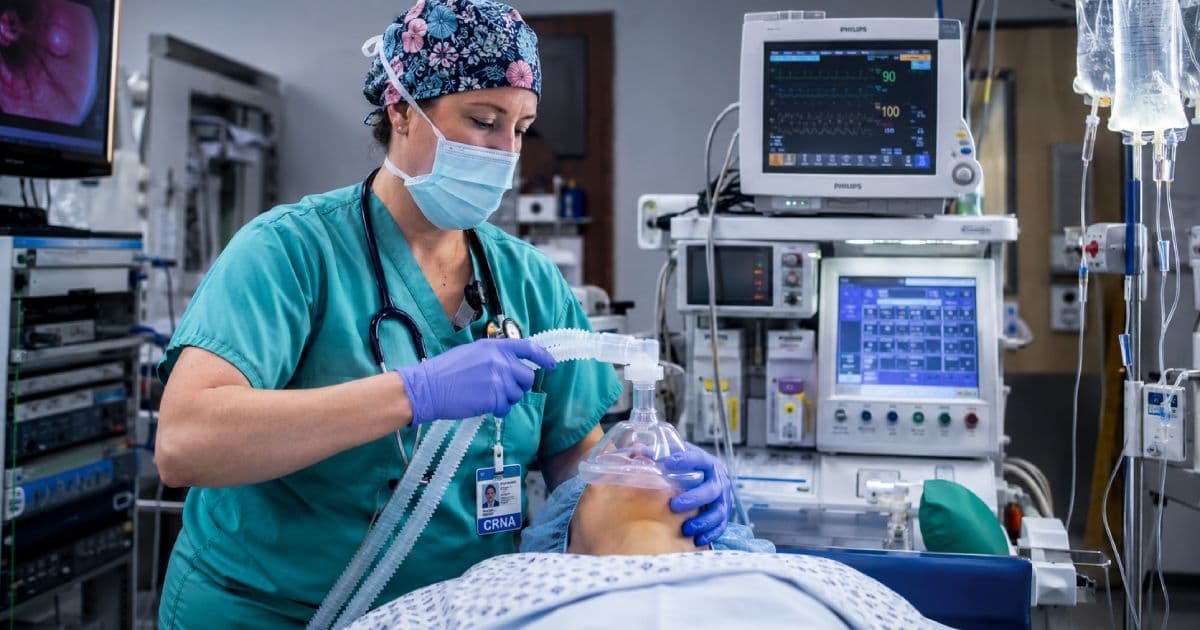
CRNA is one of the highest-responsibility paths in nursing.
You are not just “putting people to sleep.” You are protecting oxygenation, ventilation, circulation, pain control, temperature, emergence, and safety during some of the most vulnerable minutes of a patient’s life.
That is why the path is demanding.
To become a Certified Registered Nurse Anesthetist, you need a strong RN foundation, high-acuity critical care experience, doctoral nurse anesthesia education, national certification, state licensure or APRN recognition, and the judgment to handle rapidly changing physiology under pressure.
This guide gives you the full roadmap: requirements, ICU experience, GPA, CCRN, shadowing, application strategy, CRNA school, NBCRNA certification, salary, opt-out states, financing, and first-job planning.
What is a CRNA?
A Certified Registered Nurse Anesthetist, or CRNA, is an advanced practice registered nurse who provides anesthesia and anesthesia-related care.
CRNAs care for patients before, during, and after procedures requiring anesthesia, sedation, airway management, pain control, and physiologic monitoring.
CRNAs may provide care in:
- Hospital operating rooms
- Obstetric units
- Critical access hospitals
- Ambulatory surgery centers
- Endoscopy suites
- Interventional radiology
- Cardiac cath labs
- Emergency and trauma settings
- Pain management settings
- Dental and oral surgery offices
- Plastic surgery offices
- Military, VA, and federal facilities
- Rural and underserved hospitals
- Ketamine or procedural sedation settings, where allowed by law and policy
AANA says CRNAs practise in every setting where anesthesia is delivered and notes that more than 67,000 CRNAs/nurse anesthesiologists work in practice settings of every type.
Official source:
What CRNAs do
CRNA work spans the perioperative and procedural continuum.
Pre-anesthesia
CRNAs may:
- Review health history
- Assess airway
- Review labs and diagnostics
- Identify anesthesia risks
- Discuss anesthesia plan and consent processes as appropriate
- Plan airway, access, monitoring, and medication strategy
- Coordinate with surgeon/proceduralist and care team
- Prepare equipment and emergency medications
Intra-anesthesia
CRNAs may:
- Induce anesthesia
- Manage airway and ventilation
- Place or manage invasive monitoring according to training, role, and facility policy
- Titrate anesthetic agents, opioids, adjuncts, fluids, and vasoactive medications
- Monitor hemodynamics and oxygenation continuously
- Respond to hypotension, hypertension, arrhythmias, bleeding, bronchospasm, aspiration risk, difficult airway, malignant hyperthermia, and other emergencies
- Provide regional anesthesia or peripheral nerve blocks where trained, credentialed, and allowed
- Maintain documentation and communicate with the surgical/procedural team
Post-anesthesia
CRNAs may:
- Guide emergence
- Transfer care to PACU or ICU
- Manage immediate post-anesthesia complications
- Address pain and nausea/vomiting prevention
- Support safe handoff and follow-up
- Participate in quality review and adverse-event analysis
CRNA vs anesthesiologist
CRNAs and anesthesiologists both provide anesthesia care, but they reach the role through different professional routes.
| Factor | CRNA | Anesthesiologist |
|---|---|---|
| Professional pathway | RN → critical care experience → doctoral nurse anesthesia program → NBCRNA certification | Medical school → anesthesiology residency → medical board pathway |
| Credential | Certified Registered Nurse Anesthetist | MD or DO physician anesthesiologist |
| Training model | Advanced practice nursing and nurse anesthesia | Medical and surgical specialty training |
| Practice settings | OR, OB, ASC, rural hospitals, procedural areas, military, VA, office-based settings | OR, ICU, pain, perioperative medicine, procedural settings, academic medicine |
| Practice model | Independent, collaborative, or anesthesia care team depending on state law and facility policy | Independent physician practice and/or anesthesia care team leadership depending on setting |
| Scope and authority | State law, APRN rules, facility bylaws, credentialing, and payer rules | State medical license, specialty training, hospital privileges, payer rules |
CRNA practice models and opt-out states
Some CRNAs practise independently. Others practise in anesthesia care team models with anesthesiologists. Others work in collaborative models that vary by hospital, state, and employer.
AANA’s opt-out fact sheet says 25 states and Guam have opted out of the federal Medicare physician supervision requirement as of 2026.
Official sources:
Important nuance:
- Opt-out applies to a federal Medicare/Medicaid physician supervision requirement for certain facility reimbursement conditions.
- Opt-out does not automatically erase state scope-of-practice law, facility bylaws, credentialing rules, payer contracts, or employer policy.
- Non-opt-out states may still have CRNAs practising with varying degrees of autonomy depending on state law and facility structure.
- Always check the state board, AANA state resources, and the employer’s bylaws before assuming how a role works.
How long does it take to become a CRNA?
A common timeline is 7 to 10 years from the start of nursing education.
| Stage | Typical time |
|---|---|
| BSN or qualifying nursing degree | About 4 years, or less if accelerated/bridge |
| RN licensure and ICU experience | Minimum 1 year; often 2-3+ years for competitive applicants |
| CRNA doctoral program | Commonly 36-51 months |
| Certification and licensure steps | Varies by state and timing |
A strong, realistic timeline:
- BSN: 4 years
- ICU RN experience: 2 years
- CRNA school: 3 years
- NCE, licensure, credentialing: a few months depending on state and employer
Total: about 9 years.
Some nurses move faster through accelerated BSN or bridge routes. Others take longer because they build more ICU experience, retake science courses, complete graduate prerequisites, or apply across multiple cycles.
Step 1: Earn a BSN or qualifying baccalaureate degree
Most future CRNAs start with a BSN.
COA states that all U.S. nurse anesthesia educational programs are doctoral-level and require a baccalaureate degree for entry. The baccalaureate degree must be in nursing or a related science.
Official source:
Common starting routes include:
- Traditional BSN
- Accelerated BSN for students with a non-nursing bachelor’s degree
- ADN → RN-to-BSN
- ADN → BSN or related bridge pathway
- Military or international routes requiring careful state and program review
GPA target
Minimum GPA requirements vary, but competitive applicants often have stronger grades than the minimum.
Aim for:
- Cumulative GPA: 3.5+ if possible
- Science GPA: 3.4+ if possible
- Strong grades in anatomy, physiology, chemistry, pathophysiology, pharmacology, statistics, and advanced sciences
- Recent academic success if your older GPA is weaker
Step 2: Become licensed as an RN
After completing an approved nursing program, you must pass the NCLEX-RN and obtain RN licensure.
You will need an active, unencumbered RN license for CRNA school. Programs may also ask for licensure in the state where clinical experiences occur.
For NCLEX preparation, see NurseZee’s NCLEX prep guide.
Step 3: Get high-acuity critical care experience
Critical care experience is not optional.
COA explains that nurse anesthesia programs require a minimum of one year of full-time RN work experience, or part-time equivalent, in a critical care setting. COA defines critical care experience as experience in which the RN develops independent decision-making, advanced monitoring interpretation, physiologic/pharmacologic knowledge, patient assessment, and psychomotor skills.
COA’s critical care definition includes settings where RNs routinely manage one or more of the following:
- Invasive hemodynamic monitors such as pulmonary artery catheter, CVP, or arterial line
- Cardiac assist devices
- Mechanical ventilation
- Vasoactive infusions
Examples may include surgical ICU, cardiothoracic ICU, coronary ICU, medical ICU, pediatric ICU, and neonatal ICU.
Official source:
What ICU experience is best for CRNA school?
The strongest experience usually comes from high-acuity ICUs where nurses manage unstable patients and complex physiology.
Strong options often include:
- CVICU
- SICU
- MICU
- Neuro ICU
- Trauma ICU
- Cardiac ICU
- Burn ICU
- High-acuity PICU
- High-acuity NICU, depending on program
- Mixed medical-surgical ICU with vents, pressors, and invasive monitoring
Experience that may be less consistently accepted:
- Emergency department
- PACU
- Stepdown
- Telemetry
- Cath lab
- Flight nursing
- Rapid response
- Procedural sedation
- Long-term acute care
Some programs may consider non-ICU experience if the applicant can demonstrate competence with unstable patients, ventilators, invasive monitoring, and critical care pharmacology. Others are strict. Check each program before applying.
How much ICU experience do you really need?
The minimum is usually one year full time, but minimum is not the same as competitive.
A realistic target:
- Minimum: 1 year full-time critical care RN experience
- Stronger: 2 years in a high-acuity ICU
- Very strong: 2-4 years with charge, preceptor, CCRN, QI, and complex device exposure
Apply when you can speak confidently about:
- Shock states
- Hemodynamics
- Ventilator modes
- Sedation and analgesia
- Vasoactive drips
- Acid-base balance
- Arterial blood gases
- Fluid responsiveness
- Renal replacement therapy, if applicable
- Invasive monitoring
- Difficult clinical judgment cases
- Ethical pressure and team communication
ICU skills checklist for CRNA applicants
Use this as a development plan before applying.
Step 4: Earn CCRN or relevant specialty certification
CCRN is not always formally required, but it is one of the strongest signals of critical care readiness.
It shows that you took your ICU knowledge seriously and can handle specialty-level content.
Other useful certifications may include:
- ACLS
- PALS, if pediatric experience
- TNCC, for trauma/ED-related experience
- CMC or CSC, for cardiac subspecialty credentials
- NIHSS, if neuro-focused
- Specialty device competencies, where relevant
Step 5: Shadow CRNAs
Shadowing helps you confirm that you actually want anesthesia, not just CRNA salary or autonomy.
Aim to shadow in more than one setting if possible:
- Main OR
- OB anesthesia
- Regional anesthesia
- Ambulatory surgery center
- Rural or critical access hospital
- Pediatric or cardiac exposure if available
After each shadow day, write:
- What cases you observed
- Airway or anesthetic techniques you saw
- What surprised you
- How CRNAs communicated with patients and surgeons
- What safety checks stood out
- What you still need to learn
Step 6: Build a competitive CRNA application
Strong CRNA applications usually show four things:
- Academic readiness
- High-acuity ICU competence
- Professional maturity
- Real understanding of anesthesia
Competitive profile
A competitive applicant may have:
- BSN or qualifying baccalaureate degree
- Active RN license
- 2+ years high-acuity ICU experience
- CCRN
- Strong science GPA
- Recent graduate-level science A if needed
- Leadership: charge, preceptor, committee, QI
- Shadowing with reflective notes
- Strong references from ICU leadership and faculty/CRNA where appropriate
- Clear personal statement
- Interview readiness for physiology, pharmacology, and emotional resilience
Personal statement angle
Weak:
“I want to become a CRNA because I want autonomy and a better salary.”
Stronger:
“My ICU experience caring for unstable post-cardiac surgery patients taught me how quickly hemodynamics, ventilation, sedation, and communication can change a patient’s trajectory. I am drawn to nurse anesthesia because it demands precise physiology, vigilance, technical skill, and calm decision-making during high-risk moments.”
References
Choose references who can speak to:
- Critical thinking
- ICU competence
- Pharmacology knowledge
- Calm under pressure
- Communication
- Integrity
- Teachability
- Leadership
- Reliability
- Growth mindset
Good references may include:
- ICU manager
- Assistant nurse manager
- Intensivist or anesthesiologist who knows your work
- CRNA you shadowed or worked with, if allowed and meaningful
- Charge nurse or educator
- Faculty from a recent science course
For application materials, see NurseZee’s guide to writing a nursing resume or CV.
Step 7: Choose a COA-accredited doctoral nurse anesthesia program
COA accredits U.S. nurse anesthesia educational programs. COA states that U.S. programs vary in length and are doctoral-level with a minimum length of 36 months.
Official sources:
- COA accredited programs and standards
- COA: Requirements to Practice as a Nurse Anesthetist in the United States
AANA’s education facts page says that, as of March 2026, there are 155 accredited nurse anesthesia programs in the United States and Puerto Rico, with programs ranging from 36 to 51 months.
Official source:
DNP vs DNAP for CRNA
You may see two common doctoral degrees:
- DNP: Doctor of Nursing Practice
- DNAP: Doctor of Nurse Anesthesia Practice
Both can be legitimate entry-to-practice nurse anesthesia degrees if the program is COA-accredited and meets state and NBCRNA eligibility requirements.
Do not choose based on letters alone. Compare:
- COA accreditation status
- NCE pass rates
- Attrition rate
- Clinical sites
- Case diversity
- Regional anesthesia exposure
- OB, pediatric, cardiac, thoracic, trauma, and rural exposure
- Faculty support
- Simulation resources
- Cost of attendance
- Ability to work, usually very limited
- Clinical travel and housing requirements
- State licensure compatibility
What CRNA school is like
CRNA school is usually full time, intense, and difficult to combine with paid work.
Expect:
- Advanced physiology
- Advanced pharmacology
- Chemistry and physics of anesthesia
- Anesthesia equipment and technology
- Airway management
- Regional anesthesia
- Obstetric anesthesia
- Pediatric anesthesia
- Cardiac and thoracic considerations
- Crisis management
- Pain management
- Pathophysiology
- Research and evidence-based practice
- Health policy and leadership
- Doctoral project or scholarly work
- Simulation
- Progressive clinical immersion
COA’s 2026 practice-doctorate standards state that entry-into-practice competencies are those required at graduation to provide safe, competent, and ethical anesthesia and anesthesia-related care for diagnostic, therapeutic, and surgical procedures.
Official source:
Step 8: Pass the NBCRNA National Certification Examination
After graduating from a COA-accredited nurse anesthesia program, candidates must pass the NBCRNA National Certification Examination, often called the NCE.
NBCRNA says the NCE is designed to measure the knowledge, skills, and abilities necessary for entry-level nurse anesthesia practice. It is a variable-length computerized adaptive test.
Current NBCRNA NCE resource details include:
- Variable-length CAT exam
- 100 to 170 questions
- Three-hour maximum
- Item types may include multiple choice, calculations, drag-and-drop, hotspot, and graphics
- Can be taken up to four times in the year following completion of a nurse anesthesia educational program
Official sources:
Step 9: Apply for state licensure, APRN recognition, and credentialing
After certification, you still need authority to practise in your state and facility.
Depending on state and employer, you may need:
- RN license
- APRN license or recognition
- CRNA recognition
- NBCRNA certification verification
- Prescriptive authority, if applicable
- Controlled-substance registration, if applicable
- DEA registration, if applicable
- Malpractice coverage
- Hospital privileges
- Facility credentialing
- Procedure logs and case logs
- References
- Background check
- Payer enrollment, if billing
CRNA salary and job outlook
CRNA compensation is one of the strongest in nursing.
BLS reports that nurse anesthetists had a median annual wage of $223,210 in May 2024. BLS also projects nurse anesthetist employment to grow from 53,800 in 2024 to 58,500 in 2034, a 9% increase.
For the broader APRN group of nurse anesthetists, nurse midwives, and nurse practitioners, BLS reports a 35% projected employment increase from 2024 to 2034.
Official source:
What affects CRNA pay?
CRNA pay varies by:
- State and metro area
- Rural vs urban market
- Independent vs care team model
- W-2 vs 1099 status
- Call burden
- Nights, weekends, holidays
- OB coverage
- Cardiac or high-acuity skills
- Regional anesthesia skills
- Experience
- Union or contract structure
- Facility type
- Productivity expectations
- Benefits and retirement match
- Malpractice coverage
- Relocation and sign-on incentives
Is becoming a CRNA worth it?
It can be worth it if you want high-level physiology, procedural skill, autonomy, vigilance, and responsibility.
CRNA may be a good fit if you:
- Love physiology and pharmacology
- Stay calm in emergencies
- Like high-stakes precision
- Enjoy airway management and procedures
- Want advanced autonomy
- Can handle intense training
- Communicate clearly under pressure
- Are comfortable being accountable for rapid decisions
- Can tolerate long stretches of focus
- Want a high-paying advanced practice role
CRNA may not be a good fit if you:
- Want an easy escape from bedside burnout
- Dislike pharmacology or physiology
- Freeze during emergencies
- Want a flexible part-time school schedule
- Cannot relocate or travel for clinicals
- Want to keep working full time during graduate school
- Do not like OR or procedural environments
- Want low-liability, low-stress work
- Are motivated only by salary
CRNA school cost and financing
CRNA school can be expensive, especially because most students cannot work much during the program.
Cost drivers include:
- Tuition
- University fees
- Simulation fees
- Clinical fees
- Books and software
- Board-prep materials
- Health insurance
- Travel to clinical sites
- Temporary housing
- Relocation
- Lost RN income
- Licensure and certification costs
- Background checks and health requirements
Financing options
Options may include:
- Federal student loans
- Graduate PLUS loans
- School scholarships
- AANA Foundation scholarships
- Hospital sponsorships
- Employer tuition support
- Military programs
- VA or federal employment pathways
- Rural service commitments
- State workforce scholarships
- Savings from ICU years
- Spouse/partner income planning, if applicable
Official source:
CRNA ROI reality
A high salary can make the investment worthwhile, but do not ignore debt math.
Before enrolling, calculate:
- Total tuition and fees
- Estimated living costs for 36-51 months
- Lost RN wages
- Loan interest
- Expected first-year CRNA salary in your target region
- Tax difference between W-2 and 1099 roles
- Required relocation
- Call expectations
- Benefits and retirement
- Malpractice coverage
- Loan repayment options
CRNA application timeline
Late BSN or pre-ICU stage
Focus on:
- Strong science grades
- ICU senior practicum if possible
- Shadowing if allowed
- Finding a high-acuity ICU job
- ACLS and strong clinical references
First ICU year
Focus on:
- Becoming safe and independent
- Ventilators
- Pressors
- Sedation
- Hemodynamics
- Arterial lines
- Central lines
- Shock states
- Pharmacology
- Asking smart questions
Do not rush the application if you are still struggling with ICU basics.
Second ICU year
Focus on:
- CCRN
- Charge relief or precepting
- Shadowing CRNAs
- Graduate science coursework if needed
- QI or committee work
- Program research
- Personal statement draft
- Recommendation strategy
Application year
Focus on:
- Final program list
- Prerequisite checks
- Transcripts
- References
- Personal statement
- CV
- Shadow logs
- Interview prep
- Financial plan
CRNA interview preparation
CRNA interviews often test both clinical knowledge and professional fit.
Clinical questions may cover:
- Shock types
- Ventilator modes
- ABG interpretation
- Pressor selection
- Sedation and analgesia
- Sepsis
- ARDS
- DKA
- Cardiac output
- Pulmonary hypertension
- Renal failure
- Acid-base balance
- Vasoactive medications
- Airway assessment
- Ethical scenarios
- Prioritization under pressure
Fit questions may include:
- Why CRNA?
- Why this program?
- Tell us about a time you made a mistake.
- How do you handle criticism?
- How do you respond to conflict with a provider?
- What did shadowing teach you?
- What will you do if you fail an exam?
- How will you finance school?
- How will you manage stress?
- What does professionalism mean in anesthesia?
Questions to ask CRNA programs
Ask:
- What is your NCE first-time pass rate?
- What is your attrition rate?
- How many students start and graduate?
- How many clinical sites are used?
- How far do students travel?
- Are students responsible for housing during distant clinicals?
- What is the case mix?
- How much regional anesthesia exposure is typical?
- How much OB, peds, cardiac, thoracic, neuro, trauma, and rural exposure do students get?
- Are senior students placed in independent-practice settings?
- What support exists for struggling students?
- Can students work during any part of the program?
- What is the total cost of attendance?
- What do graduates do after graduation?
First CRNA job: what to evaluate
Your first job should build confidence and competence, not just maximize salary.
Ask:
- What is the practice model?
- What supervision or collaboration structure exists?
- What cases will new grads do?
- Is there a formal onboarding period?
- How long before independent call?
- Is call required?
- Are OB, trauma, cardiac, peds, or regional cases expected?
- Is there backup at night?
- What is the CRNA-to-room ratio?
- Who manages pre-op and PACU follow-up?
- Is malpractice covered?
- Is tail coverage included?
- Are there noncompete clauses?
- Is the role W-2 or 1099?
- Are state licensure and DEA fees reimbursed?
- What is the vacation policy?
- What is the retirement match?
Common mistakes future CRNAs make
1. Applying with weak ICU experience
One year may meet the minimum, but programs want evidence that you understand critical physiology and can manage unstable patients.
2. Choosing any ICU job without checking acuity
A low-acuity ICU with few vents, few drips, and little invasive monitoring may be less competitive than a high-acuity unit.
3. Ignoring GPA until it is too late
Science GPA matters. Retake or add coursework early if needed.
4. Shadowing only once
One short shadow day may not be enough to understand the role. Shadow more than one CRNA or setting if possible.
5. Writing a salary-only personal statement
Admissions committees want to see clinical motivation, maturity, and informed commitment.
6. Underestimating finances
CRNA school is long, intense, and often incompatible with work. Budget before you start.
7. Assuming opt-out equals independent practice everywhere
Opt-out status is only one part of the practice-law picture.
Frequently asked questions about becoming a CRNA
What is a CRNA?
A Certified Registered Nurse Anesthetist is an advanced practice registered nurse who provides anesthesia and anesthesia-related care before, during, and after procedures.
How long does it take to become a CRNA?
It commonly takes 7 to 10 years: about 4 years for BSN, 1 to 3 years or more of critical care RN experience, and 36 to 51 months of doctoral nurse anesthesia education.
Do CRNAs need a doctorate now?
Yes for current entry-to-practice pathways. U.S. nurse anesthesia programs are doctoral-level, usually DNP or DNAP.
What degree do you need for CRNA school?
You typically need a BSN or qualifying baccalaureate/graduate degree in nursing or a related science, an active RN license, and critical care experience.
How much ICU experience do you need for CRNA school?
COA requires at least one year of full-time critical care RN experience or part-time equivalent. Competitive applicants often have 2 or more years in high-acuity ICU settings.
Does ER or PACU count for CRNA school?
Sometimes, but not consistently. Many programs prefer or require ICU experience. Some may consider other high-acuity experience if you can demonstrate unstable patient care, invasive monitoring, ventilators, and critical care pharmacology. Always check the specific program.
What ICU is best for CRNA school?
High-acuity adult ICU experience is often the safest choice, especially CVICU, SICU, MICU, trauma ICU, cardiac ICU, neuro ICU, or mixed medical-surgical ICU with vents, pressors, invasive monitoring, and complex cases.
Is CCRN required for CRNA school?
Not always, but CCRN is strongly recommended and often expected for competitive applicants.
How long is CRNA school?
AANA says nurse anesthesia programs range from 36 to 51 months, depending on university requirements. COA states U.S. programs are doctoral-level with a minimum length of 36 months.
Can you work during CRNA school?
Usually not realistically, or only very limited early on if the program allows it. The workload is intense, and many programs discourage employment.
What is the NBCRNA NCE?
The National Certification Examination is the certification exam required for entry into CRNA practice after completing an accredited nurse anesthesia program. NBCRNA describes it as a variable-length computerized adaptive test.
How many questions are on the NCE?
NBCRNA says the NCE has 100 to 170 questions and a maximum testing time of three hours.
How much do CRNAs make?
BLS reports that nurse anesthetists had a median annual wage of $223,210 in May 2024. Pay varies by state, setting, call, practice model, employment type, experience, and benefits.
Is CRNA demand growing?
Yes. BLS projects nurse anesthetist employment to grow 9% from 2024 to 2034, from 53,800 to 58,500 jobs.
How many CRNAs are there?
AANA says more than 67,000 CRNAs/nurse anesthesiologists work in practice settings of every type.
Are CRNAs independent?
Some are. Others work in collaborative or anesthesia care team models. Independence depends on state law, opt-out status, facility bylaws, credentialing, prescriptive authority, payer rules, and employer policy.
How many opt-out states are there?
AANA’s 2026 fact sheet lists 25 states and Guam as having opted out of the federal Medicare physician supervision requirement.
Is CRNA school worth it?
It can be worth it if you want anesthesia practice, physiology, high responsibility, and advanced procedural care — not just a higher salary. The financial return can be strong, but the path is expensive, competitive, and demanding.
Final thoughts
Becoming a CRNA is not a shortcut out of bedside nursing. It is a long, selective, high-pressure route into one of the most technically and cognitively demanding roles in advanced practice nursing.
If you are drawn to airway management, hemodynamics, pharmacology, physiology, and the responsibility of guiding patients safely through anesthesia, the path can be worth it.
Start with the fundamentals: earn strong grades, become an excellent ICU nurse, understand the role through shadowing, strengthen your science and leadership profile, choose a COA-accredited doctoral program, and plan your finances with the same seriousness you bring to patient care.
The goal is not just to get into CRNA school.
The goal is to become the kind of clinician patients can trust when they are most vulnerable.
Sources and references
- AANA: Become a CRNA
- AANA Practice in Your State
- AANA Fact Sheet Concerning State Opt-Outs PDF
- AANA Foundation Scholarships
- COA: Requirements to Practice as a Nurse Anesthetist in the United States
- COA: Accreditation Standards, Policies, Procedures, and Guidelines
- COA: Critical Care Experience Requirement
- COA Standards for Accreditation of Nurse Anesthesia Programs Practice Doctorate
- NBCRNA Certification
- NBCRNA NCE Resources
- BLS: Nurse Anesthetists, Nurse Midwives, and Nurse Practitioners
- NurseZee: NCLEX Prep
- NurseZee: How to Write a Nursing Resume or CV