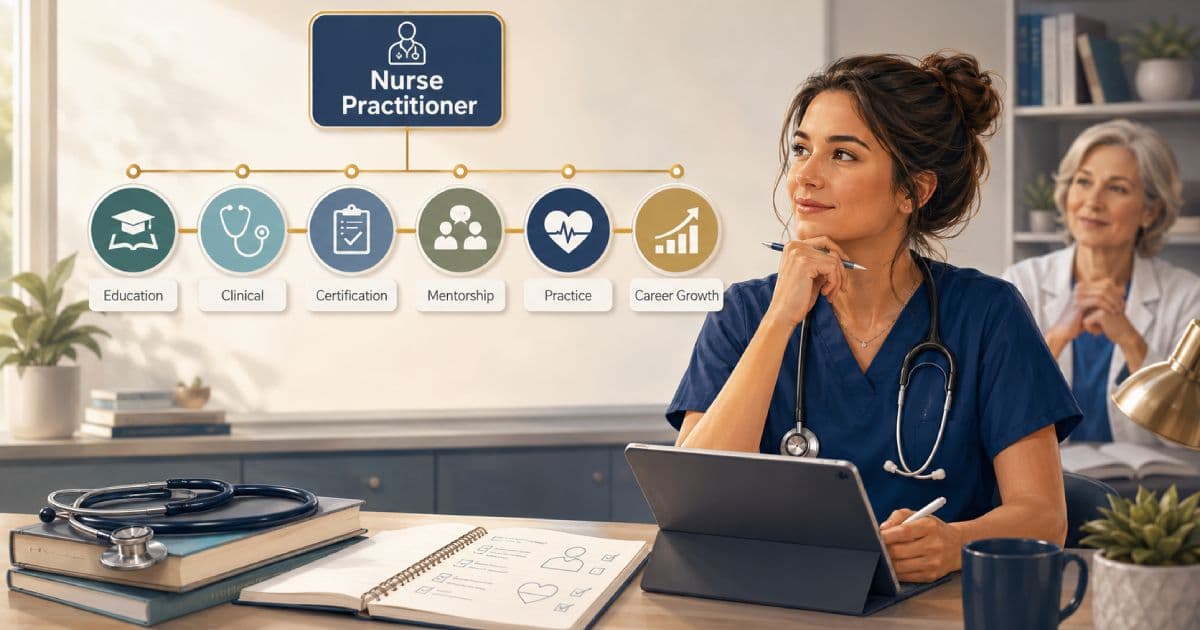
AANP's 2025 count says there are now more than 461,000 licensed nurse practitioners across the United States. That growth reflects a bigger shift in health care: NPs are no longer a backup option in primary care, mental health, urgent care, acute care, pediatrics, women's health, geriatrics, and specialty practice.
But the path to becoming an NP is easy to misunderstand.
You do not simply "get an NP degree." You choose a population focus, complete graduate education, pass a national certification exam, apply for state APRN/NP licensure, and practise under state-specific scope and prescribing rules.
This guide walks through the full path: what NPs do, which specialty to choose, MSN vs DNP, clinical hours, certification boards, state licensure, salary, and first-job planning.
What is a Nurse Practitioner?
A Nurse Practitioner, or NP, is an advanced practice registered nurse educated to assess, diagnose, order and interpret tests, prescribe medications, manage acute and chronic conditions, educate patients, and coordinate care.
NCSBN describes APRNs as registered nurses educated in a specific role and patient population at the master's or post-master's level. It says APRNs are prepared by education and certification to assess, diagnose and manage patient problems, order tests, and prescribe medications.
Official source:
NPs may work in:
- Primary care
- Urgent care
- Retail clinics
- Telehealth
- Internal medicine
- Pediatrics
- Women's health
- Psychiatry and behavioral health
- Emergency departments
- Hospitalist services
- ICUs and stepdown units
- Specialty clinics
- Oncology
- Cardiology
- Endocrinology
- Neurology
- Orthopedics
- Long-term care
- Home-based care
- Rural health
- Public health
- Academia and leadership
What NPs do day to day
Depending on specialty, state law, employer, and experience, NPs may:
- Take histories and perform physical exams
- Diagnose common acute and chronic conditions
- Order labs and imaging
- Interpret diagnostic results
- Prescribe medications
- Manage hypertension, diabetes, asthma, depression, heart failure, infections, and other conditions
- Provide preventive care and screenings
- Perform procedures within scope and training
- Admit, round, or discharge patients in some settings
- Coordinate referrals
- Educate patients and families
- Manage panels of patients
- Collaborate with physicians, pharmacists, therapists, social workers, and other team members
- Lead quality improvement and population-health work
BLS says APRNs may provide primary and specialty health care, and that scope of practice varies by state.
Official source:
NP vs RN vs PA vs physician
| Role | Core preparation | Scope pattern | Prescribing? | Independent practice? |
|---|---|---|---|---|
| RN | ADN, diploma, BSN, or entry-level route plus NCLEX-RN | Nursing assessment, care planning, education, coordination, medication administration, patient advocacy | Usually no independent prescribing | Works under RN scope and state Nurse Practice Act |
| NP | RN plus graduate NP education and national certification | Advanced assessment, diagnosis, treatment, prescribing, management by population focus | Yes, under state law | Varies by state |
| PA | Graduate PA program and national certification | Medical model diagnosis and treatment across settings, often under physician relationship rules | Yes, under state law | Varies by state |
| Physician | Medical school and residency | Full medical and surgical scope by specialty | Yes | Yes, within medical license and specialty training |
NP practice authority: full, reduced, and restricted
NP practice authority is state-specific.
AANP organizes states into three practice-environment categories:
- Full practice: NPs may evaluate patients, diagnose, order and interpret diagnostic tests, and initiate and manage treatment, including prescribing, under the exclusive licensure authority of the state board of nursing.
- Reduced practice: State law reduces NP practice in at least one element and requires a regulated relationship with another health provider or limits at least one practice element.
- Restricted practice: State law restricts at least one element of NP practice and requires career-long supervision, delegation, or team management by another health provider.
Official source:
Nurse Practitioner specialties: which one fits you?
Your NP specialty is not just a major. It determines your population focus, certification exam, state recognition, and job options.
Family Nurse Practitioner (FNP)
Population: Family/individual across the lifespan Typical settings: Primary care, urgent care, retail clinics, occupational health, community health, rural health, telehealth Best for: Nurses who want broad outpatient flexibility and variety
FNP is often the most portable NP credential because it covers a wide lifespan. It is especially common in primary care and urgent care.
Potential mismatch: FNP is usually not the best fit if your real goal is ICU, inpatient hospitalist, or high-acuity adult acute care. For those, AGACNP may align better.
Adult-Gerontology Primary Care NP (AGPCNP)
Population: Adolescents through older adults, depending on program and state interpretation Typical settings: Internal medicine, geriatric primary care, specialty clinics, long-term care, home-based primary care Best for: Nurses who like chronic disease management, adult primary care, prevention, and older-adult care
AGPCNP can be a strong fit for nurses who know they do not want pediatrics but want adult outpatient or long-term care work.
Adult-Gerontology Acute Care NP (AGACNP)
Population: Acutely ill adults and older adults Typical settings: ICU, stepdown, hospital medicine, specialty consult services, cardiology, pulmonary/critical care, transplant, procedural services Best for: ICU, ED, stepdown, and acute-care nurses who want high-acuity adult practice
AGACNP is often the better match for nurses who want inpatient acute care.
Important: Acute care and primary care are not interchangeable. Choose the program that matches the setting and patient acuity you want.
Psychiatric-Mental Health NP (PMHNP)
Population: Psychiatric-mental health care across the lifespan, depending on program and certification Typical settings: Outpatient psychiatry, integrated behavioral health, inpatient psychiatry, telepsychiatry, addiction medicine, community mental health Best for: Nurses drawn to diagnostic interviewing, psychopharmacology, therapy-informed care, substance-use treatment, and long-term patient relationships
PMHNP demand is strong in many regions, especially where psychiatric access is limited.
Potential mismatch: PMHNP is not simply FNP plus psych meds. It is its own population focus and requires comfort with complex mental health, trauma, substance use, crisis care, and longitudinal medication management.
Pediatric NP: Primary Care or Acute Care
Population: Infants, children, adolescents, and young adults depending on credential Typical settings: Primary care pediatrics, pediatric specialty clinics, children's hospitals, PICU, pediatric ED Best for: Nurses who want pediatric-focused practice and family-centered care
PNP has two main routes:
- PNP-PC: Pediatric primary care
- PNP-AC: Pediatric acute care
PNCB offers entry-to-practice pediatric NP certifications, including CPNP-PC and CPNP-AC.
Official source:
Women's Health NP (WHNP)
Population: Women's health and gender-related reproductive/sexual health across the lifespan Typical settings: OB/GYN clinics, reproductive health, urogynecology, menopause clinics, family planning, community health Best for: Nurses interested in gynecology, contraception, sexual health, reproductive care, menopause, and patient education
WHNP is not the same as Certified Nurse-Midwife. CNMs focus on midwifery and birth care in addition to reproductive health. WHNPs focus on women's and gender-related health, often in outpatient and specialty settings.
For the CNM path, see NurseZee's guide to how to become a Certified Nurse-Midwife.
Neonatal NP (NNP)
Population: High-risk neonates and infants Typical settings: NICU, neonatal transport, high-risk delivery attendance, neonatal follow-up Best for: NICU nurses who want advanced neonatal practice
NNP is a highly specialized path. Many programs expect NICU experience before admission.
How to become a Nurse Practitioner: step by step
Step 1: Become a registered nurse
The NP path starts with RN licensure.
Common routes include:
- ADN or ASN
- Diploma RN program, where available
- BSN
- Accelerated BSN for students with a non-nursing bachelor's degree
- Entry-level master's pathway in some cases
After completing an approved prelicensure nursing program, you take the NCLEX-RN and apply for RN licensure.
If you are still comparing entry routes, see NurseZee's guide to LPN vs RN vs BSN.
Step 2: Earn a BSN or qualify through a bridge path
Most NP programs require a BSN for admission, but not all students take the same path.
Possible routes:
- BSN to MSN-NP
- BSN to DNP-NP
- ADN to BSN, then MSN or DNP
- ADN/RN to MSN bridge
- RN to MSN with BSN bridge coursework
- MSN to post-graduate NP certificate
- MSN to DNP
- Non-nursing bachelor's to accelerated BSN, then NP program
- Non-nursing bachelor's to entry-level nursing graduate route, then NP preparation where available
Step 3: Build RN experience
Some NP programs admit new BSN graduates. Others prefer or require RN experience.
Experience can help you become a safer, more confident NP student, especially if it matches your specialty.
Helpful matches:
| RN background | NP specialty that may fit |
|---|---|
| ICU, stepdown, ED | AGACNP, ENP, sometimes FNP depending on goals |
| Med-surg, primary care, home health | FNP, AGPCNP |
| Behavioral health, detox, substance-use care | PMHNP |
| Pediatrics, PICU, pediatric ED | PNP-PC or PNP-AC |
| NICU | NNP |
| Women's health, OB/GYN, L&D, public health | WHNP or CNM |
| Oncology, cardiology, nephrology, endocrine | FNP, AGPCNP, AGACNP depending on setting |
How much experience do you need?
There is no universal number.
Many students benefit from 1 to 3 years of relevant RN experience before NP school. Acute-care NP and neonatal NP programs may expect more focused experience. Primary-care programs may admit strong applicants with less experience, but real patient-care experience still helps.
Step 4: Choose your NP population focus
Before choosing a school, answer:
- Do I want outpatient or inpatient practice?
- Do I want adults, children, all ages, neonates, women's health, or psychiatric care?
- Do I want high-acuity hospital work or long-term primary care relationships?
- Do I want procedures?
- Do I want nights, weekends, call, or a clinic schedule?
- Does my state recognize this specialty the way I expect?
- Are jobs available in my target region?
Do not choose FNP only because it seems broad. Broad is useful, but only if it matches your intended practice.
Step 5: Choose an accredited NP program
Look for accreditation and specialty alignment.
Common nursing program accreditors include:
- CCNE
- ACEN
CCNE accredits baccalaureate and graduate nursing programs. ACEN accredits several levels of nursing education. Always verify the exact program in the official accreditor directory.
Official sources:
For a deeper accreditation breakdown, read NurseZee's guide to ACEN vs CCNE accreditation.
Step 6: Complete graduate NP coursework
NP programs usually include:
- Advanced pathophysiology
- Advanced pharmacology
- Advanced health assessment
- Diagnostics
- Differential diagnosis
- Health promotion and prevention
- Population-specific management
- Evidence-based practice
- Epidemiology
- Health policy
- Ethics
- Quality improvement
- Role development
- Specialty clinical seminars
- Supervised clinical practicum
Step 7: Complete supervised clinical hours
Clinical hours are where NP students learn to apply advanced assessment, diagnosis, prescribing, and management under supervision.
The 2022 National Task Force Standards for Quality Nurse Practitioner Education increased the minimum expected direct patient-care hours to 750 for NP programs. A related FAQ explains that the 750-hour increase is part of a larger transition toward competency-based education.
Official sources:
You may still see programs with older hour structures during transition periods. Ask each program:
- How many direct patient-care hours are required?
- Are simulation hours counted separately?
- Does the program meet current certification expectations?
- Does the program place students, or must students find preceptors?
- What happens if a preceptor cancels?
- How are competencies evaluated?
- Are clinical sites in my state approved?
Step 8: Graduate and pass national certification
After completing your NP program, you take a national certification exam aligned with your population focus.
Common certifying organizations include:
- AANPCB
- ANCC
- PNCB
- NCC
- AACN Certification Corporation
Common NP certifications
| NP focus | Common credential examples | Common certifying body |
|---|---|---|
| Family NP | FNP-C, FNP-BC | AANPCB, ANCC |
| Adult-Gerontology Primary Care NP | AGNP-C, AGPCNP-BC | AANPCB, ANCC |
| Adult-Gerontology Acute Care NP | AGACNP-BC, ACNPC-AG | ANCC, AACN Certification Corporation |
| Psychiatric-Mental Health NP | PMHNP-BC, PMHNP-C | ANCC, AANPCB |
| Pediatric Primary Care NP | CPNP-PC | PNCB |
| Pediatric Acute Care NP | CPNP-AC | PNCB |
| Women's Health NP | WHNP-BC | NCC |
| Neonatal NP | NNP-BC | NCC |
| Emergency NP | ENP-C | AANPCB |
AANPCB states that FNP, AGNP, and PMHNP exams are offered to graduates of accredited graduate, post-graduate, and doctoral-level programs in those roles. AANPCB also offers Emergency NP specialty certification for eligible certified FNPs.
Official source:
Step 9: Apply for state APRN/NP licensure
Certification is not the same as state licensure.
After passing boards, you apply to your state board of nursing or APRN licensing authority. Requirements vary, but may include:
- Active RN license
- Graduate transcript
- National NP certification
- Application and fee
- Background check
- Population focus documentation
- Prescriptive authority application
- Controlled-substance registration, if applicable
- DEA registration, if prescribing controlled substances
- Collaborative agreement, supervision agreement, or transition-to-practice documentation in some states
Step 10: Get credentialed and start practice
Your NP license gives you legal authority. Your employer still needs to credential and privilege you.
Credentialing may include:
- License verification
- Certification verification
- DEA registration
- Malpractice coverage
- Background check
- References
- Procedure logs
- Employment history
- Peer references
- Collaborative agreement documents, if required
- Hospital or health-system privileges
- Payer enrollment
- Medicare/Medicaid enrollment
- Onboarding and proctoring
First-job questions to ask
- How many patients will I see per day?
- What is the onboarding period?
- Who is my collaborating or supervising clinician, if required?
- How much admin time is built in?
- Is there protected time for charting?
- What is the call schedule?
- Are nights, weekends, or holidays required?
- What is the panel size expectation?
- What support exists for new NPs?
- Are CME funds provided?
- Are license, DEA, and certification fees reimbursed?
- What is the malpractice coverage?
MSN vs DNP for Nurse Practitioners
Both MSN and DNP pathways can lead to NP practice if they are accredited, state-recognized, and aligned with your population focus.
MSN-NP
Best for: Students who want the direct graduate route into NP practice.
Common strengths:
- Shorter than many BSN-to-DNP pathways
- Usually lower total tuition
- Faster entry into practice
- Widely accepted for NP licensure when accredited and certification-eligible
- Good fit for students focused primarily on clinical practice
Potential drawbacks:
- Some employers prefer DNP for leadership or academic roles
- You may return later if you want a doctorate
- Less doctoral-level preparation in systems leadership and scholarship
DNP-NP
Best for: Students who want NP preparation plus doctoral-level leadership, quality improvement, health systems, informatics, policy, and evidence-translation training.
Common strengths:
- Terminal practice doctorate
- Stronger preparation for systems leadership and quality improvement
- May help in academic, administrative, or leadership pathways
- Often includes a DNP project
- May be preferred in some settings
Potential drawbacks:
- Longer timeline
- Higher total cost
- More project and systems coursework
- Not required for NP practice in many states
NP salary and job outlook
NP pay is strong, but it varies by specialty, region, experience, setting, schedule, and productivity expectations.
O*NET's BLS-based 2024 wage page lists nurse practitioners at:
| Measure | U.S. wage |
|---|---|
| Median annual wage | $129,210 |
| Median hourly wage | $62.12 |
| 10th percentile annual wage | $97,960 or less |
| 90th percentile annual wage | $169,950 or more |
Official source:
BLS's Occupational Outlook Handbook lists the broader group of nurse anesthetists, nurse midwives, and nurse practitioners at a $132,050 median annual wage in May 2024. BLS also lists the detailed nurse practitioner median annual wage at $129,210 and projects nurse practitioner employment to grow from 320,400 in 2024 to 448,800 in 2034, a 40% increase.
Official source:
What affects NP pay?
NP compensation can vary by:
- State and metro area
- Full, reduced, or restricted practice environment
- Specialty
- Outpatient vs inpatient setting
- Shift differentials
- Call requirements
- Productivity model
- Experience
- Union status
- Rural or shortage-area incentives
- Federal or VA employment
- Telehealth model
- Procedure volume
- Leadership responsibilities
Higher-paying NP roles may include:
- Acute care
- Emergency care
- Psychiatry
- Dermatology
- Critical care
- Specialty clinics
- Hospitalist services
- Some rural or shortage-area positions
- High-productivity private practice models
Lower-paying roles may still be good jobs if they offer:
- Better mentorship
- Stronger work-life balance
- Lower patient volume
- Better benefits
- Loan repayment
- More protected admin time
- Safer onboarding
- Better schedule fit
Is becoming an NP worth it?
It can be worth it if the role matches your goals and you choose the right program and first job.
NP may be a good fit if you want:
- More diagnostic responsibility
- Prescribing authority
- Long-term patient relationships
- Primary care, mental health, specialty, or acute-care management
- Patient education at a higher level
- More autonomy
- A graduate-level clinical career
- Leadership and systems influence
- Rural or underserved-community impact
NP may not be a good fit if:
- You dislike diagnostic uncertainty
- You do not want prescribing responsibility
- You do not want graduate school debt
- You want predictable low-stress work
- You dislike charting and inbox management
- You want to avoid liability
- You prefer bedside nursing teamwork and shift boundaries
- You are choosing NP only to escape burnout
How to strengthen your NP application
Academic preparation
Programs may look at:
- BSN GPA
- Science GPA
- Graduate readiness
- Statistics
- Research or evidence-based practice coursework
- Writing ability
- Pathophysiology and pharmacology performance
- Recent coursework if your GPA is older or weaker
Clinical experience
Strong applicants can explain how RN experience shaped their NP goals.
Examples:
- ICU nurse applying to AGACNP
- Psych nurse applying to PMHNP
- Pediatric nurse applying to PNP
- Clinic nurse applying to FNP or AGPCNP
- Women's health nurse applying to WHNP
- NICU nurse applying to NNP
Personal statement
A strong statement should answer:
- Why this NP population?
- Why now?
- What RN experiences shaped your decision?
- What communities or settings do you want to serve?
- Why this program?
- How will you handle graduate-level responsibility?
- What does safe, ethical advanced practice mean to you?
Weak framing
"I want to be an NP because I want more autonomy and better pay."
Stronger framing
"I want to become a Family Nurse Practitioner because my clinic and med-surg experience showed me how much timely primary care can prevent avoidable hospitalizations. I am drawn to longitudinal care, chronic disease management, patient education, and improving access in underserved communities."
Questions to ask NP programs before applying
Accreditation and certification
- Is the NP program accredited by CCNE, ACEN, or another recognized accreditor?
- Does the program prepare graduates for the exact national certification I need?
- What is the certification pass rate?
- Is the program approved or authorized for students in my state?
Clinical placement
- Does the school secure clinical placements?
- How many clinical hours are required?
- Are placements guaranteed?
- Can I use my workplace as a clinical site?
- How are preceptors approved?
- How far do students travel?
- What happens if a preceptor cancels?
- Are there enough placements in my specialty?
Faculty and support
- Are faculty practising NPs in my specialty?
- How often do students meet with faculty?
- Is there board-prep support?
- Is there remediation if students struggle?
- Can I speak with current students or alumni?
- What is the graduation rate?
Cost and schedule
- What is the total cost, including fees?
- Can I attend part time?
- Can I work during the program?
- Are campus intensives required?
- Are travel costs included?
- Does the program support military, rural, or employer tuition benefits?
Common mistakes future NPs make
1. Choosing FNP by default
FNP is broad, but it is not ideal for every career goal. If you want ICU or inpatient adult acute care, consider AGACNP. If you want psych, choose PMHNP. If you want pediatric acute care, choose PNP-AC.
2. Ignoring clinical placement
A low-tuition online program can become stressful if you are left to find preceptors alone.
3. Choosing a program not authorized in your state
Distance NP programs must meet state authorization and licensure-disclosure requirements. Verify before enrolling.
4. Assuming national certification equals state licensure
Certification is one step. State APRN/NP licensure and prescribing authority are separate.
5. Underestimating graduate school
NP school is not RN school with extra papers. You are learning diagnosis, prescribing, and management.
6. Taking a first job with no support
A new NP needs onboarding, backup, realistic patient volume, and mentorship.
7. Ignoring state practice authority
Your autonomy, collaboration requirements, and prescribing rules may change significantly if you move.
Frequently asked questions about becoming a Nurse Practitioner
What is a Nurse Practitioner?
A Nurse Practitioner is an advanced practice registered nurse with graduate education, national certification, and state licensure to diagnose, treat, prescribe, and manage patients within a population-focused scope.
How long does it take to become a Nurse Practitioner?
A common path is 6 to 8 years from the start of nursing education: about 4 years for BSN and 2 to 4 years for MSN or DNP preparation. ADN-to-BSN, RN-to-MSN, part-time, and post-master's certificate routes can change the timeline.
Do I need a BSN to become an NP?
Usually, yes, or you need a bridge route that brings you to graduate-level nursing preparation. Many NP programs require BSN admission, but some RN-to-MSN and bridge programs accept ADN-prepared RNs.
Do I need a DNP to practise as an NP?
No. An accredited MSN-NP or post-graduate certificate can still lead to NP certification and licensure when it meets state and certification requirements. DNP may help with leadership, quality improvement, academia, or systems roles.
Is MSN or DNP better for NP?
MSN is usually faster and less expensive. DNP offers doctoral-level practice preparation and may be better for leadership, quality improvement, policy, academia, or long-term advancement. Both can lead to NP practice if properly accredited and certification-eligible.
Which NP specialty should I choose?
Choose based on the population and setting you want. FNP is best for broad primary care. AGACNP is better for adult acute care. PMHNP is for psychiatric-mental health. PNP is for pediatrics. WHNP is for women's and gender-related health. NNP is for neonates.
Can FNPs work in hospitals?
Some do, but FNP education is primary care focused. For adult inpatient acute care, AGACNP may be a better match and may be required by some employers or state interpretations.
What is the difference between AGPCNP and AGACNP?
AGPCNP focuses on adult and older-adult primary care, chronic disease management, prevention, and outpatient or long-term care. AGACNP focuses on acute, complex, and unstable adult/older-adult patients in hospitals and high-acuity settings.
What is the difference between AANPCB and ANCC?
AANPCB and ANCC are national certification bodies. Some NP specialties can certify through either, while others are tied to a specific organization. Choose based on specialty, state board rules, employer expectations, and exam fit.
How many clinical hours do NP students need?
The 2022 National Task Force Standards increased the minimum direct patient-care hours for NP programs to 750. Some programs may still be transitioning, and DNP programs include additional practice/project expectations. Ask each school for current hour requirements.
Can I complete NP school online?
Many NP programs offer online didactic coursework, but clinical hours are in person. Some programs also require campus intensives, skills checkoffs, or simulation visits. Verify clinical placement support before enrolling.
How much do Nurse Practitioners make?
O*NET's BLS-based 2024 wage page lists nurse practitioners at a national median annual wage of $129,210 and a median hourly wage of $62.12. Pay varies by state, specialty, experience, employer, and schedule.
Is NP demand growing?
Yes. BLS projects nurse practitioner employment to grow from 320,400 in 2024 to 448,800 in 2034, a 40% increase. The broader APRN group is projected to grow 35% from 2024 to 2034.
Where can NPs practise independently?
States vary. AANP categorizes practice environments as full, reduced, or restricted. Check the current AANP map and your state board before making career decisions.
Can NPs prescribe medications?
Yes, NPs can prescribe medications under state law, but prescriptive authority, controlled-substance rules, DEA requirements, and collaboration rules vary by state.
Is becoming an NP worth it?
It can be worth it if you want advanced clinical responsibility, diagnosis, prescribing, patient management, and more autonomy. It may not be worth it if you are choosing NP only to escape bedside burnout or if the debt-to-income ratio does not work for your goals.
Final thoughts
Becoming a Nurse Practitioner is a serious step into advanced clinical responsibility.
Start by choosing the patient population you want to serve. Then choose the degree path, program format, clinical placement model, and certification route that match that population. Check state practice rules early. Compare total cost. Ask hard questions about clinical support. Plan your first job with mentorship and onboarding in mind.
The goal is not just to earn NP after your name. The goal is to become a safe, prepared, confident clinician who can diagnose, treat, prescribe, educate, and advocate for patients with the judgment the role requires.
Sources and references
- AANP: A Behind-the-Scenes Look at the 2025 Nurse Practitioner Count
- AANP State Practice Environment
- NCSBN APRN Consensus Model
- NCSBN APRN Consensus Model Toolkit
- NONPF: National Task Force Standards
- NTF Standards FAQ PDF
- AANPCB Certification Qualifications
- AANPCB Certifications
- ANCC Certifications
- PNCB Certifications
- CCNE Accredited Programs Directory
- ACEN Search Programs
- O*NET: Nurse Practitioner national wages
- BLS: Nurse Anesthetists, Nurse Midwives, and Nurse Practitioners
- NurseZee: ACEN vs CCNE Accreditation
- NurseZee: LPN vs RN vs BSN
- NurseZee: How to Become a Certified Nurse-Midwife