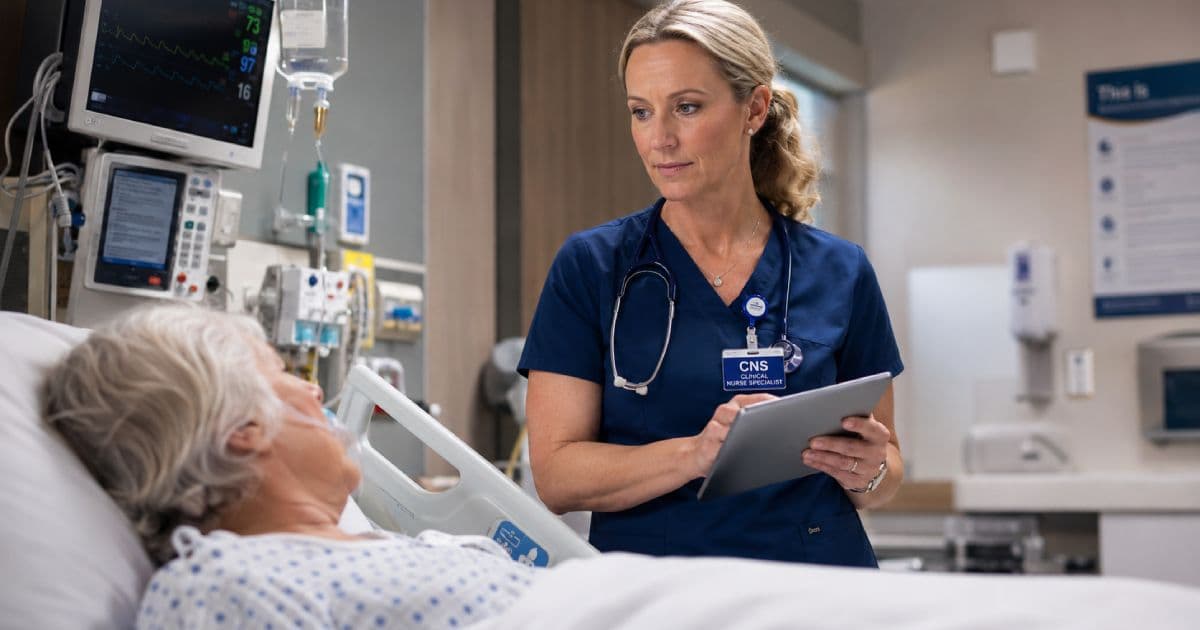
A Clinical Nurse Specialist is the APRN role many patients never hear about — but nurses, managers, quality teams, and complex units feel every day.
When a sepsis workflow improves, a CLABSI rate drops, a new graduate finally understands a high-risk protocol, or an ICU standardizes evidence-based practice across shifts, there may be a CNS behind the change.
The CNS role is easy to confuse with nurse practitioner, nurse educator, quality specialist, or nurse manager. But the role is distinct: a CNS is an advanced practice registered nurse who improves care across patients, nurses, and systems.
This guide explains what a CNS does, how the three spheres of impact work, how CNS differs from NP and nurse educator, what education and certification are required, how salary data should be interpreted, and how to build a CNS portfolio that proves measurable impact.
What is a Clinical Nurse Specialist?
A Clinical Nurse Specialist, or CNS, is an advanced practice registered nurse with graduate-level preparation in a population or specialty area.
NCSBN’s APRN Consensus Model toolkit describes the CNS as educated at an advanced level to care for patients in one of the six described populations across the continuum of care. It also says the CNS role encompasses the patient, the nurse and nursing practice, and the healthcare organization and system.
Official sources:
In real jobs, CNSs often work as expert clinicians, consultants, educators, evidence-based practice leaders, and systems-change agents.
They may support:
- Critical care
- Adult-gerontology
- Pediatrics
- Neonatal care
- Oncology
- Cardiology
- Neurology
- Perioperative services
- Emergency care
- Behavioral health
- Wound/ostomy/continence
- Palliative care
- Sepsis programs
- Patient safety
- Magnet or professional-practice work
- Clinical practice guideline implementation
The three spheres of CNS impact
The CNS role is often explained through three spheres of impact.
Sphere 1: Patient and family
In the patient/family sphere, the CNS brings advanced clinical expertise to complex or high-risk cases.
Examples:
- Consulting on deteriorating patients
- Supporting sepsis, heart failure, oncology, stroke, or ICU care
- Helping build individualized care plans
- Coaching staff through rare or complex clinical situations
- Improving patient education and transition planning
- Reviewing adverse events or near misses
- Supporting family communication in complex cases
- Identifying gaps in symptom management, safety, or escalation
Sphere 2: Nurses and nursing practice
In the nursing-practice sphere, the CNS raises the skill and consistency of nursing care.
Examples:
- Teaching staff evidence-based workflows
- Developing competency checkoffs
- Mentoring new graduate nurses
- Improving handoffs
- Building clinical decision tools
- Leading simulation
- Translating research into bedside practice
- Auditing documentation and practice gaps
- Helping nurses recognize deterioration earlier
- Supporting specialty certification and professional development
Sphere 3: Organization and system
In the system sphere, the CNS improves care at the unit, service-line, hospital, or network level.
Examples:
- Reducing CLABSI, CAUTI, falls, pressure injuries, or readmissions
- Leading quality-improvement projects
- Updating policies and procedures
- Building evidence-based practice pathways
- Partnering with informatics on order sets or documentation tools
- Supporting Magnet, regulatory, or accreditation work
- Using dashboards and run charts to track outcomes
- Standardizing high-risk workflows across units
What does a CNS do day to day?
No two CNS jobs look exactly alike.
A hospital-based CNS might spend a week doing all of this:
- Rounding on high-risk patients
- Consulting on a complex wound, delirium, sepsis, or mobility case
- Reviewing unit outcome data
- Teaching nurses at shift huddle
- Updating a clinical pathway
- Meeting with infection prevention, pharmacy, informatics, and unit leadership
- Coaching a charge nurse through escalation concerns
- Auditing practice compliance
- Presenting a quality project at shared governance
- Developing a simulation scenario
- Reviewing evidence for a policy update
- Mentoring a nurse on an evidence-based practice project
A CNS is often the person who connects bedside practice with system-level improvement.
CNS vs NP: what is the difference?
CNS and NP are both APRN roles, but they are not interchangeable.
| Factor | Clinical Nurse Specialist | Nurse Practitioner |
|---|---|---|
| Main focus | Improve outcomes for a population, nursing practice, and the system of care | Diagnose and manage individual patients, often with a panel or caseload |
| Typical role | Expert clinician, consultant, educator, evidence-based practice leader, systems-change agent | Direct care provider, diagnostician, prescriber, primary or specialty care clinician |
| Impact model | Three spheres: patient/family, nurses/nursing practice, organization/system | Primarily patient-facing diagnosis and treatment, with some QI and education depending on role |
| Common settings | Hospitals, academic medical centers, specialty service lines, children’s hospitals, quality/safety programs | Clinics, primary care, urgent care, specialty practices, hospitals, telehealth |
| Certification | CNS population certifications such as AGCNS-BC, ACCNS-AG, ACCNS-P, ACCNS-N | NP population certifications such as FNP, AGACNP, PMHNP, PNP, WHNP, NNP |
| Prescribing | State-specific and role-specific | State-specific and role-specific |
| Best fit | Nurses who like expert practice, teaching, outcomes, evidence translation, and systems improvement | Nurses who want diagnosis, treatment, prescribing, and direct patient management |
For a deeper NP pathway breakdown, see NurseZee’s guide to how to become a Nurse Practitioner.
CNS vs nurse educator vs clinical nurse leader
CNS vs nurse educator
A nurse educator focuses on teaching, curriculum, orientation, competency, or academic instruction.
A CNS may teach, but teaching is only one part of the role. The CNS is expected to connect education to measurable outcomes, clinical practice change, and system improvement.
Example:
- Nurse educator: Teaches central-line dressing change technique.
- CNS: Reviews CLABSI data, identifies practice variation, updates the policy, teaches the dressing change, audits compliance, collaborates with supply chain, and tracks whether CLABSI rates improve.
CNS vs Clinical Nurse Leader
A Clinical Nurse Leader, or CNL, is generally a master’s-prepared generalist role focused on microsystem-level care coordination and outcomes.
A CNS is an APRN role with population-focused advanced practice preparation. CNS practice may span direct care, specialty consultation, nursing practice improvement, and system-level change.
CNS vs quality improvement nurse
A QI nurse may focus on data, process improvement, reporting, and regulatory measures.
A CNS often does QI work, but brings advanced clinical expertise and specialty practice authority into the improvement process.
Is the CNS role still relevant?
Yes.
The CNS role is not being phased out. It is evolving.
Hospitals and health systems need clinicians who can connect evidence to practice, support nurses through complexity, improve outcomes, and make quality initiatives work at the bedside. CNS roles may be listed under different titles, including:
- Clinical Nurse Specialist
- APRN Clinical Nurse Specialist
- Clinical Practice Specialist
- Clinical Practice Leader
- Nursing Practice Specialist
- Clinical Outcomes Specialist
- Specialty CNS
- Quality and Practice CNS
- Professional Practice Specialist
How long does it take to become a CNS?
A common timeline is 6 to 8 years, depending on where you start.
| Starting point | Typical timeline |
|---|---|
| No nursing degree | About 6 to 8+ years |
| ADN-prepared RN | About 3 to 5+ years after RN licensure, depending on BSN bridge and graduate pathway |
| BSN-prepared RN | About 2 to 4 years for MSN, DNP, or post-graduate CNS preparation |
| MSN-prepared nurse in another area | Post-graduate CNS certificate timeline varies |
| Experienced RN returning part time | Timeline depends on work schedule and program format |
Step 1: Become a registered nurse
The CNS path starts with RN licensure.
Common RN routes include:
- ADN or ASN
- Diploma RN program, where available
- BSN
- Accelerated BSN for students with a non-nursing bachelor’s degree
- Entry-level master’s route, depending on program
After completing an approved prelicensure nursing program, you take the NCLEX-RN and apply for RN licensure.
Step 2: Earn a BSN or use a bridge route
Most CNS graduate programs expect a BSN or equivalent nursing preparation. Some programs may offer RN-to-MSN, bridge, or post-master’s pathways.
Common routes include:
- BSN to MSN-CNS
- BSN to DNP-CNS
- RN-to-MSN with CNS focus
- MSN to post-graduate CNS certificate
- MSN-to-DNP with CNS-focused practicum, depending on program
- Dual CNS/NP pathways in some schools
If you are comparing program accreditation, see NurseZee’s guide to ACEN vs CCNE accreditation.
Step 3: Build relevant RN experience
CNS students benefit from strong clinical grounding.
A CNS role requires credibility with bedside nurses and interprofessional teams. That usually comes from meaningful RN experience in a relevant specialty.
Examples:
| CNS goal | Helpful RN background |
|---|---|
| Adult-gerontology CNS | Med-surg, stepdown, ICU, progressive care, emergency, specialty clinics |
| Critical care CNS | ICU, CVICU, MICU, SICU, neuro ICU, trauma ICU |
| Pediatric CNS | Pediatric acute care, PICU, pediatric ED, pediatric specialty clinics |
| Neonatal CNS | NICU, high-risk newborn care, neonatal transport exposure |
| Oncology CNS | Inpatient oncology, infusion, BMT, radiation oncology, symptom management |
| Cardiac CNS | Telemetry, cardiac stepdown, cath lab, CVICU, heart failure programs |
| Wound/ostomy CNS | Wound care, ostomy care, med-surg, long-term care, home health |
| Behavioral health CNS | Inpatient psych, crisis, substance use, consult-liaison, community mental health |
Many nurses pursue CNS school after 2 to 5 years of focused RN experience, although program requirements vary.
Step 4: Choose an accredited CNS graduate program
CNS programs may be offered as:
- MSN-CNS
- DNP-CNS
- Post-graduate CNS certificate
- Dual CNS/NP pathway
- MSN-to-DNP with CNS-focused practicum
NACNS maintains a CNS program directory listing currently active U.S. programs that offer entry-level preparation in the CNS role.
Official source:
Before applying, verify:
- The program is accredited by CCNE, ACEN, or another recognized nursing accreditor.
- The CNS population focus matches your career goal.
- Graduates are eligible for the certification exam you need.
- The program is acceptable for CNS/APRN recognition in your target state.
- Clinical placements are supported and appropriate.
- The program includes advanced pathophysiology, advanced pharmacology, and advanced health assessment.
Step 5: Complete CNS coursework and clinical hours
CNS education includes advanced clinical and systems preparation.
Typical coursework includes:
- Advanced pathophysiology
- Advanced pharmacology
- Advanced health assessment
- Differential diagnosis and disease management
- Evidence-based practice
- Epidemiology
- Quality improvement
- Implementation science
- Healthcare systems
- Leadership
- Outcomes measurement
- Informatics
- Population-focused clinical management
- Consultation
- Policy and ethics
- Role development
ANCC’s AGCNS-BC eligibility requirements include a current RN license, a master’s, post-graduate certificate, or DNP from an accredited adult-gerontology CNS program, a minimum of 500 faculty-supervised clinical hours, and graduate-level courses in advanced physiology/pathophysiology, advanced health assessment, and advanced pharmacology.
Official source:
NACNS also states that CNS education must cover advanced pathophysiology, advanced physical assessment, and advanced pharmacology, and that CNSs complete a minimum of 500 clinical hours during education.
Official source:
Step 6: Pass national CNS certification
Certification depends on your population focus and available exams.
Common current CNS certification options include:
| Certification | Population focus | Certifying organization |
|---|---|---|
| AGCNS-BC | Adult-gerontology CNS | ANCC |
| ACCNS-AG | Adult-gerontology CNS | AACN Certification Corporation |
| ACCNS-P | Pediatric CNS | AACN Certification Corporation |
| ACCNS-N | Neonatal CNS | AACN Certification Corporation |
Official certification links:
- ANCC AGCNS-BC Certification
- AACN ACCNS-AG Certification
- AACN ACCNS-P Certification
- AACN ACCNS-N Certification
- NACNS Professional Certifications
AACN describes ACCNS-AG as an entry-level advanced practice board certification for graduate-educated CNSs who provide care across the healthcare continuum for the adult-gerontology population. ANCC says AGCNS-BC is valid for five years after eligibility requirements and the exam are completed.
Step 7: Apply for state CNS/APRN licensure or recognition
Certification is not the same as legal authority to practice.
After graduation and certification, you may need to apply for:
- APRN licensure
- CNS recognition
- Title protection
- Prescriptive authority
- Controlled-substance authority
- DEA registration, if prescribing controlled substances
- Institutional privileging
- Credentialing through the employer or health system
Requirements vary widely by state.
NACNS endorses full practice authority for all CNSs and describes CNSs as APRNs equipped to provide direct patient care, including evaluation and diagnosis, ordering and interpretation of diagnostic tests, treatment management, prescription medications, and interprofessional collaboration. That is NACNS’s policy position; it does not mean every state currently grants identical authority.
Official source:
Step 8: Get credentialed and hired
A CNS may need both state recognition and employer privileging.
Depending on the role, credentialing may include:
- RN/APRN/CNS license verification
- National certification verification
- Graduate transcripts
- Malpractice coverage
- DEA registration, if applicable
- Prescriptive authority documentation
- References
- Procedure or competency logs
- Project portfolio
- Background check
- Hospital privileges
- Payer enrollment, if billing
- Orientation and proctoring
MSN vs DNP for CNS
Both MSN and DNP routes can prepare nurses for CNS practice if the program is accredited, population-focused, certification-eligible, and state-aligned.
MSN-CNS
Best for: Nurses who want the most direct graduate route into CNS practice.
Potential advantages:
- Shorter timeline
- Lower total cost than many DNP pathways
- Faster entry into CNS role
- Strong fit for clinical practice, education, consultation, and early systems leadership
Potential drawbacks:
- Less doctoral-level preparation in systems leadership, data, policy, and project implementation
- May require returning later if you want a practice doctorate
- Some leadership or academic roles may prefer a doctorate
DNP-CNS
Best for: Nurses who want CNS preparation plus doctoral-level systems, quality, leadership, and evidence-translation depth.
Potential advantages:
- Terminal practice doctorate
- Strong preparation for complex quality improvement and implementation work
- Better fit for large health systems, Magnet projects, academic partnerships, and leadership tracks
- DNP project can become part of your CNS portfolio
Potential drawbacks:
- Longer timeline
- Higher total cost
- More systems and project coursework
- Not always required for CNS practice
CNS salary and job outlook
CNS salary data are harder to interpret than NP salary data.
The U.S. Bureau of Labor Statistics does not publish a dedicated Occupational Outlook Handbook page for Clinical Nurse Specialists. ONET has a Clinical Nurse Specialists occupation page and labels it “Bright Outlook,” but its wage page says the wage data are collected from Registered Nurses*, not CNS-specific CNS/APRN roles.
Official sources:
That means O*NET’s national RN wage numbers can be useful as a floor or context point, but they may not reflect graduate-prepared CNS compensation in advanced practice or system-level roles.
For broader APRN context, BLS reports that nurse anesthetists, nurse midwives, and nurse practitioners had a median annual wage of $132,050 in May 2024, while nurse practitioners had a detailed median of $129,210 and nurse midwives $128,790. BLS projects the combined group to grow 35% from 2024 to 2034.
Official source:
What affects CNS pay?
CNS compensation can vary by:
- State and metro area
- Health system size
- Specialty
- APRN recognition and prescriptive authority
- Academic medical center vs community hospital
- Direct patient care vs system-level role
- Leadership expectations
- Call, nights, weekends, or service-line coverage
- Certification requirements
- Union status
- Magnet or quality-program responsibilities
- Project portfolio and measurable outcomes
Specialties that may command higher compensation include:
- Critical care
- Neonatal care
- Oncology
- Cardiology
- Emergency/trauma
- Perioperative services
- Advanced wound/ostomy practice
- Large academic or tertiary care service lines
Is becoming a CNS worth it?
It can be worth it if you want to influence care beyond one assignment or one patient panel.
CNS may be a good fit if you like:
- Teaching nurses
- Solving complex clinical problems
- Translating evidence into practice
- Working with quality metrics
- Leading change without necessarily being a manager
- Consulting across units
- Improving workflows
- Building protocols and pathways
- Mentoring staff
- Measuring outcomes
- Working at the intersection of bedside care and system design
CNS may not be a good fit if you want:
- A mostly clinic-based provider panel
- A role focused almost entirely on diagnosis and prescribing
- Predictable task-based work
- Minimal meetings
- No data work
- No teaching
- No conflict or change management
- A clearly understood job title in every facility
How to build a CNS portfolio
A strong CNS portfolio proves impact across the three spheres.
Include:
- Resume or CV
- CNS certification
- Licensure and APRN recognition
- Project one-pagers
- Quality dashboards
- Run charts
- Policy or pathway examples
- Education materials
- Competency checkoffs
- Simulation outlines
- Evidence reviews
- Posters or presentations
- Publications, if any
- Committee work
- Staff feedback
- Outcome summaries
For resume structure, see NurseZee’s guide to writing a nursing resume or CV.
CNS portfolio examples
Use the PAR format: Problem, Action, Result.
Sepsis project
Problem: Sepsis bundle compliance was inconsistent on two med-surg units.
Action: Built nurse-driven screening workflow, trained charge nurses, updated escalation script, and audited bundle steps weekly.
Result: Improved screening compliance from 68% to 91% over 12 weeks and reduced time-to-provider notification by 18 minutes.
CLABSI project
Problem: Central-line dressing change practice varied by shift.
Action: Standardized competency validation, added peer-observation checklist, partnered with infection prevention, and reviewed supply availability.
Result: Increased dressing-change compliance from 72% to 94% and sustained zero CLABSI events for two quarters.
Falls project
Problem: Falls with injury increased on a 36-bed telemetry unit.
Action: Led interdisciplinary review, revised mobility prompts, educated staff on toileting rounds, and created a high-risk huddle tool.
Result: Falls with injury decreased 31% over six months.
New-to-specialty program
Problem: New-to-ICU nurses reported low confidence with vasoactive drips and ventilator alarms.
Action: Developed a 10-week skills pathway, simulation scenarios, and preceptor coaching guide.
Result: Improved skills-validation completion to 100% and increased new nurse confidence scores from 3.1 to 4.4 out of 5.CNS interview questions
Expect questions like:
- What does the CNS role mean to you?
- How do you define the three spheres of impact?
- Tell us about a quality metric you improved.
- How do you change practice when staff are resistant?
- How do you use evidence to update a workflow?
- What outcome would you target in your first 90 days?
- How do you balance direct care, education, and system work?
- What guidelines do you follow in your specialty?
- How do you partner with educators, managers, NPs, physicians, and quality teams?
- How do you sustain change after the initial rollout?
Strong questions to ask the employer
Ask:
- Which quality metrics are most urgent right now?
- Who does the CNS report to?
- How is CNS impact measured?
- Is this role expected to bill, prescribe, or hold privileges?
- Is state APRN/CNS recognition required?
- What data support is available?
- How many units or service lines does the CNS cover?
- What is the relationship between CNSs, educators, quality, and managers?
- Are there other CNSs in the organization?
- What projects failed recently, and why?
- What does success look like at 6 and 12 months?
30-60-90 day CNS plan
Days 1-30: Listen, map, and learn
Priorities:
- Meet stakeholders
- Clarify reporting structure
- Review quality dashboards
- Shadow high-risk workflows
- Learn committee structure
- Review policies and order sets
- Identify urgent pain points
- Build a stakeholder map
- Find quick wins that do not require major change
Deliverables:
- Stakeholder list
- Baseline metric summary
- Top three practice gaps
- Early-win recommendation
- First project proposal draft
Days 31-60: Launch one focused improvement
Priorities:
- Choose one measurable priority
- Build a small PDSA cycle
- Create education or workflow tools
- Identify unit champions
- Define audit method
- Communicate why the change matters
- Share early results
Deliverables:
- Aim statement
- Driver diagram or logic model
- Education tool
- Audit tool
- Early run chart
- Staff feedback summary
Days 61-90: Sustain and spread
Priorities:
- Refine the intervention
- Build sustainment into huddles or governance
- Identify spread units
- Report outcomes to leadership
- Plan project two
- Clarify long-term CNS dashboard
Deliverables:
- 90-day outcome report
- Sustainment plan
- Spread plan
- Updated portfolio artifact
- Next-project recommendation
Common mistakes future CNSs make
1. Choosing CNS because it sounds less “provider-focused” than NP
CNS can include diagnosis, treatment, prescribing, and direct patient consultation depending on state law and role. It is not a low-responsibility APRN path.
2. Ignoring certification availability
Before choosing a specialty, confirm whether there is a national certification route that matches your population focus and state requirements.
3. Picking a program without checking state rules
Your program may be accredited, but you still need state CNS/APRN recognition and, in some roles, prescriptive authority.
4. Building an educator-only portfolio
Teaching matters, but CNS hiring teams want outcomes. Include metrics, projects, and system impact.
5. Underestimating politics and change management
CNS work often involves changing practice. Resistance is part of the job.
6. Overclaiming project results
Use honest, defensible metrics. Be clear about your role and the team’s contribution.
Frequently asked questions about Clinical Nurse Specialists
What is a Clinical Nurse Specialist?
A Clinical Nurse Specialist is a graduate-prepared advanced practice registered nurse who improves care for a population through direct patient care, nursing-practice development, and system-level change.
Is a CNS an APRN?
Yes. The CNS is one of the APRN roles in the APRN Consensus Model, along with nurse practitioner, certified nurse-midwife, and certified registered nurse anesthetist.
What are the three spheres of CNS impact?
The three spheres are patient/family, nurses and nursing practice, and organization/system.
What is the difference between CNS and NP?
NPs usually focus on diagnosing and managing individual patients or panels. CNSs focus on improving outcomes for a population by working across direct care, nursing practice, and systems. Both are APRN roles, but their preparation and job design differ.
Can a CNS prescribe medication?
It depends on state law, education, certification, prescriptive authority, and employer privileging. NACNS supports full practice authority for CNSs, but actual authority varies by state.
How long does it take to become a CNS?
From the start of nursing education, it commonly takes 6 to 8 years. BSN-prepared RNs may complete CNS graduate preparation in about 2 to 4 years, depending on MSN, DNP, full-time, or part-time enrollment.
Do I need a DNP to become a CNS?
Not always. Many CNSs qualify through an MSN-CNS or post-graduate certificate. A DNP may be useful for systems leadership, quality improvement, academia, or executive-track roles.
What certifications are available for CNSs?
Common national CNS certifications include ANCC’s AGCNS-BC and AACN Certification Corporation’s ACCNS-AG, ACCNS-P, and ACCNS-N.
How many clinical hours does a CNS program require?
ANCC’s AGCNS-BC eligibility requires at least 500 faculty-supervised clinical hours in the AGCNS program. NACNS also references 500 clinical hours as the minimum for APRN education under the Consensus Model.
What does a CNS do in a hospital?
A hospital CNS may consult on complex patients, lead evidence-based practice, train nurses, update policies, reduce adverse events, monitor quality metrics, support specialty programs, and improve workflows.
Is CNS the same as nurse educator?
No. A CNS may teach, but the role is broader and tied to clinical expertise, consultation, outcomes, evidence translation, and system improvement.
Is CNS a good career?
It can be a strong career for nurses who enjoy expert clinical practice, education, quality improvement, evidence-based practice, and system-level leadership. It may be less satisfying for nurses who want a straightforward direct-provider role or minimal organizational work.
How much do Clinical Nurse Specialists make?
CNS-specific salary data are inconsistent. O*NET lists CNS as a Bright Outlook occupation but says its wage data are collected from registered nurses. BLS does not publish a CNS-only Occupational Outlook Handbook page. Use local employer salary ranges, APRN pay context, and role responsibilities when evaluating compensation.
Where do CNSs work?
CNSs commonly work in hospitals, academic medical centers, children’s hospitals, specialty service lines, quality and safety programs, professional practice departments, outpatient specialty clinics, and health systems.
How do I find CNS programs?
Start with the NACNS CNS Program Directory, then verify accreditation, certification eligibility, state alignment, clinical placement support, and population focus.
Final thoughts
The Clinical Nurse Specialist path is for nurses who want to change care at more than one bedside.
A CNS can help a deteriorating patient, coach the nurses caring for that patient, and redesign the system that allowed the risk to grow unnoticed. That three-level impact is what makes the role powerful.
If you are drawn to expert practice, evidence, teaching, quality, and measurable change, CNS may be the APRN path that fits you best. Start by choosing your population focus, confirming certification and state requirements, finding an accredited CNS program, and building a portfolio that proves you can move outcomes — not just explain them.
Sources and references
- NCSBN APRN Consensus Model
- NCSBN APRN Consensus Model Toolkit
- NACNS: What is a CNS?
- NACNS CNS Program Directory
- NACNS Professional Certifications
- NACNS CNS Competencies
- NACNS CNS Full Practice Authority Position Statement
- ANCC Adult-Gerontology Clinical Nurse Specialist Certification
- AACN ACCNS-AG Certification
- AACN ACCNS-P Certification
- AACN ACCNS-N Certification
- CCNE Accredited Programs Directory
- ACEN Search Programs
- O*NET Clinical Nurse Specialists
- O*NET Clinical Nurse Specialists wages
- BLS: Nurse Anesthetists, Nurse Midwives, and Nurse Practitioners
- NurseZee: How to Become a Nurse Practitioner
- NurseZee: ACEN vs CCNE Accreditation
- NurseZee: How to Write a Nursing Resume or CV