Most Certified Nurse-Midwife and Certified Midwife births in the United States happen exactly where many people do not expect them: in hospitals. ACNM’s essential facts report says 94% of CNM/CM-attended births in 2022 occurred in hospitals, with 3% in freestanding birth centers and 3% at home.
That matters because the CNM role is often misunderstood.
Certified Nurse-Midwives do not “just do home births.” They are advanced practice providers who care for people across reproductive, pregnancy, birth, postpartum, newborn, gynecologic, sexual health, and primary-care needs. Many work in hospitals, health systems, OB/GYN practices, community clinics, birth centers, academic settings, and public health.
If you want a career that blends advanced clinical judgment, relationship-based care, physiologic birth, reproductive health, education, and patient autonomy, CNM can be a powerful path.
What is a Certified Nurse-Midwife?
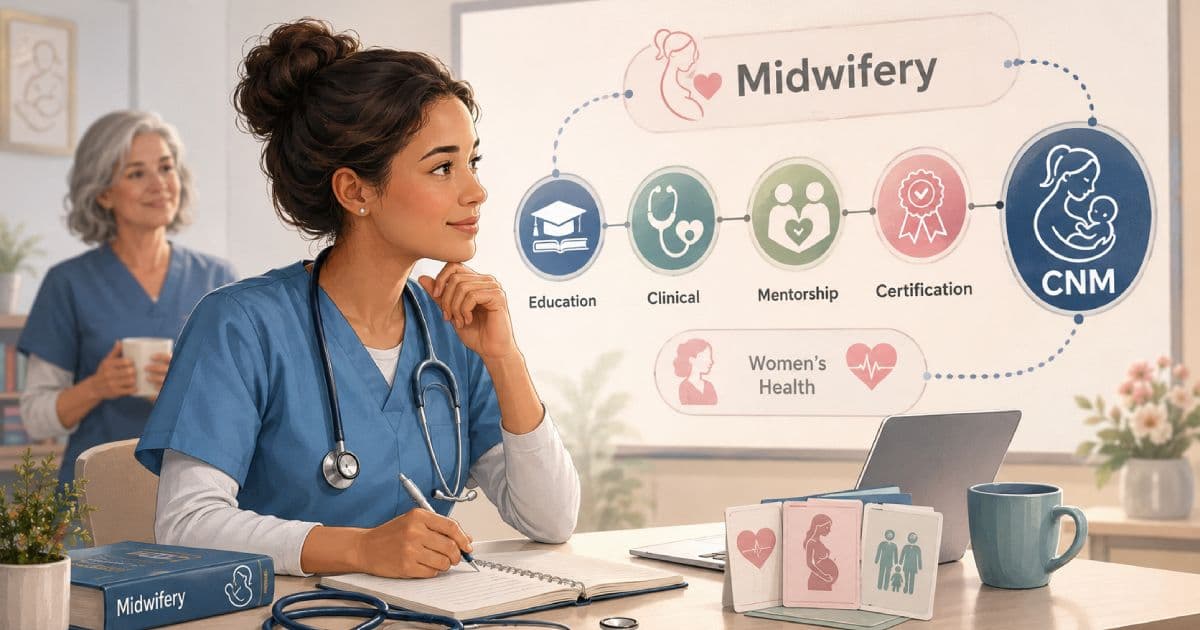
A Certified Nurse-Midwife, or CNM, is a graduate-prepared nurse-midwife who has completed an accredited midwifery education program, passed the AMCB national certification exam, and met state licensure requirements.
CNMs provide care that may include:
- Primary care within scope
- Annual exams and preventive care
- Contraception counseling and prescribing
- STI screening and treatment
- Menstrual and menopause care
- Preconception counseling
- Prenatal care
- Labor and birth care
- Postpartum care
- Breast/chestfeeding and lactation support
- Newborn care during the early newborn period
- Miscarriage and early pregnancy care, depending on setting and state rules
- Patient education and shared decision-making
- Collaboration, consultation, and referral when care moves outside midwifery scope
ACNM’s Essential Facts report says CNMs and CMs can provide a full range of primary health care services across life stages, including general health check-ups, screenings, vaccination, pregnancy, birth, postpartum and newborn care, gynecologic care, STI treatment, and prescribing medications including many pain-control medications and birth control.
CNMs are part of mainstream health care
CNMs work in many settings, but most CNM/CM-attended births occur in hospitals.
ACNM’s report states that in 2022:
- CNMs/CMs attended 10.9% of total U.S. births
- CNMs/CMs attended 90% of all midwife-attended births
- 94% of CNM/CM-attended births occurred in hospitals
- 3% occurred in freestanding birth centers
- 3% occurred at home
What CNMs do day to day
CNM work depends on setting, scope, and local law.
A hospital-based CNM may:
- See triage patients
- Manage labor for low-risk or moderate-risk patients within scope
- Provide fetal monitoring interpretation
- Support physiologic labor
- Order medications, labs, and imaging
- Perform vaginal deliveries
- Repair some lacerations, depending on training and privileging
- Coordinate postpartum care
- Consult or transfer to OB/GYN physicians for complications
- Participate in emergency response until the surgical or physician team takes over
A clinic-based CNM may:
- Provide prenatal visits
- Do annual exams
- Prescribe contraception
- Insert or remove LARC methods if trained and privileged
- Treat common gynecologic conditions
- Manage postpartum follow-up
- Provide preconception counseling
- Screen for depression, intimate partner violence, and social needs
- Coordinate referrals
A birth-center CNM may:
- Provide prenatal care
- Attend low-risk labor and birth
- Monitor parent and newborn after birth
- Use transfer protocols when risk changes
- Coordinate collaborative care with hospitals or physicians
CNM vs OB/GYN vs doula
| Role | Training | Clinical authority | Birth role | Prescribes medications? | Performs C-sections? |
|---|---|---|---|---|---|
| Certified Nurse-Midwife | RN license + graduate midwifery education + AMCB certification + state licensure | Advanced practice nursing / midwifery scope varies by state | Yes, usually for low-risk and appropriate-risk vaginal births with collaboration/escalation as needed | Yes, under state law and prescriptive authority rules | No |
| OB/GYN physician | MD/DO + OB/GYN residency + board pathway | Medical and surgical physician scope | Yes, low-risk and high-risk pregnancy/birth | Yes | Yes |
| Doula | Non-clinical support training or certification; requirements vary | No clinical scope | Emotional, physical, educational support | No | No |
CNM vs CM vs CPM
Midwifery credentials can be confusing. Here is the plain-English version.
Certified Nurse-Midwife (CNM)
A CNM is:
- A registered nurse
- Graduate educated in nurse-midwifery/midwifery
- Educated through an ACME-accredited or preaccredited program
- Certified by AMCB
- Licensed or recognized by the state
- Usually regulated as an APRN or nurse-midwife
- Able to practise in hospitals, clinics, birth centers, and community settings depending on state law and privileges
Certified Midwife (CM)
A CM is:
- Not required to be an RN
- Graduate educated in midwifery through an ACME-accredited or preaccredited program
- Certified by AMCB
- Authorized in fewer states than CNMs
- Similar in education and certification standards to CNMs, but not based on RN licensure
ACNM’s Essential Facts report says CMs have the same scope of practice, accredited education, and national certification as CNMs, but CM authorization is state-specific and not available everywhere.
Certified Professional Midwife (CPM)
A CPM is:
- Certified through the North American Registry of Midwives
- Focused primarily on out-of-hospital birth
- Not an APRN credential
- Licensed or regulated differently by state
- Separate from CNM/CM education and certification pathways
How long does it take to become a CNM?
A common timeline is 6 to 8 years, but it can be shorter or longer depending on your starting point.
| Starting point | Possible timeline |
|---|---|
| No college degree | About 6 to 8+ years |
| ADN-prepared RN | About 3 to 5+ years after RN licensure, depending on BSN bridge and graduate program |
| BSN-prepared RN | About 2 to 4 years for MSN/DNP midwifery program, depending on full-time vs part-time |
| Non-nursing bachelor’s degree | Often accelerated RN/BSN first, then graduate midwifery, or direct-entry route where available |
Most CNM candidates complete:
- RN preparation
- Graduate midwifery education
- AMCB certification
- State licensure
Step 1: Become an RN
The CNM route starts with nursing.
You can become an RN through:
- ADN/ASN program
- Diploma RN program, where available
- BSN program
- Accelerated BSN if you already hold a non-nursing bachelor’s degree
- Direct-entry graduate route that includes RN preparation, depending on program and state
After completing an approved RN program, you must pass the NCLEX-RN and become licensed as a registered nurse.
Step 2: Build relevant RN experience
Not every midwifery program requires labor and delivery experience, but relevant experience can make you a stronger applicant and a safer future clinician.
Helpful experience includes:
- Labor and delivery
- Mother/baby
- Postpartum
- Antepartum
- OB triage
- Newborn nursery
- NICU, especially for newborn assessment skills
- Women’s health clinics
- Reproductive health clinics
- Public health
- Community health
- Family planning
- Lactation support
- Doula work, if separate from nursing role and properly scoped
Is labor and delivery experience required?
It depends on the program.
Some programs prefer or strongly value L&D experience. Others admit strong applicants from different backgrounds if they can show maturity, clinical judgment, communication skills, and commitment to midwifery care.
How much RN experience should you get?
Many applicants aim for 1 to 2 years of relevant RN experience before applying. That is not a universal rule, but it can help with:
- Labor assessment
- Fetal monitoring familiarity
- Emergency recognition
- Team communication
- Patient education
- Confidence in high-emotion situations
- Stronger references
Step 3: Choose an ACME-accredited midwifery program
To become eligible for AMCB certification as a CNM, you must complete a graduate degree through a midwifery program accredited by or holding preaccreditation status from the Accreditation Commission for Midwifery Education, or ACME.
ACME’s program directory explains that listed programs have met ACME criteria and that ACME awards preaccreditation, initial accreditation, and continued accreditation.
Official directory:
Common CNM program types
You may see:
- MSN in Nurse-Midwifery
- MS in Midwifery
- DNP with Nurse-Midwifery specialty
- Post-graduate certificate in nurse-midwifery
- Dual nurse-midwifery / women’s health nurse practitioner programs
- Direct-entry or graduate-entry pathways, depending on program
Online and hybrid CNM programs
Many midwifery programs use online or hybrid didactic courses, but clinical education is hands-on and supervised. Ask how the program handles clinical placement.
Before applying, ask:
- Does the school place students, or must students find preceptors?
- Are clinical sites guaranteed?
- How far can clinicals be from home?
- Are birth numbers and clinical hours clearly explained?
- What happens if a preceptor cancels?
- How are students evaluated for safe entry-level practice?
Step 4: Complete graduate midwifery coursework and clinical training
CNM programs prepare students for entry-level midwifery practice across normal and abnormal findings, physiology, pharmacology, clinical decision-making, and collaborative care.
Coursework may include:
- Advanced pathophysiology
- Advanced pharmacology
- Advanced health assessment
- Antepartum care
- Intrapartum care
- Postpartum care
- Newborn care
- Gynecologic and sexual health
- Primary care
- Contraception and family planning
- Epidemiology and evidence-based practice
- Health equity
- Interprofessional collaboration
- Professional role development
- Legal and ethical issues
- Quality and safety
Clinical training may include:
- Prenatal visits
- Labor management
- Birth attendance
- Postpartum visits
- Newborn assessments
- Gynecology visits
- Family planning visits
- Primary care encounters
- Collaborative consultations
- Referral and transfer-of-care situations
Step 5: Pass the AMCB certification exam
After graduation, CNM candidates apply to the American Midwifery Certification Board, or AMCB, for the national certification exam.
AMCB’s 2026 candidate handbook says CNM candidates must have:
- Proof of active U.S. RN licensure on the date of examination
- Satisfactory completion of a graduate degree or institutional requirements for a graduate degree from an ACME-accredited or preaccredited program
- Program director verification that requirements were met
- Program director attestation that the candidate is performing at the level of a safe beginning practitioner
The handbook also says candidates have up to four attempts within 24 months of program completion, and AMCB encourages taking the exam as soon as possible after graduation.
Official source:
Step 6: Apply for state CNM/APRN licensure
Passing AMCB certification is not the final step. You still need the legal authority to practise in your state.
State requirements may include:
- RN license
- AMCB CNM certification
- Graduate transcript
- Application and fee
- Background check
- APRN licensure or recognition
- Nurse-midwife license or certificate, depending on state terminology
- Prescriptive authority application
- Controlled-substance registration, if applicable
- DEA registration, if prescribing controlled substances
- Collaborative agreement or transition-to-practice documents in some states
State scope varies
ACNM states that CNMs are licensed, independent health care providers with prescriptive authority in all 50 states, D.C., and U.S. territories, and are defined as primary care providers under federal law. However, that does not mean every state has the same practice environment.
NCSL’s scope-of-practice map explains that practice authority and prescriptive authority vary by state and territory. Some states allow full independent practice and prescribing, while others require physician relationships, transition periods, or collaboration arrangements.
Official source:
Step 7: Get hired, credentialed, and privileged
Your state license lets you practise legally. Your employer or clinical site still has to credential and privilege you.
Depending on the setting, credentialing may require:
- AMCB verification
- RN/APRN/CNM license verification
- DEA registration, if applicable
- Malpractice coverage
- Collaborative agreement documents, where required
- Procedure logs
- Birth logs
- References
- Background check
- Immunizations and occupational health records
- BLS, NRP, ACLS, fetal monitoring, or other certifications
- Hospital privileging documents
- Peer review and proctoring period
Common first CNM jobs include:
- Hospitalist-style laborist/midwife roles
- OB/GYN clinic plus call coverage
- Full-scope midwifery practice
- Birth center practice
- Federally qualified health center
- Community health clinic
- Academic faculty role
- Public health or reproductive-health program
Step 8: Maintain certification and licensure
AMCB certification is not permanent.
The 2026 AMCB Certificate Maintenance Program guide says the certificate is valid for five years, and compliance with the Certificate Maintenance Program is mandatory to renew.
AMCB lists two basic maintenance options:
- Complete AMCB Certificate Maintenance Modules, approved continuing education, annual fees, and recertification application requirements.
- Use the reexamination method during the certification cycle.
Official source:
You also need to maintain:
- State RN license if required
- State APRN/CNM licensure
- Prescriptive authority
- DEA registration if applicable
- Continuing education required by state or employer
- Hospital privileges, if applicable
- Professional liability coverage
How much do nurse midwives make?
For wage context, O*NET’s BLS-based 2024 wage table lists nurse midwives at:
| Measure | U.S. wage |
|---|---|
| 10th percentile | $74,670 or less |
| Median annual wage | $128,790 |
| 90th percentile | $177,040 or more |
| Median hourly wage | $61.92 |
Source:
The broader BLS Occupational Outlook Handbook category for nurse anesthetists, nurse midwives, and nurse practitioners reports a median annual wage of $132,050 in May 2024 and projects overall employment for the combined APRN category to grow 35% from 2024 to 2034, with about 32,700 openings per year on average.
Source:
CNM career outlook
The demand picture is strong, but read the data carefully.
BLS projects 35% growth from 2024 to 2034 for the combined APRN group that includes nurse anesthetists, nurse midwives, and nurse practitioners. That is not a CNM-only projection, but it is the most current BLS Occupational Outlook Handbook projection for the grouped occupation.
CNM demand can be shaped by:
- Maternity-care access needs
- Rural and underserved community needs
- Hospital staffing models
- Birth-center access
- Medicaid and insurance reimbursement
- State scope-of-practice laws
- Physician collaboration requirements
- Public interest in physiologic and relationship-based maternity care
- Reproductive-health access and policy changes
Pros and challenges of becoming a CNM
Pros
- Meaningful relationship-based care
- Mix of primary care, reproductive health, pregnancy, birth, and postpartum care
- Advanced practice autonomy
- Strong patient education role
- Opportunity to support physiologic birth
- Ability to improve access in underserved areas
- High earning potential compared with many RN roles
- Multiple settings: hospital, clinic, birth center, public health, academia
Challenges
- Graduate school is demanding and expensive
- Clinical placement may be stressful
- Call schedules can be hard on family life
- Birth work is unpredictable
- Rare bad outcomes are emotionally heavy
- State laws can limit autonomy in some places
- Liability and risk management matter
- Some jobs require nights, weekends, holidays, and call
- Workload can be intense in high-volume practices
How to strengthen your CNM application
Academic preparation
Aim for strong grades in:
- Anatomy and physiology
- Microbiology
- Chemistry
- Statistics
- Pathophysiology
- Pharmacology
- Maternal-newborn coursework
- Health assessment
If your GPA is weaker, consider:
- Retaking key science courses
- Taking graduate-level pathophysiology or statistics
- Showing strong recent academic performance
- Explaining growth without making excuses
Clinical experience
Valuable experience includes:
- Labor and delivery RN
- Mother/baby RN
- Postpartum RN
- OB triage RN
- Reproductive health clinic RN
- Public health RN
- Community health RN
- Lactation support
- Doula work
- Perinatal loss or bereavement support experience
- Volunteer work in maternal health or reproductive health
Shadowing and exposure
Try to shadow:
- Hospital CNM
- Birth-center CNM
- Clinic-based CNM
- Full-scope midwifery practice
- OB/GYN team
- Reproductive-health clinic
After shadowing, reflect on:
- How CNMs communicate risk
- How they support autonomy
- How they collaborate with physicians
- How they handle emergencies
- How they balance physiologic birth with safety
Personal statement themes
Strong CNM statements often show:
- Respect for patient autonomy
- Commitment to evidence-based care
- Understanding of health equity
- Realistic view of birth risk
- Calm under pressure
- Interprofessional teamwork
- Interest in primary care and gynecology, not only birth
- Commitment to underserved communities, if genuine
- Reflection on clinical experiences
Weak angle
“I want to deliver babies because birth is beautiful.”
Stronger angle
“I want to become a CNM because I am drawn to full-scope, evidence-based reproductive and primary care that supports physiologic birth when safe, recognizes risk early, and centers informed decision-making.”
Questions to ask CNM programs before applying
Accreditation and certification
- Are you currently ACME-accredited or preaccredited?
- Are graduates eligible for AMCB certification?
- What is your AMCB pass rate?
- What happens if accreditation status changes?
Clinical placement
- Does the school place students, or do students find preceptors?
- Are birth numbers and clinical encounters clearly tracked?
- How far do students travel for clinicals?
- What happens if a clinical site or preceptor cancels?
- Are students placed in hospital, birth center, clinic, and community settings?
- How is clinical readiness evaluated?
Program format
- Is the program MSN, DNP, certificate, or dual specialty?
- Is it full-time, part-time, online, hybrid, or campus-based?
- How many campus visits are required?
- Can students work during the program?
- What are the on-call expectations during clinicals?
Cost and outcomes
- What is the total program cost?
- Are clinical travel costs included?
- Are students responsible for finding housing during immersions?
- What financial aid is available?
- What percentage of students graduate on time?
- Where do graduates work?
- Do graduates obtain jobs in the state where I want to practise?
Common mistakes future CNMs make
1. Choosing a program without checking ACME
If your goal is CNM certification, ACME accreditation or preaccreditation status matters. Verify in the ACME directory.
2. Thinking CNM is only birth
Full-scope midwifery includes primary care, sexual and reproductive health, gynecology, prenatal care, birth, postpartum, and newborn care.
3. Ignoring state law
Scope, collaboration, prescribing, controlled substances, and APRN rules vary.
4. Underestimating clinical placement
Online coursework does not mean easy clinical logistics. Ask detailed placement questions.
5. Waiting too long to prepare for AMCB
Build your study timeline before graduation. AMCB encourages candidates to test soon after program completion.
6. Not planning for call life
Full-scope birth work may mean nights, weekends, holidays, and unpredictable schedules.
7. Applying with a “birth is magical” statement only
Birth can be meaningful, but CNM practice is clinical, evidence-based, high-responsibility work.
Frequently asked questions about becoming a CNM
What is a Certified Nurse-Midwife?
A Certified Nurse-Midwife is a graduate-prepared nurse-midwife who has RN licensure, completed an ACME-accredited or preaccredited midwifery program, passed the AMCB certification exam, and met state licensure requirements.
How long does it take to become a CNM?
It commonly takes 6 to 8 years from the start of nursing education, but the timeline depends on whether you begin with an ADN, BSN, non-nursing bachelor’s degree, or existing RN license.
Do I need to be an RN before becoming a CNM?
For the CNM credential, yes. AMCB’s candidate handbook says CNM candidates must have proof of active U.S. RN licensure on the date of examination.
Do I need a BSN to become a CNM?
Not always, but BSN is often the cleanest route. Some programs accept ADN-prepared RNs through bridge pathways, RN-to-MSN routes, or require BSN completion before graduate midwifery coursework.
What degree do CNMs need?
CNMs need graduate-level midwifery education, typically an MSN, MS, DNP, or post-graduate certificate pathway that meets AMCB eligibility through ACME accreditation or preaccreditation status.
What is ACME?
ACME is the Accreditation Commission for Midwifery Education. It accredits midwifery education programs that prepare CNM and CM candidates.
What is AMCB?
AMCB is the American Midwifery Certification Board. It administers national certification for CNMs and CMs.
Can CNMs prescribe medications?
Yes, but details vary by state. ACNM says CNMs have prescriptive authority in all states and D.C., while NCSL notes that some states require physician relationships, collaboration, or transition periods for practice or prescribing.
Can CNMs perform C-sections?
No. C-sections are surgical procedures performed by physicians. CNMs may assist, collaborate, identify when surgical care is needed, and transfer or consult according to scope and facility policy.
Do CNMs only attend home births?
No. ACNM’s Essential Facts report says 94% of CNM/CM-attended births in 2022 occurred in hospitals.
Can CNMs work in hospitals?
Yes. Hospitals are the most common birth setting for CNM/CM-attended births in the United States.
What is the difference between CNM and CM?
CNMs are registered nurses with graduate midwifery education and AMCB certification. CMs complete graduate midwifery education and AMCB certification but are not required to be RNs. CM authorization is available in fewer states.
What is the difference between CNM and CPM?
CNMs are graduate-prepared nurse-midwives certified by AMCB and licensed under state nursing or midwifery laws. CPMs are certified through NARM and focus mainly on community and out-of-hospital birth. CPM licensure varies by state and is not an APRN credential.
How much do nurse midwives make?
O*NET’s BLS-based 2024 wage table lists nurse midwives at a national median annual wage of $128,790, with the 10th percentile at $74,670 or less and the 90th percentile at $177,040 or more.
Is CNM demand strong?
The broader BLS APRN category that includes nurse midwives is projected to grow 35% from 2024 to 2034. CNM demand also depends on state scope laws, local maternity-care needs, employer models, and reproductive-health access.
Is becoming a CNM worth it?
It can be worth it if you want advanced practice responsibility, relationship-based reproductive health care, pregnancy and birth care, and patient education. It may not be the right fit if you need predictable hours, dislike call, or do not want high-liability clinical decision-making.
Final thoughts
Becoming a Certified Nurse-Midwife is a serious advanced-practice path. It requires RN preparation, graduate midwifery education, national certification, state licensure, and ongoing maintenance.
It is also one of the most relationship-centered roles in nursing.
The best CNMs combine clinical sharpness with humility: they support physiologic birth when safe, recognize risk early, collaborate without ego, respect patient autonomy, and provide care across much more than birth.
If that sounds like the kind of clinician you want to become, start with the basics: choose a strong RN pathway, get meaningful reproductive-health or perinatal experience, verify ACME accreditation, understand AMCB requirements, and check the state laws where you hope to practise.
Sources and references
- ACNM: Essential Facts about Midwives PDF
- ACNM: Issue Areas and Core Documents
- ACNM: Core Competencies for Basic Midwifery Practice PDF
- ACME Accredited Midwifery Education Programs
- AMCB Certification
- AMCB Candidate Handbook
- AMCB Certificate Maintenance Program Guide
- NCSL: Certified Nurse Midwife Practice and Prescriptive Authority
- eCFR: Certified nurse-midwives’ services
- O*NET: Nurse Midwives national wages
- BLS: Nurse Anesthetists, Nurse Midwives, and Nurse Practitioners
- NARM: Certified Professional Midwife information